
CH HYDROGEN BONDING INTERACTIONS IN THE CARBONYL SULFIDETRIFLUOROMETHANE
C-H HYDROGEN BONDING INTERACTIONS IN THE CARBONYL SULFIDE-TRIFLUOROMETHANE DIMER Michal M. Serafin, Sean A. Peebles Department of Chemistry, 600 Lincoln Avenue, Eastern Illinois University, Charleston, IL 61920 USA
Introduction • Systematic study of HCF 3 complexes to characterize weak intermolecular forces • Complex splitting pattern in HCCH-HCF 3 dimer not fully understood • OCS-HCF 3 is a less complex system since carbonyl sulfide is not symmetric – possibly providing a simpler spectrum
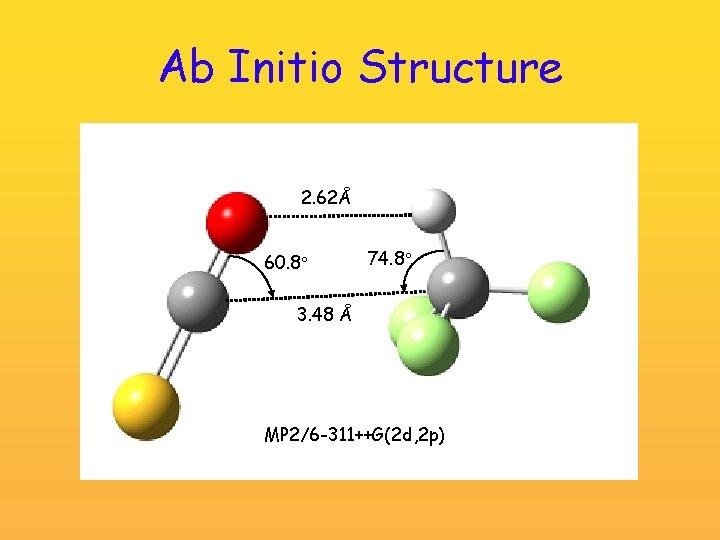
Ab Initio Structure 2. 62Å 60. 8 74. 8 3. 48 Å MP 2/6 -311++G(2 d, 2 p)
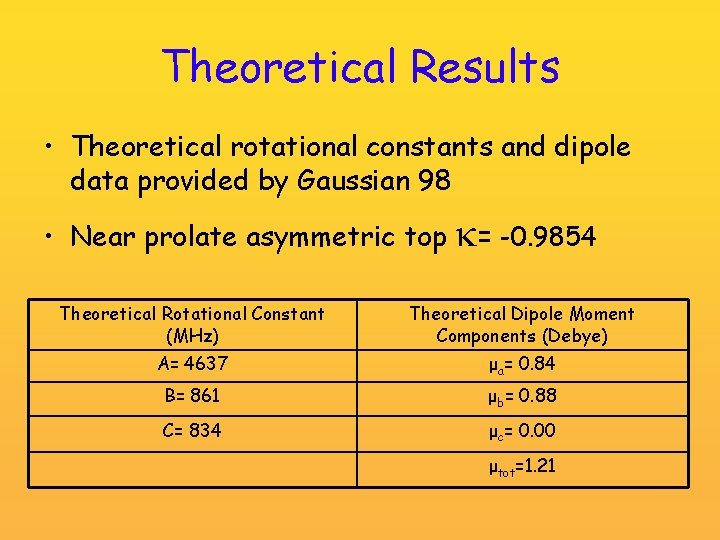
Theoretical Results • Theoretical rotational constants and dipole data provided by Gaussian 98 • Near prolate asymmetric top = -0. 9854 Theoretical Rotational Constant (MHz) Theoretical Dipole Moment Components (Debye) A= 4637 μa= 0. 84 B= 861 μb= 0. 88 C= 834 μc= 0. 00 μtot=1. 21
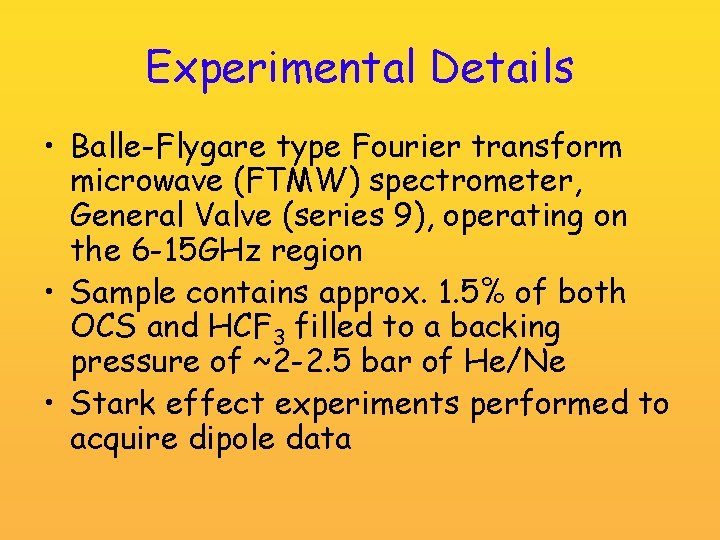
Experimental Details • Balle-Flygare type Fourier transform microwave (FTMW) spectrometer, General Valve (series 9), operating on the 6 -15 GHz region • Sample contains approx. 1. 5% of both OCS and HCF 3 filled to a backing pressure of ~2 -2. 5 bar of He/Ne • Stark effect experiments performed to acquire dipole data
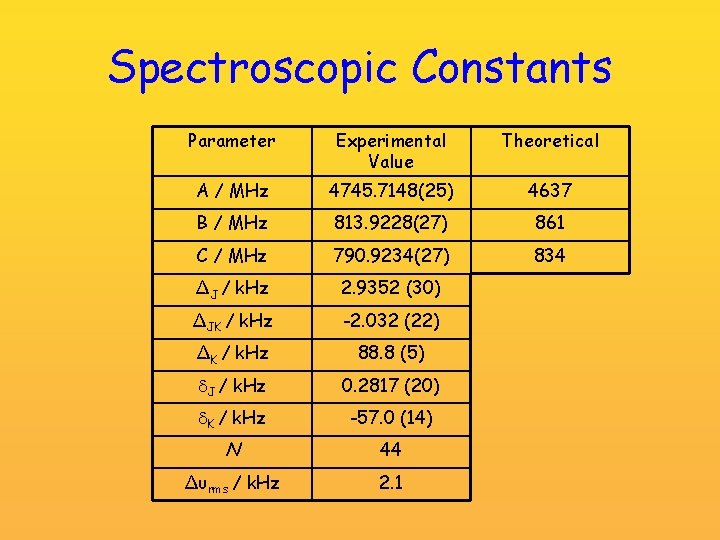
Spectroscopic Constants Parameter Experimental Value Theoretical A / MHz 4745. 7148(25) 4637 B / MHz 813. 9228(27) 861 C / MHz 790. 9234(27) 834 ∆J / k. Hz 2. 9352 (30) ∆JK / k. Hz -2. 032 (22) ∆K / k. Hz 88. 8 (5) J / k. Hz 0. 2817 (20) K / k. Hz -57. 0 (14) N 44 ∆υrms / k. Hz 2. 1
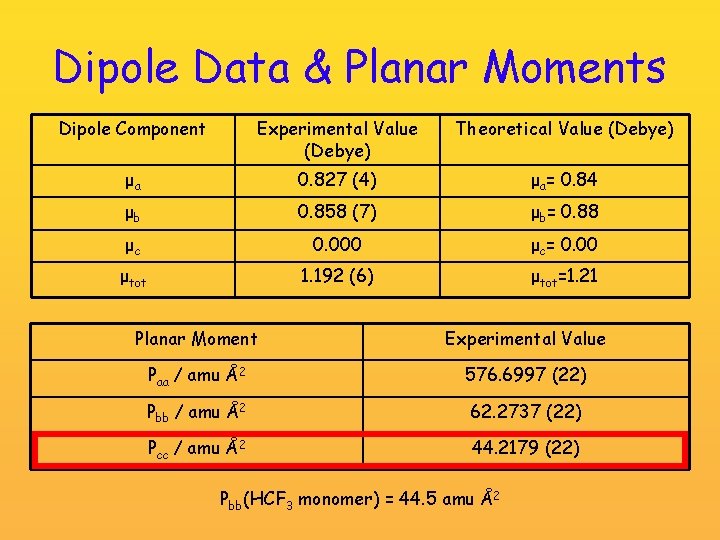
Dipole Data & Planar Moments Dipole Component Experimental Value (Debye) Theoretical Value (Debye) μa 0. 827 (4) μa= 0. 84 μb 0. 858 (7) μb= 0. 88 μc 0. 000 μc= 0. 00 μtot 1. 192 (6) μtot=1. 21 Planar Moment Experimental Value Paa / amu Å2 576. 6997 (22) Pbb / amu Å2 62. 2737 (22) Pcc / amu Å2 44. 2179 (22) Pbb(HCF 3 monomer) = 44. 5 amu Å2
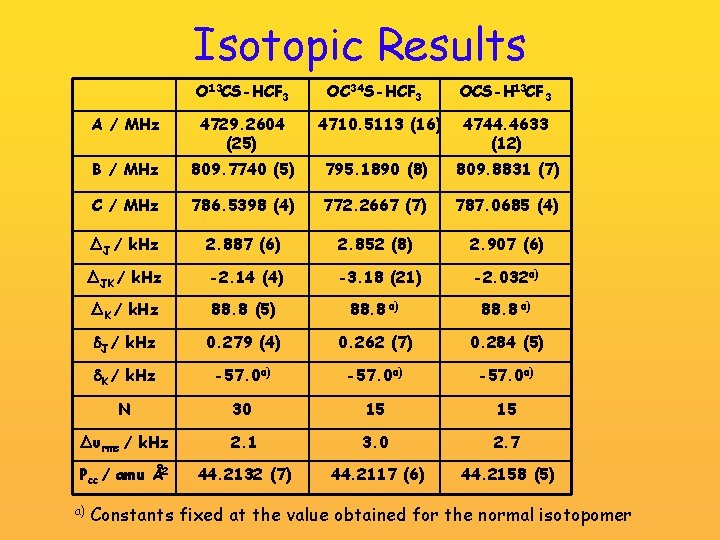
Isotopic Results O 13 CS-HCF 3 OC 34 S-HCF 3 OCS-H 13 CF 3 A / MHz 4729. 2604 (25) 4710. 5113 (16) 4744. 4633 (12) B / MHz 809. 7740 (5) 795. 1890 (8) 809. 8831 (7) C / MHz 786. 5398 (4) 772. 2667 (7) 787. 0685 (4) ∆J / k. Hz 2. 887 (6) 2. 852 (8) 2. 907 (6) ∆JK / k. Hz -2. 14 (4) -3. 18 (21) -2. 032 a) ∆K / k. Hz 88. 8 (5) 88. 8 a) J / k. Hz 0. 279 (4) 0. 262 (7) 0. 284 (5) K / k. Hz -57. 0 a) N 30 15 15 ∆υrms / k. Hz 2. 1 3. 0 2. 7 Pcc / amu Å2 44. 2132 (7) 44. 2117 (6) 44. 2158 (5) a) Constants fixed at the value obtained for the normal isotopomer
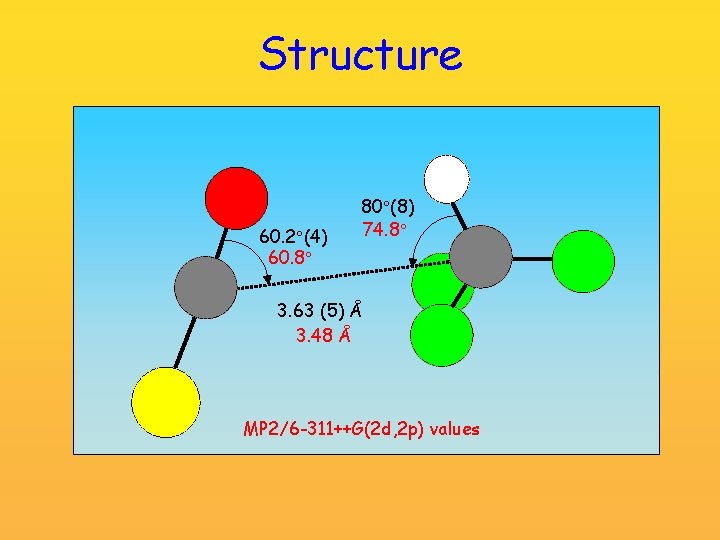
Structure 60. 2 (4) 60. 8 80 (8) 74. 8 3. 63 (5) Å 3. 48 Å MP 2/6 -311++G(2 d, 2 p) values
Conclusion • Complex splitting pattern not observed • Observed spectrum consistent with ab initio structure • Next project: DFM-OCS dimer
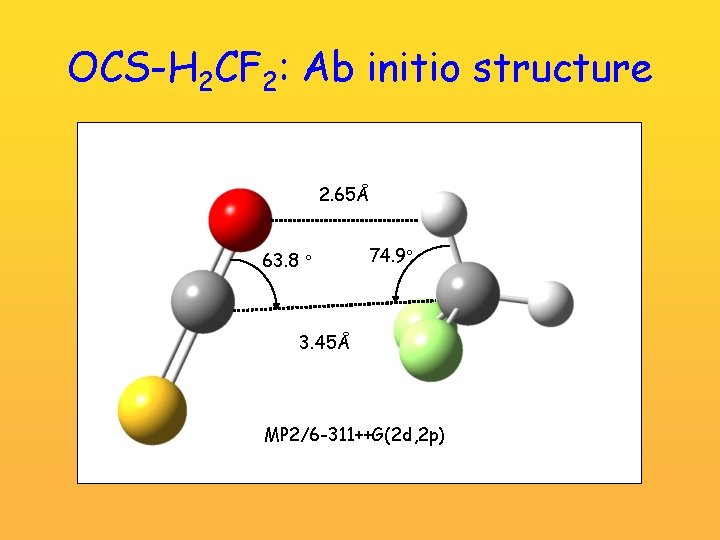
OCS-H 2 CF 2: Ab initio structure 2. 65Å 63. 8 74. 9 3. 45Å MP 2/6 -311++G(2 d, 2 p)
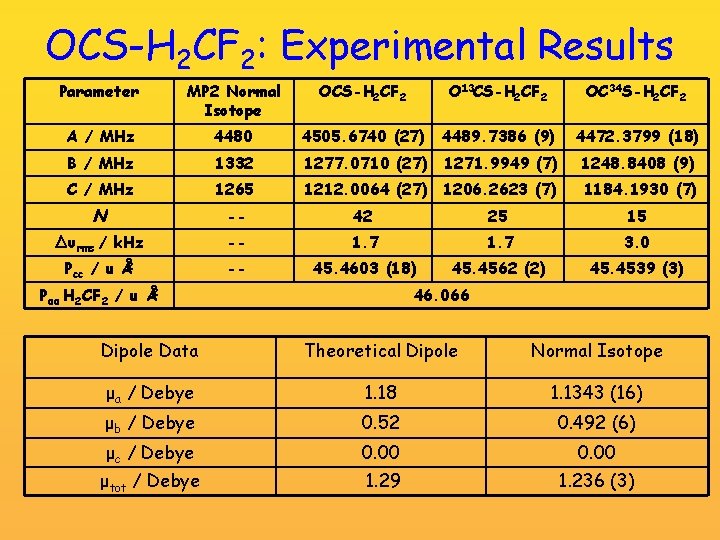
OCS-H 2 CF 2: Experimental Results Parameter MP 2 Normal Isotope OCS-H 2 CF 2 O 13 CS-H 2 CF 2 OC 34 S-H 2 CF 2 A / MHz 4480 4505. 6740 (27) 4489. 7386 (9) 4472. 3799 (18) B / MHz 1332 1277. 0710 (27) 1271. 9949 (7) 1248. 8408 (9) C / MHz 1265 1212. 0064 (27) 1206. 2623 (7) 1184. 1930 (7) N -- 42 25 15 ∆υrms / k. Hz -- 1. 7 3. 0 Pcc / u Å2 -- 45. 4603 (18) 45. 4562 (2) 45. 4539 (3) Paa H 2 CF 2 / u Å2 46. 066 Dipole Data Theoretical Dipole Normal Isotope μa / Debye 1. 18 1. 1343 (16) μb / Debye 0. 52 0. 492 (6) μc / Debye 0. 00 μtot / Debye 1. 29 1. 236 (3)

Acknowledgements • American Chemical Society, Petroleum Research Fund, No. 39752 -GB 6 • Dr. E. M. Treadwell
- Slides: 13