
Ch 9 TCPIP Laboratorium Telematika ITB Cisco Regional
Ch 9. TCP/IP Laboratorium Telematika - ITB Cisco Regional Networking Academy Semester 1 Version 2. 1. 1 Duration: 60 minutes
Overview n n TCP/IP implementation of the OSI model. TCP/IP functions: u of the transport layer. u of the network layer. n ICMP - Internet Control Message Protocol u control and message functions (network layer).
TCP/IP Introduction n n Internet protocols communicate across any interconnected networks: LANs and WANs Internet Protocol suite includes: u Layer 3 and 4 specifications (such as IP and TCP). u Specifications for applications such as e-mail, remote login, terminal emulation, and file transfer. u Reliable and “unreliable” transport. u Connectionless datagram delivery at the network layer
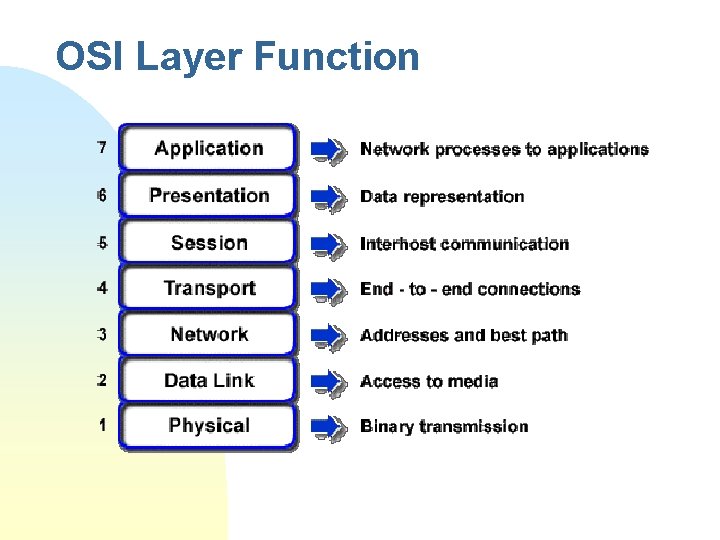
OSI Layer Function
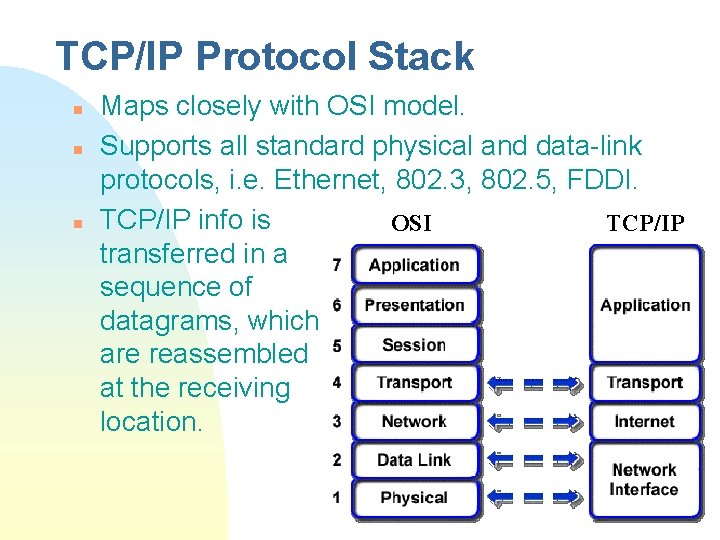
TCP/IP Protocol Stack n n n Maps closely with OSI model. Supports all standard physical and data-link protocols, i. e. Ethernet, 802. 3, 802. 5, FDDI. TCP/IP info is OSI TCP/IP transferred in a sequence of datagrams, which are reassembled at the receiving location.
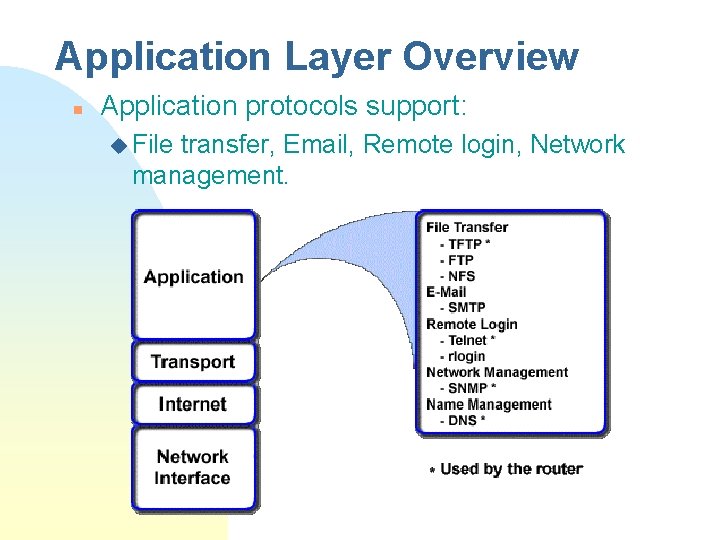
Application Layer Overview n Application protocols support: u File transfer, Email, Remote login, Network management.
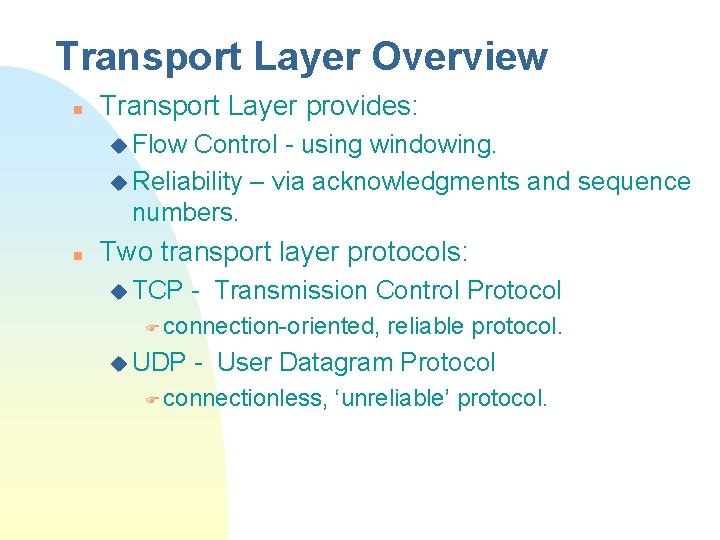
Transport Layer Overview n Transport Layer provides: u Flow Control - using windowing. u Reliability – via acknowledgments and sequence numbers. n Two transport layer protocols: u TCP - Transmission Control Protocol F connection-oriented, u UDP reliable protocol. - User Datagram Protocol F connectionless, ‘unreliable’ protocol.
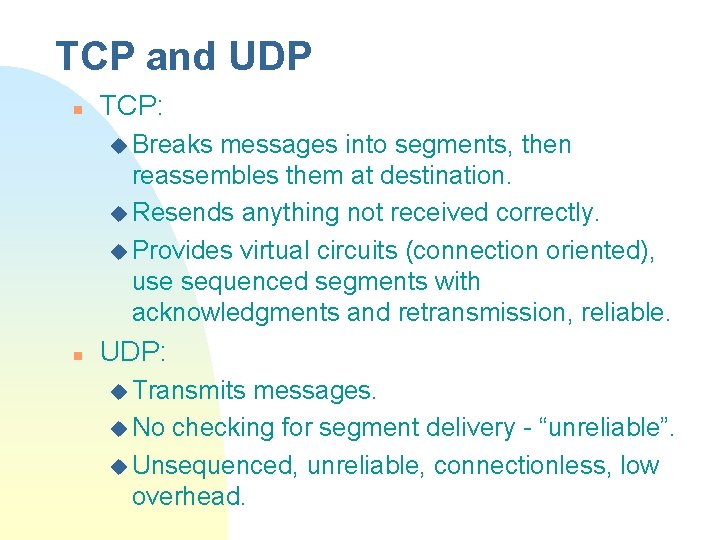
TCP and UDP n TCP: u Breaks messages into segments, then reassembles them at destination. u Resends anything not received correctly. u Provides virtual circuits (connection oriented), use sequenced segments with acknowledgments and retransmission, reliable. n UDP: u Transmits messages. u No checking for segment delivery - “unreliable”. u Unsequenced, unreliable, connectionless, low overhead.
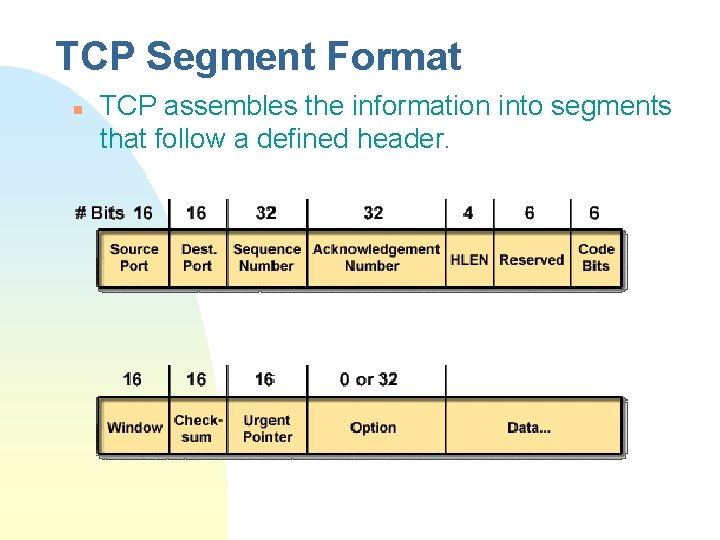
TCP Segment Format n TCP assembles the information into segments that follow a defined header.
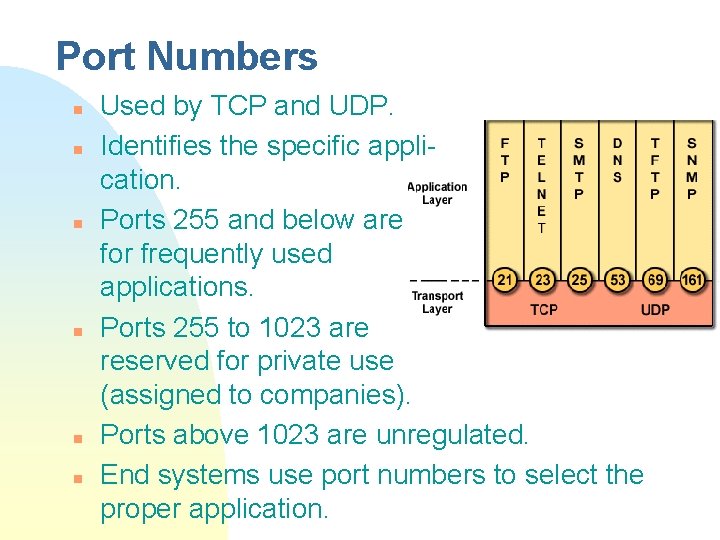
Port Numbers n n n Used by TCP and UDP. Identifies the specific application. Ports 255 and below are for frequently used applications. Ports 255 to 1023 are reserved for private use (assigned to companies). Ports above 1023 are unregulated. End systems use port numbers to select the proper application.
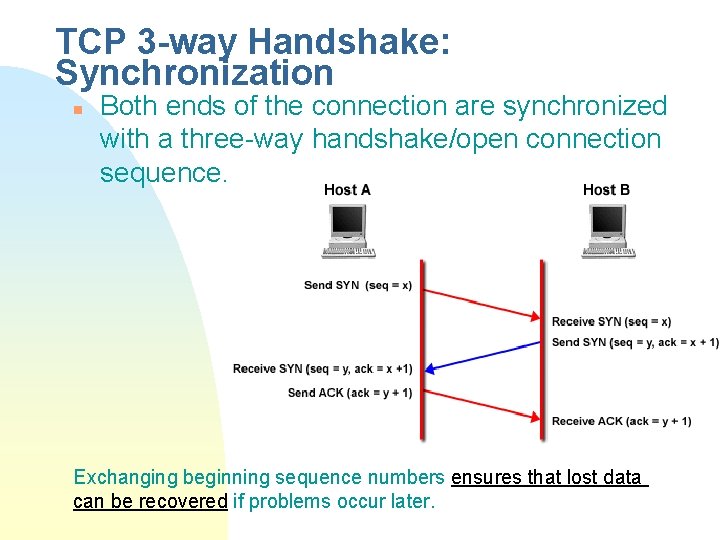
TCP 3 -way Handshake: Synchronization n Both ends of the connection are synchronized with a three-way handshake/open connection sequence. Exchanging beginning sequence numbers ensures that lost data can be recovered if problems occur later.
TCP Sliding Window n Window size - # of data packets that can be sent while awaiting acknowledgement. u Larger window size allows more data to be transmitted pending acknowledgment. n Sliding window - window size is negotiated dynamically during TCP session. u More n efficient use of bandwidth. Expectational acknowledgement - ACK number of next expected data packet.
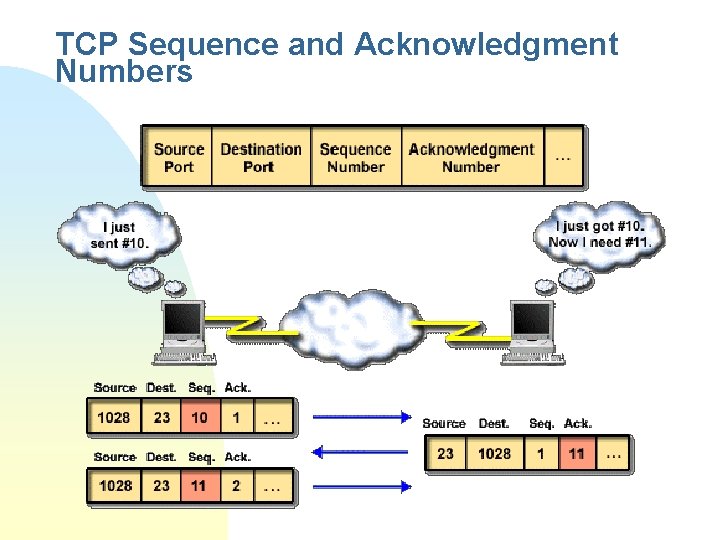
TCP Sequence and Acknowledgment Numbers
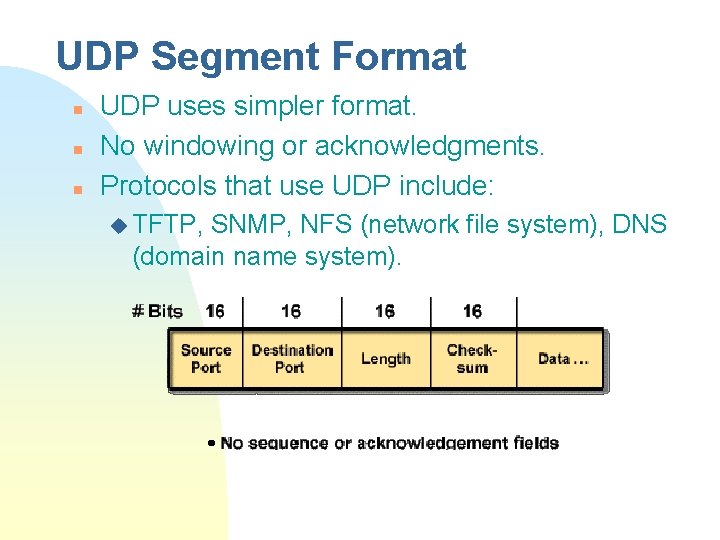
UDP Segment Format n n n UDP uses simpler format. No windowing or acknowledgments. Protocols that use UDP include: u TFTP, SNMP, NFS (network file system), DNS (domain name system).
Network Layer Protocols n n n Network Layer Protocols include: IP - connectionless, best-effort delivery routing. ICMP - control and messaging capabilities. ARP - to determine MAC (hardware) addresses for know IP addresses. RARP - to determine IP (logical or network) addresses from know MAC addresses.
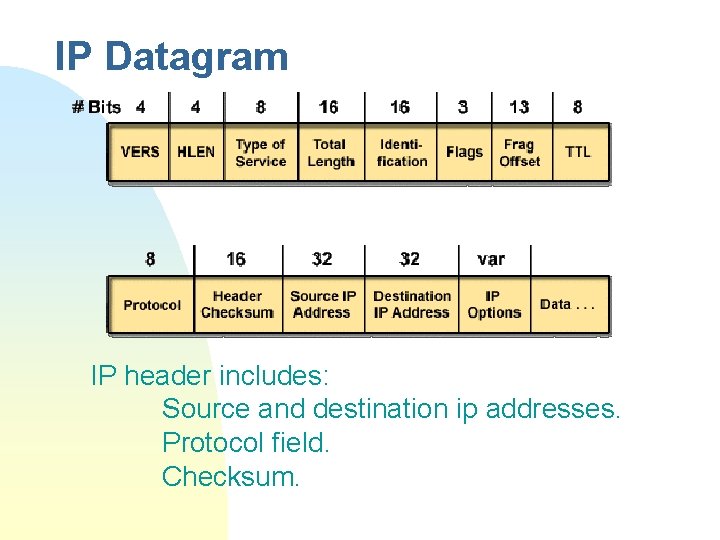
IP Datagram IP header includes: Source and destination ip addresses. Protocol field. Checksum.
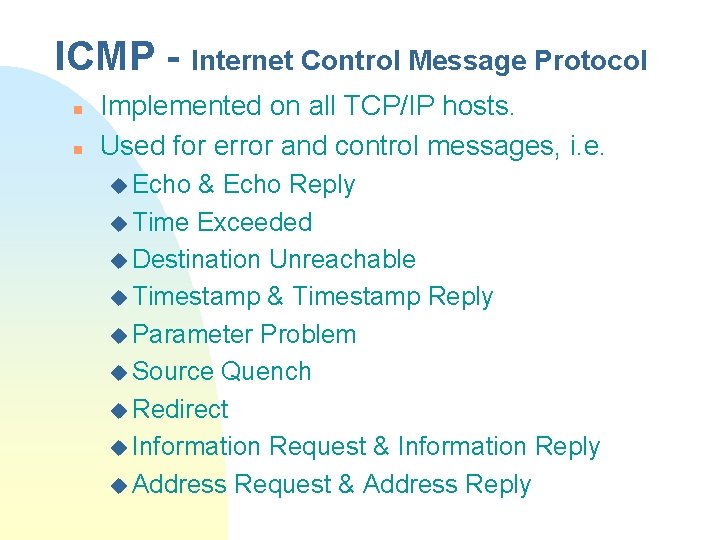
ICMP - Internet Control Message Protocol n n Implemented on all TCP/IP hosts. Used for error and control messages, i. e. u Echo & Echo Reply u Time Exceeded u Destination Unreachable u Timestamp & Timestamp Reply u Parameter Problem u Source Quench u Redirect u Information Request & Information Reply u Address Request & Address Reply
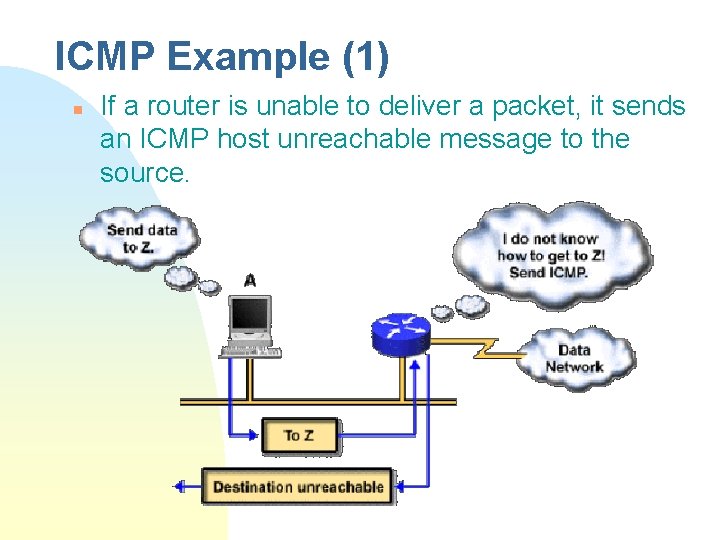
ICMP Example (1) n If a router is unable to deliver a packet, it sends an ICMP host unreachable message to the source.
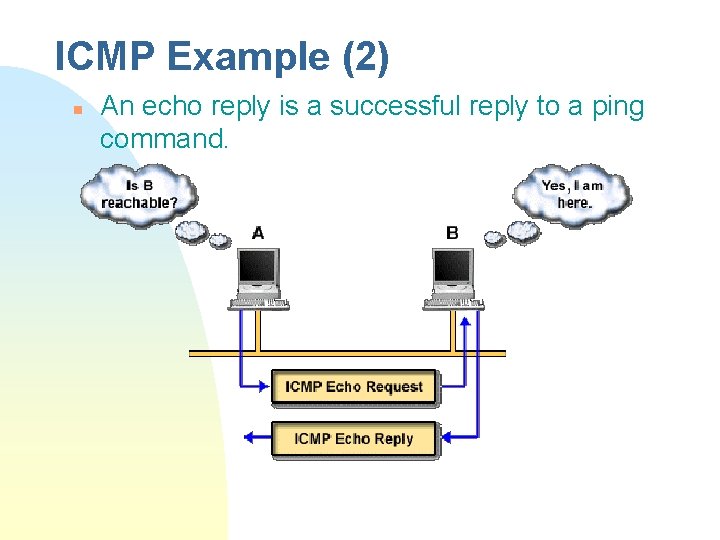
ICMP Example (2) n An echo reply is a successful reply to a ping command.
ARP - address resolution protocol n Maps known IP address to a MAC address. u For destination IP address, ARP table is checked. u If no ARP entry, ARP request is broadcast. u Host with the known IP address responds with its MAC address. n Prior to ARP broadcast, subnet mask is consulted, to determine that node is on the same subnet.
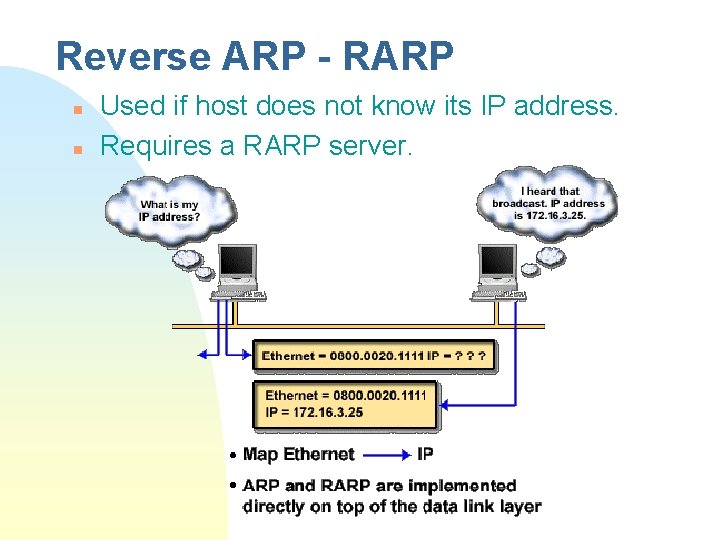
Reverse ARP - RARP n n Used if host does not know its IP address. Requires a RARP server.
Summary (1) n n TCP & UDP operate at Transport Layer Protocol: u supports application layer functions like FTP, email, and remote login. u Provides reliable (TCP) and unreliable (UDP) transport. n n Port Numbers - used to identify the application. TCP Segment Format include: u port numbers, Sequence number, Window size, Checksum.
Summary (2) n UDP Segment Format: u no windowing or acknowledgements. u Used by TFTP, SNMP, NFS, DNS. n IP operates at the Network Layer. u Connectionless, n Network Layer features include: u ICMP, n best-effort delivery. ARP, RARP IP Datagram Header u Version, header length, total length, TTL. u Protocol Field - identifies Layer 4 protocol used. u IP address - source and destination.
The End
- Slides: 25