
Ch 9 Plate Tectonics AG EARTH SCIENCE MS

- Slides: 23
Ch. 9 Plate Tectonics AG. EARTH SCIENCE MS. WEIGEL
Continental Drift SECTION 1
How Did Continents Come To Be? �https: //youtu. be/zocutif 0 c. QY
Questions �Will California eventually slide into the ocean? �Have continents really drifted apart over the centuries? �During the last few decades, new data has dramatically changed our understanding of the Earth at work
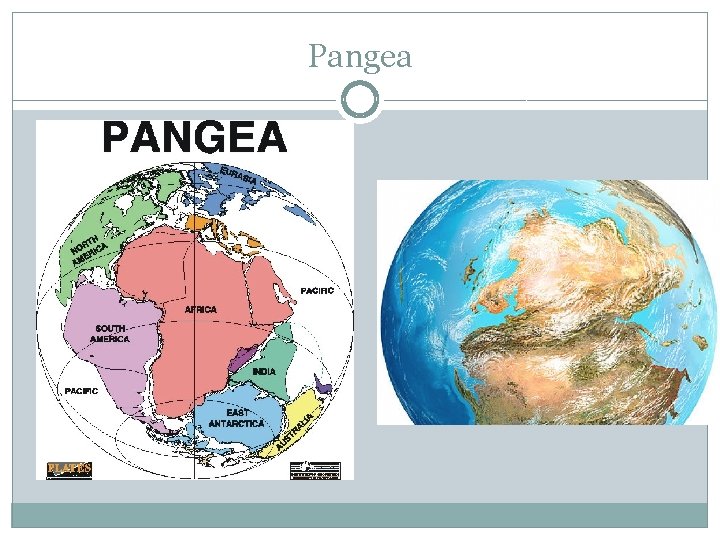
An Idea Before Its Time The idea of continents fitting like puzzle pieces cam when better maps were available. 2. In 1915, a German scientist Alfred Wegener proposed a radical hypothesis of continental drift. 3. His continental drift hypothesis stated that the continents had once been joined to form a single supercontinent. 4. He call this supercontinent Pangea, meaning all land. 1.
Pangea
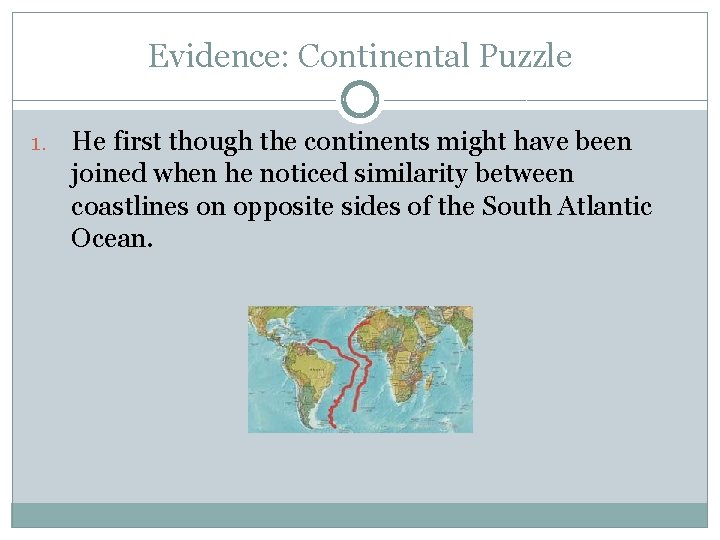
Evidence: Continental Puzzle 1. He first though the continents might have been joined when he noticed similarity between coastlines on opposite sides of the South Atlantic Ocean.
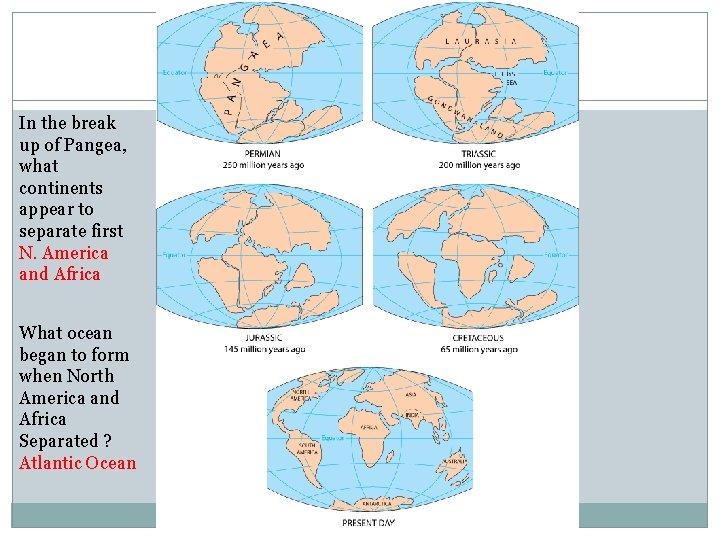
In the break up of Pangea, what continents appear to separate first N. America and Africa What ocean began to form when North America and Africa Separated ? Atlantic Ocean
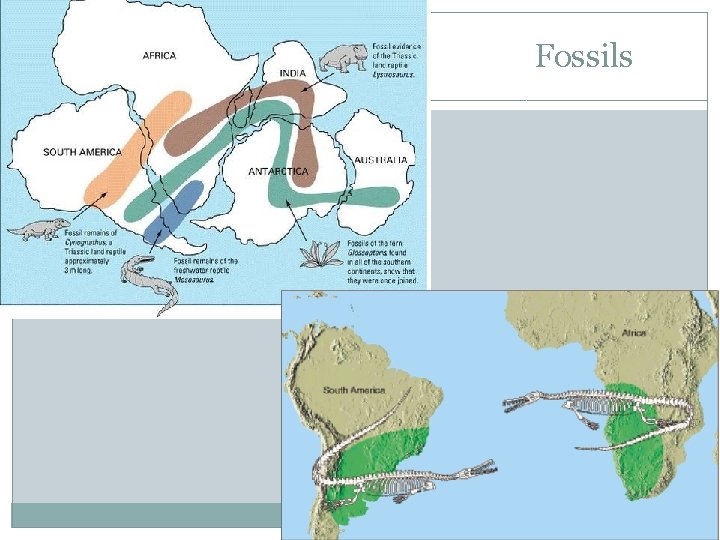
Evidence: Matching Fossils Fossil evidence for continental drift includes several fossil organisms found on different landmasses. 1. He reasoned organism could not have crossed vast oceans 2. Mesosaurus, an aquatic reptile has fossils in south America and southern Africa 3. The idea of land bridges was once the most widely accepted explanation
Fossils
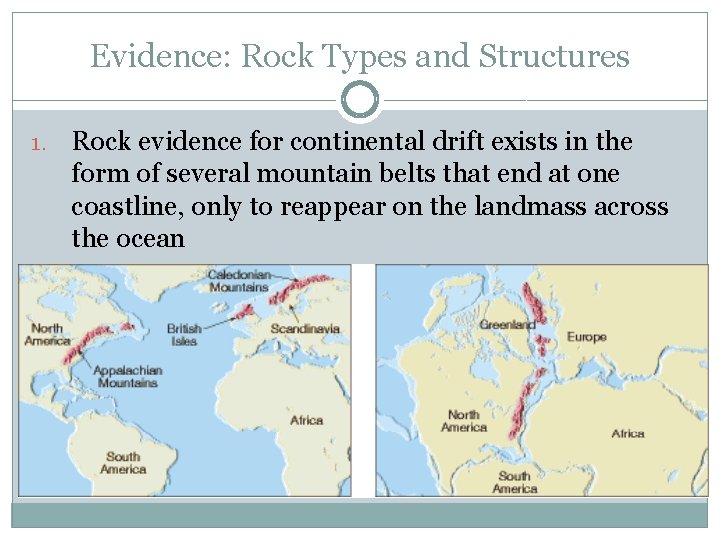
Evidence: Rock Types and Structures 1. Rock evidence for continental drift exists in the form of several mountain belts that end at one coastline, only to reappear on the landmass across the ocean
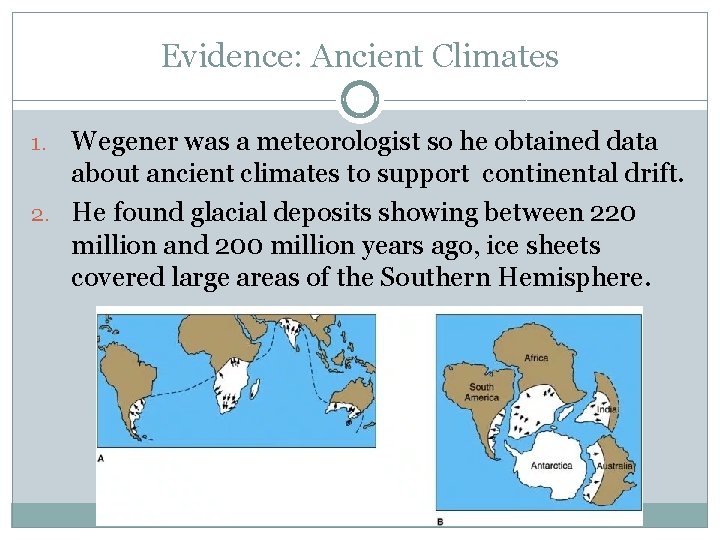
Evidence: Ancient Climates Wegener was a meteorologist so he obtained data about ancient climates to support continental drift. 2. He found glacial deposits showing between 220 million and 200 million years ago, ice sheets covered large areas of the Southern Hemisphere. 1.
Rejecting a Hypothesis Wegener drift hypothesis faced great criticism. 2. Objects were that he could not describe a mechanism that was capable of moving the continents across the globe. 3. He proposed tidal influence of the Moon was strong even to give westward motion. 4. He also suggested the larger and sturdier continents broke through the oceanic crust. 1.
A New Theory Emerges During the following years after Wegener’s hypothesis, major strides in technology allowed for scientists to gain more information about the ocean floor. 2. By 1968 the findings of earthquake activity and Earth’s magnetic field led to a new theory, known as Plate Tectonics. 3. This theory proves framework for understanding geologic processes. 1.
Plate Tectonics SECTION 2
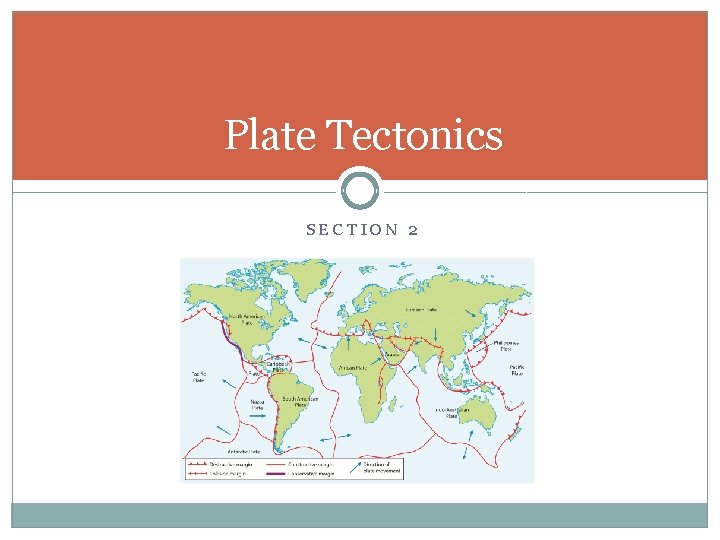
Earth’s Major Plates According of plate tectonics theory, the uppermost mantle along with the overlying crust, behaves as a strong, ridged layer. 2. This layer is known as the lithosphere. 3. The lithosphere is divided into segments called plates, which move and continually change shape and size. 4. Plate tectonics contributes to the processes in the rock cycle that form igneous and metamorphic rocks. 1.
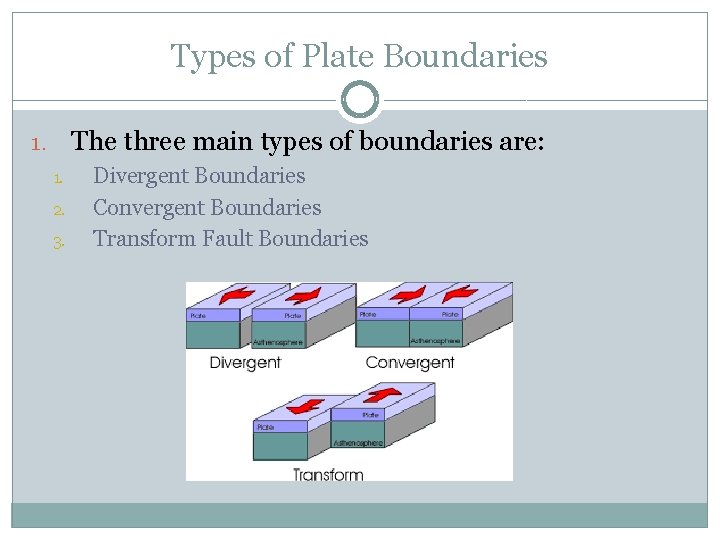
Types of Plate Boundaries The three main types of boundaries are: 1. 1. 2. 3. Divergent Boundaries Convergent Boundaries Transform Fault Boundaries
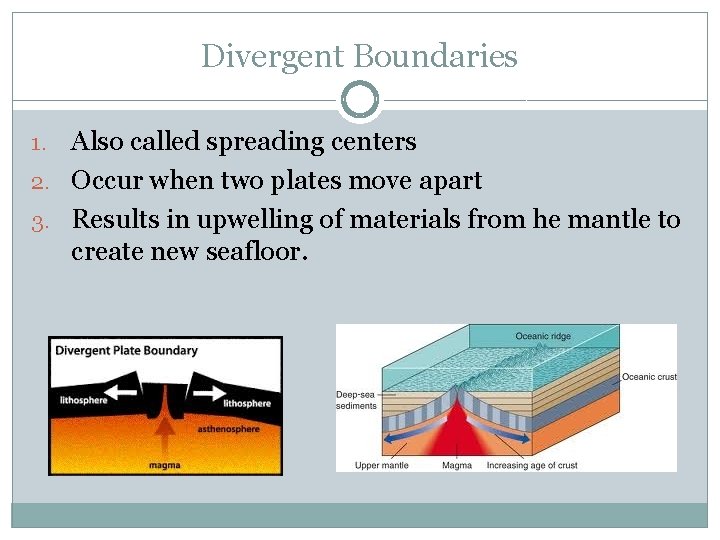
Divergent Boundaries Also called spreading centers 2. Occur when two plates move apart 3. Results in upwelling of materials from he mantle to create new seafloor. 1.
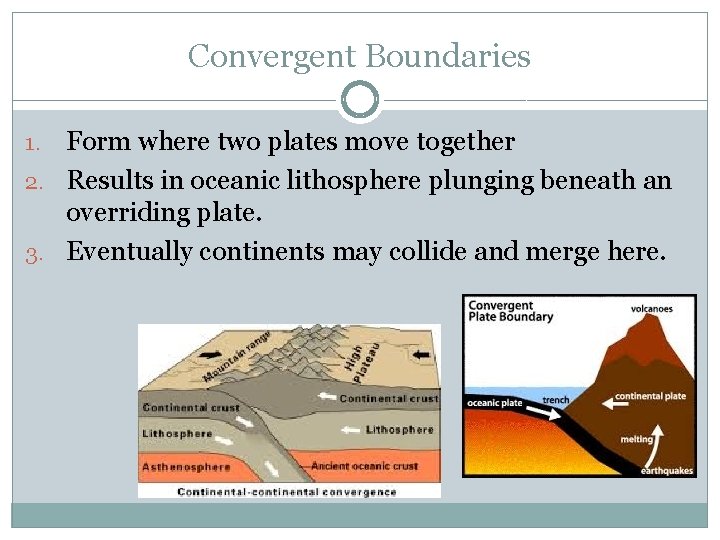
Convergent Boundaries Form where two plates move together 2. Results in oceanic lithosphere plunging beneath an overriding plate. 3. Eventually continents may collide and merge here. 1.
Convergent plates �Two types: Subduction- oceanic plate goes beneath another 2. Collision- two converging plates carrying continents collide pushing one up- this causes mountains 1.
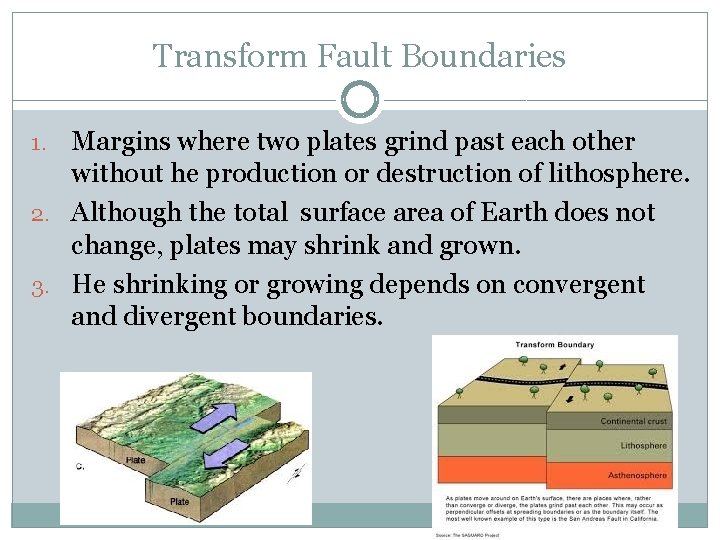
Transform Fault Boundaries Margins where two plates grind past each other without he production or destruction of lithosphere. 2. Although the total surface area of Earth does not change, plates may shrink and grown. 3. He shrinking or growing depends on convergent and divergent boundaries. 1.
Actions at Plate Boundaries SECTION 3