
Ch 9 Overexploitation Long History of Overexploitation Overexploitation
- Slides: 16
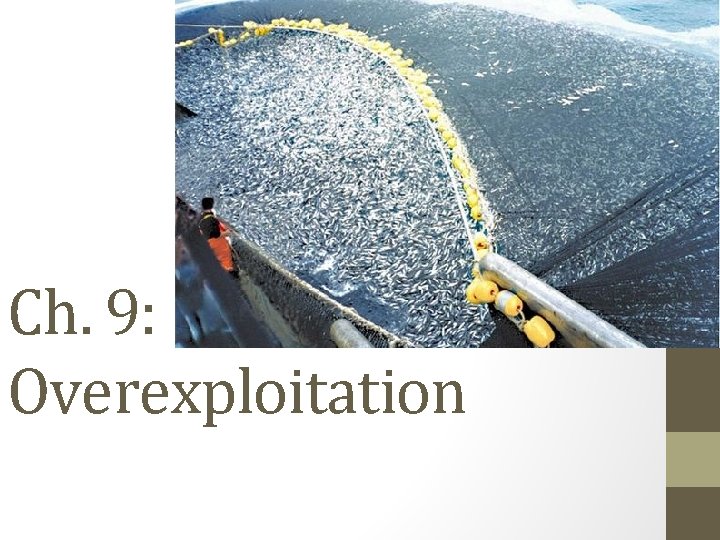
Ch. 9: Overexploitation
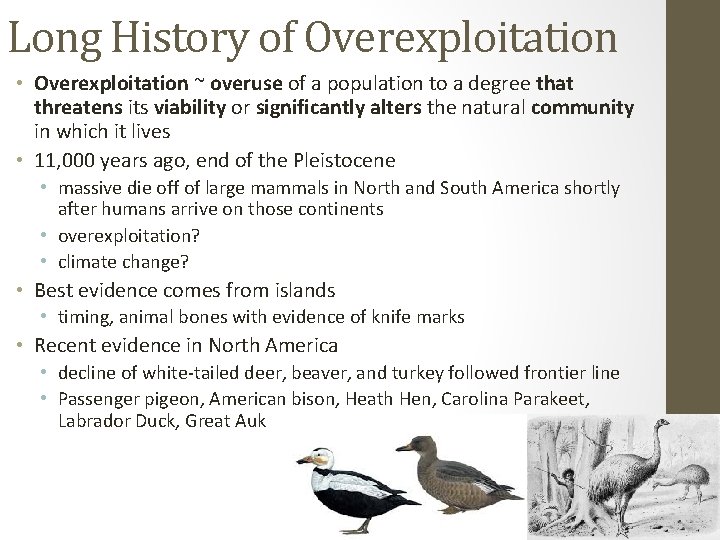
Long History of Overexploitation • Overexploitation ~ overuse of a population to a degree that threatens its viability or significantly alters the natural community in which it lives • 11, 000 years ago, end of the Pleistocene • massive die off of large mammals in North and South America shortly after humans arrive on those continents • overexploitation? • climate change? • Best evidence comes from islands • timing, animal bones with evidence of knife marks • Recent evidence in North America • decline of white-tailed deer, beaver, and turkey followed frontier line • Passenger pigeon, American bison, Heath Hen, Carolina Parakeet, Labrador Duck, Great Auk
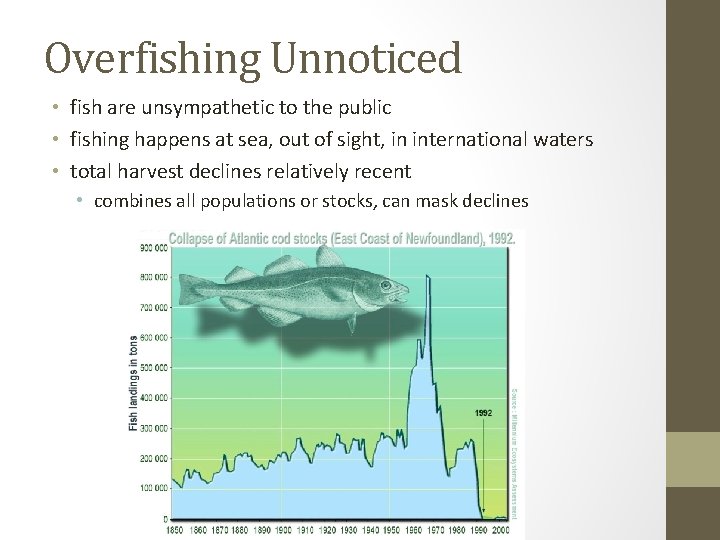
Overfishing Unnoticed • fish are unsympathetic to the public • fishing happens at sea, out of sight, in international waters • total harvest declines relatively recent • combines all populations or stocks, can mask declines
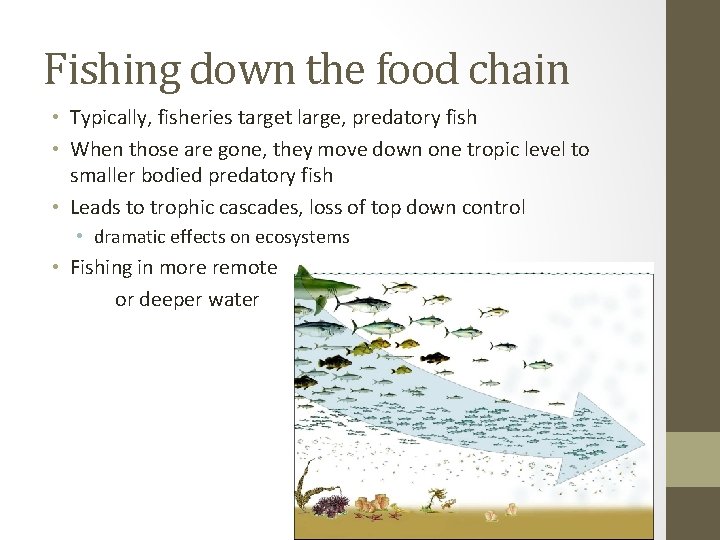
Fishing down the food chain • Typically, fisheries target large, predatory fish • When those are gone, they move down one tropic level to smaller bodied predatory fish • Leads to trophic cascades, loss of top down control • dramatic effects on ecosystems • Fishing in more remote or deeper water
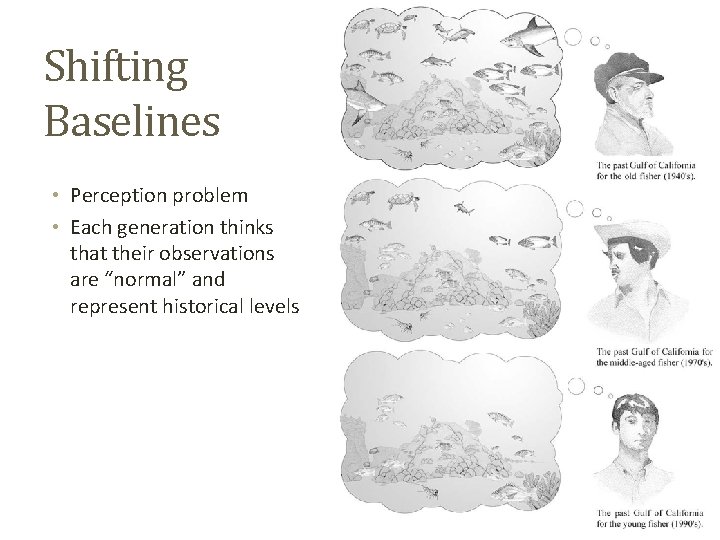
Shifting Baselines • Perception problem • Each generation thinks that their observations are “normal” and represent historical levels
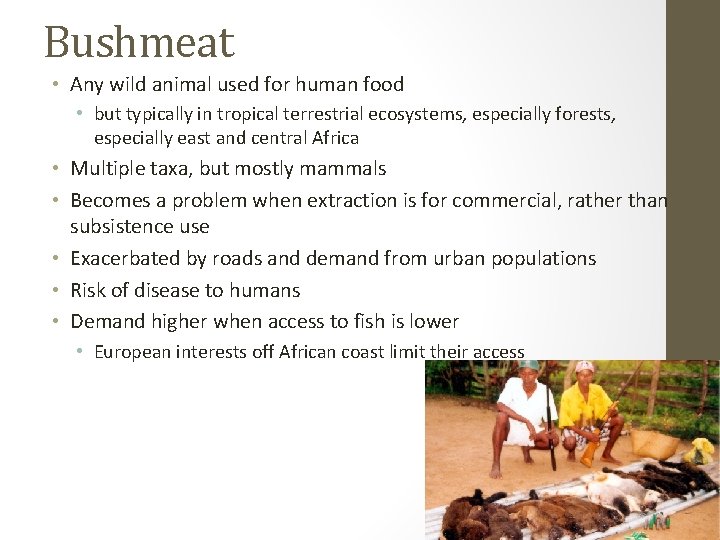
Bushmeat • Any wild animal used for human food • but typically in tropical terrestrial ecosystems, especially forests, especially east and central Africa • Multiple taxa, but mostly mammals • Becomes a problem when extraction is for commercial, rather than subsistence use • Exacerbated by roads and demand from urban populations • Risk of disease to humans • Demand higher when access to fish is lower • European interests off African coast limit their access
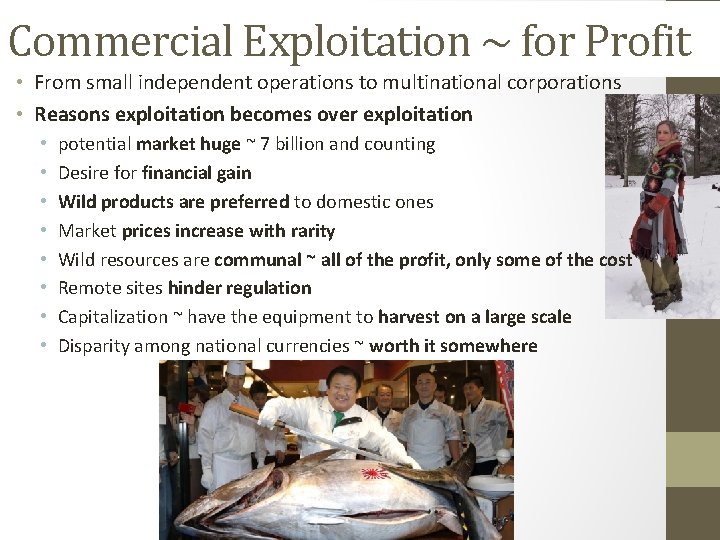
Commercial Exploitation ~ for Profit • From small independent operations to multinational corporations • Reasons exploitation becomes over exploitation • • potential market huge ~ 7 billion and counting Desire for financial gain Wild products are preferred to domestic ones Market prices increase with rarity Wild resources are communal ~ all of the profit, only some of the cost Remote sites hinder regulation Capitalization ~ have the equipment to harvest on a large scale Disparity among national currencies ~ worth it somewhere
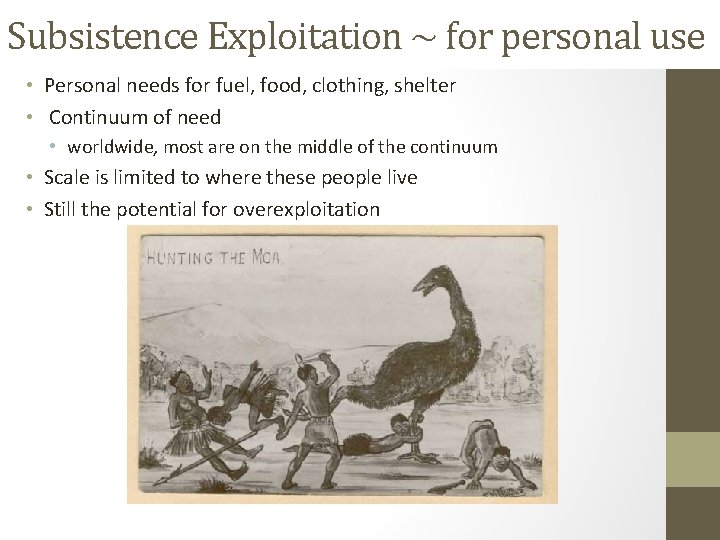
Subsistence Exploitation ~ for personal use • Personal needs for fuel, food, clothing, shelter • Continuum of need • worldwide, most are on the middle of the continuum • Scale is limited to where these people live • Still the potential for overexploitation
Recreational Exploitation • Hunting, fishing, wildlife watching • May be detrimental, may contribute to conservation efforts, or both • Collecting • orchids, butterflies, nests and eggs • Non-consumptive • bird-watching, hiking • still has an impact
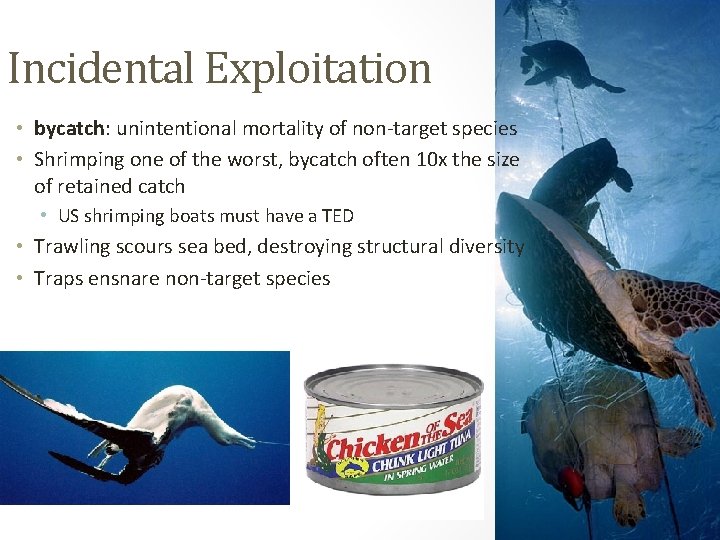
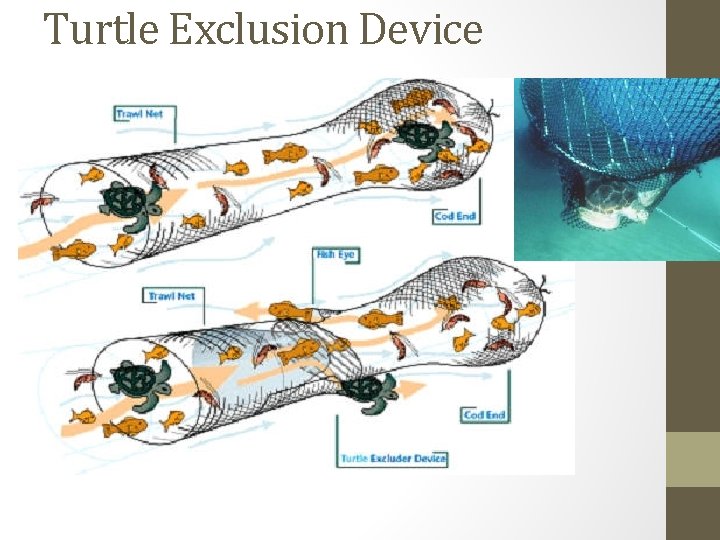
Incidental Exploitation • bycatch: unintentional mortality of non-target species • Shrimping one of the worst, bycatch often 10 x the size of retained catch • US shrimping boats must have a TED • Trawling scours sea bed, destroying structural diversity • Traps ensnare non-target species
Turtle Exclusion Device
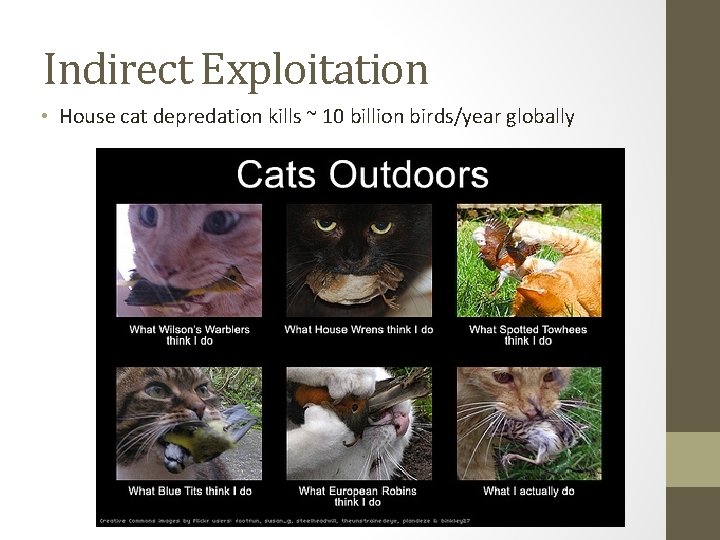
Indirect Exploitation • House cat depredation kills ~ 10 billion birds/year globally
Consequences of Overexploitation • Reduced populations subject to small population problems • Population structure effects ~ not all individuals equally susceptible to exploitation • Age ~ fishing targets largest fish, which are the oldest and most reproductively valuable • very different than a natural predator ~ mismatch in age-specific mortality • Sex ~ males more exploited in mammals, antlers, larger home ranges • skewed sex ratio ~ can shrink effective population size • Genetic ~ high-grading in forests leaves only diseased or disfigured trees to reproduce • loss of alleles, behaviors, inherited changes in body size • Remember that small populations subject to demographic stochasticity
Consequences of Overexploitation • Ecosystem effects ~ especially if over exploited species is dominant, keystone, ecological engineer • harvest of snags reduces habitat for fungi and insects, food and shelter for woodpeckers • hunting of sea otters led to loss of top-down control, explosion of sea urchins, and decline in kelp ~ loss of kelp based ecosystem due to trophic cascade. • Empty forest Syndrome ~ forest stands, but no large mammals or birds, doomed to disappear if no one is there to disperse seeds and perform other important functions
Balancing Act • Need for material goods, food, etc. • Pets and plant collectors have larger impact than you realize • shipping damage, need to harvest many more than are desired • Primates for medical research • Loss of ecosystems generally worse than overexploitation • but overexploitation can lead to ecosystem loss
Discussion Qs • Who should be given priority? Commercial, subsistence, or recreational uses? • Compare the pros and cons of plantation vs. natural timber.