
Ch 9 Lecture 3 Constitutional Isomers and Structures
![2) 2 -coordinate complexes a) Cu(I) and Ag(I) complexes are known: [Ag(NH 3)2]+ b)](https://slidetodoc.com/presentation_image_h2/a90dfdaf93f63bd7483d434b8de858dd/image-4.jpg "2) 2 -coordinate complexes a) Cu(I) and Ag(I) complexes are known: [Ag(NH 3)2]+ b)")
- Slides: 12
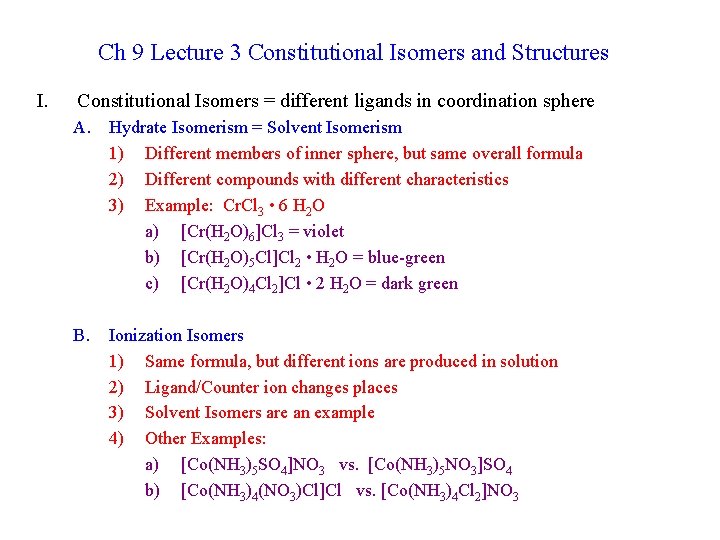
Ch 9 Lecture 3 Constitutional Isomers and Structures I. Constitutional Isomers = different ligands in coordination sphere A. Hydrate Isomerism = Solvent Isomerism 1) Different members of inner sphere, but same overall formula 2) Different compounds with different characteristics 3) Example: Cr. Cl 3 • 6 H 2 O a) [Cr(H 2 O)6]Cl 3 = violet b) [Cr(H 2 O)5 Cl]Cl 2 • H 2 O = blue-green c) [Cr(H 2 O)4 Cl 2]Cl • 2 H 2 O = dark green B. Ionization Isomers 1) Same formula, but different ions are produced in solution 2) Ligand/Counter ion changes places 3) Solvent Isomers are an example 4) Other Examples: a) [Co(NH 3)5 SO 4]NO 3 vs. [Co(NH 3)5 NO 3]SO 4 b) [Co(NH 3)4(NO 3)Cl]Cl vs. [Co(NH 3)4 Cl 2]NO 3
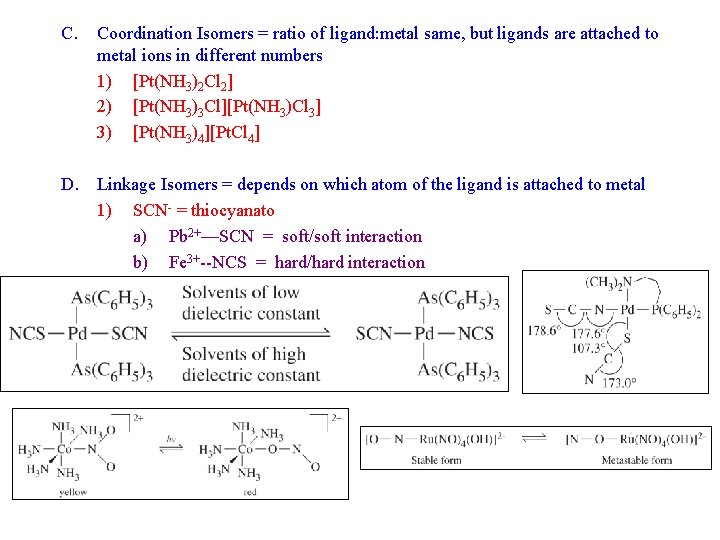
C. Coordination Isomers = ratio of ligand: metal same, but ligands are attached to metal ions in different numbers 1) [Pt(NH 3)2 Cl 2] 2) [Pt(NH 3)3 Cl][Pt(NH 3)Cl 3] 3) [Pt(NH 3)4][Pt. Cl 4] D. Linkage Isomers = depends on which atom of the ligand is attached to metal 1) SCN- = thiocyanato a) Pb 2+—SCN = soft/soft interaction b) Fe 3+--NCS = hard/hard interaction 2) NO 2 - = nitrito M—ONO vs. M—NO 2
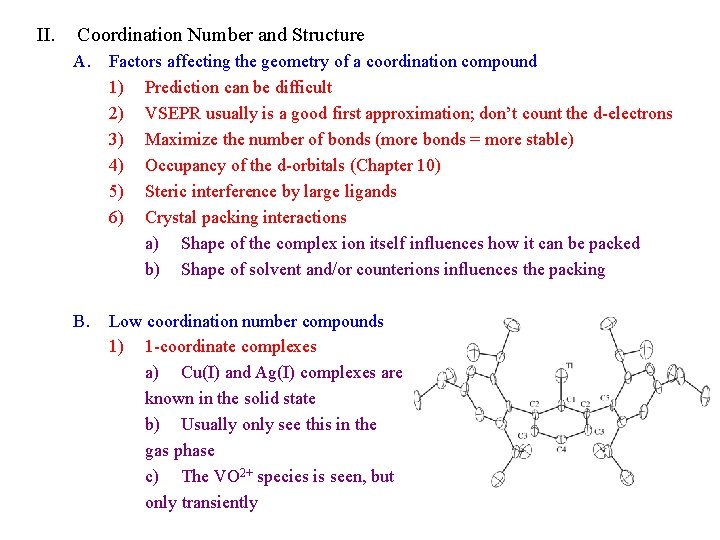
II. Coordination Number and Structure A. Factors affecting the geometry of a coordination compound 1) Prediction can be difficult 2) VSEPR usually is a good first approximation; don’t count the d-electrons 3) Maximize the number of bonds (more bonds = more stable) 4) Occupancy of the d-orbitals (Chapter 10) 5) Steric interference by large ligands 6) Crystal packing interactions a) Shape of the complex ion itself influences how it can be packed b) Shape of solvent and/or counterions influences the packing B. Low coordination number compounds 1) 1 -coordinate complexes a) Cu(I) and Ag(I) complexes are known in the solid state b) Usually only see this in the gas phase c) The VO 2+ species is seen, but only transiently
2) 2 -coordinate complexes a) Cu(I) and Ag(I) complexes are known: [Ag(NH 3)2]+ b) These metals are d 10 and don’t require much more e- density c) VSEPR geometry is linear d) Sterically large ligands encourage this coordination number e) Some d 6 and d 7 metal ions can also do this
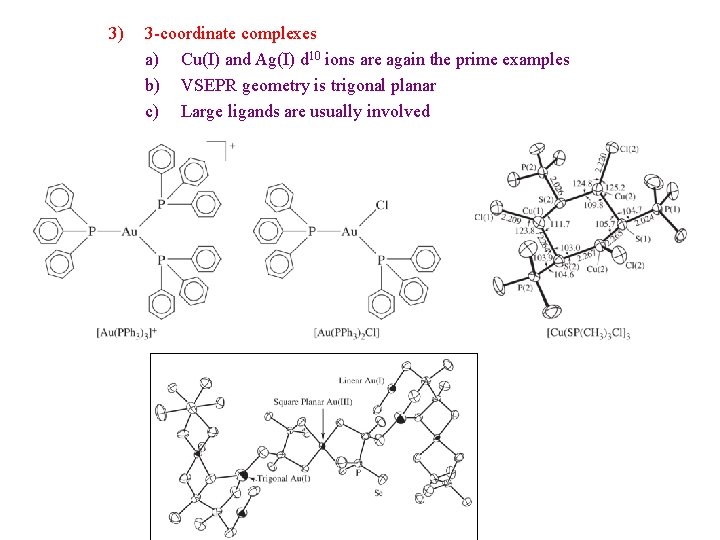
3) 3 -coordinate complexes a) Cu(I) and Ag(I) d 10 ions are again the prime examples b) VSEPR geometry is trigonal planar c) Large ligands are usually involved
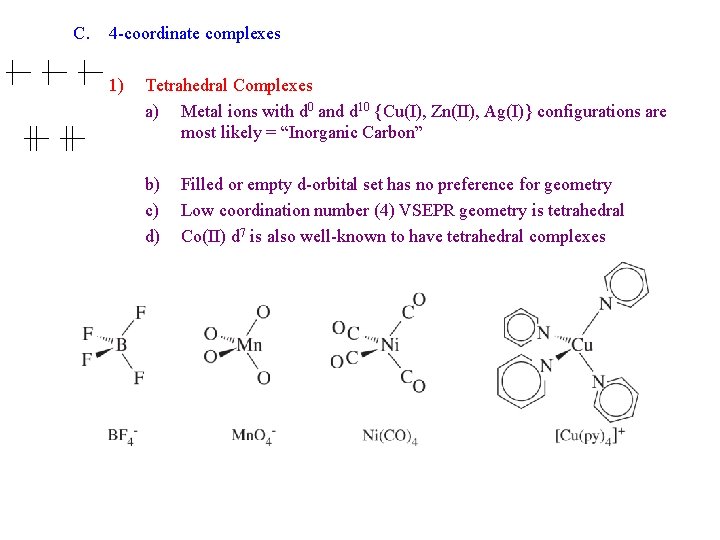
C. 4 -coordinate complexes 1) Tetrahedral Complexes a) Metal ions with d 0 and d 10 {Cu(I), Zn(II), Ag(I)} configurations are most likely = “Inorganic Carbon” b) c) d) Filled or empty d-orbital set has no preference for geometry Low coordination number (4) VSEPR geometry is tetrahedral Co(II) d 7 is also well-known to have tetrahedral complexes
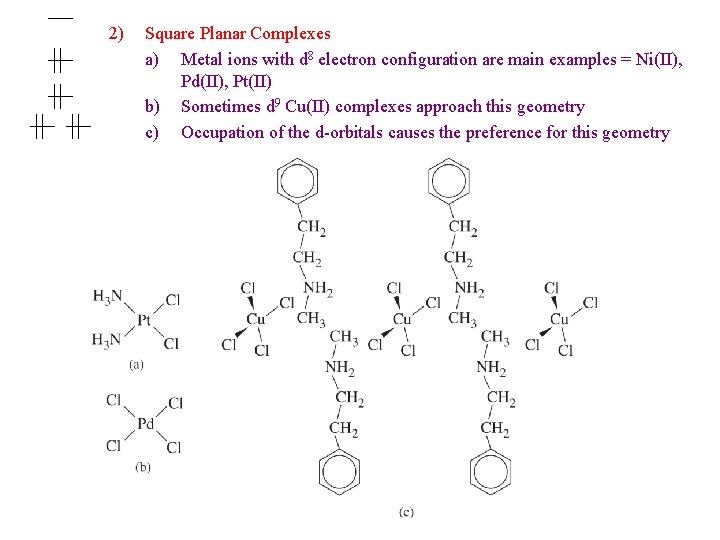
2) Square Planar Complexes a) Metal ions with d 8 electron configuration are main examples = Ni(II), Pd(II), Pt(II) b) Sometimes d 9 Cu(II) complexes approach this geometry c) Occupation of the d-orbitals causes the preference for this geometry
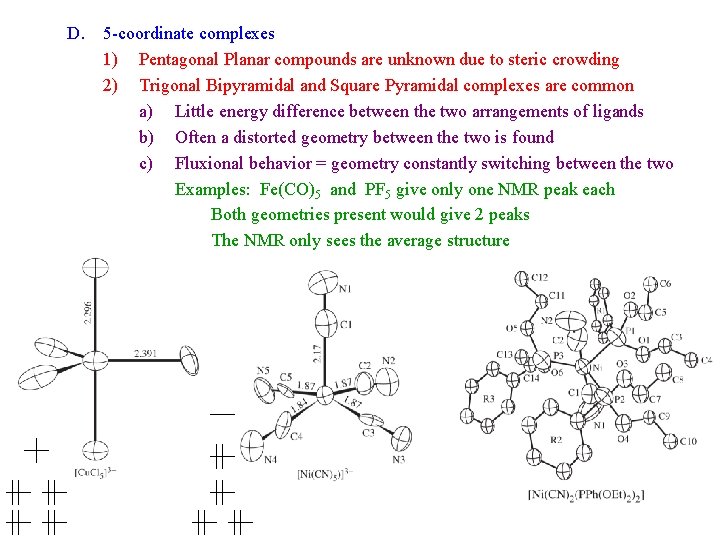
D. 5 -coordinate complexes 1) Pentagonal Planar compounds are unknown due to steric crowding 2) Trigonal Bipyramidal and Square Pyramidal complexes are common a) Little energy difference between the two arrangements of ligands b) Often a distorted geometry between the two is found c) Fluxional behavior = geometry constantly switching between the two Examples: Fe(CO)5 and PF 5 give only one NMR peak each Both geometries present would give 2 peaks The NMR only sees the average structure
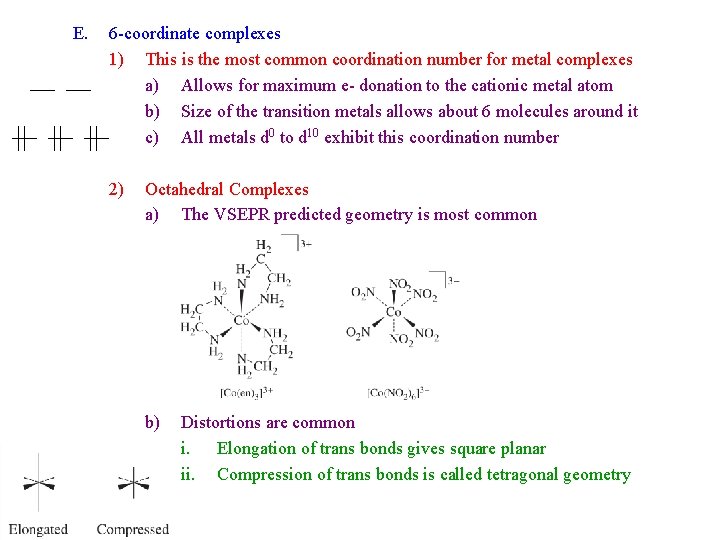
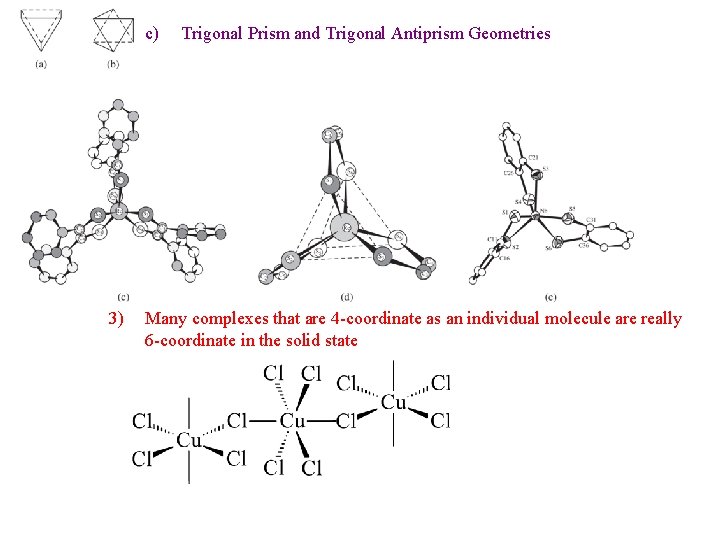
E. 6 -coordinate complexes 1) This is the most common coordination number for metal complexes a) Allows for maximum e- donation to the cationic metal atom b) Size of the transition metals allows about 6 molecules around it c) All metals d 0 to d 10 exhibit this coordination number 2) Octahedral Complexes a) The VSEPR predicted geometry is most common b) Distortions are common i. Elongation of trans bonds gives square planar ii. Compression of trans bonds is called tetragonal geometry
c) 3) Trigonal Prism and Trigonal Antiprism Geometries Many complexes that are 4 -coordinate as an individual molecule are really 6 -coordinate in the solid state
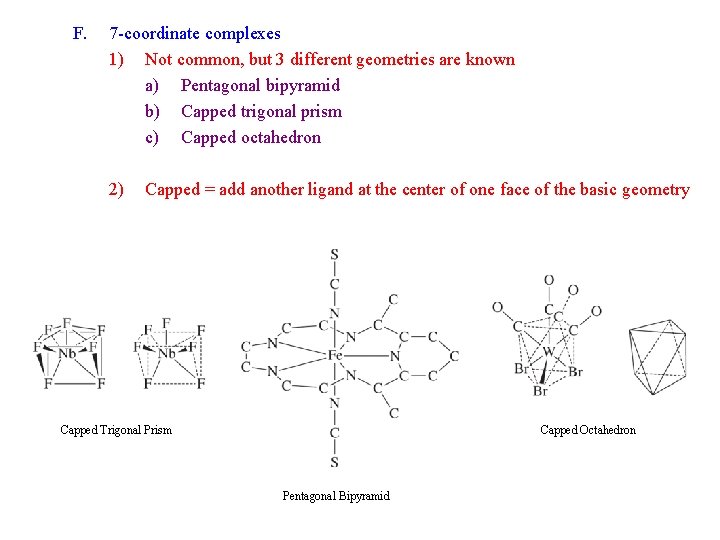
F. 7 -coordinate complexes 1) Not common, but 3 different geometries are known a) Pentagonal bipyramid b) Capped trigonal prism c) Capped octahedron 2) Capped = add another ligand at the center of one face of the basic geometry Capped Trigonal Prism Capped Octahedron Pentagonal Bipyramid
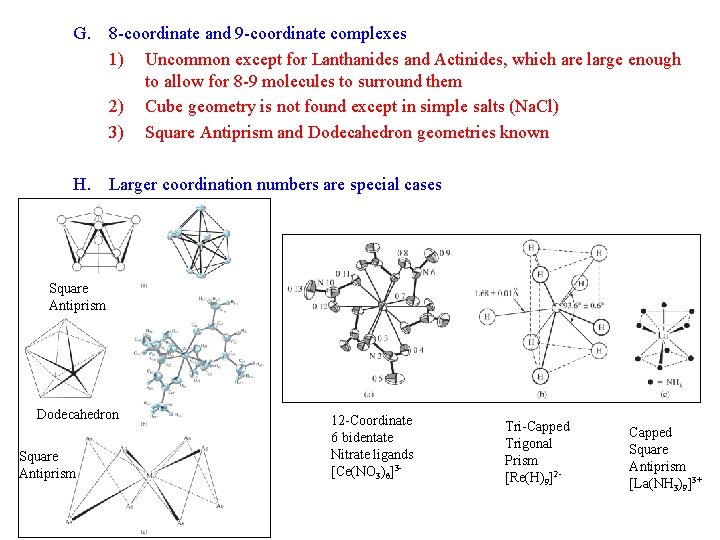
G. 8 -coordinate and 9 -coordinate complexes 1) Uncommon except for Lanthanides and Actinides, which are large enough to allow for 8 -9 molecules to surround them 2) Cube geometry is not found except in simple salts (Na. Cl) 3) Square Antiprism and Dodecahedron geometries known H. Larger coordination numbers are special cases Square Antiprism Dodecahedron Square Antiprism 12 -Coordinate 6 bidentate Nitrate ligands [Ce(NO 3)6]3 - Tri-Capped Trigonal Prism [Re(H)9]2 - Capped Square Antiprism [La(NH 3)9]3+