
CH 9 INDIRECT AND MUTUAL HOLDINGS Affiliation StructuresDirect



- Slides: 59
CH 9 INDIRECT AND MUTUAL HOLDINGS
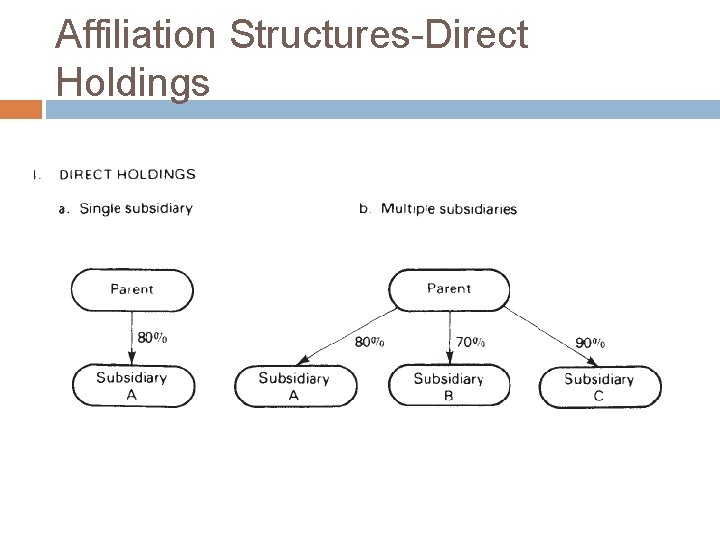
Affiliation Structures-Direct Holdings
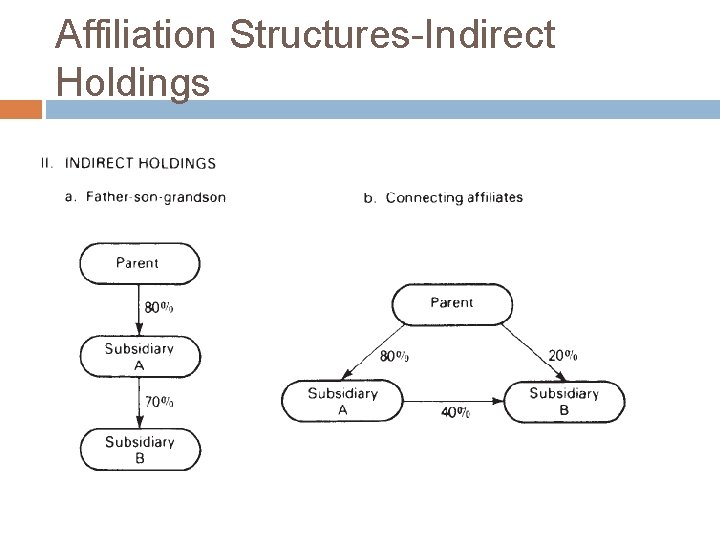
Affiliation Structures-Indirect Holdings
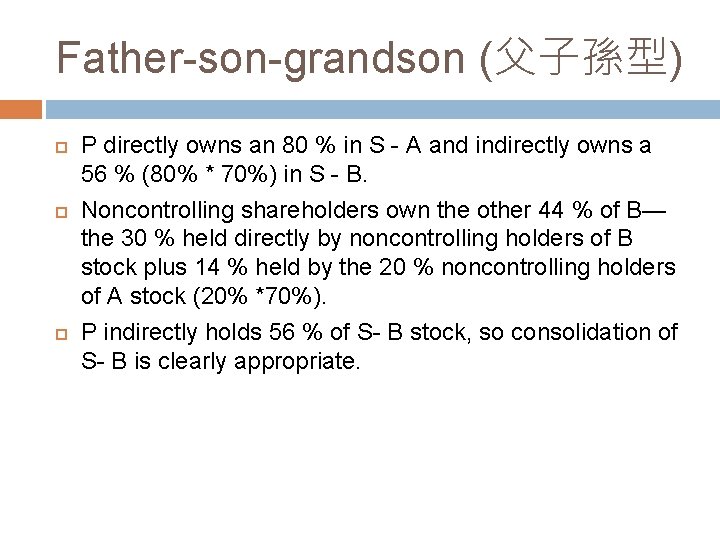
Father-son-grandson (父子孫型) P directly owns an 80 % in S - A and indirectly owns a 56 % (80% * 70%) in S - B. Noncontrolling shareholders own the other 44 % of B— the 30 % held directly by noncontrolling holders of B stock plus 14 % held by the 20 % noncontrolling holders of A stock (20% *70%). P indirectly holds 56 % of S- B stock, so consolidation of S- B is clearly appropriate.
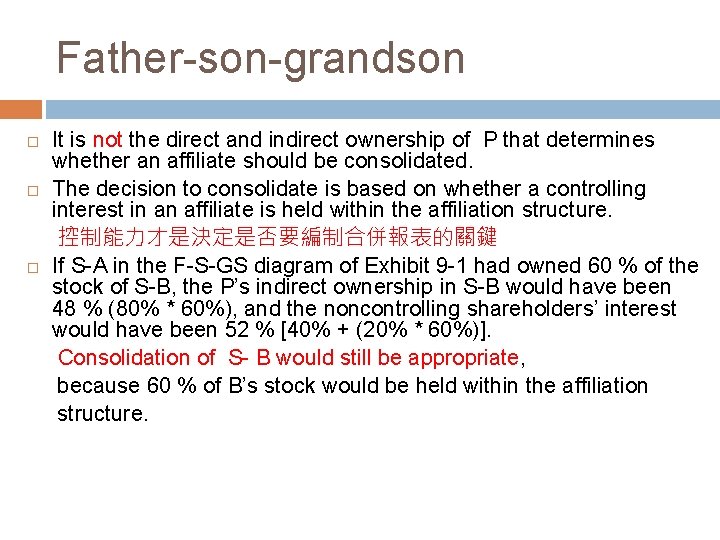
Father-son-grandson It is not the direct and indirect ownership of P that determines whether an affiliate should be consolidated. The decision to consolidate is based on whether a controlling interest in an affiliate is held within the affiliation structure. 控制能力才是決定是否要編制合併報表的關鍵 If S-A in the F-S-GS diagram of Exhibit 9 -1 had owned 60 % of the stock of S-B, the P’s indirect ownership in S-B would have been 48 % (80% * 60%), and the noncontrolling shareholders’ interest would have been 52 % [40% + (20% * 60%)]. Consolidation of S- B would still be appropriate, because 60 % of B’s stock would be held within the affiliation structure.
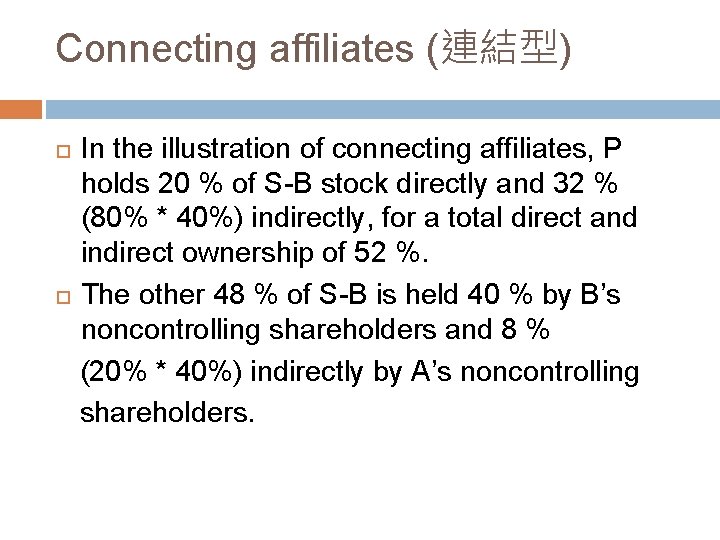
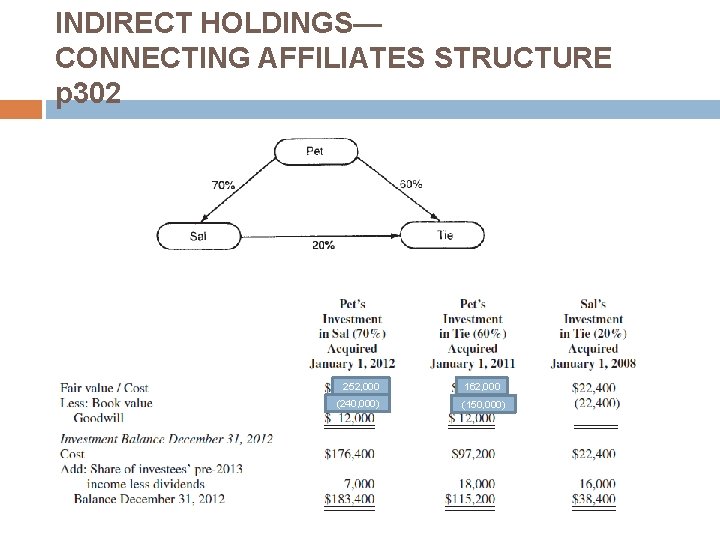
Connecting affiliates (連結型) In the illustration of connecting affiliates, P holds 20 % of S-B stock directly and 32 % (80% * 40%) indirectly, for a total direct and indirect ownership of 52 %. The other 48 % of S-B is held 40 % by B’s noncontrolling shareholders and 8 % (20% * 40%) indirectly by A’s noncontrolling shareholders.
Mutual Holdings 相互持股
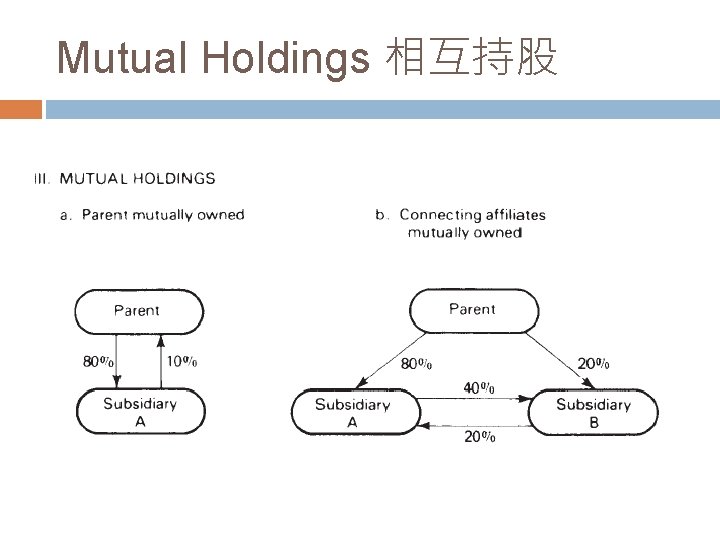
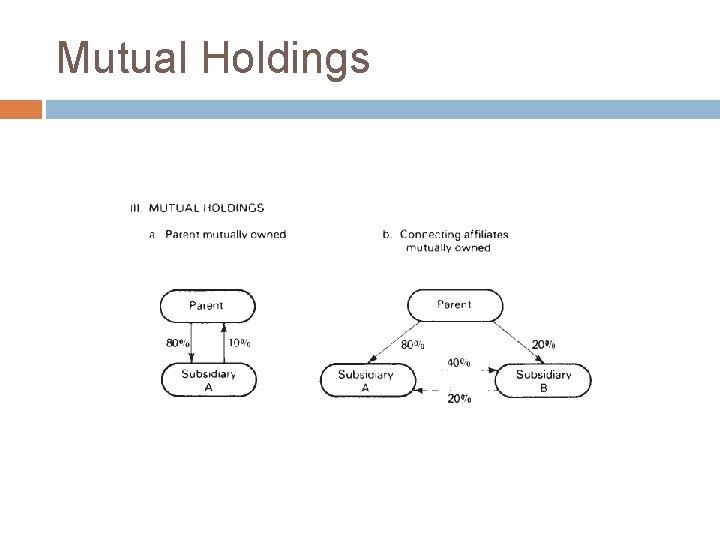
Mutual Holdings In diagram a , P owns 80 % of S-A, and S-A owns 10 % of P. Thus, 10 % of P’s stock is held within the affiliation structure and 90 % is outstanding. In diagram b, P is not a party to the mutual holding relationship, but S-A owns 40 % of S-B, and S-B owns 20% of S-A. The complexity involved in this latter case requires the use of simultaneous equations or other appropriate mathematical procedures to allocate incomes and equities among the affiliates.
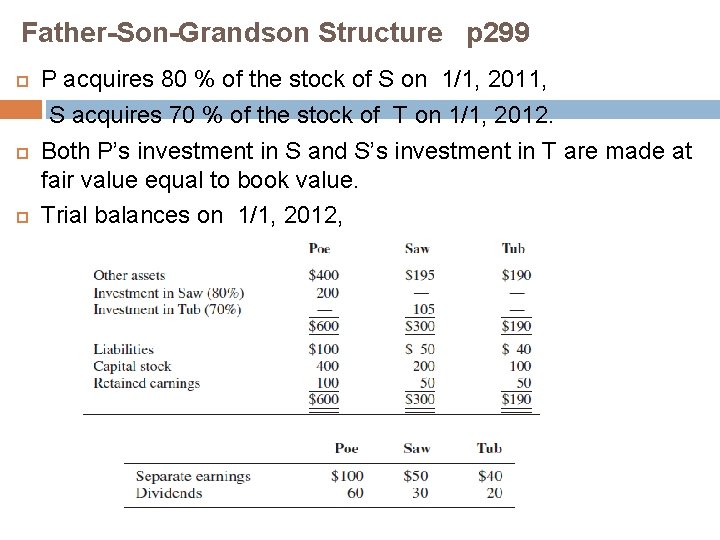
Father-Son-Grandson Structure p 299 P acquires 80 % of the stock of S on 1/1, 2011, S acquires 70 % of the stock of T on 1/1, 2012. Both P’s investment in S and S’s investment in T are made at fair value equal to book value. Trial balances on 1/1, 2012,
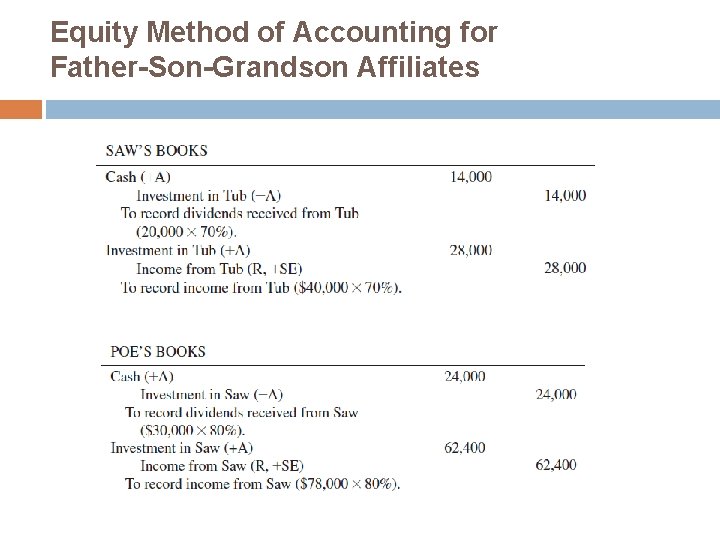
Equity Method of Accounting for Father-Son-Grandson Affiliates
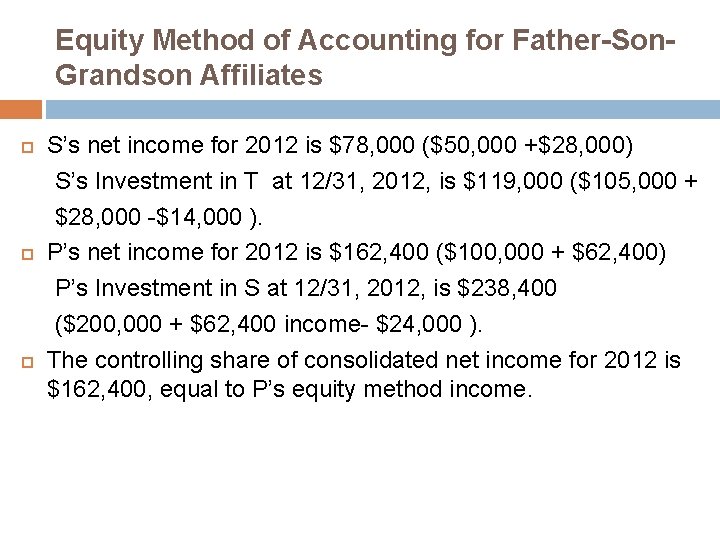
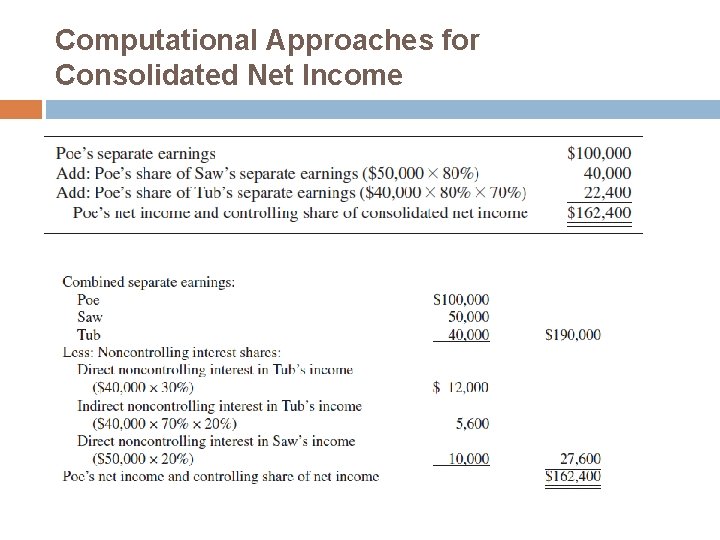
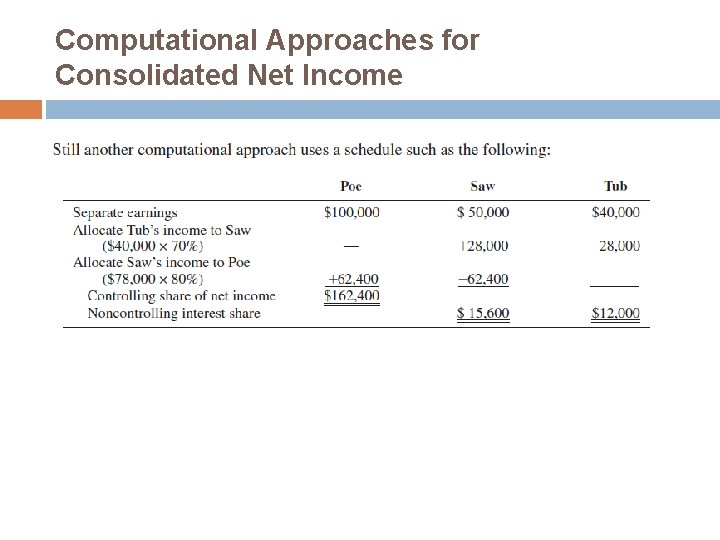
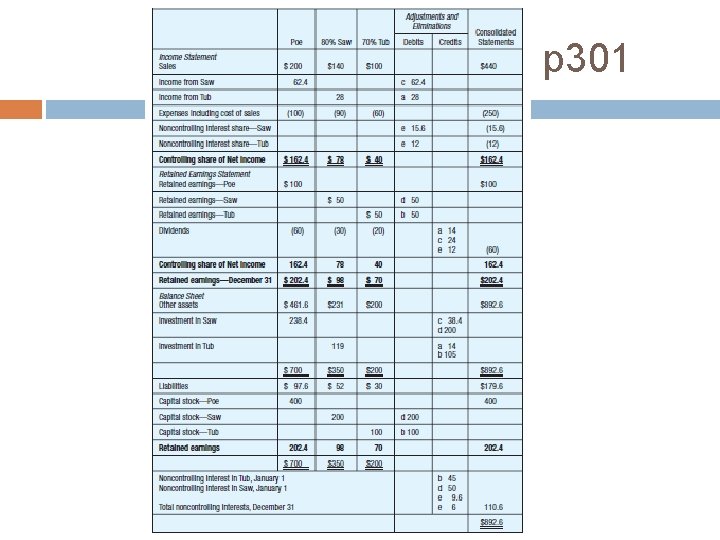
Equity Method of Accounting for Father-Son. Grandson Affiliates S’s net income for 2012 is $78, 000 ($50, 000 +$28, 000) S’s Investment in T at 12/31, 2012, is $119, 000 ($105, 000 + $28, 000 -$14, 000 ). P’s net income for 2012 is $162, 400 ($100, 000 + $62, 400) P’s Investment in S at 12/31, 2012, is $238, 400 ($200, 000 + $62, 400 income- $24, 000 ). The controlling share of consolidated net income for 2012 is $162, 400, equal to P’s equity method income.
Computational Approaches for Consolidated Net Income
Computational Approaches for Consolidated Net Income
p p p 301
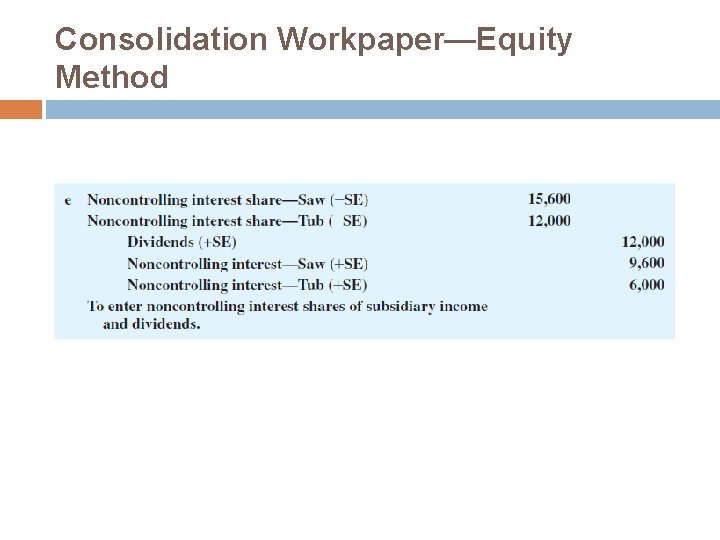
Consolidation Workpaper—Equity Method
INDIRECT HOLDINGS— CONNECTING AFFILIATES STRUCTURE p 302 252, 000 (240, 000) 162, 000 (150, 000)
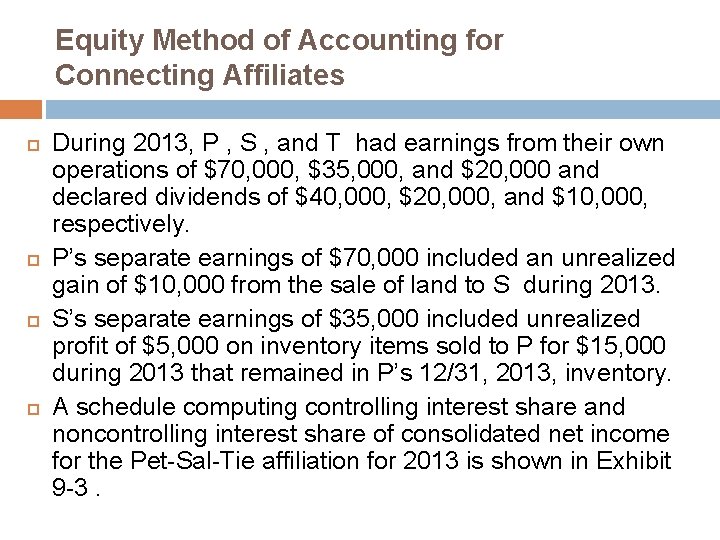
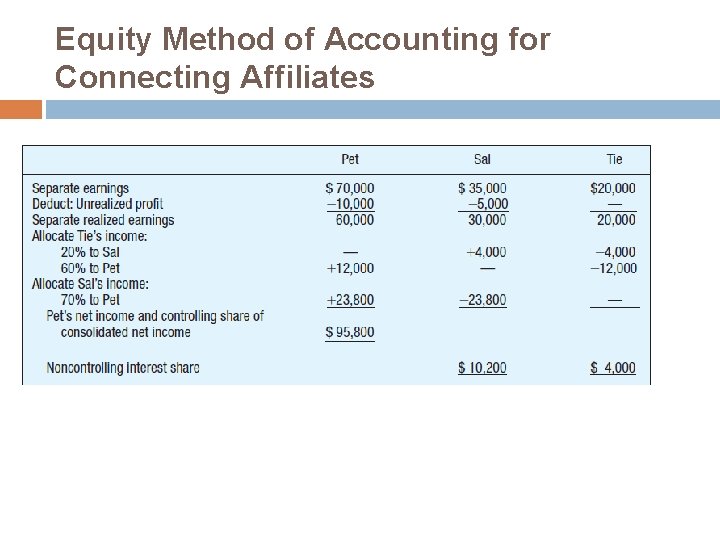
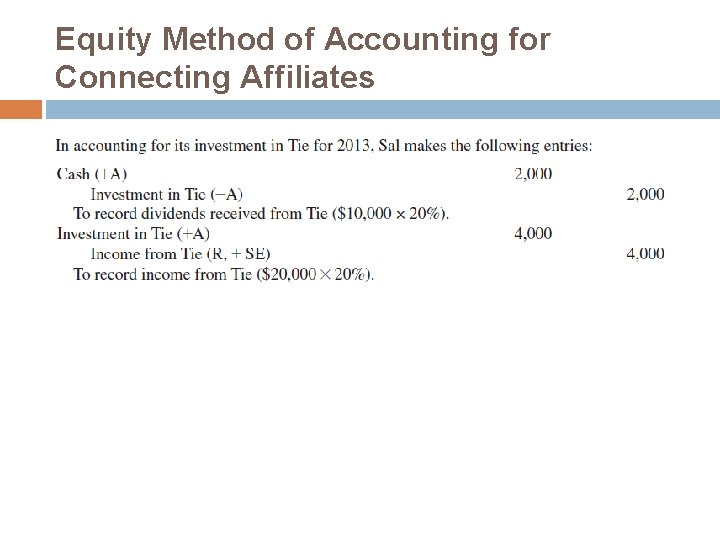
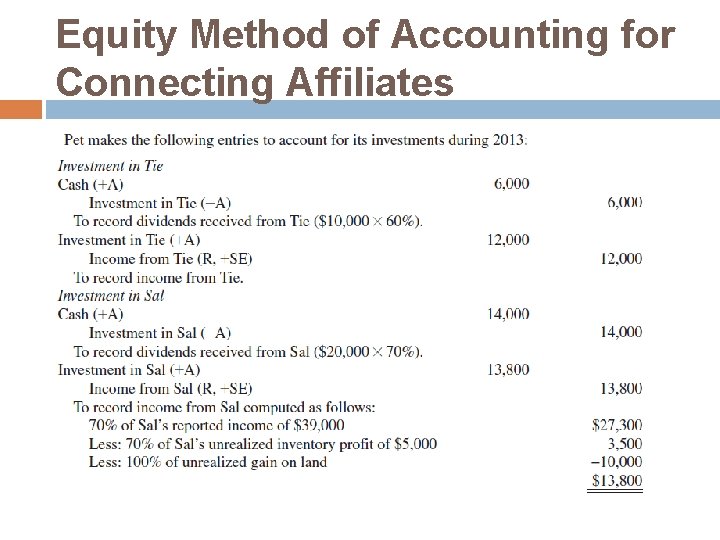
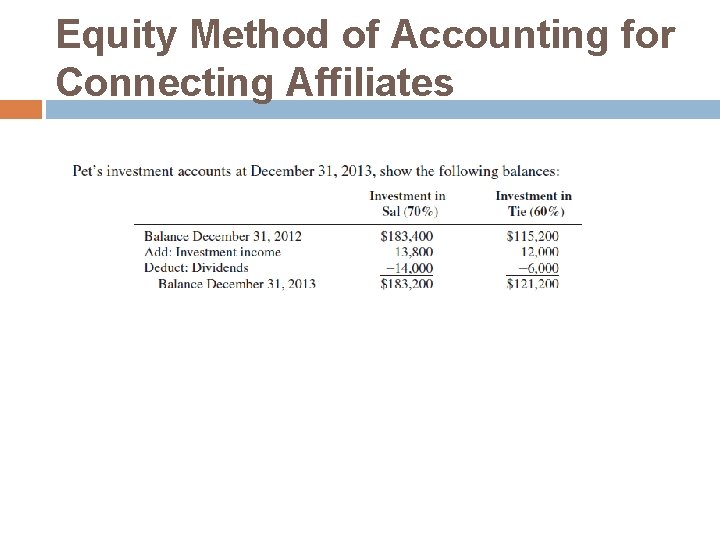
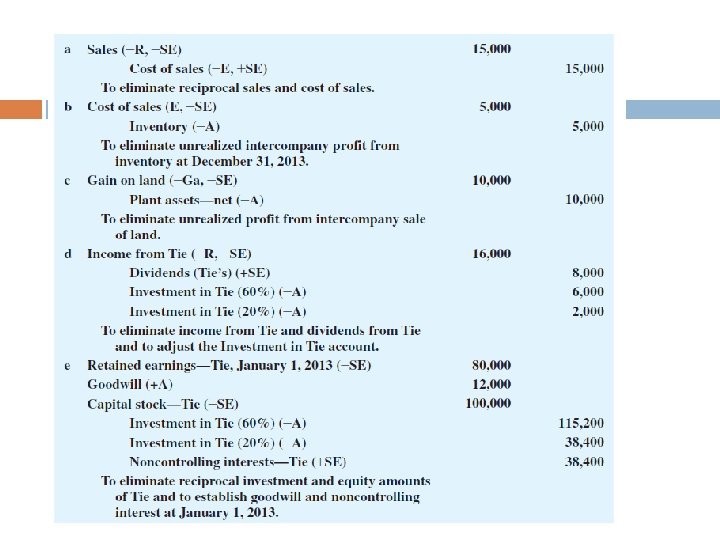
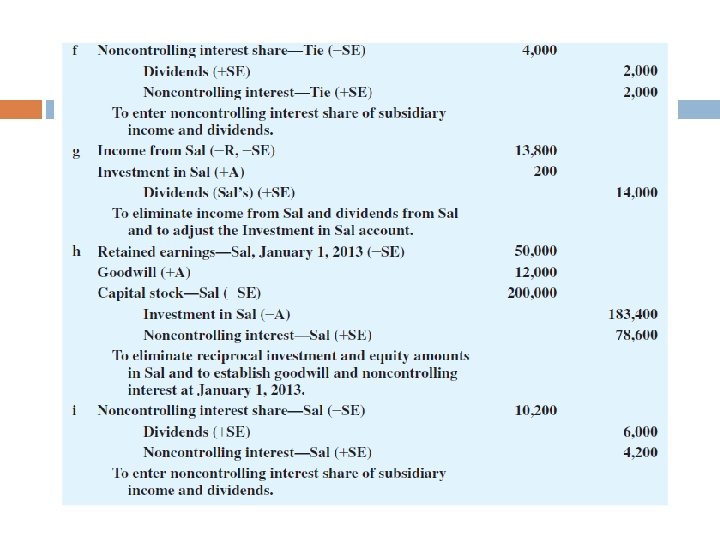
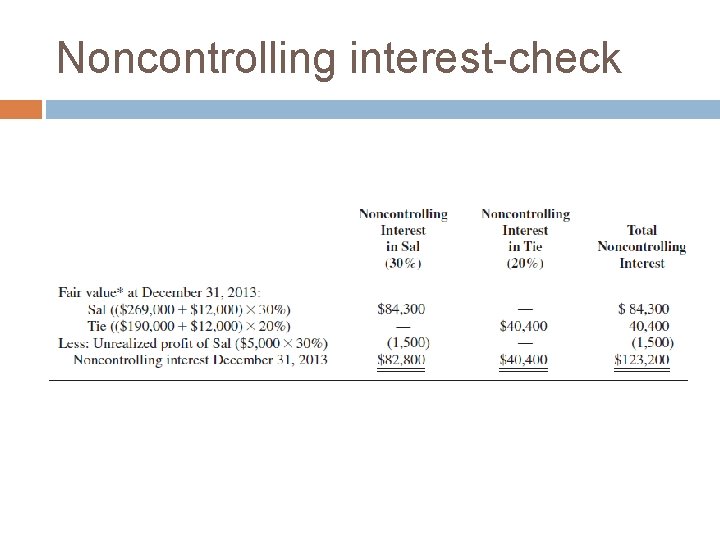
Equity Method of Accounting for Connecting Affiliates During 2013, P , S , and T had earnings from their own operations of $70, 000, $35, 000, and $20, 000 and declared dividends of $40, 000, $20, 000, and $10, 000, respectively. P’s separate earnings of $70, 000 included an unrealized gain of $10, 000 from the sale of land to S during 2013. S’s separate earnings of $35, 000 included unrealized profit of $5, 000 on inventory items sold to P for $15, 000 during 2013 that remained in P’s 12/31, 2013, inventory. A schedule computing controlling interest share and noncontrolling interest share of consolidated net income for the Pet-Sal-Tie affiliation for 2013 is shown in Exhibit 9 -3.
Equity Method of Accounting for Connecting Affiliates
Equity Method of Accounting for Connecting Affiliates
Equity Method of Accounting for Connecting Affiliates
Equity Method of Accounting for Connecting Affiliates
Noncontrolling interest-check
Mutual Holdings
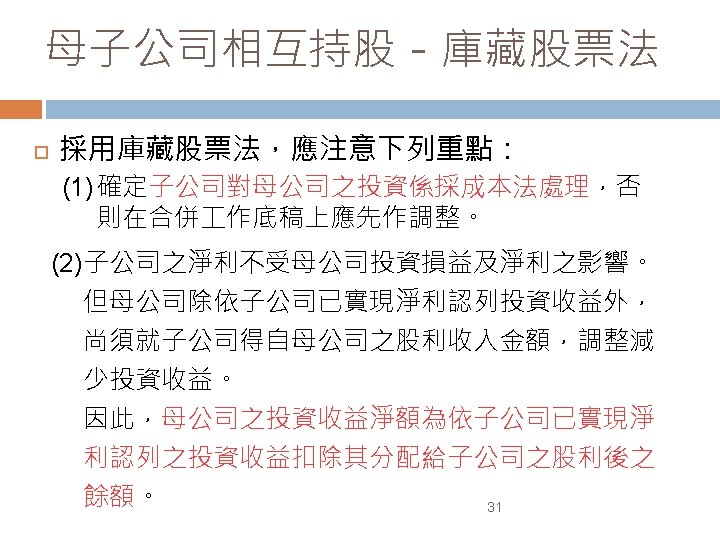
Mutual Holdings—Parent Stock Held By Subsidiary There are two generally accepted methods of accounting for parent stock held by a subsidiary—the treasury stock approach and the conventional approach. The treasury stock approach(庫藏股票法) considers parent stock held by a subsidiary to be treasury stock of the consolidated entity. Accordingly, we maintain the investment account on the books of the subsidiary on a cost basis and deduct it at cost from stockholders’ equity in the consolidated balance sheet. The conventional approach(傳統法) is to account for the subsidiary investment in parent stock on an equity basis and to eliminate the subsidiary investment account against the parent equity accounts in the usual manner. Although both approaches are acceptable, they do not result in equivalent consolidated financial statements. In particular, the consolidated retained earnings and noncontrolling interest amounts usually differ under the two methods.
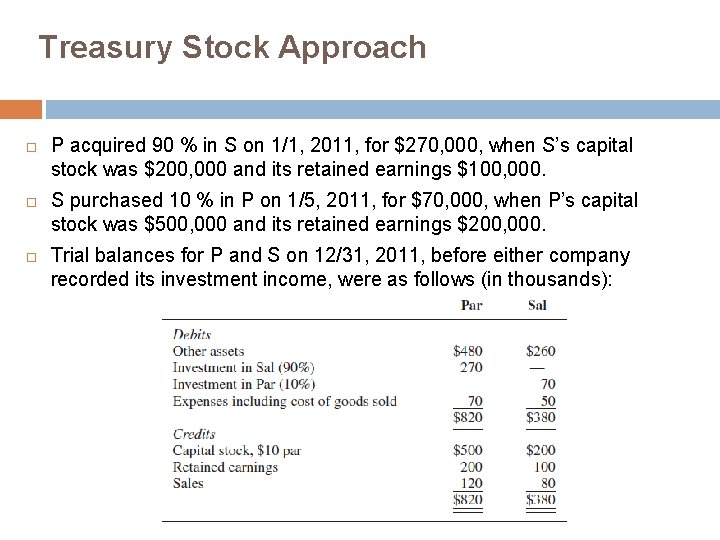
Treasury Stock Approach P acquired 90 % in S on 1/1, 2011, for $270, 000, when S’s capital stock was $200, 000 and its retained earnings $100, 000. S purchased 10 % in P on 1/5, 2011, for $70, 000, when P’s capital stock was $500, 000 and its retained earnings $200, 000. Trial balances for P and S on 12/31, 2011, before either company recorded its investment income, were as follows (in thousands):
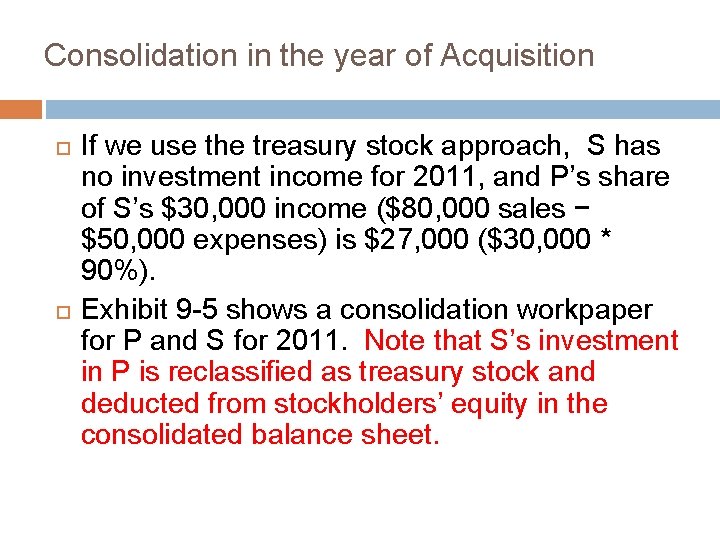
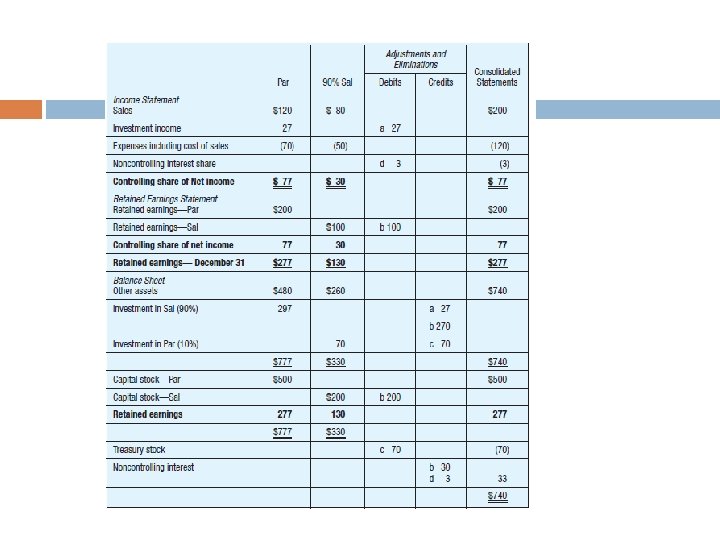
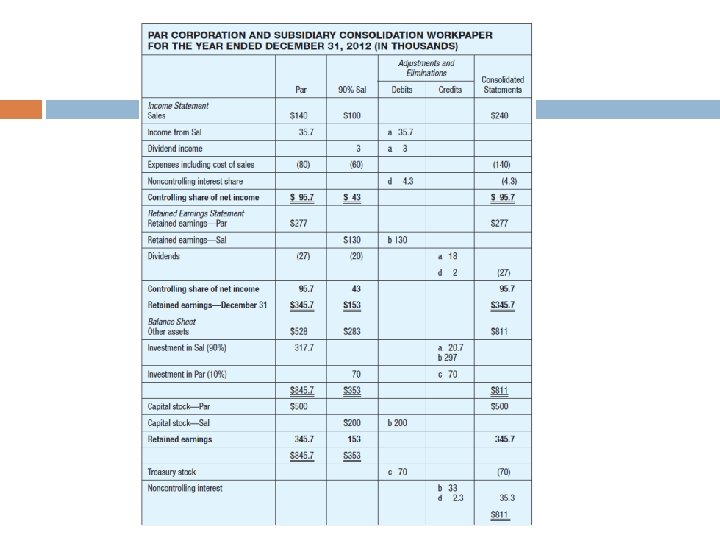
Consolidation in the year of Acquisition If we use the treasury stock approach, S has no investment income for 2011, and P’s share of S’s $30, 000 income ($80, 000 sales − $50, 000 expenses) is $27, 000 ($30, 000 * 90%). Exhibit 9 -5 shows a consolidation workpaper for P and S for 2011. Note that S’s investment in P is reclassified as treasury stock and deducted from stockholders’ equity in the consolidated balance sheet.
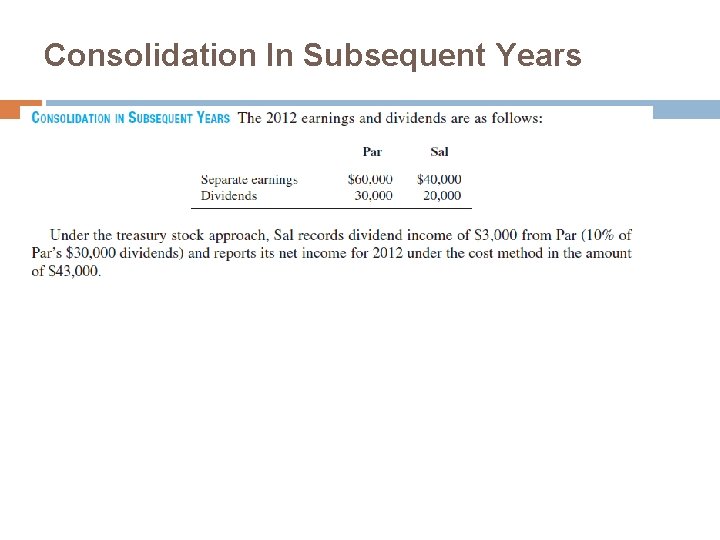
Consolidation In Subsequent Years
The consolidated balance sheets in Exhibits 95 and 9 -6 for the treasury stock approach consolidated 100 % of P’s capital stock and retained earnings and deducted the cost of S’s 10 % investment in P from the consolidated stockholders’ equity.
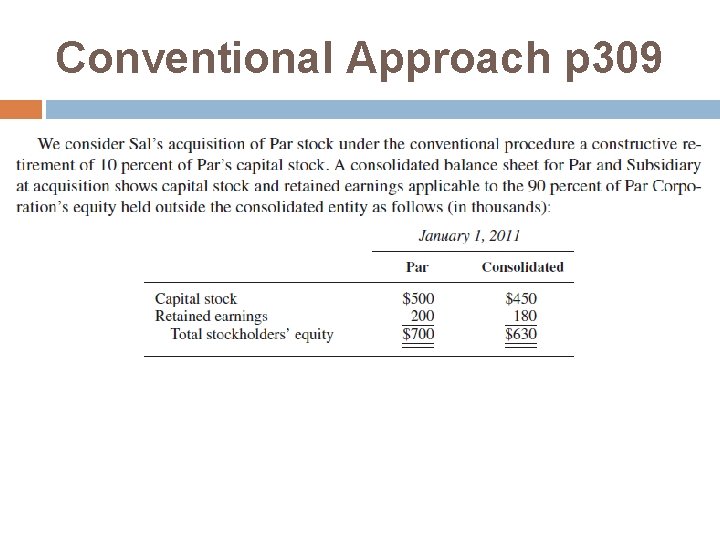
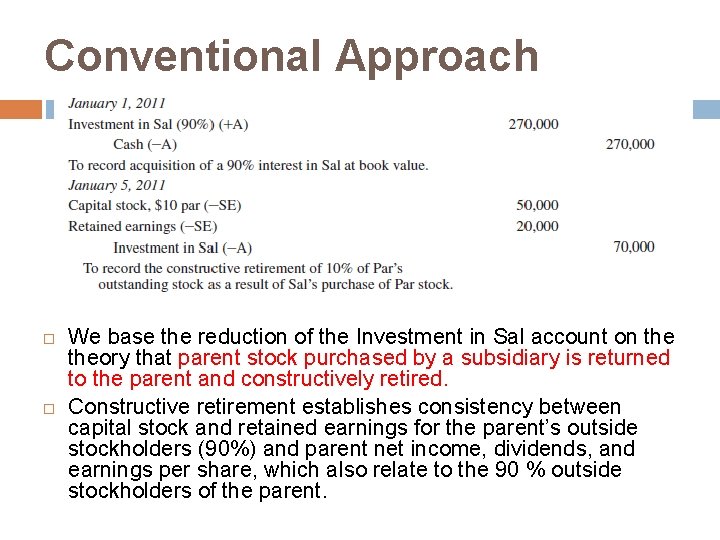
Conventional Approach Under the conventional approach, we consider parent stock held by a subsidiary as constructively retired, and the capital stock and retained earnings applicable to the interest held by the subsidiary do not appear in the consolidated financial statements.
Conventional Approach p 309
Conventional Approach We base the reduction of the Investment in Sal account on theory that parent stock purchased by a subsidiary is returned to the parent and constructively retired. Constructive retirement establishes consistency between capital stock and retained earnings for the parent’s outside stockholders (90%) and parent net income, dividends, and earnings per share, which also relate to the 90 % outside stockholders of the parent.
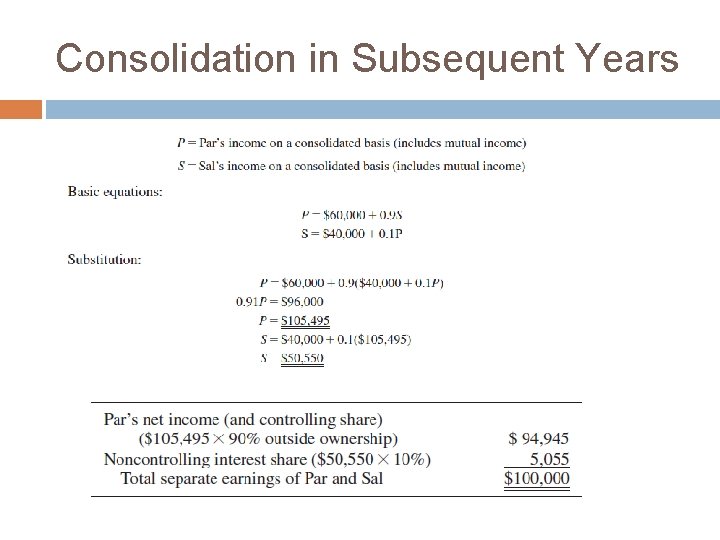
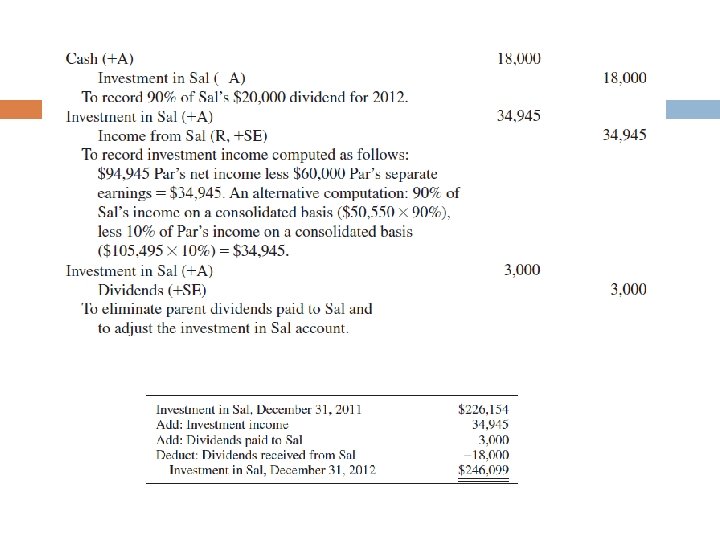
Allocation of Mutual Income When we use the conventional method of accounting for mutually held stock, the income of the parent on an equity basis cannot be determined until the income of the subsidiary has been determined on an equity basis, and vice versa. We accomplish the allocation of income to the affiliates and to outside stockholders in two steps. First, we compute the incomes of P and S on a consolidated basis, which includes the mutual income held by the affiliates. Next, we multiply these amounts by the percentage ownership held within the affiliated group and the noncontrolling interest percentage to determine consolidated net income on an equity basis and noncontrolling interest share.
Allocation of Mutual Income
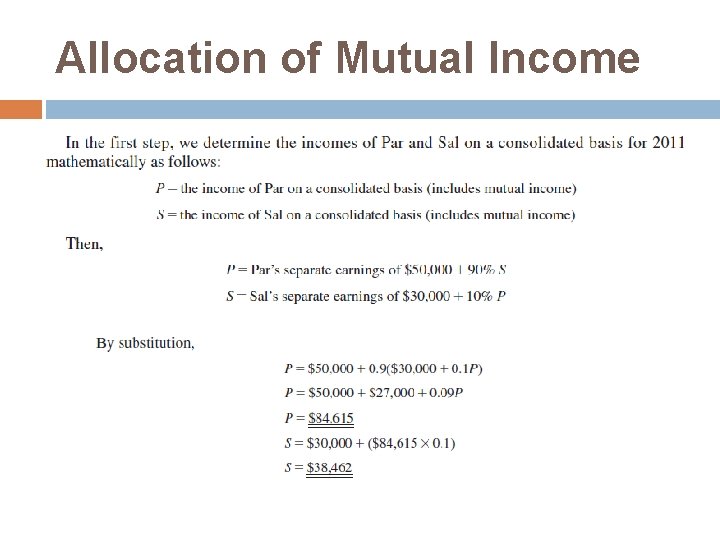
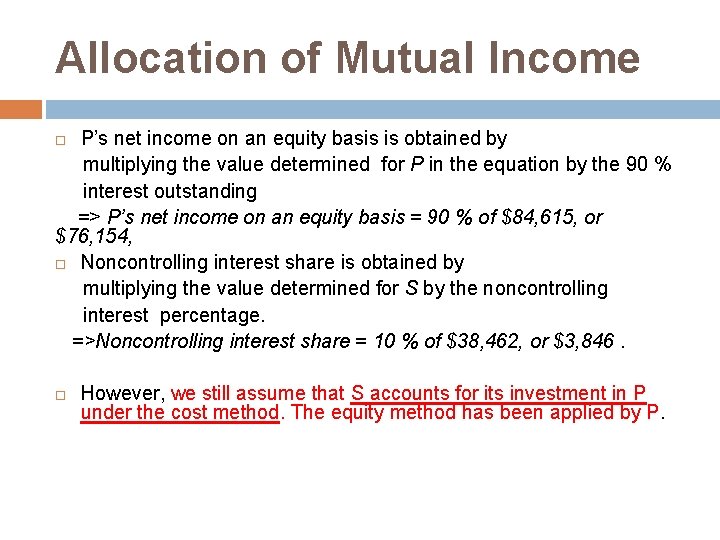
Allocation of Mutual Income P’s net income on an equity basis is obtained by multiplying the value determined for P in the equation by the 90 % interest outstanding => P’s net income on an equity basis = 90 % of $84, 615, or $76, 154, Noncontrolling interest share is obtained by multiplying the value determined for S by the noncontrolling interest percentage. =>Noncontrolling interest share = 10 % of $38, 462, or $3, 846. However, we still assume that S accounts for its investment in P under the cost method. The equity method has been applied by P.
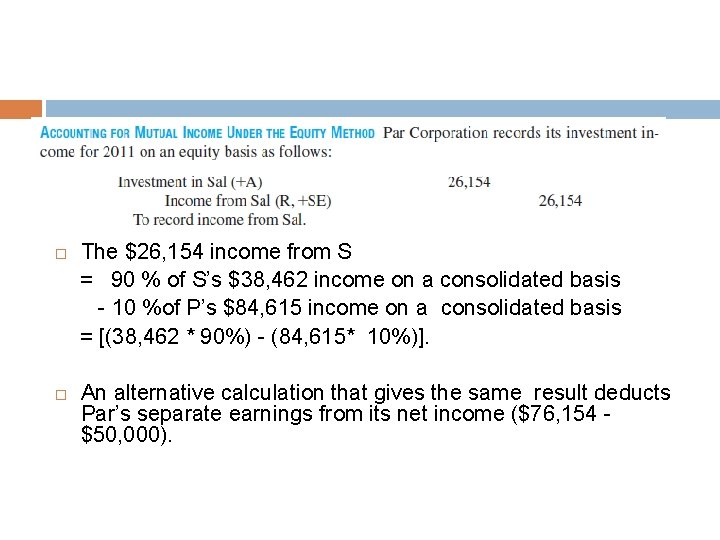
The $26, 154 income from S = 90 % of S’s $38, 462 income on a consolidated basis - 10 %of P’s $84, 615 income on a consolidated basis = [(38, 462 * 90%) - (84, 615* 10%)]. An alternative calculation that gives the same result deducts Par’s separate earnings from its net income ($76, 154 $50, 000).
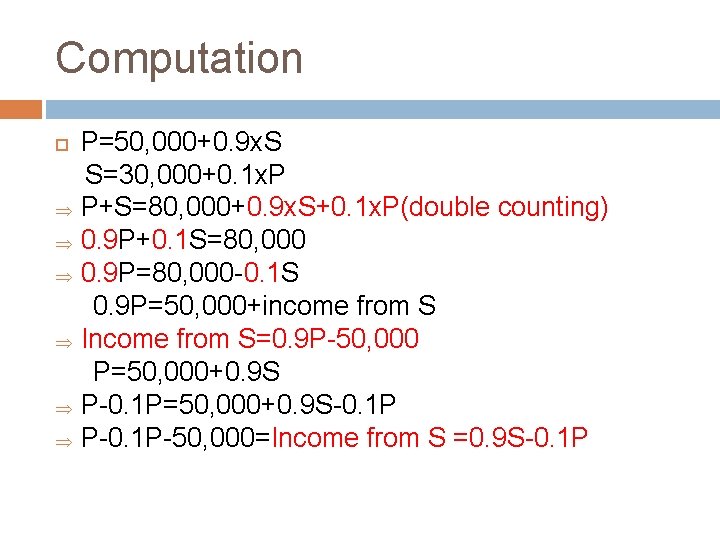
Computation Þ Þ Þ P=50, 000+0. 9 x. S S=30, 000+0. 1 x. P P+S=80, 000+0. 9 x. S+0. 1 x. P(double counting) 0. 9 P+0. 1 S=80, 000 0. 9 P=80, 000 -0. 1 S 0. 9 P=50, 000+income from S Income from S=0. 9 P-50, 000 P=50, 000+0. 9 S P-0. 1 P=50, 000+0. 9 S-0. 1 P P-0. 1 P-50, 000=Income from S =0. 9 S-0. 1 P
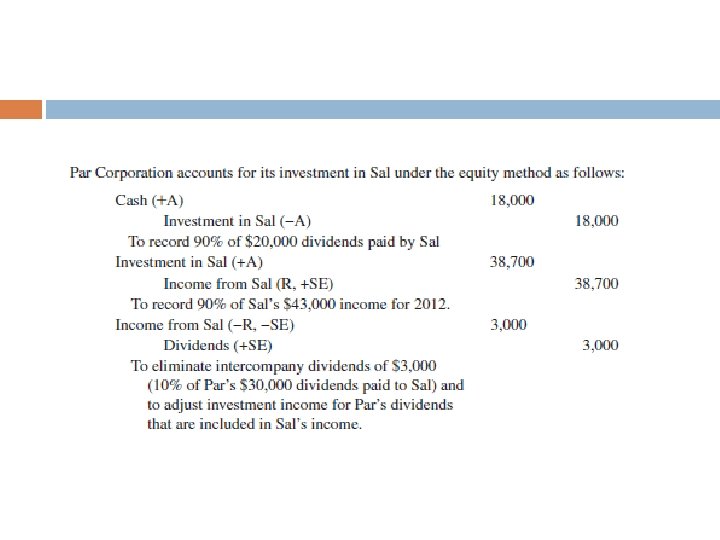
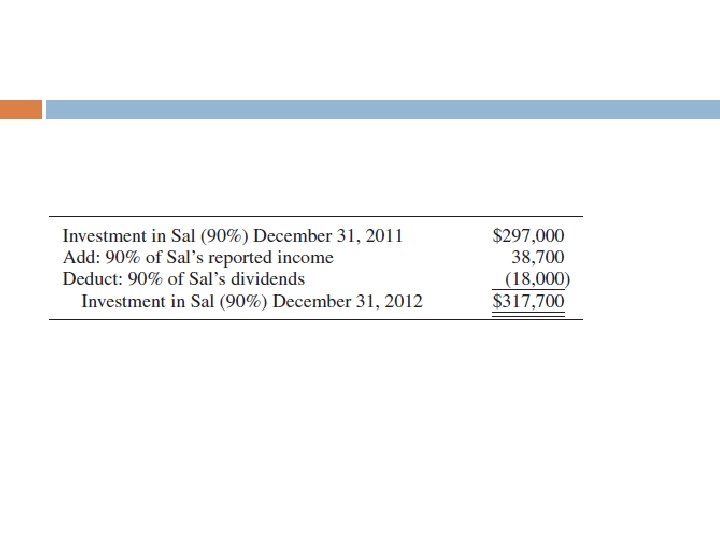
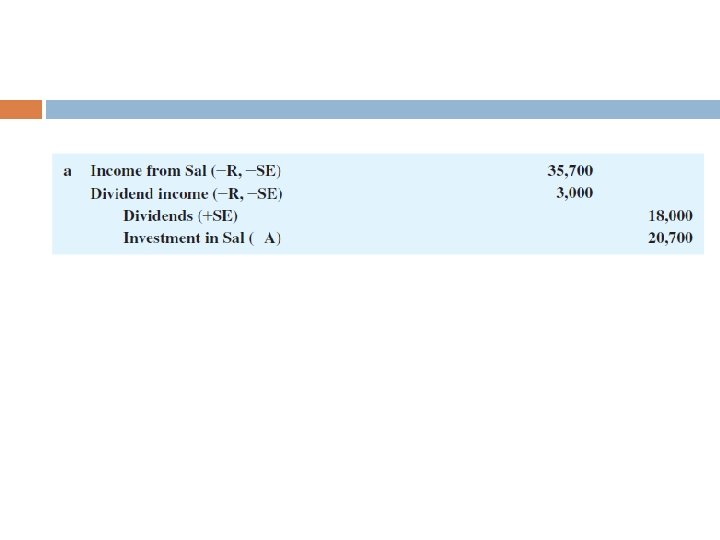
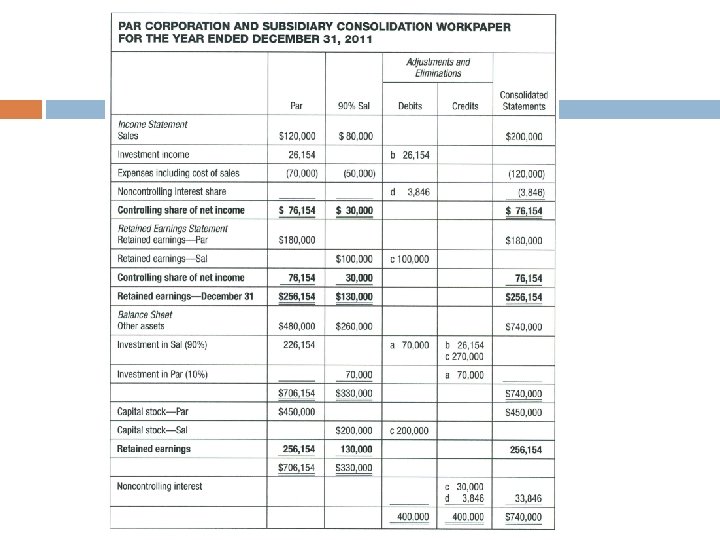
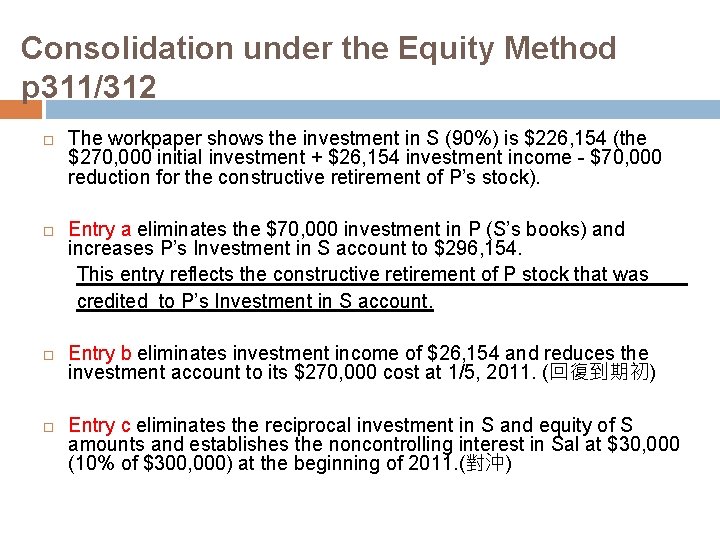
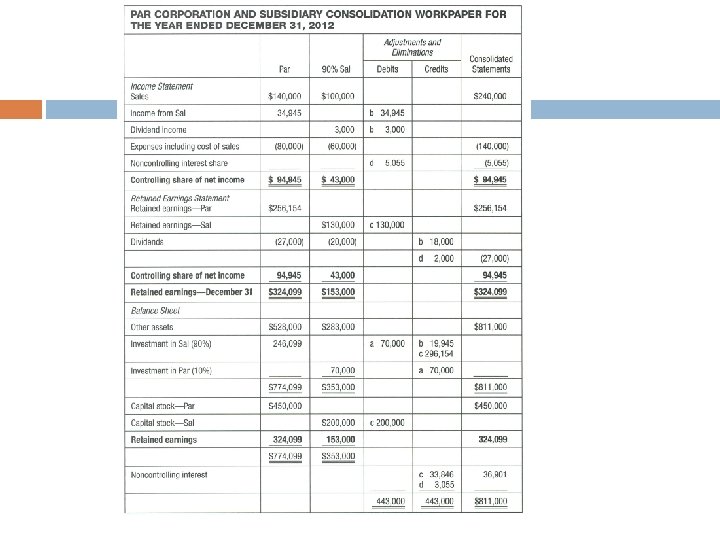
Consolidation under the Equity Method p 311/312 The workpaper shows the investment in S (90%) is $226, 154 (the $270, 000 initial investment + $26, 154 investment income - $70, 000 reduction for the constructive retirement of P’s stock). Entry a eliminates the $70, 000 investment in P (S’s books) and increases P’s Investment in S account to $296, 154. This entry reflects the constructive retirement of P stock that was credited to P’s Investment in S account. Entry b eliminates investment income of $26, 154 and reduces the investment account to its $270, 000 cost at 1/5, 2011. (回復到期初) Entry c eliminates the reciprocal investment in S and equity of S amounts and establishes the noncontrolling interest in Sal at $30, 000 (10% of $300, 000) at the beginning of 2011. (對沖)
Consolidation under the Equity Method p 311/312 Note that net income, capital stock, and retained earnings in the separate statements of P are equal to the controlling share of consolidated net income, consolidated capital stock, and consolidated retained earnings. This equality would not have existed without the entry to record the constructive retirement of stock on P’s books.
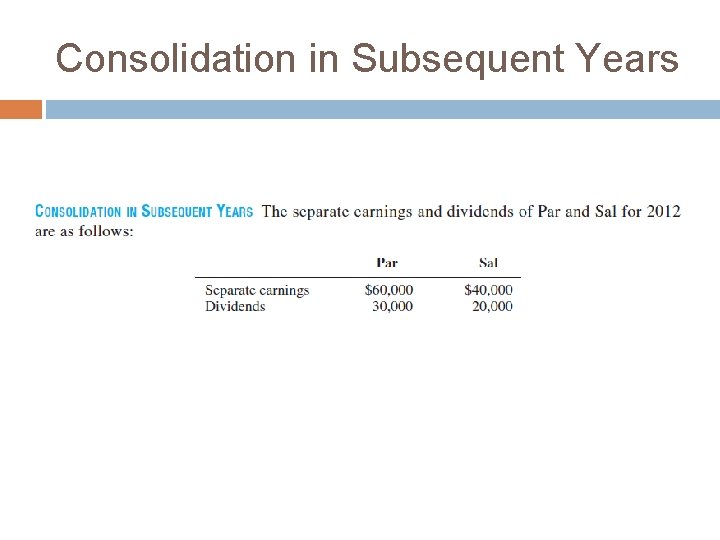
Consolidation in Subsequent Years
Consolidation in Subsequent Years
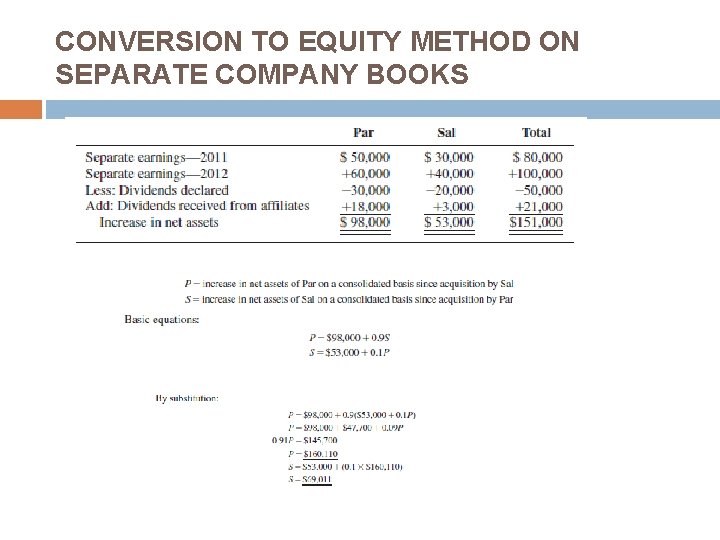
CONVERSION TO EQUITY METHOD ON SEPARATE COMPANY BOOKS
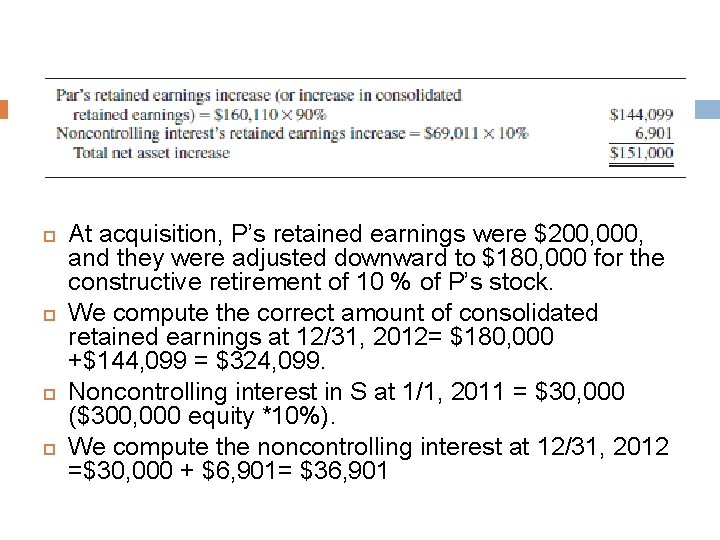
At acquisition, P’s retained earnings were $200, 000, and they were adjusted downward to $180, 000 for the constructive retirement of 10 % of P’s stock. We compute the correct amount of consolidated retained earnings at 12/31, 2012= $180, 000 +$144, 099 = $324, 099. Noncontrolling interest in S at 1/1, 2011 = $30, 000 ($300, 000 equity *10%). We compute the noncontrolling interest at 12/31, 2012 =$30, 000 + $6, 901= $36, 901