
CH 9 EUROPE SECTION 1 GEOGRPAHY PHYSICAL GEOGRAPHY


- Slides: 19
CH. 9 EUROPE SECTION 1: GEOGRPAHY
PHYSICAL GEOGRAPHY • Europe is a “peninsula of peninsulas. ” • A peninsula is a body of land surrounded on three sides by water. • Most of Europe lies within the humid temperate climate region. • The Mediterranean climate brings mild, rainy winters and hot, dry summers and supports long growing seasons. • Iceland, Greenland, and northern Scandinavia have a polar climate and a limited growing season.
COASTLINE • Europe has more than 24, 000 miles of coastline. • The water access has benefited Europe's growth of trade and the development of industry. • The location of the continent near large bodies of water also encouraged exploration. • Over time, towns often grew up near bays, which are bodies of water surrounded on three sides by land.
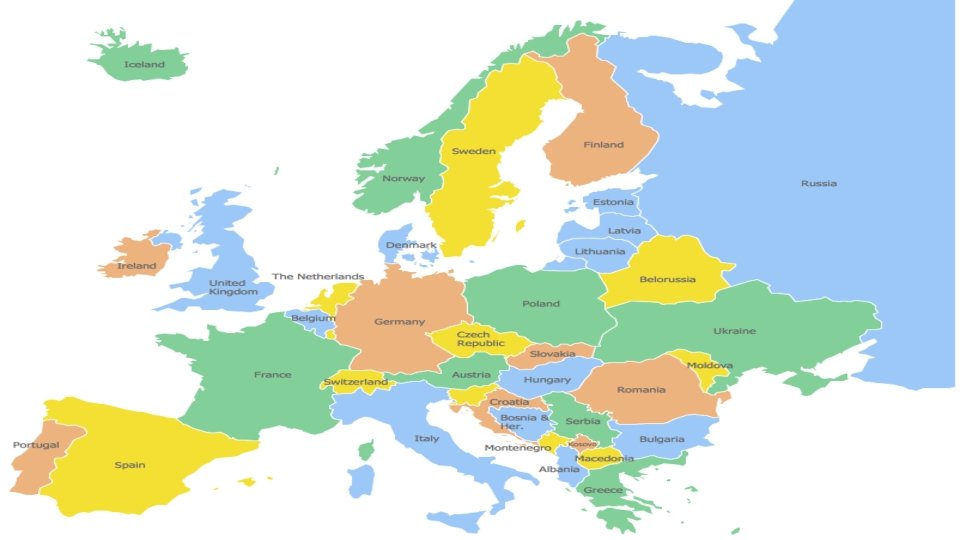
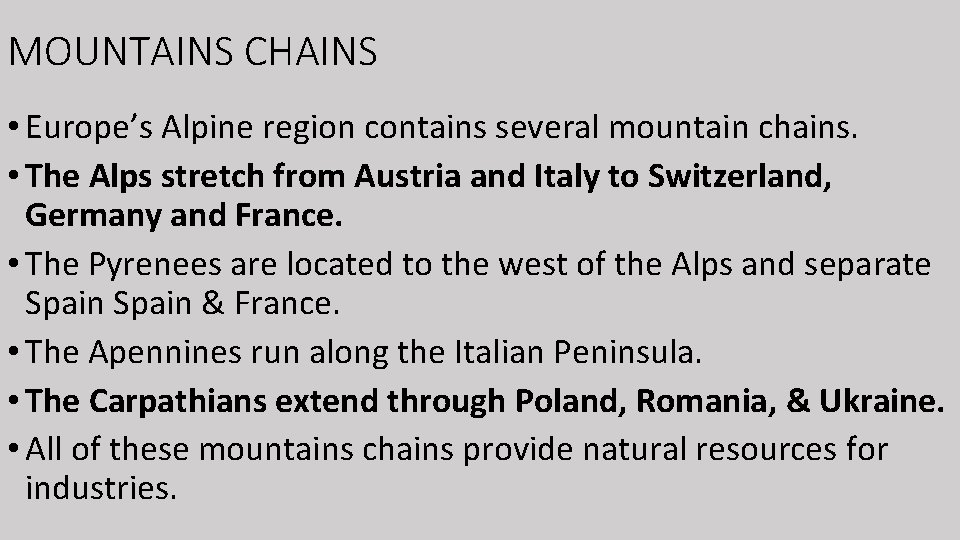
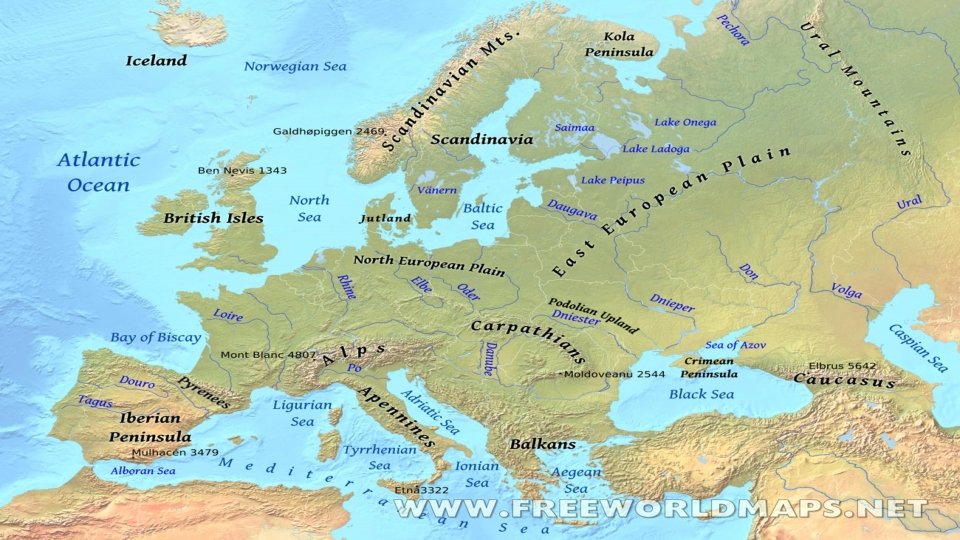
MOUNTAINS CHAINS • Europe’s Alpine region contains several mountain chains. • The Alps stretch from Austria and Italy to Switzerland, Germany and France. • The Pyrenees are located to the west of the Alps and separate Spain & France. • The Apennines run along the Italian Peninsula. • The Carpathians extend through Poland, Romania, & Ukraine. • All of these mountains chains provide natural resources for industries.
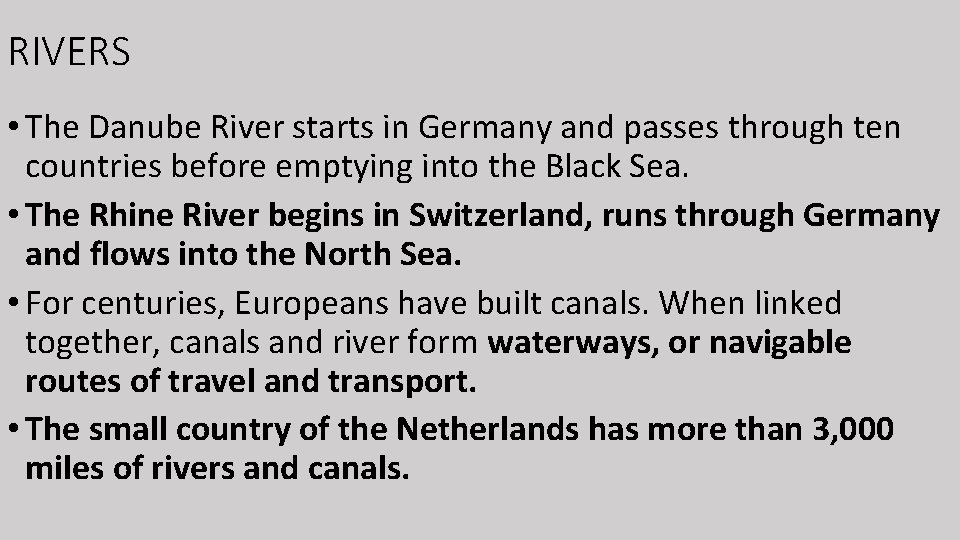
RIVERS • The Danube River starts in Germany and passes through ten countries before emptying into the Black Sea. • The Rhine River begins in Switzerland, runs through Germany and flows into the North Sea. • For centuries, Europeans have built canals. When linked together, canals and river form waterways, or navigable routes of travel and transport. • The small country of the Netherlands has more than 3, 000 miles of rivers and canals.
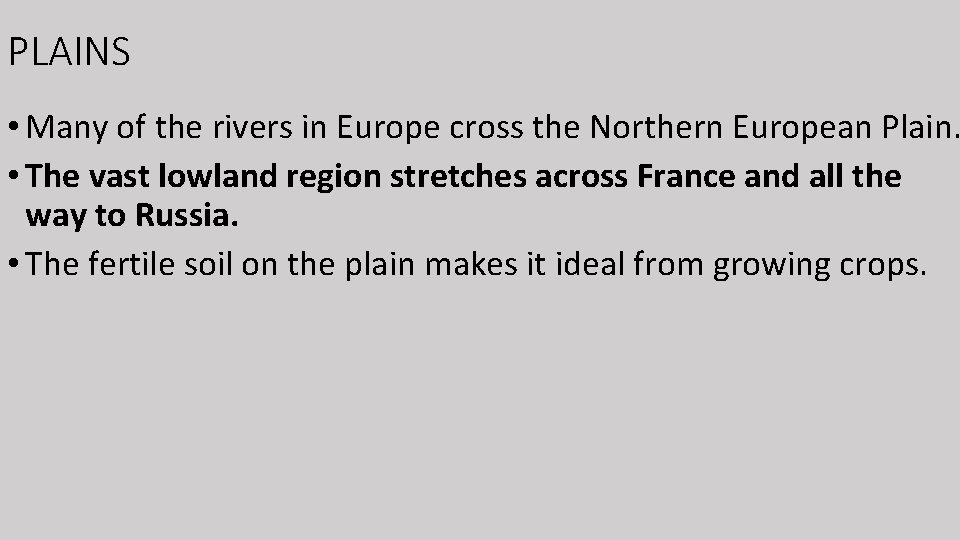
PLAINS • Many of the rivers in Europe cross the Northern European Plain. • The vast lowland region stretches across France and all the way to Russia. • The fertile soil on the plain makes it ideal from growing crops.
• SECTION 3: EMERGING EUROPE
EXPLORATION & COLONIZATION • Prince Henry of Portugal founded navigation school. • Around 1415, sends navigators to Africa to establish new trade routes. • The voyages were filled with danger and lasted months. • An Englishman, Sir Francis Drake, sailed around the world in 1577.
THE INDUSTRIAL REVOLUTION • The Industrial Revolution was a period when industry grew rapidly, and the production of machine made goods greatly increased. • The Industrial Revolution started in Great Britain in the 1700’s. • The textile industry was the first to be transformed, manufactures began using machines. • 1770, James Hargrove created the spinning jenny. • The machine was able to make cotton & wool yarn at a much faster rate.
THE INDUSTRIAL REVOLUTION • Around 1776, James Watt developed the steam engine, which was powered by coal. • Resulted in coal becoming a important raw material. • In the late 1700’s, the Industrial Revolution spread to the rest of Europe. • In 1825, George Stephenson built the first railroad system in England. • By 1850, thousands of miles of tracks crossed Europe.
IMPACT OF THE REVOLUTION • More people moved to cities to work in the factories. • Standard of living rose and so did the middle class. • However, working conditions were harsh. • 16 hour work days & child labor was common. • Many workers lived in overcrowded houses and no sewer systems. • Diseases spread quickly in these cramped buildings.
THE FRENCH REVOLUTION • For years, France’s lower & middle class had suffered injustices. • French society was made up of Three Estates: -First Estate was made up of clergy - Second Estate was made up of the nobility. - Third Estate included everyone else. • The Third Estate began to call for change, influenced by the Enlightenment. • On July 14, 1789, mobs attacked the Bastille, France’s ancient prison. Starting the revolution.
THE FRENCH REVOLUTION • The Third Estate formed the National Assembly. • On August 26, 1789, they issued the Declaration of the Rights of Man and of the Citizen. • This document guaranteed liberty, equality, and property to citizens. • Finally, in 1792, the Jacobins, a groups of radical, seized power and formed the National Convention, executing the King & Queen. • The leader, Maximillian Robespierre, led a Reign of Terror. Using the guillotine to cut off heads of an estimated 40, 000 people. • After years of violence, Napoleon Bonaparte overthrew the government.
NATIONALISM & WW 1 • Nationalism is a strong sense of loyalty to one’s country. • Nationalism led to the unification of Italy & Germany. • Britain, France, & Russia formed the Triple Entente. • The German Empire and Austria-Hungary formed the Central Powers. • In 1914, Archduke Franz Ferdinand of Austria-Hungary was assassinated in Serbia by a terrorist of the Black Hand. • Austria-Hungary declared war on Serbia, b/c Serbia was an ally of Russia, Russia declared war on Austria-Hungary.
NATIONALISM & WW 1 • The Great War, dragged on for 4 years. • Both sides fought from trenches and used deadly technology, including machine guns, airplanes, tanks, and poison gas. • In 1917, Russia’s government was overthrown and made peace with Germany. • The same year, the U. S. joined the war on the side of the Triple Entente. • In 1918, Germany surrendered but 17 million people had died. • In 1919, Germany signed the Treaty of Versailles.
WW 2 & THE COLD WAR • Due to the harsh demands of the Treaty of Versailles and the Great Depression damaged the German economy. • During the 1930’s, Adolf Hitler rose to power in Germany. • In 1936, Hitler made alliance with Italy & Japan forming the Axis Powers. • In 1936, Germany invaded Poland starting WW 2. • Great Britain & France were Poland’s allies. • Germany quickly conquered most of Europe, including France. • In 1941, Japan attacked the U. S. at Pearl Harbor, forcing them into the war.
WW 2 & THE COLD WAR • After 5 years of war, Germany surrendered on May 8, 1945. • Allied troops were stunned to fined the Nazi concentration camps where 6 million Jewish people had been murdered. This was called the Holocaust. • Japan continued to fight until the U. S. dropped atomic bombs on Hiroshima & Nagasaki. • After the war, an imaginary boundary that separated Eastern & Western Europe was called the Iron Curtain between the U. S. & Soviet Union. • The division marked the beginning of the Cold War, a period of great tension between the two countries.