
Ch 9 Chemical Reactions n Identifying a Chemical
- Slides: 15
Ch. 9 Chemical Reactions n Identifying a Chemical Change n Describing Chemical Change n Types of Chemical Reactions n Reactions in Aqueous Solution
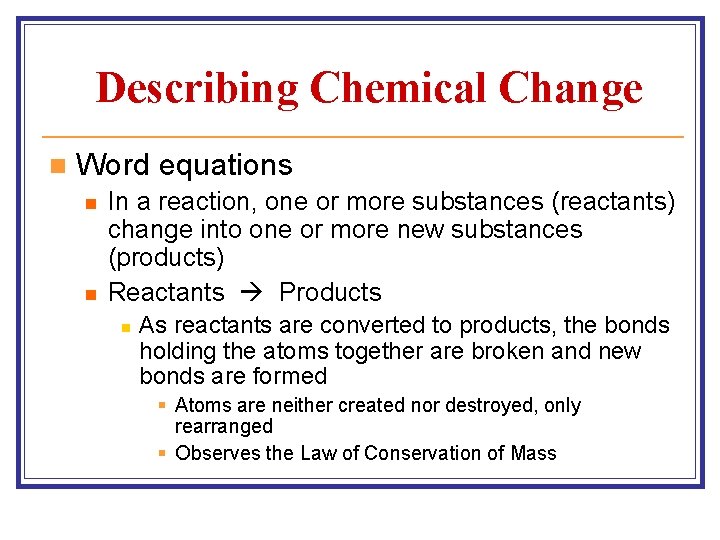
Describing Chemical Change n Word equations n n In a reaction, one or more substances (reactants) change into one or more new substances (products) Reactants Products n As reactants are converted to products, the bonds holding the atoms together are broken and new bonds are formed § Atoms are neither created nor destroyed, only rearranged § Observes the Law of Conservation of Mass
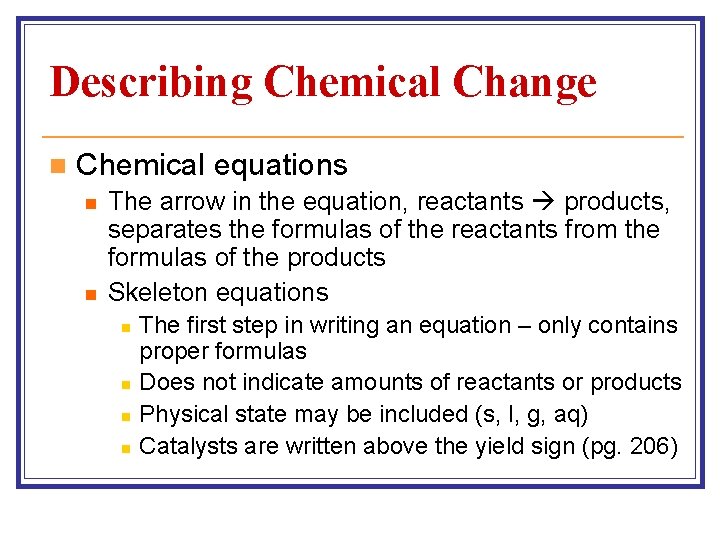
Describing Chemical Change n Chemical equations n n The arrow in the equation, reactants products, separates the formulas of the reactants from the formulas of the products Skeleton equations n n The first step in writing an equation – only contains proper formulas Does not indicate amounts of reactants or products Physical state may be included (s, l, g, aq) Catalysts are written above the yield sign (pg. 206)
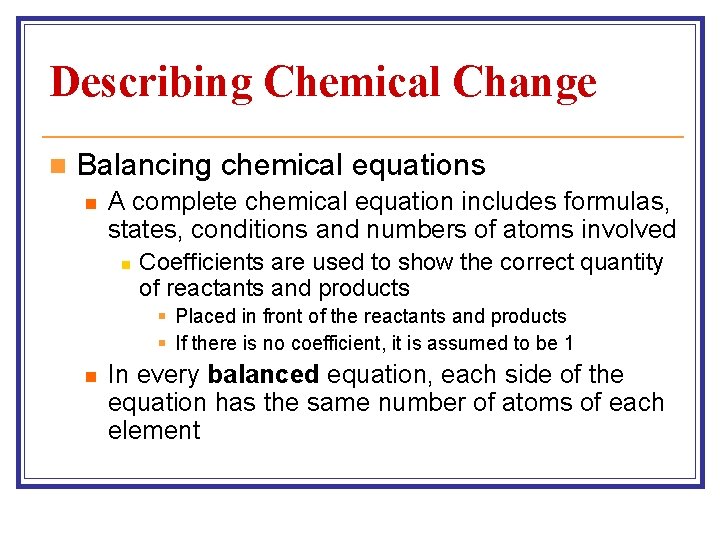
Describing Chemical Change n Balancing chemical equations n A complete chemical equation includes formulas, states, conditions and numbers of atoms involved n Coefficients are used to show the correct quantity of reactants and products § Placed in front of the reactants and products § If there is no coefficient, it is assumed to be 1 n In every balanced equation, each side of the equation has the same number of atoms of each element
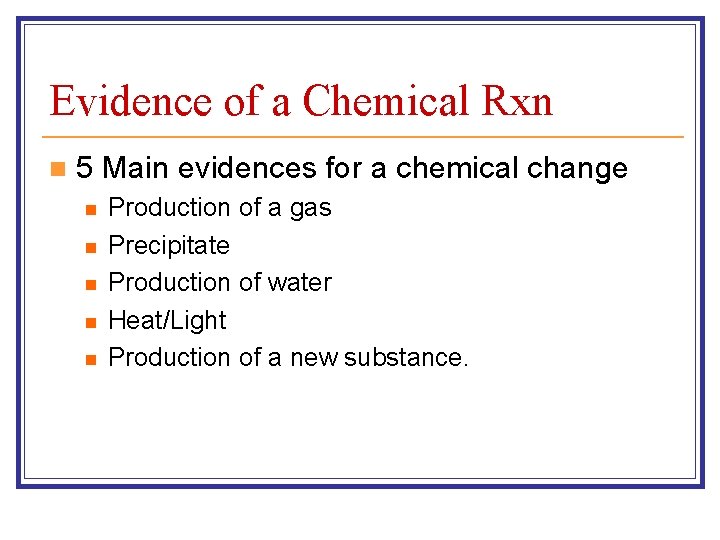
Evidence of a Chemical Rxn n 5 Main evidences for a chemical change n n n Production of a gas Precipitate Production of water Heat/Light Production of a new substance.
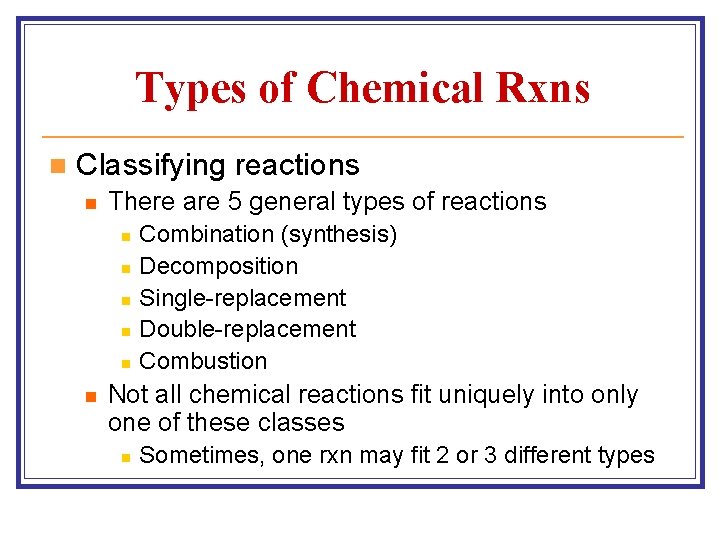
Types of Chemical Rxns n Classifying reactions n There are 5 general types of reactions n n n Combination (synthesis) Decomposition Single-replacement Double-replacement Combustion Not all chemical reactions fit uniquely into only one of these classes n Sometimes, one rxn may fit 2 or 3 different types
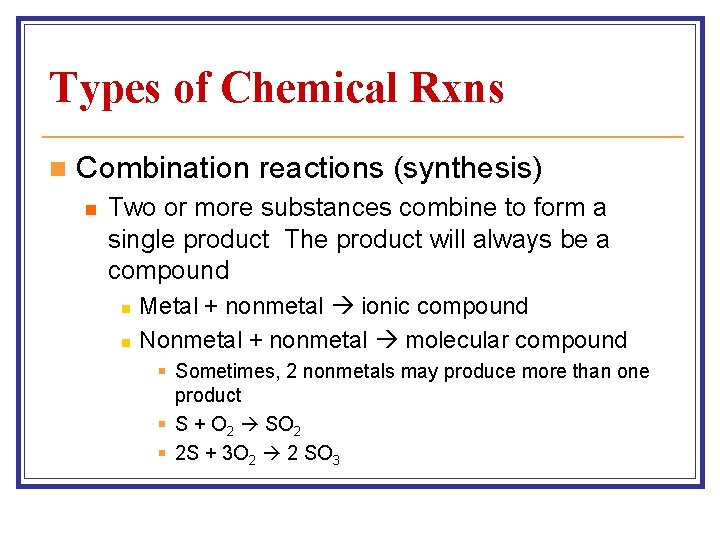
Types of Chemical Rxns n Combination reactions (synthesis) n Two or more substances combine to form a single product The product will always be a compound n n Metal + nonmetal ionic compound Nonmetal + nonmetal molecular compound § Sometimes, 2 nonmetals may produce more than one product § S + O 2 SO 2 § 2 S + 3 O 2 2 SO 3
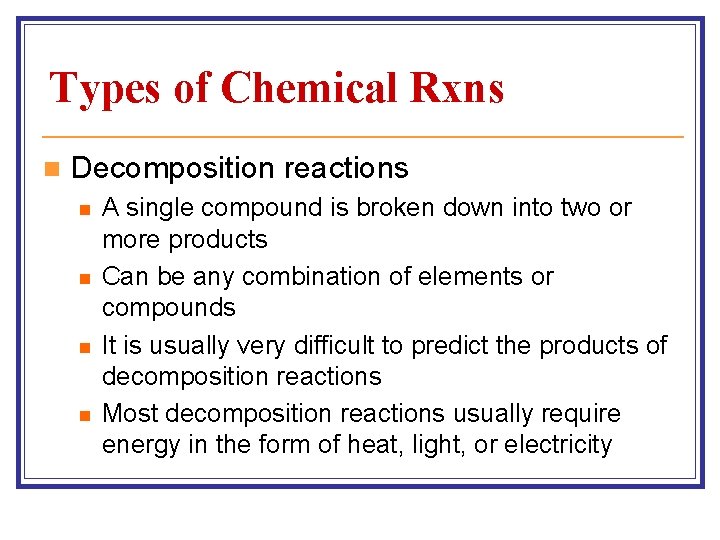
Types of Chemical Rxns n Decomposition reactions n n A single compound is broken down into two or more products Can be any combination of elements or compounds It is usually very difficult to predict the products of decomposition reactions Most decomposition reactions usually require energy in the form of heat, light, or electricity
Types of Chemical Rxns n Single-replacement reactions n n n One element replaces a second element in a compound Also known as single-displacement reactions Whether one metal will replace another can be determined by the chemical reactivities of the two metals n The activity series lists the order of decreasing reactivity § A metal can replace any metal listed below it on the series
Types of Chemical Rxns n Single-replacement reactions n A nonmetal can also replace another nonmetal in a compound n n This replacement is usually limited to halogens The activity of halogens decreases as you move down the group § Fluorine can replace any of the halogens, chlorine can replace any halogen beneath it, etc.
Types of Chemical Rxns n Double-replacement reactions n Involve an exchange of positive ions between two reacting compounds n Generally take place between two ionic compounds in aqueous solution n Often characterized by the formation of a precipitate
Ch. 8. 2 Types of Chemical Rxns n Combustion reactions n n An element or compound reacts with oxygen, often producing energy in form of heat and light These reactions commonly involve hydrocarbons, compounds of H and C n n n The complete combustion of a hydrocarbon produces CO 2 and H 2 O (elemental O and toxic CO may be by-products) If the supply of O 2 is insufficient during the rxn, combustion will be incomplete A large amount of heat is usually released
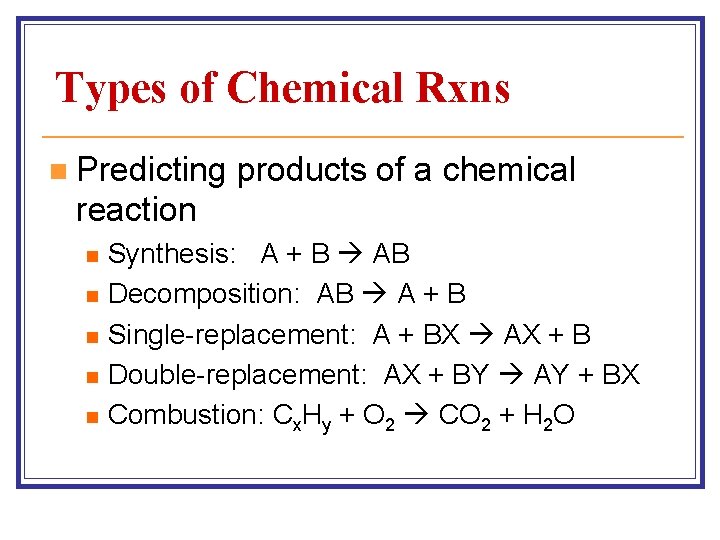
Types of Chemical Rxns n Predicting products of a chemical reaction n n Synthesis: A + B AB Decomposition: AB A + B Single-replacement: A + BX AX + B Double-replacement: AX + BY AY + BX Combustion: Cx. Hy + O 2 CO 2 + H 2 O
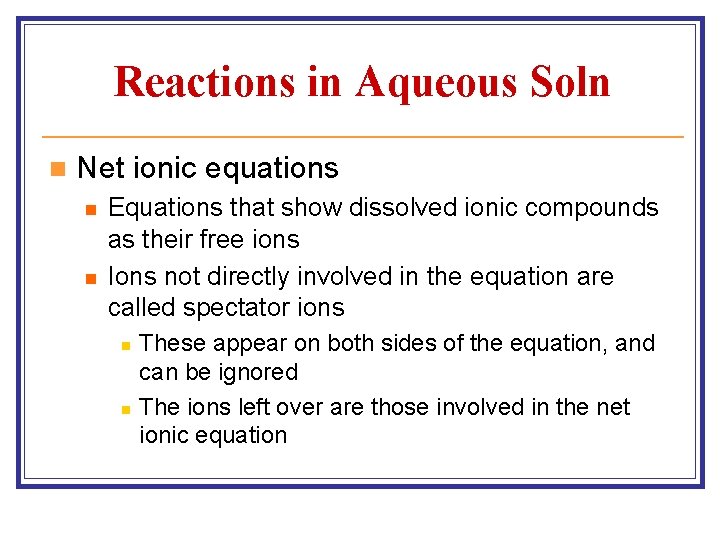
Reactions in Aqueous Soln n Net ionic equations n n Equations that show dissolved ionic compounds as their free ions Ions not directly involved in the equation are called spectator ions n n These appear on both sides of the equation, and can be ignored The ions left over are those involved in the net ionic equation
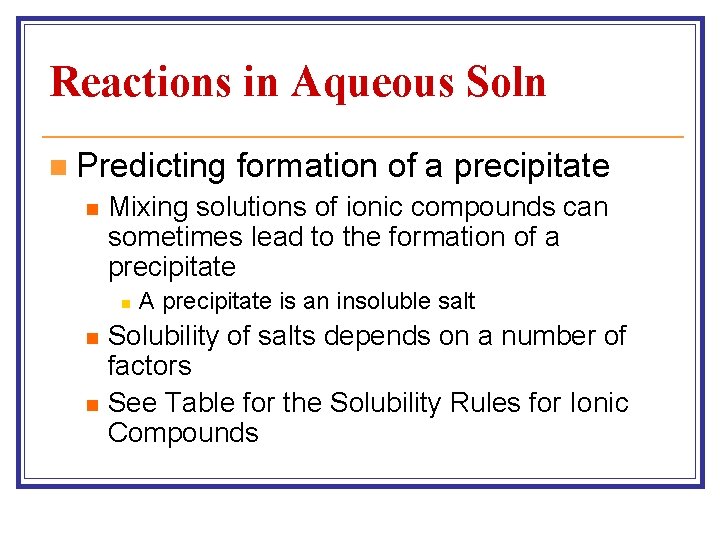
Reactions in Aqueous Soln n Predicting n Mixing solutions of ionic compounds can sometimes lead to the formation of a precipitate n n n formation of a precipitate A precipitate is an insoluble salt Solubility of salts depends on a number of factors See Table for the Solubility Rules for Ionic Compounds