
Ch 8 The Cellular Basis of Reproduction and
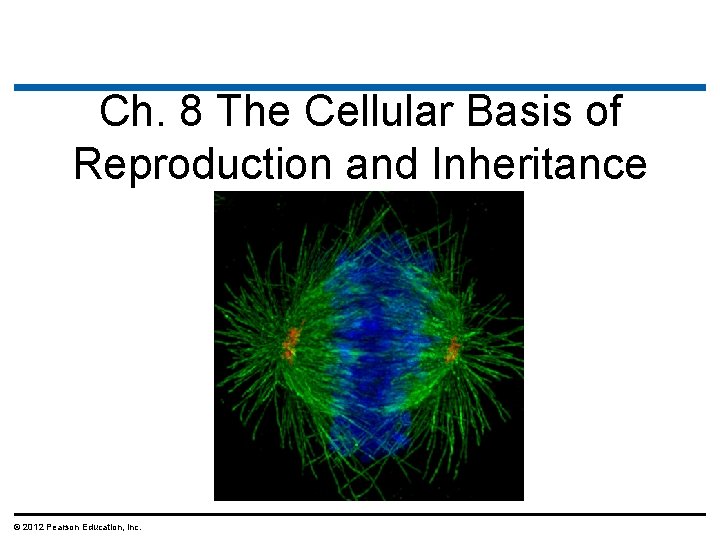
Ch. 8 The Cellular Basis of Reproduction and Inheritance © 2012 Pearson Education, Inc.
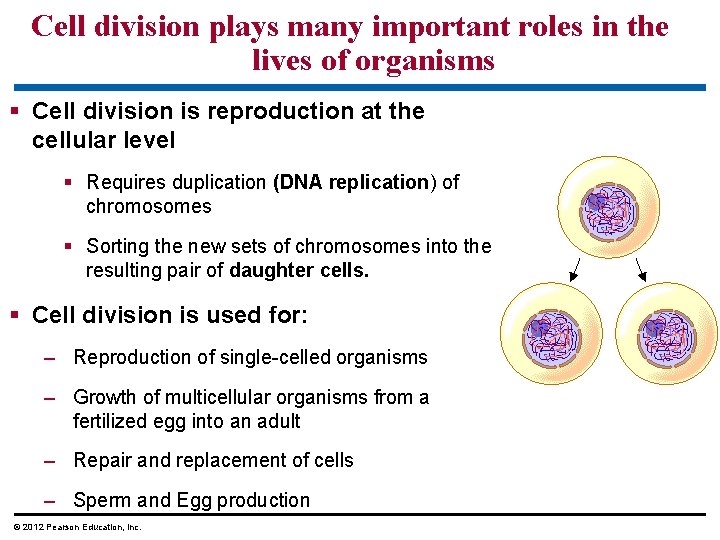
Cell division plays many important roles in the lives of organisms § Cell division is reproduction at the cellular level § Requires duplication (DNA replication) of chromosomes § Sorting the new sets of chromosomes into the resulting pair of daughter cells. § Cell division is used for: – Reproduction of single-celled organisms – Growth of multicellular organisms from a fertilized egg into an adult – Repair and replacement of cells – Sperm and Egg production © 2012 Pearson Education, Inc.

Prokaryotes reproduce by binary fission § Prokaryotes reproduce by binary fission or “dividing in half” § Binary Fission Occurs in Three Steps: 1. Duplication of the chromosome and separation of the copies 2. Elongation of the cell and movement of the copies 3. Continued elongation and division into two daughter cells. § The chromosome of a prokaryote is: § A single circular DNA molecule & associated proteins § Much smaller than eukaryotic DNA © 2012 Pearson Education, Inc.
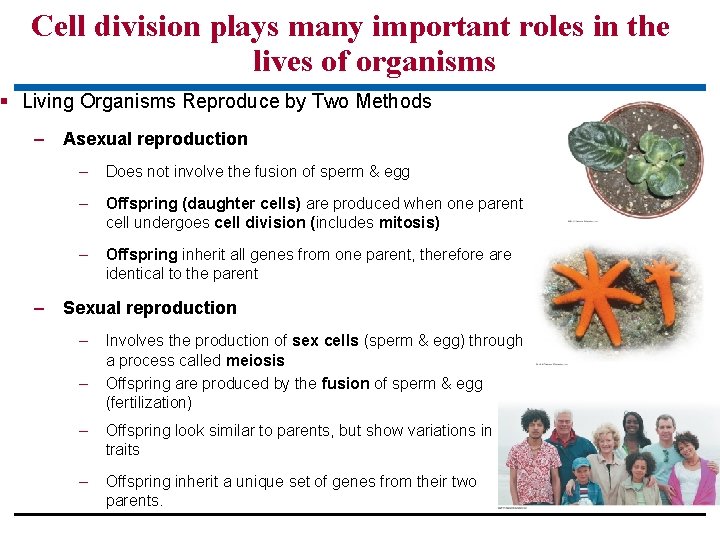
Cell division plays many important roles in the lives of organisms § Living Organisms Reproduce by Two Methods – – Asexual reproduction – Does not involve the fusion of sperm & egg – Offspring (daughter cells) are produced when one parent cell undergoes cell division (includes mitosis) – Offspring inherit all genes from one parent, therefore are identical to the parent Sexual reproduction – – Involves the production of sex cells (sperm & egg) through a process called meiosis Offspring are produced by the fusion of sperm & egg (fertilization) – Offspring look similar to parents, but show variations in traits – Offspring inherit a unique set of genes from their two parents.
THE EUKARYOTIC CELL CYCLE AND MITOSIS © 2012 Pearson Education, Inc.
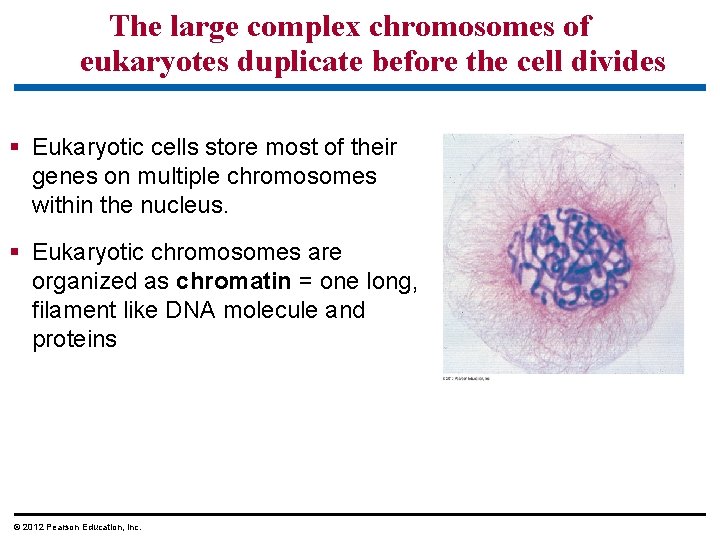
The large complex chromosomes of eukaryotes duplicate before the cell divides § Eukaryotic cells store most of their genes on multiple chromosomes within the nucleus. § Eukaryotic chromosomes are organized as chromatin = one long, filament like DNA molecule and proteins © 2012 Pearson Education, Inc.
The large complex chromosomes of eukaryotes duplicate before the cell divides § Before a eukaryotic cell divides, it duplicates all of its chromosomes, resulting in two copies called sister chromatids joined by a centromere. § When a cell divides, sister chromatids separate from each other, (now called chromosomes) and sort into separate daughter cells. © 2012 Pearson Education, Inc.
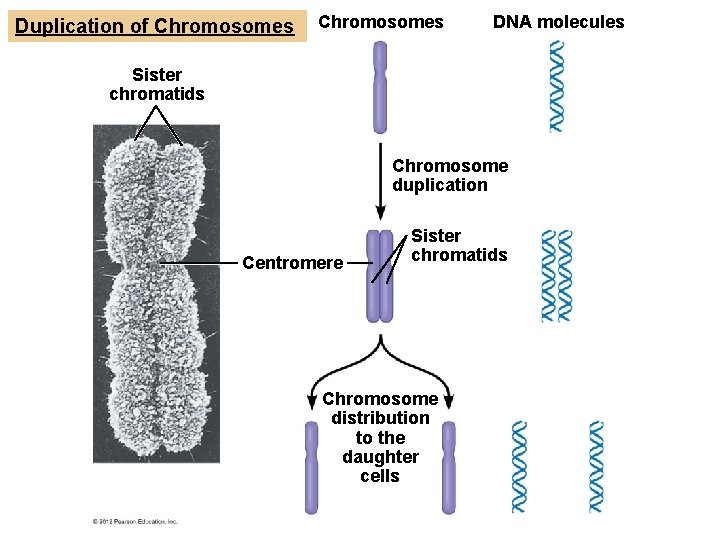
Duplication of Chromosomes DNA molecules Sister chromatids Chromosome duplication Centromere Sister chromatids Chromosome distribution to the daughter cells
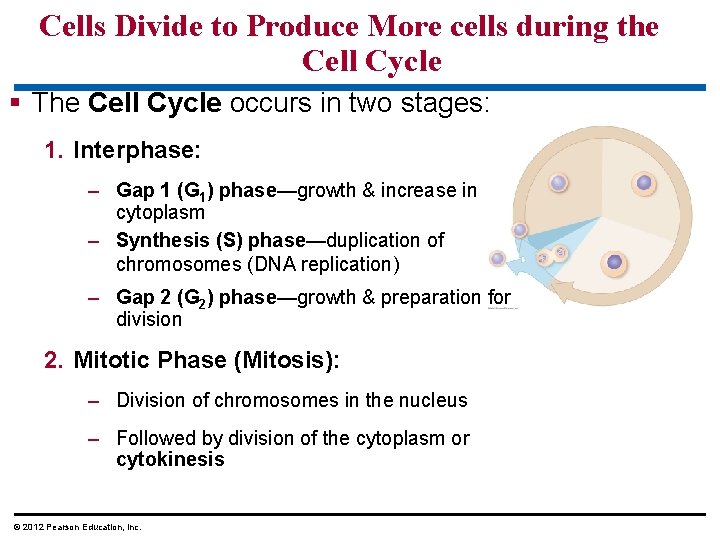
Cells Divide to Produce More cells during the Cell Cycle § The Cell Cycle occurs in two stages: 1. Interphase: – Gap 1 (G 1) phase—growth & increase in cytoplasm – Synthesis (S) phase—duplication of chromosomes (DNA replication) – Gap 2 (G 2) phase—growth & preparation for division 2. Mitotic Phase (Mitosis): – Division of chromosomes in the nucleus – Followed by division of the cytoplasm or cytokinesis © 2012 Pearson Education, Inc.
Cell division is a Continuum of Dynamic Changes § Mitosis progresses through a series of stages in the following order: – Prophase/Prometaphase – Metaphase – Anaphase – Telophase – Cytokinesis © 2012 Pearson Education, Inc.
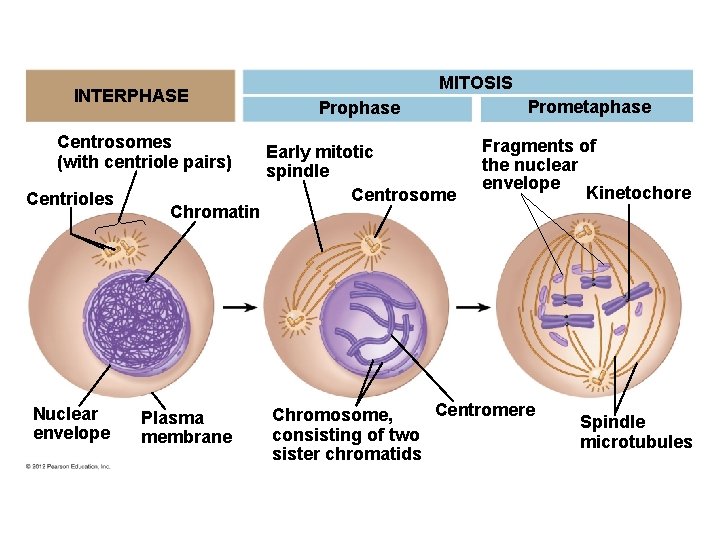
INTERPHASE Centrosomes (with centriole pairs) Centrioles Nuclear envelope Chromatin Plasma membrane MITOSIS Prophase Prometaphase Early mitotic spindle Centrosome Fragments of the nuclear envelope Kinetochore Centromere Chromosome, consisting of two sister chromatids Spindle microtubules
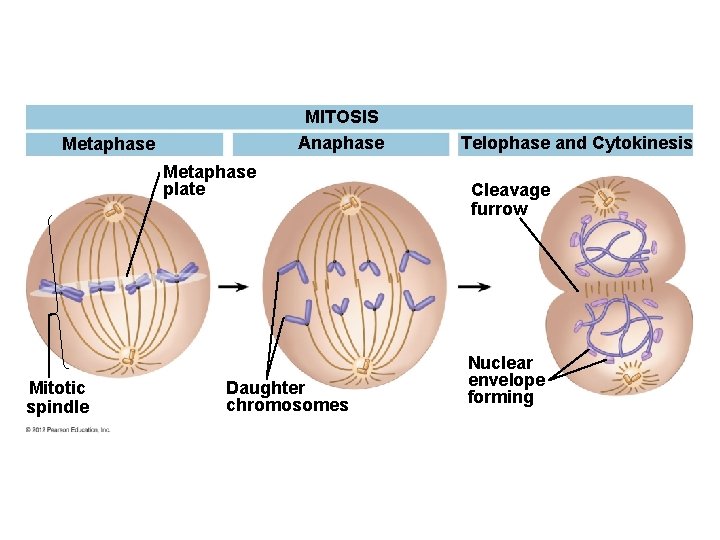
MITOSIS Anaphase Metaphase plate Mitotic spindle Daughter chromosomes Telophase and Cytokinesis Cleavage furrow Nuclear envelope forming
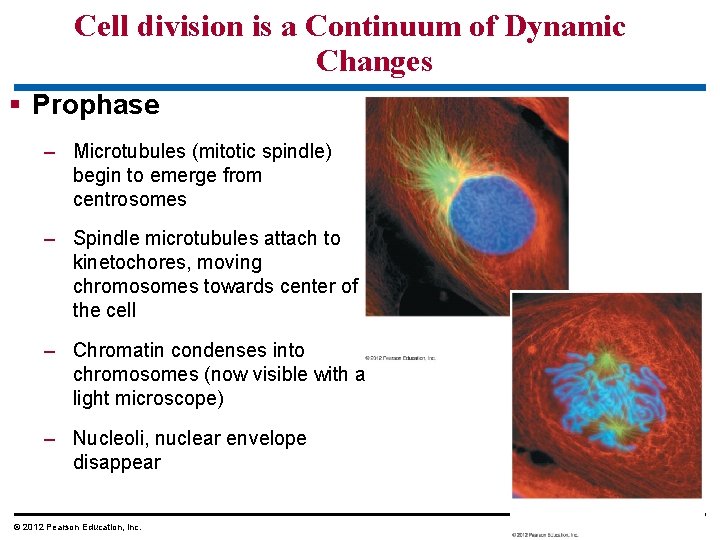
Cell division is a Continuum of Dynamic Changes § Prophase – Microtubules (mitotic spindle) begin to emerge from centrosomes – Spindle microtubules attach to kinetochores, moving chromosomes towards center of the cell – Chromatin condenses into chromosomes (now visible with a light microscope) – Nucleoli, nuclear envelope disappear © 2012 Pearson Education, Inc.
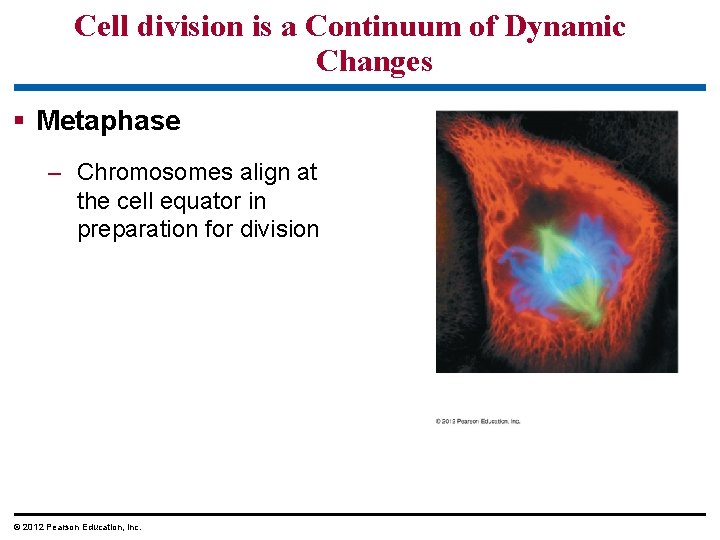
Cell division is a Continuum of Dynamic Changes § Metaphase – Chromosomes align at the cell equator in preparation for division © 2012 Pearson Education, Inc.
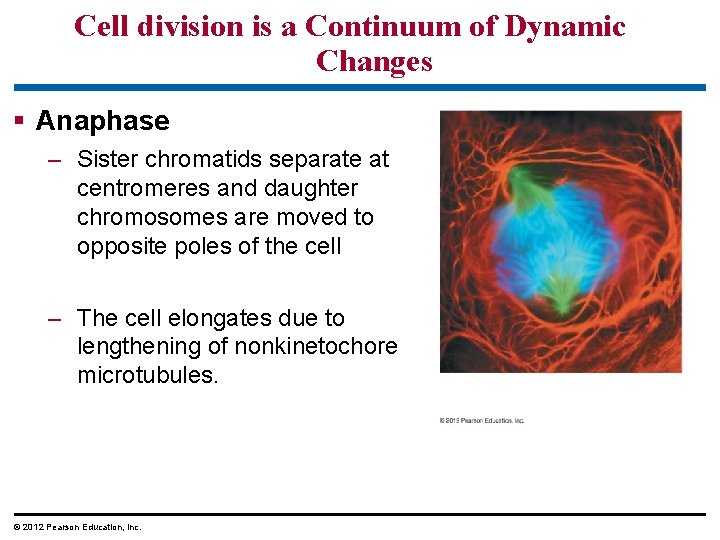
Cell division is a Continuum of Dynamic Changes § Anaphase – Sister chromatids separate at centromeres and daughter chromosomes are moved to opposite poles of the cell – The cell elongates due to lengthening of nonkinetochore microtubules. © 2012 Pearson Education, Inc.
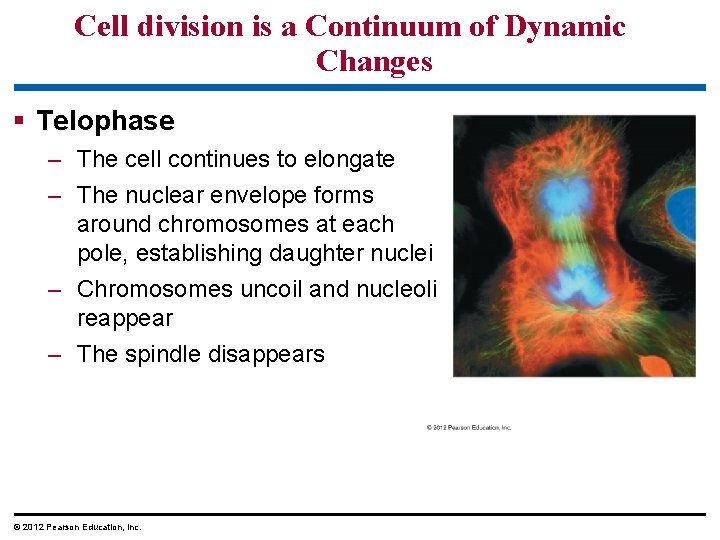
Cell division is a Continuum of Dynamic Changes § Telophase – The cell continues to elongate – The nuclear envelope forms around chromosomes at each pole, establishing daughter nuclei – Chromosomes uncoil and nucleoli reappear – The spindle disappears © 2012 Pearson Education, Inc.
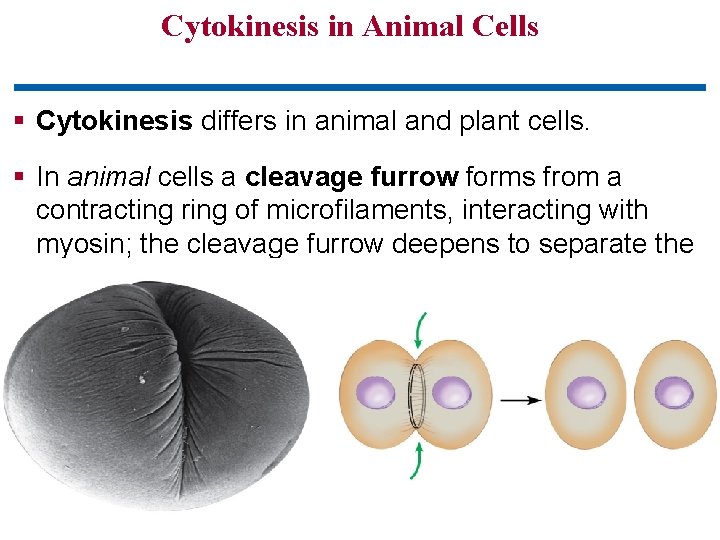
Cytokinesis in Animal Cells § Cytokinesis differs in animal and plant cells. § In animal cells a cleavage furrow forms from a contracting ring of microfilaments, interacting with myosin; the cleavage furrow deepens to separate the contents into two cells. © 2012 Pearson Education, Inc.
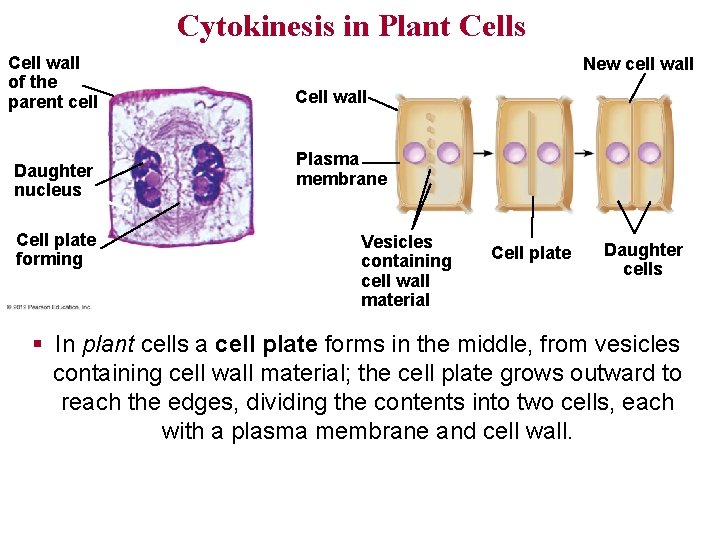
Cytokinesis in Plant Cells Cell wall of the parent cell Daughter nucleus Cell plate forming New cell wall Cell wall Plasma membrane Vesicles containing cell wall material Cell plate Daughter cells § In plant cells a cell plate forms in the middle, from vesicles containing cell wall material; the cell plate grows outward to reach the edges, dividing the contents into two cells, each with a plasma membrane and cell wall.
Anchorage, Cell Density, and Chemical Growth Factors affect Cell Division § The cells within an organism’s body divide and develop at different rates. § Cell division is controlled by – the presence of essential nutrients – growth factors, proteins that stimulate division – density-dependent inhibition, in which crowded cells stop dividing – anchorage dependence, the need for cells to be in contact with a solid surface to divide © 2012 Pearson Education, Inc.
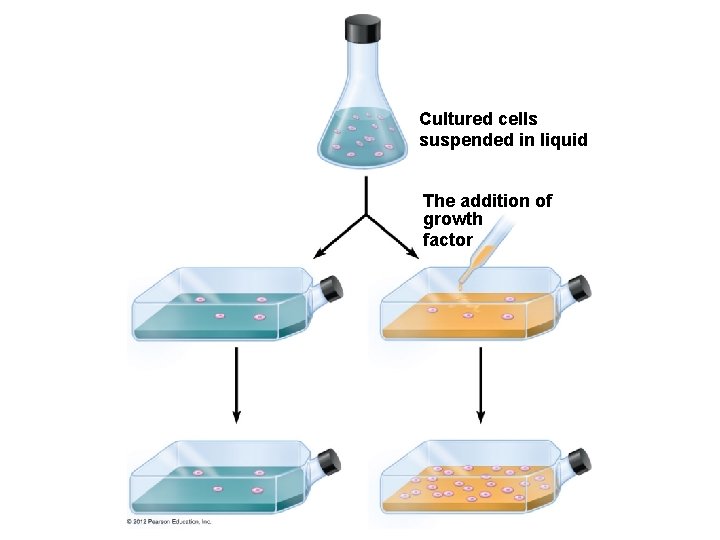
Cultured cells suspended in liquid The addition of growth factor
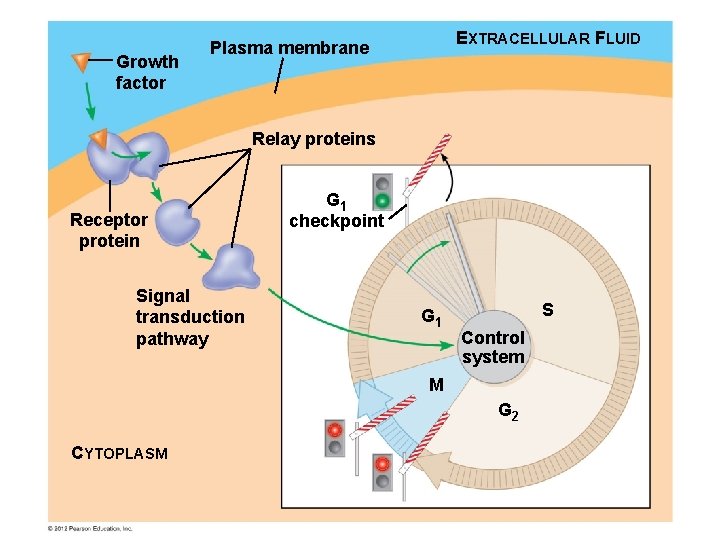
Growth factor EXTRACELLULAR FLUID Plasma membrane Relay proteins Receptor protein Signal transduction pathway G 1 checkpoint G 1 S Control system M G 2 CYTOPLASM
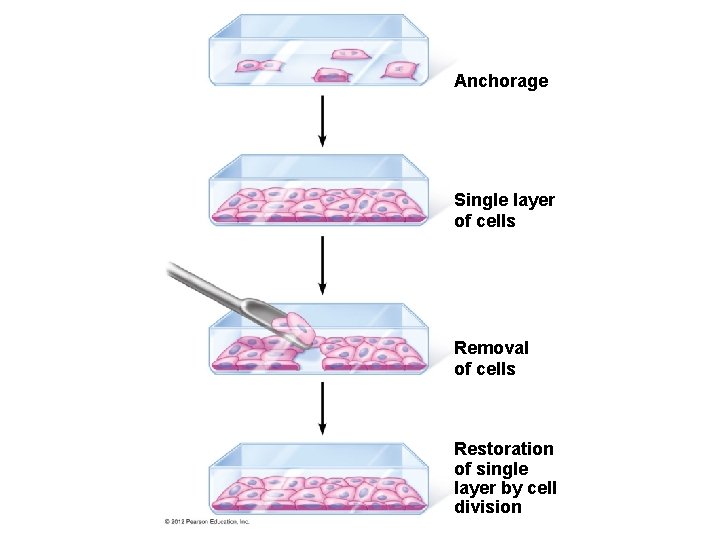
Anchorage Single layer of cells Removal of cells Restoration of single layer by cell division
CONNECTION: Growing out of control, cancer cells produce malignant tumors § Cancer cells escape controls of the cell cycle. § Cancer cells divide rapidly, often in the absence of growth factors, spread to other tissues through the circulatory system, and grow without being inhibited by other cells. © 2012 Pearson Education, Inc.
CONNECTION: Growing out of control, cancer cells produce malignant tumors § A tumor is an abnormally growing mass of body cells. – Benign tumors remain at the original site. – Malignant tumors spread to other locations, a process called metastasis. © 2012 Pearson Education, Inc.
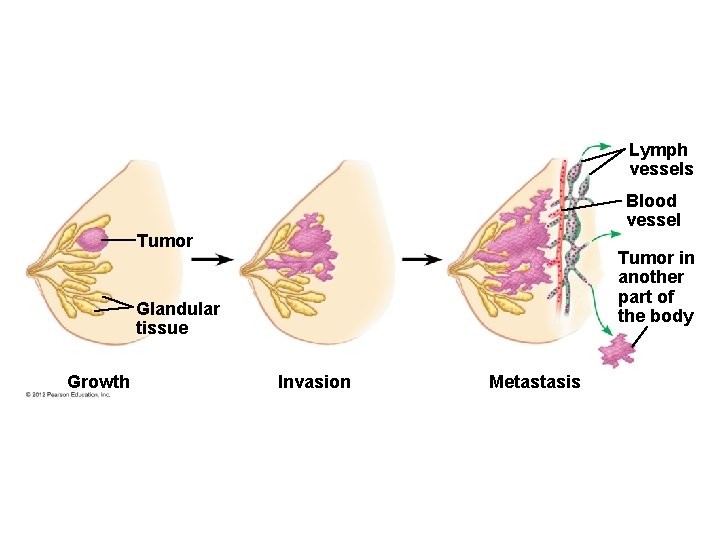
Lymph vessels Blood vessel Tumor in another part of the body Glandular tissue Growth Invasion Metastasis
MEIOSIS AND CROSSING OVER © 2012 Pearson Education, Inc.
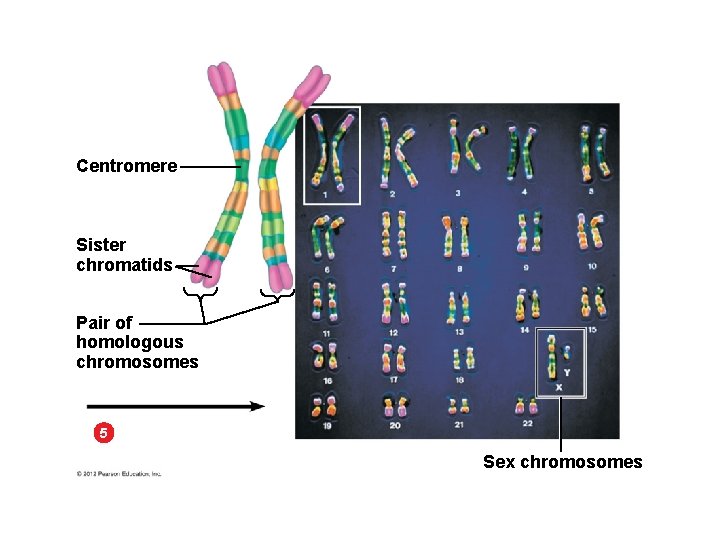
Chromosomes are Matched in Homologous Pairs § Humans and many animals & plants are diploid meaning that their body cells have two sets of chromosomes, one set from each parent. § Human body (somatic) cells are diploid, containing a total of 46 chromosomes arranged as 23 homologous pairs. § One pair of chromosomes = sex chromosomes = X and Y; they differ in size and genetic composition. § The other 22 pairs of chromosomes = autosomes; they have the same size and genetic composition.
Chromosomes are Matched in Homologous Pairs § Homologous chromosomes are matched in length, centromere position, and gene locations (except X & Y) § A locus (plural, loci) is the position of a gene. § Different versions of a gene may be found at the same locus on maternal and paternal chromosomes = alleles © 2012 Pearson Education, Inc.
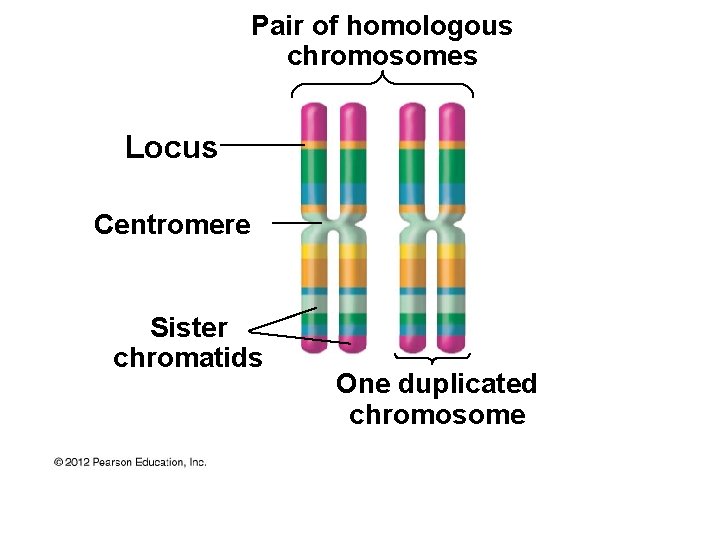
Pair of homologous chromosomes Locus Centromere Sister chromatids One duplicated chromosome
Gametes Have a Single Set of Chromosomes § Meiosis is a process that converts diploid nuclei to haploid nuclei. – Diploid cells have two homologous chromosomes present – Haploid cells have one set of chromosomes § Meiosis occurs in sex organs, producing gametes (sperm and egg) § Fertilization is the union of sperm and egg. § The resulting zygote has a diploid chromosome number, having received one set of chromosomes from each parent. © 2012 Pearson Education, Inc.
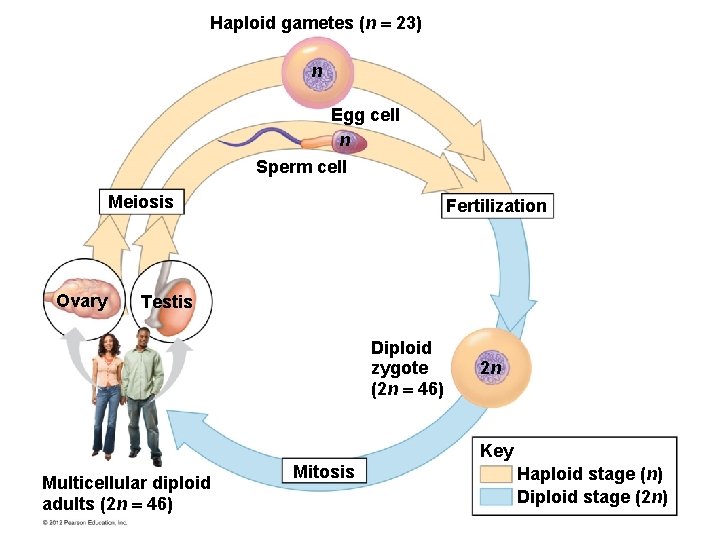
Haploid gametes (n 23) n Egg cell n Sperm cell Meiosis Ovary Fertilization Testis Diploid zygote (2 n 46) 2 n Key Multicellular diploid adults (2 n 46) Mitosis Haploid stage (n) Diploid stage (2 n)
Stages of Meiosis § Meiosis I – Prophase I – events occurring in the nucleus. – Chromatin condenses – Homologous chromosomes synapse and the pairs, with four chromatids, is called a tetrad – Nonsister chromatids exchange genetic material by crossing over © 2012 Pearson Education, Inc.
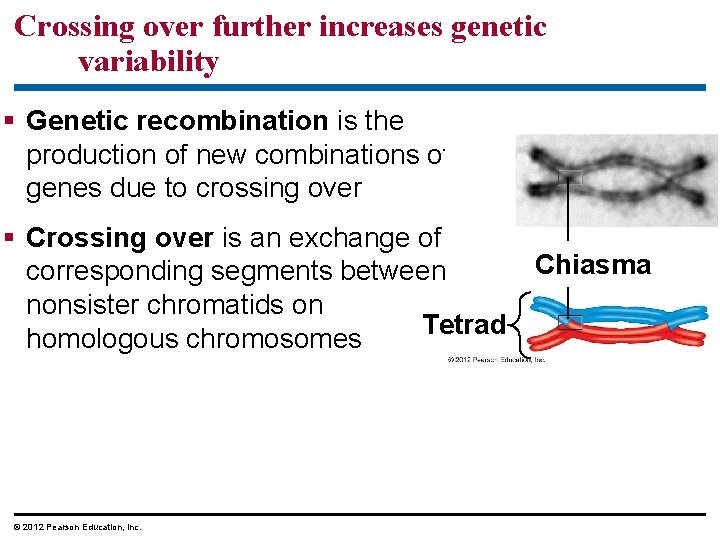
Crossing over further increases genetic variability § Genetic recombination is the production of new combinations of genes due to crossing over § Crossing over is an exchange of Chiasma corresponding segments between nonsister chromatids on Tetrad homologous chromosomes © 2012 Pearson Education, Inc.
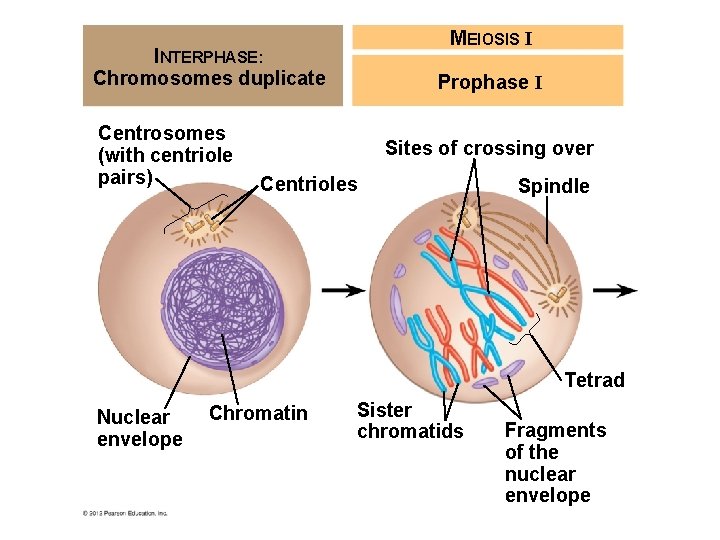
MEIOSIS I INTERPHASE: Chromosomes duplicate Centrosomes (with centriole pairs) Prophase I Sites of crossing over Centrioles Spindle Tetrad Nuclear envelope Chromatin Sister chromatids Fragments of the nuclear envelope
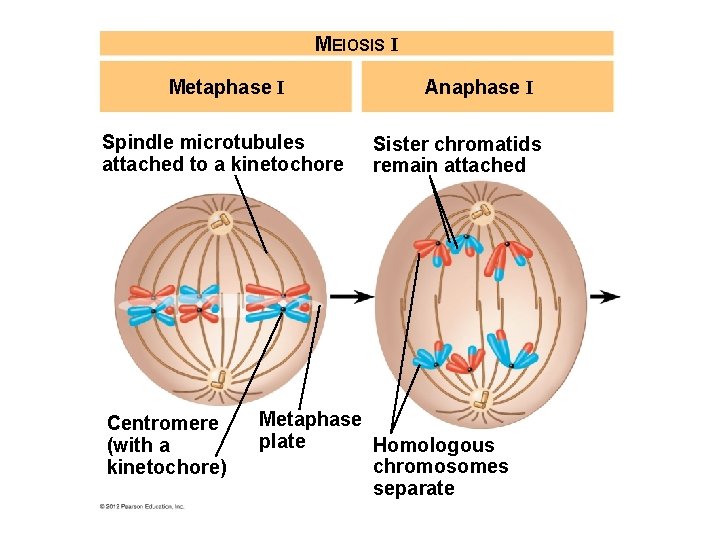
MEIOSIS I Metaphase I Spindle microtubules attached to a kinetochore Centromere (with a kinetochore) Anaphase I Sister chromatids remain attached Metaphase plate Homologous chromosomes separate
Stages of Meiosis § Meiosis I § Metaphase I – Tetrads align at the cell equator § Anaphase I – Homologous pairs separate and move toward opposite poles of the cell § Telophase I /cytokinesis- Duplicated chromosomes have reached the poles, a nuclear envelope re-forms around chromosomes § Each nucleus has the haploid number of chromosomes © 2012 Pearson Education, Inc.
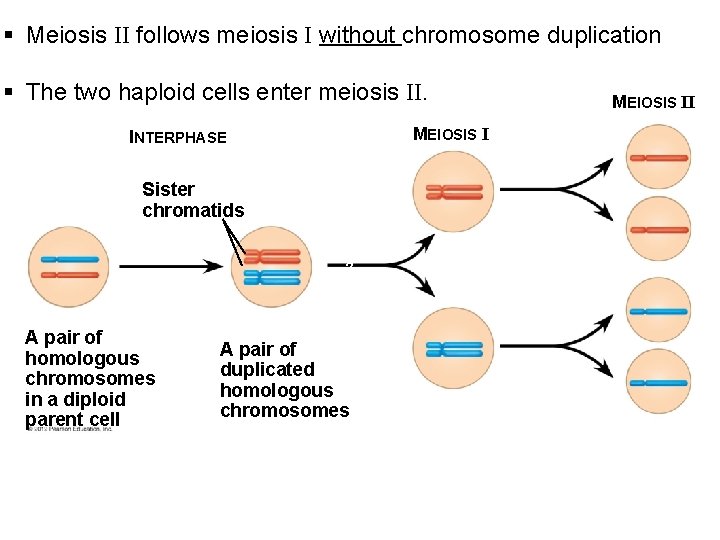
§ Meiosis II follows meiosis I without chromosome duplication § The two haploid cells enter meiosis II. MEIOSIS II MEIOSIS I INTERPHASE 2 Sister chromatids 1 2 A pair of homologous chromosomes in a diploid parent cell A pair of duplicated homologous chromosomes
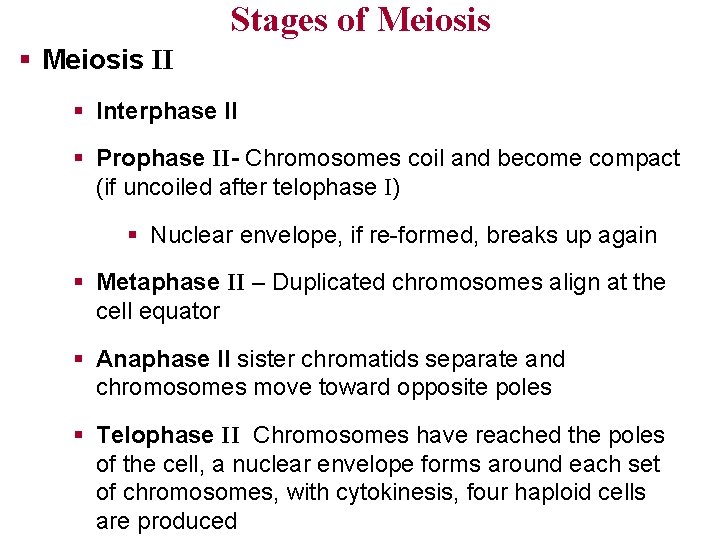
Stages of Meiosis § Meiosis II § Interphase II § Prophase II- Chromosomes coil and become compact (if uncoiled after telophase I) § Nuclear envelope, if re-formed, breaks up again § Metaphase II – Duplicated chromosomes align at the cell equator § Anaphase II sister chromatids separate and chromosomes move toward opposite poles § Telophase II Chromosomes have reached the poles of the cell, a nuclear envelope forms around each set of chromosomes, with cytokinesis, four haploid cells are produced
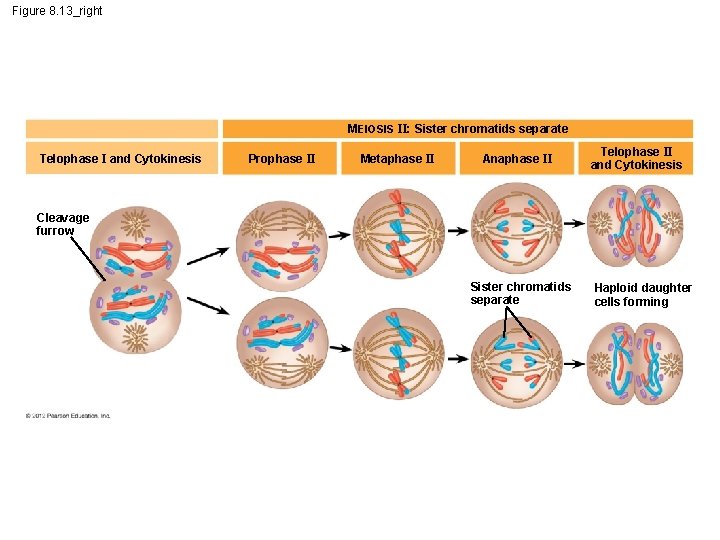
Figure 8. 13_right MEIOSIS II: Sister chromatids separate Telophase I and Cytokinesis Prophase II Metaphase II Anaphase II Telophase II and Cytokinesis Cleavage furrow Sister chromatids separate Haploid daughter cells forming
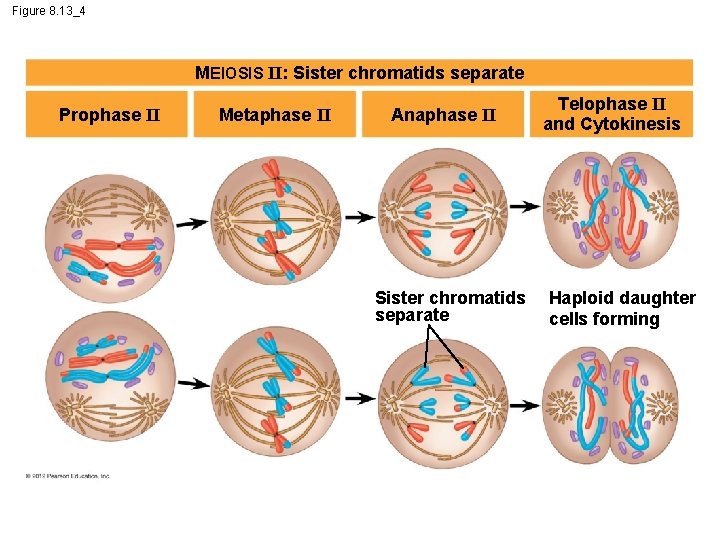
Figure 8. 13_4 MEIOSIS II: Sister chromatids separate Prophase II Metaphase II Anaphase II Sister chromatids separate Telophase II and Cytokinesis Haploid daughter cells forming
Mitosis and Meiosis have Important Similarities and Differences § Mitosis and meiosis both – Begin with diploid parent cells – Have chromosomes that are duplicated once during interphase § The end products of mitosis and meiosis differ – Mitosis produces two genetically identical diploid somatic daughter cells – Meiosis produces four genetically unique haploid gametes © 2012 Pearson Education, Inc.
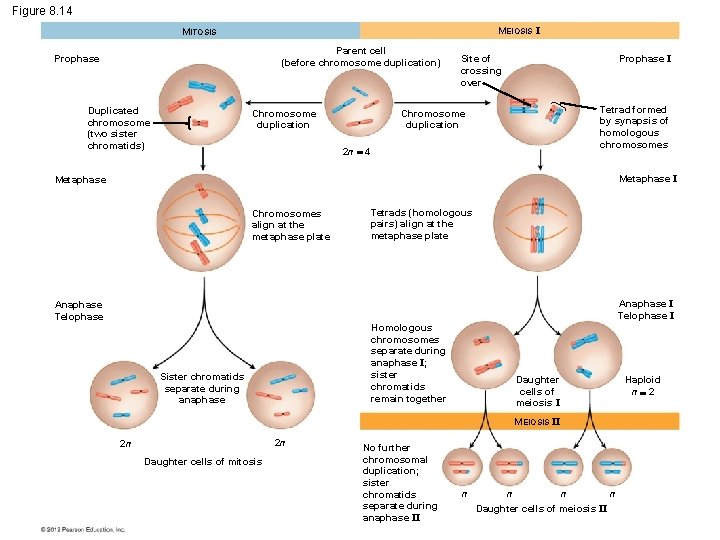
Figure 8. 14 MEIOSIS I MITOSIS Parent cell (before chromosome duplication) Prophase Duplicated chromosome (two sister chromatids) Chromosome duplication Site of crossing over Prophase I Tetrad formed by synapsis of homologous chromosomes Chromosome duplication 2 n 4 Metaphase I Metaphase Chromosomes align at the metaphase plate Tetrads (homologous pairs) align at the metaphase plate Anaphase I Telophase I Anaphase Telophase Homologous chromosomes separate during anaphase I; sister chromatids remain together Sister chromatids separate during anaphase Daughter cells of meiosis I MEIOSIS II 2 n 2 n Daughter cells of mitosis No further chromosomal duplication; sister chromatids separate during anaphase II n n Daughter cells of meiosis II Haploid n 2
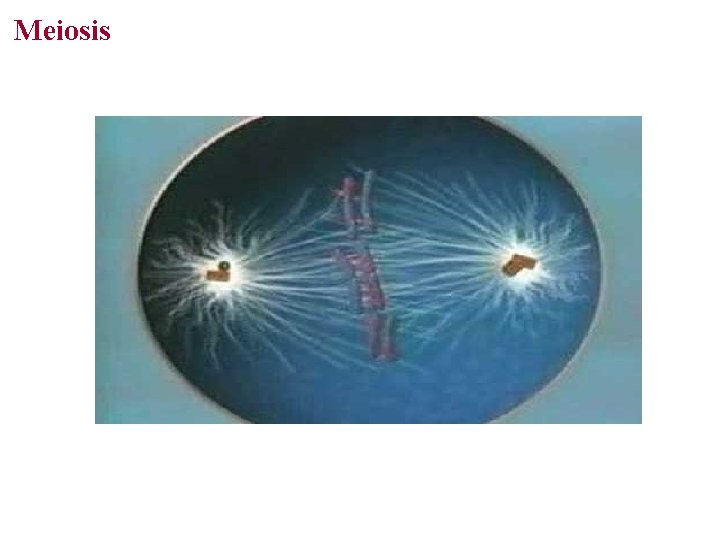
Meiosis
Independent Orientation of Chromosomes in Meiosis and Random Fertilization lead to Varied Offspring § Genetic variation in gametes produced by meiosis results from independent orientation at metaphase I and random fertilization © 2012 Pearson Education, Inc.
Independent Orientation of Chromosomes in Meiosis and Random Fertilization lead to Varied Offspring § Independent orientation at metaphase I – Each pair of chromosomes independently aligns at the cell equator – There is an equal probability of the maternal or paternal chromosome moving towards a given pole – The number of combinations for chromosomes packaged into gametes is 2 n where n = haploid number of chromosomes © 2012 Pearson Education, Inc.
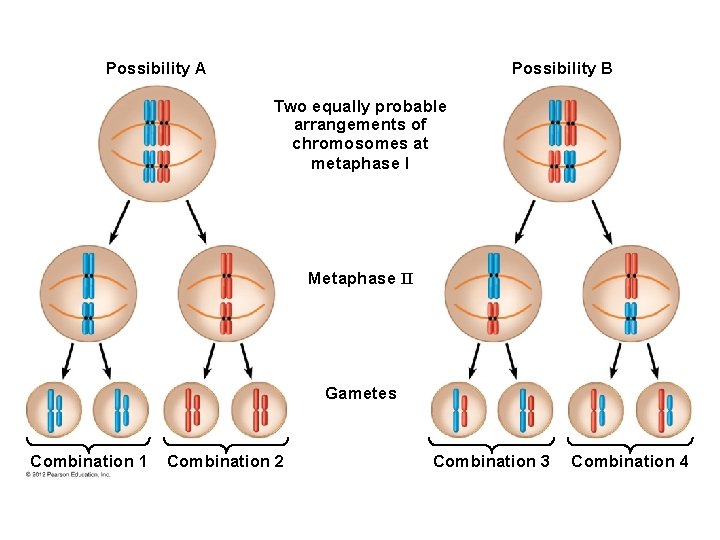
Possibility A Possibility B Two equally probable arrangements of chromosomes at metaphase I Metaphase II Gametes Combination 1 Combination 2 Combination 3 Combination 4
Independent Orientation of Chromosomes in Meiosis and Random Fertilization lead to Varied Offspring § Random fertilization – The combination of each unique sperm with each unique egg increases genetic variability in the offspring © 2012 Pearson Education, Inc.
ALTERATIONS OF CHROMOSOME NUMBER AND STRUCTURE © 2012 Pearson Education, Inc.
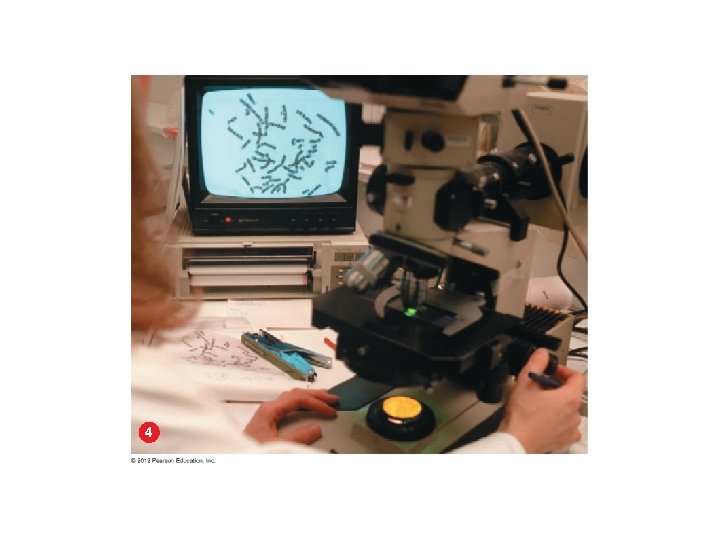
A Karyotype is a Photographic Inventory of an Individual’s Chromosomes § A karyotype is an ordered display of magnified images of an individual’s chromosomes arranged in pairs. § Karyotypes – are often produced from dividing cells arrested at metaphase of mitosis – Karyotypes allow for the observation of – homologous chromosome pairs – chromosome number, sex – chromosome structure © 2012 Pearson Education, Inc.
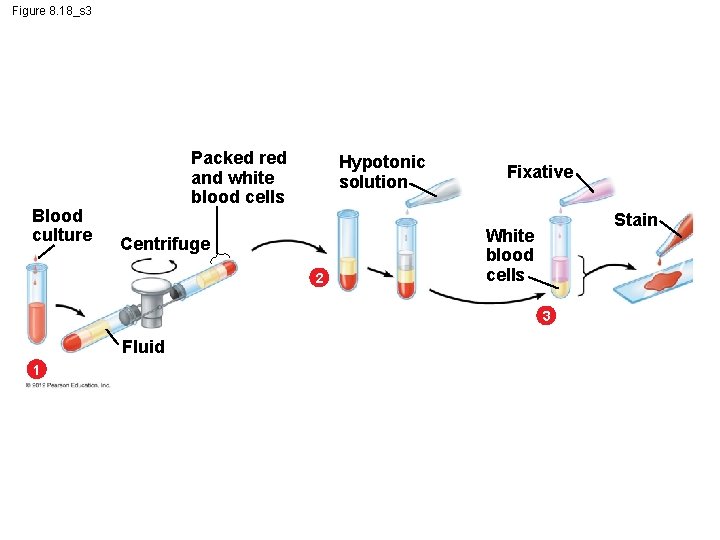
Figure 8. 18_s 3 Blood culture Packed red and white blood cells Hypotonic solution Centrifuge 2 Fixative Stain White blood cells 3 Fluid 1
4
Centromere Sister chromatids Pair of homologous chromosomes 5 Sex chromosomes
An Extra Copy of Chromosome 21 causes Down Syndrome § Trisomy 21 called Down syndrome, produces a characteristic set of symptoms, which include: – characteristic facial features – short stature – involves the inheritance of three copies of chromosome 21 and is the most common human chromosome abnormality. © 2012 Pearson Education, Inc.
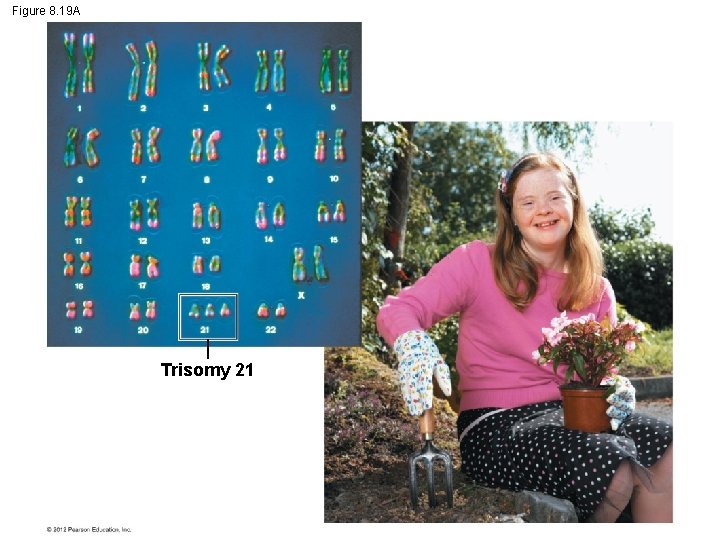
Figure 8. 19 A Trisomy 21
Accidents during Meiosis can alter Chromosome Number § Nondisjunction is the failure of chromosomes or chromatids to separate normally during meiosis. This can happen during – meiosis I, if both members of a homologous pair go to one pole or – meiosis II if both sister chromatids go to one pole. § Fertilization after nondisjunction yields zygotes with altered numbers of chromosomes. © 2012 Pearson Education, Inc.
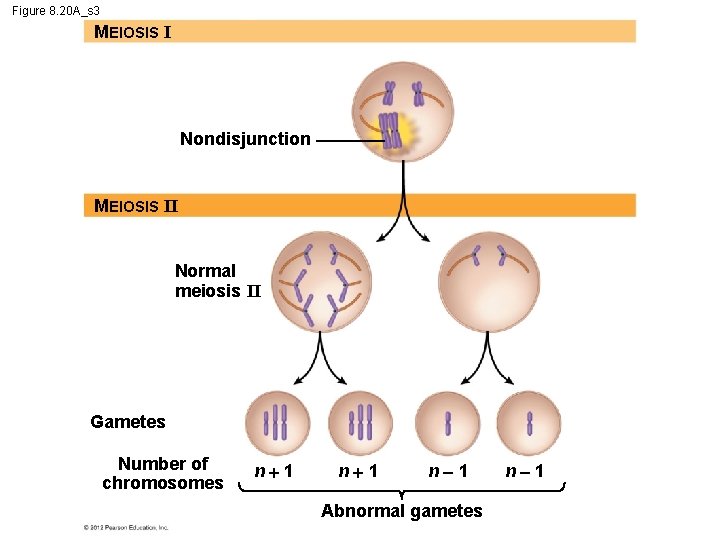
Figure 8. 20 A_s 3 MEIOSIS I Nondisjunction MEIOSIS II Normal meiosis II Gametes Number of chromosomes n 1 n 1 Abnormal gametes n 1
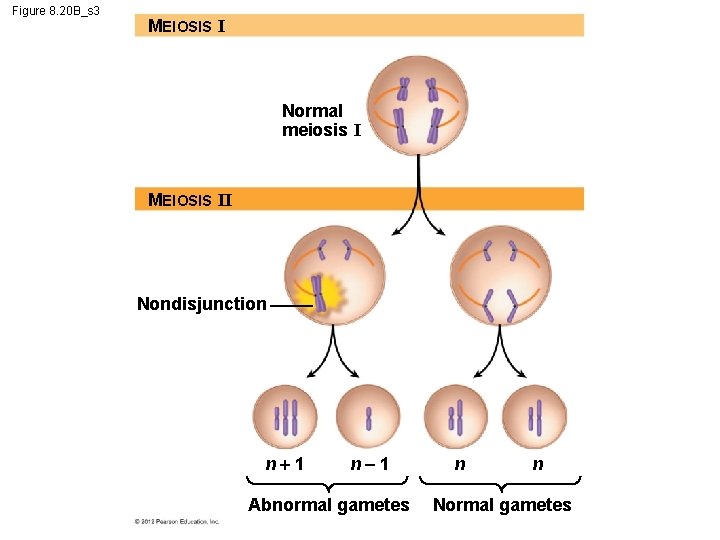
Figure 8. 20 B_s 3 MEIOSIS I Normal meiosis I MEIOSIS II Nondisjunction n 1 Abnormal gametes n n Normal gametes
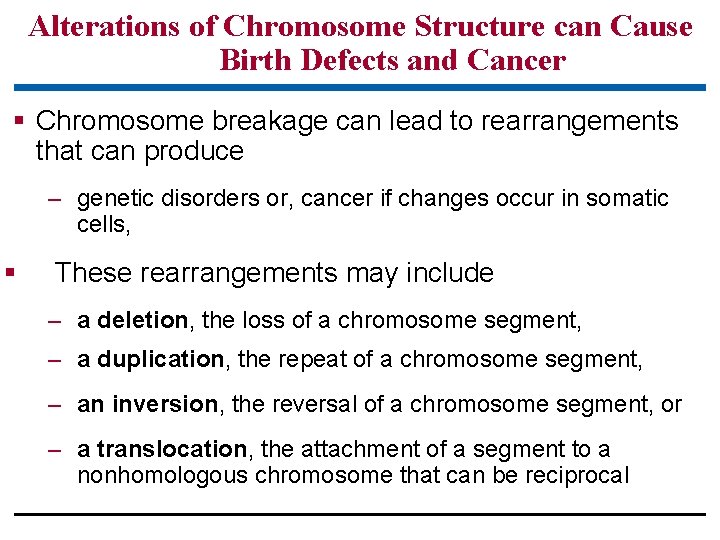
Alterations of Chromosome Structure can Cause Birth Defects and Cancer § Chromosome breakage can lead to rearrangements that can produce – genetic disorders or, cancer if changes occur in somatic cells, § These rearrangements may include – a deletion, the loss of a chromosome segment, – a duplication, the repeat of a chromosome segment, – an inversion, the reversal of a chromosome segment, or – a translocation, the attachment of a segment to a nonhomologous chromosome that can be reciprocal
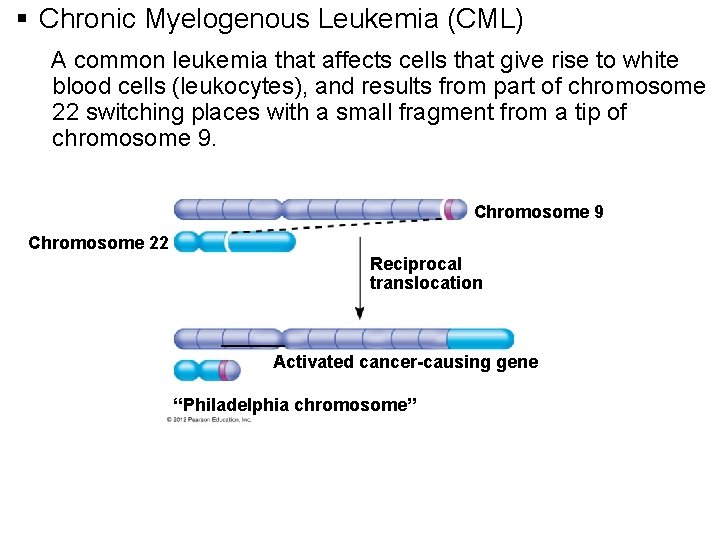
§ Chronic Myelogenous Leukemia (CML) A common leukemia that affects cells that give rise to white blood cells (leukocytes), and results from part of chromosome 22 switching places with a small fragment from a tip of chromosome 9. Chromosome 9 Chromosome 22 Reciprocal translocation Activated cancer-causing gene “Philadelphia chromosome”
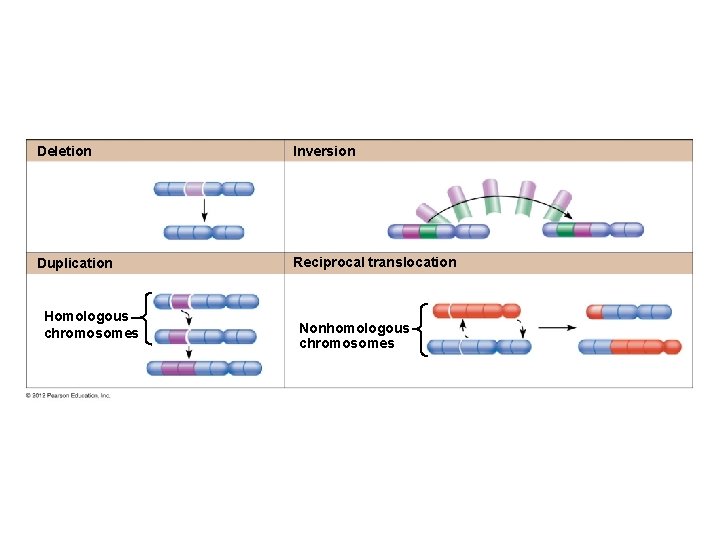
Deletion Inversion Duplication Reciprocal translocation Homologous chromosomes Nonhomologous chromosomes
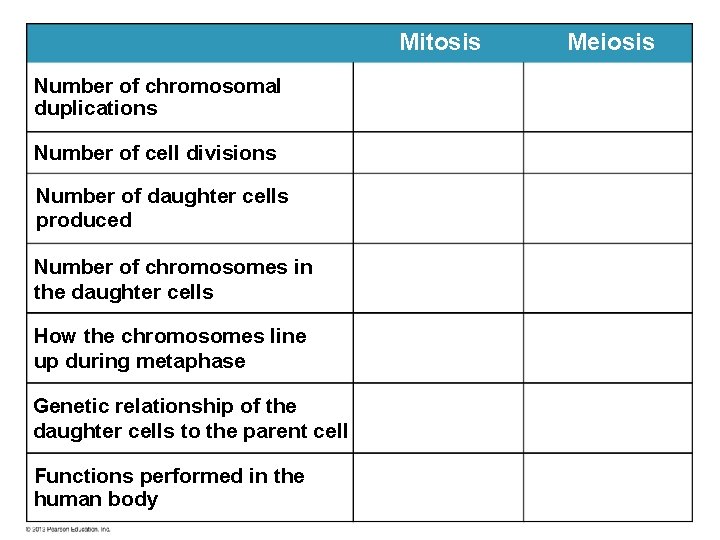
Mitosis Number of chromosomal duplications Number of cell divisions Number of daughter cells produced Number of chromosomes in the daughter cells How the chromosomes line up during metaphase Genetic relationship of the daughter cells to the parent cell Functions performed in the human body Meiosis
- Slides: 61