
Ch 8 Single replacement reactions u A BX
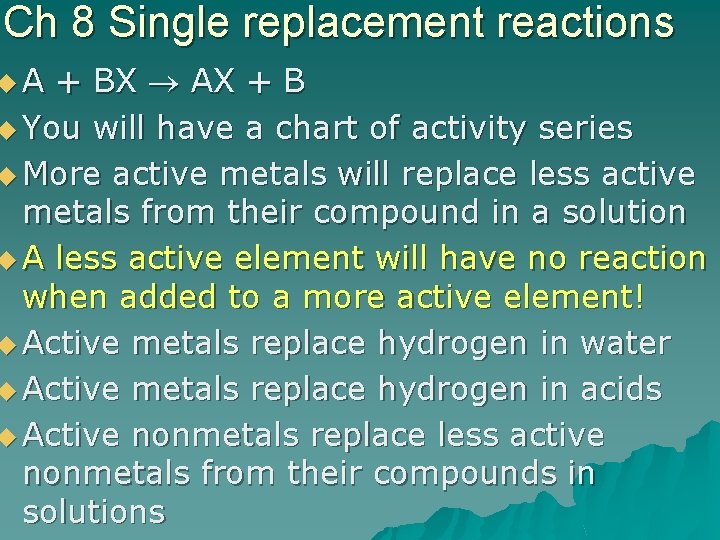
Ch 8 Single replacement reactions u. A + BX AX + B u You will have a chart of activity series u More active metals will replace less active metals from their compound in a solution u A less active element will have no reaction when added to a more active element! u Active metals replace hydrogen in water u Active metals replace hydrogen in acids u Active nonmetals replace less active nonmetals from their compounds in solutions
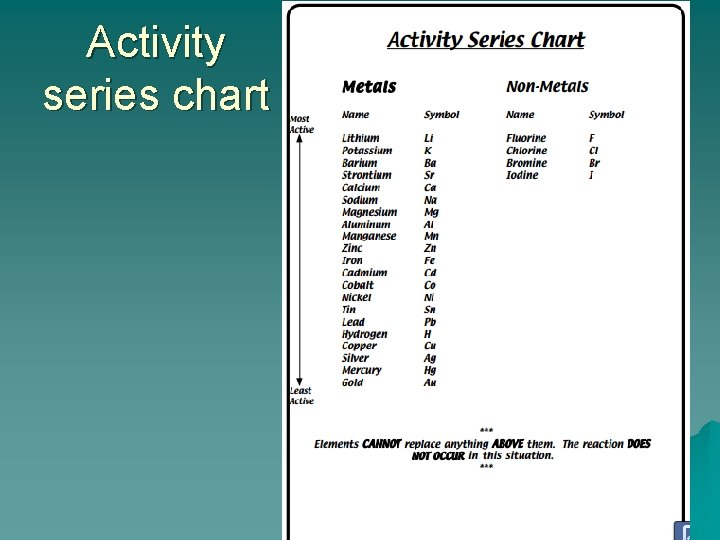
Activity series chart
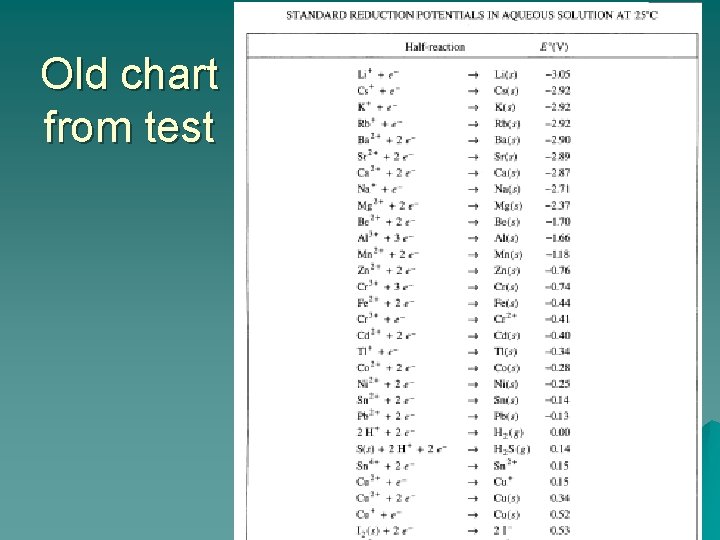
Old chart from test
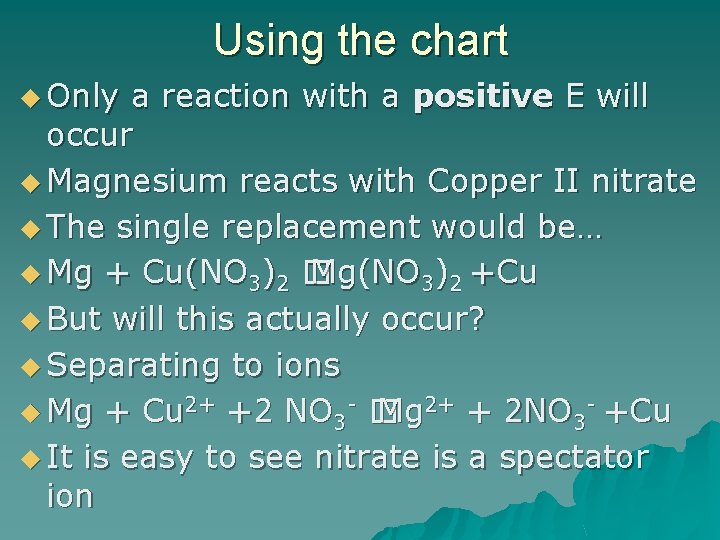
Using the chart u Only a reaction with a positive E will occur u Magnesium reacts with Copper II nitrate u The single replacement would be… u Mg + Cu(NO 3)2 � Mg(NO 3)2 +Cu u But will this actually occur? u Separating to ions u Mg + Cu 2+ +2 NO 3 - � Mg 2+ + 2 NO 3 - +Cu u It is easy to see nitrate is a spectator ion
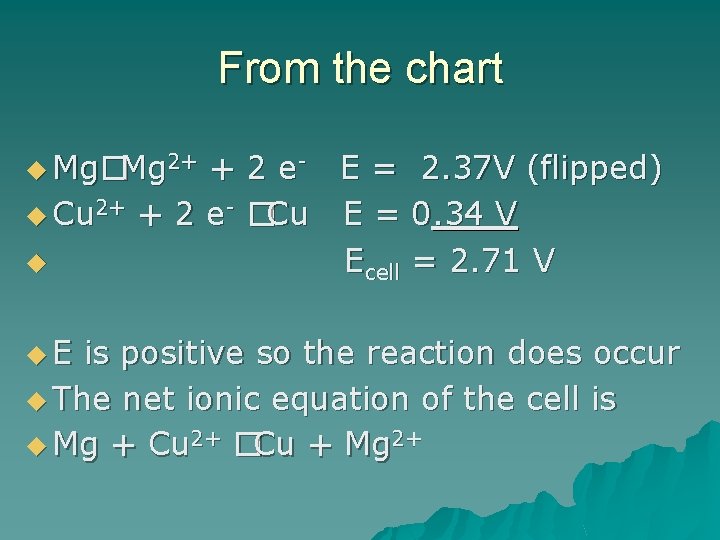
From the chart u Mg�Mg 2+ u Cu 2+ u u. E + 2 e- E = 2. 37 V (flipped) + 2 e- �Cu E = 0. 34 V Ecell = 2. 71 V is positive so the reaction does occur u The net ionic equation of the cell is u Mg + Cu 2+ �Cu + Mg 2+
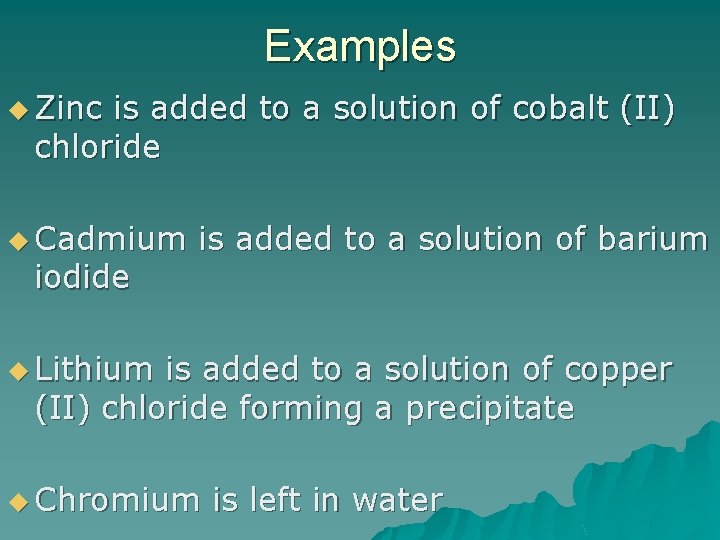
Examples u Zinc is added to a solution of cobalt (II) chloride u Cadmium iodide is added to a solution of barium u Lithium is added to a solution of copper (II) chloride forming a precipitate u Chromium is left in water
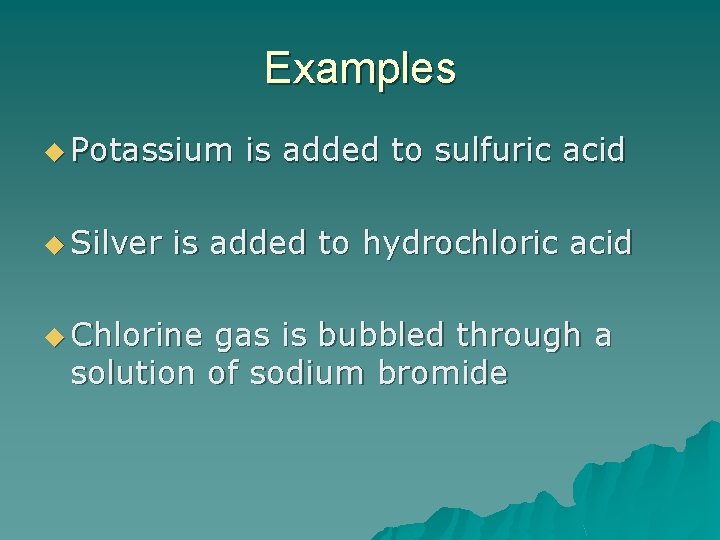
Examples u Potassium u Silver is added to sulfuric acid is added to hydrochloric acid u Chlorine gas is bubbled through a solution of sodium bromide
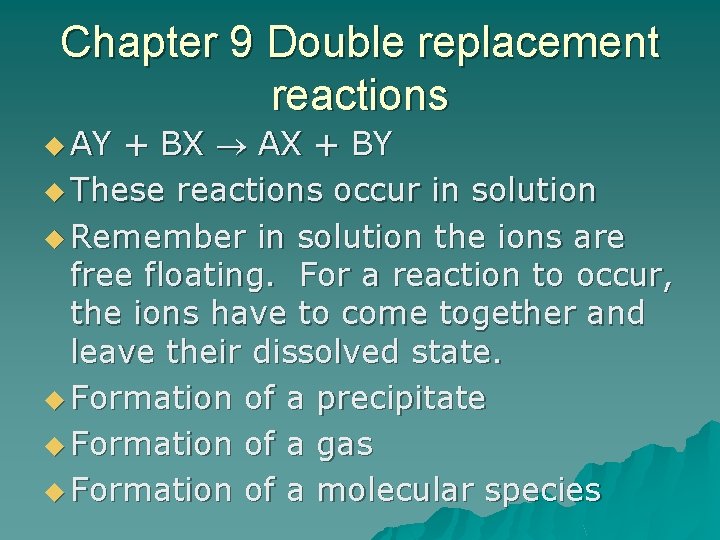
Chapter 9 Double replacement reactions u AY + BX AX + BY u These reactions occur in solution u Remember in solution the ions are free floating. For a reaction to occur, the ions have to come together and leave their dissolved state. u Formation of a precipitate u Formation of a gas u Formation of a molecular species
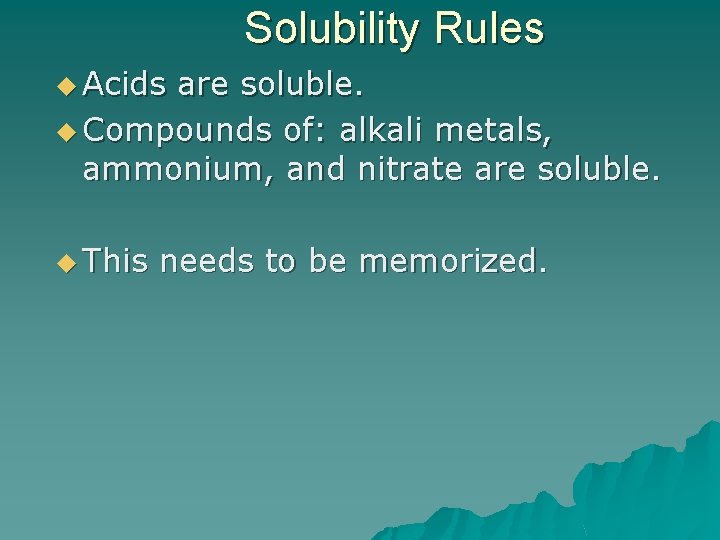
Solubility Rules u Acids are soluble. u Compounds of: alkali metals, ammonium, and nitrate are soluble. u This needs to be memorized.
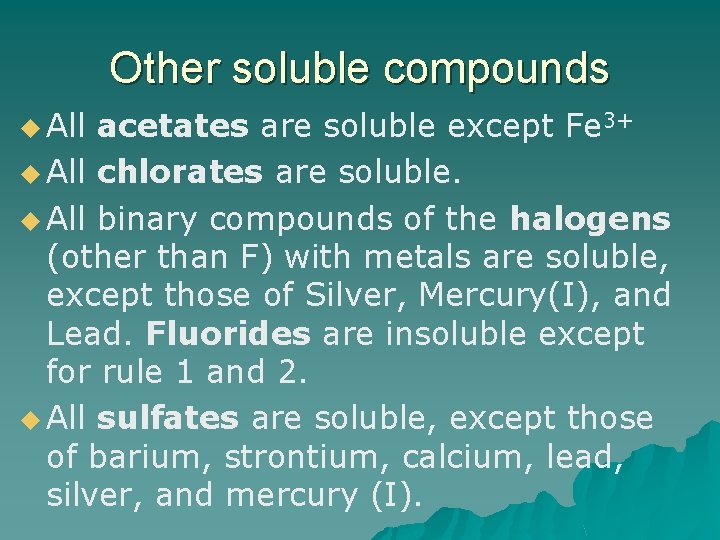
Other soluble compounds u All acetates are soluble except Fe 3+ u All chlorates are soluble. u All binary compounds of the halogens (other than F) with metals are soluble, except those of Silver, Mercury(I), and Lead. Fluorides are insoluble except for rule 1 and 2. u All sulfates are soluble, except those of barium, strontium, calcium, lead, silver, and mercury (I).
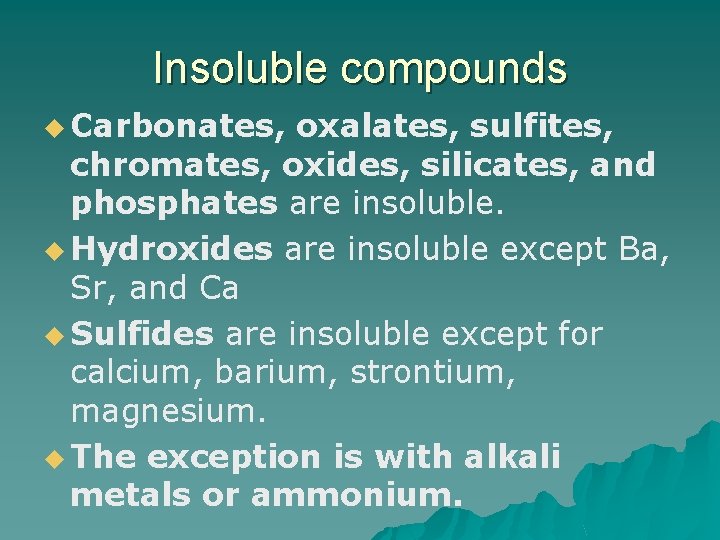
Insoluble compounds u Carbonates, oxalates, sulfites, chromates, oxides, silicates, and phosphates are insoluble. u Hydroxides are insoluble except Ba, Sr, and Ca u Sulfides are insoluble except for calcium, barium, strontium, magnesium. u The exception is with alkali metals or ammonium.
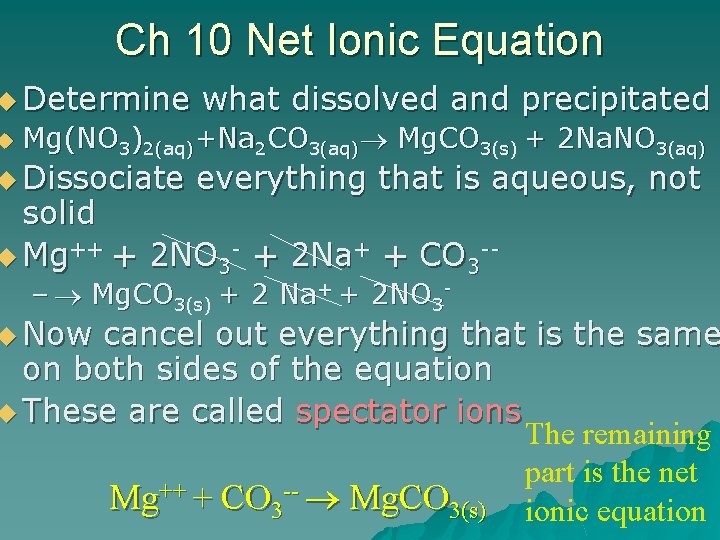
Ch 10 Net Ionic Equation u Determine u what dissolved and precipitated Mg(NO 3)2(aq)+Na 2 CO 3(aq) Mg. CO 3(s) + 2 Na. NO 3(aq) u Dissociate everything that is aqueous, not solid u Mg++ + 2 NO 3 - + 2 Na+ + CO 3 -– Mg. CO 3(s) + 2 Na+ + 2 NO 3 - u Now cancel out everything that is the same on both sides of the equation u These are called spectator ions The remaining part is the net Mg++ + CO 3 -- Mg. CO 3(s) ionic equation
Examples u Hydrochloric nitrate acid reacts with silver u Potassium carbonate reacts with calcium chloride u Sodium chloride reacts with ammonium oxalate u Scandium chromate acetate reacts with lithium
u H 2 S Gases (hydrogen sulfide) is formed from any sulfide reacting with an acid u CO 2 (Carbon dioxide) is formed from any carbonate reacting with an acid, water is also produced u SO 2 (sulfur dioxide) is formed from any sulfite reacting with an acid, water is also produced u NH 3 (ammonia) is formed from ammonium reacting with a soluble hydroxide
Examples u Ammonium chloride reacts with calcium hydroxide u Sodium sulfide is combined with nitric acid u Ammonium carbonate is combined with barium chlorate u Lithium acid sulfite reacts with phosphoric
- Slides: 15