
CH 8 Historical Globalization Silk Road and Early
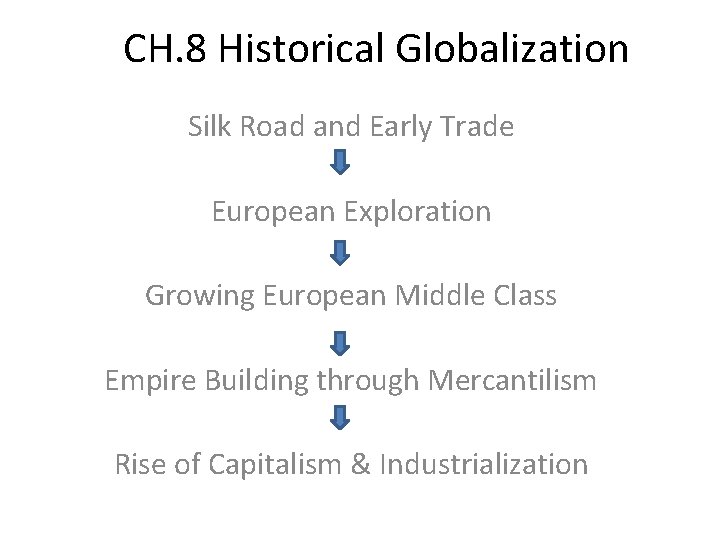
CH. 8 Historical Globalization Silk Road and Early Trade European Exploration Growing European Middle Class Empire Building through Mercantilism Rise of Capitalism & Industrialization
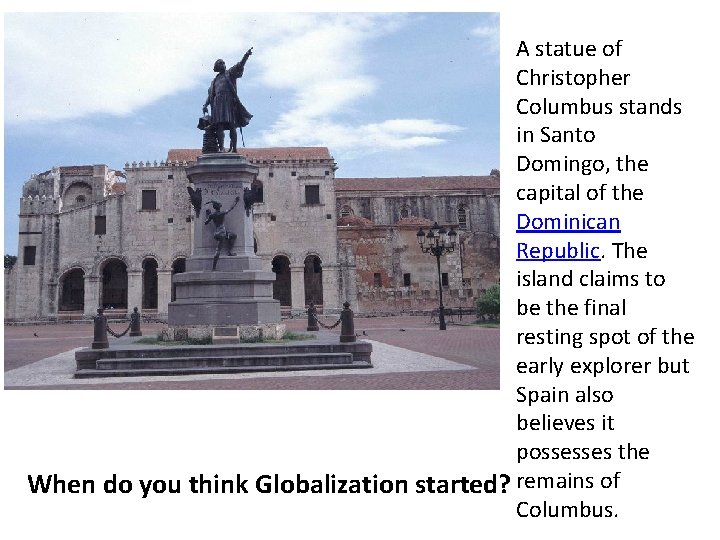
A statue of Christopher Columbus stands in Santo Domingo, the capital of the Dominican Republic. The island claims to be the final resting spot of the early explorer but Spain also believes it possesses the When do you think Globalization started? remains of Columbus.
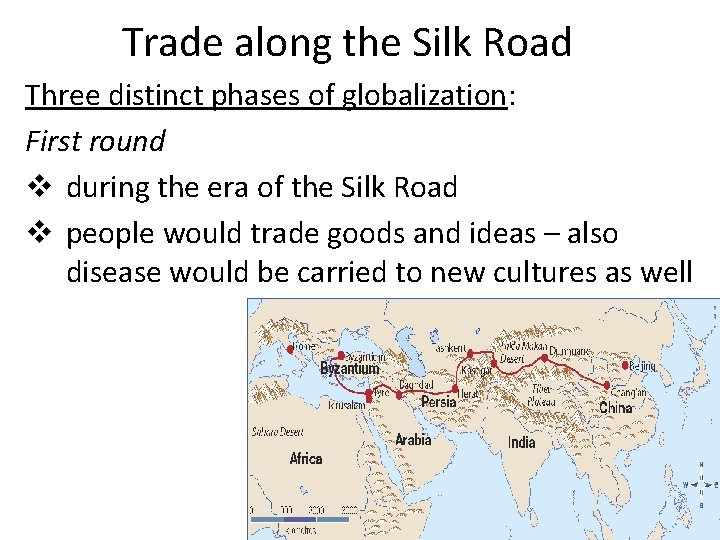
Trade along the Silk Road Three distinct phases of globalization: First round v during the era of the Silk Road v people would trade goods and ideas – also disease would be carried to new cultures as well

Three distinct phases of globalization: Second phase v Began around the 1400’s v New technologies were developed that enabled Europeans to travel farther and faster – maps, compass, large square sails v Countries were able to protect their goods with cannons – intro. of gunpowder and muskets v Related to European Old Imperialism – one country’s domination over another country’s economic, political, and cultural institutions. v This round is classified as Historical globalization

Three distinct phases of globalization: Third phase v. The world is currently in this phase v. Began after WWII (1945) v. Rapid growth of world markets and instant communication v. Rapid rise of China and India as world economic powers
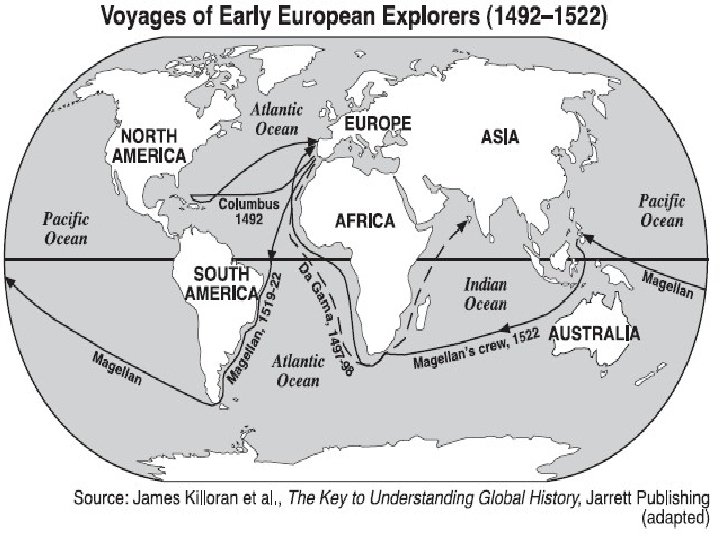
Global Competition for Trade • In the centuries after Columbus’s first expedition European countries with strong seafaring traditions — Portuguese, Spanish, British, Dutch, and the French - began competing to establish colonial empires in the Americas and on other continents. • European Old Imperialism : policy of extending a country’s power by acquiring new territories and establishing control over other countries and peoples – motivated by trade. • This European imperialism was motivated by Gold, Glory and God. – Gold – increase wealth in a nation – Glory – the desire for adventures – make a name for oneself – God – the desire of Christian missionaries to find converts • This style of Old Imperialism brought economic prosperity, and economic prosperity brought power.
- Effects of European colonial settlement • Once European countries established colonies, they encouraged settlers to emigrate from their home country to the newly acquired lands. • This emigration served a number of purposes: – Settlers provided a pool of people to run the colony – supervise the gathering of resources – protect the home country’s trading interests • Also helped reduce conflict at home - European peasants were driven off land their family had worked for generations. • Encouraging these peasants to emigrate reduced the potential for conflict at home and helped establish European customs and culture in the colony.
Effects of European colonial settlement • Slavery: As new settlers moved in, European governments simply declared that Indigenous peoples were their subjects and often enslaved or displaced them to make room. • Conflict: This sometimes created conflict as one Indigenous groups was forced to migrate to land that had traditionally been regarded as another group’s territory. • Depopulation: Conflict and disease wiped out large amounts of indigenous populations
Rise of the Middle Class • In the centuries after the fall of Rome in 476 CE, European societies were engulfed in wars - people lived in isolated, self-sufficient communities. • Social status was often determined by birth, and social power was defined by the amount of land a person owned. • Absolutism – a theory of government that gives all power to the monarchy. • Kings and/or Queens ruled with absolutism. • At the same time, towns and cities were growing attracting traders, craftspeople, bankers, entrepreneurs, artists, and scholars.
First the Royalty…now the Middle Class • During 500 – 1400 CE, European Monarchs sought the trade goods coming from the East down the Silk Road. • 1400 -1700 CE – with the growing power and wealth of the Middle Class in Europe, people wanted to attain goods like the royalty had for many years. • As well, now that countries had greater contact, they began competing for land resources around the world (Empire Building) • They first created colonies but would later simply come to strip the acquired lands of its resources
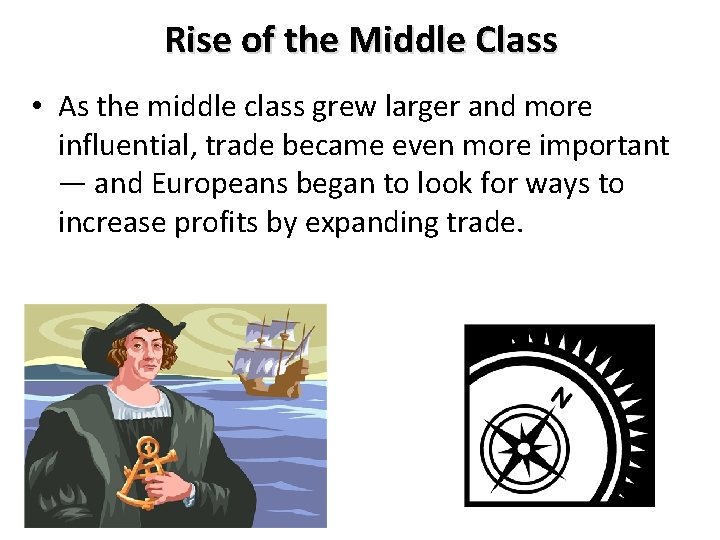
Rise of the Middle Class • As the middle class grew larger and more influential, trade became even more important — and Europeans began to look for ways to increase profits by expanding trade.
Mercantilism – Complete Handout 2. 5. 6 • From the 16 th to the 18 th centuries, European governments strictly controlled trade. To ensure prosperity, they believed that the balance of trade must favour the home country: its exports must be higher than its imports. • As a result, colonies were viewed as a source of cheap raw materials. • A colony’s raw materials were to be shipped to the home country and only there could they be used to make finished products. • The products made in the European country were then shipped back to the colony or other markets and sold.
Mercantilism is the Solution �What is mercantilism? = System of Trade… - Control of trade by a colonizing or Imperial nation. 1. The Powerful home country establishes a colony in another territory in the world 2. Extracts the natural resources (raw materials)and ships to home country. 3. Manufactures goods out of the raw materials. 4. Ships goods back to colony for sale and profit
What were some forces causing Mercantilism? - the drive for more trade, - the colonizing countries’ belief that profits could be assured only if trade was controlled and competition eliminated - the growth of the middle class of Europe - discovery of valuable raw materials in lands that could be colonized
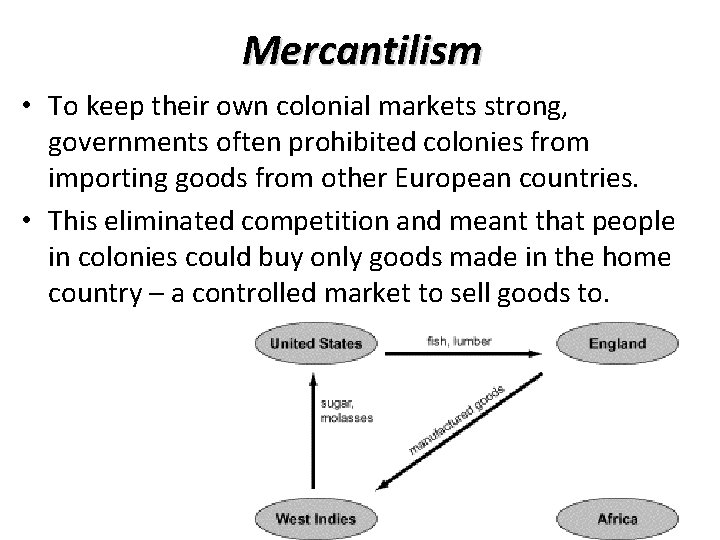
Mercantilism • To keep their own colonial markets strong, governments often prohibited colonies from importing goods from other European countries. • This eliminated competition and meant that people in colonies could buy only goods made in the home country – a controlled market to sell goods to.
Decline of Mercantilism • 18 th century - many people began to resist mercantilism • 1776 – American colonists had no say in British politics and therefore had taxation without representation – no choice in what taxes they would be pay. • The American colonists revolted against the British forming their own United States of America. • 1776 - Adam Smith published The Wealth of Nations. • This book challenged government economic control and advocated individualism, competition, and choice as routes to economic prosperity. • Smith’s book set forth the groundwork for an economic system that would later become known as capitalism.
CH. 8 Lesson 1 Summary • Silk Road and Early Trade • European Exploration • Growing European Middle Class • Empire Building through Mercantilism
Results of Contact Ø Population Displacement: Indigenous people were displaced – forced off their land or killed Ø Diseases were introduced by Europeans – used purposely as a form of control – small pox on blankets in North America (estimated 75 to 90 % of Indigenous Peoples of the Americas may have died as a result of contact) Ø Indigenous Peoples experienced process of acculturation and many became assimilated into European cultures Ø Slave and Indentured labour
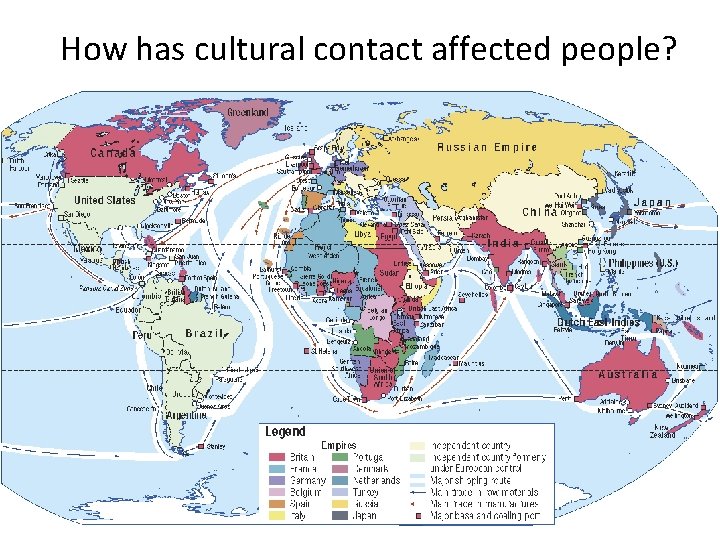
How has cultural contact affected people?
- Slides: 20