
CH 8 Alkynes An Introduction to Organic Synthesis
- Slides: 42
CH 8 Alkynes: An Introduction to Organic Synthesis Renee Becker CHM 2210 Valencia Community College 1
Alkynes • Hydrocarbons that contain carbon-carbon triple bonds • Acetylene, the simplest alkyne is produced industrially from methane and steam at high temperature • Our study of alkynes provides an introduction to organic synthesis, the preparation of organic molecules from simpler organic molecules 2
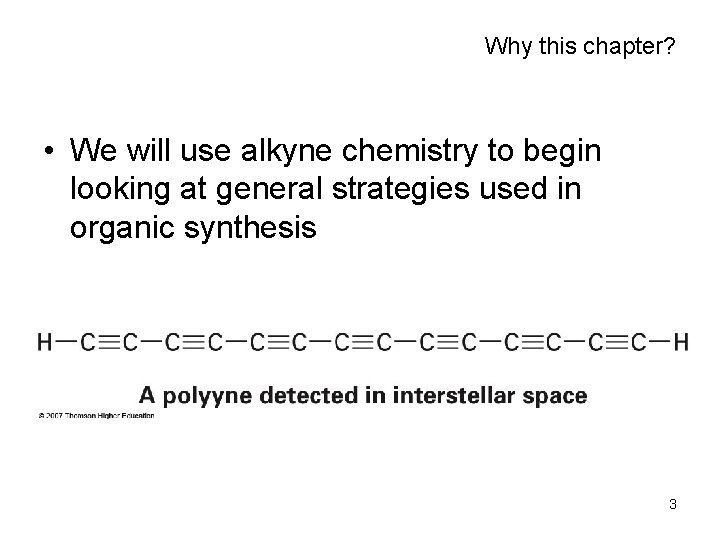
Why this chapter? • We will use alkyne chemistry to begin looking at general strategies used in organic synthesis 3
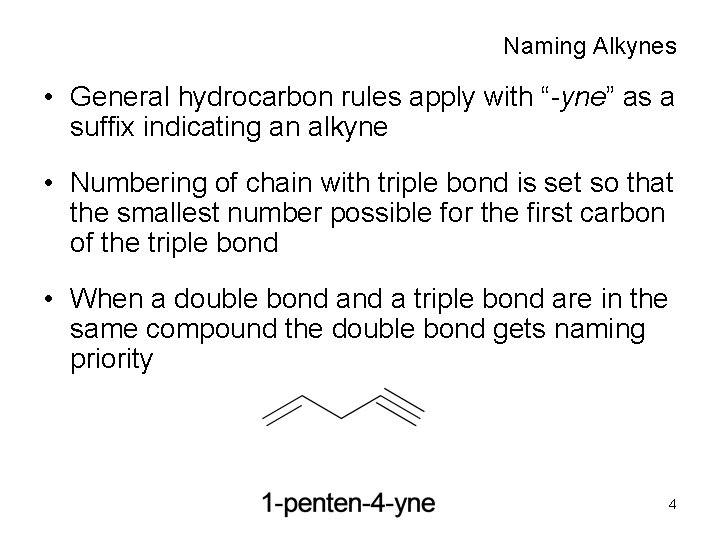
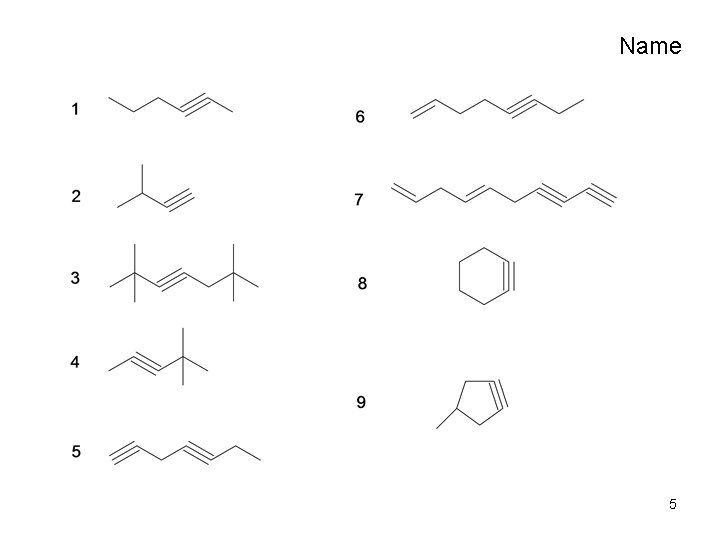
Naming Alkynes • General hydrocarbon rules apply with “-yne” as a suffix indicating an alkyne • Numbering of chain with triple bond is set so that the smallest number possible for the first carbon of the triple bond • When a double bond a triple bond are in the same compound the double bond gets naming priority 4
Name 5
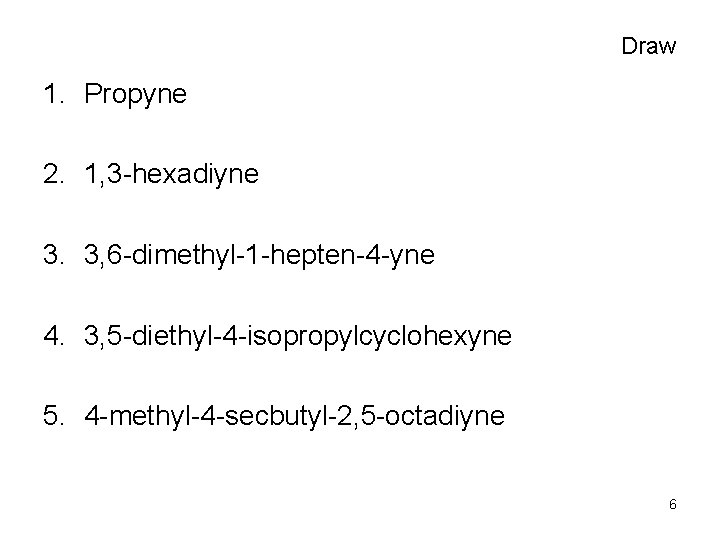
Draw 1. Propyne 2. 1, 3 -hexadiyne 3. 3, 6 -dimethyl-1 -hepten-4 -yne 4. 3, 5 -diethyl-4 -isopropylcyclohexyne 5. 4 -methyl-4 -secbutyl-2, 5 -octadiyne 6
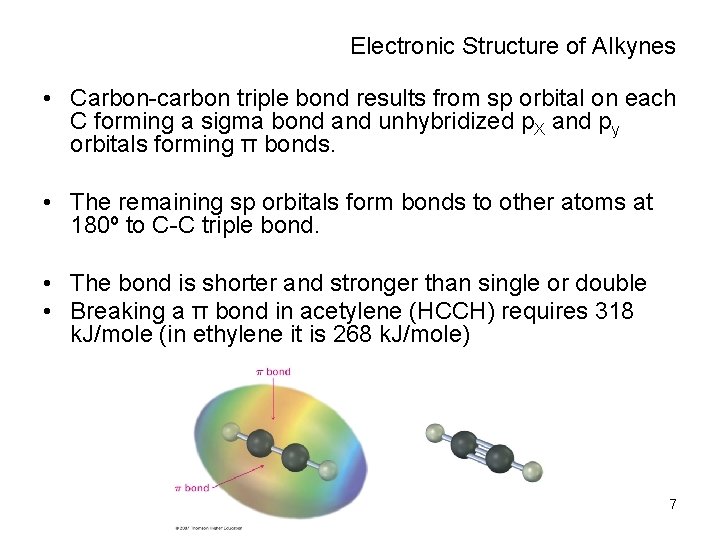
Electronic Structure of Alkynes • Carbon-carbon triple bond results from sp orbital on each C forming a sigma bond and unhybridized p. X and py orbitals forming π bonds. • The remaining sp orbitals form bonds to other atoms at 180º to C-C triple bond. • The bond is shorter and stronger than single or double • Breaking a π bond in acetylene (HCCH) requires 318 k. J/mole (in ethylene it is 268 k. J/mole) 7
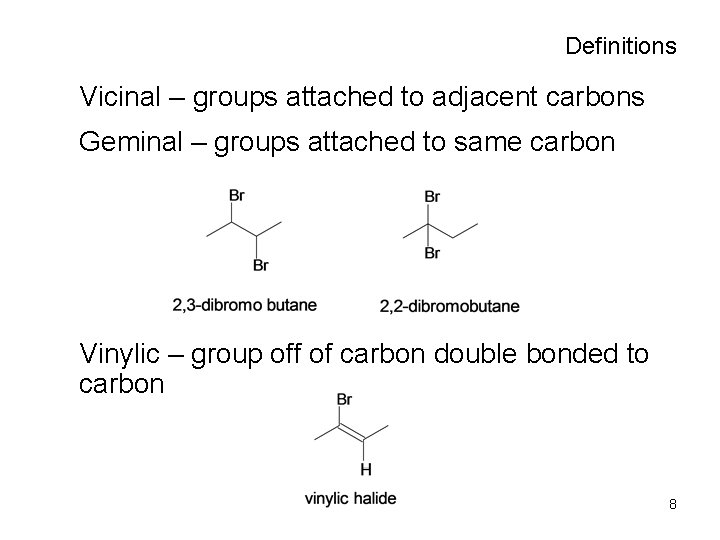
Definitions Vicinal – groups attached to adjacent carbons Geminal – groups attached to same carbon Vinylic – group off of carbon double bonded to carbon 8
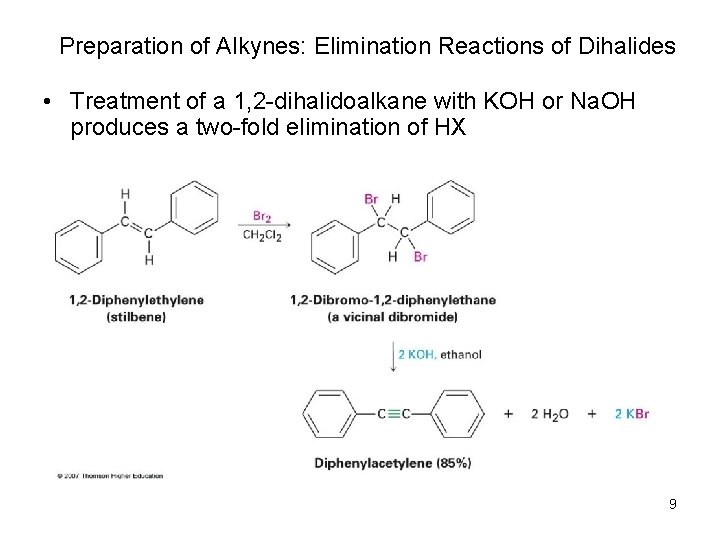
Preparation of Alkynes: Elimination Reactions of Dihalides • Treatment of a 1, 2 -dihalidoalkane with KOH or Na. OH produces a two-fold elimination of HX 9
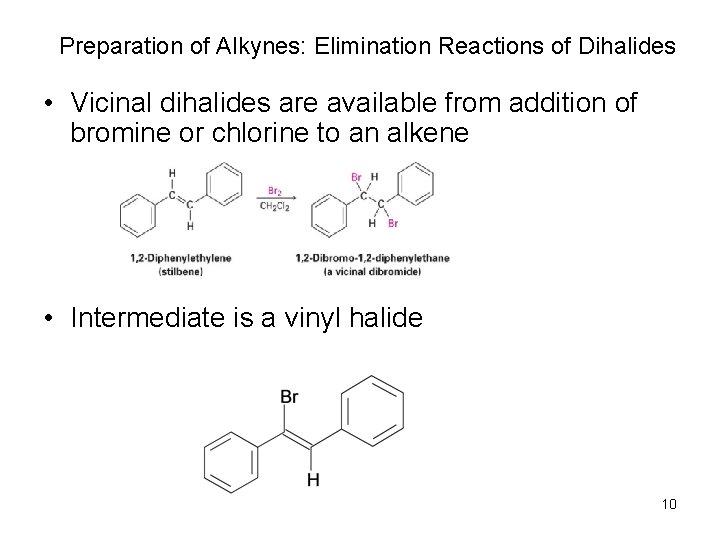
Preparation of Alkynes: Elimination Reactions of Dihalides • Vicinal dihalides are available from addition of bromine or chlorine to an alkene • Intermediate is a vinyl halide 10
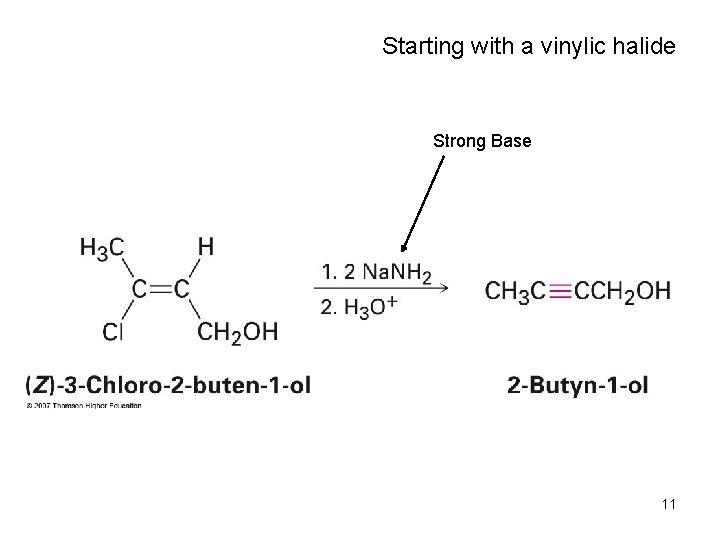
Starting with a vinylic halide Strong Base 11
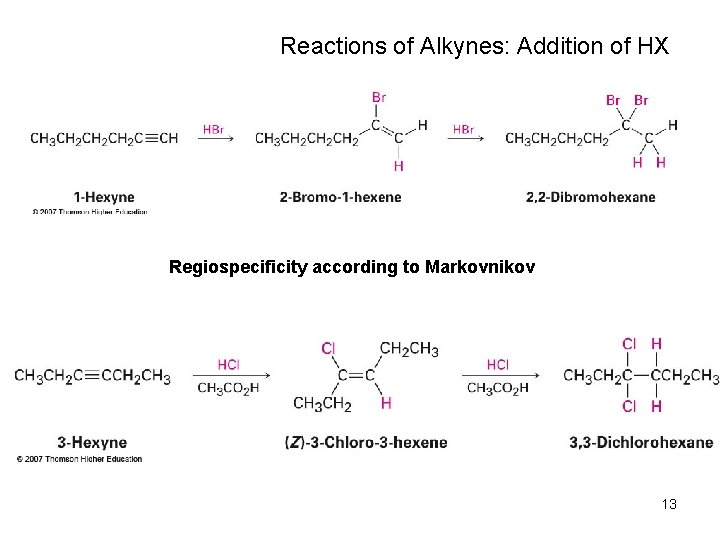
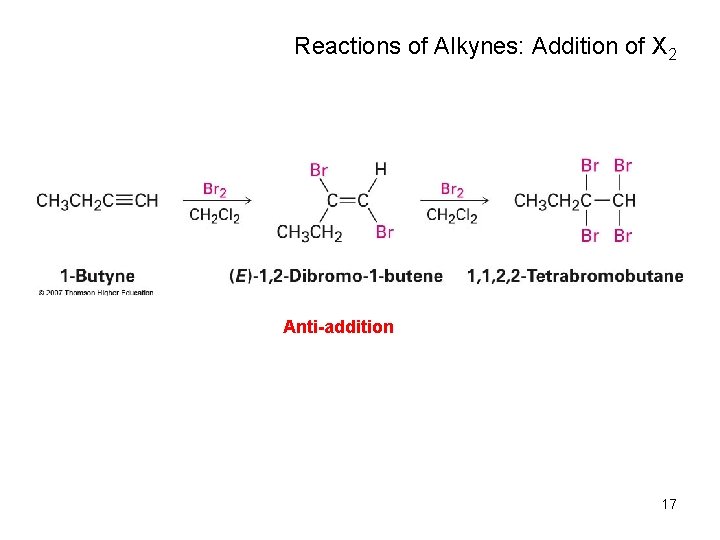
Reactions of Alkynes: Addition of HX and X 2 • Addition reactions of alkynes are similar to those of alkenes • Intermediate alkene reacts further with excess reagent • Regiospecificity according to Markovnikov 12
Reactions of Alkynes: Addition of HX Regiospecificity according to Markovnikov 13
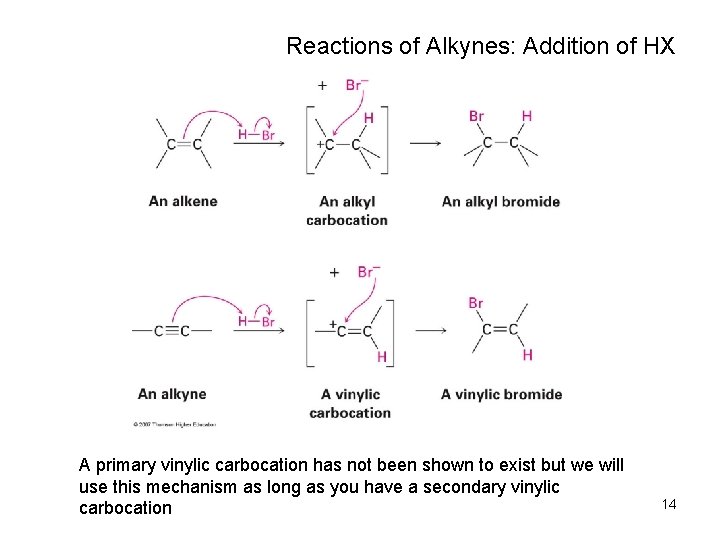
Reactions of Alkynes: Addition of HX A primary vinylic carbocation has not been shown to exist but we will use this mechanism as long as you have a secondary vinylic carbocation 14
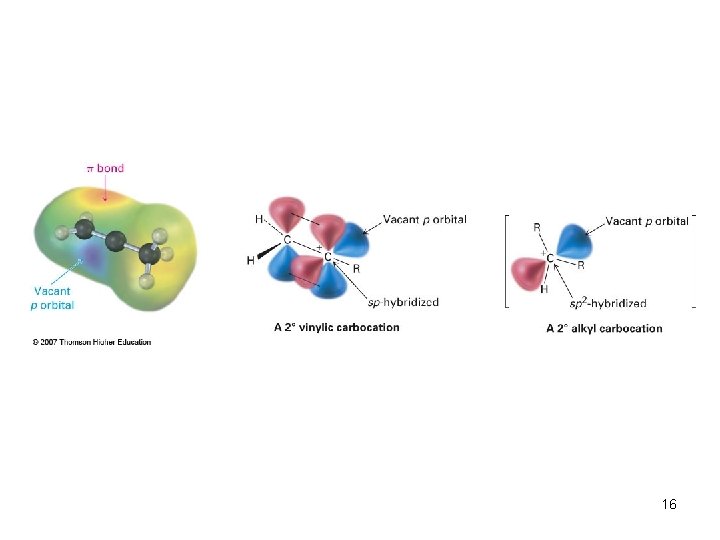
Reactions of Alkynes: Addition of HX • Addition of H-X to alkyne should produce a vinylic carbocation intermediate – Secondary vinyl carbocations form less readily than primary alkyl carbocations – Primary vinyl carbocations probably do not form at all • Nonethelss, H-Br can add to an alkyne to give a vinyl bromide if the Br is not on a primary carbon 15
16
Reactions of Alkynes: Addition of X 2 Anti-addition 17
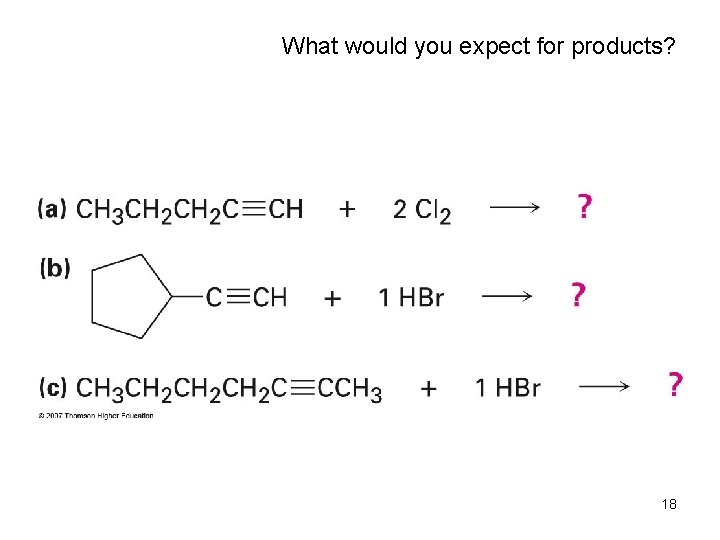
What would you expect for products? 18
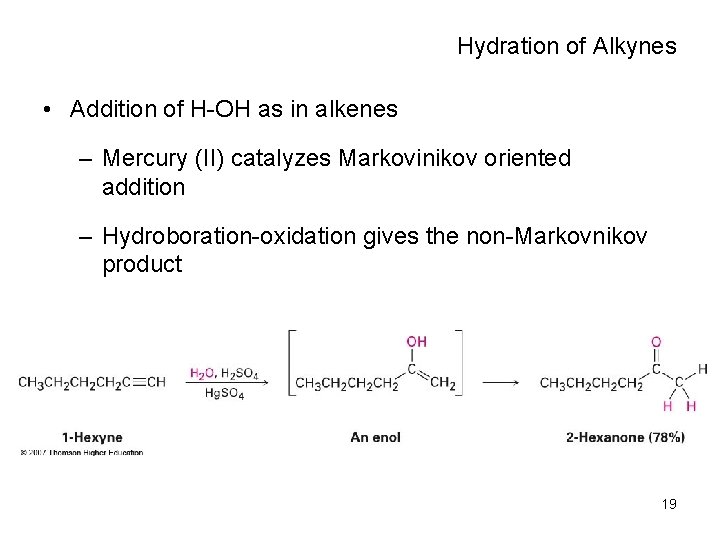
Hydration of Alkynes • Addition of H-OH as in alkenes – Mercury (II) catalyzes Markovinikov oriented addition – Hydroboration-oxidation gives the non-Markovnikov product 19
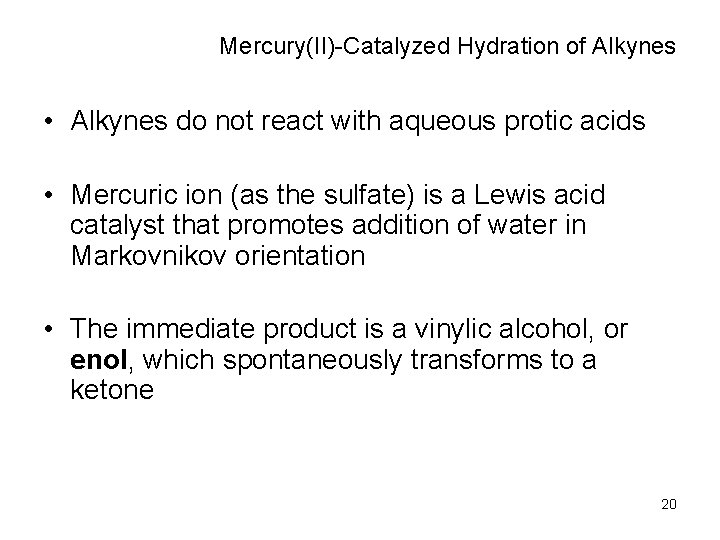
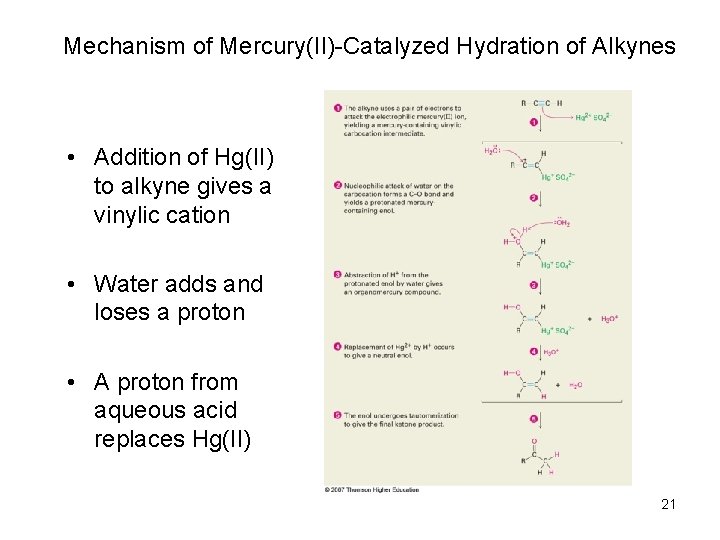
Mercury(II)-Catalyzed Hydration of Alkynes • Alkynes do not react with aqueous protic acids • Mercuric ion (as the sulfate) is a Lewis acid catalyst that promotes addition of water in Markovnikov orientation • The immediate product is a vinylic alcohol, or enol, which spontaneously transforms to a ketone 20
Mechanism of Mercury(II)-Catalyzed Hydration of Alkynes • Addition of Hg(II) to alkyne gives a vinylic cation • Water adds and loses a proton • A proton from aqueous acid replaces Hg(II) 21
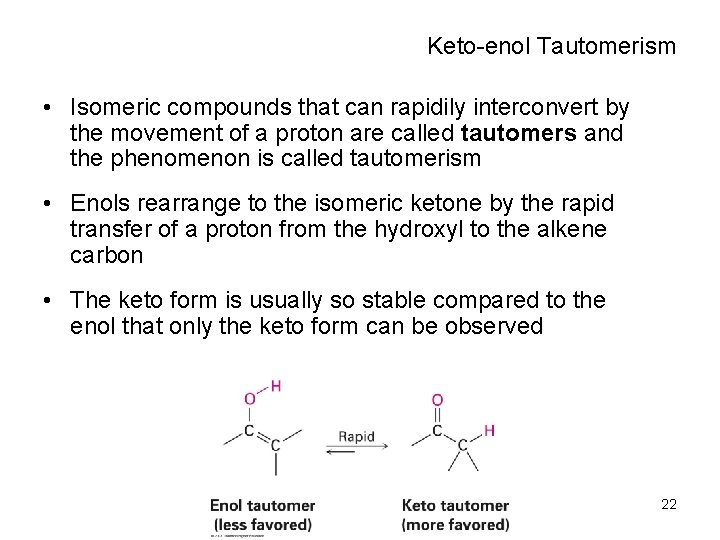
Keto-enol Tautomerism • Isomeric compounds that can rapidily interconvert by the movement of a proton are called tautomers and the phenomenon is called tautomerism • Enols rearrange to the isomeric ketone by the rapid transfer of a proton from the hydroxyl to the alkene carbon • The keto form is usually so stable compared to the enol that only the keto form can be observed 22
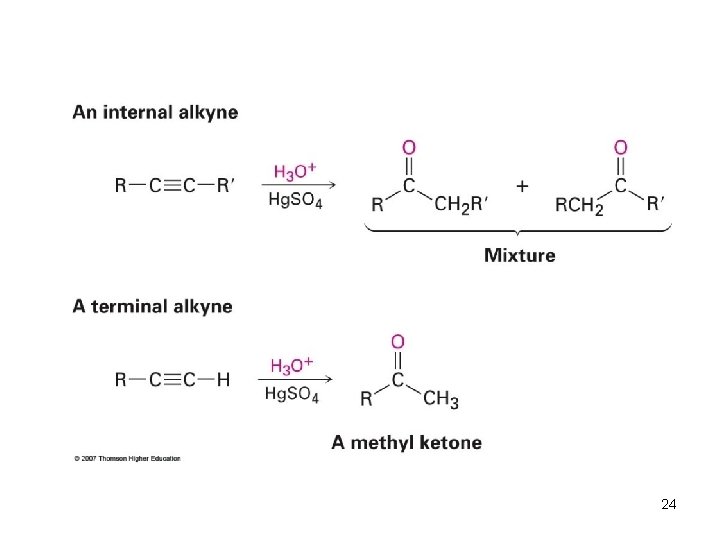
Hydration of Unsymmetrical Alkynes • If the alkyl groups at either end of the C-C triple bond are not the same, both products can form and this is not normally useful • If the triple bond is at the first carbon of the chain (then H is what is attached to one side) this is called a terminal alkyne • Hydration of a terminal always gives the methyl ketone, which is useful 23
24
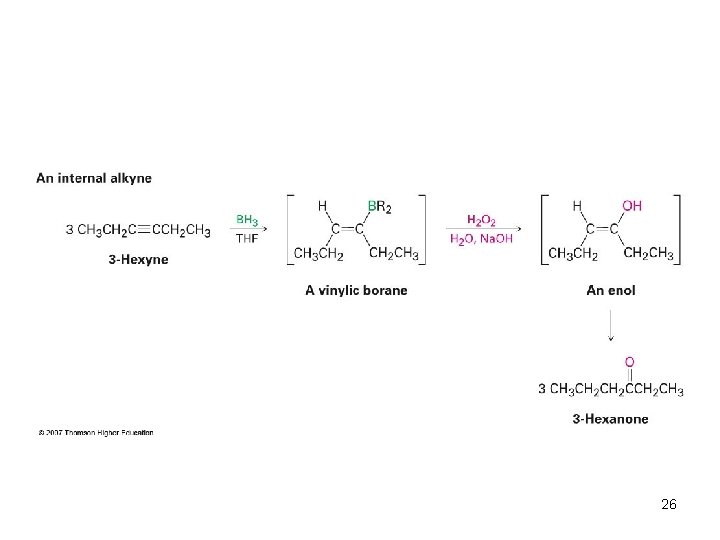
Hydroboration/Oxidation of Alkynes • BH 3 (borane) adds to alkynes to give a vinylic borane • Oxidation with H 2 O 2 produces an enol that converts to the ketone or aldehyde • Process converts alkyne to ketone or aldehyde with orientation opposite to mercuric ion catalyzed hydration • Non-Markovnikov Product 25
26
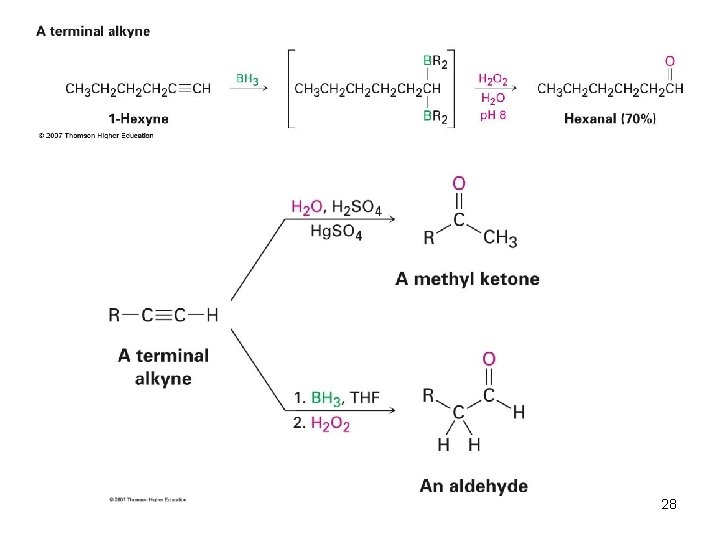
Comparison of Hydration of Terminal Alkynes • Hydroboration/oxidation converts terminal alkynes to aldehydes because addition of water is non-Markovnikov • The product from the mercury(II) catalyzed hydration converts terminal alkynes to methyl ketones 27
28
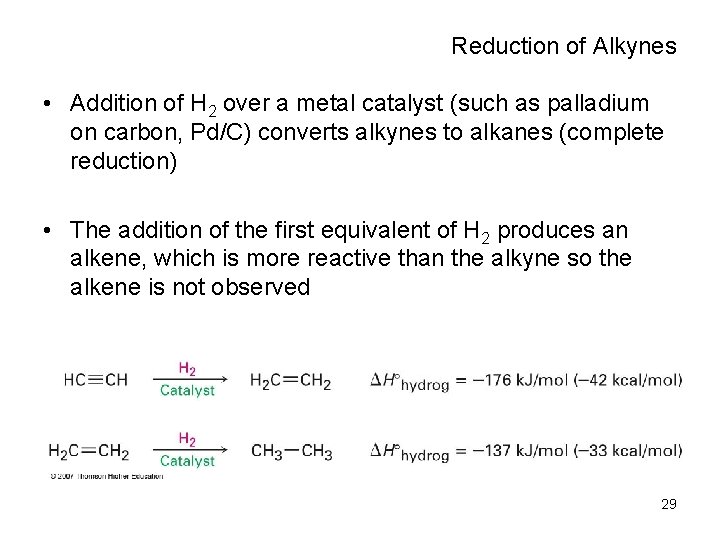
Reduction of Alkynes • Addition of H 2 over a metal catalyst (such as palladium on carbon, Pd/C) converts alkynes to alkanes (complete reduction) • The addition of the first equivalent of H 2 produces an alkene, which is more reactive than the alkyne so the alkene is not observed 29
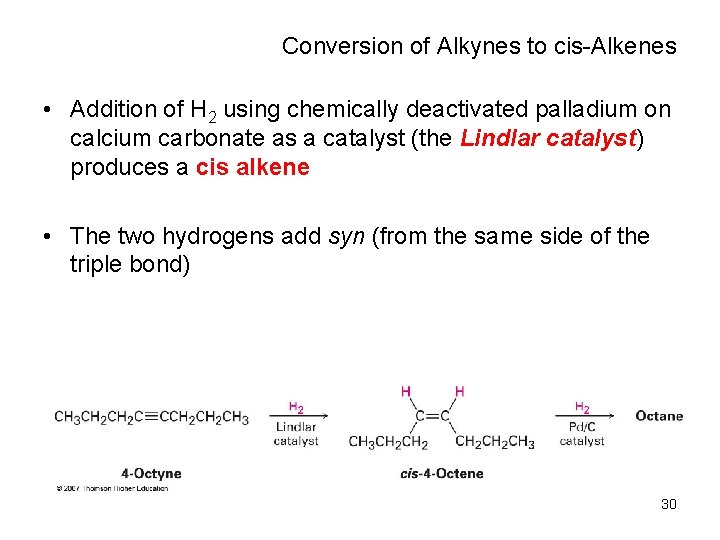
Conversion of Alkynes to cis-Alkenes • Addition of H 2 using chemically deactivated palladium on calcium carbonate as a catalyst (the Lindlar catalyst) produces a cis alkene • The two hydrogens add syn (from the same side of the triple bond) 30
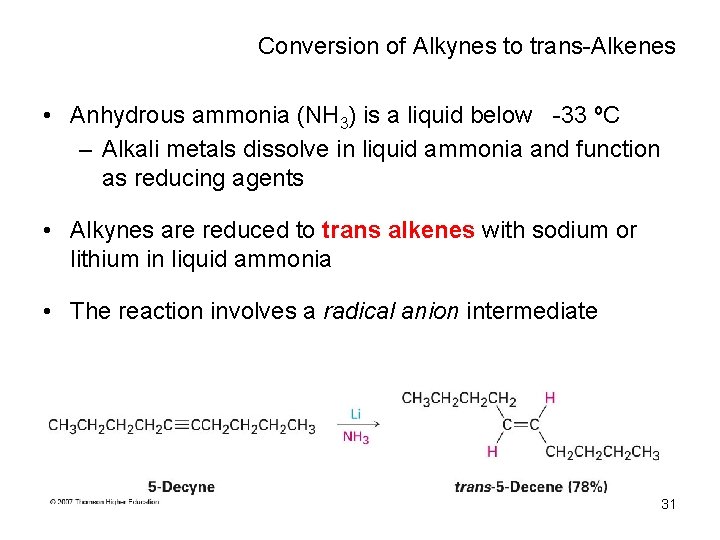
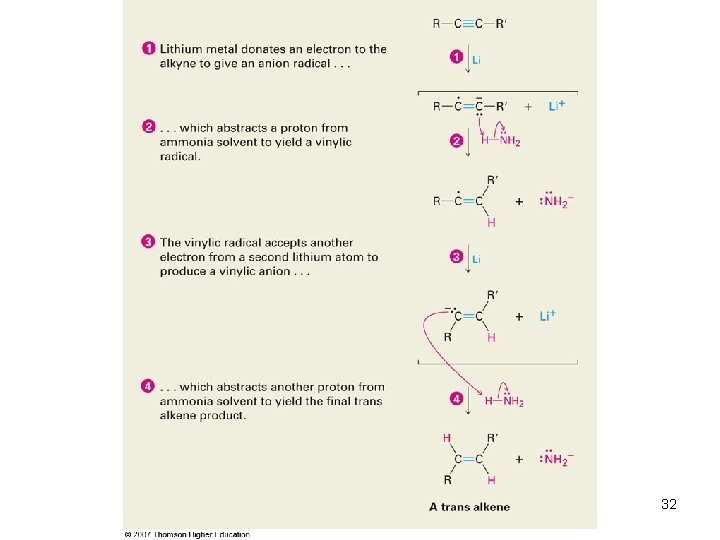
Conversion of Alkynes to trans-Alkenes • Anhydrous ammonia (NH 3) is a liquid below -33 ºC – Alkali metals dissolve in liquid ammonia and function as reducing agents • Alkynes are reduced to trans alkenes with sodium or lithium in liquid ammonia • The reaction involves a radical anion intermediate 31
32
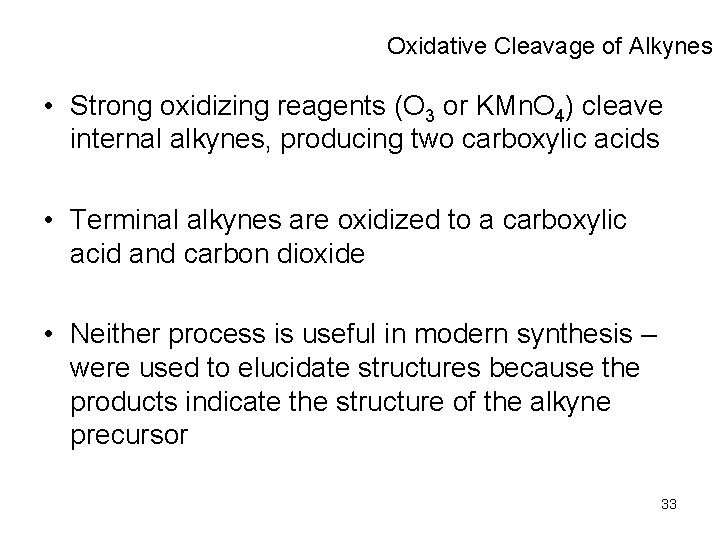
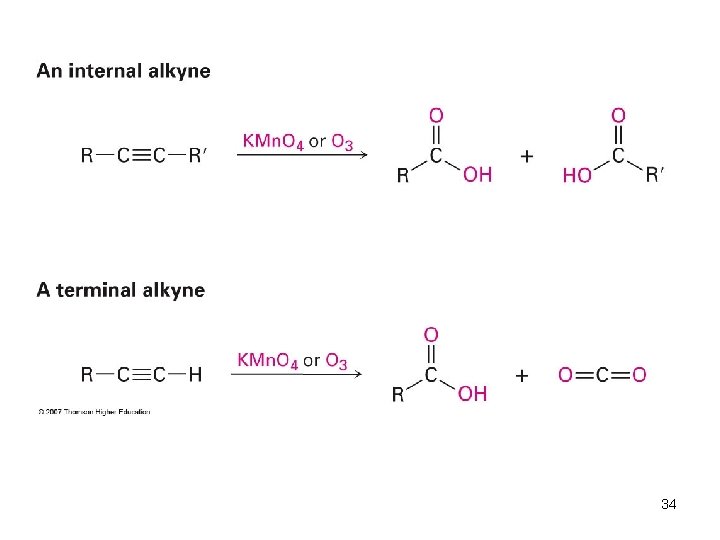
Oxidative Cleavage of Alkynes • Strong oxidizing reagents (O 3 or KMn. O 4) cleave internal alkynes, producing two carboxylic acids • Terminal alkynes are oxidized to a carboxylic acid and carbon dioxide • Neither process is useful in modern synthesis – were used to elucidate structures because the products indicate the structure of the alkyne precursor 33
34
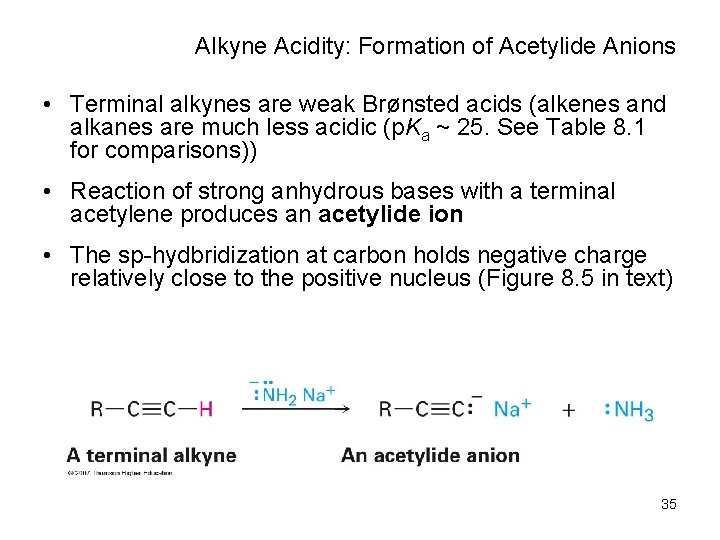
Alkyne Acidity: Formation of Acetylide Anions • Terminal alkynes are weak Brønsted acids (alkenes and alkanes are much less acidic (p. Ka ~ 25. See Table 8. 1 for comparisons)) • Reaction of strong anhydrous bases with a terminal acetylene produces an acetylide ion • The sp-hydbridization at carbon holds negative charge relatively close to the positive nucleus (Figure 8. 5 in text) 35
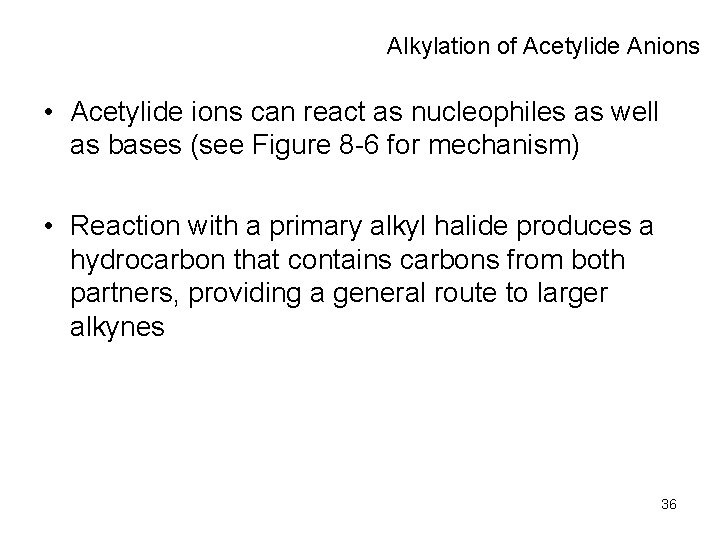
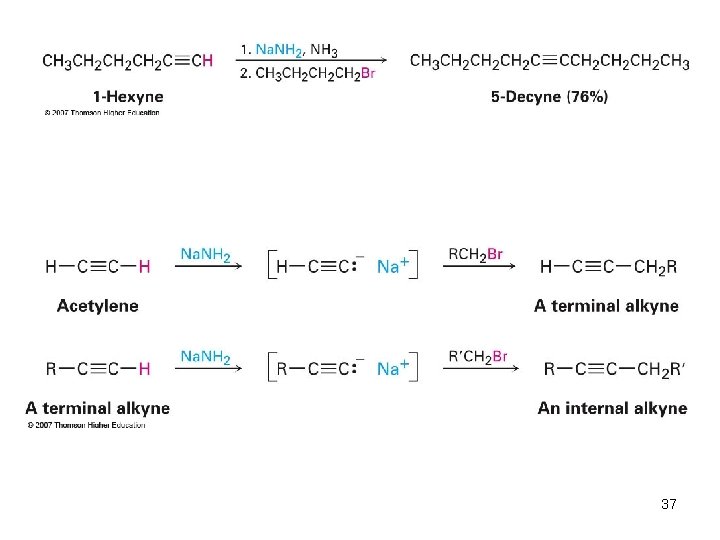
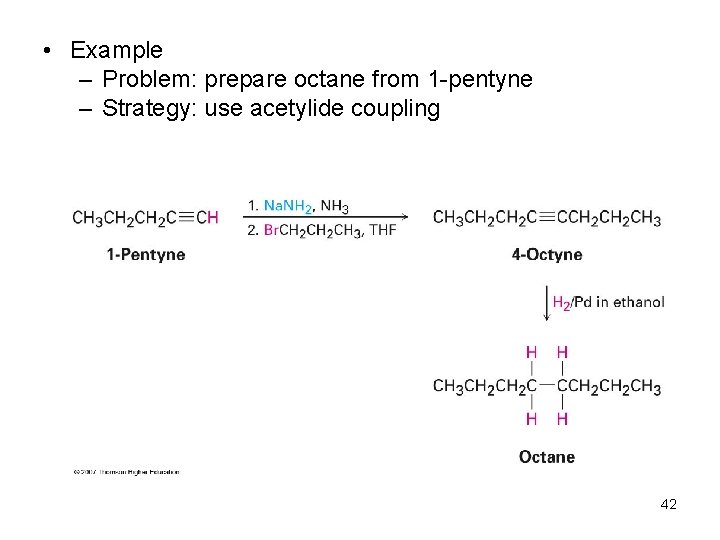
Alkylation of Acetylide Anions • Acetylide ions can react as nucleophiles as well as bases (see Figure 8 -6 for mechanism) • Reaction with a primary alkyl halide produces a hydrocarbon that contains carbons from both partners, providing a general route to larger alkynes 36
37
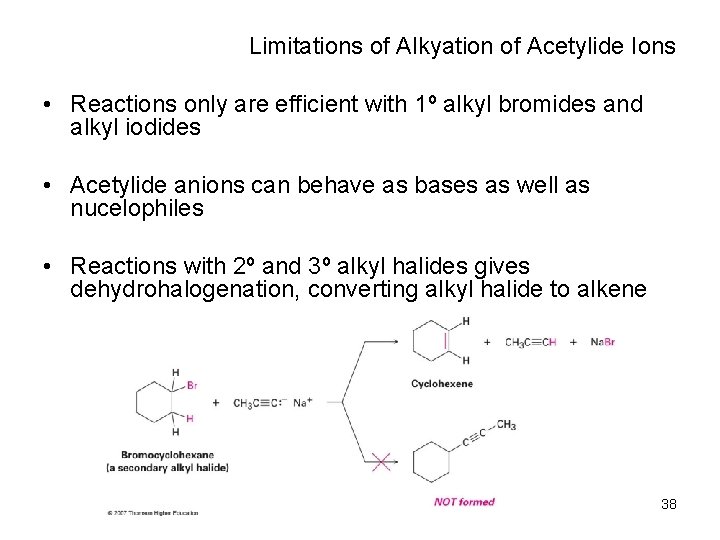
Limitations of Alkyation of Acetylide Ions • Reactions only are efficient with 1º alkyl bromides and alkyl iodides • Acetylide anions can behave as bases as well as nucelophiles • Reactions with 2º and 3º alkyl halides gives dehydrohalogenation, converting alkyl halide to alkene 38
An Introduction to Organic Synthesis • Organic synthesis creates molecules by design • Synthesis can produce new molecules that are needed as drugs or materials • Syntheses can be designed and tested to improve efficiency and safety for making known molecules • Highly advanced synthesis is used to test ideas and methods, answering challenges • Chemists who engage in synthesis may see some work as elegant or beautiful when it uses novel ideas or combinations of steps – this is very subjective and not part of an introductory course 39
Synthesis as a Tool for Learning Organic Chemistry • In order to propose a synthesis you must be familiar with reactions – – What they begin with What they lead to How they are accomplished What the limitations are • A synthesis combines a series of proposed steps to go from a defined set of reactants to a specified product – Questions related to synthesis can include partial information about a reaction of series that the student completes 40
Strategies for Synthesis • Compare the target and the starting material • Consider reactions that efficiently produce the outcome. Look at the product and think of what can lead to it (Read the practice problems in the text) 41
• Example – Problem: prepare octane from 1 -pentyne – Strategy: use acetylide coupling 42