
CH 7 WORK LEISURE AND MASS MEDIA Todays
- Slides: 22
CH 7 WORK, LEISURE, AND MASS MEDIA
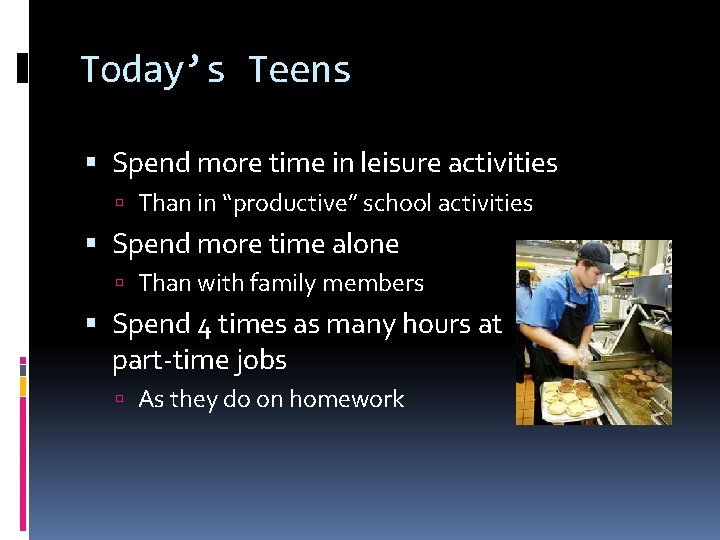
Today’s Teens Spend more time in leisure activities Than in “productive” school activities Spend more time alone Than with family members Spend 4 times as many hours at part-time jobs As they do on homework
Patterns of Time Use
Patterns of Time Use (continued) Suburban, middle-class, white teenagers, and urban, poor, African American teenagers have very similar time allocation. ~50% Leisure, 24% Maintenance, 20 -28% Productive
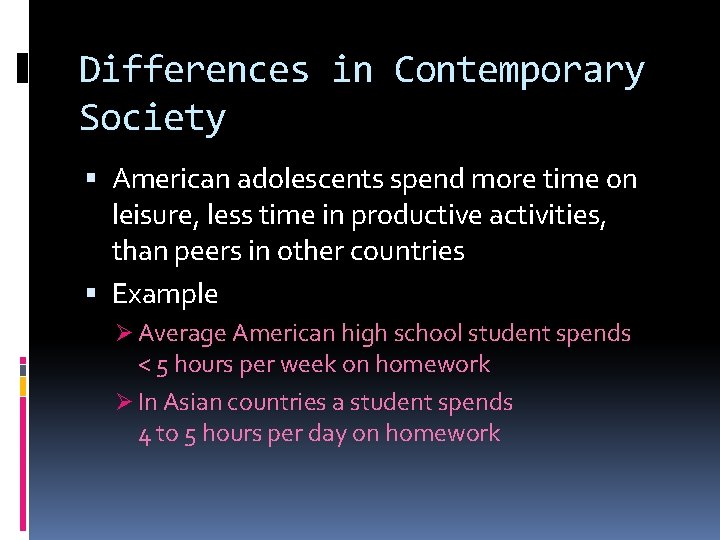
Differences in Contemporary Society American adolescents spend more time on leisure, less time in productive activities, than peers in other countries Example Ø Average American high school student spends < 5 hours per week on homework Ø In Asian countries a student spends 4 to 5 hours per day on homework
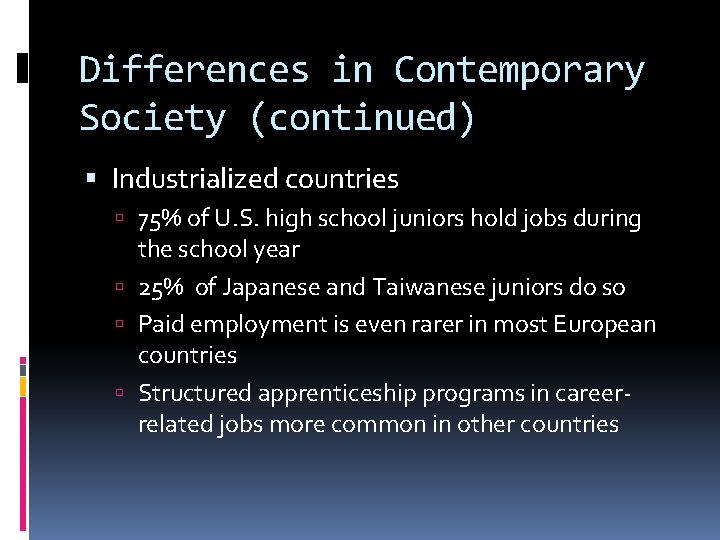
Differences in Contemporary Society (continued) Industrialized countries 75% of U. S. high school juniors hold jobs during the school year 25% of Japanese and Taiwanese juniors do so Paid employment is even rarer in most European countries Structured apprenticeship programs in careerrelated jobs more common in other countries
Adolescents and Work: Beneficial or Detrimental?
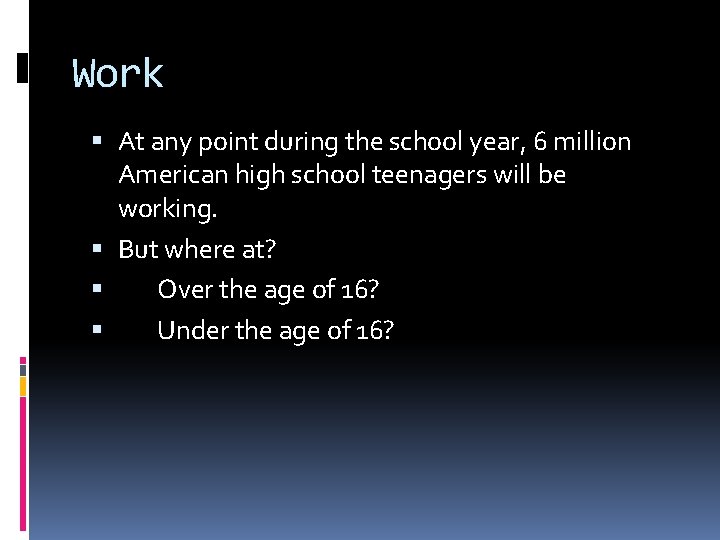
Work At any point during the school year, 6 million American high school teenagers will be working. But where at? Over the age of 16? Under the age of 16?
Adolescents and Work: • Most people believe that working helps teens build character, teaches them about the real world, and prepares them for adulthood • But recent studies show that benefits of working during adolescence have been overstated
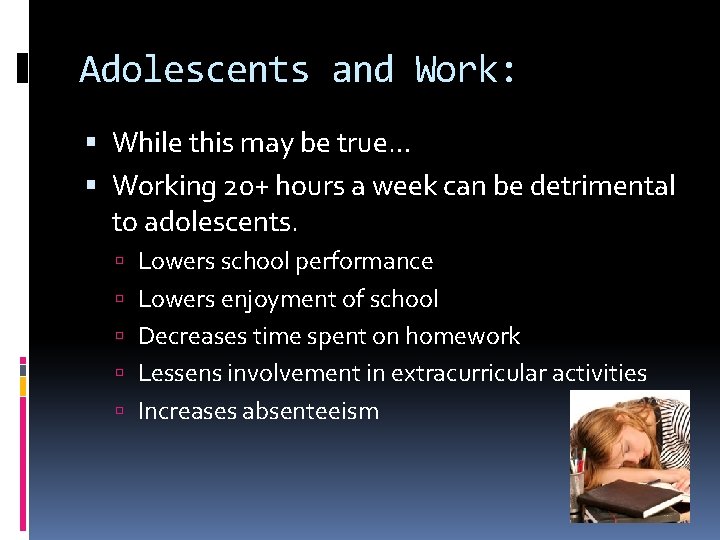
Adolescents and Work: While this may be true… Working 20+ hours a week can be detrimental to adolescents. Lowers school performance Lowers enjoyment of school Decreases time spent on homework Lessens involvement in extracurricular activities Increases absenteeism
Adolescents and Work: Problem Behavior Time-honored belief: Working will deter teens from criminal activity by keeping them out of trouble Research findings: Working long hours may actually be associated with increases in �aggression �school misconduct �precocious sexual activity �minor delinquency
Adolescents and Work: Problem Behavior Differential Impact: Middle-Class vs. Poor Youth �Poor youth – working may not lead to problem behavior – WHY? �Working during junior high may increase chances of problem behavior as opposed to working later in high school—working early make school seem less important
Adolescents and Mass Media: The average adolescent spends more than 7 hours each day using one or more media The average teenager spends over 50 hours a week using digital media, more than a full-time job! Many adolescents view TV, listen to music, get on the internet, and play video games, all from their bedrooms �This context makes parental monitoring more difficult
Videos http: //www. pbs. org/wgbh/pages/frontline/dig italnation/living-faster/split-focus/how-doteens-do-homework-today. html? play http: //www. pbs. org/wgbh/pages/frontline/dig italnation/living-faster/digitalnatives/rewiring-young-brains. html
Adolescents and Mass Media: Discussion How does all of this media intake impact adolescents? Food for Thought: Politicians often argue that adolescents’ development is being adversely affected by the mass media. How do you respond to these claims?
Video http: //www. youtube. com/watch? v=Uz. EOZF 9 MNS 0
Media Impact on Sexual Themes 70% of prime television contains sexual themes Objectification of women, sex as a symbol of masculinity, sex as competition How often are consequences shown?
The Adolescent Consumer The average adolescent has more than $400 in spending money per month. In 2008 Teenagers were projected to spend more than $200 billion
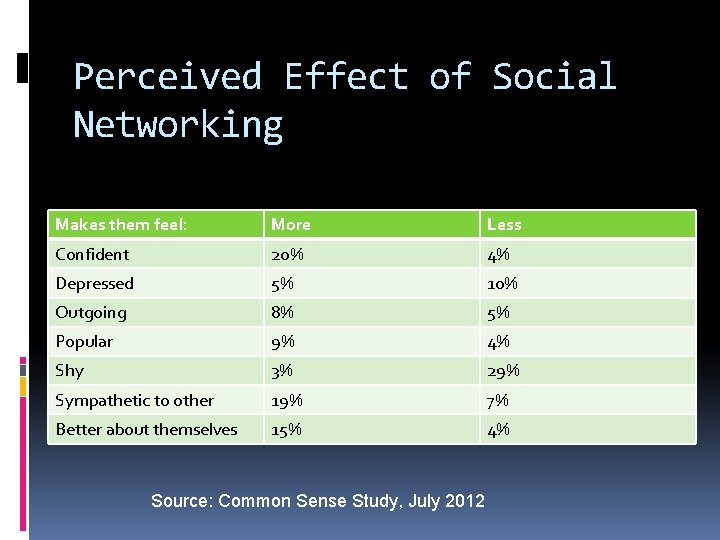
Perceived Effect of Social Networking Makes them feel: More Less Confident 20% 4% Depressed 5% 10% Outgoing 8% 5% Popular 9% 4% Shy 3% 29% Sympathetic to other 19% 7% Better about themselves 15% 4% Source: Common Sense Study, July 2012
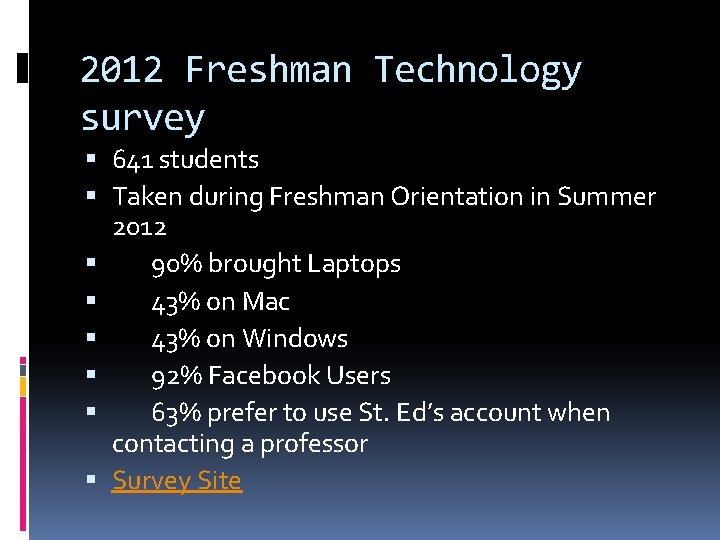
2012 Freshman Technology survey 641 students Taken during Freshman Orientation in Summer 2012 90% brought Laptops 43% on Mac 43% on Windows 92% Facebook Users 63% prefer to use St. Ed’s account when contacting a professor Survey Site
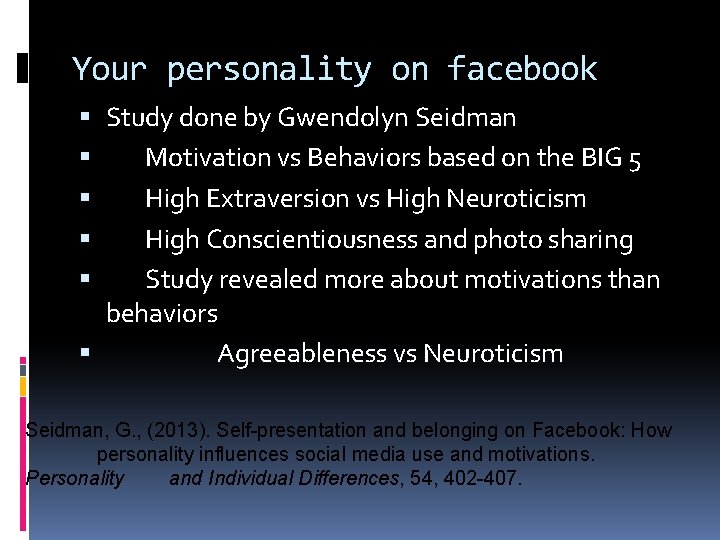
Your personality on facebook Study done by Gwendolyn Seidman Motivation vs Behaviors based on the BIG 5 High Extraversion vs High Neuroticism High Conscientiousness and photo sharing Study revealed more about motivations than behaviors Agreeableness vs Neuroticism Seidman, G. , (2013). Self-presentation and belonging on Facebook: How personality influences social media use and motivations. Personality and Individual Differences, 54, 402 -407.
Effect of media Based on the statistics of how much time people spend online and with media every day, what are your opinions on this video