
Ch 7 The Space Radiation Environment and the
- Slides: 65
Ch. 7 The Space Radiation Environment and the Space Weather Information 王若宇 張元翰 黃唯蓉 許皓威
7. 1. 1 Space Radiation and Utilization of the Space Environment 7. 1. 2 Overview of the Space Radiation Environment 7. 1. 3 Galactic Cosmic Rays 王若宇 andy 19961010@gmail. com
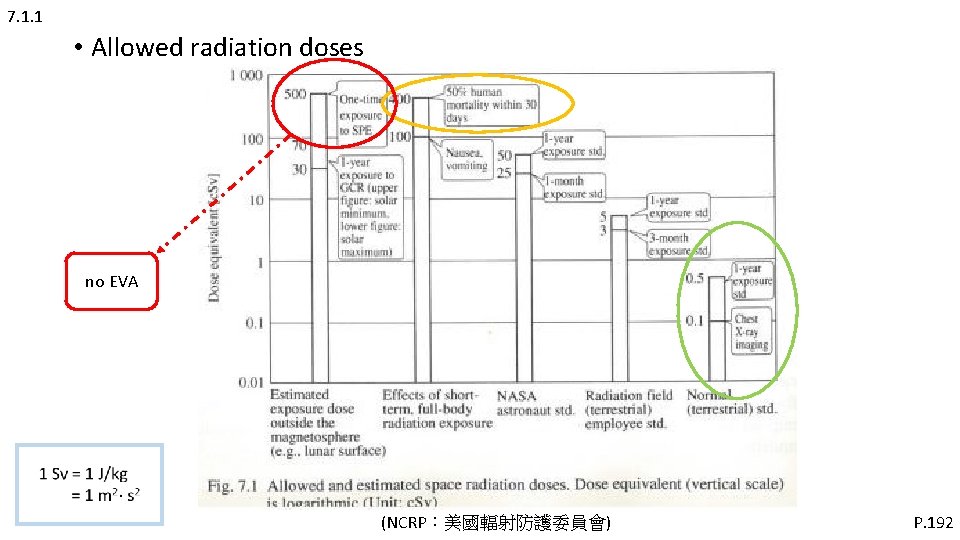
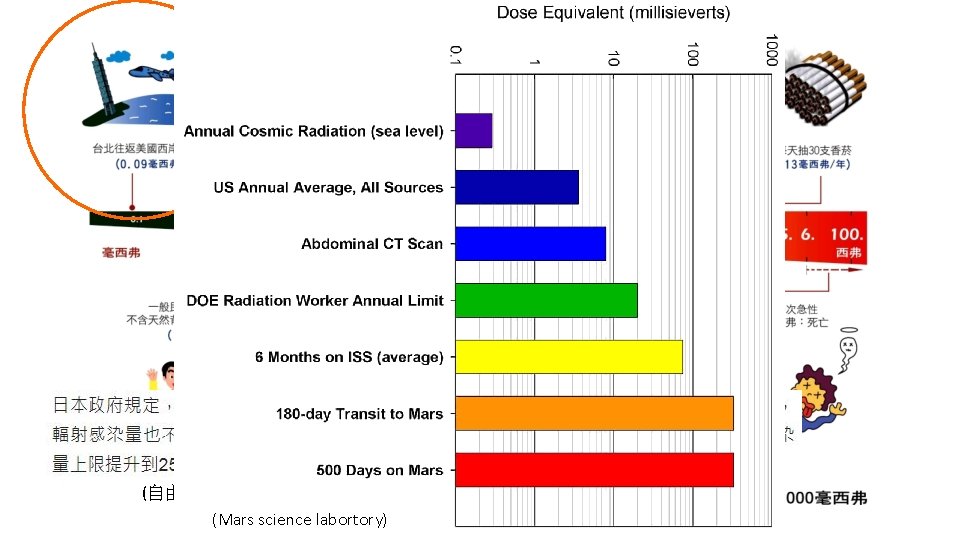
7. 1. 1 • Allowed radiation doses no EVA (NCRP:美國輻射防護委員會) P. 192
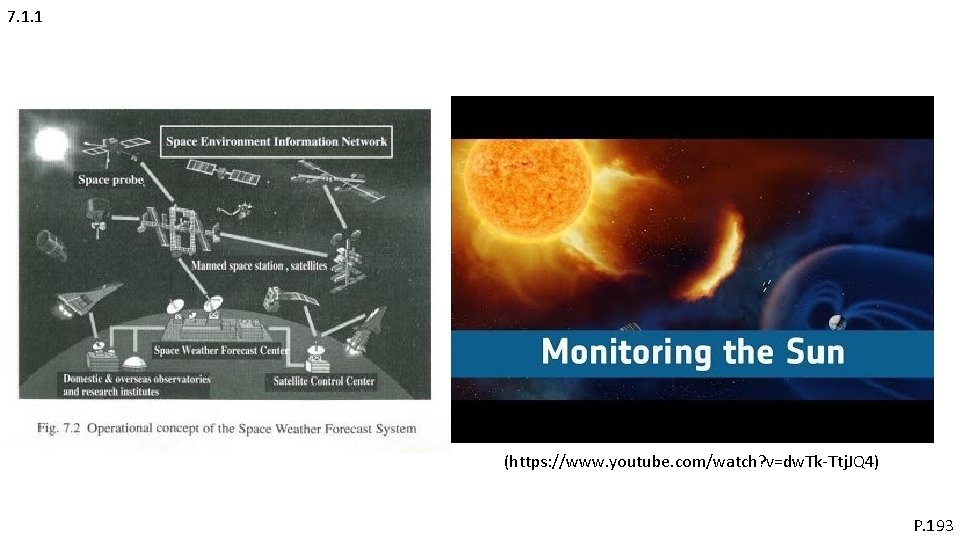
7. 1. 1 (https: //www. youtube. com/watch? v=dw. Tk-Ttj. JQ 4) P. 193
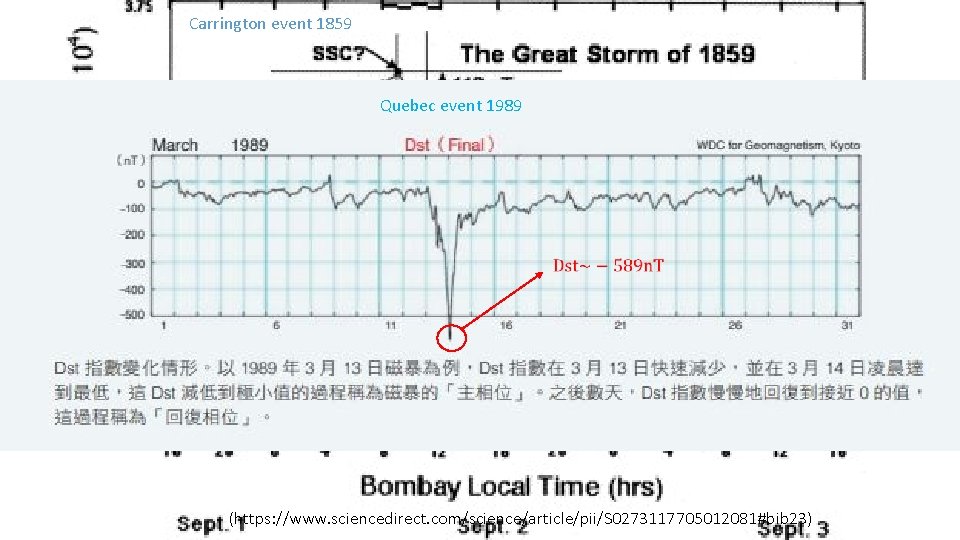
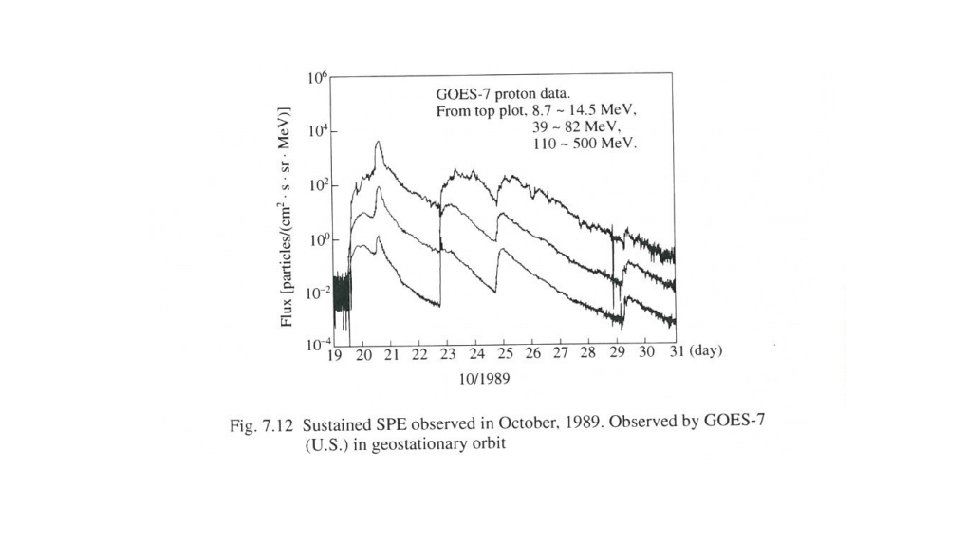
Carrington event 1859 Quebec event 1989 (電離層太空天氣預報 - 國內學術電子期刊系統) (https: //www. sciencedirect. com/science/article/pii/S 0273117705012081#bib 23)
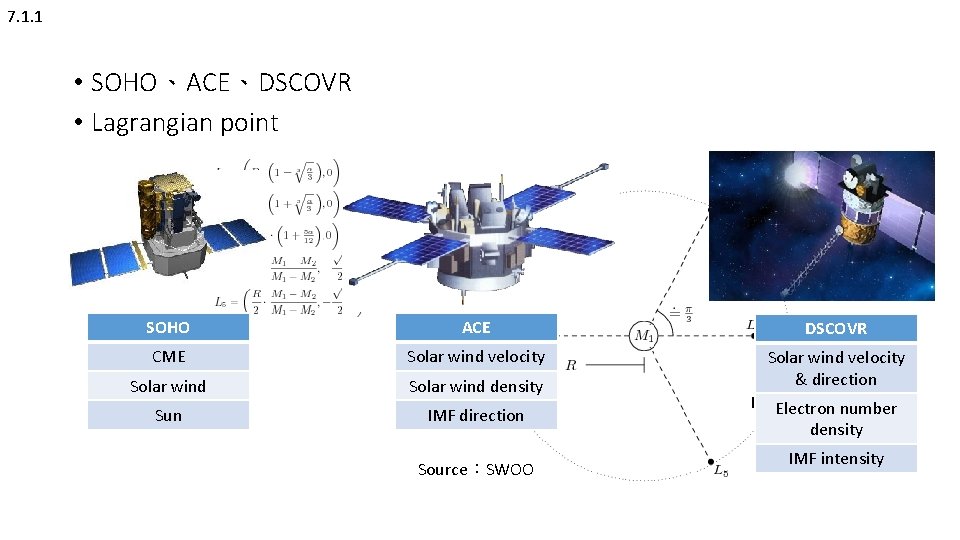
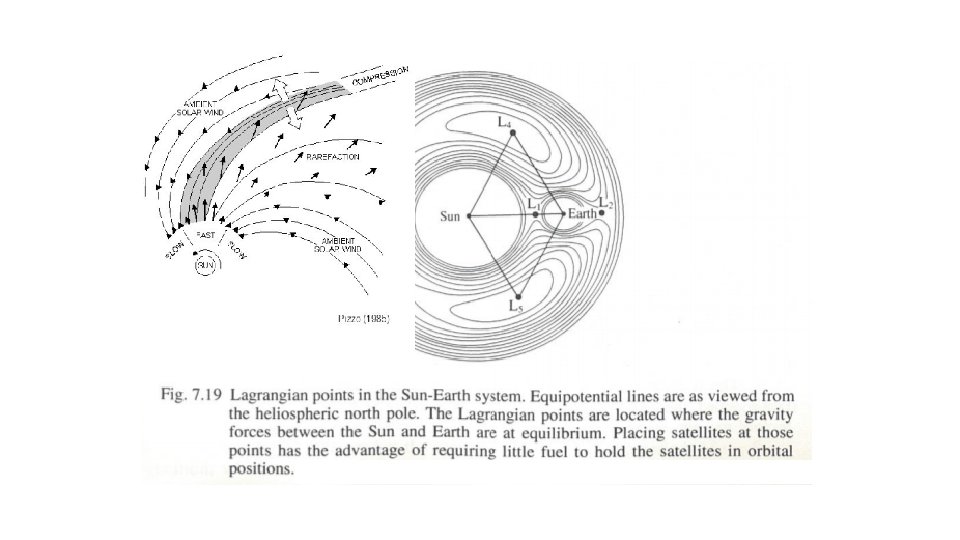
7. 1. 1 • SOHO、ACE、DSCOVR • Lagrangian point SOHO ACE CME Solar wind velocity Solar wind density Sun IMF direction Source:SWOO DSCOVR Solar wind velocity & direction L 1約距地球0. 01 AU Electron number density IMF intensity
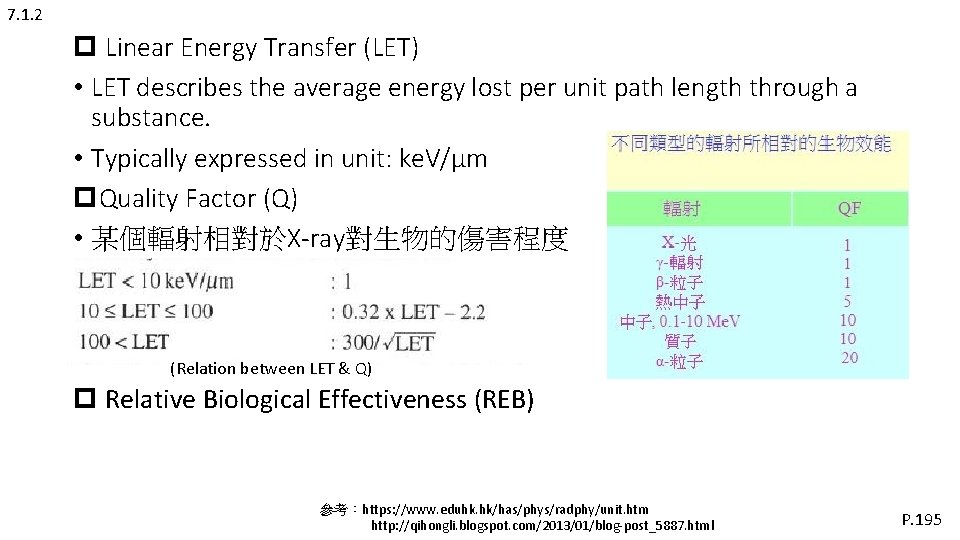
7. 1. 2 p Linear Energy Transfer (LET) • LET describes the average energy lost per unit path length through a substance. • Typically expressed in unit: ke. V/μm p. Quality Factor (Q) • 某個輻射相對於X-ray對生物的傷害程度 (Relation between LET & Q) p Relative Biological Effectiveness (REB) 參考:https: //www. eduhk. hk/has/phys/radphy/unit. htm http: //qihongli. blogspot. com/2013/01/blog-post_5887. html P. 195
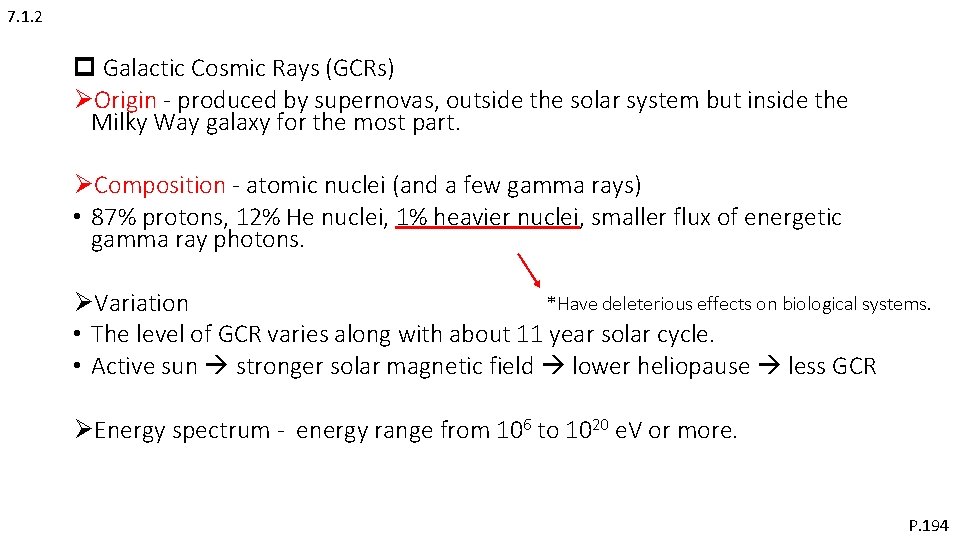
7. 1. 2 p Galactic Cosmic Rays (GCRs) ØOrigin - produced by supernovas, outside the solar system but inside the Milky Way galaxy for the most part. ØComposition - atomic nuclei (and a few gamma rays) • 87% protons, 12% He nuclei, 1% heavier nuclei, smaller flux of energetic gamma ray photons. *Have deleterious effects on biological systems. ØVariation • The level of GCR varies along with about 11 year solar cycle. • Active sun stronger solar magnetic field lower heliopause less GCR ØEnergy spectrum - energy range from 106 to 1020 e. V or more. P. 194
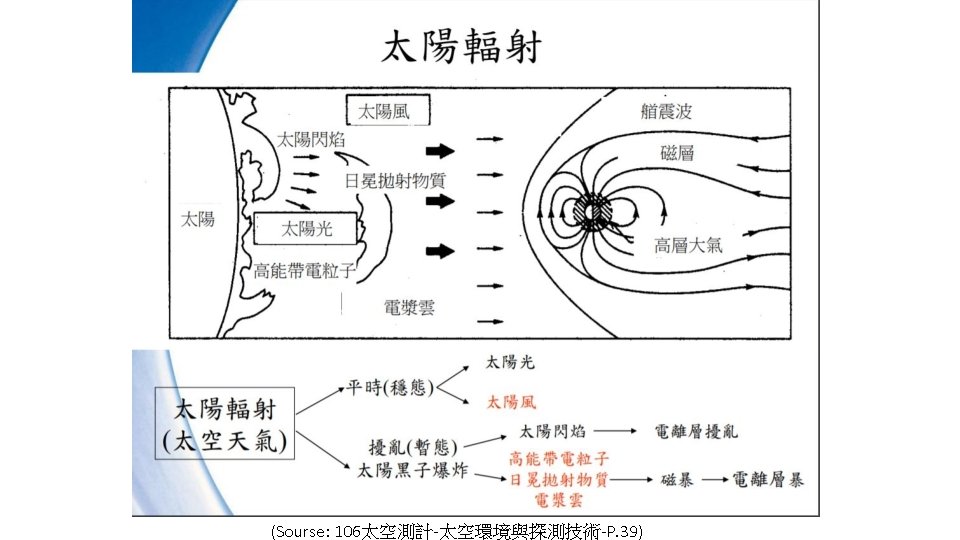
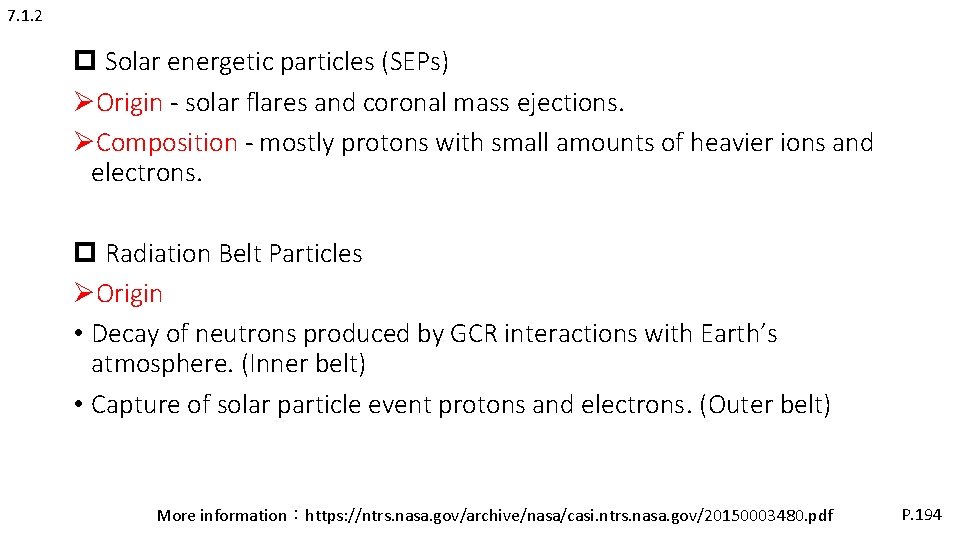
7. 1. 2 p Solar energetic particles (SEPs) ØOrigin - solar flares and coronal mass ejections. ØComposition - mostly protons with small amounts of heavier ions and electrons. p Radiation Belt Particles ØOrigin • Decay of neutrons produced by GCR interactions with Earth’s atmosphere. (Inner belt) • Capture of solar particle event protons and electrons. (Outer belt) More information:https: //ntrs. nasa. gov/archive/nasa/casi. ntrs. nasa. gov/20150003480. pdf P. 194
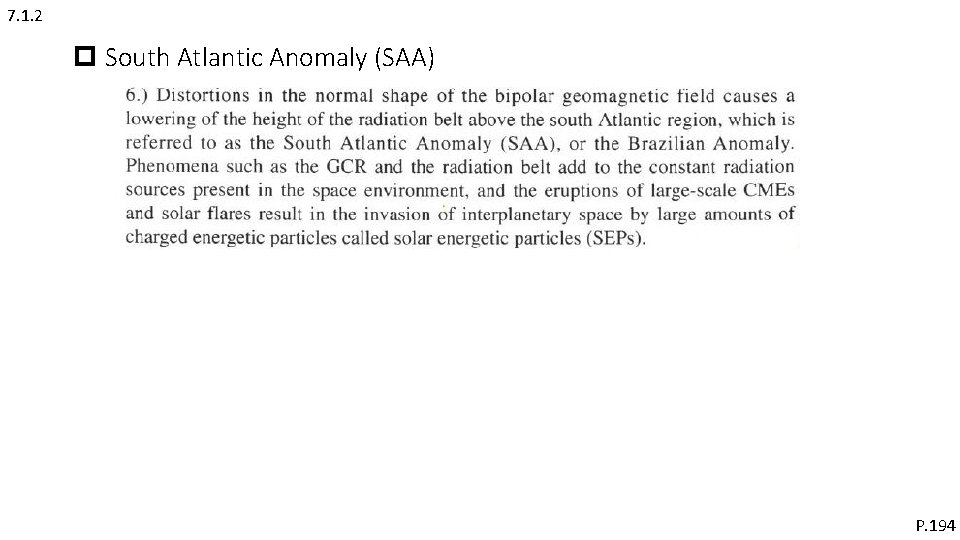
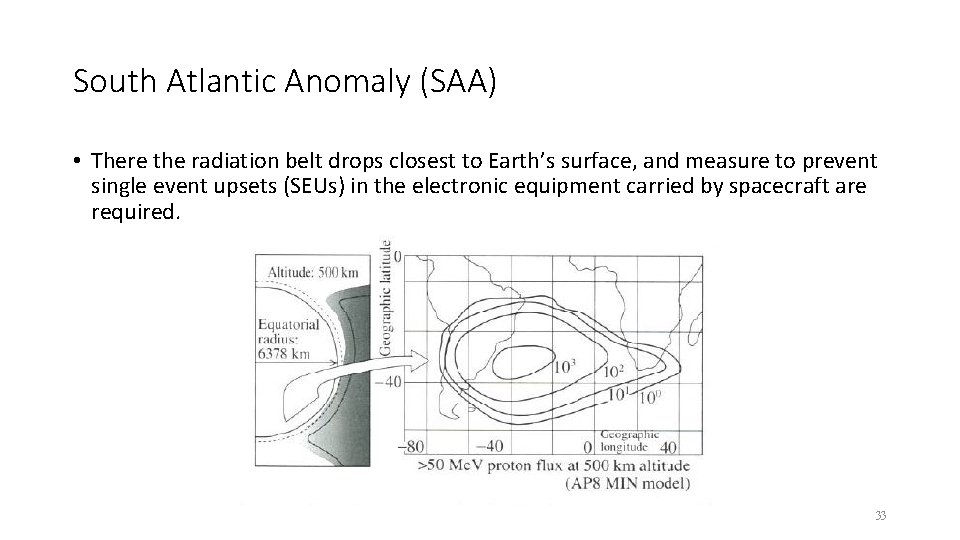
7. 1. 2 p South Atlantic Anomaly (SAA) P. 194
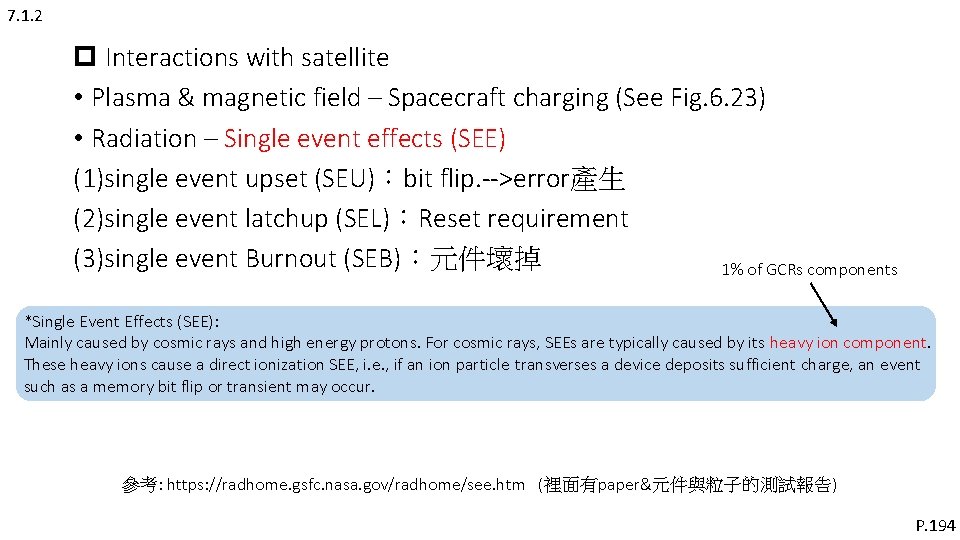
7. 1. 2 p Interactions with satellite • Plasma & magnetic field – Spacecraft charging (See Fig. 6. 23) • Radiation – Single event effects (SEE) (1)single event upset (SEU):bit flip. -->error產生 (2)single event latchup (SEL):Reset requirement (3)single event Burnout (SEB):元件壞掉 1% of GCRs components *Single Event Effects (SEE): Mainly caused by cosmic rays and high energy protons. For cosmic rays, SEEs are typically caused by its heavy ion component. These heavy ions cause a direct ionization SEE, i. e. , if an ion particle transverses a device deposits sufficient charge, an event such as a memory bit flip or transient may occur. 參考: https: //radhome. gsfc. nasa. gov/radhome/see. htm (裡面有paper&元件與粒子的測試報告) P. 194
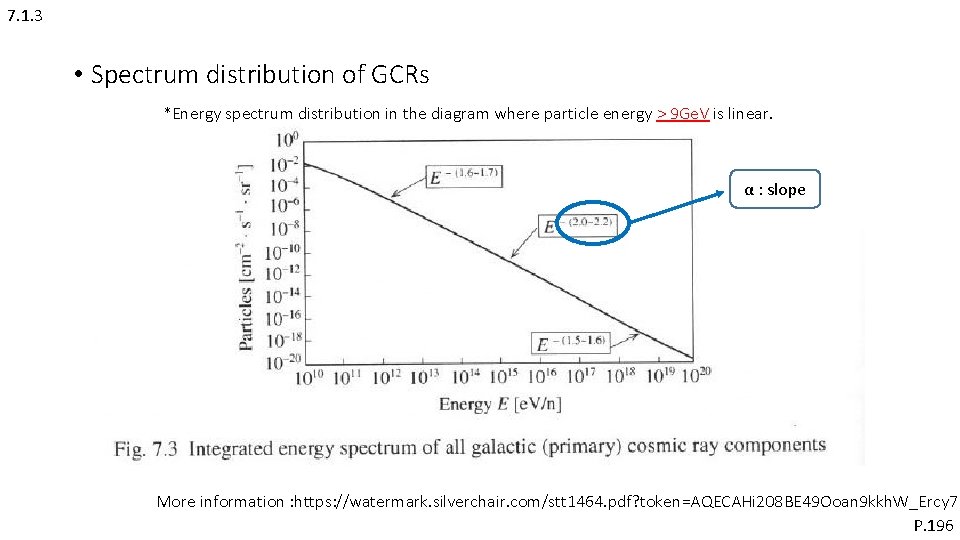
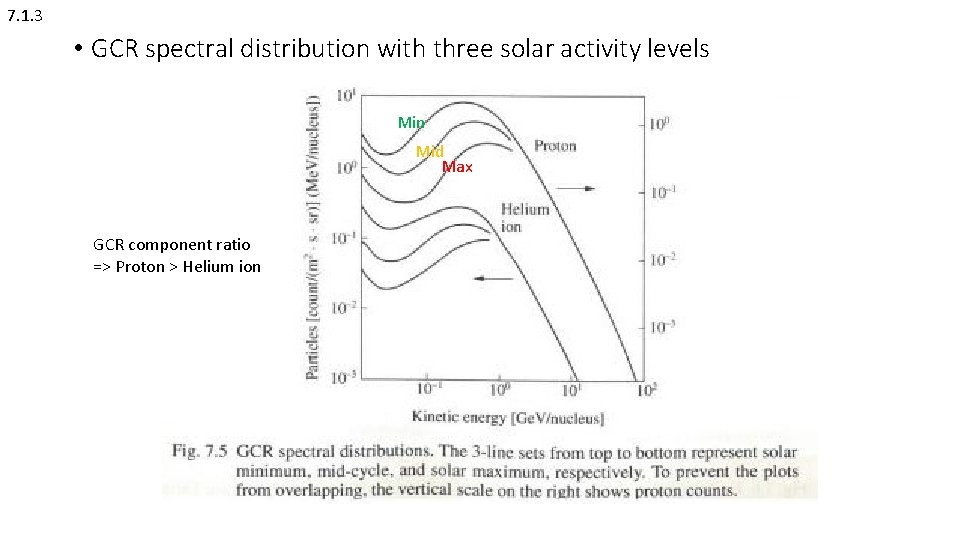
7. 1. 3 • Spectrum distribution of GCRs *Energy spectrum distribution in the diagram where particle energy > 9 Ge. V is linear. α : slope More information : https: //watermark. silverchair. com/stt 1464. pdf? token=AQECAHi 208 BE 49 Ooan 9 kkh. W_Ercy 7 D P. 196
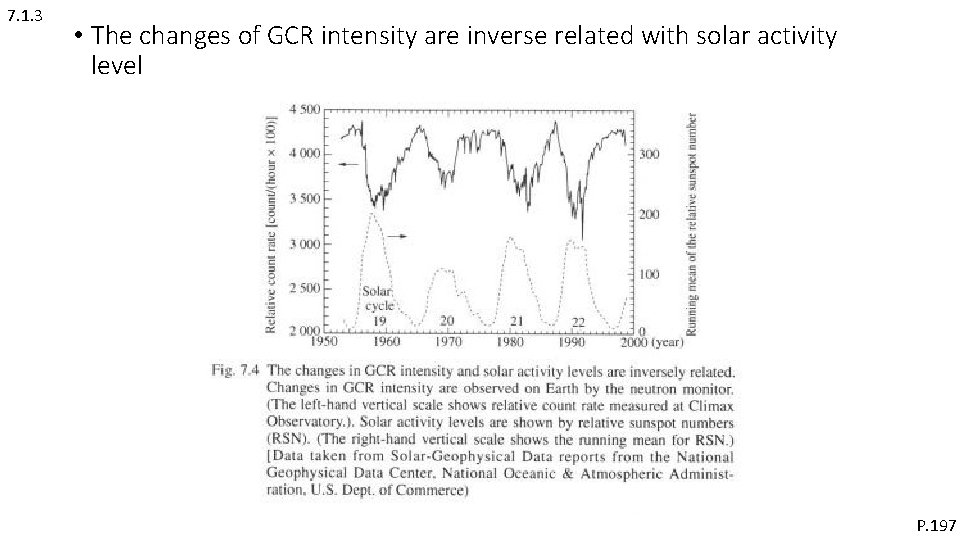
7. 1. 3 • The changes of GCR intensity are inverse related with solar activity level P. 197
7. 1. 3 • GCR spectral distribution with three solar activity levels Min Mid Max GCR component ratio => Proton > Helium ion
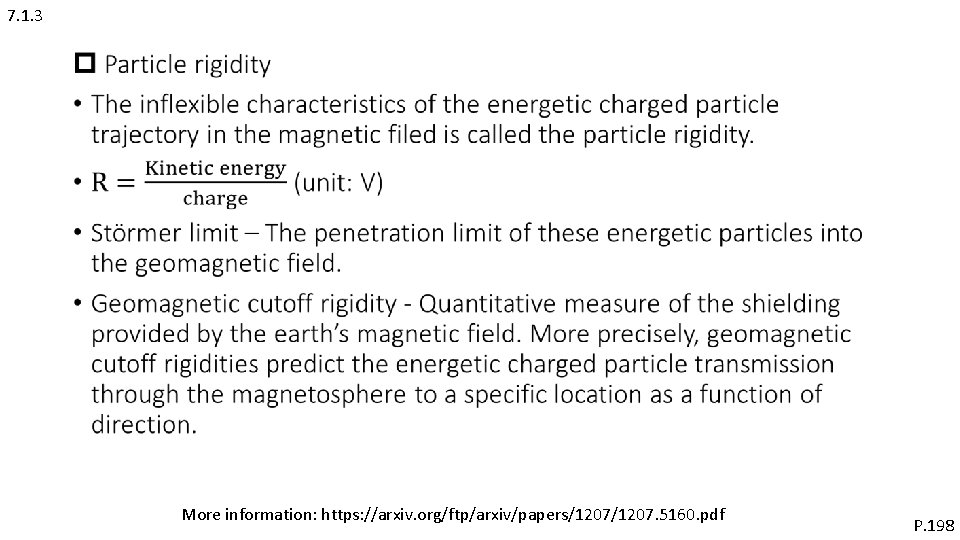
7. 1. 3 • More information: https: //arxiv. org/ftp/arxiv/papers/1207. 5160. pdf P. 198
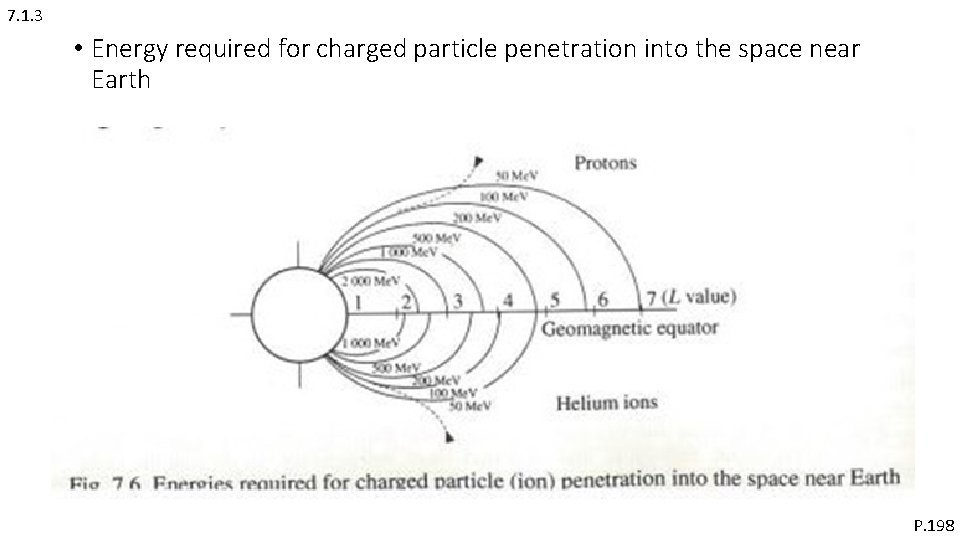
7. 1. 3 • Energy required for charged particle penetration into the space near Earth P. 198
7. 1. 4 The Radiation Belt 7. 1. 5 Solar Particle Event 張元瀚
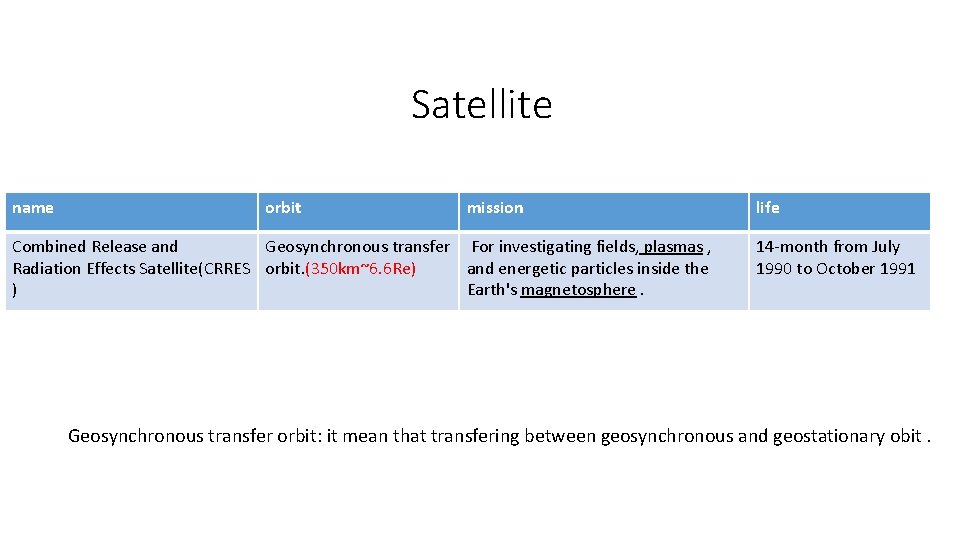
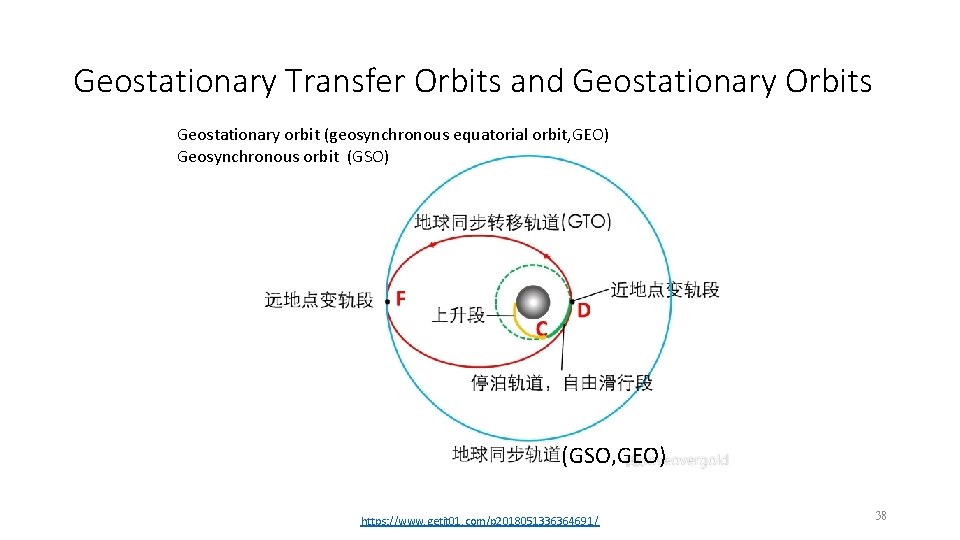
Satellite name orbit mission Combined Release and Geosynchronous transfer For investigating fields, plasmas , Radiation Effects Satellite(CRRES orbit. (350 km~6. 6 Re) and energetic particles inside the ) Earth's magnetosphere. life 14 -month from July 1990 to October 1991 Geosynchronous transfer orbit: it mean that transfering between geosynchronous and geostationary obit.
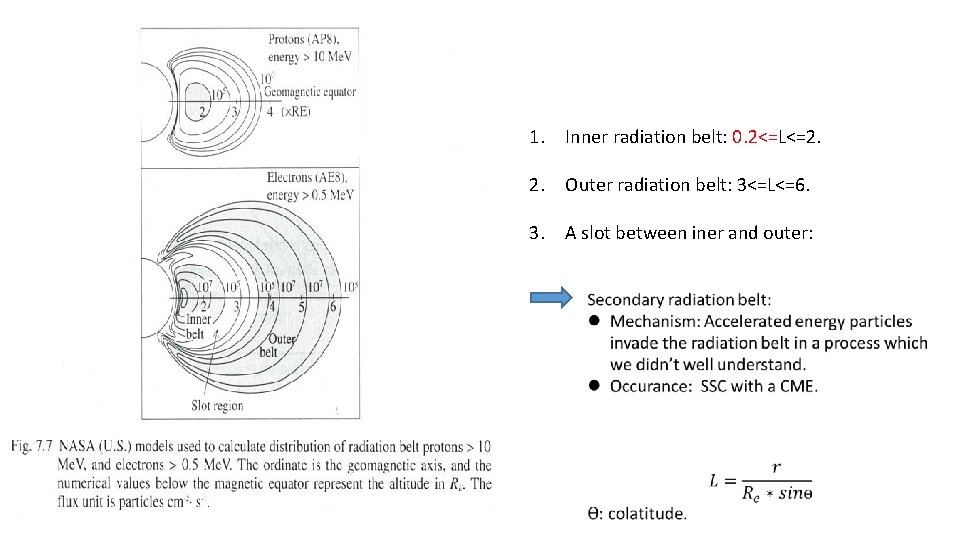
1. Inner radiation belt: 0. 2<=L<=2. 2. Outer radiation belt: 3<=L<=6. 3. A slot between iner and outer:
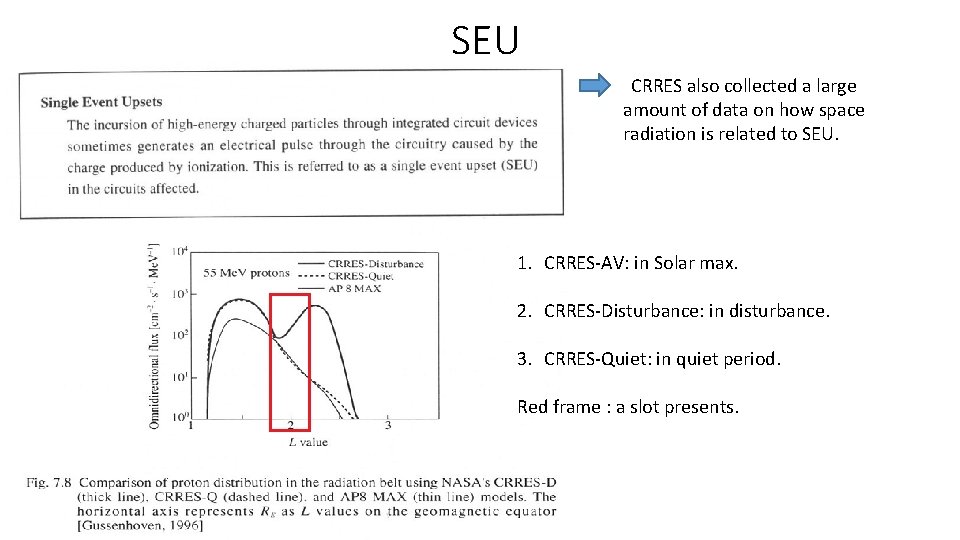
SEU CRRES also collected a large amount of data on how space radiation is related to SEU. 1. CRRES-AV: in Solar max. 2. CRRES-Disturbance: in disturbance. 3. CRRES-Quiet: in quiet period. Red frame : a slot presents.
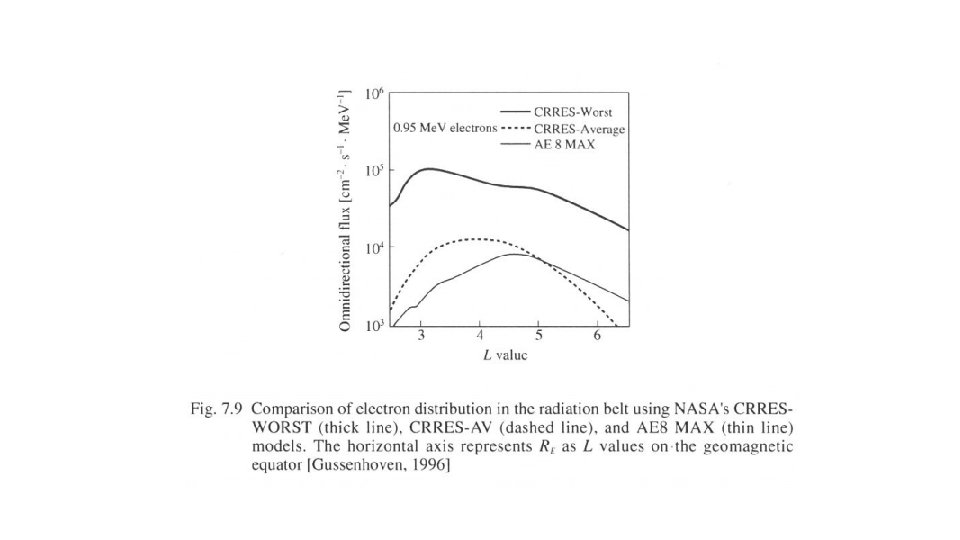
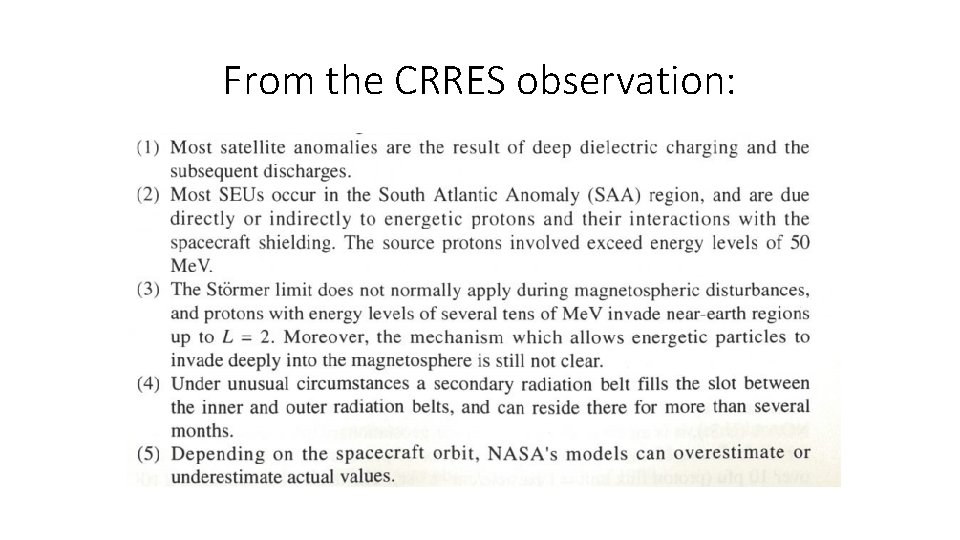
From the CRRES observation:
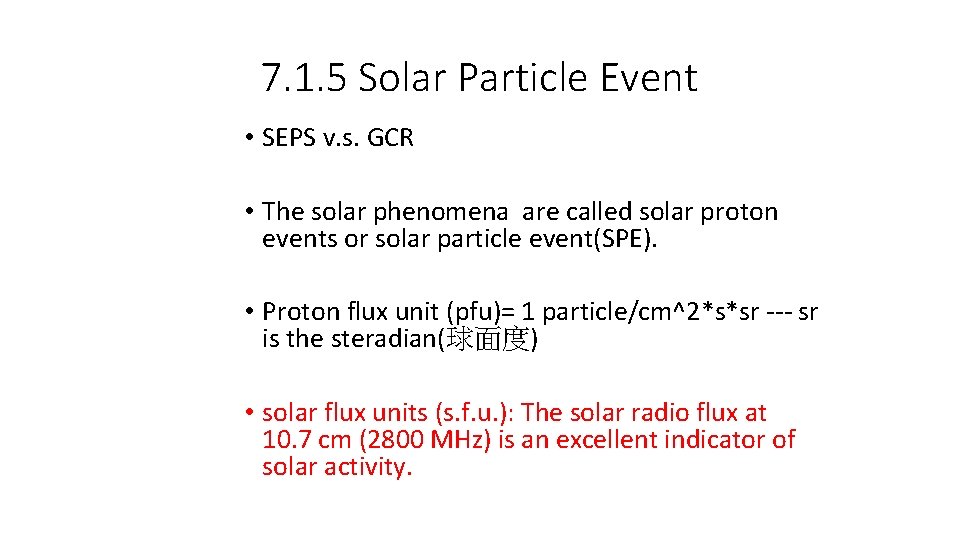
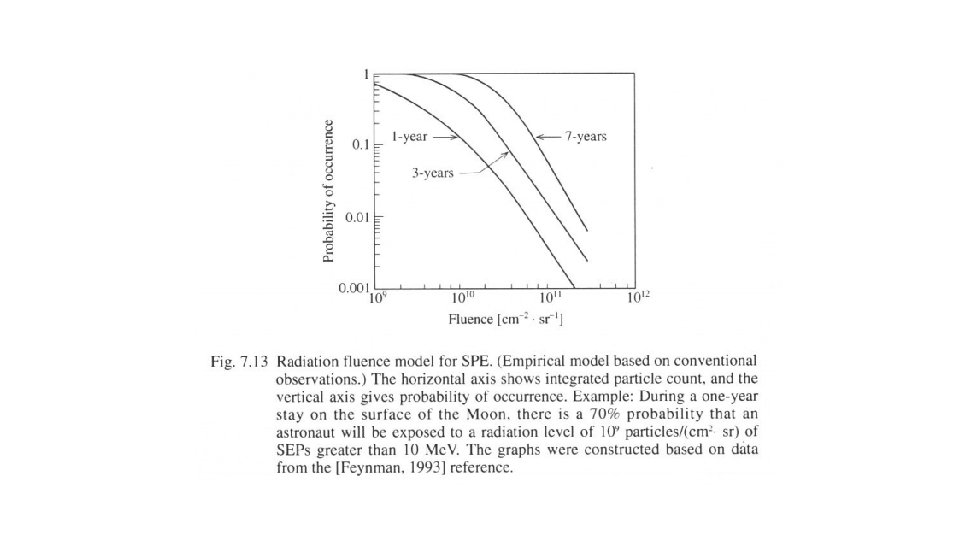
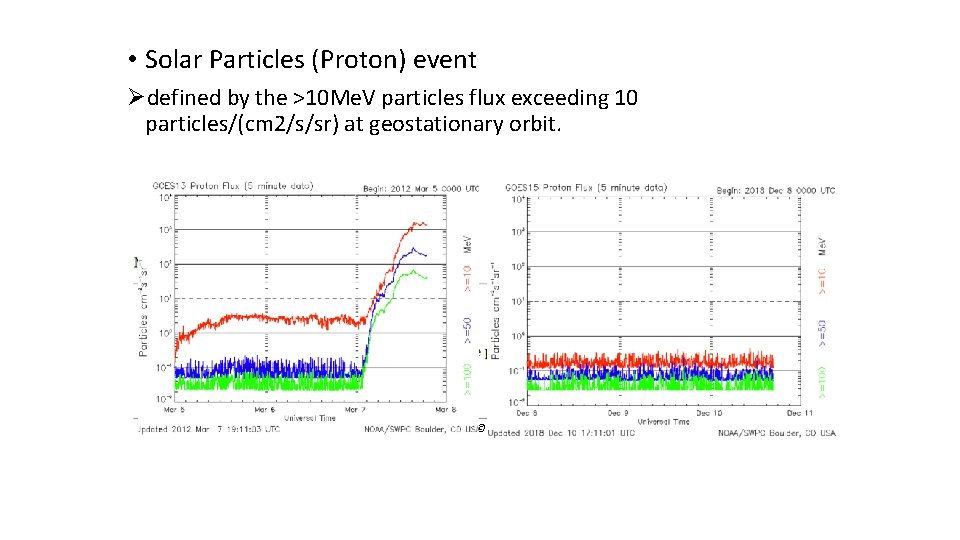
7. 1. 5 Solar Particle Event • SEPS v. s. GCR • The solar phenomena are called solar proton events or solar particle event(SPE). • Proton flux unit (pfu)= 1 particle/cm^2*s*sr --- sr is the steradian(球面度) • solar flux units (s. f. u. ): The solar radio flux at 10. 7 cm (2800 MHz) is an excellent indicator of solar activity.
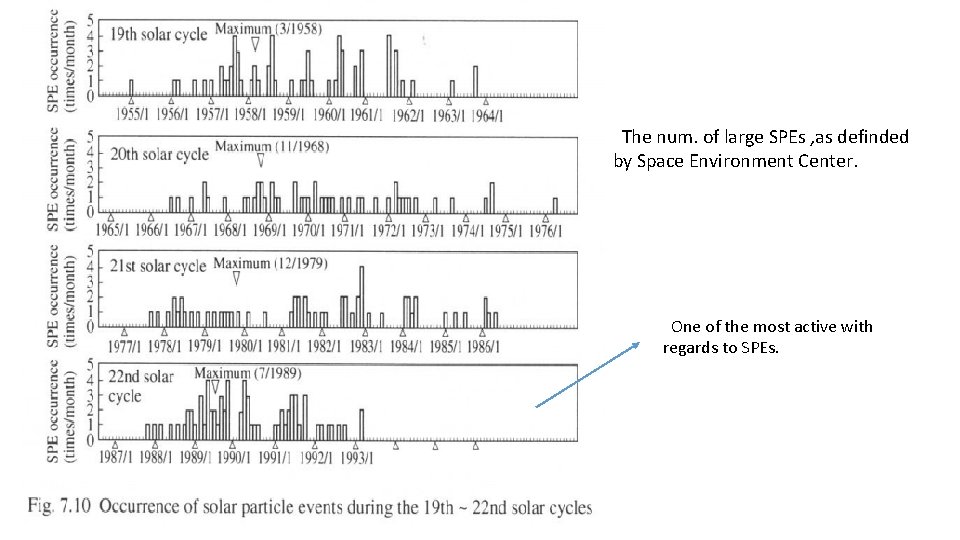
The num. of large SPEs , as definded by Space Environment Center. One of the most active with regards to SPEs.
7. 2 The Effects of the Space Radiation Environment 黃唯蓉 31
Outline • Introduction • 7. 2. 1 The Effects of Radiation in the Space Environment • 7. 2. 2 The Effects of Radiation at the Earth’s Surface • 7. 2. 3 Non-Radiation Effects 32
South Atlantic Anomaly (SAA) • There the radiation belt drops closest to Earth’s surface, and measure to prevent single event upsets (SEUs) in the electronic equipment carried by spacecraft are required. 33
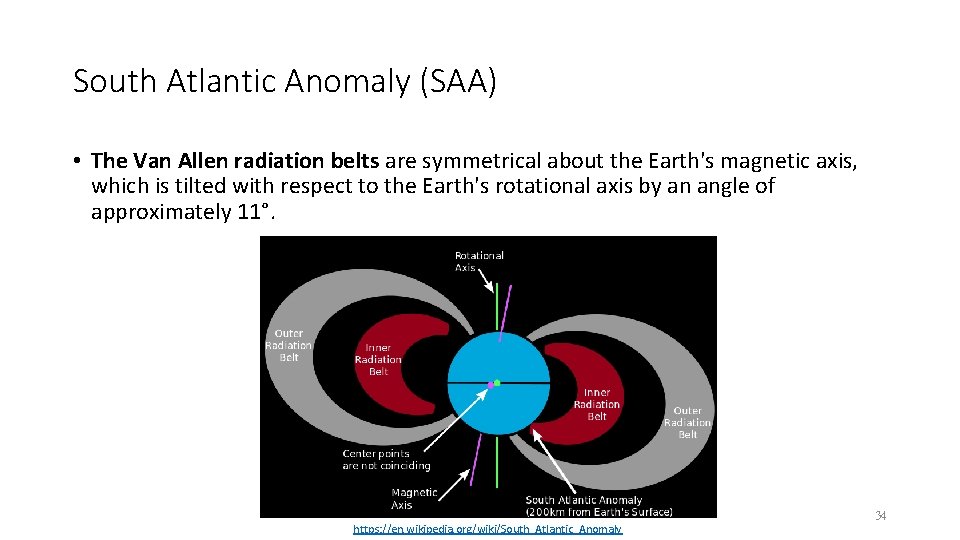
South Atlantic Anomaly (SAA) • The Van Allen radiation belts are symmetrical about the Earth's magnetic axis, which is tilted with respect to the Earth's rotational axis by an angle of approximately 11°. 34 https: //en. wikipedia. org/wiki/South_Atlantic_Anomaly
Single Event Upset (SEU) • A single event upset (SEU) is a change of state caused by one single ionizing particle (ions, electrons, photons. . . ) striking a sensitive node in a micro-electronic device. • Transition of potential state: 0 1 or 1 0. • Single event upset (SEU) is defined by NASA as "radiation-induced errors in microelectronic circuits caused when charged particles (usually from the radiation belts or from cosmic rays) lose energy by ionizing the medium through which they pass, leaving behind a wake of electron-hole pairs. " https: //en. wikipedia. org/wiki/Single_event_upset https: //zh. wikipedia. org/wiki/%E 5%8 D%95%E 7%B 2%92%E 5%AD%90%E 7%BF%BB%E 8%BD%AC http: //holbert. faculty. asu. edu/eee 560/see. html 35
Single Event • Single event upset (soft error) • Single event latchup (soft or hard error) Single event latchup (SEL) is a condition that causes loss of device functionality due to a single-event induced current state. • Single event burnout (hard failure) Single event burnout (SEB) is a condition that can cause device destruction due to a high current state in a power transistor. http: //holbert. faculty. asu. edu/eee 560/see. html 36
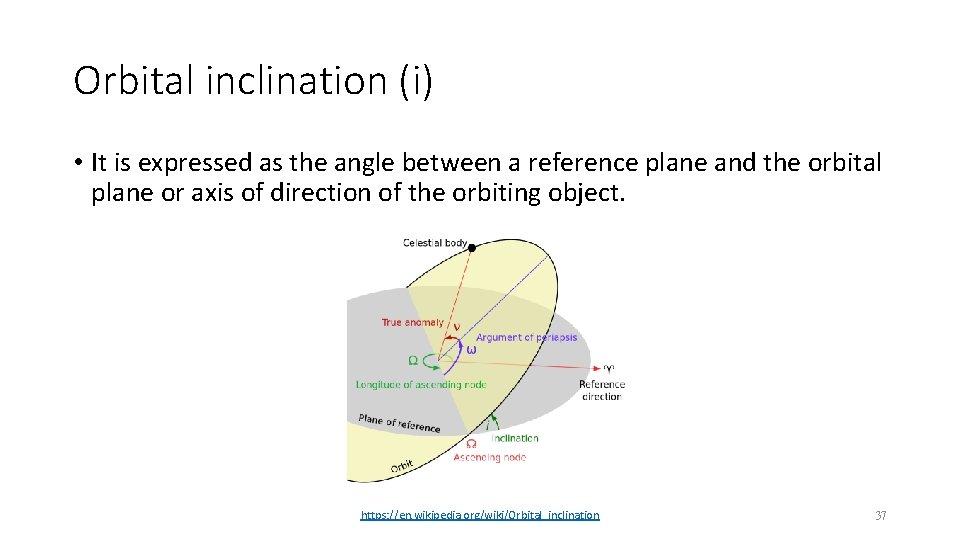
Orbital inclination (i) • It is expressed as the angle between a reference plane and the orbital plane or axis of direction of the orbiting object. https: //en. wikipedia. org/wiki/Orbital_inclination 37
Geostationary Transfer Orbits and Geostationary Orbits Geostationary orbit (geosynchronous equatorial orbit, GEO) Geosynchronous orbit (GSO) (GSO, GEO) https: //www. getit 01. com/p 2018051336364691/ 38
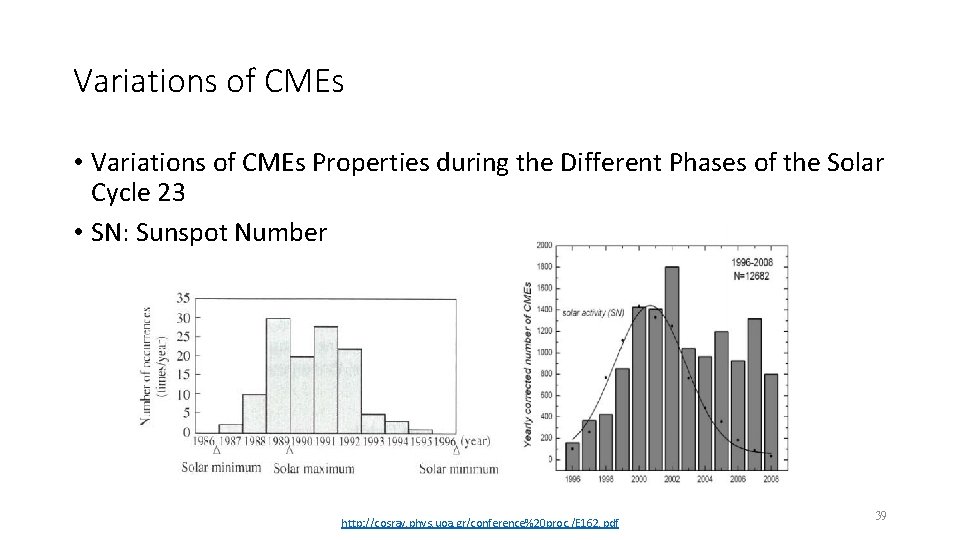
Variations of CMEs • Variations of CMEs Properties during the Different Phases of the Solar Cycle 23 • SN: Sunspot Number http: //cosray. phys. uoa. gr/conference%20 proc. /E 162. pdf 39
Summary 1 • The main effects of GCRs and SPEs to spacecraft • Law altitude proton • High altitude electron 40
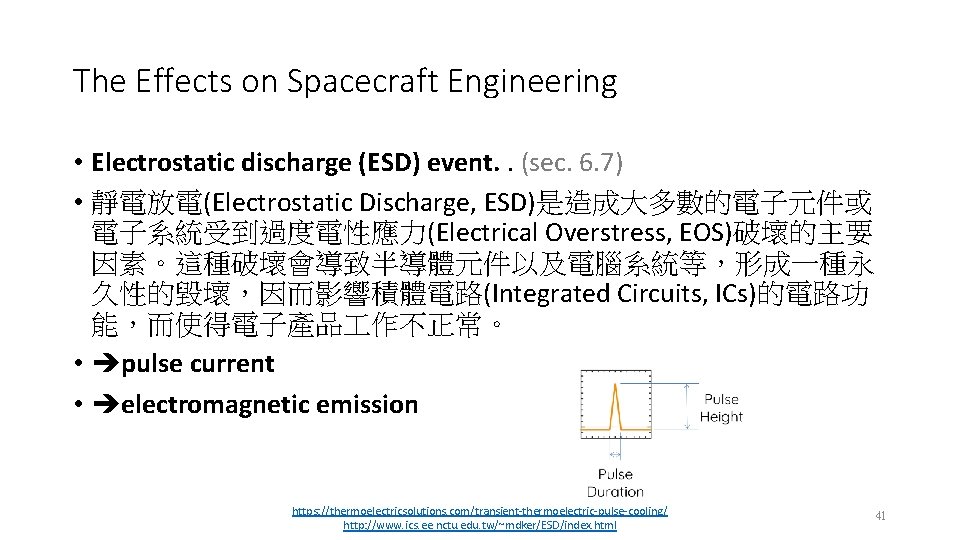
The Effects on Spacecraft Engineering • Electrostatic discharge (ESD) event. . (sec. 6. 7) • 靜電放電(Electrostatic Discharge, ESD)是造成大多數的電子元件或 電子系統受到過度電性應力(Electrical Overstress, EOS)破壞的主要 因素。這種破壞會導致半導體元件以及電腦系統等,形成一種永 久性的毀壞,因而影響積體電路(Integrated Circuits, ICs)的電路功 能,而使得電子產品 作不正常。 • pulse current • electromagnetic emission https: //thermoelectricsolutions. com/transient-thermoelectric-pulse-cooling/ http: //www. ics. ee. nctu. edu. tw/~mdker/ESD/index. html 41
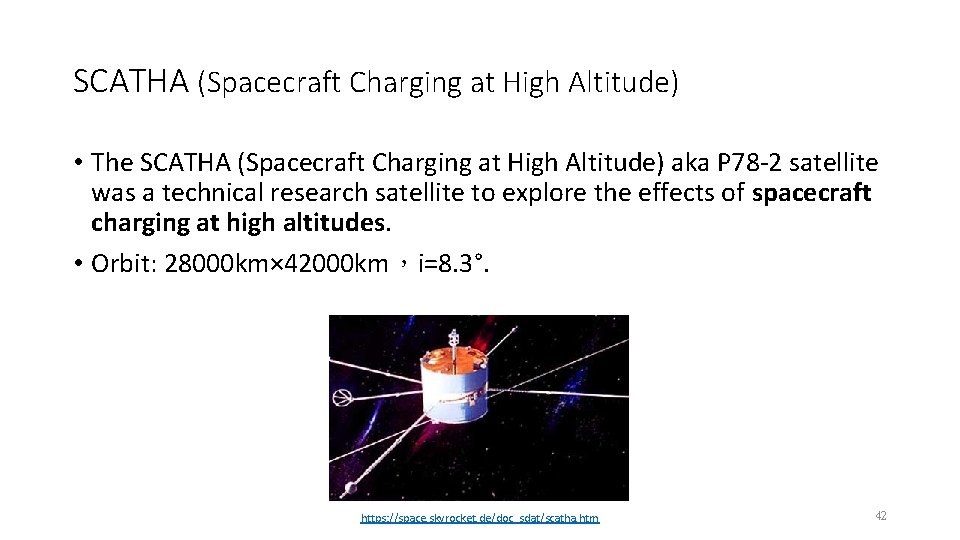
SCATHA (Spacecraft Charging at High Altitude) • The SCATHA (Spacecraft Charging at High Altitude) aka P 78 -2 satellite was a technical research satellite to explore the effects of spacecraft charging at high altitudes. • Orbit: 28000 km× 42000 km,i=8. 3°. https: //space. skyrocket. de/doc_sdat/scatha. htm 42
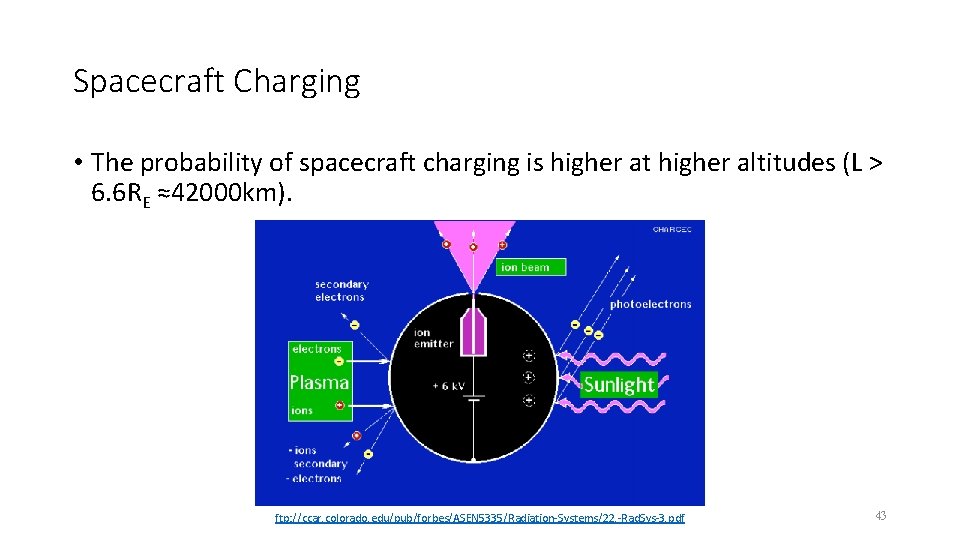
Spacecraft Charging • The probability of spacecraft charging is higher at higher altitudes (L > 6. 6 RE ≈42000 km). ftp: //ccar. colorado. edu/pub/forbes/ASEN 5335/Radiation-Systems/22. -Rad. Sys-3. pdf 43
Deep dielectric charging (internal, or bulk charging) • This is caused by energetic electrons (> several hundred ke. V) penetrating into the interior parts of the spacecraft and storing charges inside of dielectric components such as cables and semiconductor. https: //www. bc. edu/content/dam/files/research_sites/isr/pdf/Extreme. Eventsin. Geospace-Lai. pdf https: //www. sciencedirect. com/science/article/abs/pii/0304388687900829 44
Summary 2 • Prevent 1. Better designing connectors for IC boards and cable. 2. Increasing effective shielding thickness. 3. Use of charge prevention paint and investigating trial and error 4. Increasing electron flux levels to over several Me. V Have Not Been Found. • Reason, Effect and Prevent 1. Energetic electrons degradation of solar panel or other characteristic. shielding design 2. Integrated circuits(IC) smaller devices single event soft error. reduce IC single event ( Latch up maybe burnout) https: //en. wikipedia. org/wiki/Latch-up 46
The Effects on Human Body and Other Biological Systems • US • Space Environment Center (SEC SWPC? ? ? ) and Johnson Space Center’s (JSC) Space Radiation Analysis Group (SRAG) • 24 -hour a day basis • Caution to EVA • Russia • Bio. Medical Problems http: //holbert. faculty. asu. edu/eee 560/see. html 47
Biological systems • Biological effects (RBE) of High-Z and High-Energy particles (HZE) and high linear energy transfer (LET) • HZE: 高(H)原子序數(Z)和能量(E)粒子 • LET: In dosimetry, linear energy transfer (LET) is the amount of energy that an ionizing particle transfers to the material traversed per unit distance. • Radiation • Low-gravity • Cancer https: //en. wikipedia. org/wiki/HZE_ions https: //en. wikipedia. org/wiki/Linear_energy_transfer 48
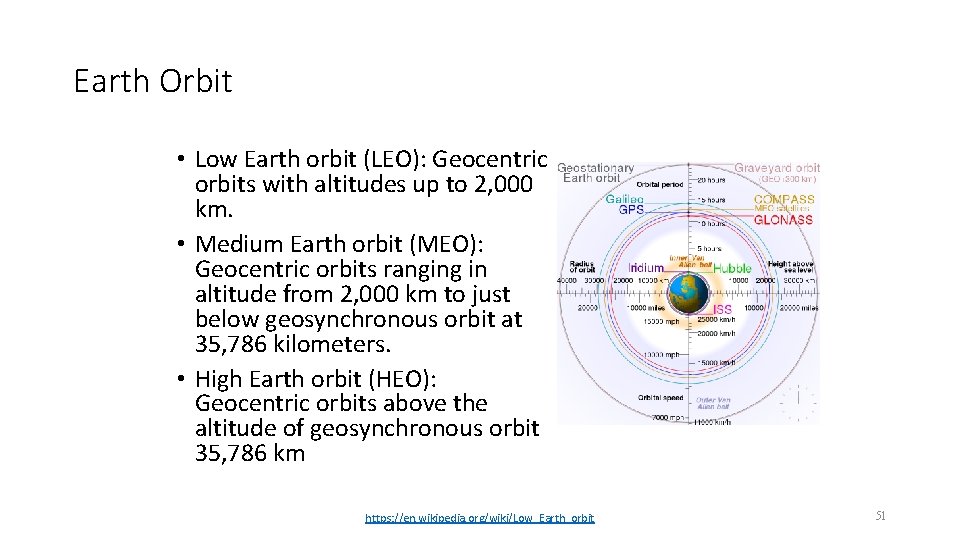
Earth Orbit • Low Earth orbit (LEO): Geocentric orbits with altitudes up to 2, 000 km. • Medium Earth orbit (MEO): Geocentric orbits ranging in altitude from 2, 000 km to just below geosynchronous orbit at 35, 786 kilometers. • High Earth orbit (HEO): Geocentric orbits above the altitude of geosynchronous orbit 35, 786 km https: //en. wikipedia. org/wiki/Low_Earth_orbit 51
The Effects of Radiation at the Earth’s Surface • Space only contribute about one-third of the radiation at the Earth’s surface. The radiation we do have at ground-level is from high-energy GCRs, which varies about 10% depending on solar activities. • High-energy charged atmosphere ionize gases promote the formation of ice crystals in upper atmosphere release latent heat 52
The Effects of Radiation at the Earth’s Surface • QBO: The quasi-biennial oscillation (QBO) is a quasiperiodic oscillation of the equatorial zonal wind between easterlies and westerlies in the tropical stratosphere with a mean period of 28 to 29 months. • SOI: The Southern Oscillation is the atmospheric component of El Niño. This component is an oscillation in surface air pressure between the tropical eastern and the western Pacific Ocean waters. 53
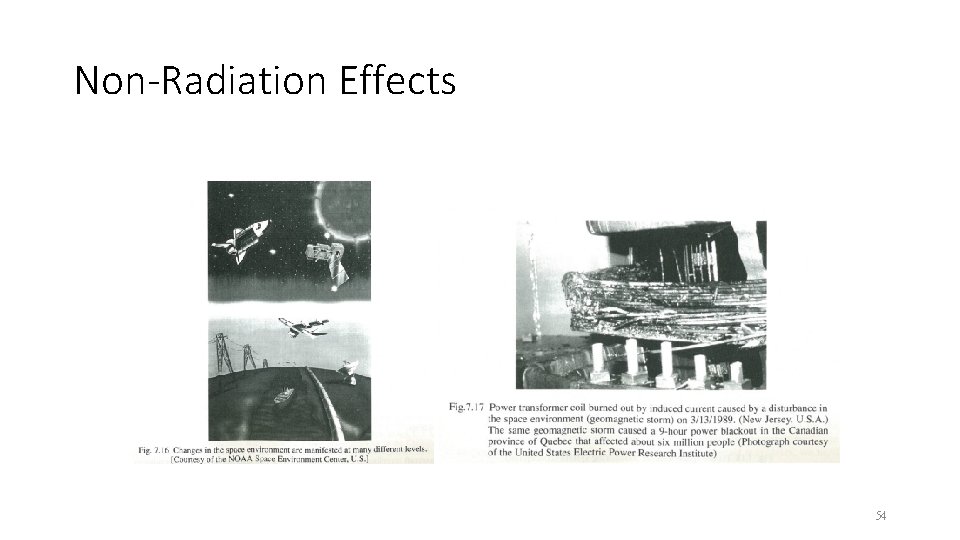
Non-Radiation Effects 54
Non-Radiation Effects • Solar Electromagnetic Waves • Communications and Navigation • Satellite Attitude • Satellite Drag • Satellite Eclipse • Atomic Oxygen • Space debris 55
Reference • https: //agupubs. onlinelibrary. wiley. com/doi/pdf/10. 1029/2001 gl 014 017 The energetic storm particle event of October 20, 1989 • http: //www. ss. ncu. edu. tw/~Space. Edu/database/Intro. Space_notes_e xam/Magnetosphere. Phys. html Magnetosphere. Phys 56
7. 3 Predicting the Space Radiation Environment and Future Observation Requirements 7. 4 Utilization of Space Weather Information 7. 5 Conclustion – Future Prospects Speaker: 許皓威 信箱: willy 21527@gmail. com
7. 3 Predicting the Space Radiation Environment and Future Observation Requirements • Forecasting Galactic Cosmic Rays
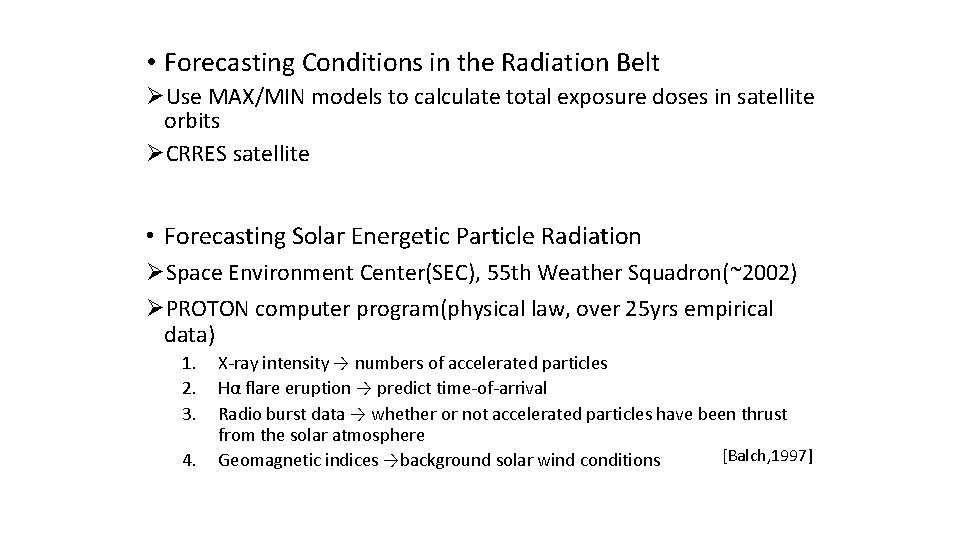
• Forecasting Conditions in the Radiation Belt ØUse MAX/MIN models to calculate total exposure doses in satellite orbits ØCRRES satellite • Forecasting Solar Energetic Particle Radiation ØSpace Environment Center(SEC), 55 th Weather Squadron(~2002) ØPROTON computer program(physical law, over 25 yrs empirical data) 1. 2. 3. 4. X-ray intensity → numbers of accelerated particles Hα flare eruption → predict time-of-arrival Radio burst data → whether or not accelerated particles have been thrust from the solar atmosphere [Balch, 1997] Geomagnetic indices →background solar wind conditions
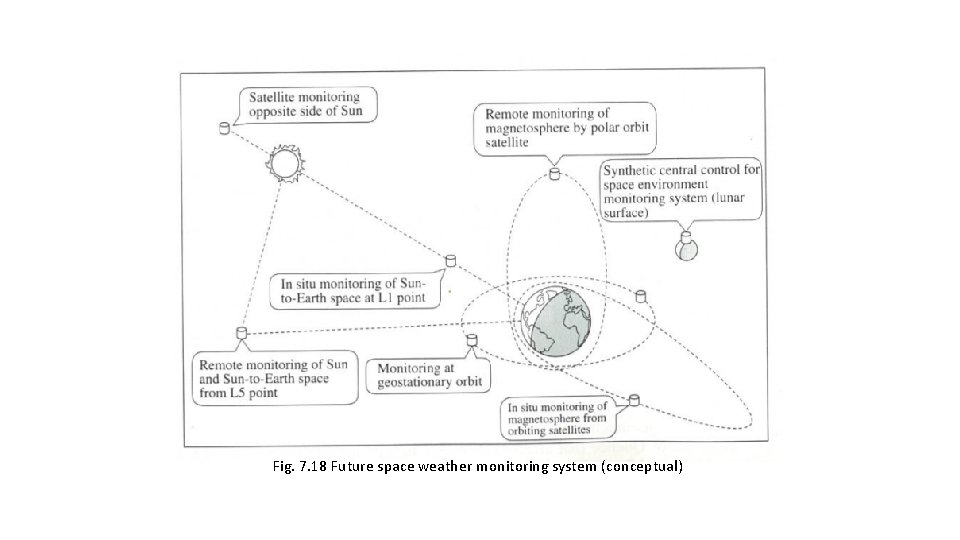
Fig. 7. 18 Future space weather monitoring system (conceptual)
• Solar Particles (Proton) event Ødefined by the >10 Me. V particles flux exceeding 10 particles/(cm 2/s/sr) at geostationary orbit. © Université de Strasbourg/CNRS
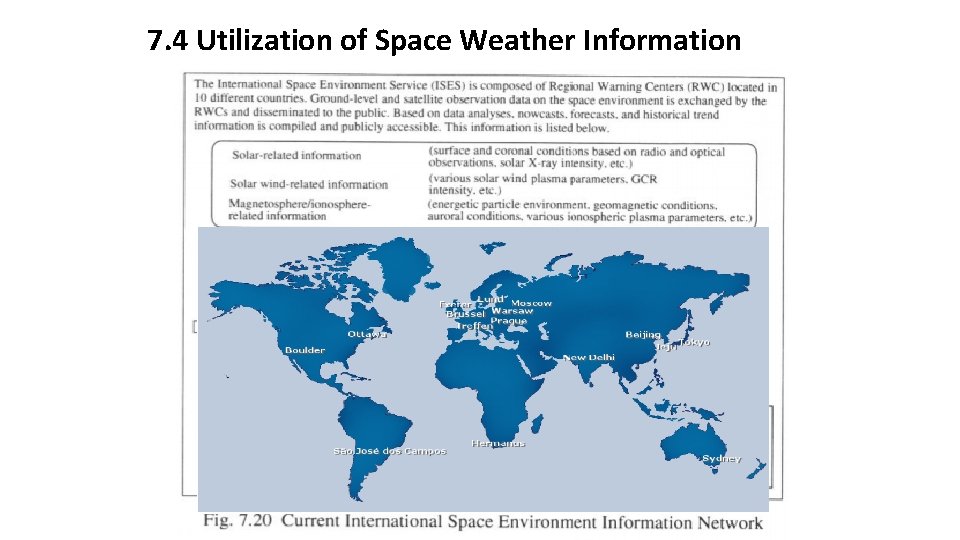
7. 4 Utilization of Space Weather Information
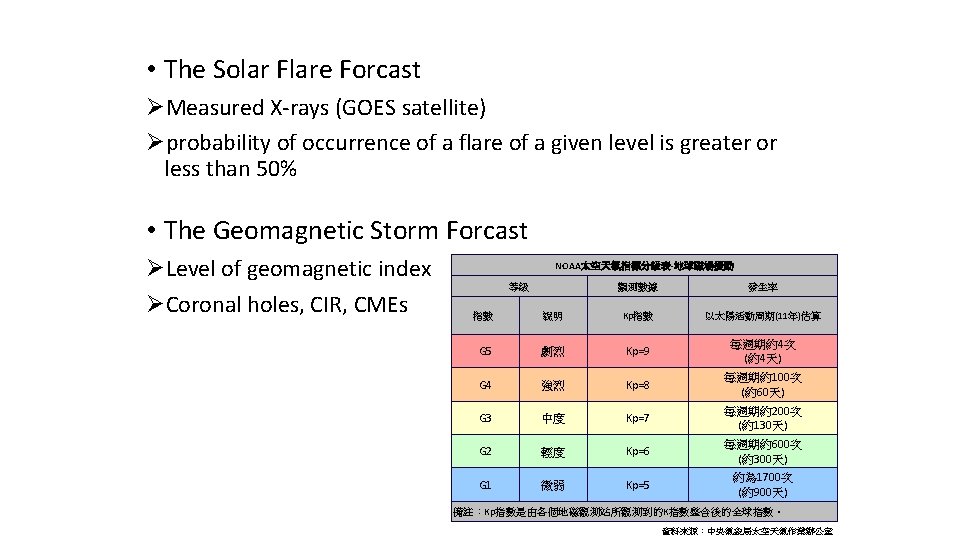
• The Solar Flare Forcast ØMeasured X-rays (GOES satellite) Øprobability of occurrence of a flare of a given level is greater or less than 50% • The Geomagnetic Storm Forcast ØLevel of geomagnetic index ØCoronal holes, CIR, CMEs NOAA太空天氣指標分級表-地球磁場擾動 等級 觀測數據 發生率 說明 Kp指數 以太陽活動周期(11年)估算 G 5 劇烈 Kp=9 每週期約4次 (約4天) G 4 強烈 Kp=8 每週期約100次 (約60天) G 3 中度 Kp=7 每週期約200次 (約130天) G 2 輕度 Kp=6 每週期約600次 (約300天) G 1 微弱 Kp=5 約為 1700次 (約900天) 指數 備註:Kp指數是由各個地磁觀測站所觀測到的K指數整合後的全球指數。 資料來源:中央氣象局太空天氣作業辦公室
7. 5 Conclustion – Future Prospects • Mars • Space tourism • ….