
Ch 7 The Merchandising Company The Merchandising Company
- Slides: 48
Ch 7– The Merchandising Company
The Merchandising Company o There are 3 types of Businesses 1. A Service Company 2. A Merchandise Company 3. A Manufacturing Company n We have covered the Accounting Cycle for a Service Company, now we will learn the differences of a Merchandise company
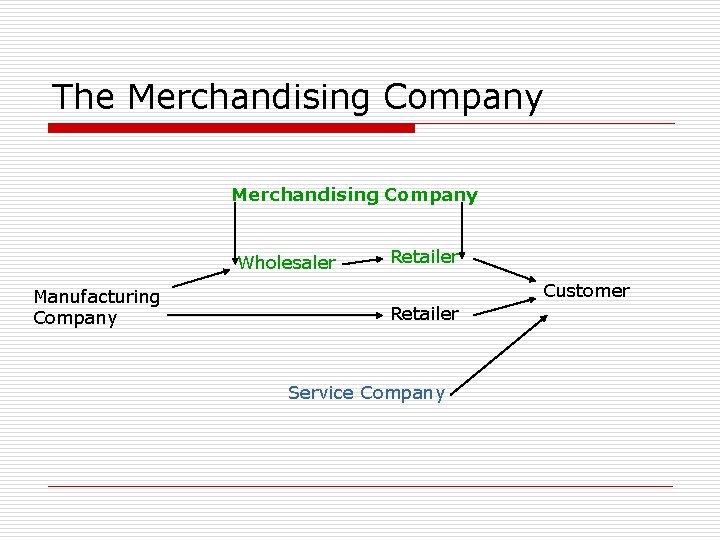
The Merchandising Company Wholesaler Manufacturing Company Retailer Customer Retailer Service Company
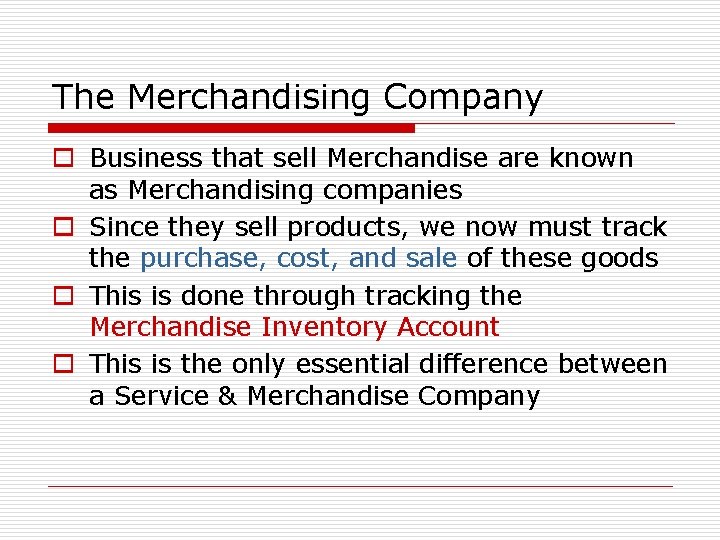
The Merchandising Company o Business that sell Merchandise are known as Merchandising companies o Since they sell products, we now must track the purchase, cost, and sale of these goods o This is done through tracking the Merchandise Inventory Account o This is the only essential difference between a Service & Merchandise Company
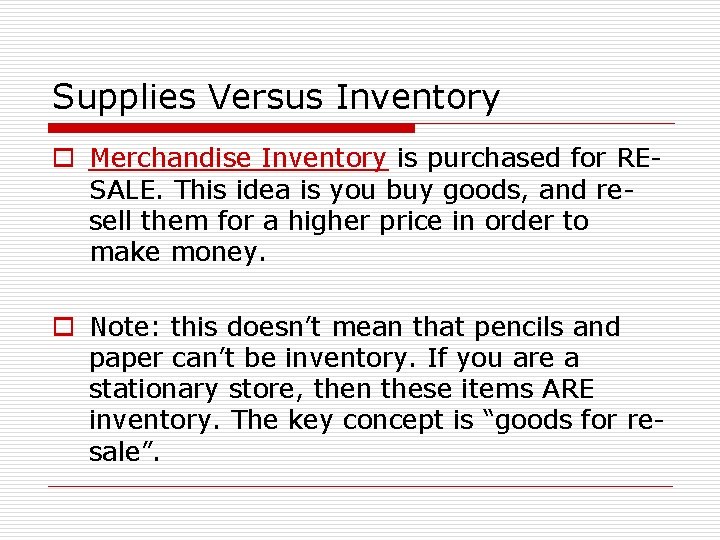
Supplies Versus Inventory o Merchandise Inventory is purchased for RESALE. This idea is you buy goods, and resell them for a higher price in order to make money. o Note: this doesn’t mean that pencils and paper can’t be inventory. If you are a stationary store, then these items ARE inventory. The key concept is “goods for resale”.
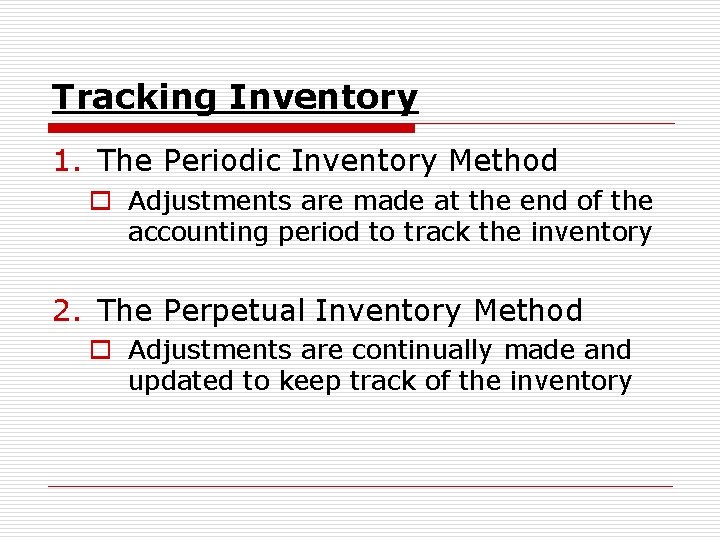
Tracking Inventory 1. The Periodic Inventory Method o Adjustments are made at the end of the accounting period to track the inventory 2. The Perpetual Inventory Method o Adjustments are continually made and updated to keep track of the inventory
The Merchandising Company The concept of Cost of Goods Sold (COGS) o Since now we are selling goods, part of the cost of generating revenue is the cost of the items we are selling. o It is calculated like this:
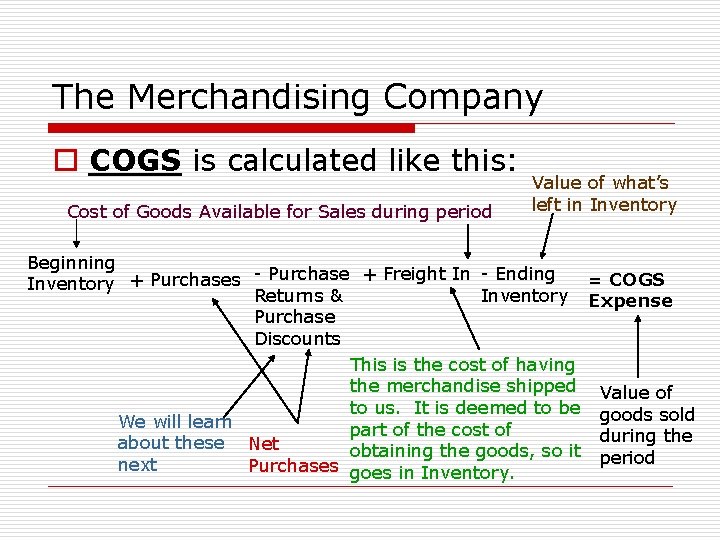
The Merchandising Company o COGS is calculated like this: Cost of Goods Available for Sales during period Value of what’s left in Inventory Beginning - Purchase + Freight In - Ending = COGS Inventory + Purchases Returns & Inventory Expense Purchase Discounts This is the cost of having the merchandise shipped Value of to us. It is deemed to be goods sold We will learn part of the cost of during the about these Net obtaining the goods, so it period next Purchases goes in Inventory.
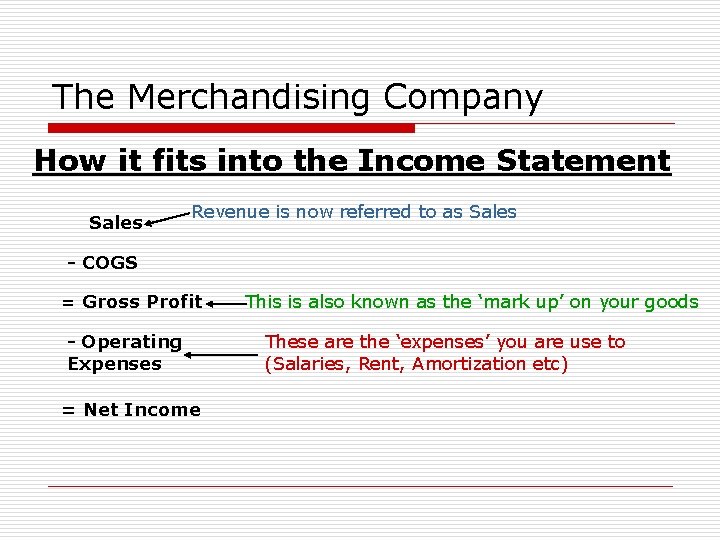
The Merchandising Company How it fits into the Income Statement Sales Revenue is now referred to as Sales - COGS = Gross Profit - Operating Expenses = Net Income This is also known as the ‘mark up’ on your goods These are the ‘expenses’ you are use to (Salaries, Rent, Amortization etc)
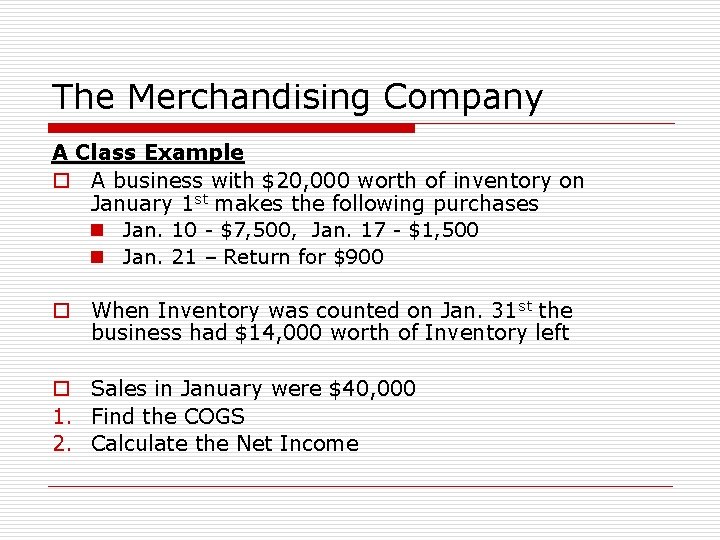
The Merchandising Company A Class Example o A business with $20, 000 worth of inventory on January 1 st makes the following purchases n Jan. 10 - $7, 500, Jan. 17 - $1, 500 n Jan. 21 – Return for $900 o When Inventory was counted on Jan. 31 st the business had $14, 000 worth of Inventory left o Sales in January were $40, 000 1. Find the COGS 2. Calculate the Net Income
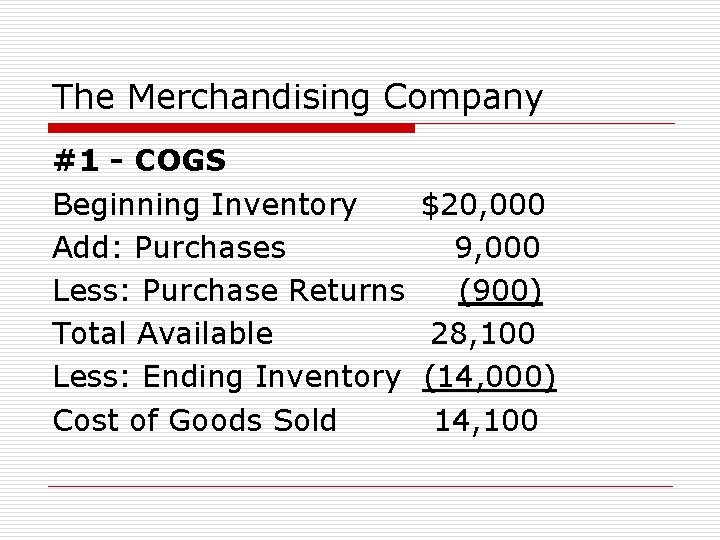
The Merchandising Company #1 - COGS Beginning Inventory Add: Purchases Less: Purchase Returns Total Available Less: Ending Inventory Cost of Goods Sold $20, 000 9, 000 (900) 28, 100 (14, 000) 14, 100
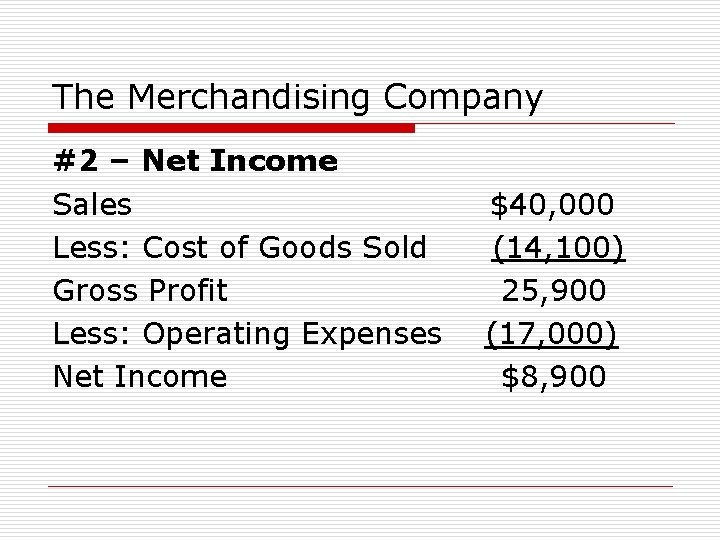
The Merchandising Company #2 – Net Income Sales Less: Cost of Goods Sold Gross Profit Less: Operating Expenses Net Income $40, 000 (14, 100) 25, 900 (17, 000) $8, 900
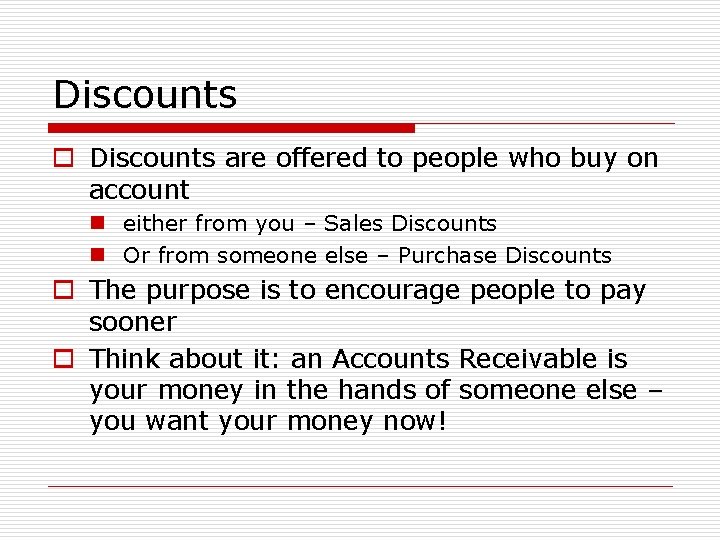
Discounts o Discounts are offered to people who buy on account n either from you – Sales Discounts n Or from someone else – Purchase Discounts o The purpose is to encourage people to pay sooner o Think about it: an Accounts Receivable is your money in the hands of someone else – you want your money now!
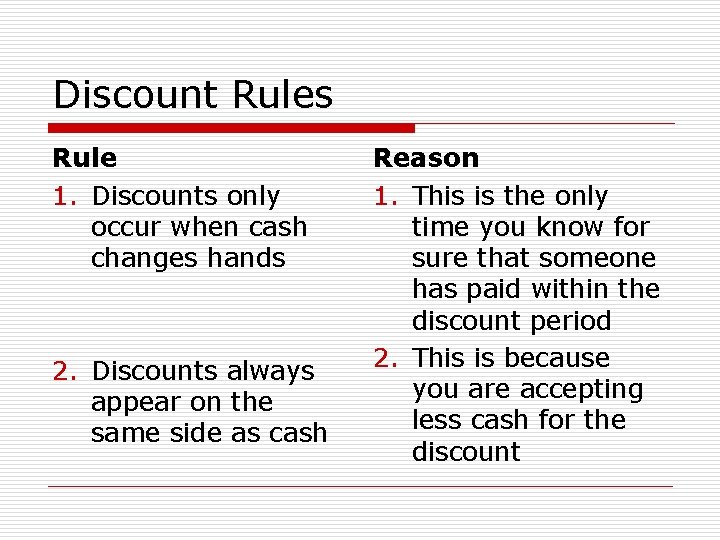
Discount Rules Rule 1. Discounts only occur when cash changes hands 2. Discounts always appear on the same side as cash Reason 1. This is the only time you know for sure that someone has paid within the discount period 2. This is because you are accepting less cash for the discount
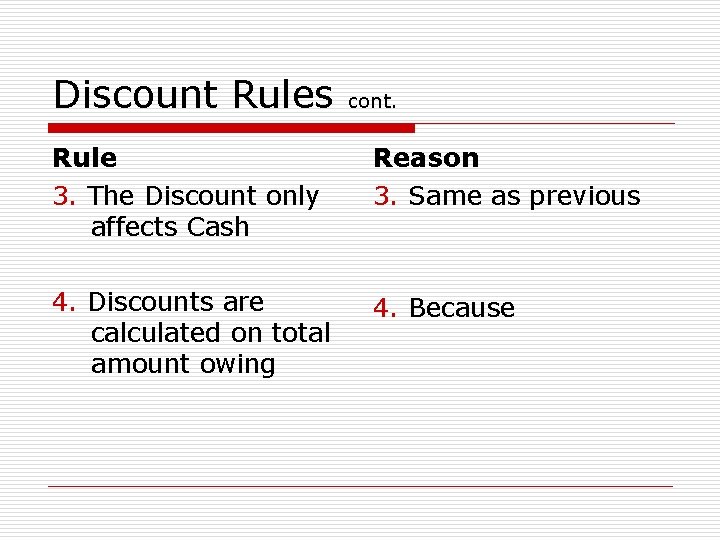
Discount Rules cont. Rule 3. The Discount only affects Cash Reason 3. Same as previous 4. Discounts are calculated on total amount owing 4. Because
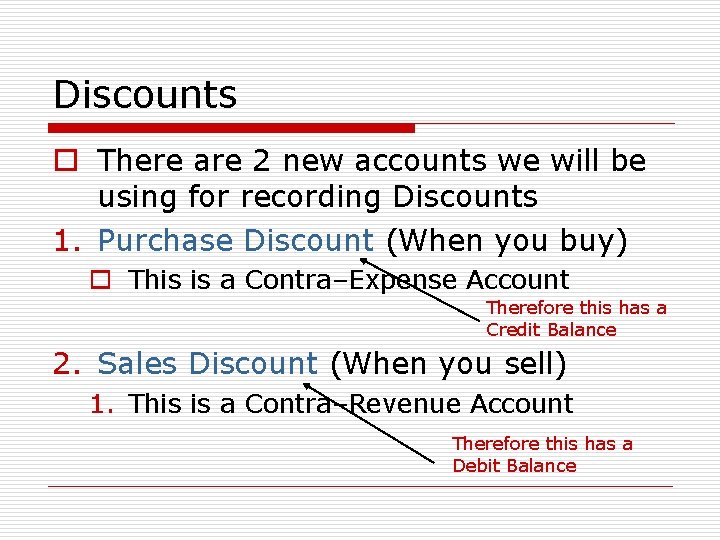
Discounts o There are 2 new accounts we will be using for recording Discounts 1. Purchase Discount (When you buy) o This is a Contra–Expense Account Therefore this has a Credit Balance 2. Sales Discount (When you sell) 1. This is a Contra–Revenue Account Therefore this has a Debit Balance
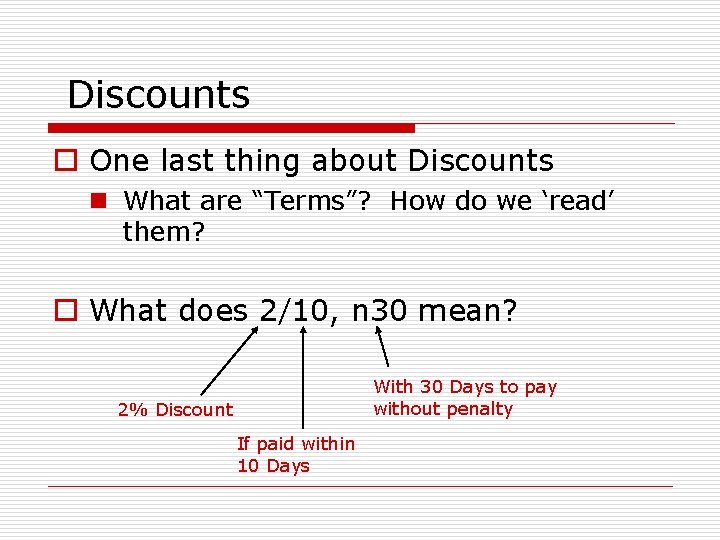
Discounts o One last thing about Discounts n What are “Terms”? How do we ‘read’ them? o What does 2/10, n 30 mean? With 30 Days to pay without penalty 2% Discount If paid within 10 Days
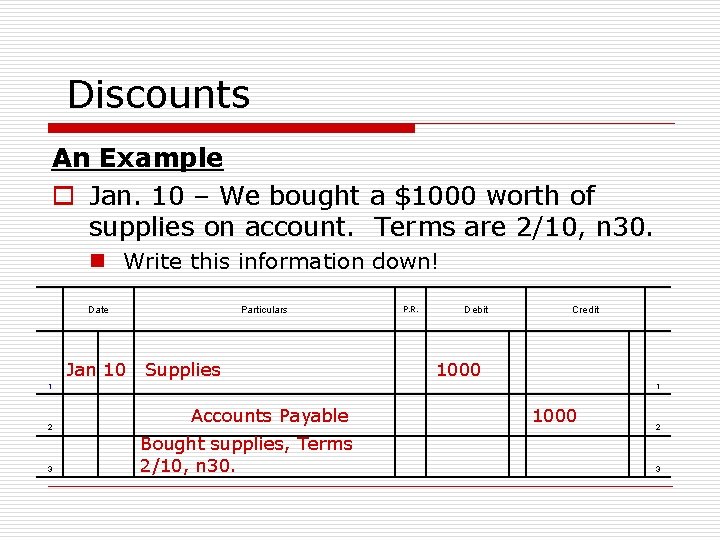
Discounts An Example o Jan. 10 – We bought a $1000 worth of supplies on account. Terms are 2/10, n 30. n Write this information down! Date Jan 10 Particulars Supplies P. R. Debit Credit 1000 1 2 3 1 Accounts Payable Bought supplies, Terms 2/10, n 30. 1000 2 3
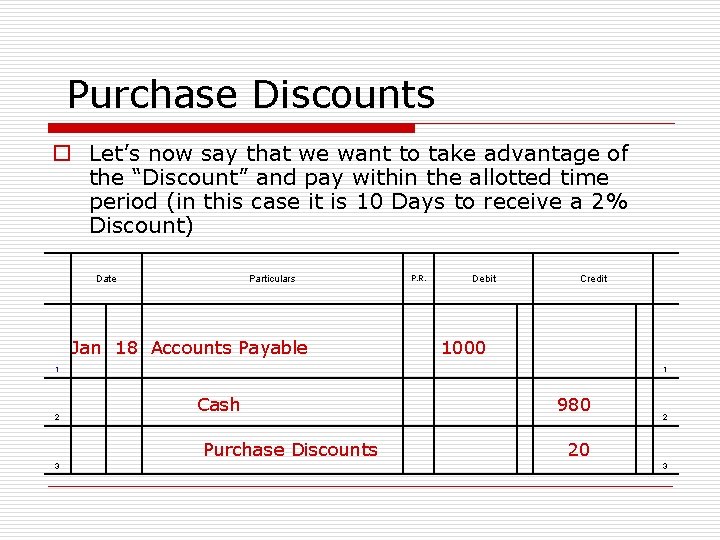
Purchase Discounts o Let’s now say that we want to take advantage of the “Discount” and pay within the allotted time period (in this case it is 10 Days to receive a 2% Discount) Date Particulars Jan 18 Accounts Payable P. R. Debit Credit 1000 1 2 1 Cash Purchase Discounts 3 980 2 20 3
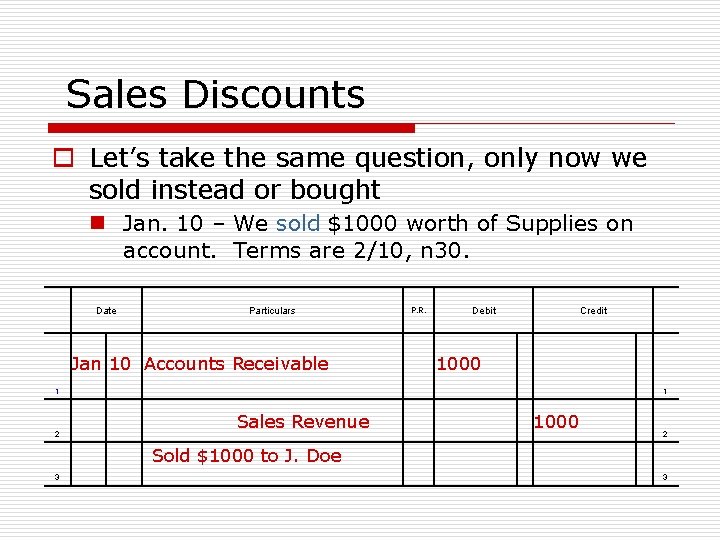
Sales Discounts o Let’s take the same question, only now we sold instead or bought n Jan. 10 – We sold $1000 worth of Supplies on account. Terms are 2/10, n 30. Date Particulars Jan 10 Accounts Receivable P. R. Debit Credit 1000 1 2 1 Sales Revenue 1000 2 Sold $1000 to J. Doe 3 3
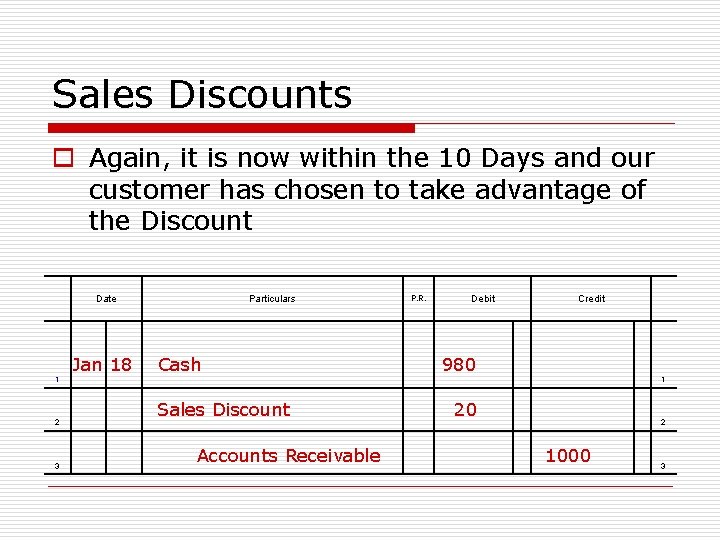
Sales Discounts o Again, it is now within the 10 Days and our customer has chosen to take advantage of the Discount Date Jan 18 Particulars Cash P. R. Debit Credit 980 1 2 3 1 Sales Discount Accounts Receivable 20 2 1000 3
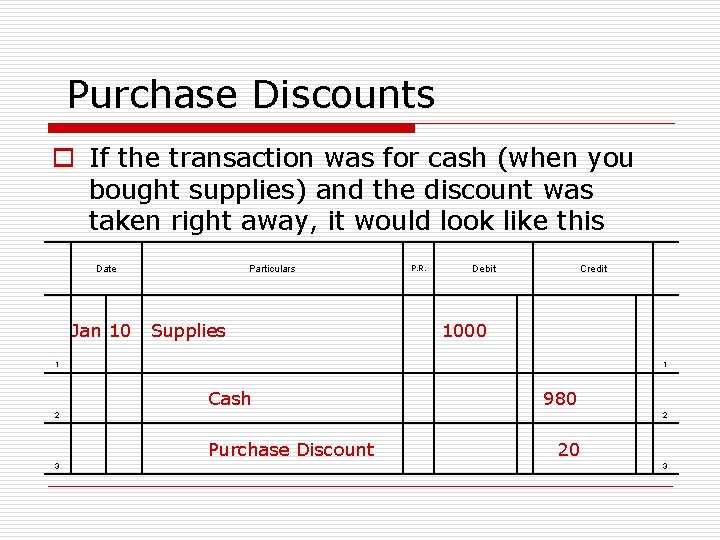
Purchase Discounts o If the transaction was for cash (when you bought supplies) and the discount was taken right away, it would look like this Date Jan 10 Particulars Supplies P. R. Debit Credit 1000 1 1 Cash 980 2 2 Purchase Discount 3 20 3
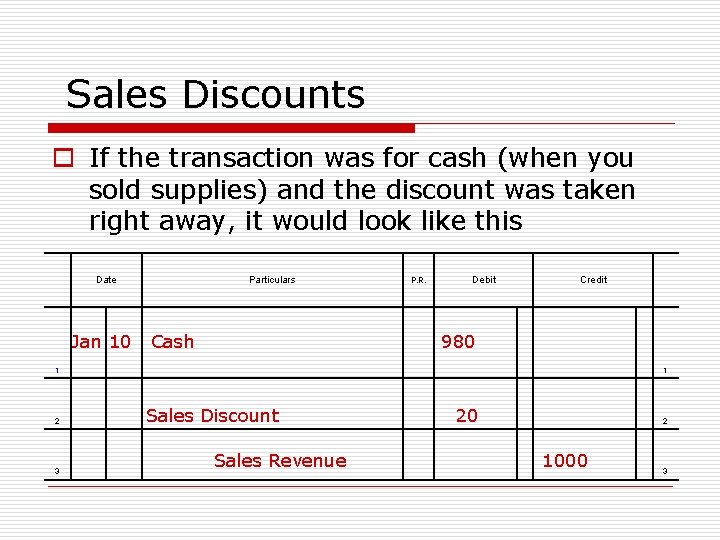
Sales Discounts o If the transaction was for cash (when you sold supplies) and the discount was taken right away, it would look like this Date Jan 10 Particulars Cash P. R. Debit Credit 980 1 2 3 1 Sales Discount Sales Revenue 20 2 1000 3
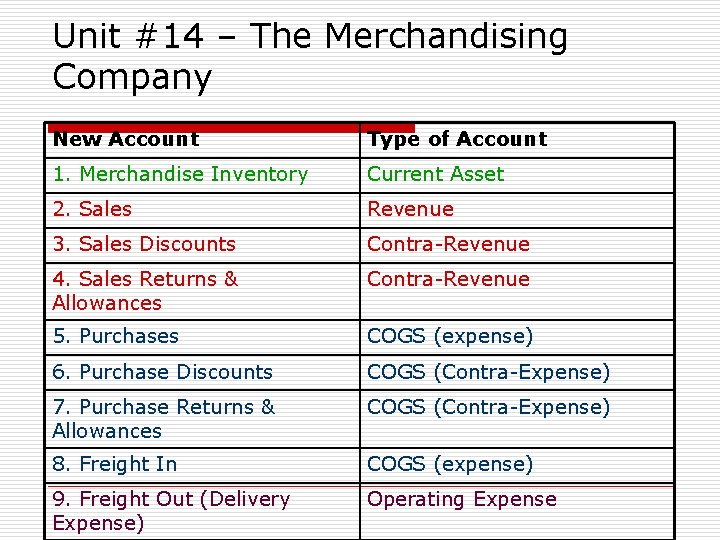
Unit #14 – The Merchandising Company o To track the purchase, cost, and shipment of merchandise new accounts are needed. n They are as follows:
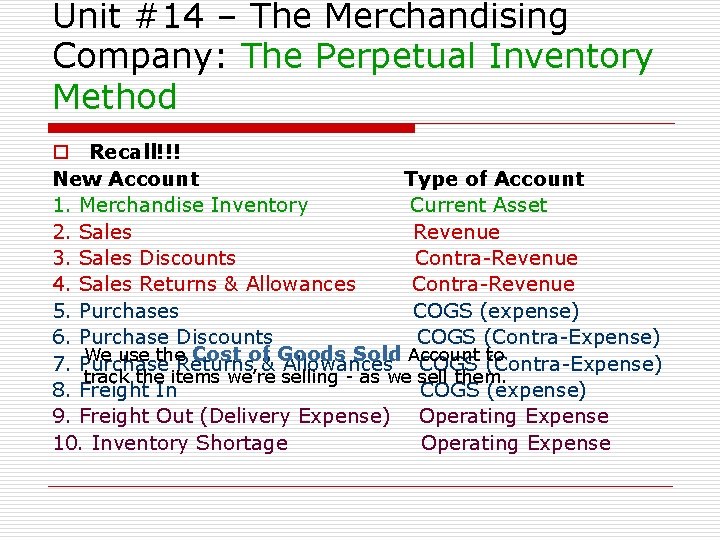
Unit #14 – The Merchandising Company New Account Type of Account 1. Merchandise Inventory Current Asset 2. Sales Revenue 3. Sales Discounts Contra-Revenue 4. Sales Returns & Allowances Contra-Revenue 5. Purchases COGS (expense) 6. Purchase Discounts COGS (Contra-Expense) 7. Purchase Returns & Allowances COGS (Contra-Expense) 8. Freight In COGS (expense) 9. Freight Out (Delivery Expense) Operating Expense
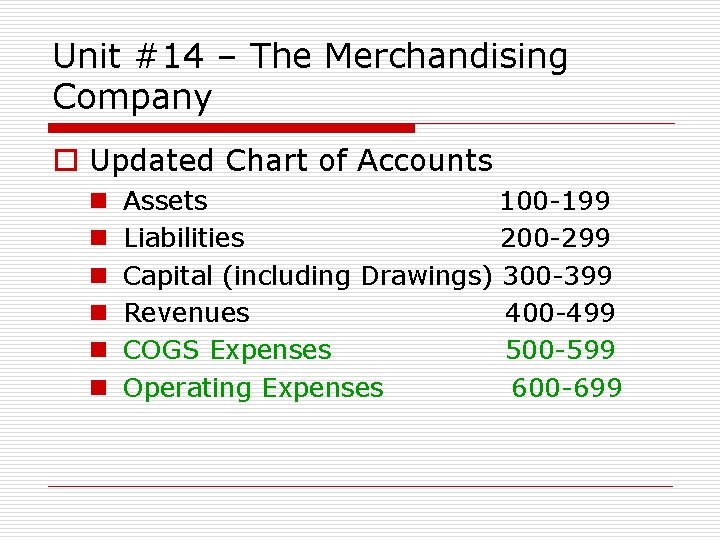
Unit #14 – The Merchandising Company o Updated Chart of Accounts n n n Assets 100 -199 Liabilities 200 -299 Capital (including Drawings) 300 -399 Revenues 400 -499 COGS Expenses 500 -599 Operating Expenses 600 -699
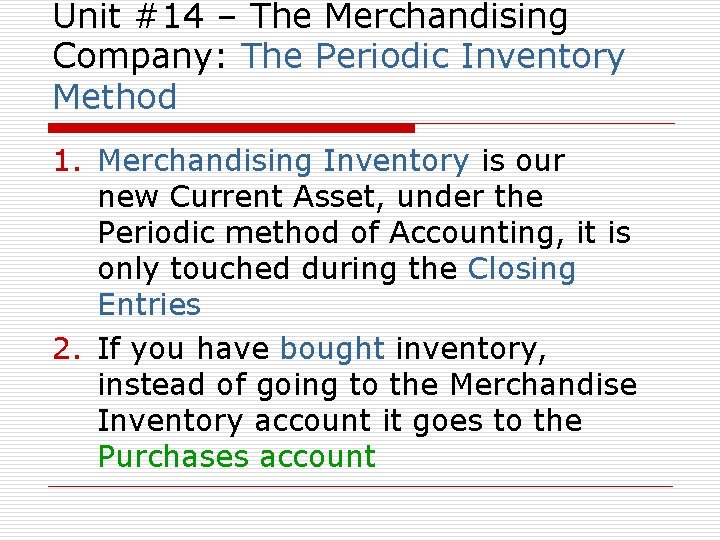
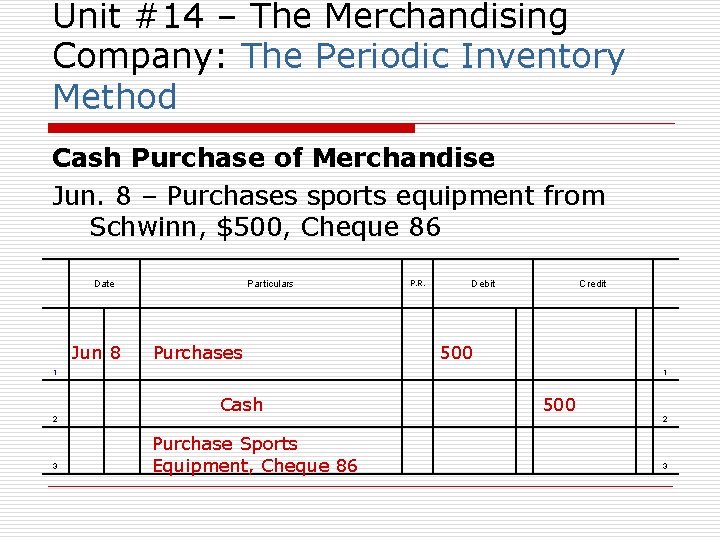
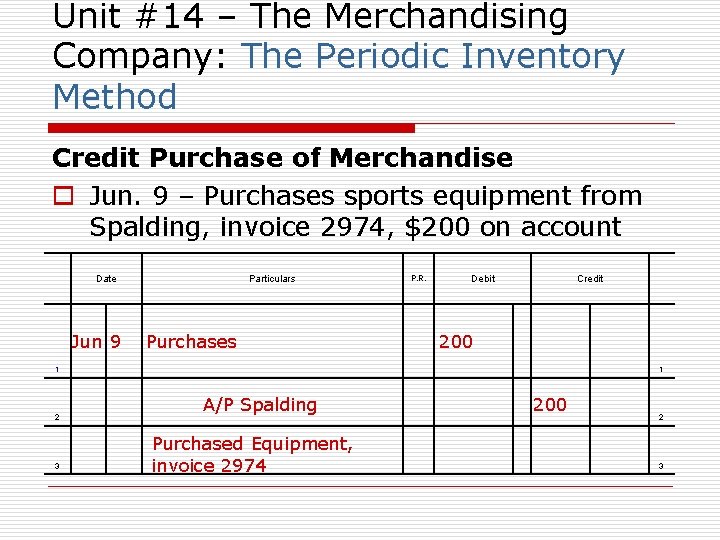
Unit #14 – The Merchandising Company: The Periodic Inventory Method 1. Merchandising Inventory is our new Current Asset, under the Periodic method of Accounting, it is only touched during the Closing Entries 2. If you have bought inventory, instead of going to the Merchandise Inventory account it goes to the Purchases account
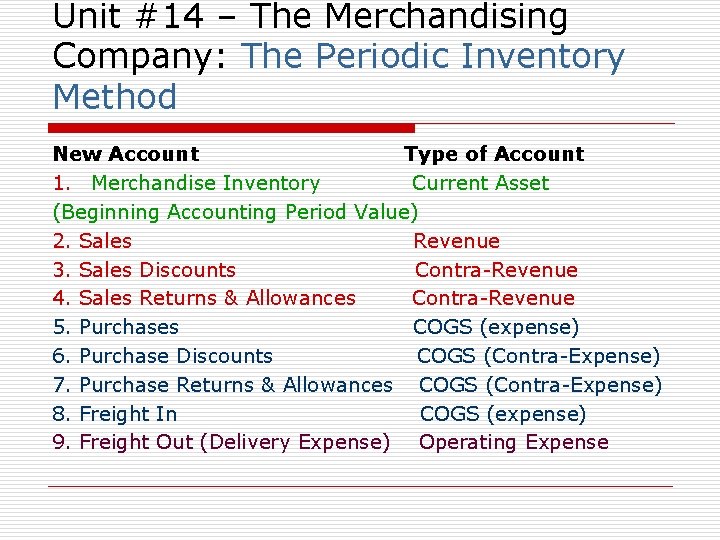
Unit #14 – The Merchandising Company: The Periodic Inventory Method New Account Type of Account 1. Merchandise Inventory Current Asset (Beginning Accounting Period Value) 2. Sales Revenue 3. Sales Discounts Contra-Revenue 4. Sales Returns & Allowances Contra-Revenue 5. Purchases COGS (expense) 6. Purchase Discounts COGS (Contra-Expense) 7. Purchase Returns & Allowances COGS (Contra-Expense) 8. Freight In COGS (expense) 9. Freight Out (Delivery Expense) Operating Expense
Unit #14 – The Merchandising Company: The Periodic Inventory Method Cash Purchase of Merchandise Jun. 8 – Purchases sports equipment from Schwinn, $500, Cheque 86 Date Jun 8 Particulars Purchases P. R. Debit Credit 500 1 1 Cash 2 3 500 2 Purchase Sports Equipment, Cheque 86 3
Unit #14 – The Merchandising Company: The Periodic Inventory Method Credit Purchase of Merchandise o Jun. 9 – Purchases sports equipment from Spalding, invoice 2974, $200 on account Date Jun 9 Particulars Purchases P. R. Debit Credit 200 1 2 3 1 A/P Spalding Purchased Equipment, invoice 2974 200 2 3
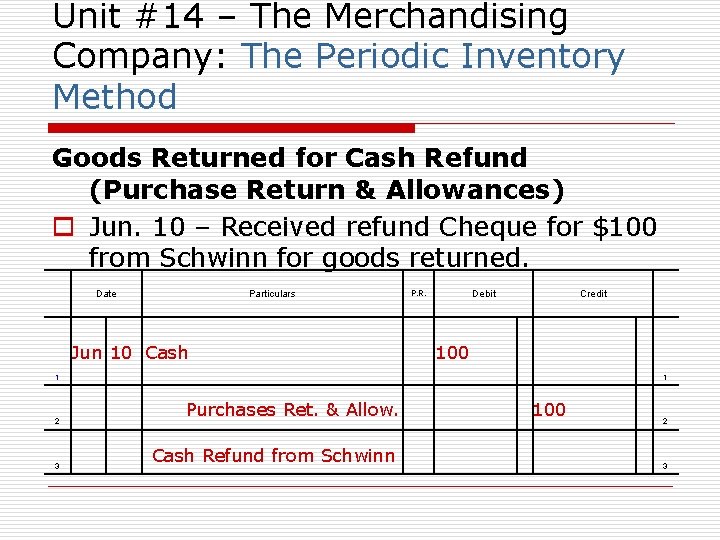
Unit #14 – The Merchandising Company: The Periodic Inventory Method Goods Returned for Cash Refund (Purchase Return & Allowances) o Jun. 10 – Received refund Cheque for $100 from Schwinn for goods returned. Date Particulars Jun 10 Cash Debit P. R. Credit 100 1 2 3 1 Purchases Ret. & Allow. Cash Refund from Schwinn 100 2 3
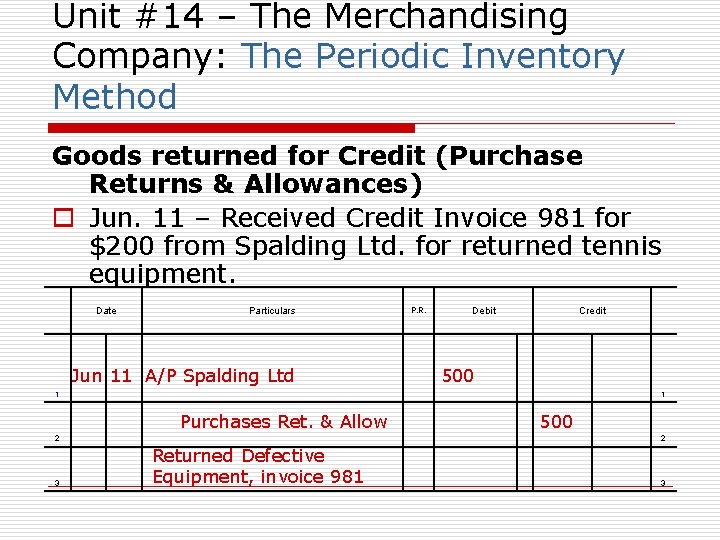
Unit #14 – The Merchandising Company: The Periodic Inventory Method Goods returned for Credit (Purchase Returns & Allowances) o Jun. 11 – Received Credit Invoice 981 for $200 from Spalding Ltd. for returned tennis equipment. Date Particulars Jun 11 A/P Spalding Ltd P. R. Debit Credit 500 1 1 Purchases Ret. & Allow 2 3 500 2 Returned Defective Equipment, invoice 981 3
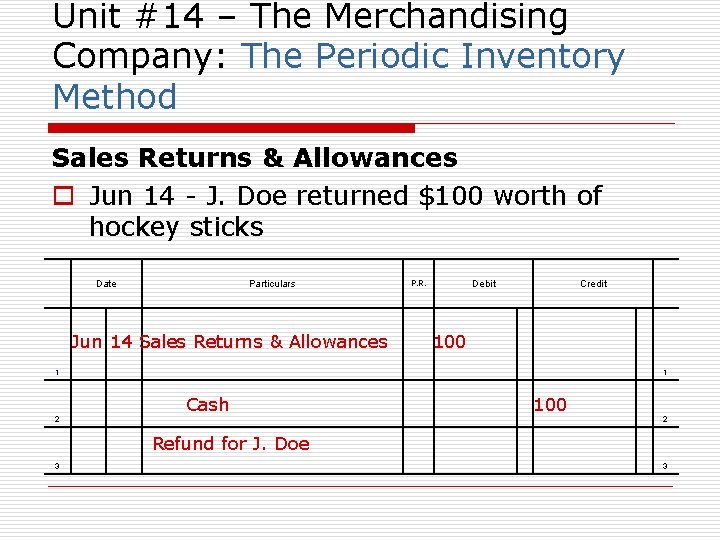
Unit #14 – The Merchandising Company: The Periodic Inventory Method Sales Returns & Allowances o Jun 14 - J. Doe returned $100 worth of hockey sticks Date Particulars Jun 14 Sales Returns & Allowances Debit P. R. Credit 100 1 1 Cash 2 100 2 Refund for J. Doe 3 3
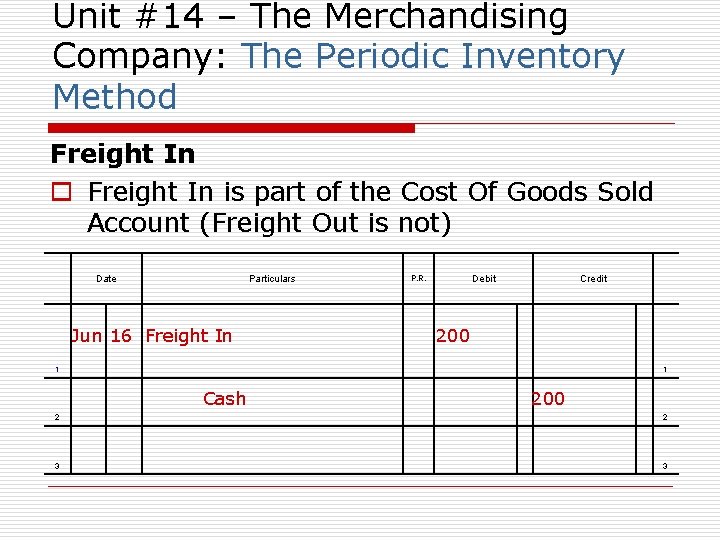
Unit #14 – The Merchandising Company: The Periodic Inventory Method Freight In o Freight In is part of the Cost Of Goods Sold Account (Freight Out is not) Date Particulars Jun 16 Freight In Debit P. R. Credit 200 1 1 Cash 200 2 2 3 3
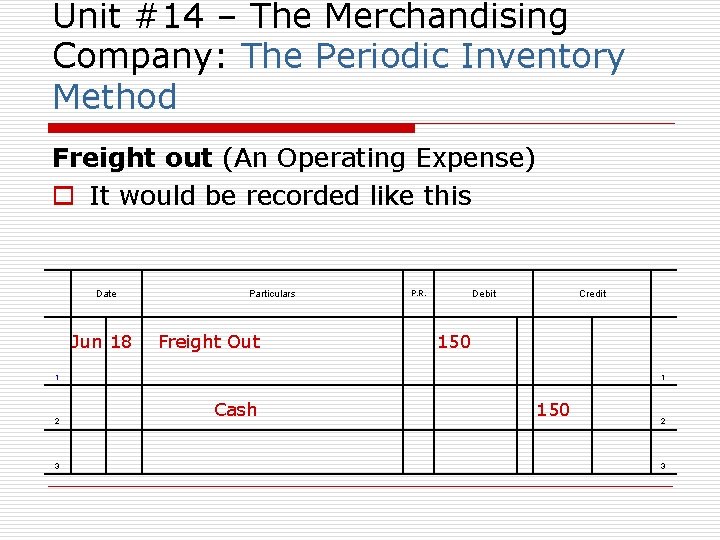
Unit #14 – The Merchandising Company: The Periodic Inventory Method Freight out (An Operating Expense) o It would be recorded like this Date Jun 18 Particulars Freight Out Debit P. R. Credit 150 1 2 3 1 Cash 150 2 3
Unit #14 – The Merchandising Company: The Periodic Inventory Method o The previous examples along with the Purchase & Sales Discount examples are the new entries you may have to make into the General Journal for a Merchandising Company using the Periodic Inventory Method.
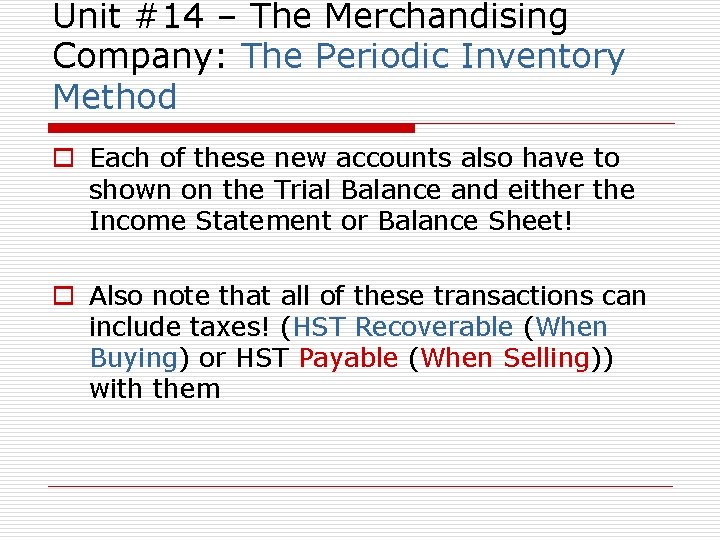
Unit #14 – The Merchandising Company: The Periodic Inventory Method o Each of these new accounts also have to shown on the Trial Balance and either the Income Statement or Balance Sheet! o Also note that all of these transactions can include taxes! (HST Recoverable (When Buying) or HST Payable (When Selling)) with them
Unit #14 – The Merchandising Company: The Perpetual Inventory Method o The name perpetual is a reference to the fact that the merchandise inventory account always shows us the value of inventory that should be on hand (i. e. it is perpetually kept up to date). o As technology becomes more and more widespread and affordable, most businesses have acquired computerized inventory and accounting systems. In fact, some computerized accounting software programs do not even support the periodic method of accounting anymore – only the perpetual!
Unit #14 – The Merchandising Company: The Perpetual Inventory Method o Recall!!! New Account Type of Account 1. Merchandise Inventory Current Asset 2. Sales Revenue 3. Sales Discounts Contra-Revenue 4. Sales Returns & Allowances Contra-Revenue 5. Purchases COGS (expense) 6. Purchase Discounts COGS (Contra-Expense) We use the Cost of Goods Sold Account to 7. Purchase Returns & Allowances COGS (Contra-Expense) track the items we’re selling - as we sell them. 8. Freight In COGS (expense) 9. Freight Out (Delivery Expense) Operating Expense 10. Inventory Shortage Operating Expense
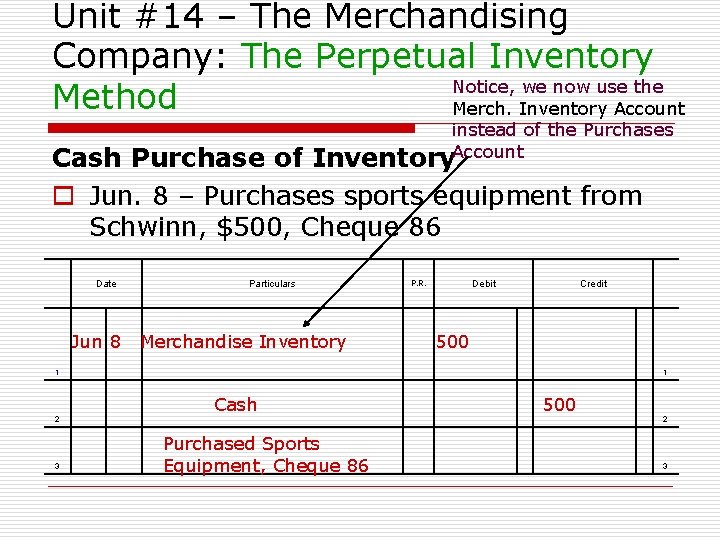
Unit #14 – The Merchandising Company: The Perpetual Inventory Notice, we now use the Method Merch. Inventory Account instead of the Purchases Account Cash Purchase of Inventory o Jun. 8 – Purchases sports equipment from Schwinn, $500, Cheque 86 Date Jun 8 Particulars Merchandise Inventory Debit P. R. Credit 500 1 1 Cash 2 3 500 2 Purchased Sports Equipment, Cheque 86 3
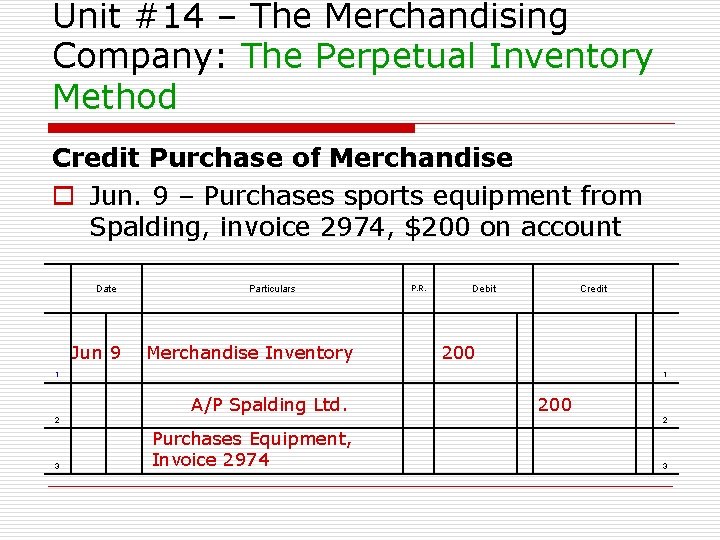
Unit #14 – The Merchandising Company: The Perpetual Inventory Method Credit Purchase of Merchandise o Jun. 9 – Purchases sports equipment from Spalding, invoice 2974, $200 on account Date Jun 9 Particulars Merchandise Inventory P. R. Debit Credit 200 1 1 A/P Spalding Ltd. 2 3 200 2 Purchases Equipment, Invoice 2974 3
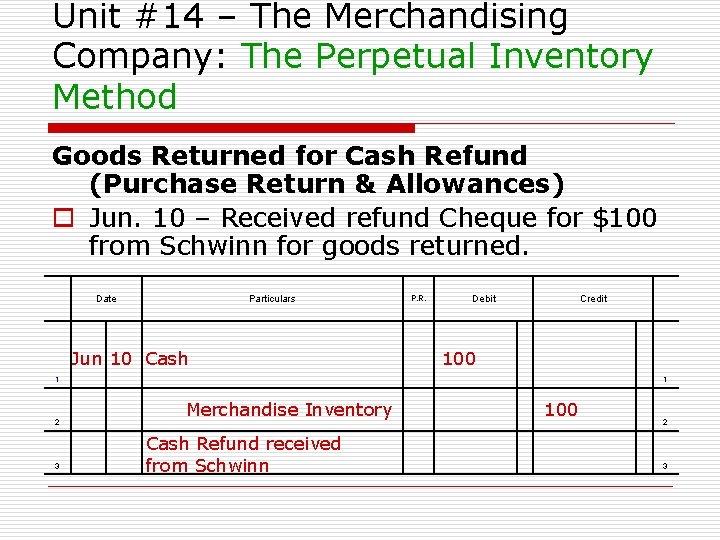
Unit #14 – The Merchandising Company: The Perpetual Inventory Method Goods Returned for Cash Refund (Purchase Return & Allowances) o Jun. 10 – Received refund Cheque for $100 from Schwinn for goods returned. Date Particulars Jun 10 Cash P. R. Debit Credit 100 1 2 3 1 Merchandise Inventory Cash Refund received from Schwinn 100 2 3
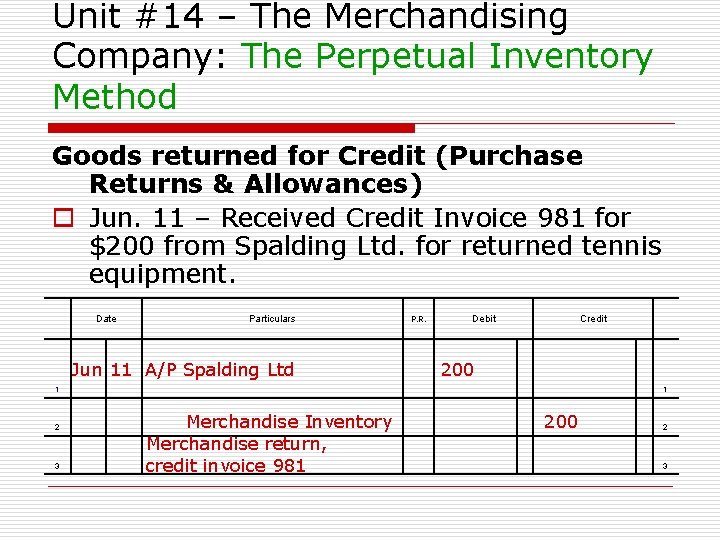
Unit #14 – The Merchandising Company: The Perpetual Inventory Method Goods returned for Credit (Purchase Returns & Allowances) o Jun. 11 – Received Credit Invoice 981 for $200 from Spalding Ltd. for returned tennis equipment. Date Particulars Jun 11 A/P Spalding Ltd P. R. Debit Credit 200 1 2 3 1 Merchandise Inventory Merchandise return, credit invoice 981 200 2 3
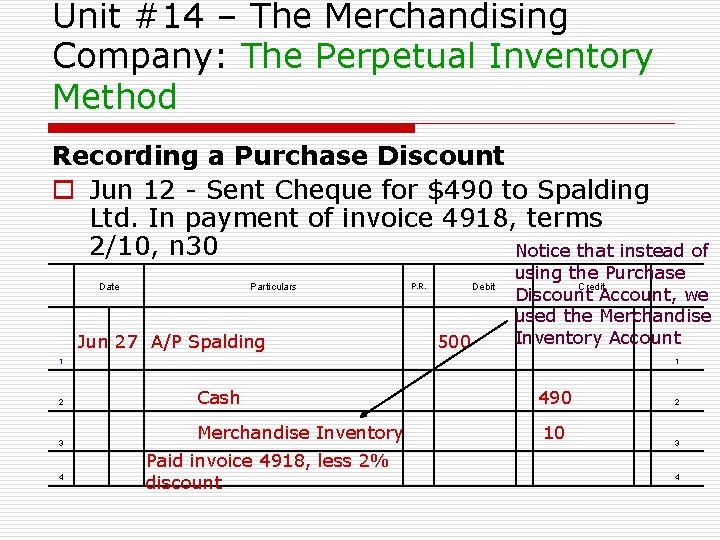
Unit #14 – The Merchandising Company: The Perpetual Inventory Method Recording a Purchase Discount o Jun 12 - Sent Cheque for $490 to Spalding Ltd. In payment of invoice 4918, terms 2/10, n 30 Notice that instead of Date Particulars Jun 27 A/P Spalding Debit P. R. 500 using the Purchase Credit Discount Account, we used the Merchandise Inventory Account 1 2 3 4 1 Cash 490 Merchandise Inventory 10 Paid invoice 4918, less 2% discount 2 3 4
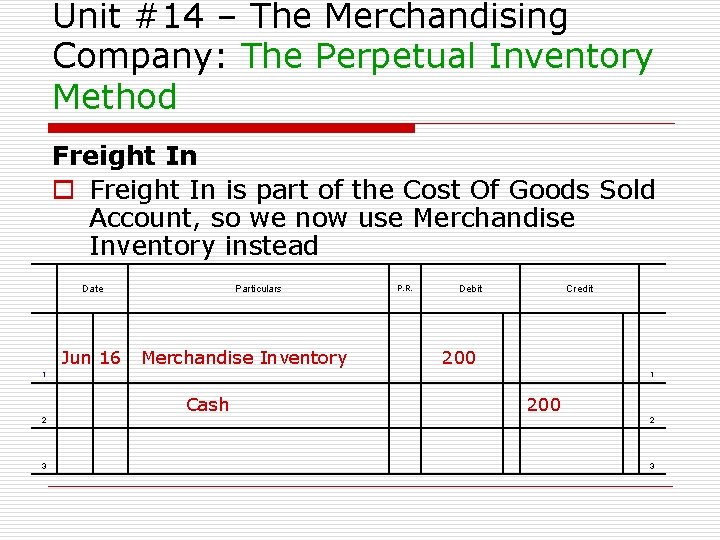
Unit #14 – The Merchandising Company: The Perpetual Inventory Method Freight In o Freight In is part of the Cost Of Goods Sold Account, so we now use Merchandise Inventory instead Date Jun 16 Particulars Merchandise Inventory P. R. Debit Credit 200 1 1 Cash 200 2 2 3 3
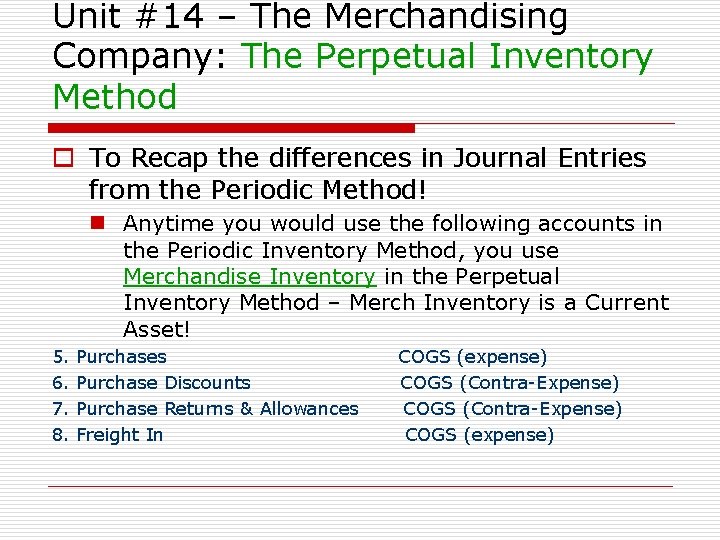
Unit #14 – The Merchandising Company: The Perpetual Inventory Method o To Recap the differences in Journal Entries from the Periodic Method! n Anytime you would use the following accounts in the Periodic Inventory Method, you use Merchandise Inventory in the Perpetual Inventory Method – Merch Inventory is a Current Asset! 5. 6. 7. 8. Purchases Purchase Discounts Purchase Returns & Allowances Freight In COGS (expense) COGS (Contra-Expense) COGS (expense)
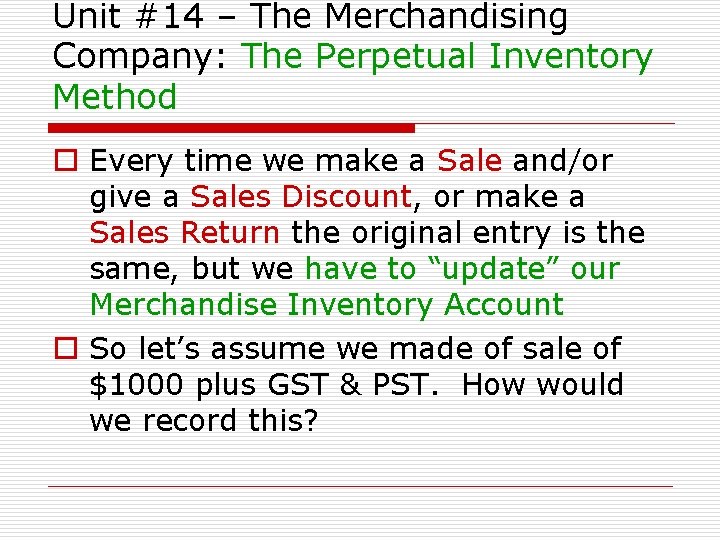
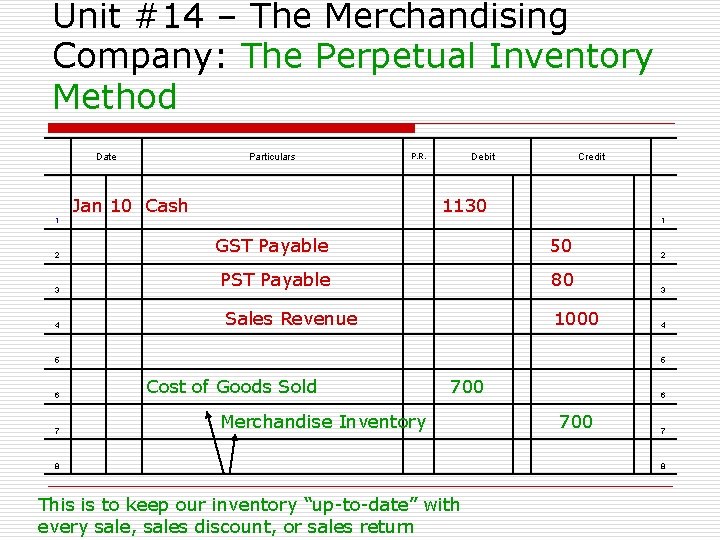
Unit #14 – The Merchandising Company: The Perpetual Inventory Method o Every time we make a Sale and/or give a Sales Discount, or make a Sales Return the original entry is the same, but we have to “update” our Merchandise Inventory Account o So let’s assume we made of sale of $1000 plus GST & PST. How would we record this?
Unit #14 – The Merchandising Company: The Perpetual Inventory Method Date Particulars Debit P. R. Jan 10 Cash Credit 1130 1 2 3 4 1 GST Payable 50 PST Payable 80 Sales Revenue 1000 5 6 7 2 3 4 5 Cost of Goods Sold 700 Merchandise Inventory 8 This is to keep our inventory “up-to-date” with every sale, sales discount, or sales return 6 700 7 8