
Ch 7 Operator Overloading Timothy Budd Ch 7
Ch 7. Operator Overloading Timothy Budd Ch 7. Operator Overloading
Introduction Almost all operators in C++ can be overloaded with new meanings. Operators may not look like functions but can hide function invocations. You cannot overload the meaning of operators if all arguments are primitive data types, nor can you change the precedence or associativity of operators. Ch 7. Operator Overloading 2
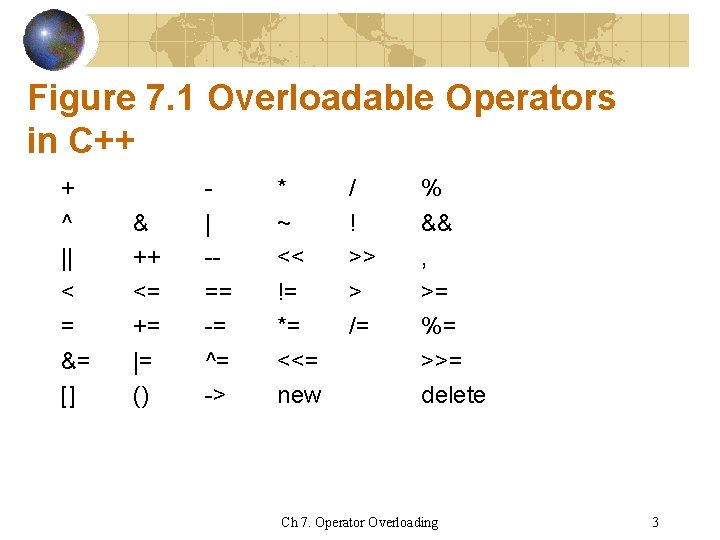
Figure 7. 1 Overloadable Operators in C++ + ^ || < = &= [] & ++ <= += |= () | -== -= ^= -> * ~ << != *= <<= new / ! >> > /= % && , >= %= >>= delete Ch 7. Operator Overloading 3
Overloaded Functions or Methods Operators can be defined either as functions or as member functions. How to decide which option is preferable An ordinary function is normally not permitted access to the private portions of the class, whereas a member function is allowed such access. Implicit conversions will be performed for both right and left arguments if the operator is defined in functional form, but only for the right argument if the operator is defined as a member function. Ch 7. Operator Overloading 4

Figure 7. 2 Comparison Defined as an Ordinary Function class box { public: box (int v) : value(v) { } int value; }; // define meaning of comparison for boxes bool operator < (box & left, box & right) { return left. value < right. value; } Ch 7. Operator Overloading 5
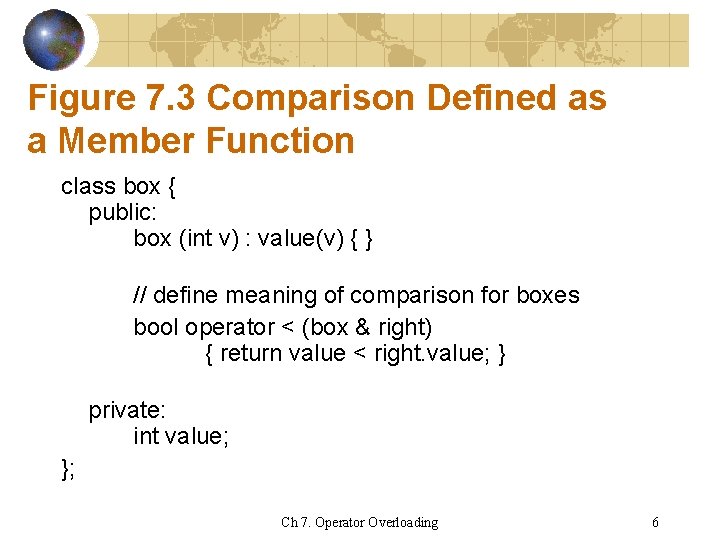
Figure 7. 3 Comparison Defined as a Member Function class box { public: box (int v) : value(v) { } // define meaning of comparison for boxes bool operator < (box & right) { return value < right. value; } private: int value; }; Ch 7. Operator Overloading 6
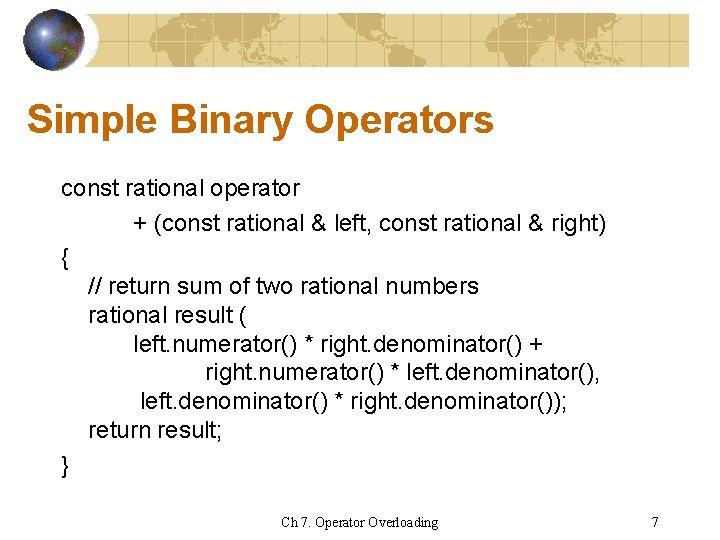
Simple Binary Operators const rational operator + (const rational & left, const rational & right) { // return sum of two rational numbers rational result ( left. numerator() * right. denominator() + right. numerator() * left. denominator(), left. denominator() * right. denominator()); return result; } Ch 7. Operator Overloading 7
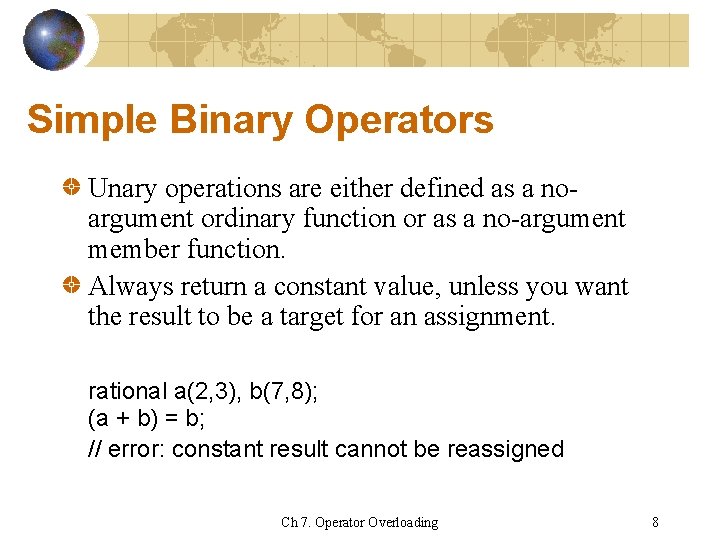
Simple Binary Operators Unary operations are either defined as a noargument ordinary function or as a no-argument member function. Always return a constant value, unless you want the result to be a target for an assignment. rational a(2, 3), b(7, 8); (a + b) = b; // error: constant result cannot be reassigned Ch 7. Operator Overloading 8
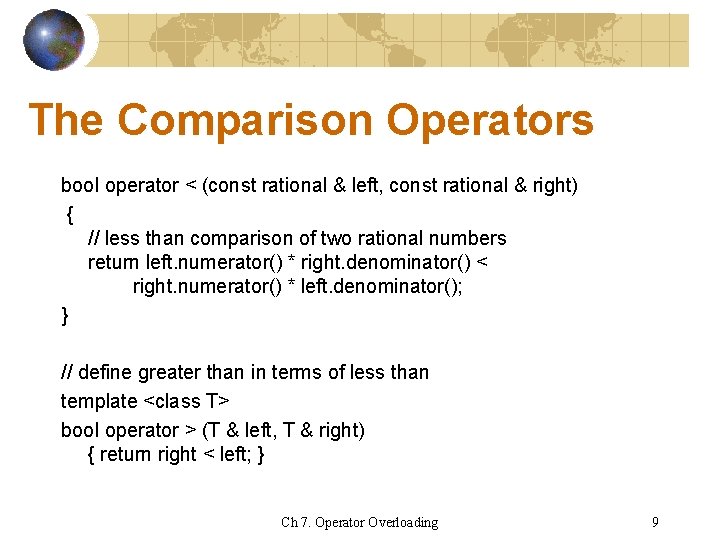
The Comparison Operators bool operator < (const rational & left, const rational & right) { // less than comparison of two rational numbers return left. numerator() * right. denominator() < right. numerator() * left. denominator(); } // define greater than in terms of less than template <class T> bool operator > (T & left, T & right) { return right < left; } Ch 7. Operator Overloading 9
The Increment and Decrement Operators If the increment operator is overloaded, you should define both the prefix and postfix forms. Whenever you have a choice, always invoke the prefix form of the increment operator as it is usually simpler. Ch 7. Operator Overloading 10
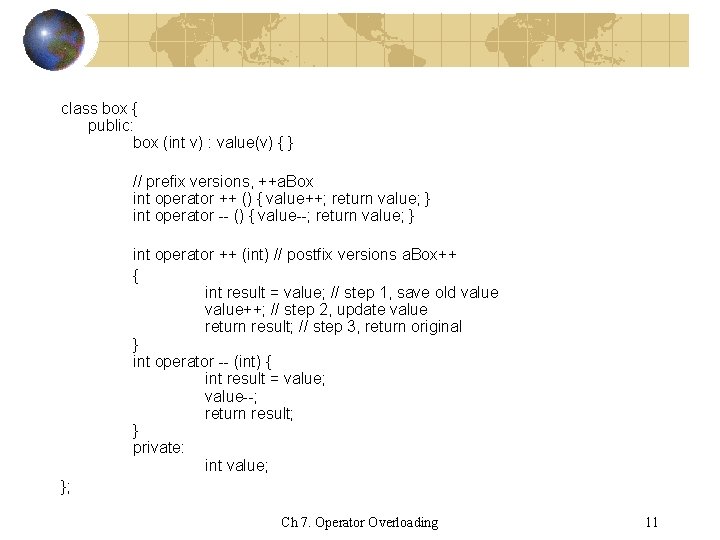
class box { public: box (int v) : value(v) { } // prefix versions, ++a. Box int operator ++ () { value++; return value; } int operator -- () { value--; return value; } int operator ++ (int) // postfix versions a. Box++ { int result = value; // step 1, save old value++; // step 2, update value return result; // step 3, return original } int operator -- (int) { int result = value; value--; return result; } private: int value; }; Ch 7. Operator Overloading 11
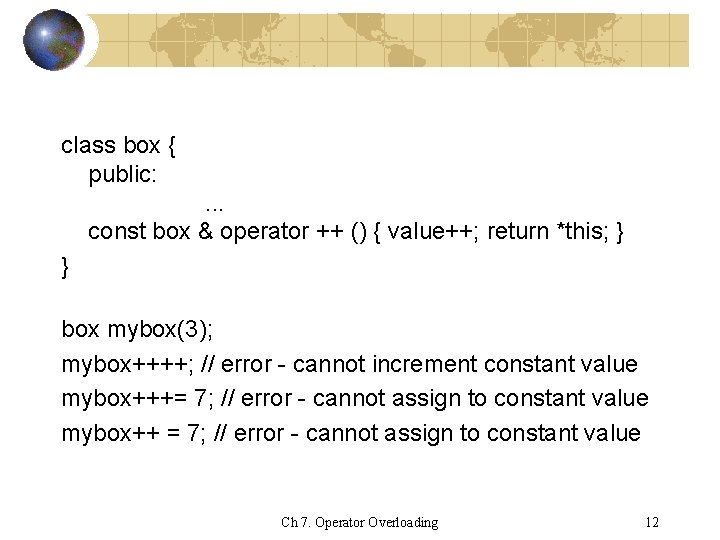
class box { public: . . . const box & operator ++ () { value++; return *this; } } box mybox(3); mybox++++; // error - cannot increment constant value mybox+++= 7; // error - cannot assign to constant value mybox++ = 7; // error - cannot assign to constant value Ch 7. Operator Overloading 12
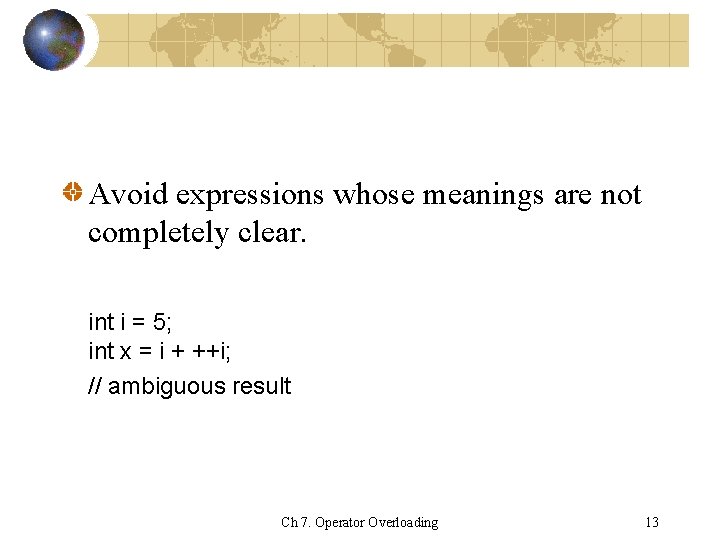
Avoid expressions whose meanings are not completely clear. int i = 5; int x = i + ++i; // ambiguous result Ch 7. Operator Overloading 13
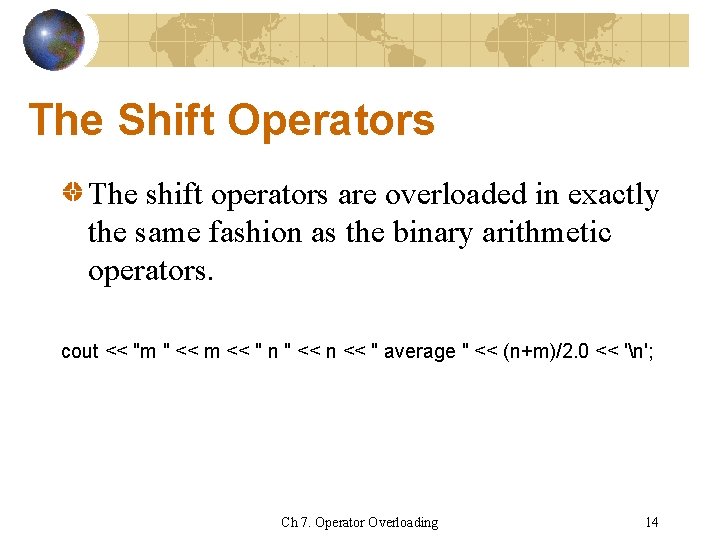
The Shift Operators The shift operators are overloaded in exactly the same fashion as the binary arithmetic operators. cout << "m " << m << " n " << n << " average " << (n+m)/2. 0 << 'n'; Ch 7. Operator Overloading 14
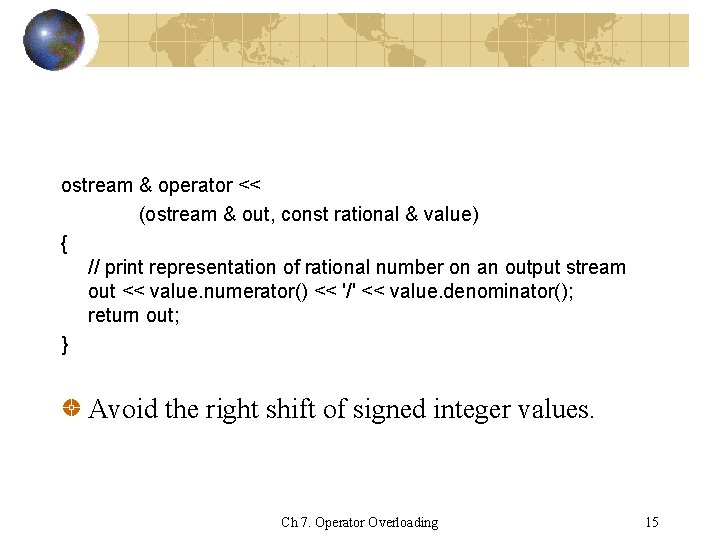
ostream & operator << (ostream & out, const rational & value) { // print representation of rational number on an output stream out << value. numerator() << '/' << value. denominator(); return out; } Avoid the right shift of signed integer values. Ch 7. Operator Overloading 15
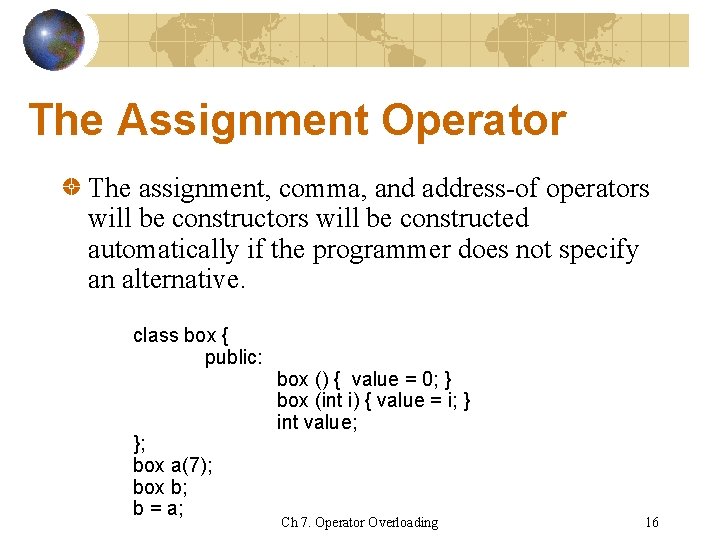
The Assignment Operator The assignment, comma, and address-of operators will be constructed automatically if the programmer does not specify an alternative. class box { public: }; box a(7); box b; b = a; box () { value = 0; } box (int i) { value = i; } int value; Ch 7. Operator Overloading 16
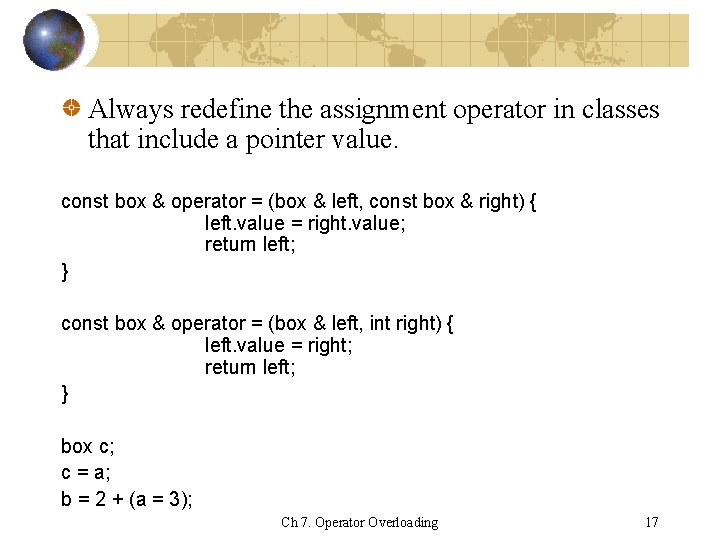
Always redefine the assignment operator in classes that include a pointer value. const box & operator = (box & left, const box & right) { left. value = right. value; return left; } const box & operator = (box & left, int right) { left. value = right; return left; } box c; c = a; b = 2 + (a = 3); Ch 7. Operator Overloading 17
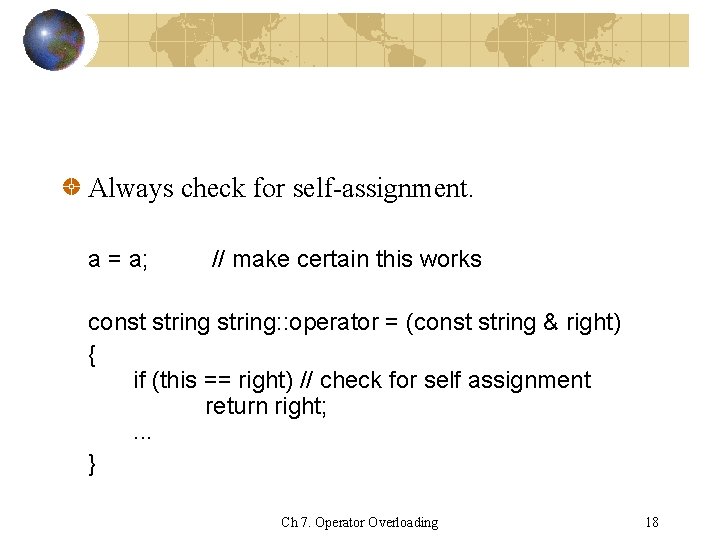
Always check for self-assignment. a = a; // make certain this works const string: : operator = (const string & right) { if (this == right) // check for self assignment return right; . . . } Ch 7. Operator Overloading 18
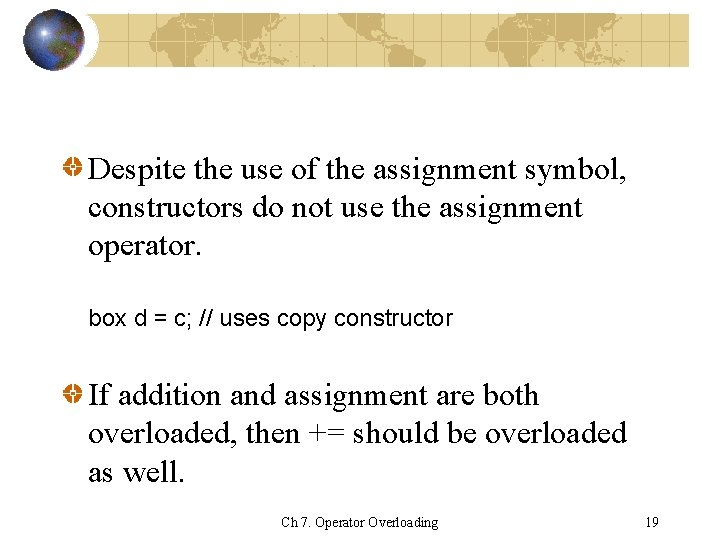
Despite the use of the assignment symbol, constructors do not use the assignment operator. box d = c; // uses copy constructor If addition and assignment are both overloaded, then += should be overloaded as well. Ch 7. Operator Overloading 19
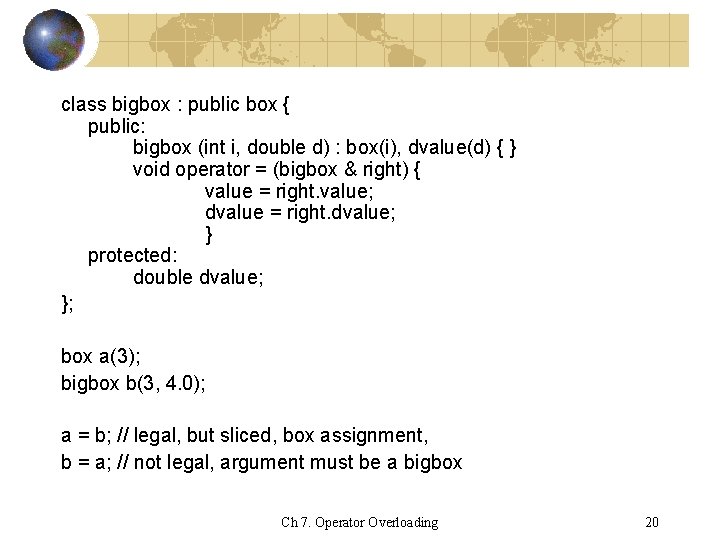
class bigbox : public box { public: bigbox (int i, double d) : box(i), dvalue(d) { } void operator = (bigbox & right) { value = right. value; dvalue = right. dvalue; } protected: double dvalue; }; box a(3); bigbox b(3, 4. 0); a = b; // legal, but sliced, box assignment, b = a; // not legal, argument must be a bigbox Ch 7. Operator Overloading 20
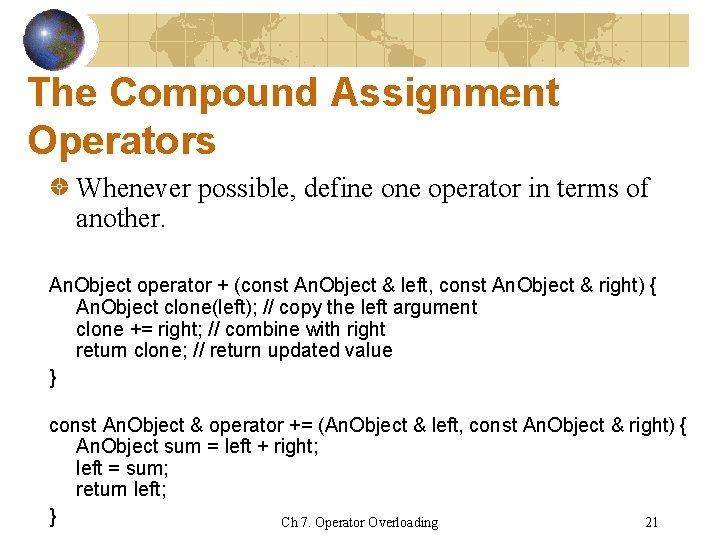
The Compound Assignment Operators Whenever possible, define operator in terms of another. An. Object operator + (const An. Object & left, const An. Object & right) { An. Object clone(left); // copy the left argument clone += right; // combine with right return clone; // return updated value } const An. Object & operator += (An. Object & left, const An. Object & right) { An. Object sum = left + right; left = sum; return left; } Ch 7. Operator Overloading 21
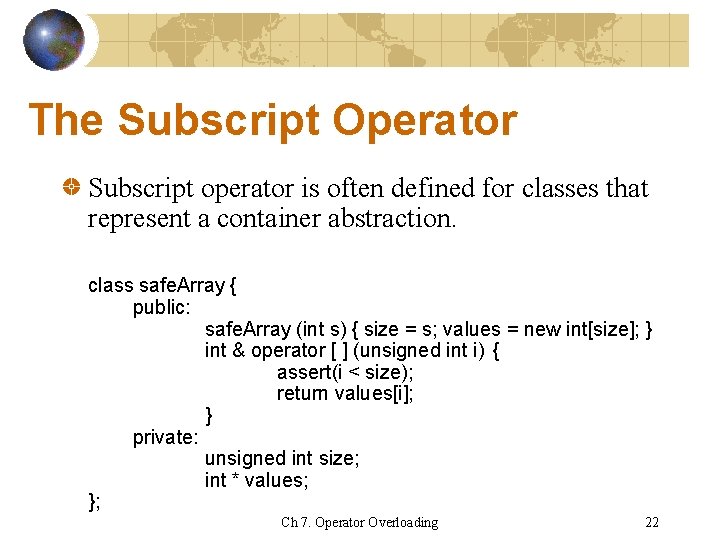
The Subscript Operator Subscript operator is often defined for classes that represent a container abstraction. class safe. Array { public: safe. Array (int s) { size = s; values = new int[size]; } int & operator [ ] (unsigned int i) { assert(i < size); return values[i]; } private: unsigned int size; int * values; }; Ch 7. Operator Overloading 22
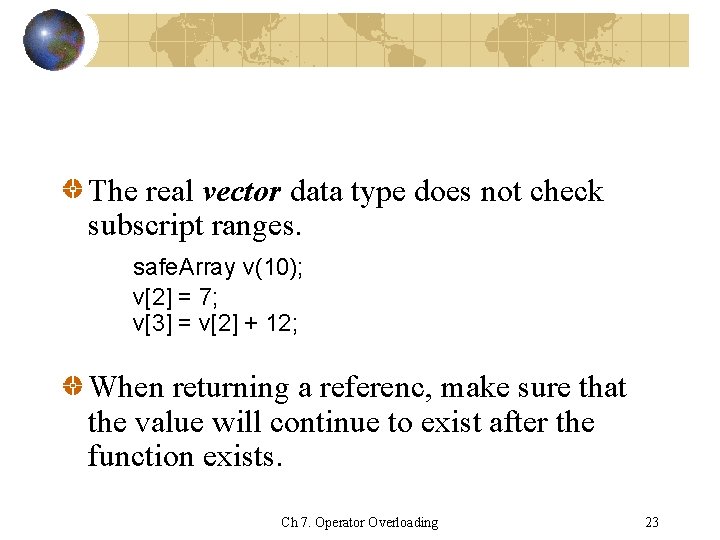
The real vector data type does not check subscript ranges. safe. Array v(10); v[2] = 7; v[3] = v[2] + 12; When returning a referenc, make sure that the value will continue to exist after the function exists. Ch 7. Operator Overloading 23
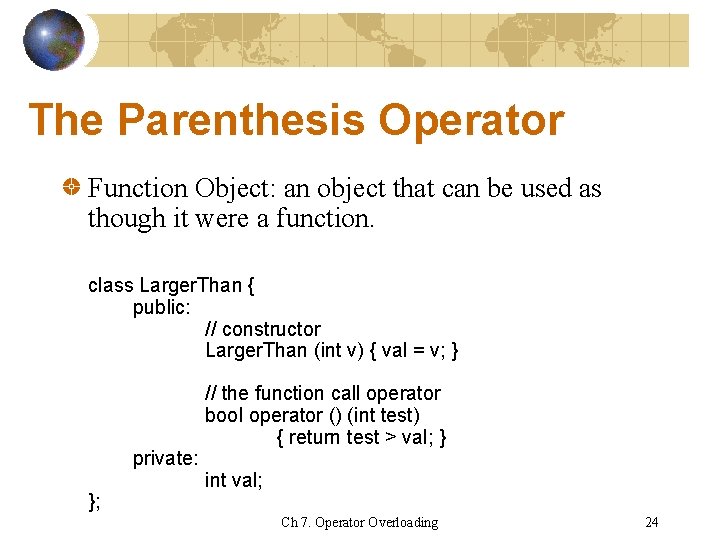
The Parenthesis Operator Function Object: an object that can be used as though it were a function. class Larger. Than { public: // constructor Larger. Than (int v) { val = v; } private: }; // the function call operator bool operator () (int test) { return test > val; } int val; Ch 7. Operator Overloading 24
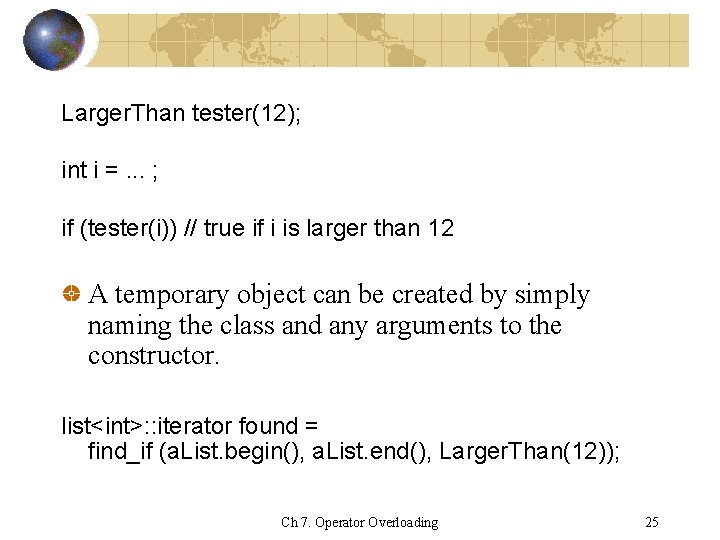
Larger. Than tester(12); int i =. . . ; if (tester(i)) // true if i is larger than 12 A temporary object can be created by simply naming the class and any arguments to the constructor. list<int>: : iterator found = find_if (a. List. begin(), a. List. end(), Larger. Than(12)); Ch 7. Operator Overloading 25
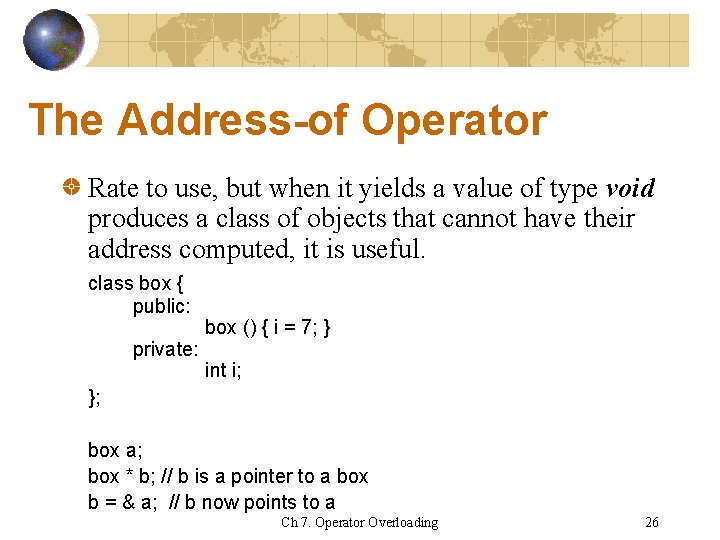
The Address-of Operator Rate to use, but when it yields a value of type void produces a class of objects that cannot have their address computed, it is useful. class box { public: private: box () { i = 7; } int i; }; box a; box * b; // b is a pointer to a box b = & a; // b now points to a Ch 7. Operator Overloading 26
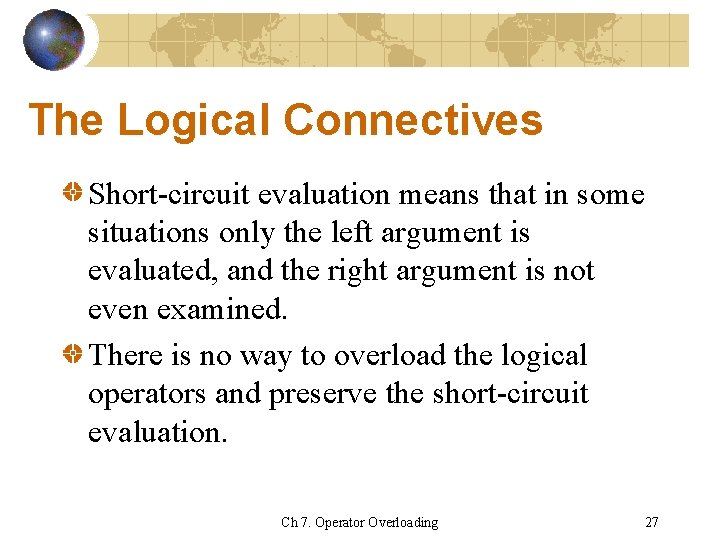
The Logical Connectives Short-circuit evaluation means that in some situations only the left argument is evaluated, and the right argument is not even examined. There is no way to overload the logical operators and preserve the short-circuit evaluation. Ch 7. Operator Overloading 27
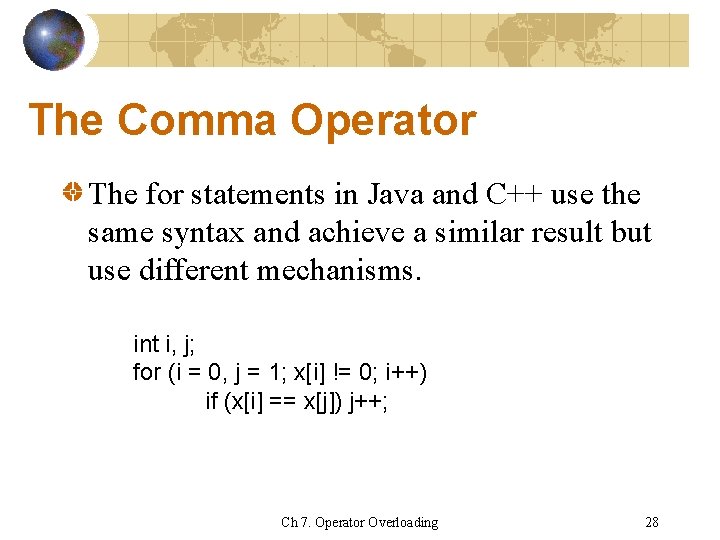
The Comma Operator The for statements in Java and C++ use the same syntax and achieve a similar result but use different mechanisms. int i, j; for (i = 0, j = 1; x[i] != 0; i++) if (x[i] == x[j]) j++; Ch 7. Operator Overloading 28
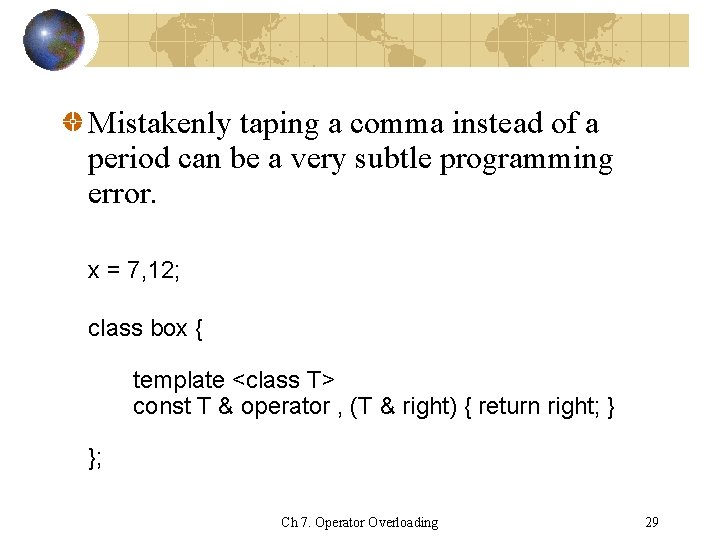
Mistakenly taping a comma instead of a period can be a very subtle programming error. x = 7, 12; class box { template <class T> const T & operator , (T & right) { return right; } }; Ch 7. Operator Overloading 29
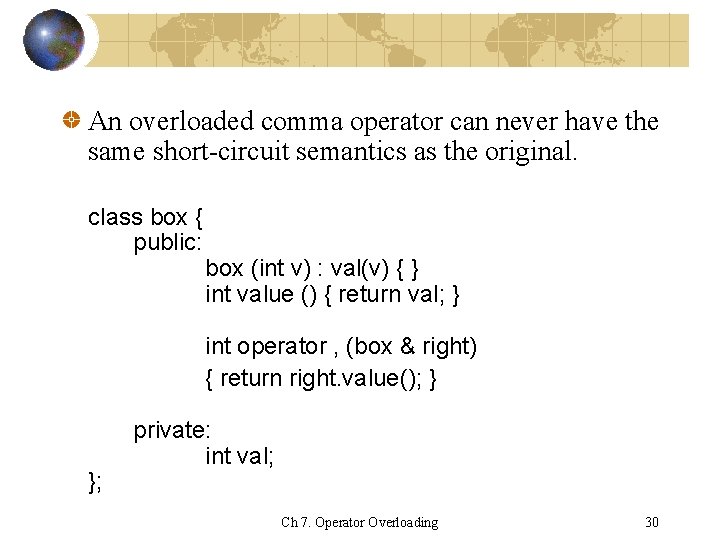
An overloaded comma operator can never have the same short-circuit semantics as the original. class box { public: box (int v) : val(v) { } int value () { return val; } int operator , (box & right) { return right. value(); } }; private: int val; Ch 7. Operator Overloading 30
The Arrow Operator Overloading arrow operator is useful in creating objects that have a ‘pointer-like’ behavior. The arrow operator can be defined only as a member function, and the return type must either be a pointer to a class type or an object for which the member access arrow is itself defined. A smart pointer is an object that can be used in the manner of a pointer. Ch 7. Operator Overloading 31
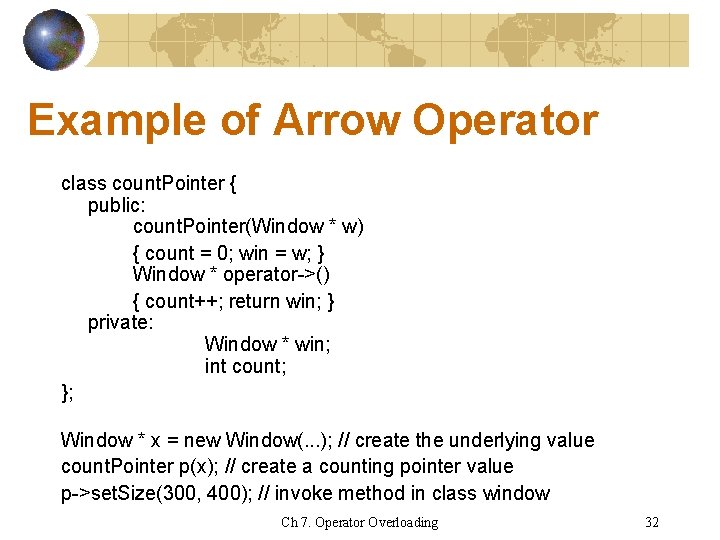
Example of Arrow Operator class count. Pointer { public: count. Pointer(Window * w) { count = 0; win = w; } Window * operator->() { count++; return win; } private: Window * win; int count; }; Window * x = new Window(. . . ); // create the underlying value count. Pointer p(x); // create a counting pointer value p->set. Size(300, 400); // invoke method in class window Ch 7. Operator Overloading 32
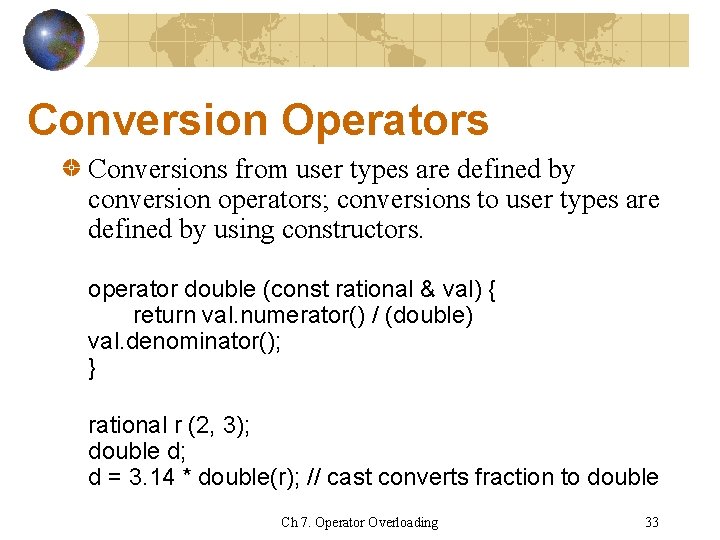
Conversion Operators Conversions from user types are defined by conversion operators; conversions to user types are defined by using constructors. operator double (const rational & val) { return val. numerator() / (double) val. denominator(); } rational r (2, 3); double d; d = 3. 14 * double(r); // cast converts fraction to double Ch 7. Operator Overloading 33
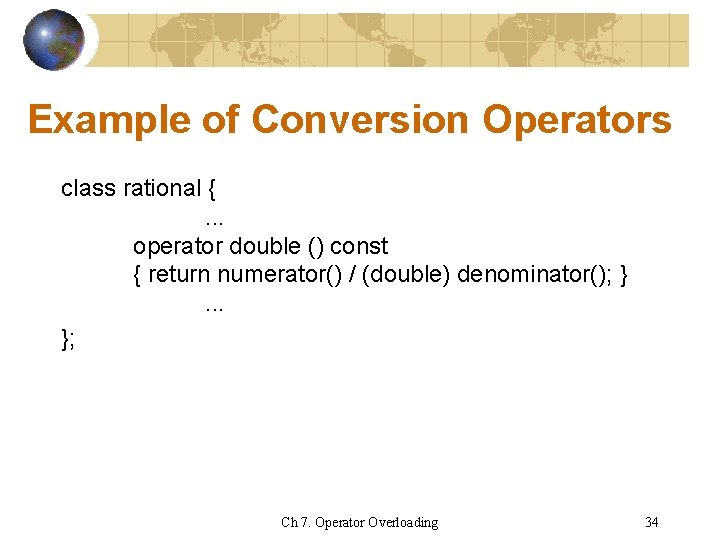
Example of Conversion Operators class rational {. . . operator double () const { return numerator() / (double) denominator(); }. . . }; Ch 7. Operator Overloading 34
Memory management Operators It is possible to overload the memory management operators new and delete, obtaining even more control over these tasks than is provided by the default implementations. Ch 7. Operator Overloading 35
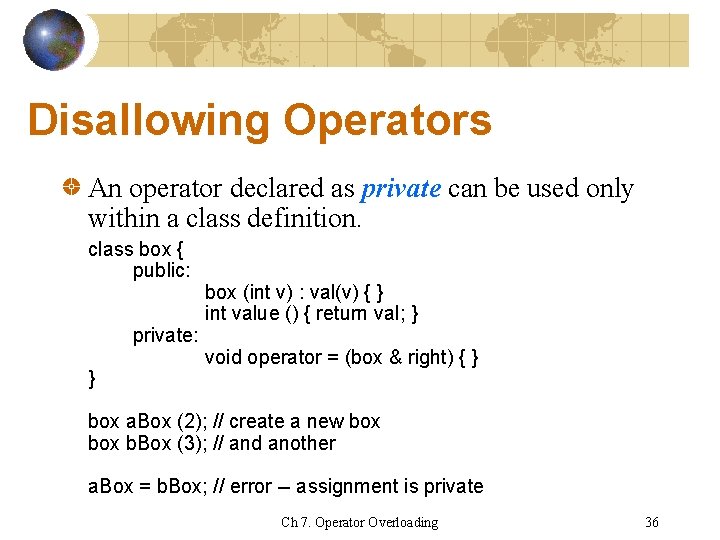
Disallowing Operators An operator declared as private can be used only within a class definition. class box { public: private: } box (int v) : val(v) { } int value () { return val; } void operator = (box & right) { } box a. Box (2); // create a new box b. Box (3); // and another a. Box = b. Box; // error -- assignment is private Ch 7. Operator Overloading 36
Implicit Functions and Invocations Implicit function definitions and implicit function invocations are invoked without the programmer directly requesting it. Ch 7. Operator Overloading 37
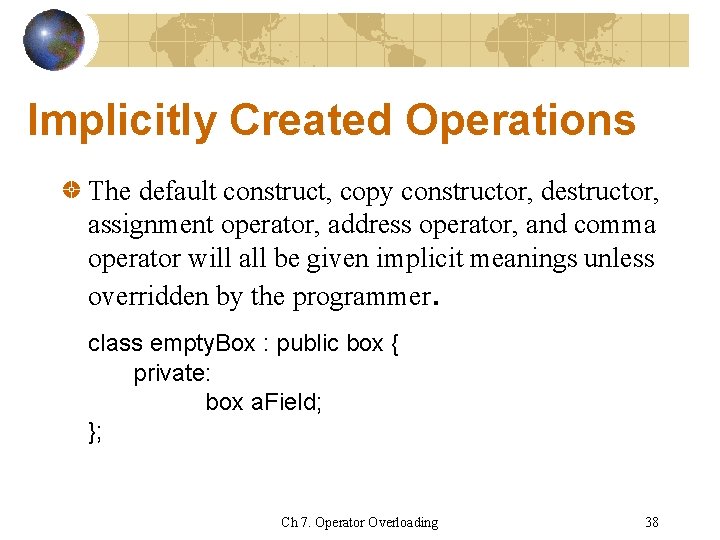
Implicitly Created Operations The default construct, copy constructor, destructor, assignment operator, address operator, and comma operator will all be given implicit meanings unless overridden by the programmer. class empty. Box : public box { private: box a. Field; }; Ch 7. Operator Overloading 38
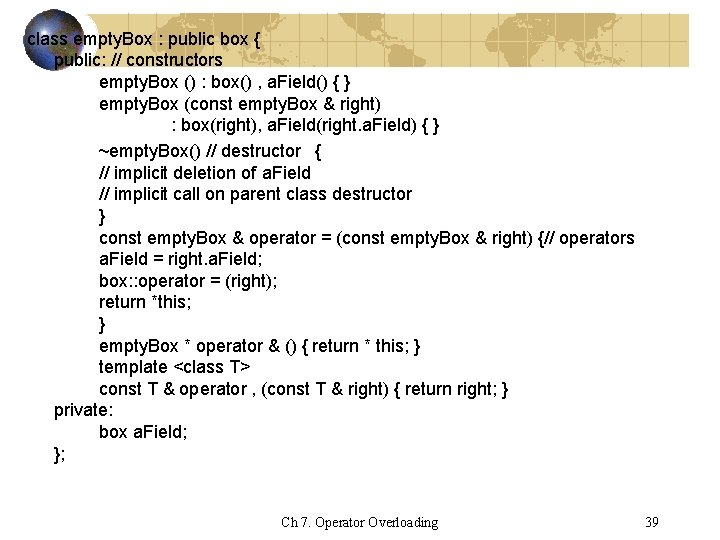
class empty. Box : public box { public: // constructors empty. Box () : box() , a. Field() { } empty. Box (const empty. Box & right) : box(right), a. Field(right. a. Field) { } ~empty. Box() // destructor { // implicit deletion of a. Field // implicit call on parent class destructor } const empty. Box & operator = (const empty. Box & right) {// operators a. Field = right. a. Field; box: : operator = (right); return *this; } empty. Box * operator & () { return * this; } template <class T> const T & operator , (const T & right) { return right; } private: box a. Field; }; Ch 7. Operator Overloading 39
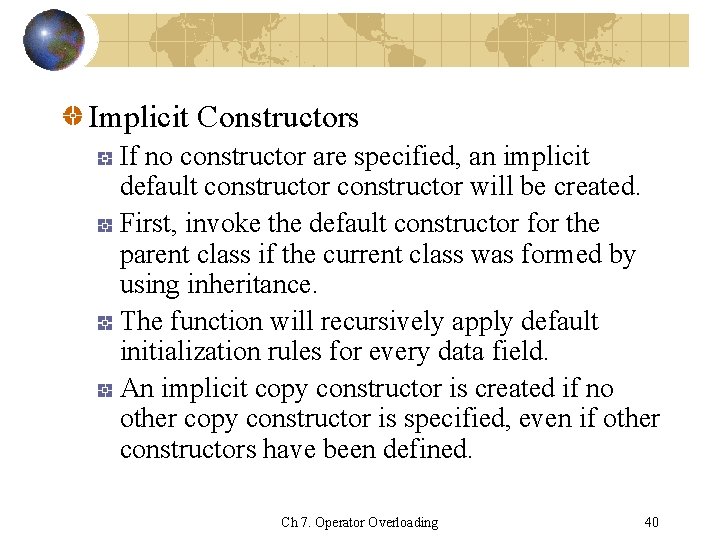
Implicit Constructors If no constructor are specified, an implicit default constructor will be created. First, invoke the default constructor for the parent class if the current class was formed by using inheritance. The function will recursively apply default initialization rules for every data field. An implicit copy constructor is created if no other copy constructor is specified, even if other constructors have been defined. Ch 7. Operator Overloading 40
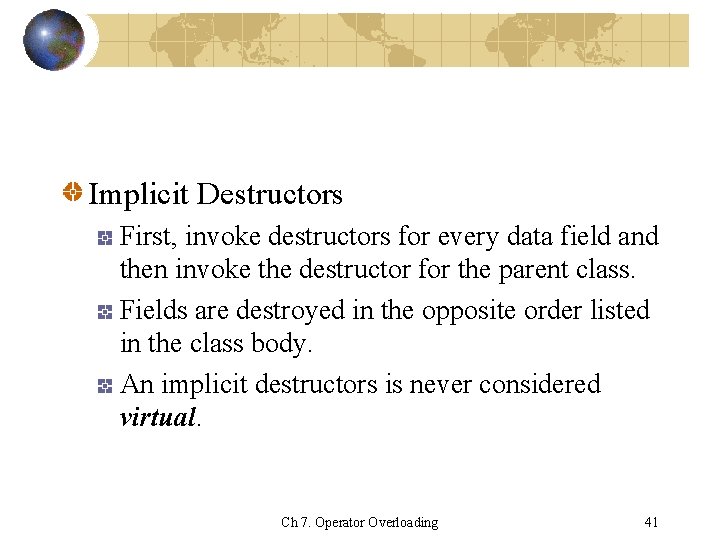
Implicit Destructors First, invoke destructors for every data field and then invoke the destructor for the parent class. Fields are destroyed in the opposite order listed in the class body. An implicit destructors is never considered virtual. Ch 7. Operator Overloading 41
Implicit Assignment Operator Created implicitly, takes as an argument a value of the same type as the class and recursively assigns each data field from the corresponding fields in the argument object. If there is parent class, the assignment operator for the parent class is then invoked. Ch 7. Operator Overloading 42
Implicit Address and Comma The implicit address simply returns a reference to the current object. The implicit comma operator simply returns a reference to the argument object. Ch 7. Operator Overloading 43
Implicit Function Invocations Implicit function invocation can greatly increase a program’s execution time. A copy constructor always invoked to pass a by-value object. Ch 7. Operator Overloading 44
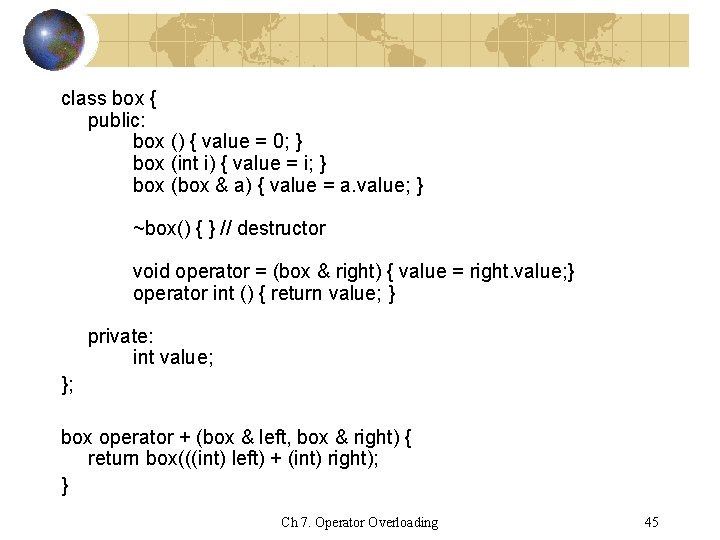
class box { public: box () { value = 0; } box (int i) { value = i; } box (box & a) { value = a. value; } ~box() { } // destructor void operator = (box & right) { value = right. value; } operator int () { return value; } private: int value; }; box operator + (box & left, box & right) { return box(((int) left) + (int) right); } Ch 7. Operator Overloading 45
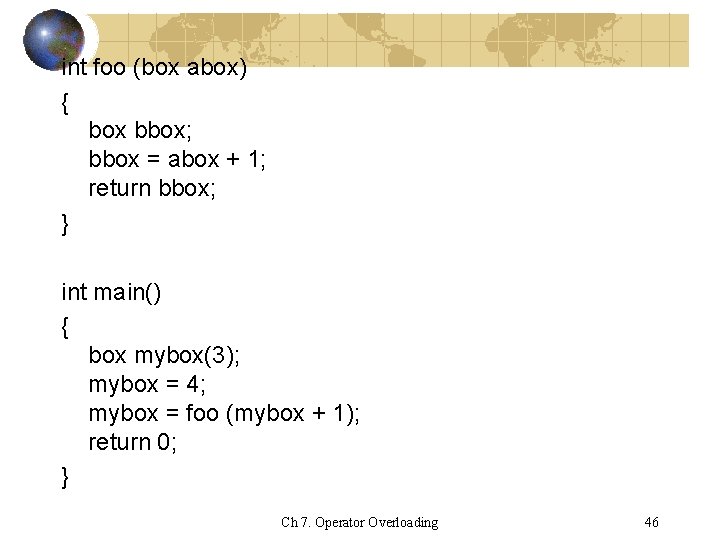
int foo (box abox) { box bbox; bbox = abox + 1; return bbox; } int main() { box mybox(3); mybox = 4; mybox = foo (mybox + 1); return 0; } Ch 7. Operator Overloading 46
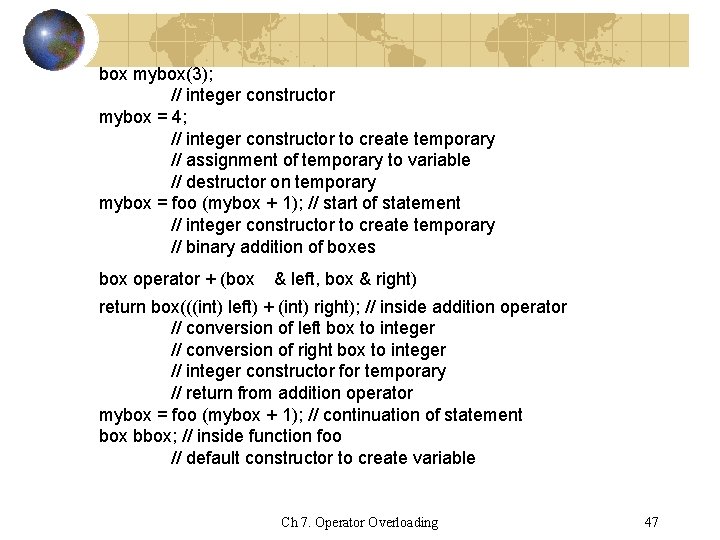
box mybox(3); // integer constructor mybox = 4; // integer constructor to create temporary // assignment of temporary to variable // destructor on temporary mybox = foo (mybox + 1); // start of statement // integer constructor to create temporary // binary addition of boxes box operator + (box & left, box & right) return box(((int) left) + (int) right); // inside addition operator // conversion of left box to integer // conversion of right box to integer // integer constructor for temporary // return from addition operator mybox = foo (mybox + 1); // continuation of statement box bbox; // inside function foo // default constructor to create variable Ch 7. Operator Overloading 47
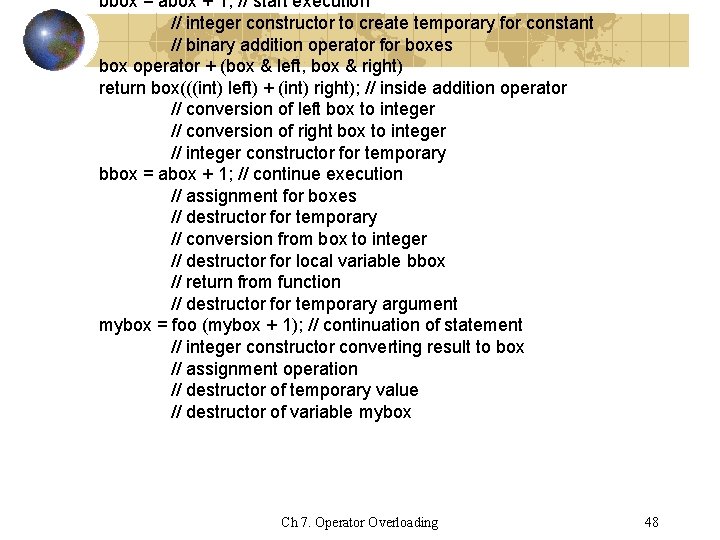
bbox = abox + 1; // start execution // integer constructor to create temporary for constant // binary addition operator for boxes box operator + (box & left, box & right) return box(((int) left) + (int) right); // inside addition operator // conversion of left box to integer // conversion of right box to integer // integer constructor for temporary bbox = abox + 1; // continue execution // assignment for boxes // destructor for temporary // conversion from box to integer // destructor for local variable bbox // return from function // destructor for temporary argument mybox = foo (mybox + 1); // continuation of statement // integer constructor converting result to box // assignment operation // destructor of temporary value // destructor of variable mybox Ch 7. Operator Overloading 48
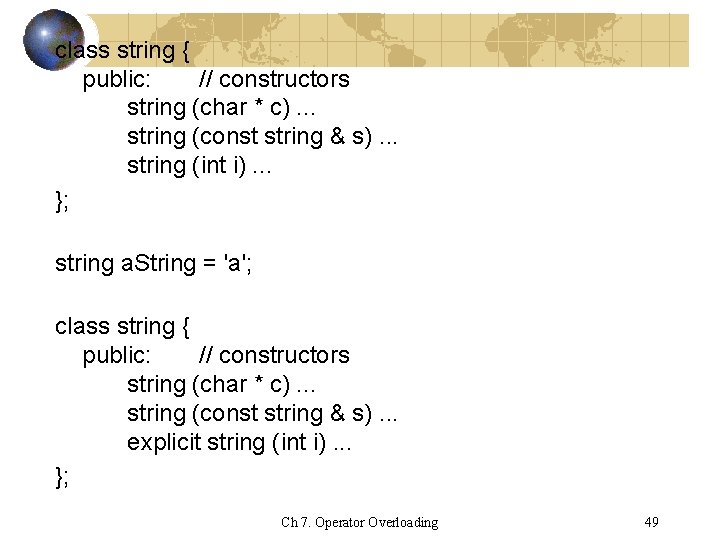
class string { public: // constructors string (char * c). . . string (const string & s). . . string (int i). . . }; string a. String = 'a'; class string { public: // constructors string (char * c). . . string (const string & s). . . explicit string (int i). . . }; Ch 7. Operator Overloading 49
- Slides: 49