
Ch 7 Meiosis Sexual Reproduction Volvox asexual reprod



- Slides: 72
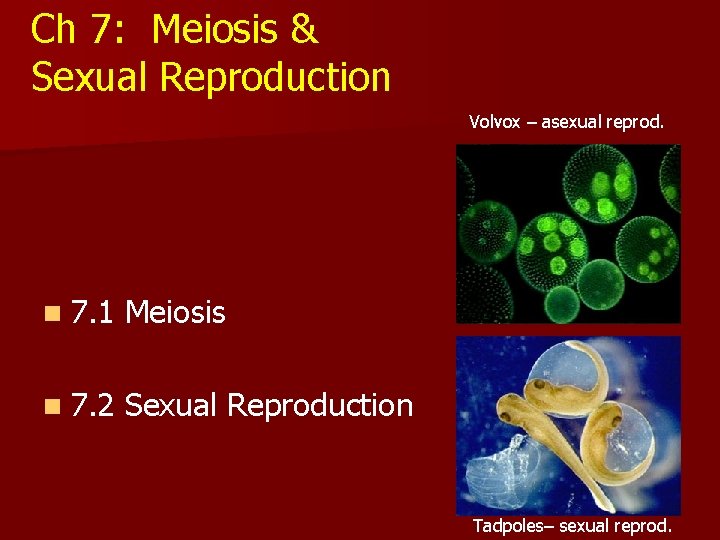
Ch 7: Meiosis & Sexual Reproduction Volvox – asexual reprod. n 7. 1 Meiosis n 7. 2 Sexual Reproduction Tadpoles– sexual reprod.
Enduring Understanding Biological systems utilize free energy & molecular building blocks to grow, reproduce, & maintain dynamic homeostasis.
Essential Questions • How does life create new life? • Why does sex – that is sexual reproduction – exist?
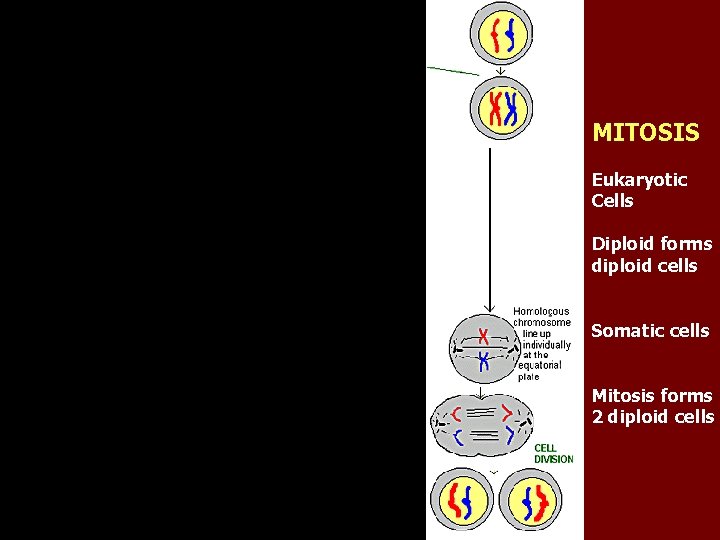
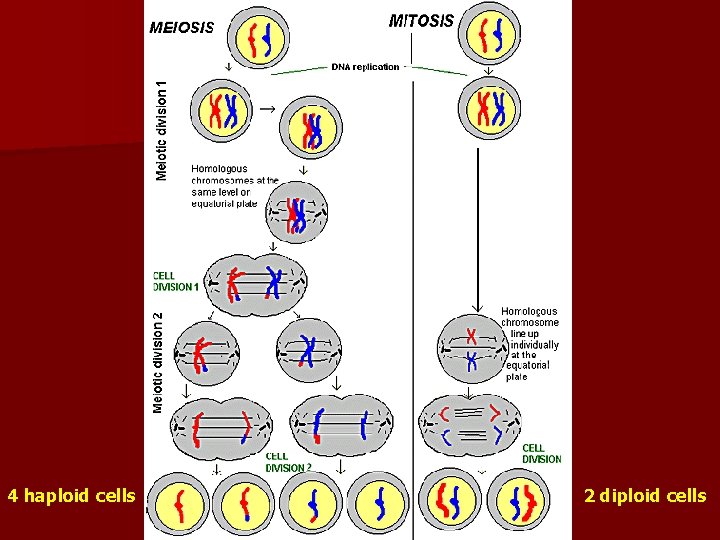
MEIOSIS MITOSIS Eukaryotic Cells Diploid forms haploid cells Diploid forms diploid cells Sex cells/ Spores Somatic cells Meiosis forms 4 haploid cells Mitosis forms 2 diploid cells
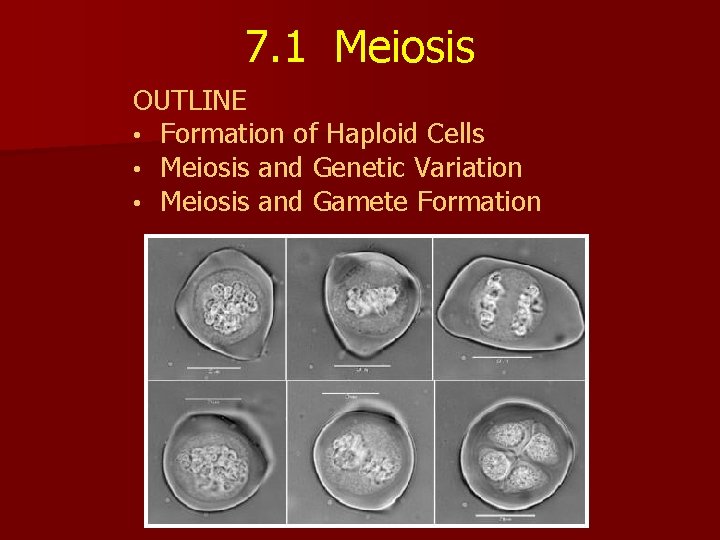
7. 1 Meiosis OUTLINE • Formation of Haploid Cells • Meiosis and Genetic Variation • Meiosis and Gamete Formation
Formation of haploid cells n Meiosis - halves the number of chromosomes – forms reproductive cells. n Greek word “meioun” – to make smaller – Chromosome number split in half
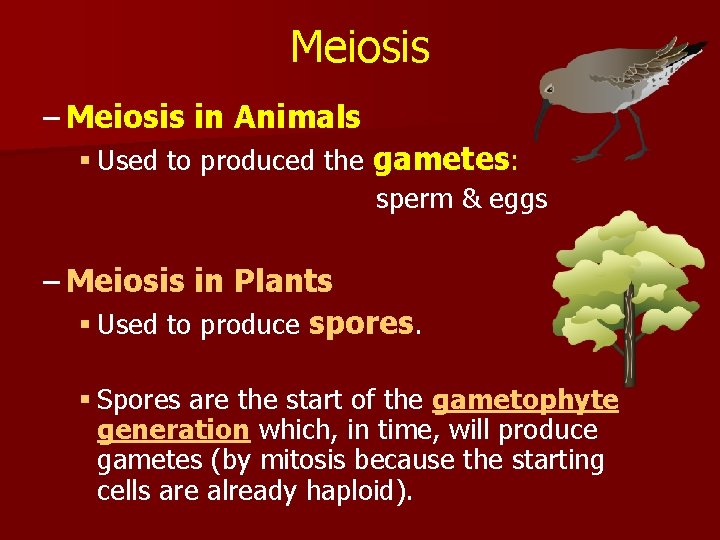
Meiosis – Meiosis in Animals § Used to produced the gametes: sperm & eggs – Meiosis in Plants § Used to produce spores. § Spores are the start of the gametophyte generation which, in time, will produce gametes (by mitosis because the starting cells are already haploid).
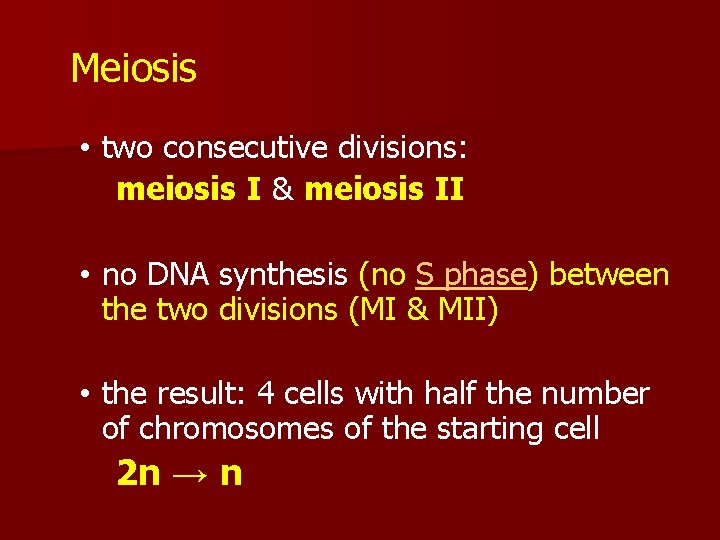
Meiosis • two consecutive divisions: meiosis I & meiosis II • no DNA synthesis (no S phase) between the two divisions (MI & MII) • the result: 4 cells with half the number of chromosomes of the starting cell 2 n → n
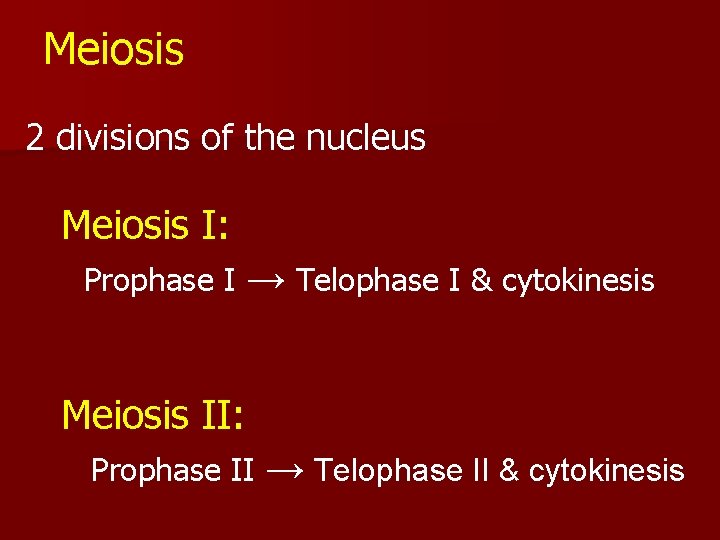
Meiosis 2 divisions of the nucleus Meiosis I: Prophase I → Telophase I & cytokinesis Meiosis II: Prophase II → Telophase II & cytokinesis
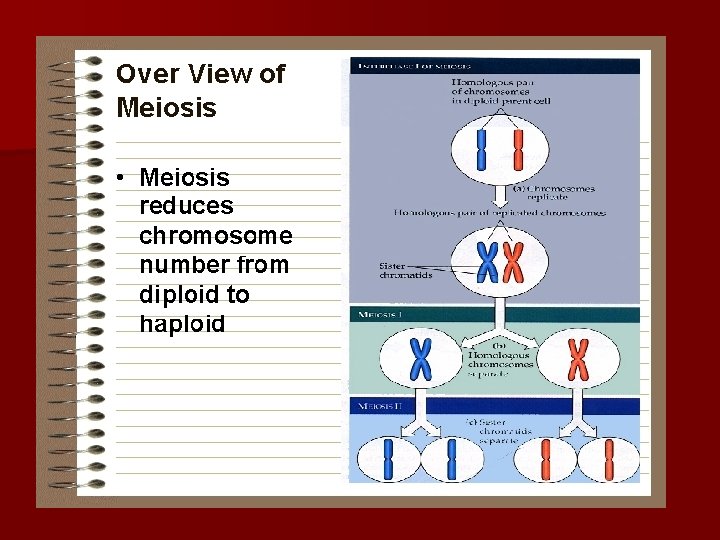
Meiosis • Before meiosis begins, the DNA in the original cell is replicated. • Meiosis starts with the homologous chromosomes. • KNOW P. 144 Stages of Meiosis
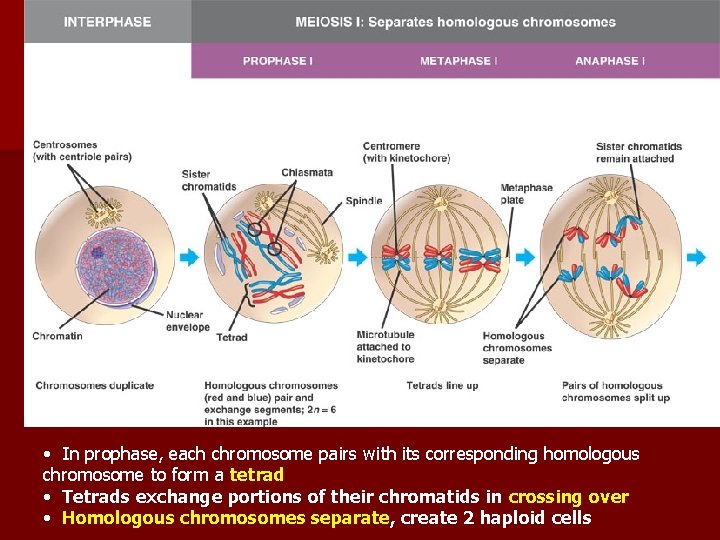
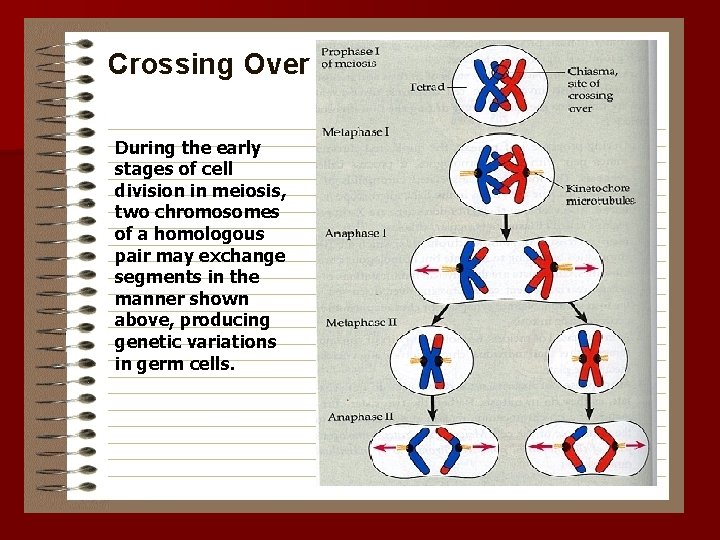
• In prophase, each chromosome pairs with its corresponding homologous chromosome to form a tetrad • Tetrads exchange portions of their chromatids in crossing over • Homologous chromosomes separate, create 2 haploid cells
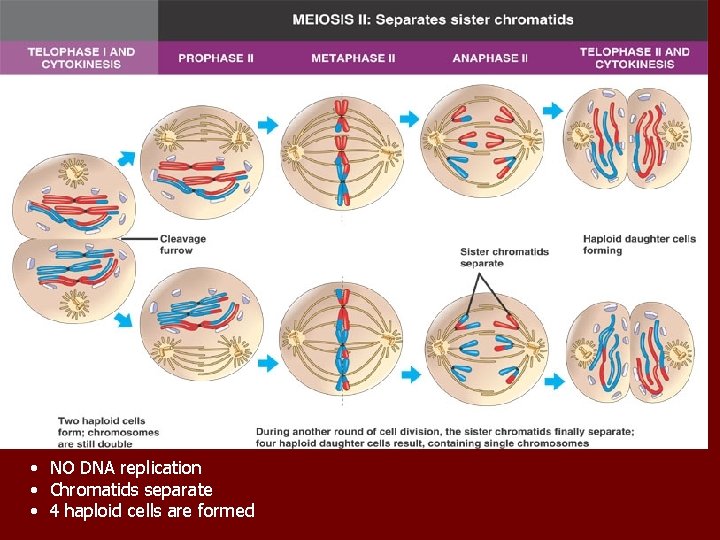
• NO DNA replication • Chromatids separate • 4 haploid cells are formed
4 haploid cells 2 diploid cells
Review Meiosis -animation
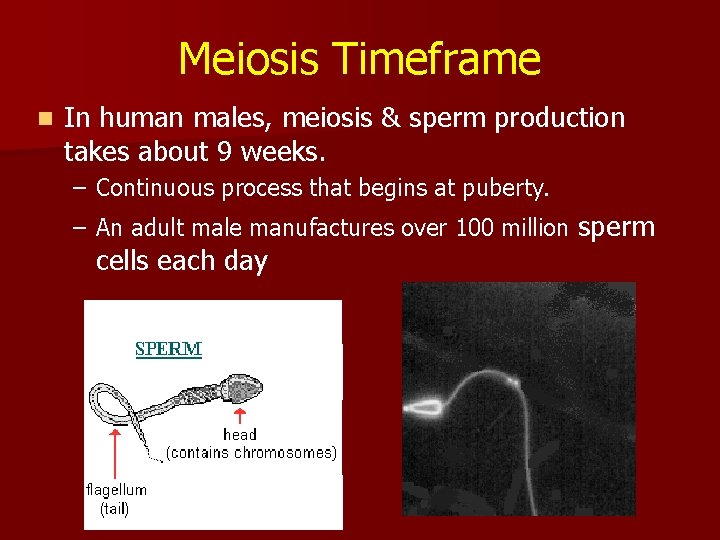
Meiosis Timeframe n In human males, meiosis & sperm production takes about 9 weeks. – Continuous process that begins at puberty. – An adult male manufactures over 100 million sperm cells each day
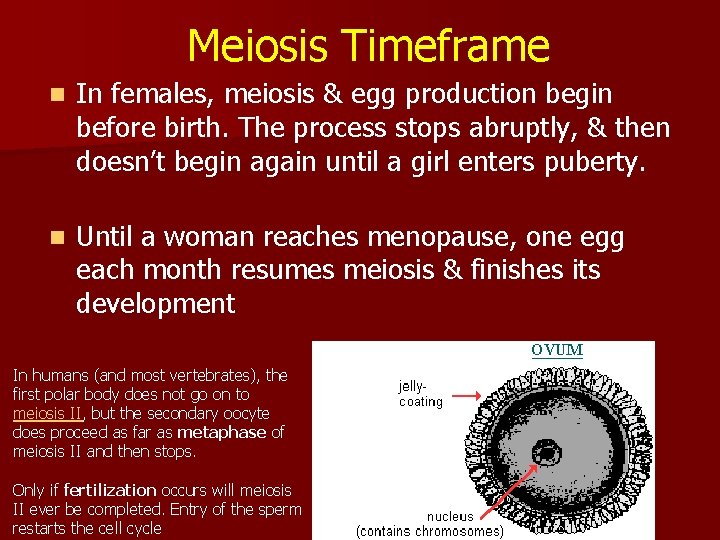
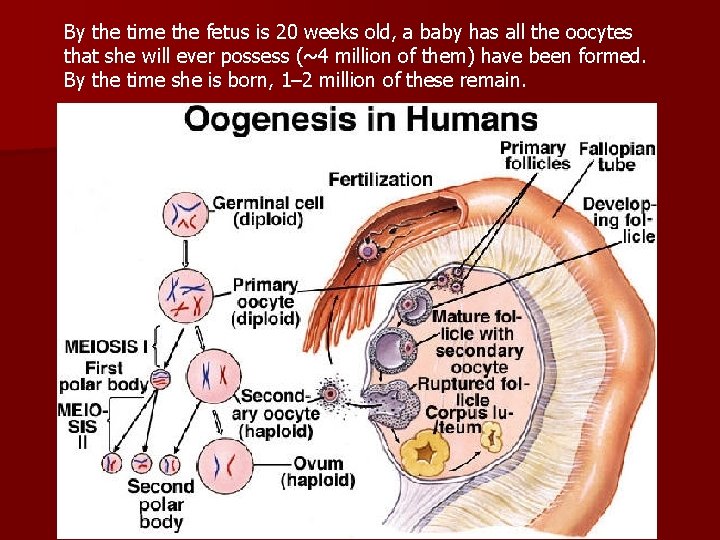
Meiosis Timeframe n In females, meiosis & egg production begin before birth. The process stops abruptly, & then doesn’t begin again until a girl enters puberty. n Until a woman reaches menopause, one egg each month resumes meiosis & finishes its development In humans (and most vertebrates), the first polar body does not go on to meiosis II, but the secondary oocyte does proceed as far as metaphase of meiosis II and then stops. Only if fertilization occurs will meiosis II ever be completed. Entry of the sperm restarts the cell cycle
Meiosis and Genetic Variation • Meiosis is an important process that allows for the rapid generation of new combinations. • Genetic variation: 1. Independent assortment 2. Crossing over 3. Random fertilization
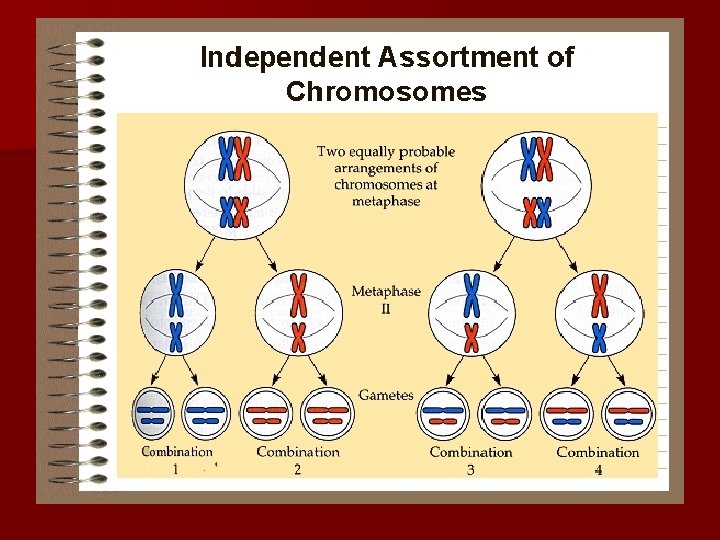
1. Independent Assortment • The random distribution of homologous chromosomes during meiosis. • Each of the 23 pairs of chromosomes separates independently. - Thus 223 ( about 8 million) gametes with different gene combinations can be produced from one original cell by this mechanism!
Independent Assortment animation
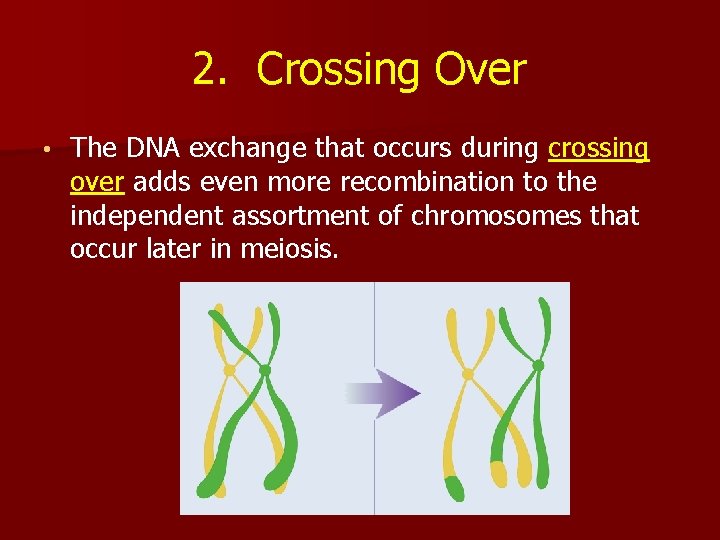
2. Crossing Over • The DNA exchange that occurs during crossing over adds even more recombination to the independent assortment of chromosomes that occur later in meiosis.
During the early stages of cell division in meiosis, two chromosomes of a homologous pair may exchange segments in the manner shown above, producing genetic variations in germ cells.
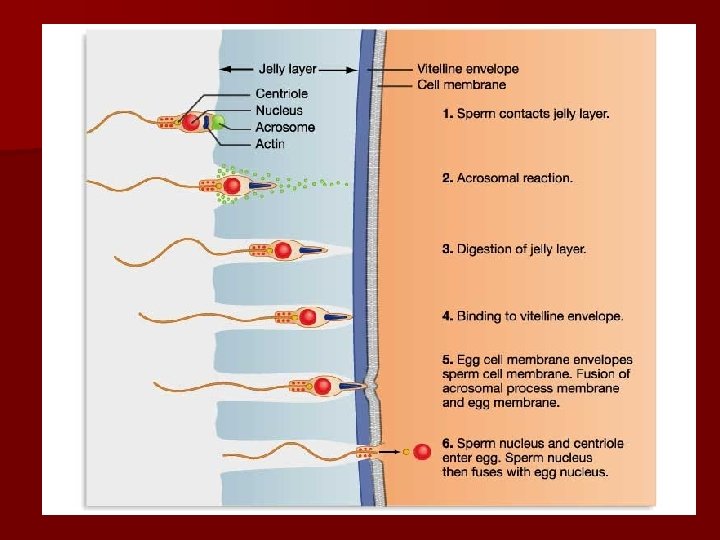
3. Random fertilization • Zygote is created by random joining of two gametes • Fertilization of egg by sperm is random • About 300 million sperm released by human male at once (100 – 500 million) • The number of possible outcomes is squared • 223 x 223 = 64 trillion
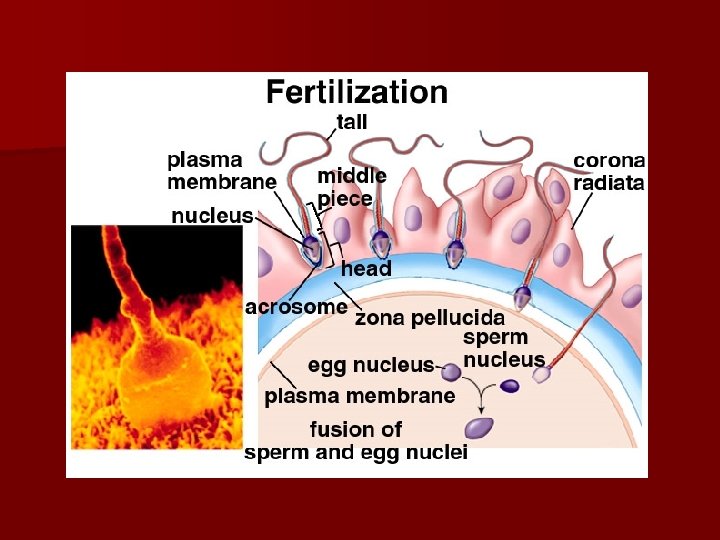
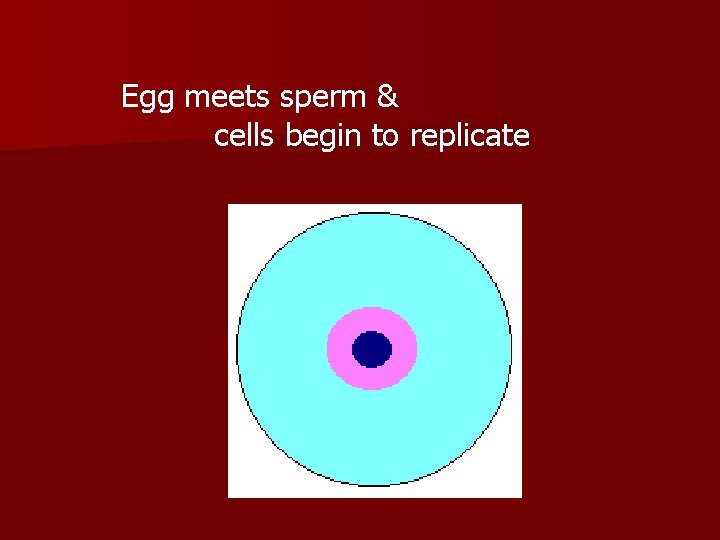
Egg meets sperm & cells begin to replicate
Meiosis - Animation Cells Alive - Meiosis
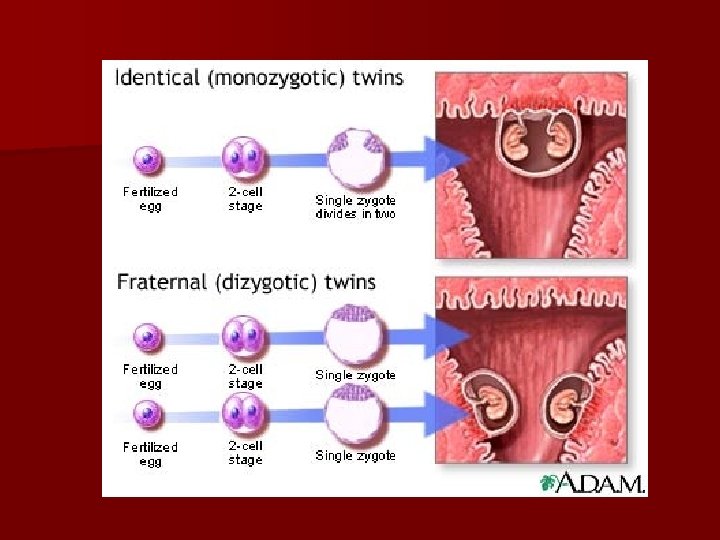
Twin questions answered n Identical -- monozygotic (one zygote) - single fertilized egg splits into two genetically identical parts. – twins share the same DNA set – physical appearance is influenced by environmental factors & not just genetics, identical twins can actually look very different. n Fraternal -- or dizygotic (two zygotes) -two separate eggs are fertilized & implant in the uterus. – Genetic connection is no more or less the same as siblings born at separate times. – May look alike, or they may not.
Twin questions answered n Polar body twinning, or "half identical" twinning. – mother's egg splits before fertilization and then each half is then fertilized by a sperm. – This may explain why some fraternal twins look as alike as some identicals, but it hasn't been proven that it occurs. n Conjoined twins form exactly like identical twins, but at some point during the stage where the single egg splits, the process stops, and the twins develop attached to one another. – This occurs in about 1 out of every 100, 000 live births, but 60% of conjoined twins are either stillborn or lost in utero.
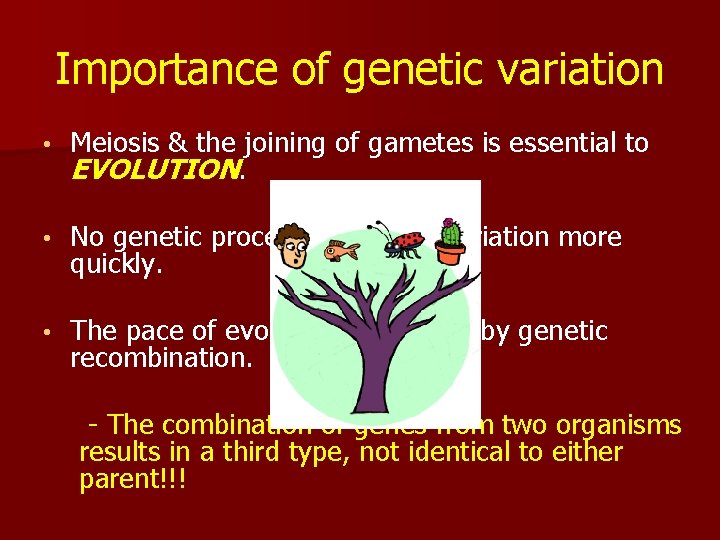
Importance of genetic variation • Meiosis & the joining of gametes is essential to EVOLUTION. • No genetic process generates variation more quickly. • The pace of evolution is sped up by genetic recombination. - The combination of genes from two organisms results in a third type, not identical to either parent!!!
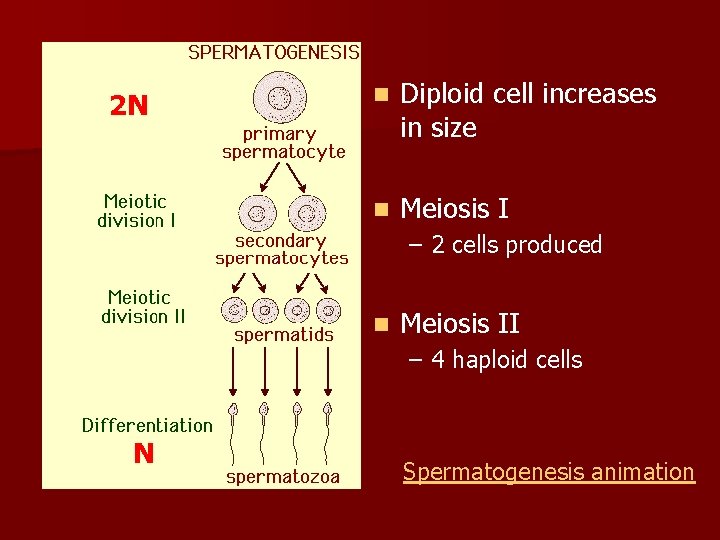
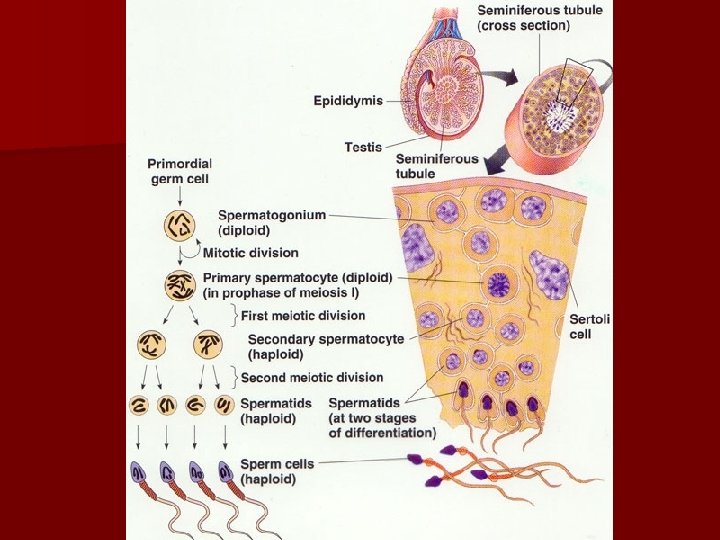
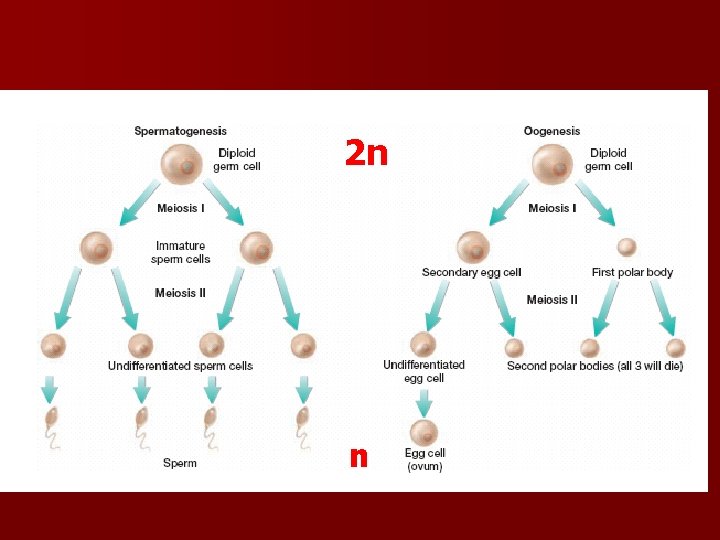
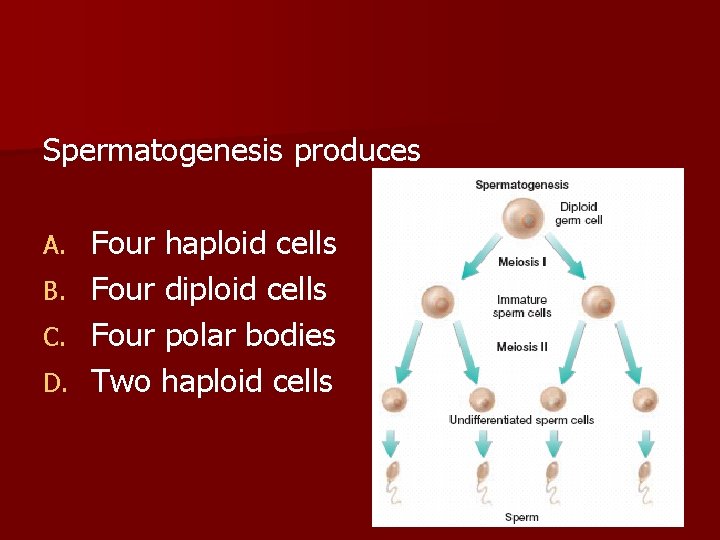
Meiosis in Males • Spermatogenesis – the process by which sperm are produced • Occurs in testes • 4 sperm are produced for each cell undergoing meiosis.
2 N n Diploid cell increases in size n Meiosis I – 2 cells produced n Meiosis II – 4 haploid cells N Spermatogenesis animation
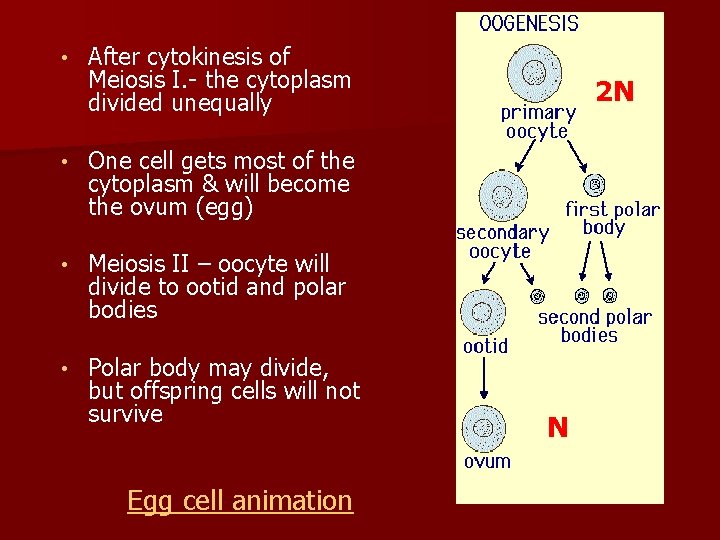
Meiosis in Females • Oogenesis – formation of gametes in females –eggs • Occurs in ovaries • Will produce 3 polar bodies which will not survive & 1 egg cell (ovum)
• After cytokinesis of Meiosis I. - the cytoplasm divided unequally • One cell gets most of the cytoplasm & will become the ovum (egg) • Meiosis II – oocyte will divide to ootid and polar bodies • Polar body may divide, but offspring cells will not survive Egg cell animation 2 N N
By the time the fetus is 20 weeks old, a baby has all the oocytes that she will ever possess (~4 million of them) have been formed. By the time she is born, 1– 2 million of these remain.
2 n n
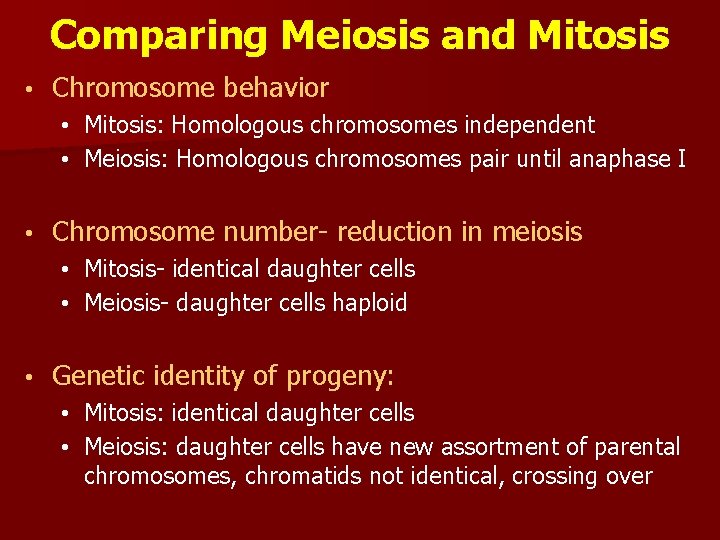
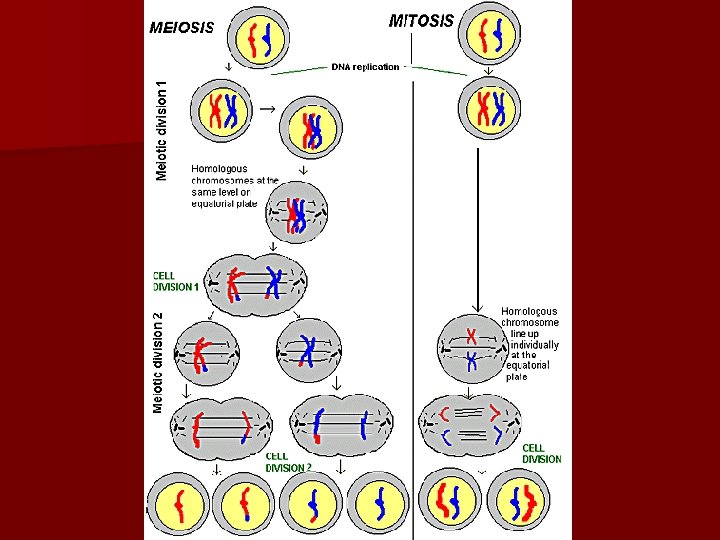
Comparing Meiosis and Mitosis • Chromosome behavior • Mitosis: Homologous chromosomes independent • Meiosis: Homologous chromosomes pair until anaphase I • Chromosome number- reduction in meiosis • Mitosis- identical daughter cells • Meiosis- daughter cells haploid • Genetic identity of progeny: • Mitosis: identical daughter cells • Meiosis: daughter cells have new assortment of parental chromosomes, chromatids not identical, crossing over
Review of Meiosis
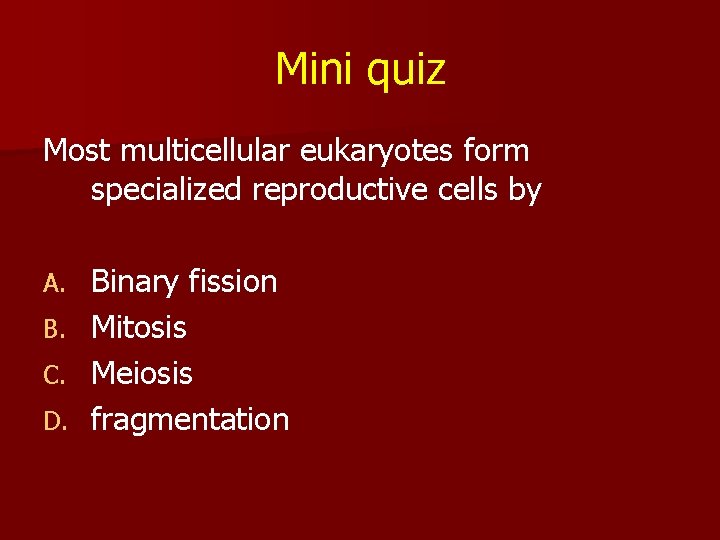
Mini quiz Most multicellular eukaryotes form specialized reproductive cells by Binary fission B. Mitosis C. Meiosis D. fragmentation A.
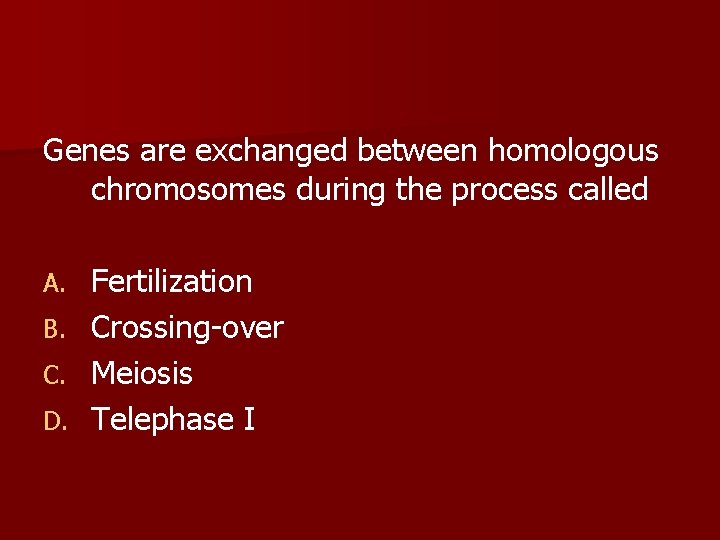
Genes are exchanged between homologous chromosomes during the process called Fertilization B. Crossing-over C. Meiosis D. Telephase I A.
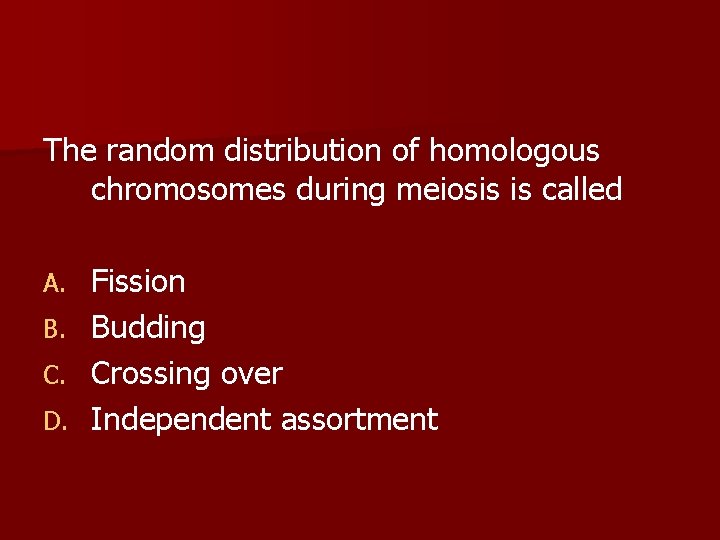
The random distribution of homologous chromosomes during meiosis is called Fission B. Budding C. Crossing over D. Independent assortment A.
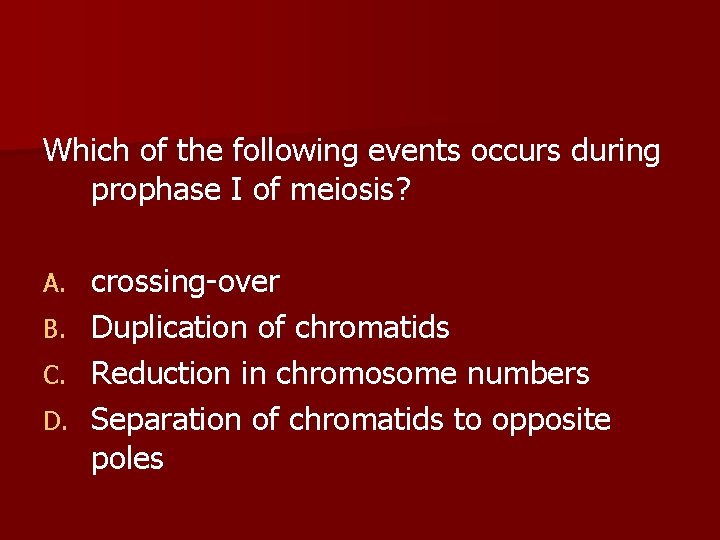
Which of the following events occurs during prophase I of meiosis? crossing-over B. Duplication of chromatids C. Reduction in chromosome numbers D. Separation of chromatids to opposite poles A.
Spermatogenesis produces Four haploid cells B. Four diploid cells C. Four polar bodies D. Two haploid cells A.
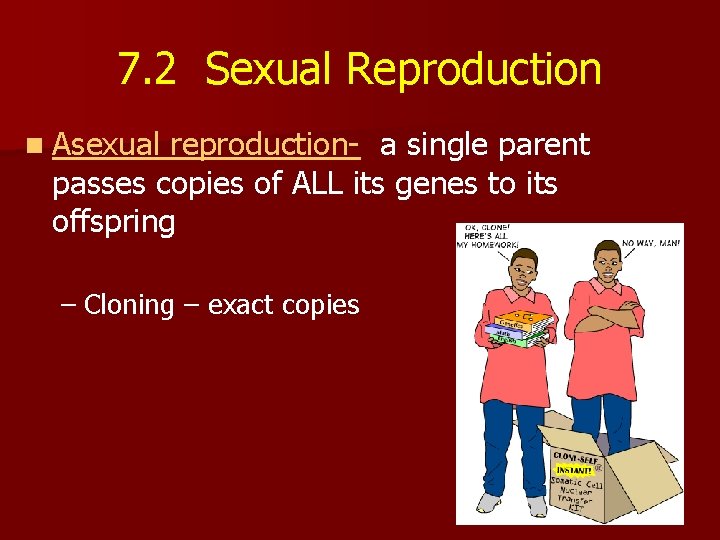
7. 2 Sexual Reproduction n Asexual reproduction- a single parent passes copies of ALL its genes to its offspring – Cloning – exact copies
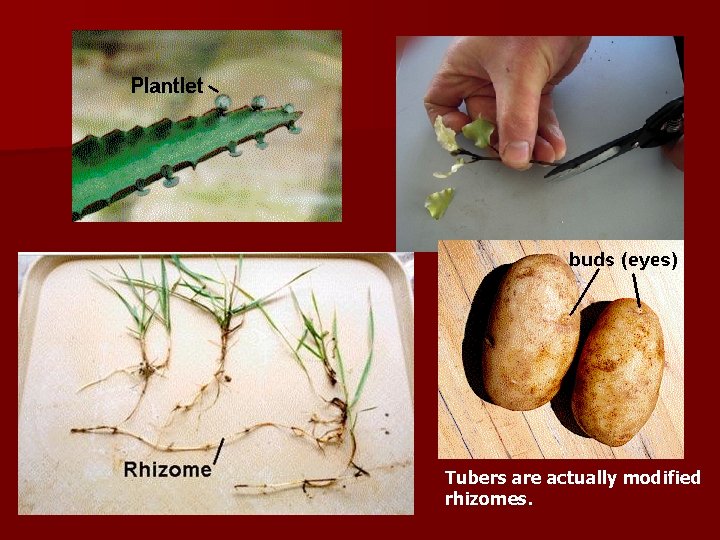
Asexual Reproduction in Plants n Stems- Stems arch over & take root at their tips, forming new plants. n Roots – Some plants ex: dandelion, trees (poplar or aspen) send up new stems from their roots. In time, an entire grove of trees may form — all part of a clone of the original tree. n Leaves -Mitosis at meristems along the leaf margins produce tiny plantlets that fall off & become new plant n Plant propagation – Cuttings taken from the parent & rooted Commercially-important plants propagated by asexual means to keep desirable traits Ex: flower color, flavor, resistance to disease
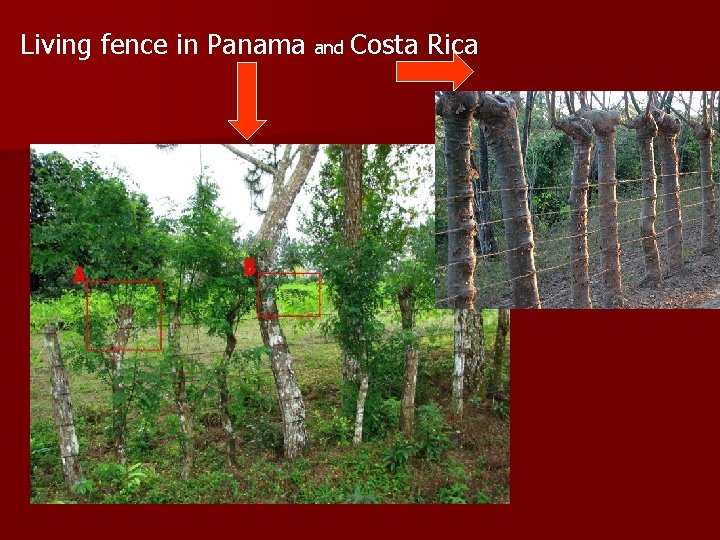
Living fence in Panama and Costa Rica
Tubers are actually modified rhizomes.
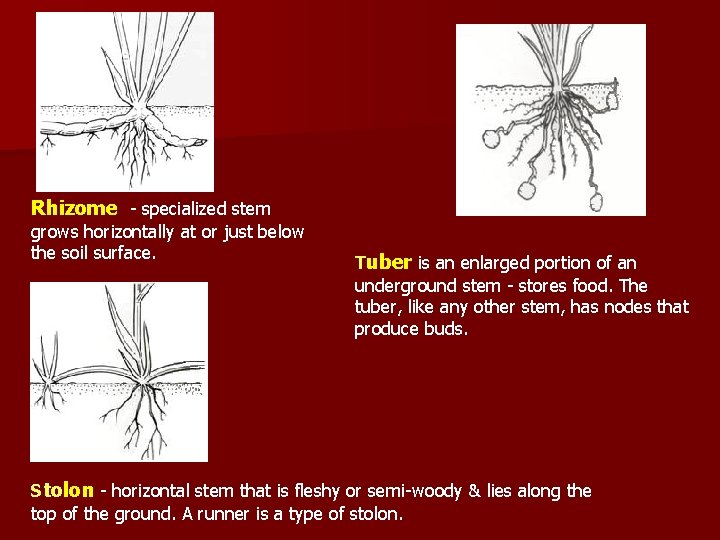
Rhizome - specialized stem grows horizontally at or just below the soil surface. Tuber is an enlarged portion of an underground stem - stores food. The tuber, like any other stem, has nodes that produce buds. Stolon - horizontal stem that is fleshy or semi-woody & lies along the top of the ground. A runner is a type of stolon.
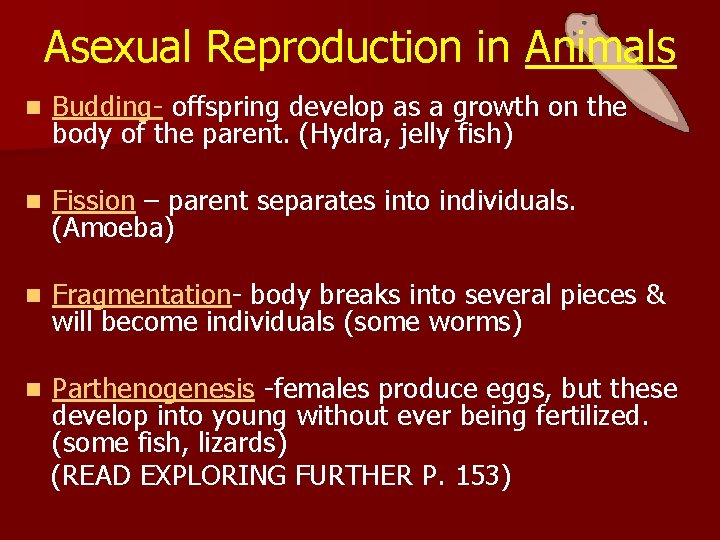
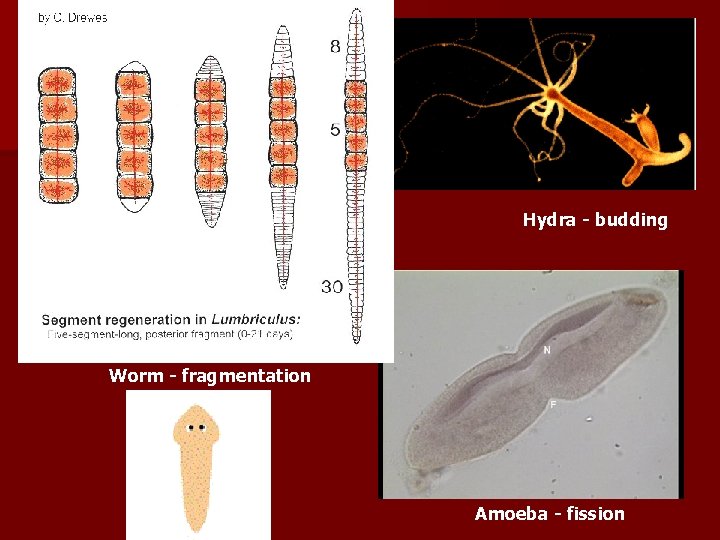
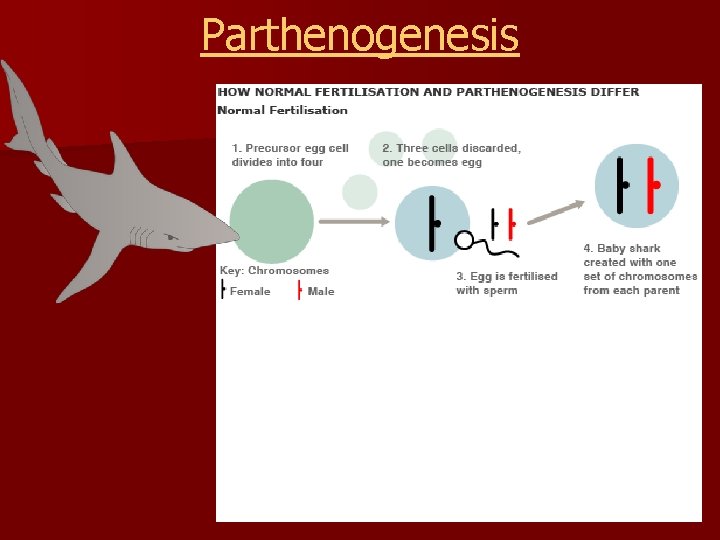
Asexual Reproduction in Animals n Budding- offspring develop as a growth on the body of the parent. (Hydra, jelly fish) n Fission – parent separates into individuals. (Amoeba) n Fragmentation- body breaks into several pieces & will become individuals (some worms) n Parthenogenesis -females produce eggs, but these develop into young without ever being fertilized. (some fish, lizards) (READ EXPLORING FURTHER P. 153)
Hydra - budding Worm - fragmentation Amoeba - fission
Parthenogenesis
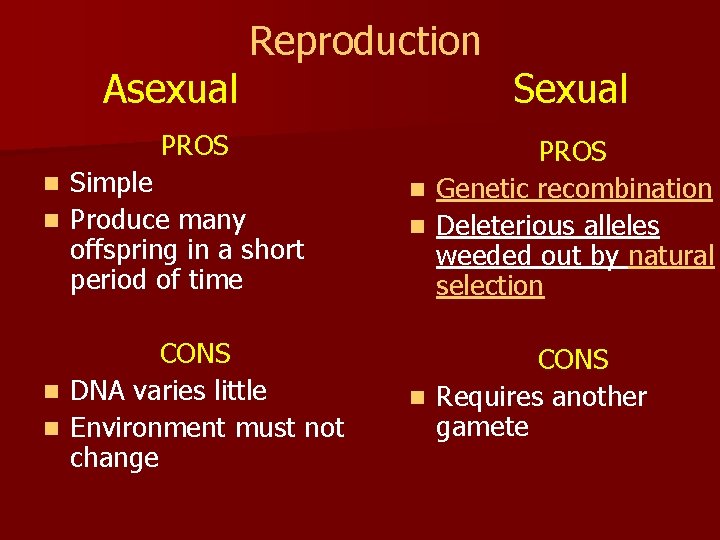
Asexual Reproduction PROS Sexual Simple n Produce many offspring in a short period of time PROS n Genetic recombination n Deleterious alleles weeded out by natural selection CONS n DNA varies little n Environment must not change CONS n Requires another gamete n
Asexual vs sexual reproduction
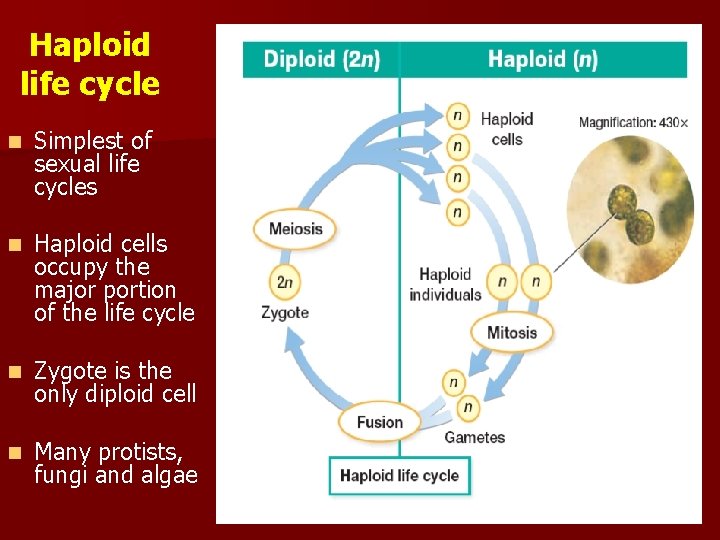
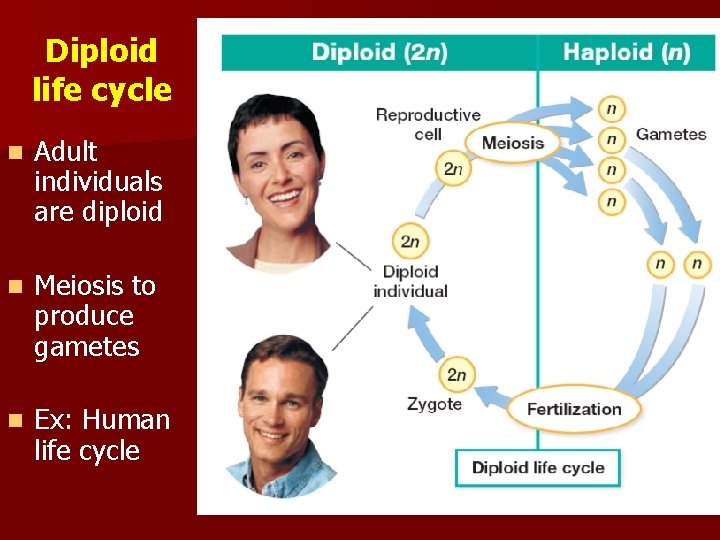
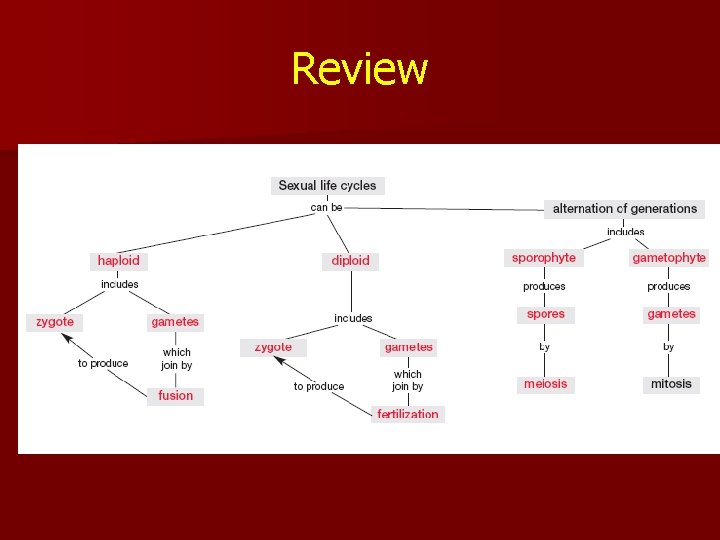
Sexual Life cycles of Eukaryotes 1. Haploid life cycle 2. Diploid life cycle 3. Alternation of generations Figures p. 152, 153, 154 in textbook!
Haploid life cycle n Simplest of sexual life cycles n Haploid cells occupy the major portion of the life cycle n Zygote is the only diploid cell n Many protists, fungi and algae
Diploid life cycle n Adult individuals are diploid n Meiosis to produce gametes n Ex: Human life cycle
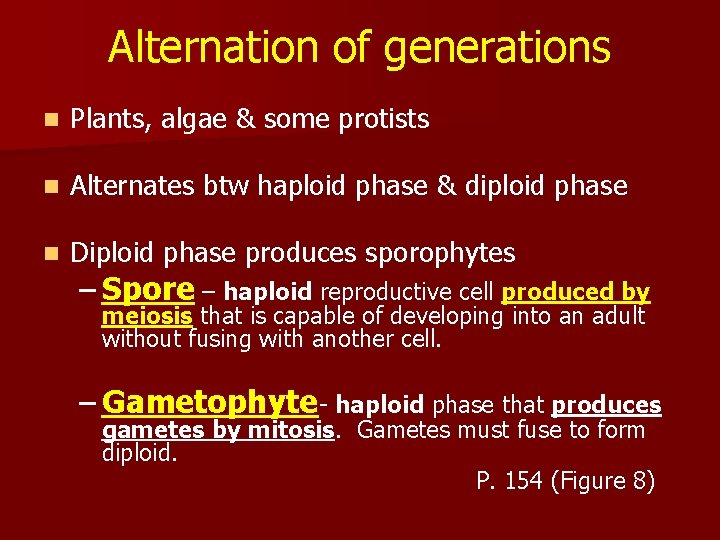
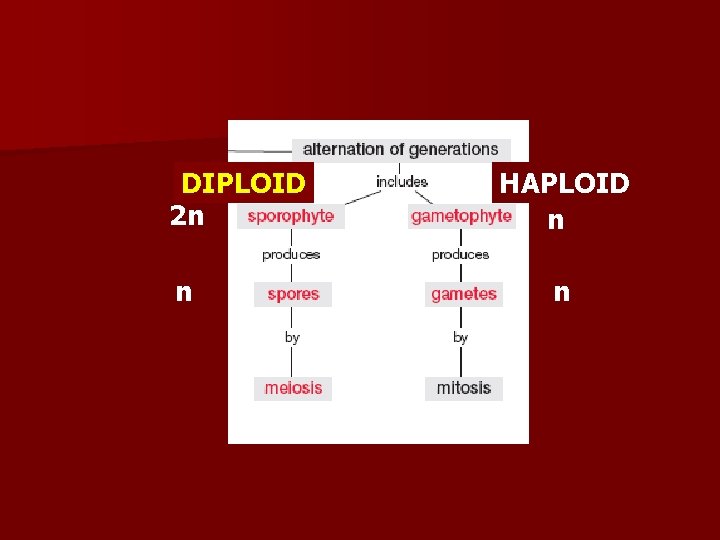
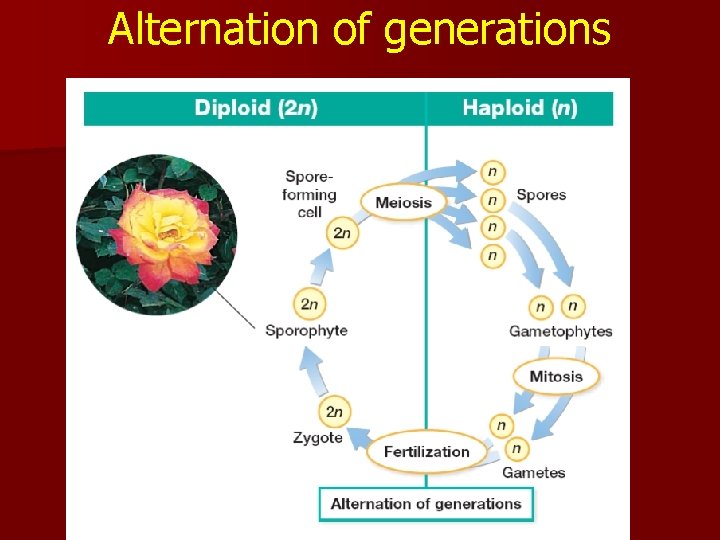
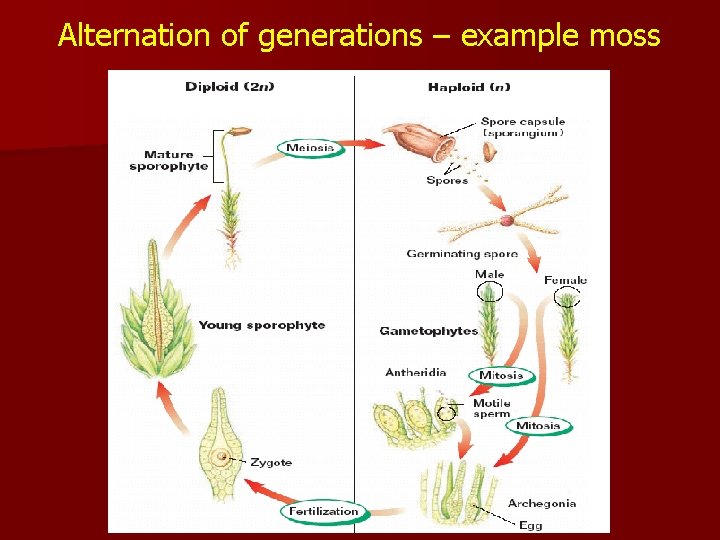
Alternation of generations n Plants, algae & some protists n Alternates btw haploid phase & diploid phase n Diploid phase produces sporophytes – Spore – haploid reproductive cell produced by meiosis that is capable of developing into an adult without fusing with another cell. – Gametophyte- haploid phase that produces gametes by mitosis. Gametes must fuse to form diploid. P. 154 (Figure 8)
DIPLOID 2 n n HAPLOID n n
Alternation of generations
Alternation of generations – example moss
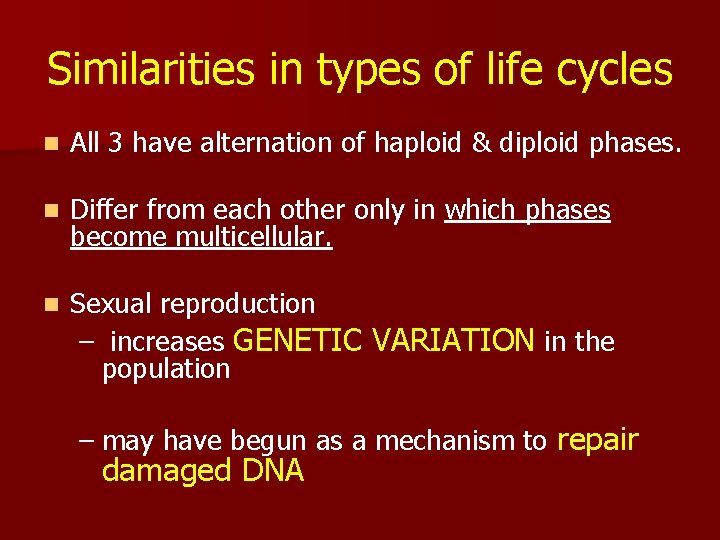
Similarities in types of life cycles n All 3 have alternation of haploid & diploid phases. n Differ from each other only in which phases become multicellular. n Sexual reproduction – increases GENETIC VARIATION in the population – may have begun as a mechanism to repair damaged DNA
Review
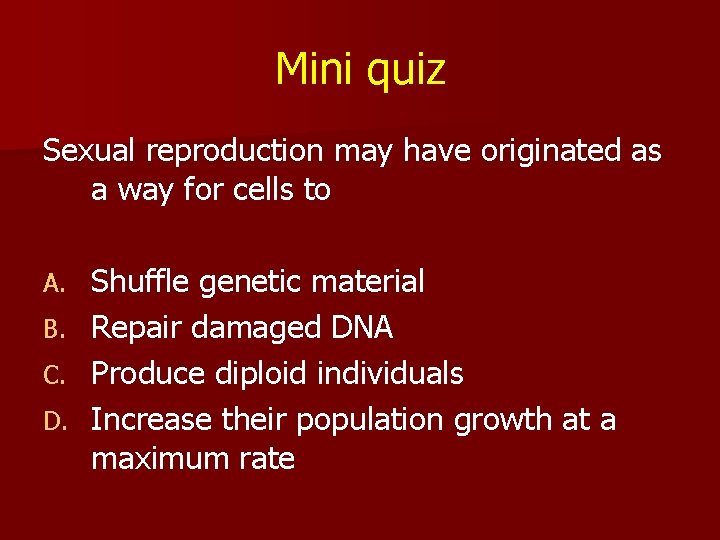
Mini quiz Sexual reproduction may have originated as a way for cells to Shuffle genetic material B. Repair damaged DNA C. Produce diploid individuals D. Increase their population growth at a maximum rate A.
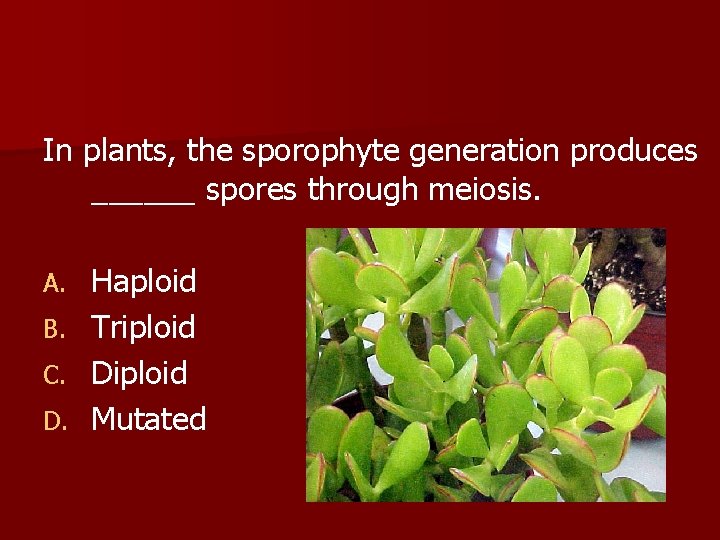
In plants, the sporophyte generation produces ______ spores through meiosis. Haploid B. Triploid C. Diploid D. Mutated A.
The amount of genetic variation in offspring is greatest in organisms that reproduce Sexually through meiosis B. Sexually through fission C. Asexually through mitosis D. Asexually through budding A.
A student states that organisms that reproduce asexually are at a disadvantage in a stable environment. If you agree – state a strength If you disagree – state a weakness
The end n To learn more check out developmental biology websites – Animals – Plants – Humans Very interesting stuff!!!!! Take a class in college!