
CH 7 CHEMISTRY E 182019 Phase equilibria G0
CH 7 CHEMISTRY E 182019 Phase equilibria G=0 Clausius Clapeyron This course is approximately at this level Rudolf Žitný, Ústav procesní a zpracovatelské techniky ČVUT FS 2010
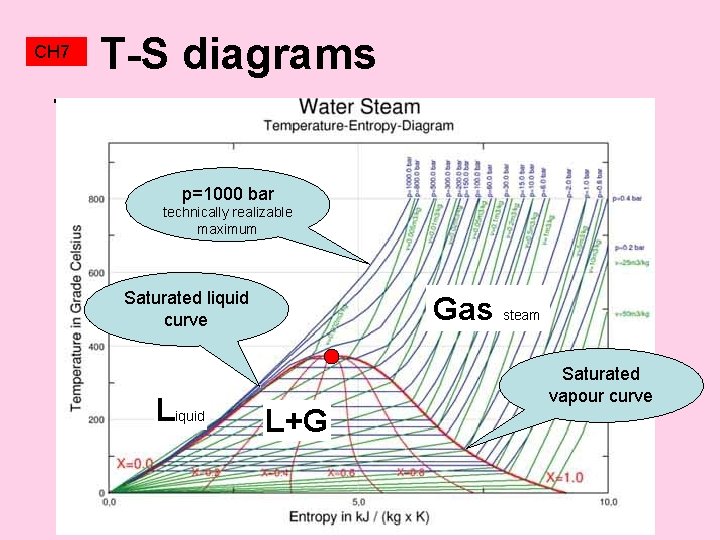
CH 7 T-S diagrams T-s diagrams p=1000 bar technically realizable maximum Saturated liquid curve Liquid Gas steam L+G Saturated vapour curve
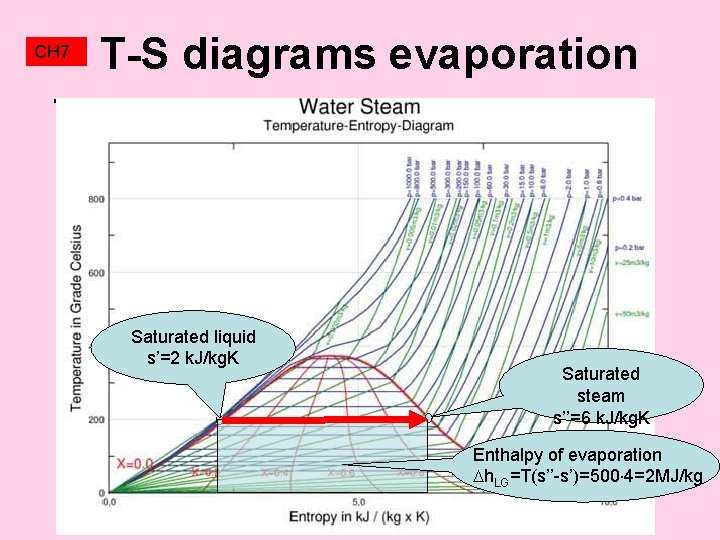
CH 7 T-S diagrams evaporation T-s diagrams Saturated liquid s’=2 k. J/kg. K Saturated steam s’’=6 k. J/kg. K Enthalpy of evaporation h. LG=T(s’’-s’)=500 4=2 MJ/kg
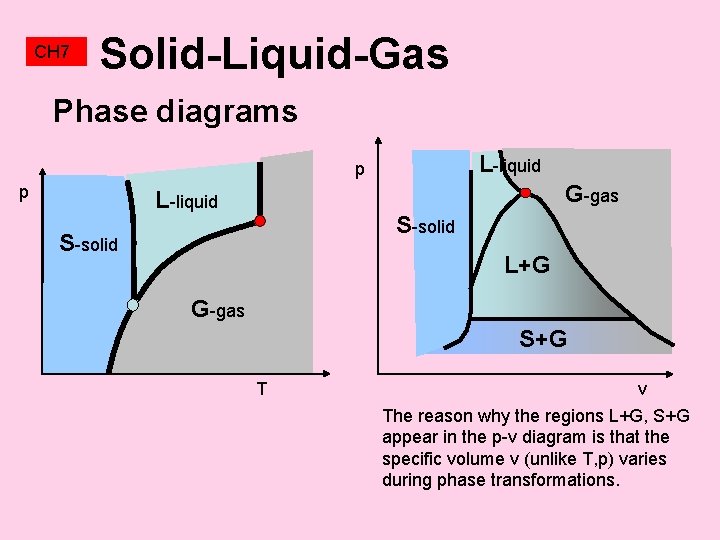
CH 7 Solid-Liquid-Gas Phase diagrams L-liquid p p G-gas L-liquid S-solid L+G G-gas S+G T v The reason why the regions L+G, S+G appear in the p-v diagram is that the specific volume v (unlike T, p) varies during phase transformations.
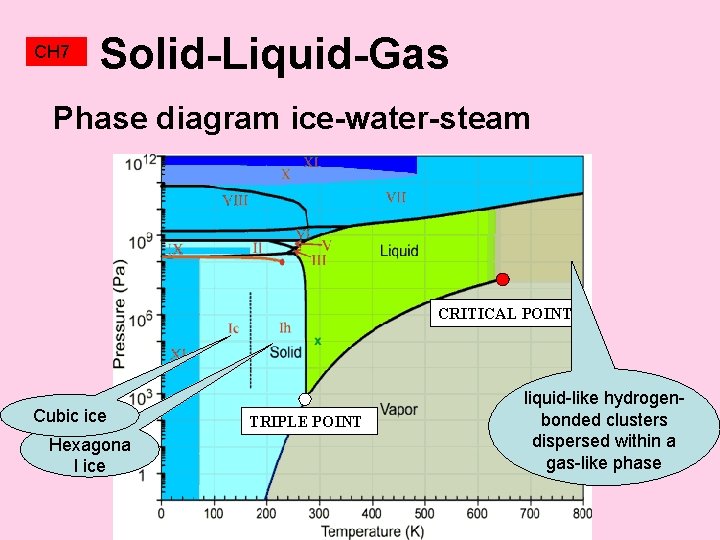
CH 7 Solid-Liquid-Gas Phase diagram ice-water-steam CRITICAL POINT Cubic ice Hexagona l ice TRIPLE POINT liquid-like hydrogenbonded clusters dispersed within a gas-like phase
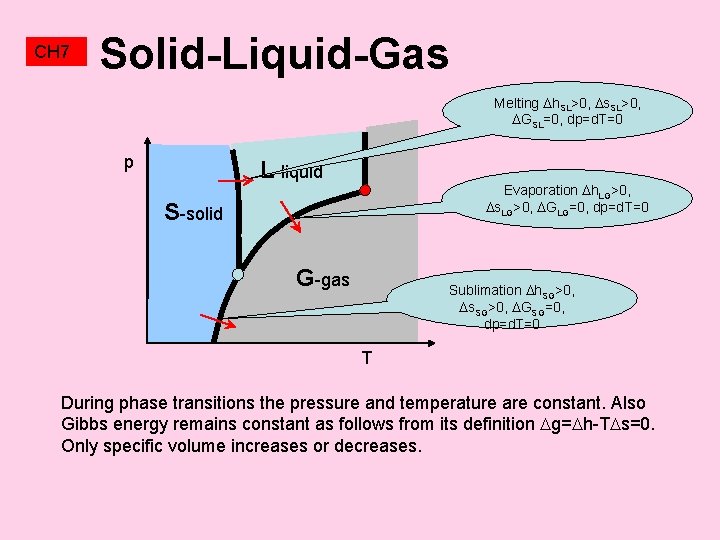
CH 7 Solid-Liquid-Gas Melting h. SL>0, s. SL>0, GSL=0, dp=d. T=0 p L-liquid Evaporation h. LG>0, s. LG>0, GLG=0, dp=d. T=0 S-solid G-gas Sublimation h. SG>0, s. SG>0, GSG=0, dp=d. T=0 T During phase transitions the pressure and temperature are constant. Also Gibbs energy remains constant as follows from its definition g= h-T s=0. Only specific volume increases or decreases.
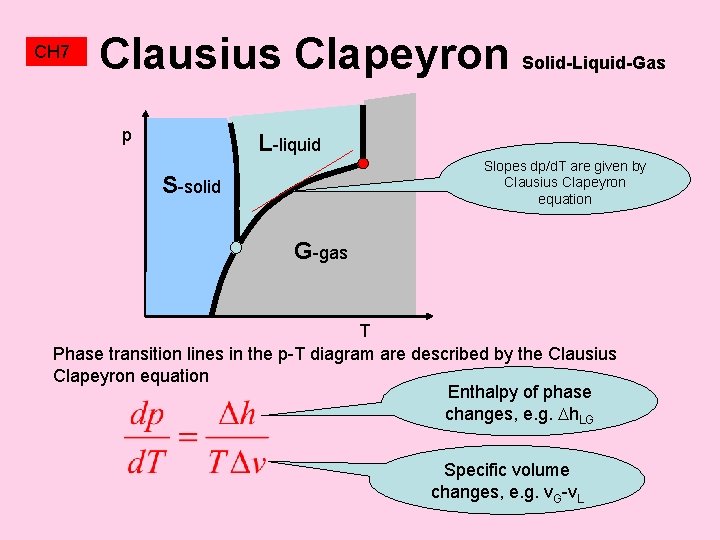
CH 7 Clausius Clapeyron Solid-Liquid-Gas p L-liquid Slopes dp/d. T are given by Clausius Clapeyron equation S-solid G-gas T Phase transition lines in the p-T diagram are described by the Clausius Clapeyron equation Enthalpy of phase changes, e. g. h. LG Specific volume changes, e. g. v. G-v. L
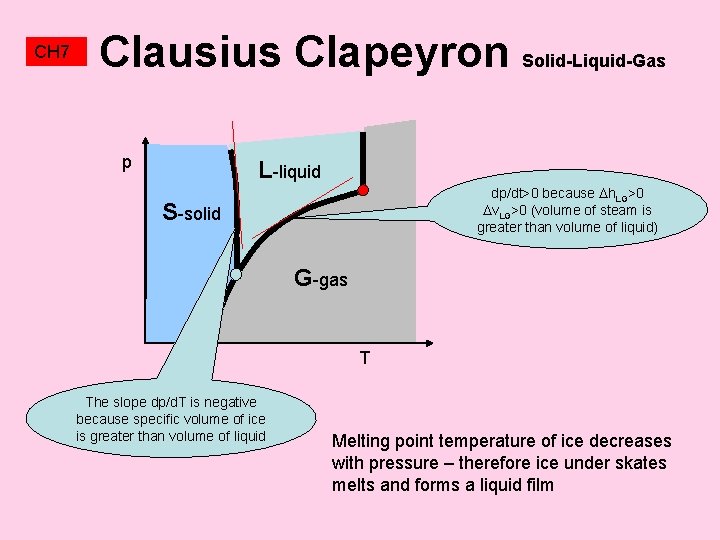
CH 7 Clausius Clapeyron Solid-Liquid-Gas p L-liquid dp/dt>0 because h. LG>0 v. LG>0 (volume of steam is greater than volume of liquid) S-solid G-gas T The slope dp/d. T is negative because specific volume of ice is greater than volume of liquid Melting point temperature of ice decreases with pressure – therefore ice under skates melts and forms a liquid film

CH 7 Clausius Clapeyron derivation Clausius Clapeyron equation can be derived from energy balance of a closed cycle in Ts diagram: Heat added-difference between Mechanical work- evaporation enthalpy at T+d. T and received in one cycle condensation enthalpy at temperature T Closed loop (evaporation, expansion, condensation, compression) T+d. T T s=s’’-s’
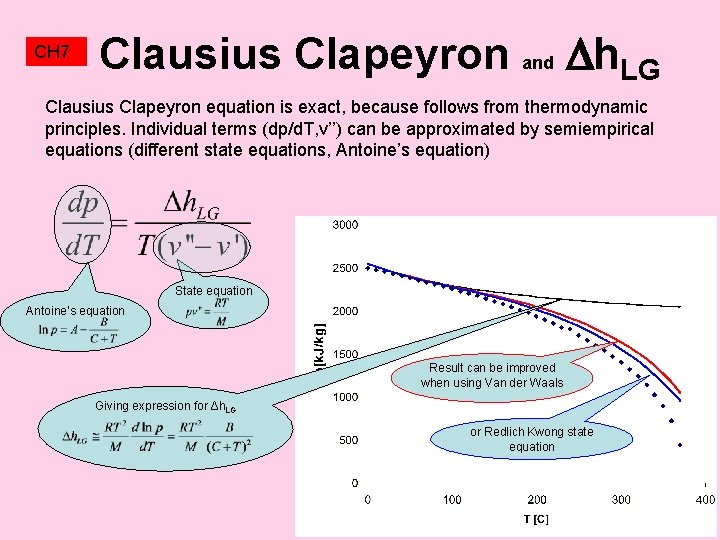
CH 7 Clausius Clapeyron and h. LG Clausius Clapeyron equation is exact, because follows from thermodynamic principles. Individual terms (dp/d. T, v’’) can be approximated by semiempirical equations (different state equations, Antoine’s equation) State equation Antoine’s equation Result can be improved when using Van der Waals Giving expression for Δh. LG or Redlich Kwong state equation
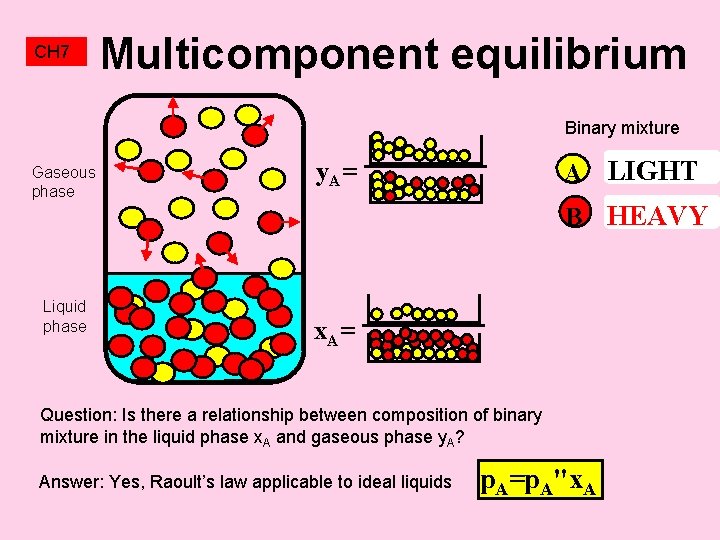
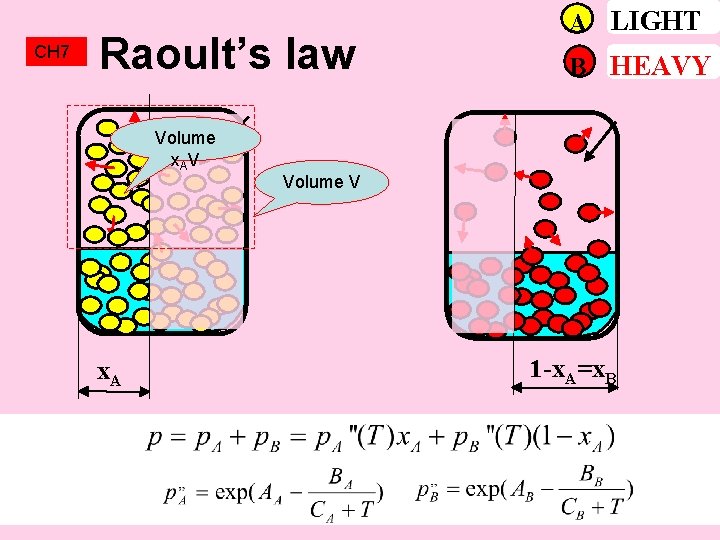
CH 7 Multicomponent equilibrium Binary mixture Gaseous phase Liquid phase A LIGHT y. A= B HEAVY x. A= Question: Is there a relationship between composition of binary mixture in the liquid phase x. A and gaseous phase y. A? Answer: Yes, Raoult’s law applicable to ideal liquids p. A=p. A"x. A
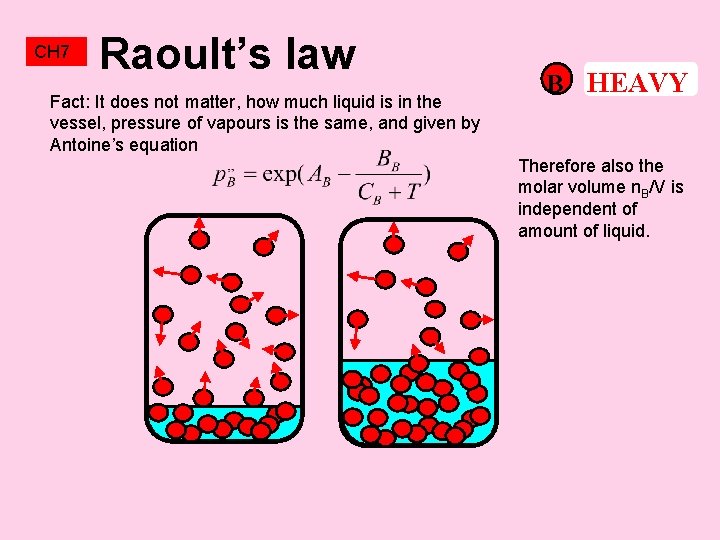
CH 7 Raoult’s law Fact: It does not matter, how much liquid is in the vessel, pressure of vapours is the same, and given by Antoine’s equation B HEAVY Therefore also the molar volume n. B/V is independent of amount of liquid.
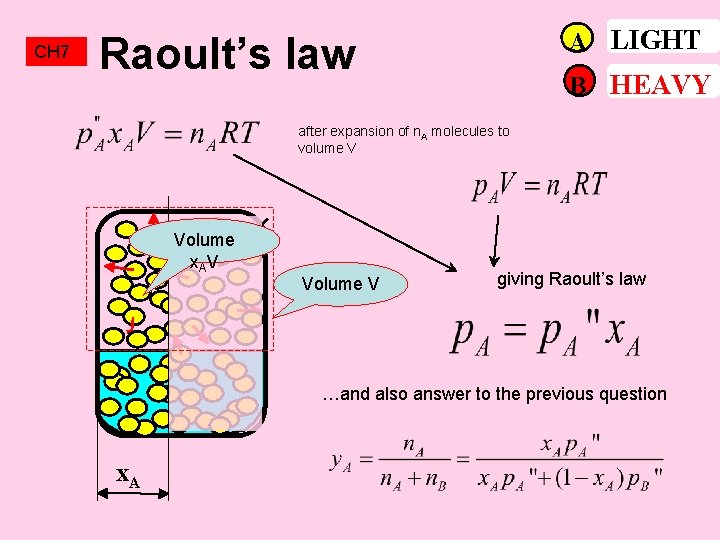
CH 7 A LIGHT Raoult’s law B HEAVY after expansion of n. A molecules to volume V Volume x. AV Volume V giving Raoult’s law …and also answer to the previous question x. A
CH 7 Raoult’s law Volume x. AV x. A A LIGHT B HEAVY Volume V 1 -x. A=x. B
CH 7 Distillation Initial composition of Liquid Mixture Cooling condensing Liquid mixture enriched by heavy component Liquid mixture enriched by light component
CH 7 Liquid – noncondensable gas Given temperature T and molar fraction of dissolved CO 2 H 2 O+CO 2 y. CO 2 What to do if T > Tcrit = 31 o. C ? Henry’s law H 2 O+CO 2 x. CO 2 Henry’s constant can be found in tables
A LIGHT Tutorial CH 7 B HEAVY Given total pressure p and molar fraction of liquid phase x. A calculate a) Equilibrium temperature T b) Molar composition of vapours p=const Repeated distillation y. A 0 x. A 1 Nonlinear equation for T (Excel solution)
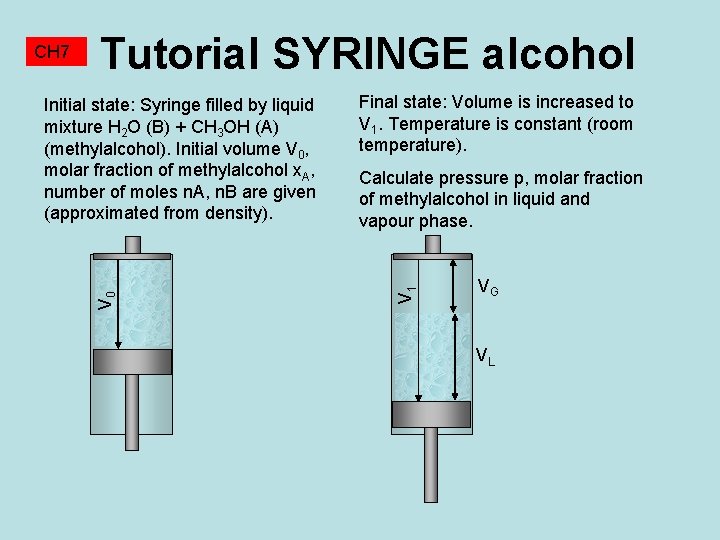
Tutorial SYRINGE alcohol V 0 Initial state: Syringe filled by liquid mixture H 2 O (B) + CH 3 OH (A) (methylalcohol). Initial volume V 0, molar fraction of methylalcohol x. A, number of moles n. A, n. B are given (approximated from density). Final state: Volume is increased to V 1. Temperature is constant (room temperature). Calculate pressure p, molar fraction of methylalcohol in liquid and vapour phase. V 1 CH 7 VG VL
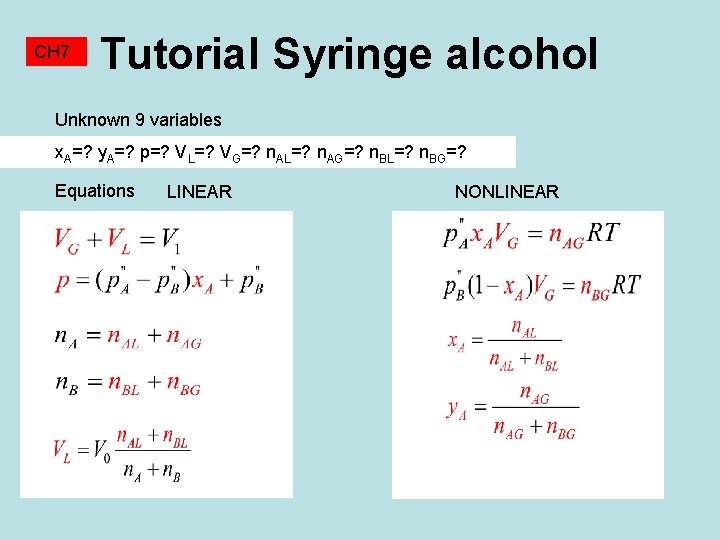
CH 7 Tutorial Syringe alcohol Unknown 9 variables x. A=? y. A=? p=? VL=? VG=? n. AL=? n. AG=? n. BL=? n. BG=? Equations LINEAR NONLINEAR
- Slides: 19