
CH 6 Symmetry elements and operations Point groups
- Slides: 19
CH 6. Symmetry elements and operations Point groups Character tables Some applications 1
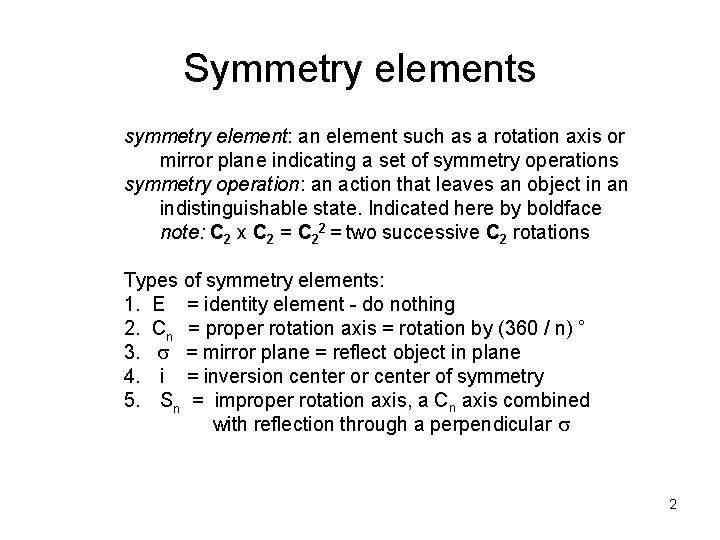
Symmetry elements symmetry element: an element such as a rotation axis or mirror plane indicating a set of symmetry operations symmetry operation: an action that leaves an object in an indistinguishable state. Indicated here by boldface note: C 2 x C 2 = C 22 = two successive C 2 rotations Types of symmetry elements: 1. E = identity element - do nothing 2. Cn = proper rotation axis = rotation by (360 / n) ° 3. s = mirror plane = reflect object in plane 4. i = inversion center or center of symmetry 5. Sn = improper rotation axis, a Cn axis combined with reflection through a perpendicular s 2
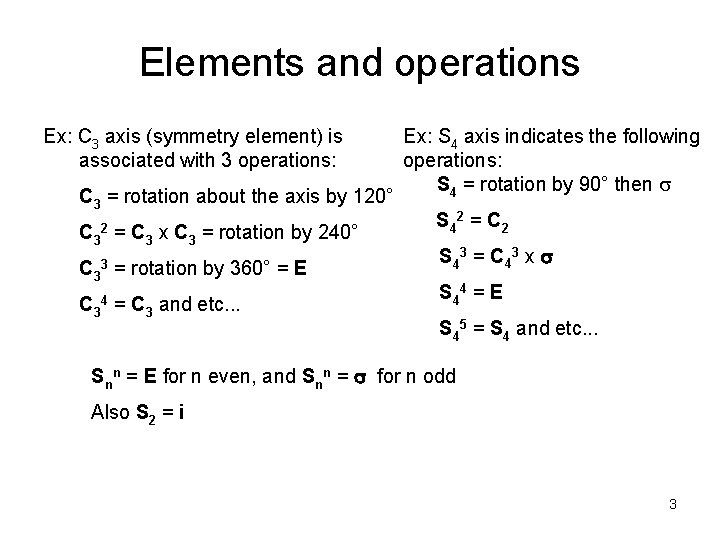
Elements and operations Ex: C 3 axis (symmetry element) is associated with 3 operations: C 3 = rotation about the axis by 120° C 3 2 = C 3 x C 3 = rotation by 240° C 3 3 = rotation by 360° = E C 3 4 = C 3 and etc. . . Ex: S 4 axis indicates the following operations: S 4 = rotation by 90° then s S 42 = C 2 S 43 = C 43 x s S 44 = E S 45 = S 4 and etc. . . Snn = E for n even, and Snn = s for n odd Also S 2 = i 3
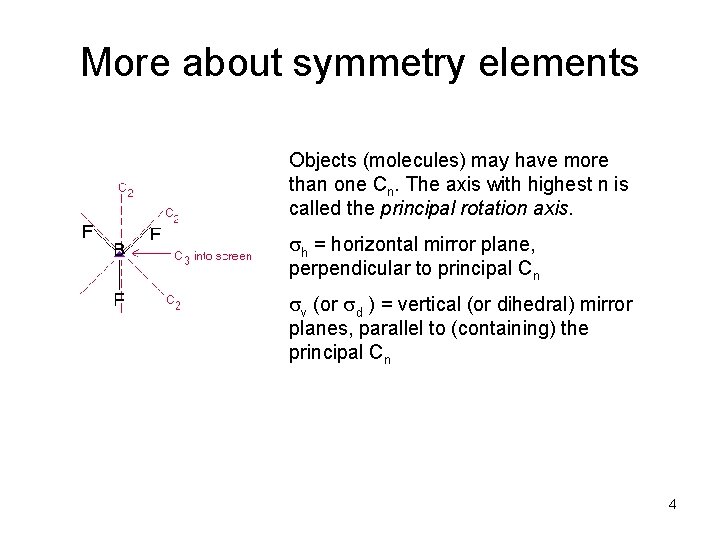
More about symmetry elements Objects (molecules) may have more than one Cn. The axis with highest n is called the principal rotation axis. sh = horizontal mirror plane, perpendicular to principal Cn sv (or sd ) = vertical (or dihedral) mirror planes, parallel to (containing) the principal Cn 4
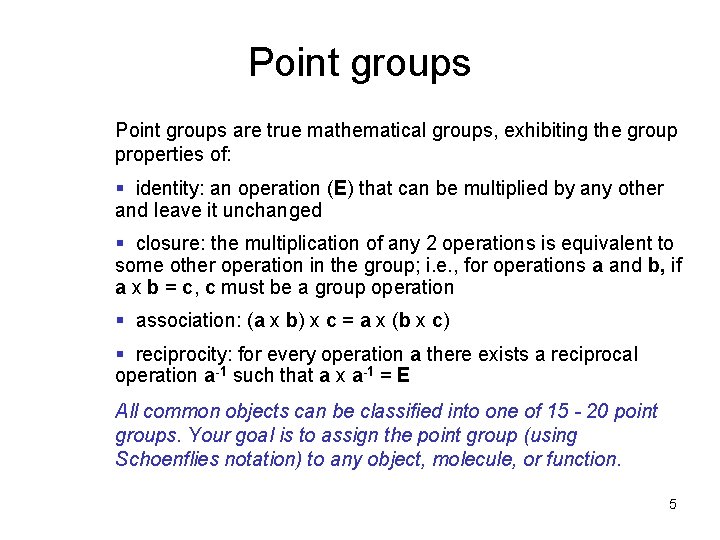
Point groups are true mathematical groups, exhibiting the group properties of: § identity: an operation (E) that can be multiplied by any other and leave it unchanged § closure: the multiplication of any 2 operations is equivalent to some other operation in the group; i. e. , for operations a and b, if a x b = c, c must be a group operation § association: (a x b) x c = a x (b x c) § reciprocity: for every operation a there exists a reciprocal operation a-1 such that a x a-1 = E All common objects can be classified into one of 15 - 20 point groups. Your goal is to assign the point group (using Schoenflies notation) to any object, molecule, or function. 5
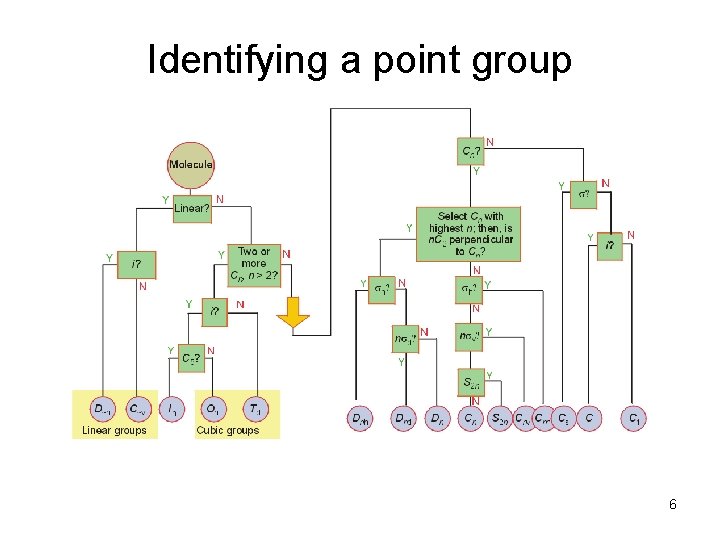
Identifying a point group 6
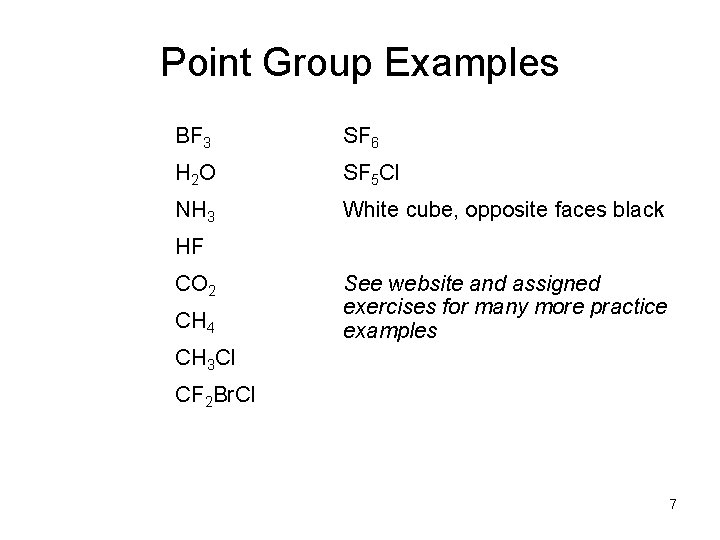
Point Group Examples BF 3 SF 6 H 2 O SF 5 Cl NH 3 White cube, opposite faces black HF CO 2 CH 4 See website and assigned exercises for many more practice examples CH 3 Cl CF 2 Br. Cl 7
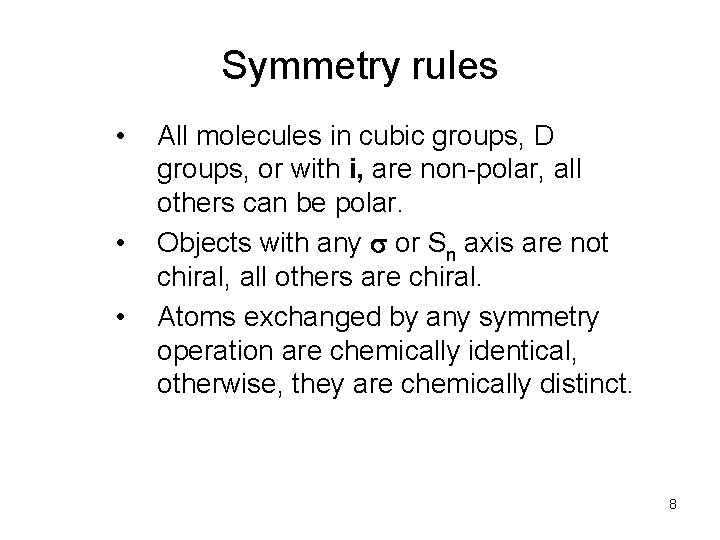
Symmetry rules • • • All molecules in cubic groups, D groups, or with i, are non-polar, all others can be polar. Objects with any s or Sn axis are not chiral, all others are chiral. Atoms exchanged by any symmetry operation are chemically identical, otherwise, they are chemically distinct. 8
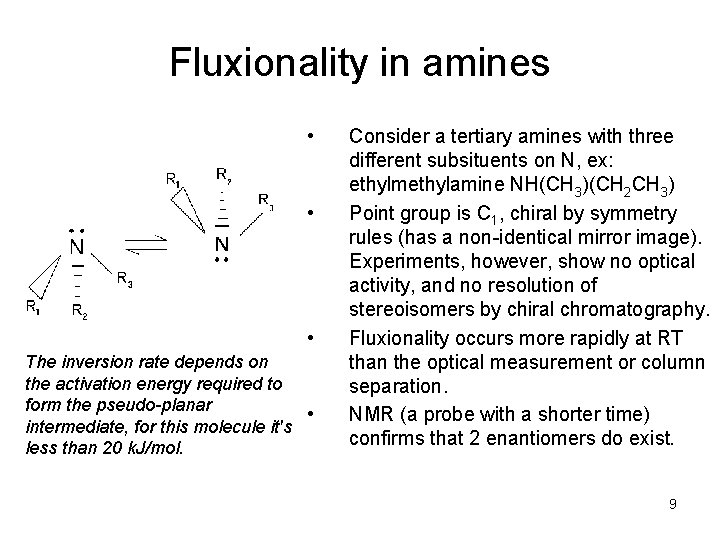
Fluxionality in amines • • • The inversion rate depends on the activation energy required to form the pseudo-planar • intermediate, for this molecule it's less than 20 k. J/mol. Consider a tertiary amines with three different subsituents on N, ex: ethylmethylamine NH(CH 3)(CH 2 CH 3) Point group is C 1, chiral by symmetry rules (has a non-identical mirror image). Experiments, however, show no optical activity, and no resolution of stereoisomers by chiral chromatography. Fluxionality occurs more rapidly at RT than the optical measurement or column separation. NMR (a probe with a shorter time) confirms that 2 enantiomers do exist. 9
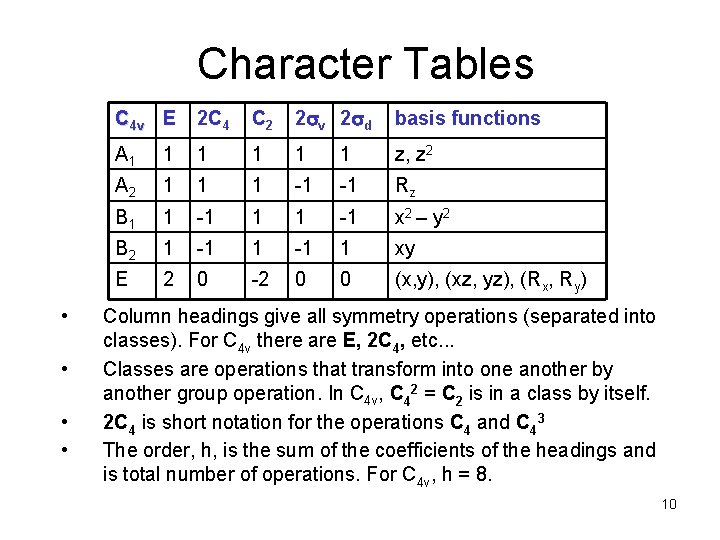
Character Tables • • C 4 v E 2 C 4 C 2 2 sv 2 sd basis functions A 1 1 1 z, z 2 A 2 1 1 1 -1 -1 Rz B 1 1 -1 x 2 – y 2 B 2 1 -1 1 xy E 2 0 -2 0 0 (x, y), (xz, yz), (Rx, Ry) Column headings give all symmetry operations (separated into classes). For C 4 v there are E, 2 C 4, etc. . . Classes are operations that transform into one another by another group operation. In C 4 v, C 42 = C 2 is in a class by itself. 2 C 4 is short notation for the operations C 4 and C 43 The order, h, is the sum of the coefficients of the headings and is total number of operations. For C 4 v, h = 8. 10
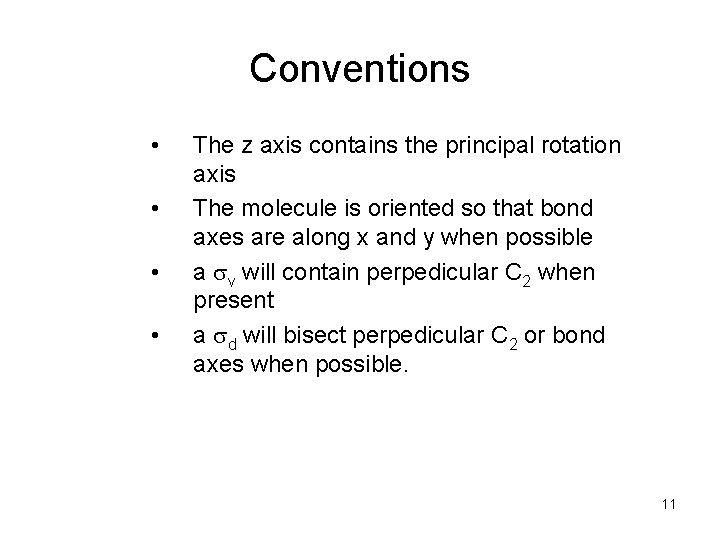
Conventions • • The z axis contains the principal rotation axis The molecule is oriented so that bond axes are along x and y when possible a sv will contain perpedicular C 2 when present a sd will bisect perpedicular C 2 or bond axes when possible. 11
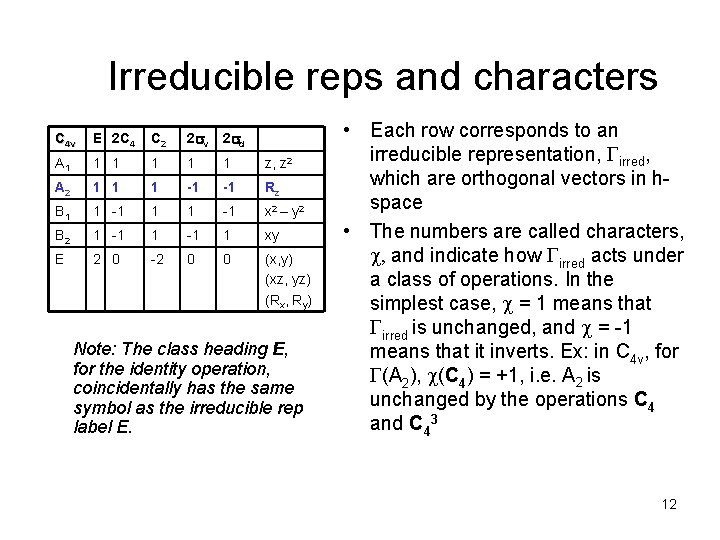
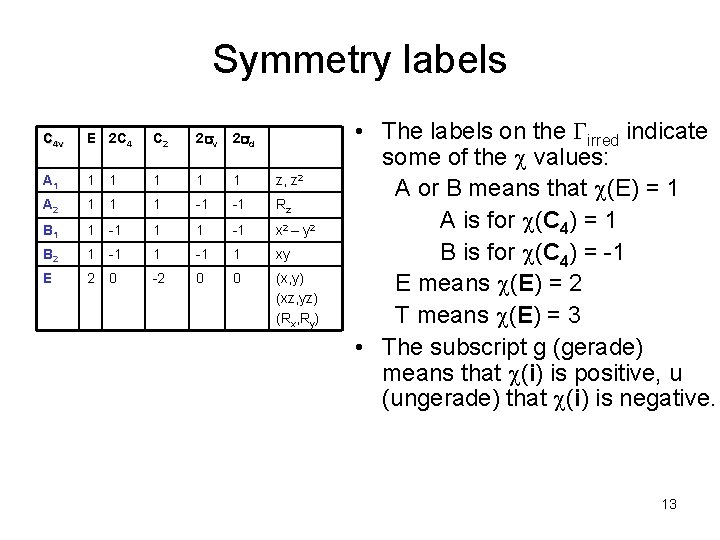
Irreducible reps and characters C 4 v E 2 C 4 C 2 2 sv 2 sd A 1 1 1 z, z 2 A 2 1 1 1 -1 -1 Rz B 1 1 -1 x 2 – y 2 B 2 1 -1 1 xy E 2 0 -2 0 0 (x, y) (xz, yz) (Rx, Ry) Note: The class heading E, for the identity operation, coincidentally has the same symbol as the irreducible rep label E. • Each row corresponds to an irreducible representation, Girred, which are orthogonal vectors in hspace • The numbers are called characters, c, and indicate how Girred acts under a class of operations. In the simplest case, c = 1 means that Girred is unchanged, and c = -1 means that it inverts. Ex: in C 4 v, for G(A 2), c(C 4) = +1, i. e. A 2 is unchanged by the operations C 4 and C 43 12
Symmetry labels C 4 v E 2 C 4 C 2 2 sv 2 sd A 1 1 1 z, z 2 A 2 1 1 1 -1 -1 Rz B 1 1 -1 x 2 – y 2 B 2 1 -1 1 xy E 2 0 -2 0 0 (x, y) (xz, yz) (Rx, Ry) • The labels on the Girred indicate some of the c values: A or B means that c(E) = 1 A is for c(C 4) = 1 B is for c(C 4) = -1 E means c(E) = 2 T means c(E) = 3 • The subscript g (gerade) means that c(i) is positive, u (ungerade) that c(i) is negative. 13
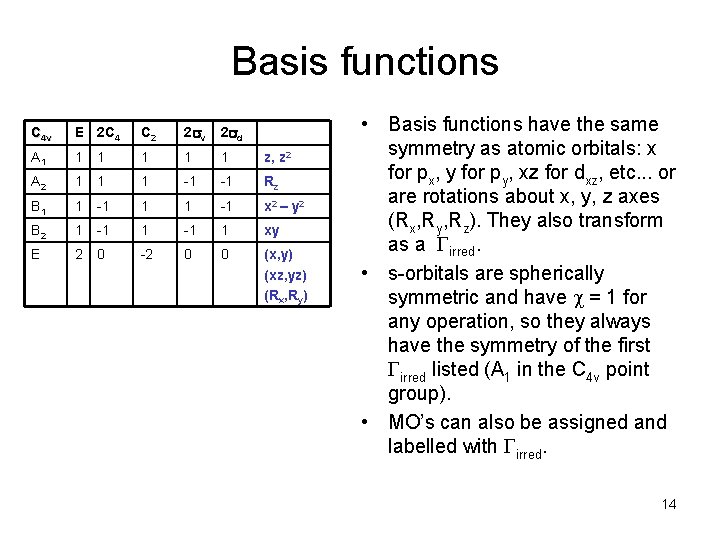
Basis functions C 4 v E 2 C 4 C 2 2 sv 2 sd A 1 1 1 z, z 2 A 2 1 1 1 -1 -1 Rz B 1 1 -1 x 2 – y 2 B 2 1 -1 1 xy E 2 0 -2 0 0 (x, y) (xz, yz) (Rx, Ry) • Basis functions have the same symmetry as atomic orbitals: x for px, y for py, xz for dxz, etc. . . or are rotations about x, y, z axes (Rx, Ry, Rz). They also transform as a Girred. • s-orbitals are spherically symmetric and have c = 1 for any operation, so they always have the symmetry of the first Girred listed (A 1 in the C 4 v point group). • MO’s can also be assigned and labelled with Girred. 14
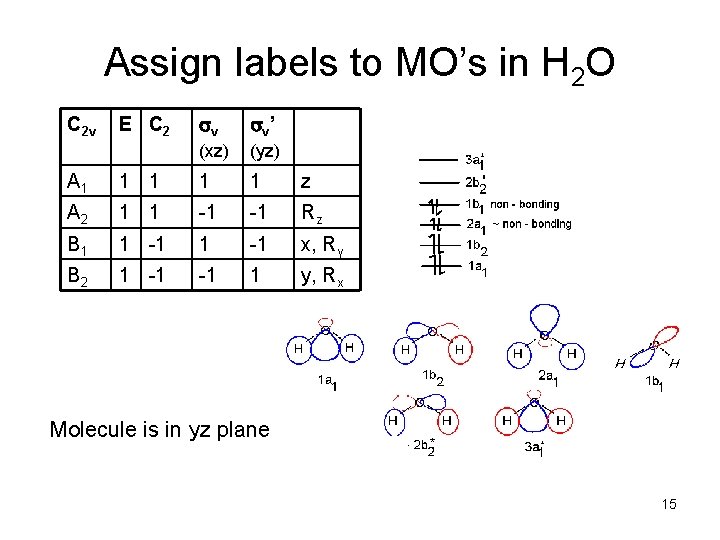
Assign labels to MO’s in H 2 O C 2 v E C 2 sv sv ’ (xz) (yz) A 1 1 1 z A 2 1 1 -1 -1 Rz B 1 1 -1 x, Ry B 2 1 -1 -1 1 y, Rx Molecule is in yz plane 15
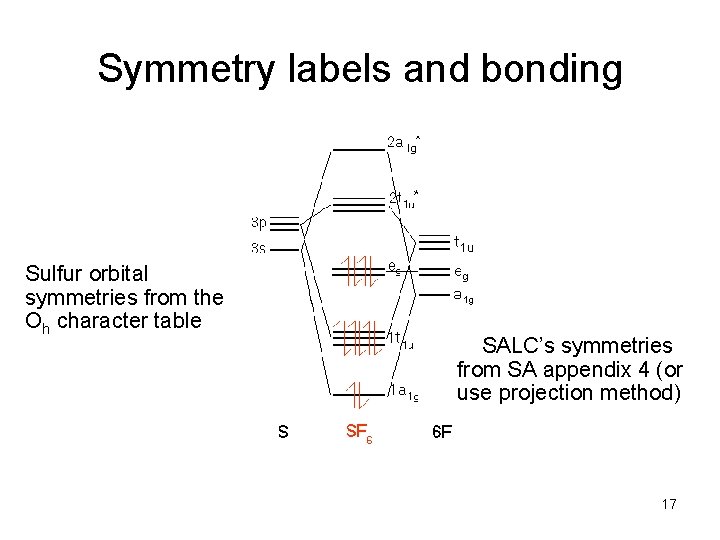
Orthogonality of Girred • all Girred within a point group are orthogonal, their cross-products are zero. • MO’s that have different symmetry labels have no net overlap • For metal-ligand compounds, label symmetries of metal orbitals from basis functions, and interact with same symmetry SALC’s only. 16
Symmetry labels and bonding 1 u Sulfur orbital symmetries from the Oh character table g 1 g SALC’s symmetries from SA appendix 4 (or use projection method) 17
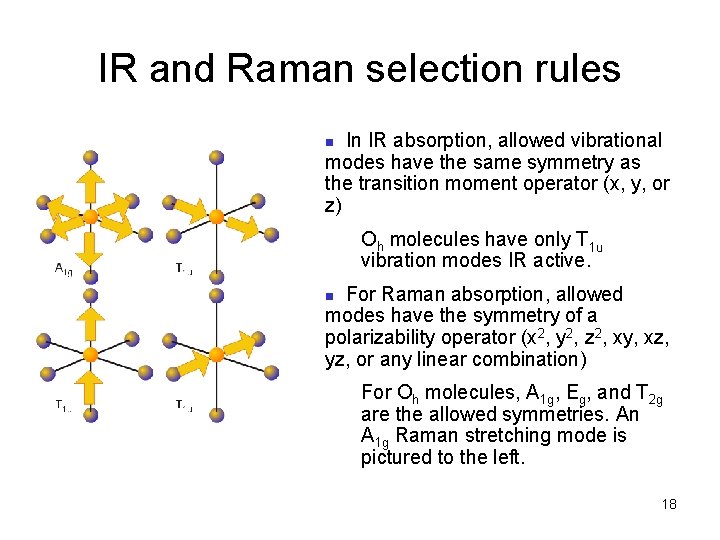
IR and Raman selection rules In IR absorption, allowed vibrational modes have the same symmetry as the transition moment operator (x, y, or z) n Oh molecules have only T 1 u vibration modes IR active. For Raman absorption, allowed modes have the symmetry of a polarizability operator (x 2, y 2, z 2, xy, xz, yz, or any linear combination) n For Oh molecules, A 1 g, Eg, and T 2 g are the allowed symmetries. An A 1 g Raman stretching mode is pictured to the left. 18
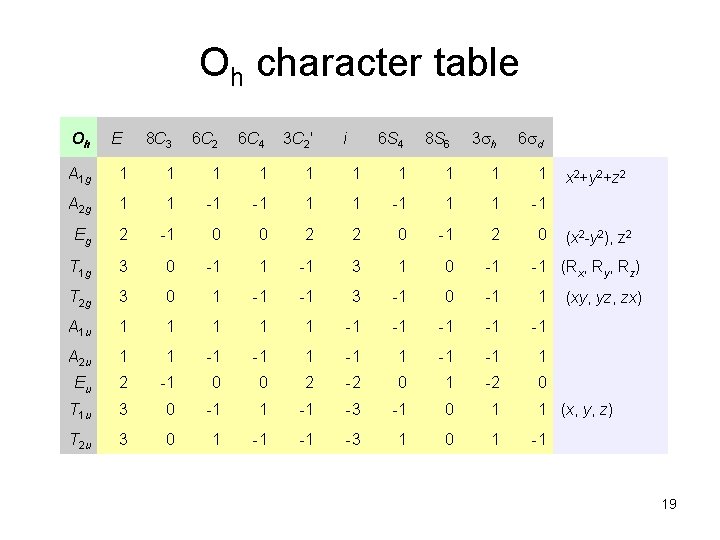
Oh character table Oh E 8 C 3 6 C 2 6 C 4 3 C 2' i 6 S 4 8 S 6 3 sh 6 sd A 1 g 1 1 1 1 1 A 2 g 1 1 -1 -1 1 1 -1 Eg 2 -1 0 0 2 2 0 -1 2 0 T 1 g 3 0 -1 1 -1 3 1 0 -1 T 2 g 3 0 1 -1 -1 3 -1 0 -1 1 A 1 u 1 1 1 -1 -1 -1 A 2 u 1 1 -1 -1 1 Eu 2 -1 0 0 2 -2 0 1 -2 0 T 1 u 3 0 -1 1 -1 -3 -1 0 1 T 2 u 3 0 1 -1 -1 -3 1 0 1 x 2+y 2+z 2 (x 2 -y 2), z 2 -1 (Rx, Ry, Rz) (xy, yz, zx) 1 (x, y, z) -1 19