
Ch 6 Microbial Growth Objectives Classify microbes into

Ch 6 Microbial Growth
Objectives: § Classify microbes into five groups on the basis of preferred temperature range. § Explain the importance of osmotic pressure to microbial growth. § Provide a use for each of the four elements (C, N, S, P) needed in large amounts for microbial growth. § Explain how microbes are classified on the basis of O 2 needs. § Identify ways in which aerobes avoid damage by toxic forms of O 2. § Describe the formation of biofilms and their potential for causing infection. § Distinguish between chemically defined and complex media. § Justify the use of each of the following: anaerobic techniques, living host cells, candle jars, selective, differential, and enrichment media. § Define colony and CFUs and describe how pure cultures can be isolated with streak plates. § Explain how microbes are preserved by deep-freezing and lyophilization. § Distinguish between binary fission and budding. § Define generation time and explain the bacterial growth curve. § Review some direct and indirect methods of measuring bacterial cell growth.

Microbial Growth Microbial growth: Increase in cell number, not cell size! Physical Requirements for Growth: Temperature § Minimum growth temperature § Optimum growth temperature § Maximum growth temperature Five groups based on optimum growth temperature 1. Psychrophiles 2. Psychrotrophs 3. Mesophiles 4. Thermophiles 5. Hyperthermophiles Fig. 6. 3

Fig 6. 3: Effect of amount of food on its cooling rate
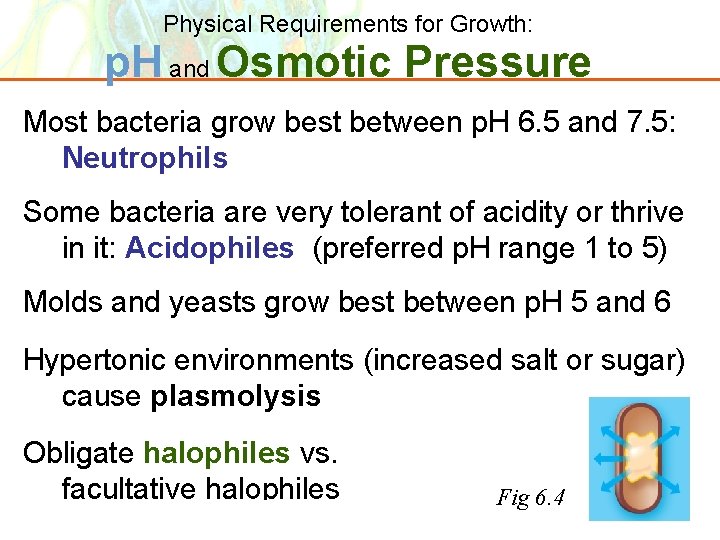
Physical Requirements for Growth: p. H and Osmotic Pressure Most bacteria grow best between p. H 6. 5 and 7. 5: Neutrophils Some bacteria are very tolerant of acidity or thrive in it: Acidophiles (preferred p. H range 1 to 5) Molds and yeasts grow best between p. H 5 and 6 Hypertonic environments (increased salt or sugar) cause plasmolysis Obligate halophiles vs. facultative halophiles Copyright © 2006 Pearson Education, Inc. , publishing as Benjamin Cummings Fig 6. 4
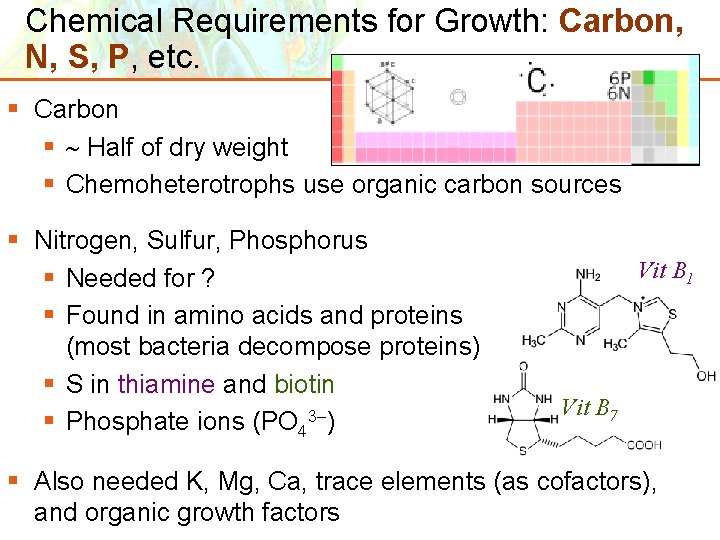
Chemical Requirements for Growth: Carbon, N, S, P, etc. § Carbon § Half of dry weight § Chemoheterotrophs use organic carbon sources § Nitrogen, Sulfur, Phosphorus Vit B 1 § Needed for ? § Found in amino acids and proteins (most bacteria decompose proteins) § S in thiamine and biotin Vit B 7 3– § Phosphate ions (PO 4 ) § Also needed K, Mg, Ca, trace elements (as cofactors), and organic growth factors Copyright © 2006 Pearson Education, Inc. , publishing as Benjamin Cummings
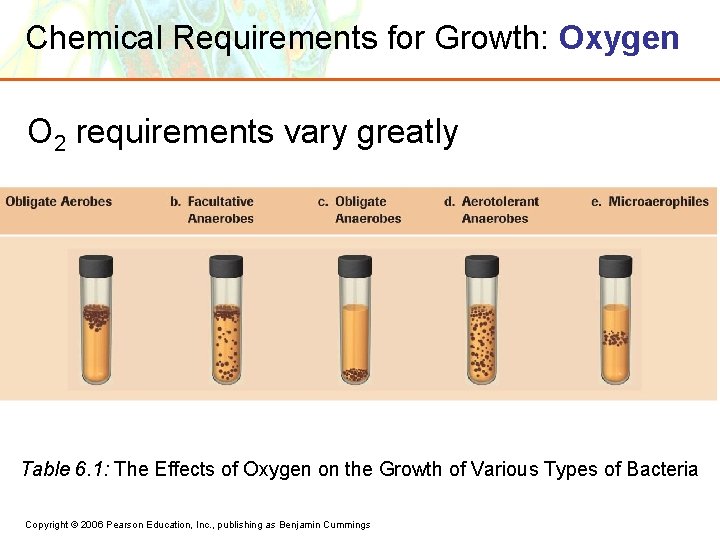
Chemical Requirements for Growth: Oxygen O 2 requirements vary greatly Table 6. 1: The Effects of Oxygen on the Growth of Various Types of Bacteria Copyright © 2006 Pearson Education, Inc. , publishing as Benjamin Cummings
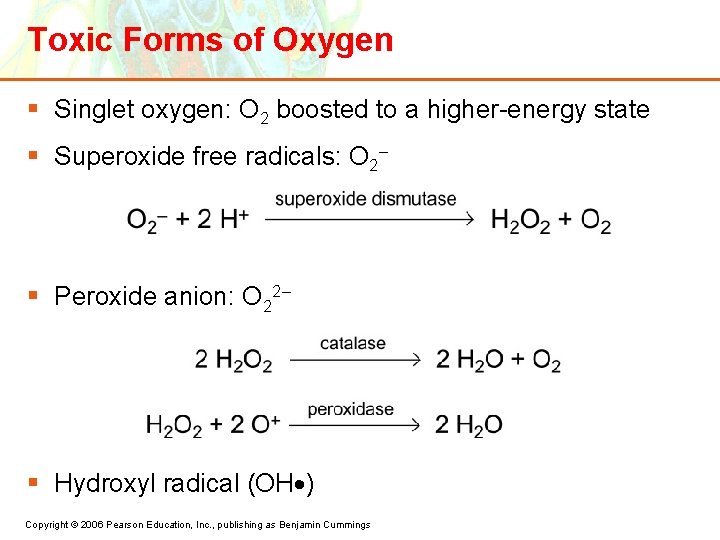
Toxic Forms of Oxygen § Singlet oxygen: O 2 boosted to a higher-energy state § Superoxide free radicals: O 2– § Peroxide anion: O 22– § Hydroxyl radical (OH ) Copyright © 2006 Pearson Education, Inc. , publishing as Benjamin Cummings
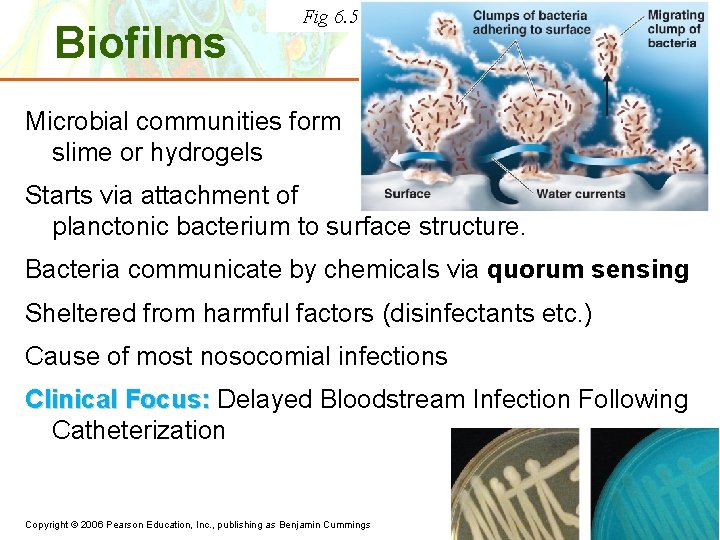
Biofilms Fig 6. 5 Microbial communities form slime or hydrogels Starts via attachment of planctonic bacterium to surface structure. Bacteria communicate by chemicals via quorum sensing Sheltered from harmful factors (disinfectants etc. ) Cause of most nosocomial infections Clinical Focus: Delayed Bloodstream Infection Following Catheterization Copyright © 2006 Pearson Education, Inc. , publishing as Benjamin Cummings
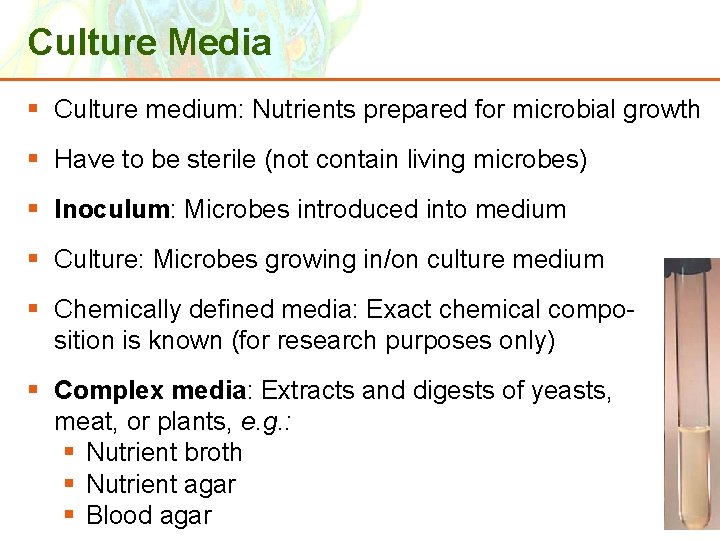
Culture Media § Culture medium: Nutrients prepared for microbial growth § Have to be sterile (not contain living microbes) § Inoculum: Microbes introduced into medium § Culture: Microbes growing in/on culture medium § Chemically defined media: Exact chemical composition is known (for research purposes only) § Complex media: Extracts and digests of yeasts, meat, or plants, e. g. : § Nutrient broth § Nutrient agar § Blood agar Copyright © 2006 Pearson Education, Inc. , publishing as Benjamin Cummings
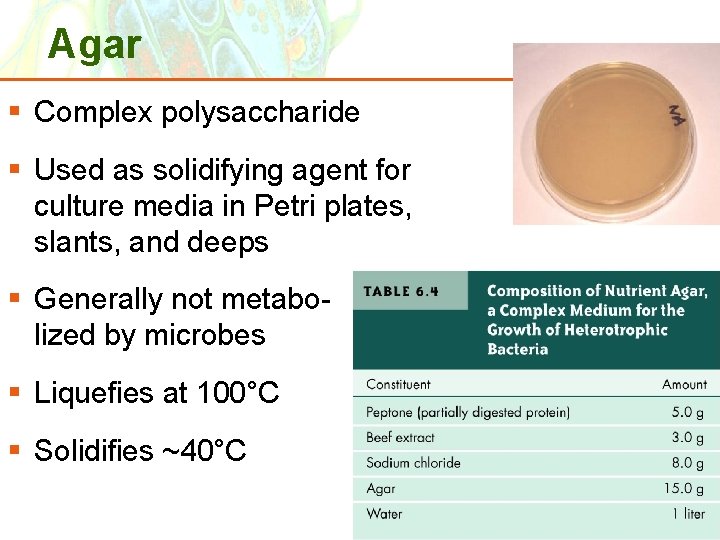
Agar § Complex polysaccharide § Used as solidifying agent for culture media in Petri plates, slants, and deeps § Generally not metabolized by microbes § Liquefies at 100°C § Solidifies ~40°C Copyright © 2006 Pearson Education, Inc. , publishing as Benjamin Cummings
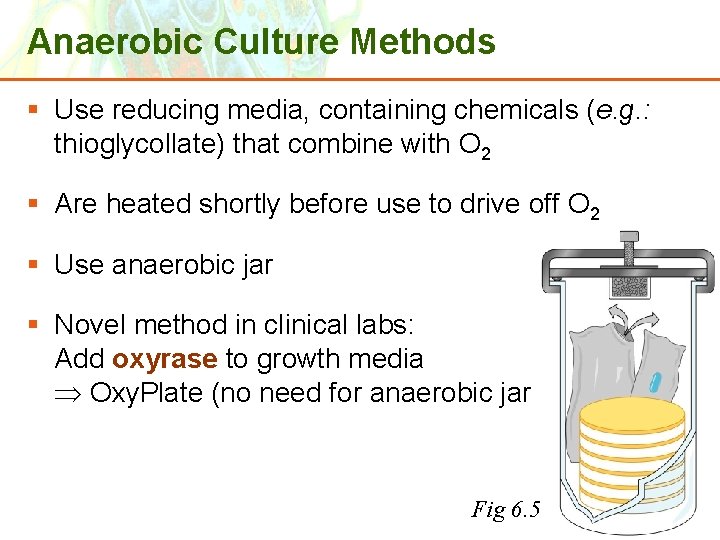
Anaerobic Culture Methods § Use reducing media, containing chemicals (e. g. : thioglycollate) that combine with O 2 § Are heated shortly before use to drive off O 2 § Use anaerobic jar § Novel method in clinical labs: Add oxyrase to growth media Oxy. Plate (no need for anaerobic jar) Copyright © 2006 Pearson Education, Inc. , publishing as Benjamin Cummings Fig 6. 5
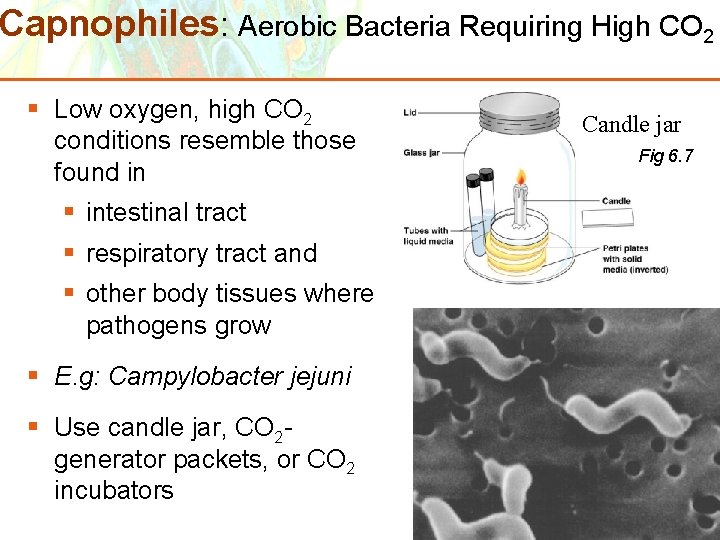
Capnophiles: Aerobic Bacteria Requiring High CO 2 § Low oxygen, high CO 2 conditions resemble those found in § intestinal tract § respiratory tract and § other body tissues where pathogens grow § E. g: Campylobacter jejuni § Use candle jar, CO 2 generator packets, or CO 2 incubators Copyright © 2006 Pearson Education, Inc. , publishing as Benjamin Cummings Candle jar Fig 6. 7

Selective Media and Differential Media Selective medium: Additives suppress unwanted and encourage desired microbes – e. g. EMB, mannitol salt agar etc. Differential medium: changed in recognizable manner by some bacteria Make it easy to distinguish colonies of different microbes – e. g. and hemolysis on blood agar; Mac. Conkey agar, EMB, mannitol salt agar etc. Copyright © 2006 Pearson Education, Inc. , publishing as Benjamin Cummings

Enrichment Media/Culture § Encourages growth of desired microbe § Example: Assume soil sample contains a few phenoldegrading bacteria and thousands of other bacteria § Inoculate phenol-containing culture medium with the soil and incubate § Transfer 1 ml to another flask of the phenol medium and incubate § Only phenol-metabolizing bacteria will be growing Copyright © 2006 Pearson Education, Inc. , publishing as Benjamin Cummings
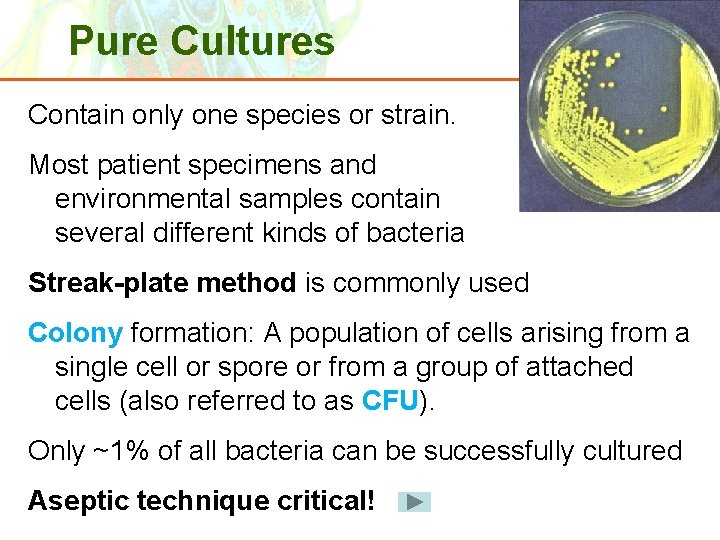
Pure Cultures Contain only one species or strain. Most patient specimens and environmental samples contain several different kinds of bacteria Streak-plate method is commonly used Colony formation: A population of cells arising from a single cell or spore or from a group of attached cells (also referred to as CFU). Only ~1% of all bacteria can be successfully cultured Aseptic technique critical! Copyright © 2006 Pearson Education, Inc. , publishing as Benjamin Cummings
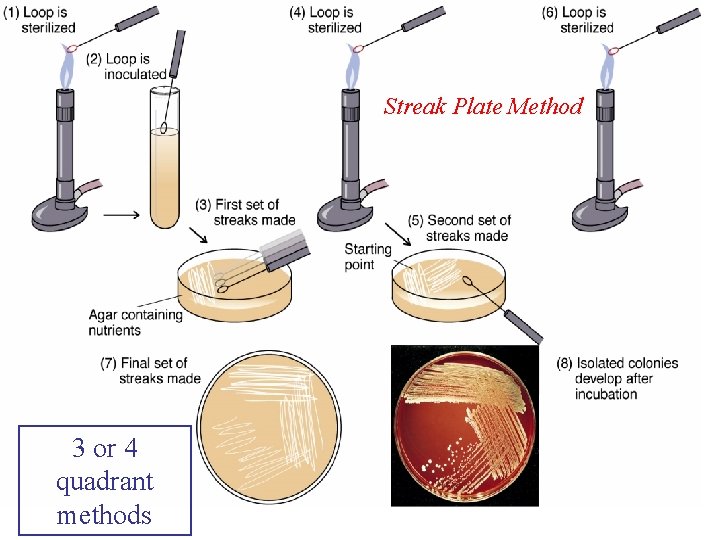
Streak Plate Method 3 or 4 quadrant methods
Preserving Bacterial Cultures § Deep-freezing: Rapid cooling of pure culture in suspension liquid to – 50°to – 95°C. Good for several years. § Lyophilization (freeze-drying): Frozen (– 54° to – 72°C) and dehydrated in a vacuum. Good for many years. Copyright © 2006 Pearson Education, Inc. , publishing as Benjamin Cummings
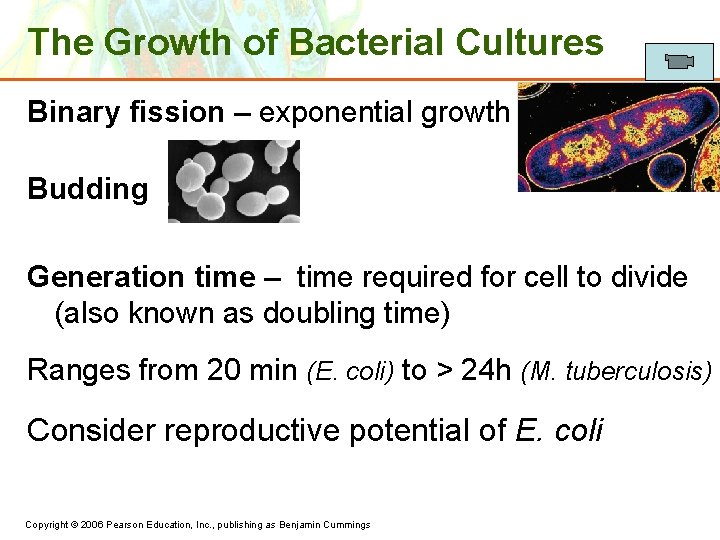
The Growth of Bacterial Cultures Binary fission – exponential growth Budding Generation time – time required for cell to divide (also known as doubling time) Ranges from 20 min (E. coli) to > 24 h (M. tuberculosis) Consider reproductive potential of E. coli Copyright © 2006 Pearson Education, Inc. , publishing as Benjamin Cummings
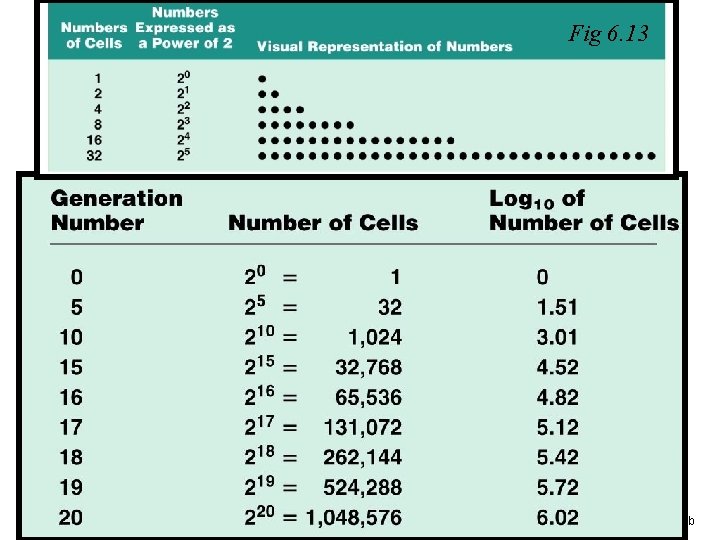
Fig 6. 13 Figure 6. 12 b
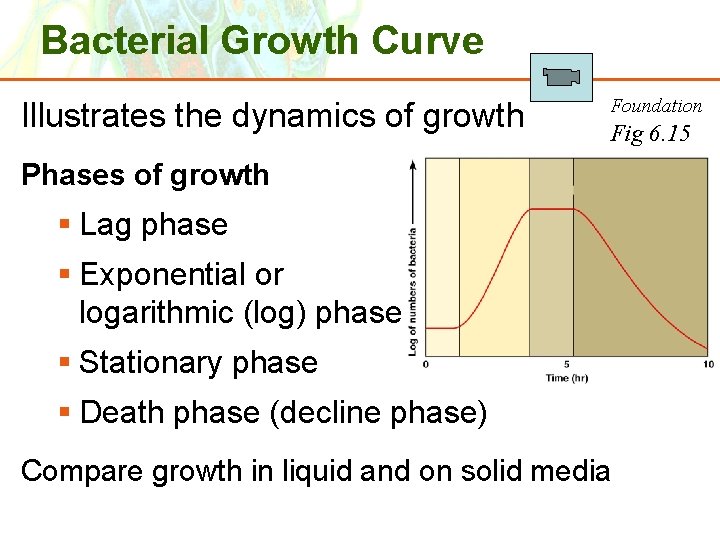
Bacterial Growth Curve Illustrates the dynamics of growth Foundation Fig 6. 15 Phases of growth § Lag phase § Exponential or logarithmic (log) phase § Stationary phase § Death phase (decline phase) Compare growth in liquid and on solid media Copyright © 2006 Pearson Education, Inc. , publishing as Benjamin Cummings
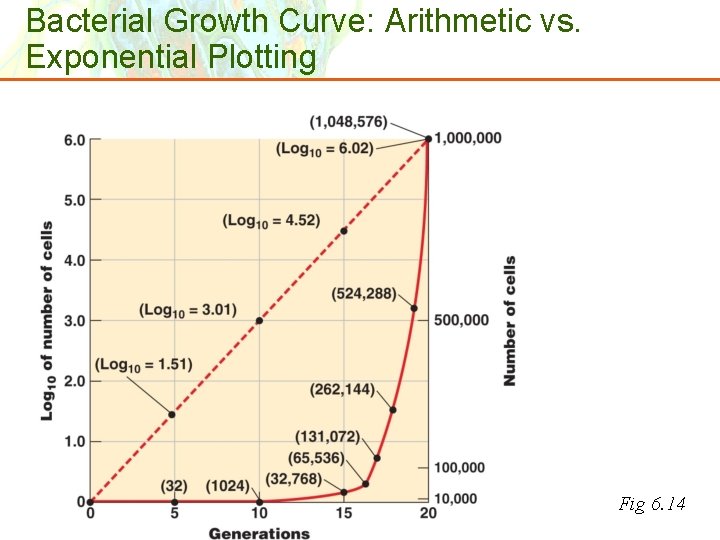
Bacterial Growth Curve: Arithmetic vs. Exponential Plotting Fig 6. 14 Copyright © 2006 Pearson Education, Inc. , publishing as Benjamin Cummings
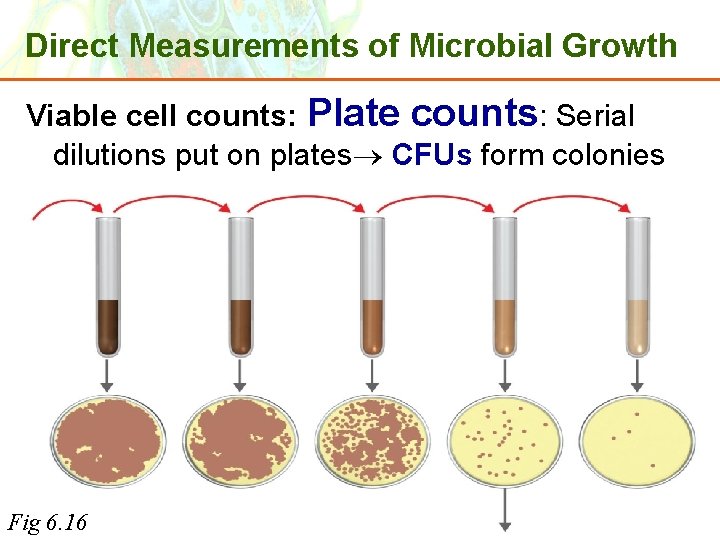
Direct Measurements of Microbial Growth Viable cell counts: Plate counts: Serial dilutions put on plates CFUs form colonies Copyright © 2006 Pearson Education, Inc. , publishing as Benjamin Cummings Fig 6. 16
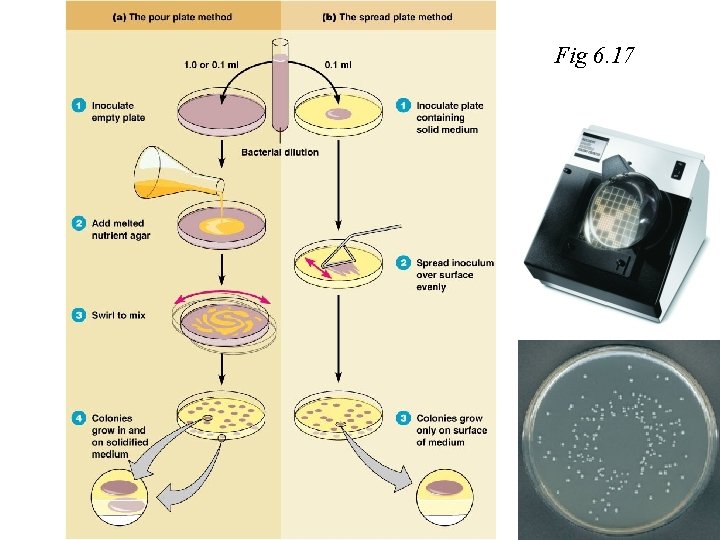
Fig 6. 17 Figure 6. 15, step 1
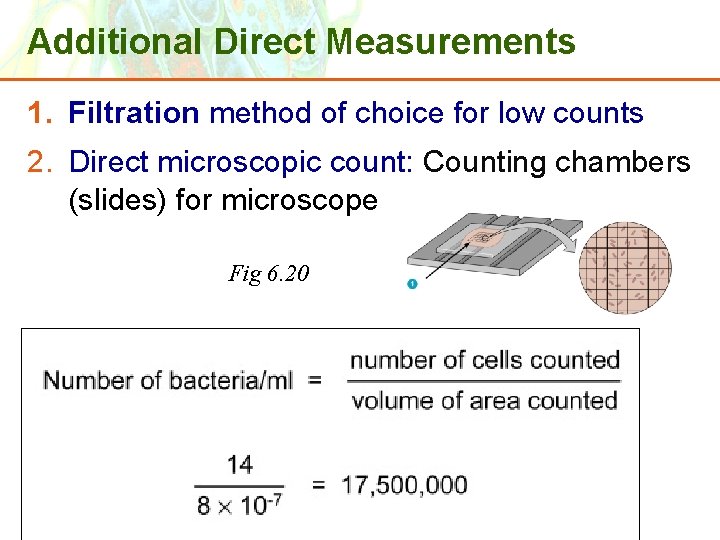
Additional Direct Measurements 1. Filtration method of choice for low counts 2. Direct microscopic count: Counting chambers (slides) for microscope Fig 6. 20 Copyright © 2006 Pearson Education, Inc. , publishing as Benjamin Cummings
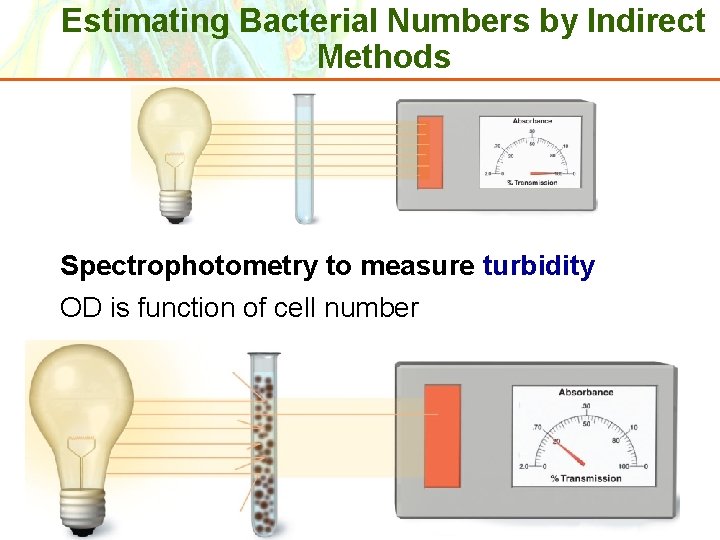
Estimating Bacterial Numbers by Indirect Methods Spectrophotometry to measure turbidity OD is function of cell number Copyright © 2006 Pearson Education, Inc. , publishing as Benjamin Cummings
Measuring Microbial Growth - Overview Direct Methods Indirect Methods § Plate counts § Turbidity § Filtration § Metabolic activity § MPN § Dry weight § Direct microscopic count Copyright © 2006 Pearson Education, Inc. , publishing as Benjamin Cummings
- Slides: 27