
Ch 6 Fault Tolerance Fault tolerance Process resilience

- Slides: 58
Ch 6 Fault Tolerance Fault tolerance Process resilience Reliable group communication Distributed commit Recovery Tanenbaum, van Steen: Ch 7 (Co. Do. Ki: Ch 2, 11, 13, 14)
Basic Concepts Dependability Includes • Availability • Reliability • Safety • Maintainability
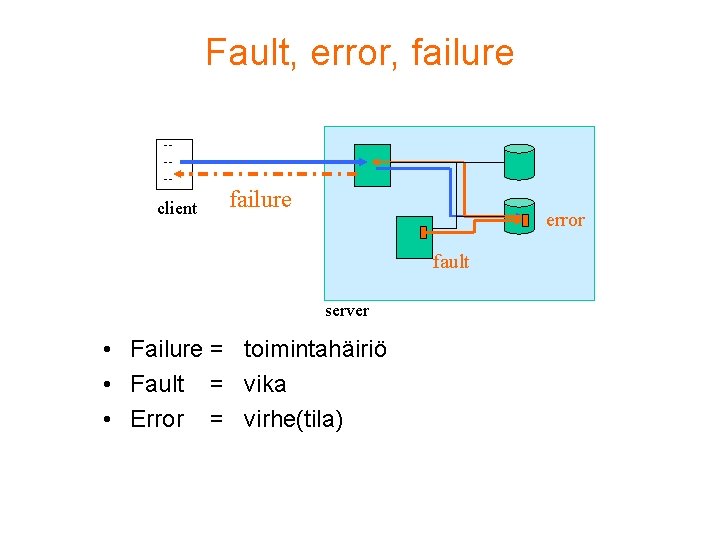
Fault, error, failure ---- client failure error fault server • Failure = toimintahäiriö • Fault = vika • Error = virhe(tila)
Failure Model • Challenge: independent failures • Detection – which component? – what went wrong? • Recovery – failure dependent – ignorance increases complexity => taxonomy of failures
Fault Tolerance • Detection • Recovery – mask the error OR – fail predictably • Designer – possible failure types? – recovery action (for the possible failure types) • A fault classification: – transient – intermittent – permanent (disappear) (disappear and reappear)
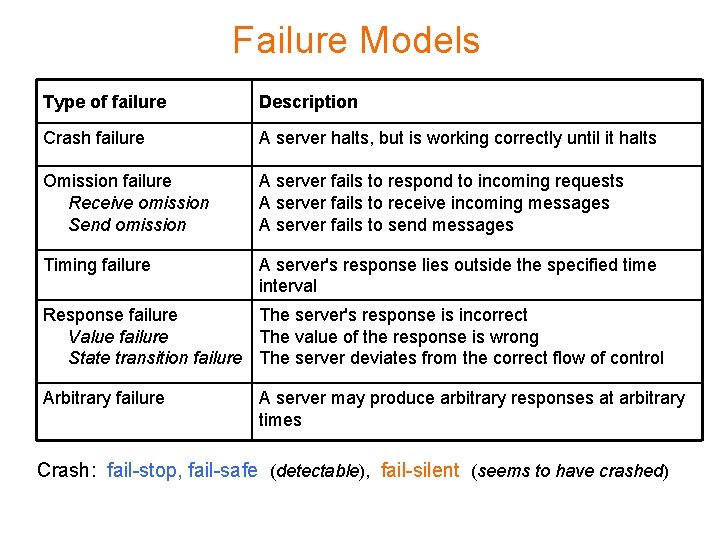
Failure Models Type of failure Description Crash failure A server halts, but is working correctly until it halts Omission failure Receive omission Send omission A server fails to respond to incoming requests A server fails to receive incoming messages A server fails to send messages Timing failure A server's response lies outside the specified time interval Response failure The server's response is incorrect Value failure The value of the response is wrong State transition failure The server deviates from the correct flow of control Arbitrary failure A server may produce arbitrary responses at arbitrary times Crash: fail-stop, fail-safe (detectable), fail-silent (seems to have crashed)
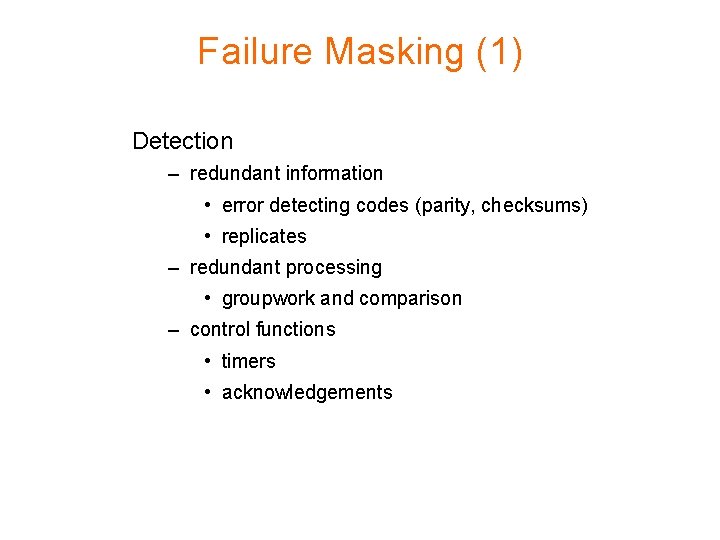
Failure Masking (1) Detection – redundant information • error detecting codes (parity, checksums) • replicates – redundant processing • groupwork and comparison – control functions • timers • acknowledgements
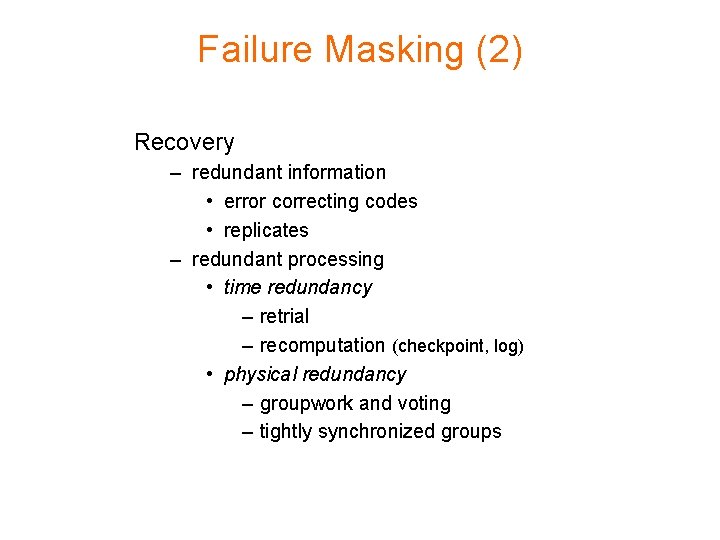
Failure Masking (2) Recovery – redundant information • error correcting codes • replicates – redundant processing • time redundancy – retrial – recomputation (checkpoint, log) • physical redundancy – groupwork and voting – tightly synchronized groups
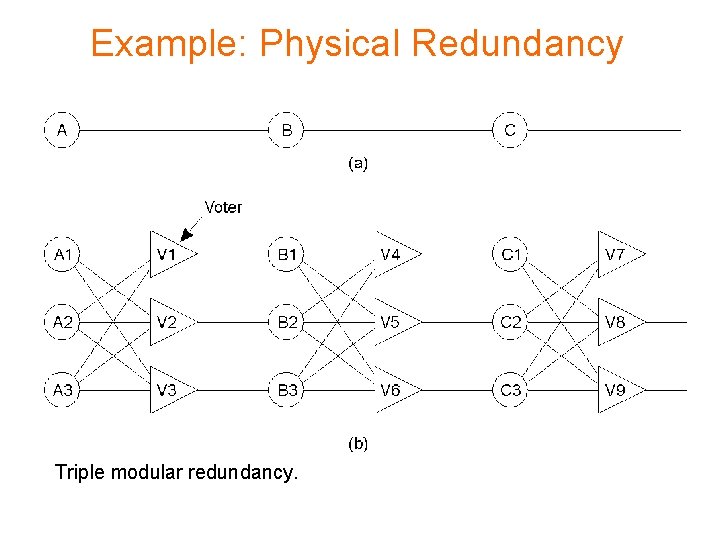
Example: Physical Redundancy Triple modular redundancy.
Failure Masking (3) • Failure models vs. implementation issues: the (sub-)system belongs to a class => certain failures do not occur => easier detection & recovery • A viewpoint: forward vs. backward recovery • Issues: – process resilience – reliable communication
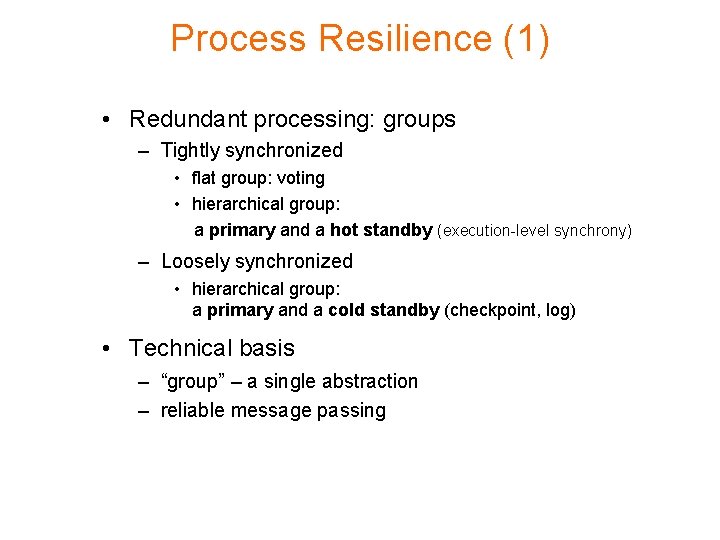
Process Resilience (1) • Redundant processing: groups – Tightly synchronized • flat group: voting • hierarchical group: a primary and a hot standby (execution-level synchrony) – Loosely synchronized • hierarchical group: a primary and a cold standby (checkpoint, log) • Technical basis – “group” – a single abstraction – reliable message passing
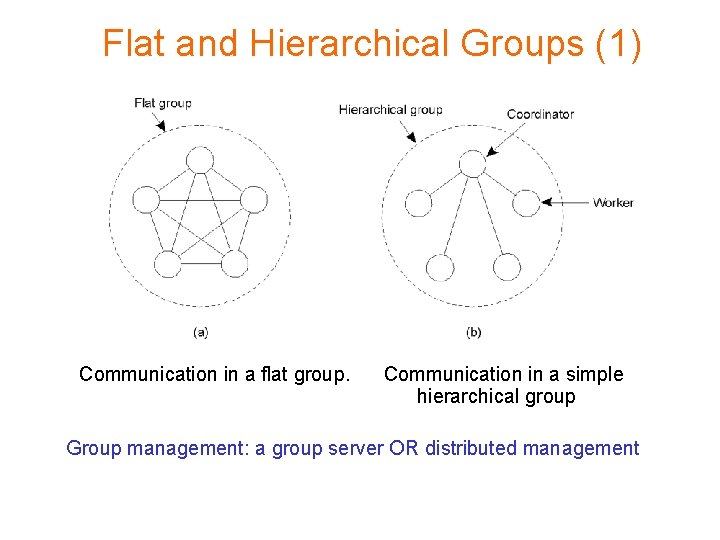
Flat and Hierarchical Groups (1) Communication in a flat group. Communication in a simple hierarchical group Group management: a group server OR distributed management
Flat and Hierarchical Groups (2) • Flat groups – symmetrical – no single point of failure – complicated decision making • Hierarchical groups – the opposite properties • Group management issues – join, leave; – crash (no notification)
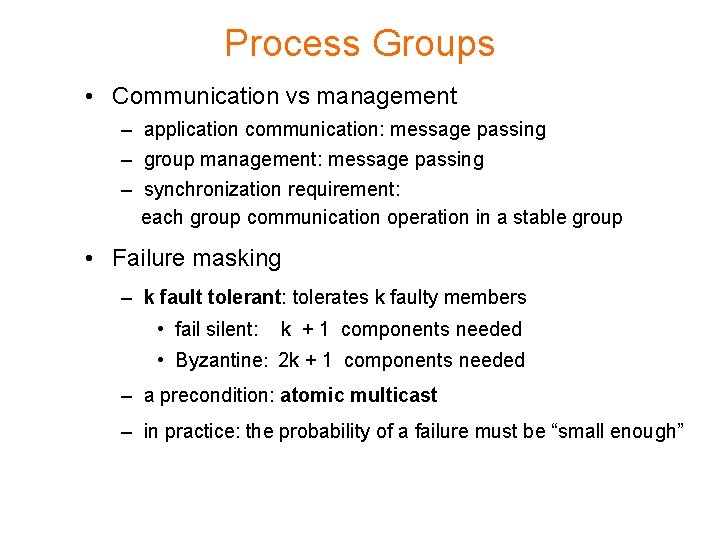
Process Groups • Communication vs management – application communication: message passing – group management: message passing – synchronization requirement: each group communication operation in a stable group • Failure masking – k fault tolerant: tolerates k faulty members • fail silent: k + 1 components needed • Byzantine: 2 k + 1 components needed – a precondition: atomic multicast – in practice: the probability of a failure must be “small enough”
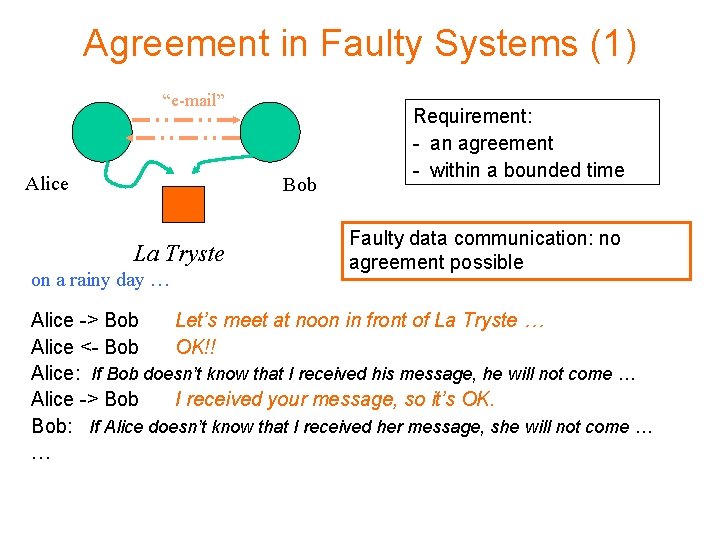
Agreement in Faulty Systems (1) “e-mail” Alice Bob La Tryste on a rainy day … Requirement: - an agreement - within a bounded time Faulty data communication: no agreement possible Alice -> Bob Let’s meet at noon in front of La Tryste … Alice <- Bob OK!! Alice: If Bob doesn’t know that I received his message, he will not come … Alice -> Bob I received your message, so it’s OK. Bob: If Alice doesn’t know that I received her message, she will not come … …
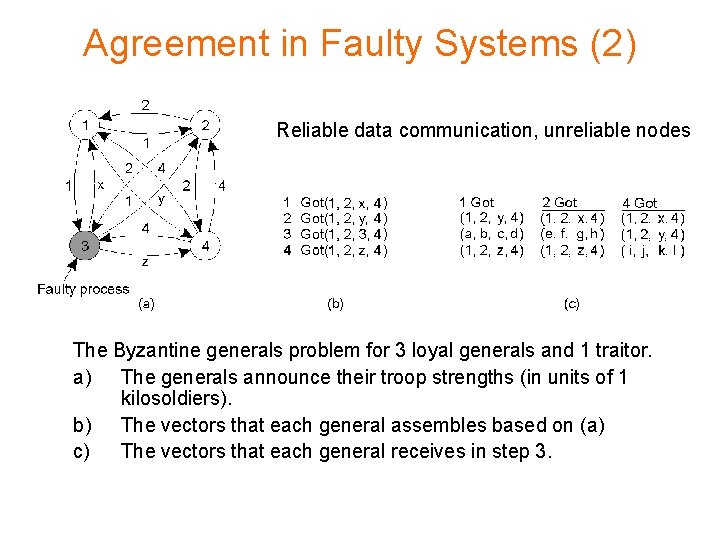
Agreement in Faulty Systems (2) Reliable data communication, unreliable nodes The Byzantine generals problem for 3 loyal generals and 1 traitor. a) The generals announce their troop strengths (in units of 1 kilosoldiers). b) The vectors that each general assembles based on (a) c) The vectors that each general receives in step 3.
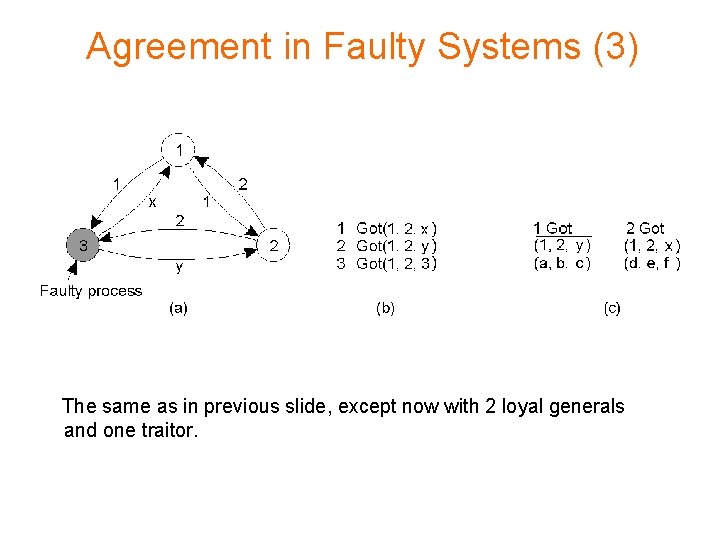
Agreement in Faulty Systems (3) The same as in previous slide, except now with 2 loyal generals and one traitor.
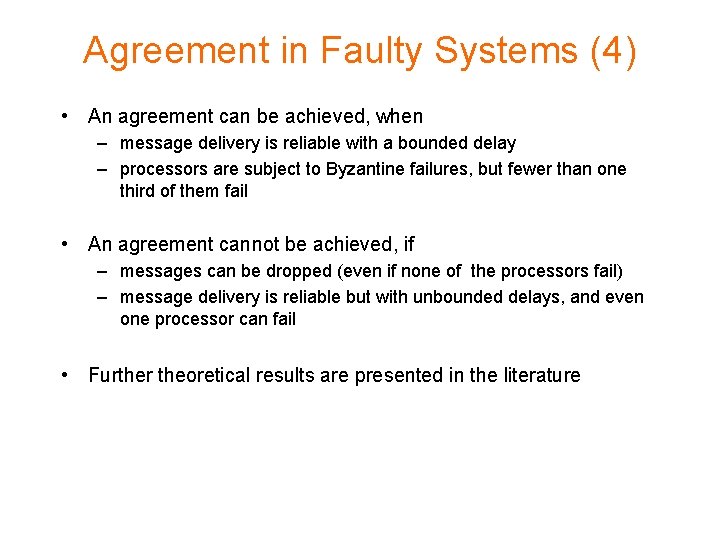
Agreement in Faulty Systems (4) • An agreement can be achieved, when – message delivery is reliable with a bounded delay – processors are subject to Byzantine failures, but fewer than one third of them fail • An agreement cannot be achieved, if – messages can be dropped (even if none of the processors fail) – message delivery is reliable but with unbounded delays, and even one processor can fail • Further theoretical results are presented in the literature
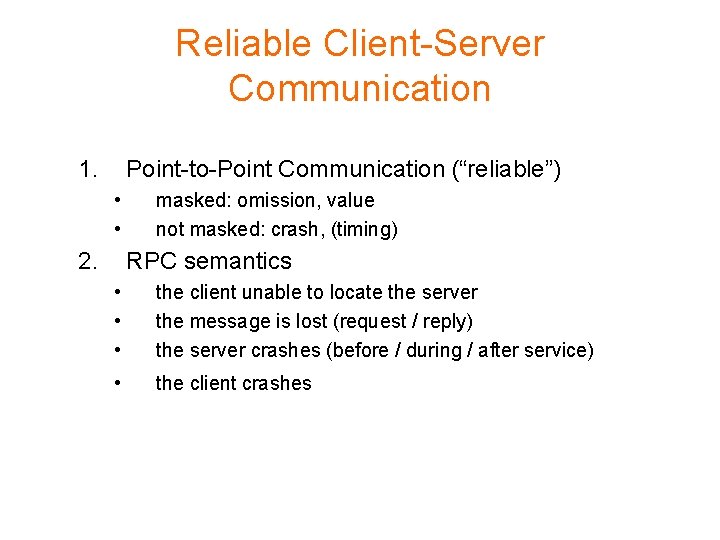
Reliable Client-Server Communication 1. Point-to-Point Communication (“reliable”) • • 2. masked: omission, value not masked: crash, (timing) RPC semantics • • • the client unable to locate the server the message is lost (request / reply) the server crashes (before / during / after service) • the client crashes
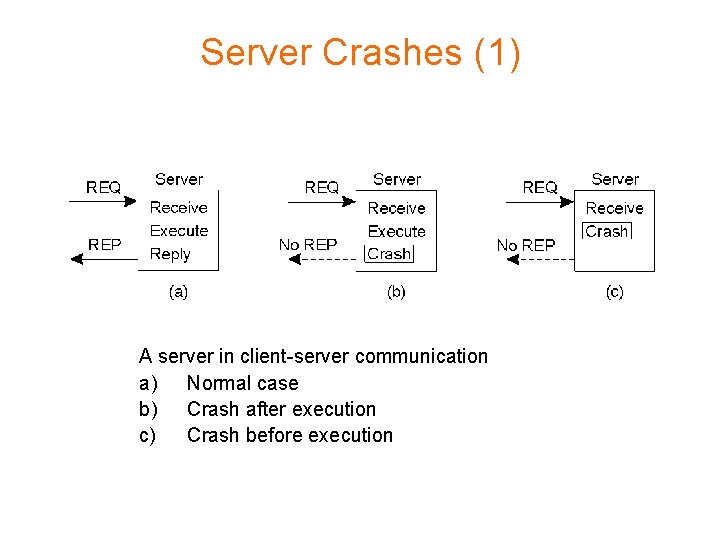
Server Crashes (1) A server in client-server communication a) Normal case b) Crash after execution c) Crash before execution
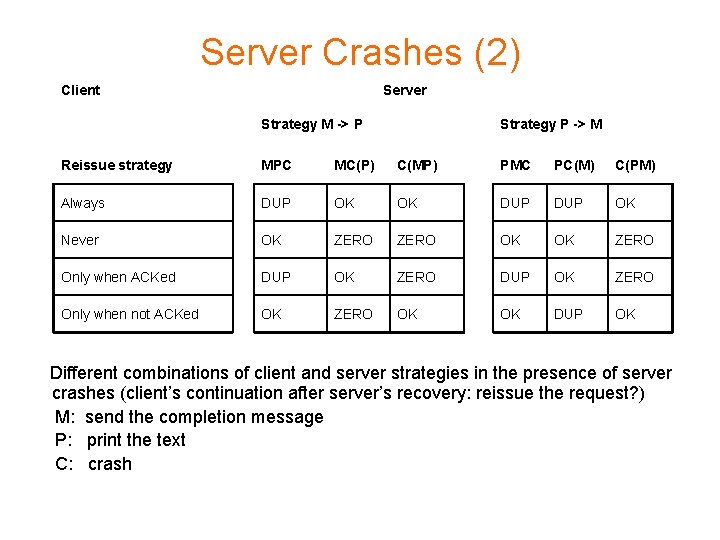
Server Crashes (2) Client Server Strategy M -> P Strategy P -> M Reissue strategy MPC MC(P) C(MP) PMC PC(M) C(PM) Always DUP OK OK DUP OK Never OK ZERO OK OK ZERO Only when ACKed DUP OK ZERO Only when not ACKed OK ZERO OK OK DUP OK Different combinations of client and server strategies in the presence of server crashes (client’s continuation after server’s recovery: reissue the request? ) M: send the completion message P: print the text C: crash
Client Crashes • Orphan: an active computation looking for a non-existing parent • Solutions – extermination: the client stub records all calls, after crash recovery all orphans are killed – reincarnation: time is divided into epochs, client reboot => broadcast “new epoch” => servers kill orphans – gentle incarnation: “new epoch” => only “real orphans” are killed – expiration: a “time-to-live” for each RPC (+ possibility to request for a further time slice) • New problems: grandorphans, reserved locks, entries in remote queues, ….
Reliable Group Communication • Lower-level data communication support – unreliable multicast (LAN) – reliable point-to-point channels – unreliable point-to-point channels • Group communication – individual point-to-point message passing – implemented in middleware or in application • Reliability – acks: lost messages, lost members – communication consistency ?
Reliability of Group Communication? • A sent message is received by all members (acks from all => ok) • Problem: during a multicast operation – an old member disappears from the group – a new member joins the group • Solution – membership changes synchronize multicasting => during an MC operation no membership changes An additional problem: the sender disappears (remember: multicast ~ for (all Pi in G) {send m to Pi } )
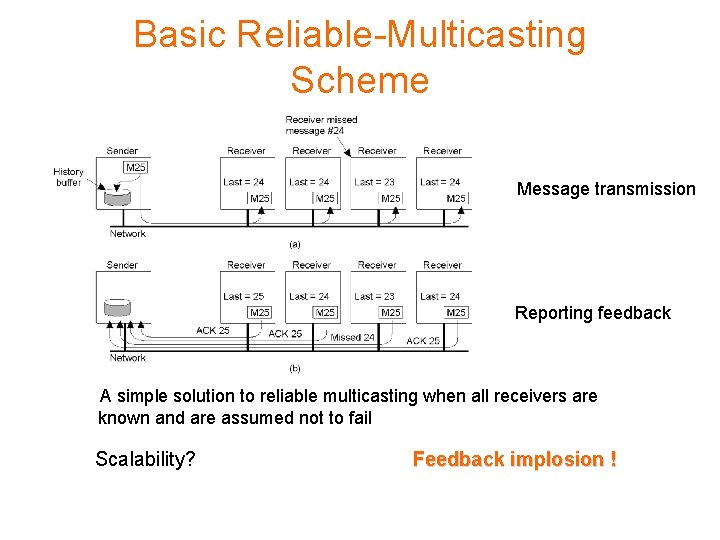
Basic Reliable-Multicasting Scheme Message transmission Reporting feedback A simple solution to reliable multicasting when all receivers are known and are assumed not to fail Scalability? Feedback implosion !
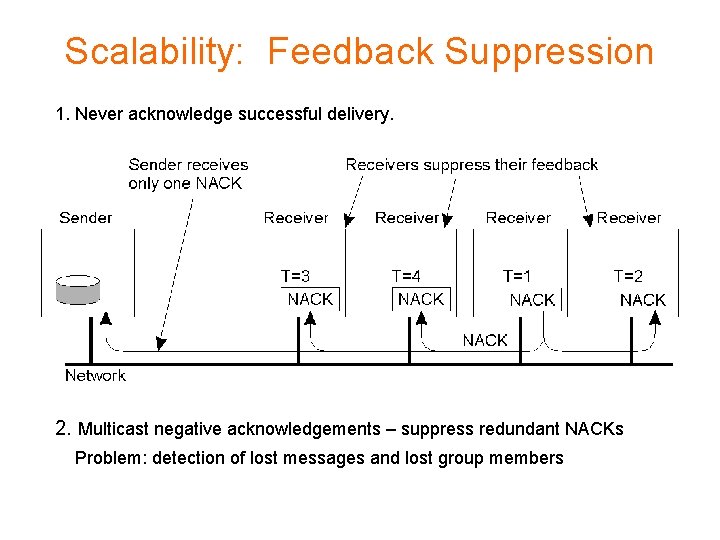
Scalability: Feedback Suppression 1. Never acknowledge successful delivery. 2. Multicast negative acknowledgements – suppress redundant NACKs Problem: detection of lost messages and lost group members
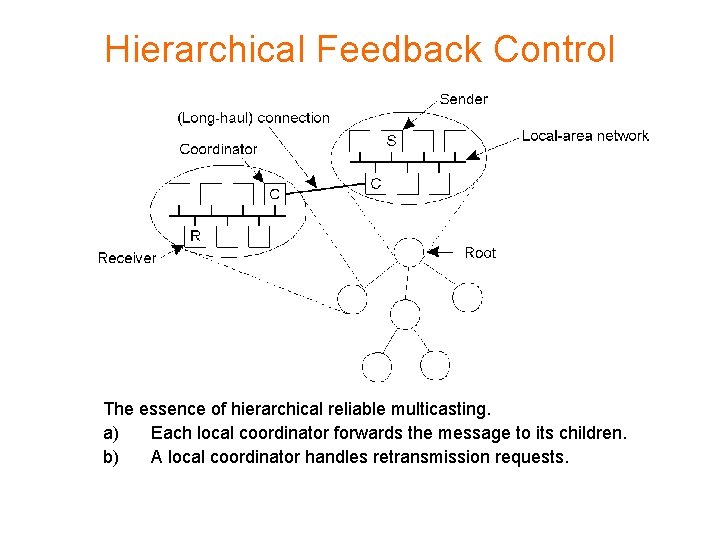
Hierarchical Feedback Control The essence of hierarchical reliable multicasting. a) Each local coordinator forwards the message to its children. b) A local coordinator handles retransmission requests.
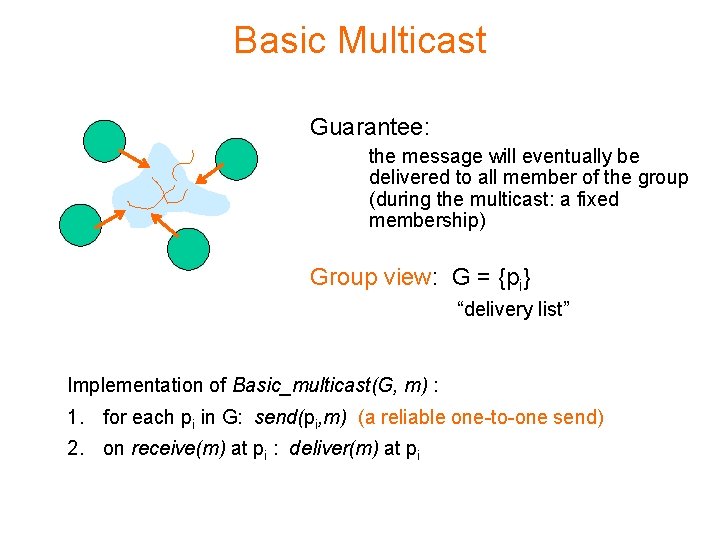
Basic Multicast Guarantee: the message will eventually be delivered to all member of the group (during the multicast: a fixed membership) Group view: G = {pi} “delivery list” Implementation of Basic_multicast(G, m) : 1. for each pi in G: send(pi, m) (a reliable one-to-one send) 2. on receive(m) at pi : deliver(m) at pi
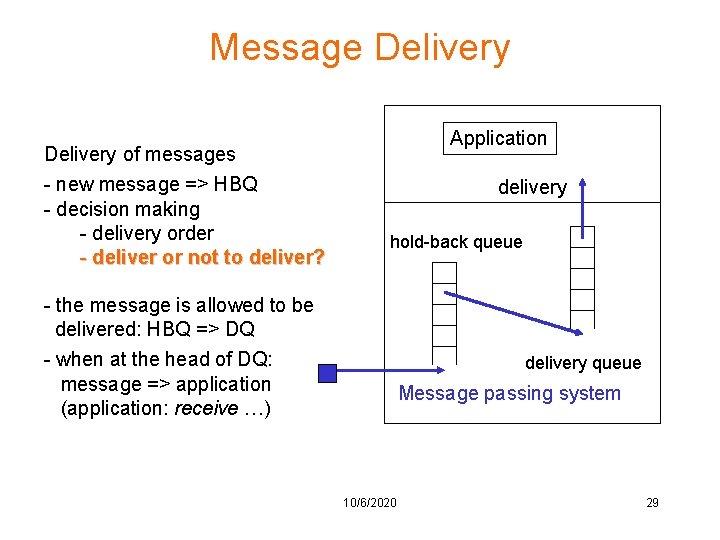
Message Delivery of messages - new message => HBQ - decision making - delivery order - deliver or not to deliver? Application delivery hold-back queue - the message is allowed to be delivered: HBQ => DQ - when at the head of DQ: message => application (application: receive …) delivery queue Message passing system 10/6/2020 29
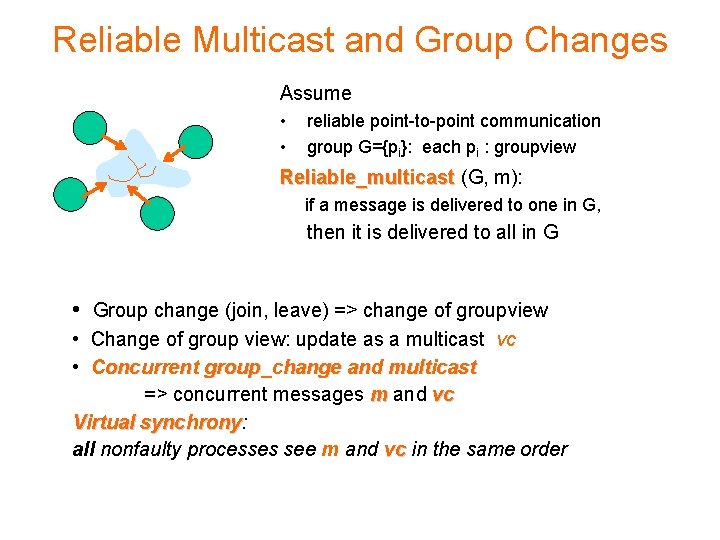
Reliable Multicast and Group Changes Assume • • reliable point-to-point communication group G={pi}: each pi : groupview Reliable_multicast (G, m): if a message is delivered to one in G, then it is delivered to all in G • Group change (join, leave) => change of groupview • Change of group view: update as a multicast vc • Concurrent group_change and multicast => concurrent messages m and vc Virtual synchrony: synchrony all nonfaulty processes see m and vc in the same order
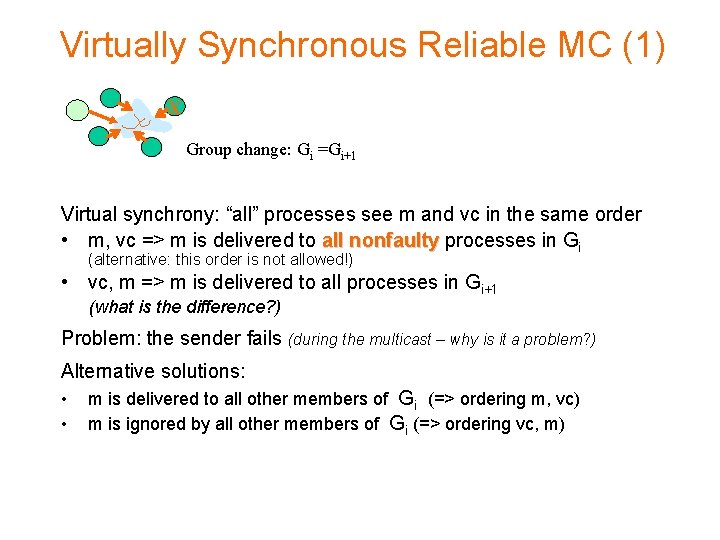
Virtually Synchronous Reliable MC (1) X Group change: Gi =Gi+1 Virtual synchrony: “all” processes see m and vc in the same order • m, vc => m is delivered to all nonfaulty processes in Gi (alternative: this order is not allowed!) • vc, m => m is delivered to all processes in Gi+1 (what is the difference? ) Problem: the sender fails (during the multicast – why is it a problem? ) Alternative solutions: • • m is delivered to all other members of Gi (=> ordering m, vc) m is ignored by all other members of Gi (=> ordering vc, m)
Virtually Synchronous Reliable MC (2) The principle of virtual synchronous multicast: - a reliable multicast, and if the sender crashes - the message may be delivered to all or ignored by each
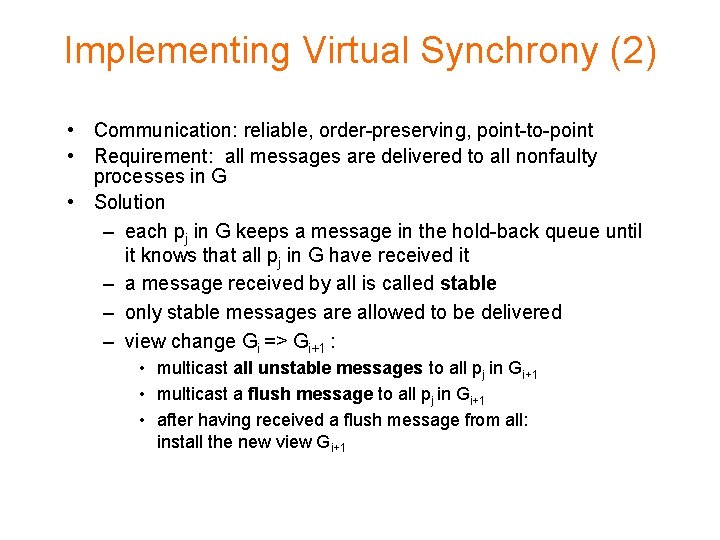
Implementing Virtual Synchrony (1) a) b) c) Process 4 notices that process 7 has crashed, sends a view change Process 6 sends out all its unstable messages, followed by a flush message Process 6 installs the new view when it has received a flush message from everyone else
Implementing Virtual Synchrony (2) • Communication: reliable, order-preserving, point-to-point • Requirement: all messages are delivered to all nonfaulty processes in G • Solution – each pj in G keeps a message in the hold-back queue until it knows that all pj in G have received it – a message received by all is called stable – only stable messages are allowed to be delivered – view change Gi => Gi+1 : • multicast all unstable messages to all pj in Gi+1 • multicast a flush message to all pj in Gi+1 • after having received a flush message from all: install the new view Gi+1
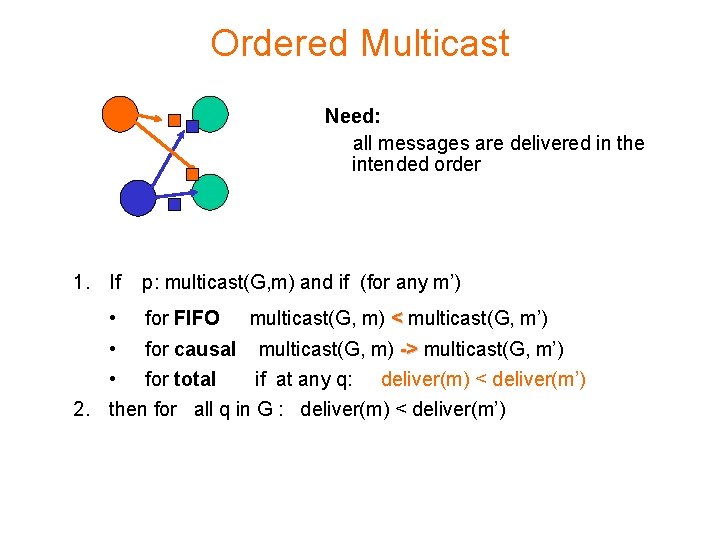
Ordered Multicast Need: all messages are delivered in the intended order 1. If • p: multicast(G, m) and if (for any m’) for FIFO multicast(G, m) < multicast(G, m’) • for causal multicast(G, m) -> multicast(G, m’) • for total if at any q: deliver(m) < deliver(m’) 2. then for all q in G : deliver(m) < deliver(m’)
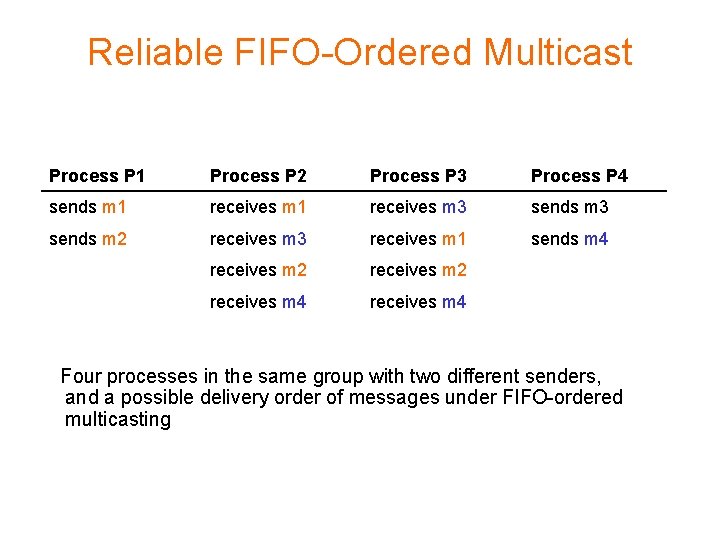
Reliable FIFO-Ordered Multicast Process P 1 Process P 2 Process P 3 Process P 4 sends m 1 receives m 3 sends m 2 receives m 3 receives m 1 sends m 4 receives m 2 receives m 4 Four processes in the same group with two different senders, and a possible delivery order of messages under FIFO-ordered multicasting
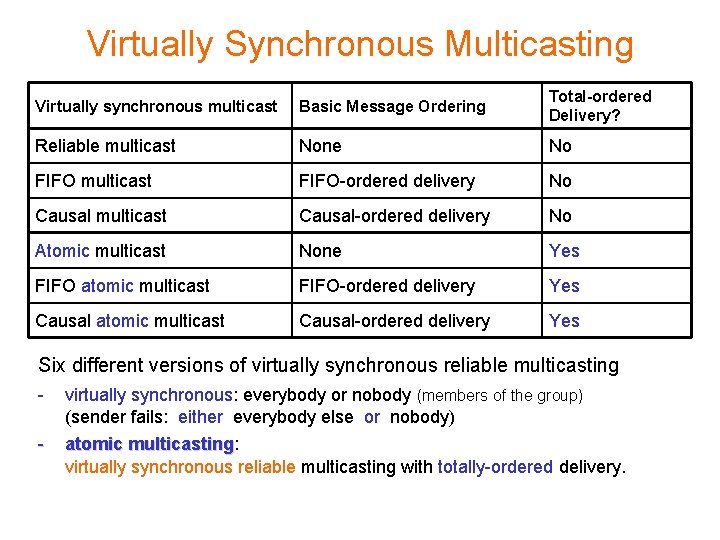
Virtually Synchronous Multicasting Virtually synchronous multicast Basic Message Ordering Total-ordered Delivery? Reliable multicast None No FIFO multicast FIFO-ordered delivery No Causal multicast Causal-ordered delivery No Atomic multicast None Yes FIFO atomic multicast FIFO-ordered delivery Yes Causal atomic multicast Causal-ordered delivery Yes Six different versions of virtually synchronous reliable multicasting - virtually synchronous: everybody or nobody (members of the group) (sender fails: either everybody else or nobody) atomic multicasting: multicasting virtually synchronous reliable multicasting with totally-ordered delivery.
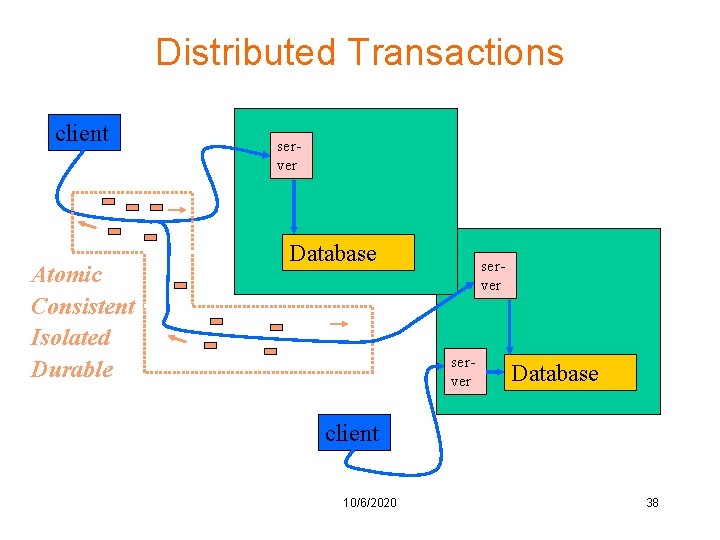
Distributed Transactions client Atomic atomic Consistent isolated Isolated serializable Durable server Database client 10/6/2020 38
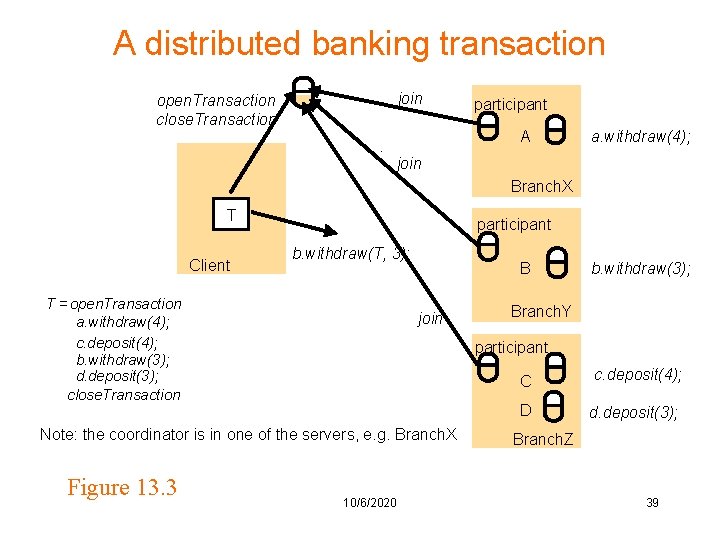
A distributed banking transaction join open. Transaction close. Transaction. participant A a. withdraw(4); join Branch. X T Client participant b. withdraw(T, 3); T = open. Transaction a. withdraw(4); c. deposit(4); b. withdraw(3); d. deposit(3); close. Transaction B join Branch. Y participant Note: the coordinator is in one of the servers, e. g. Branch. X Figure 13. 3 b. withdraw(3); 10/6/2020 C c. deposit(4); D d. deposit(3); Branch. Z 39
Concurrency Control • General organization of managers for handling distributed transactions.
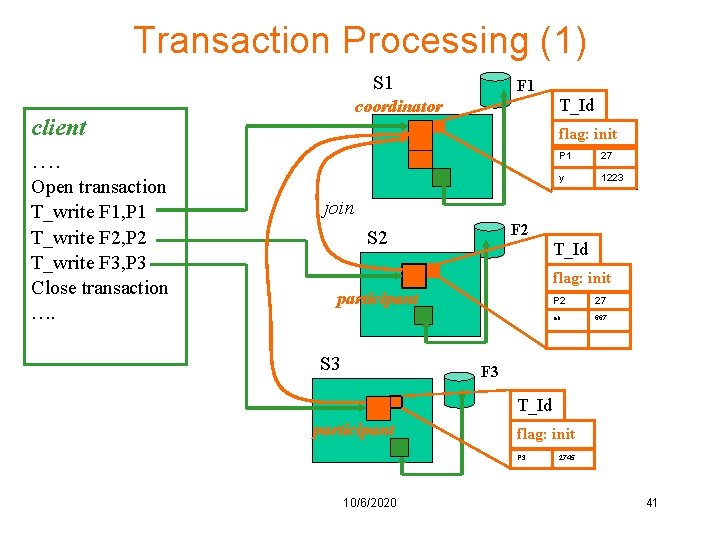
Transaction Processing (1) S 1 T_Id coordinator client …. Open transaction T_write F 1, P 1 T_write F 2, P 2 T_write F 3, P 3 Close transaction …. F 1 flag: init P 1 27 y 1223 join F 2 S 2 T_Id flag: init participant S 3 P 2 27 ab 667 F 3 T_Id participant flag: init P 3 10/6/2020 2745 41
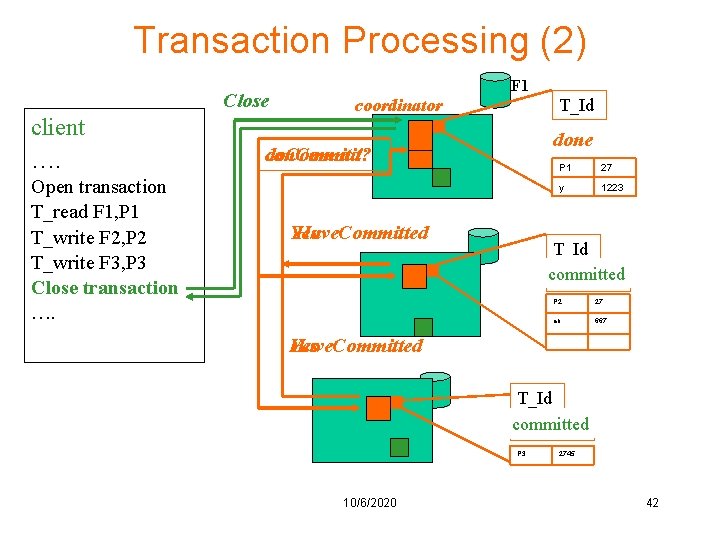
Transaction Processing (2) Close client …. Open transaction T_read F 1, P 1 T_write F 2, P 2 T_write F 3, P 3 Close transaction …. F 1 T_Id coordinator init committed wait done do. Commit ! can. Commit? Have. Committed Yes P 1 27 y 1223 T_Id committed ready init P 2 27 ab 667 Yes Have. Committed T_Id committed ready init P 3 10/6/2020 2745 42
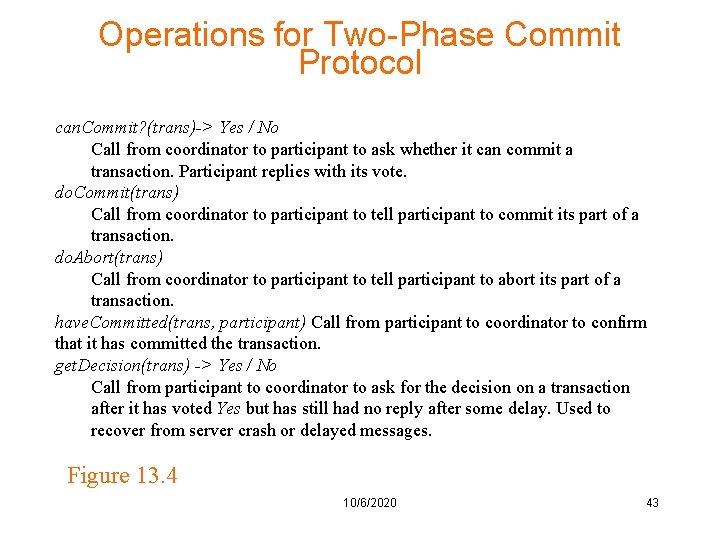
Operations for Two-Phase Commit Protocol can. Commit? (trans)-> Yes / No Call from coordinator to participant to ask whether it can commit a transaction. Participant replies with its vote. do. Commit(trans) Call from coordinator to participant to tell participant to commit its part of a transaction. do. Abort(trans) Call from coordinator to participant to tell participant to abort its part of a transaction. have. Committed(trans, participant) Call from participant to coordinator to confirm that it has committed the transaction. get. Decision(trans) -> Yes / No Call from participant to coordinator to ask for the decision on a transaction after it has voted Yes but has still had no reply after some delay. Used to recover from server crash or delayed messages. Figure 13. 4 10/6/2020 43
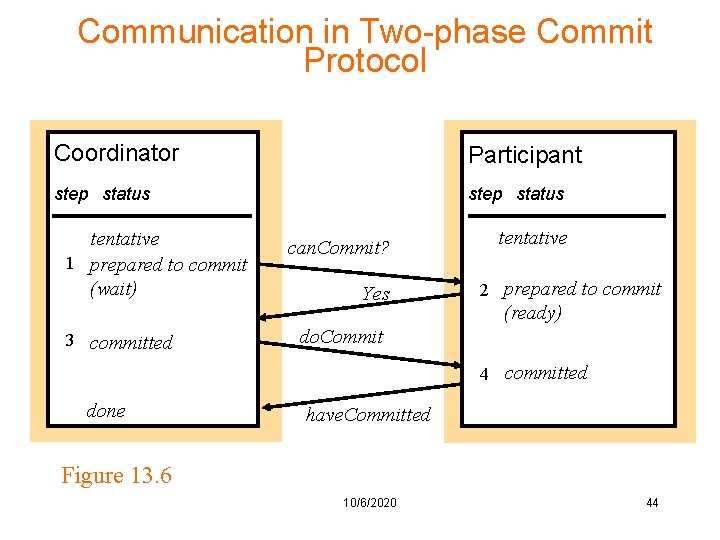
Communication in Two-phase Commit Protocol Coordinator Participant step status tentative 1 prepared to commit (wait) 3 committed can. Commit? Yes tentative 2 prepared to commit (ready) do. Commit 4 committed done have. Committed Figure 13. 6 10/6/2020 44
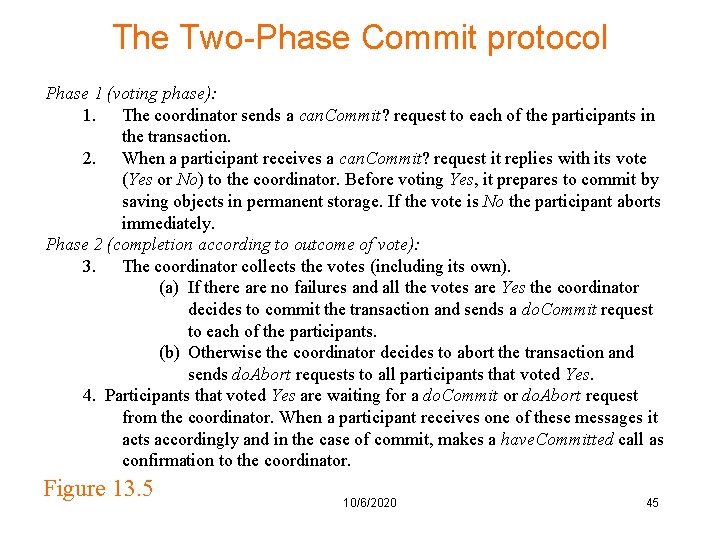
The Two-Phase Commit protocol Phase 1 (voting phase): 1. The coordinator sends a can. Commit? request to each of the participants in the transaction. 2. When a participant receives a can. Commit? request it replies with its vote (Yes or No) to the coordinator. Before voting Yes, it prepares to commit by saving objects in permanent storage. If the vote is No the participant aborts immediately. Phase 2 (completion according to outcome of vote): 3. The coordinator collects the votes (including its own). (a) If there are no failures and all the votes are Yes the coordinator decides to commit the transaction and sends a do. Commit request to each of the participants. (b) Otherwise the coordinator decides to abort the transaction and sends do. Abort requests to all participants that voted Yes. 4. Participants that voted Yes are waiting for a do. Commit or do. Abort request from the coordinator. When a participant receives one of these messages it acts accordingly and in the case of commit, makes a have. Committed call as confirmation to the coordinator. Figure 13. 5 10/6/2020 45
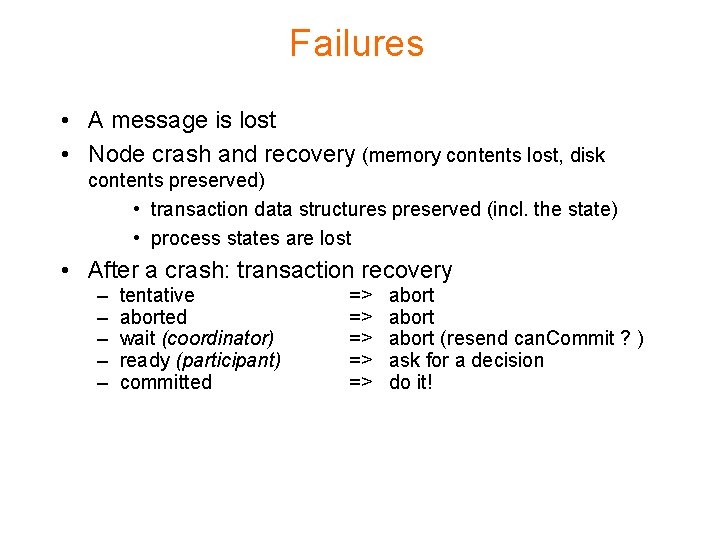
Failures • A message is lost • Node crash and recovery (memory contents lost, disk contents preserved) • transaction data structures preserved (incl. the state) • process states are lost • After a crash: transaction recovery – – – tentative aborted wait (coordinator) ready (participant) committed => => => abort (resend can. Commit ? ) ask for a decision do it!
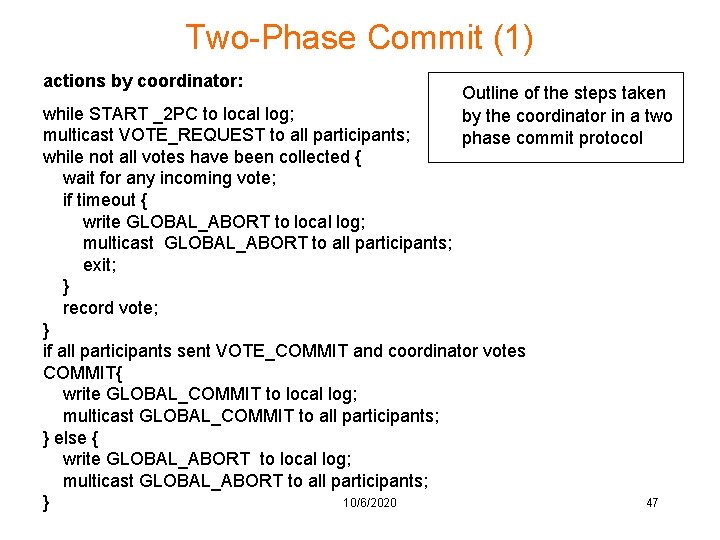
Two-Phase Commit (1) actions by coordinator: Outline of the steps taken by the coordinator in a two phase commit protocol while START _2 PC to local log; multicast VOTE_REQUEST to all participants; while not all votes have been collected { wait for any incoming vote; if timeout { write GLOBAL_ABORT to local log; multicast GLOBAL_ABORT to all participants; exit; } record vote; } if all participants sent VOTE_COMMIT and coordinator votes COMMIT{ write GLOBAL_COMMIT to local log; multicast GLOBAL_COMMIT to all participants; } else { write GLOBAL_ABORT to local log; multicast GLOBAL_ABORT to all participants; 10/6/2020 } 47
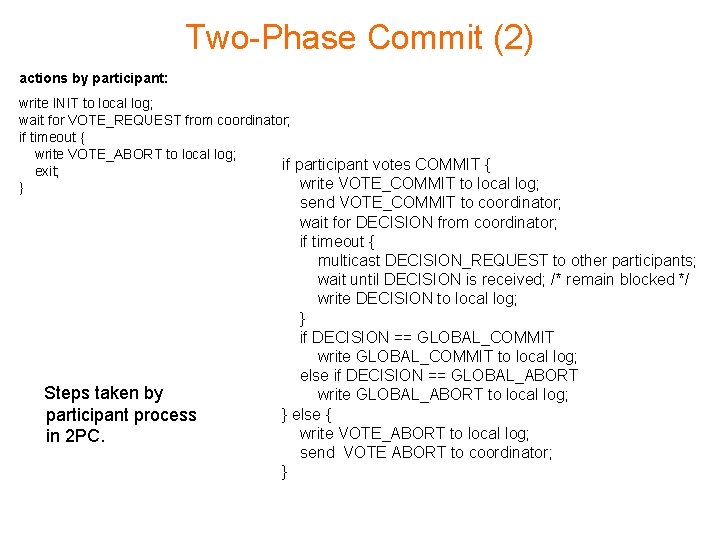
Two-Phase Commit (2) actions by participant: write INIT to local log; wait for VOTE_REQUEST from coordinator; if timeout { write VOTE_ABORT to local log; if participant votes COMMIT { exit; write VOTE_COMMIT to local log; } Steps taken by participant process in 2 PC. send VOTE_COMMIT to coordinator; wait for DECISION from coordinator; if timeout { multicast DECISION_REQUEST to other participants; wait until DECISION is received; /* remain blocked */ write DECISION to local log; } if DECISION == GLOBAL_COMMIT write GLOBAL_COMMIT to local log; else if DECISION == GLOBAL_ABORT write GLOBAL_ABORT to local log; } else { write VOTE_ABORT to local log; send VOTE ABORT to coordinator; }
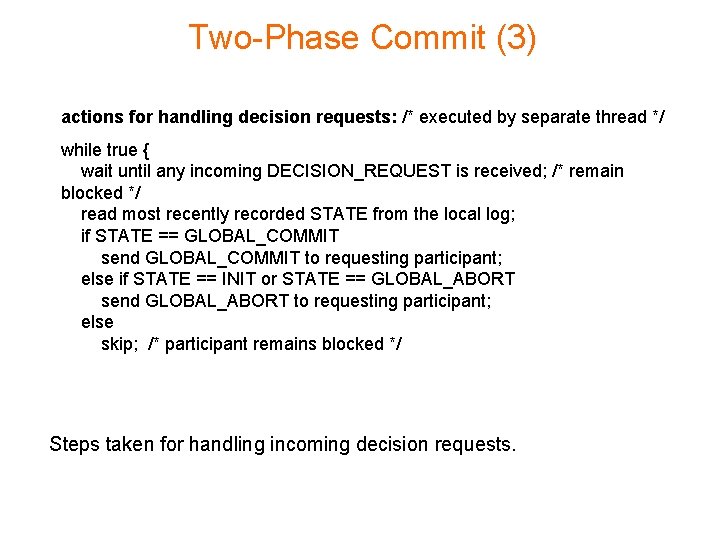
Two-Phase Commit (3) actions for handling decision requests: /* executed by separate thread */ while true { wait until any incoming DECISION_REQUEST is received; /* remain blocked */ read most recently recorded STATE from the local log; if STATE == GLOBAL_COMMIT send GLOBAL_COMMIT to requesting participant; else if STATE == INIT or STATE == GLOBAL_ABORT send GLOBAL_ABORT to requesting participant; else skip; /* participant remains blocked */ Steps taken for handling incoming decision requests.
Recovery • Fault tolerance: recovery from an error (erroneous state => error-free state) • Two approaches – backward recovery: back into a previous correct state – forward recovery: • detect that the new state is erroneous • bring the system in a correct new state challenge: the possible errors must be known in advance – forward: continuous need for redundancy • expensive when needed • recovery after a failure is not always possible backward:
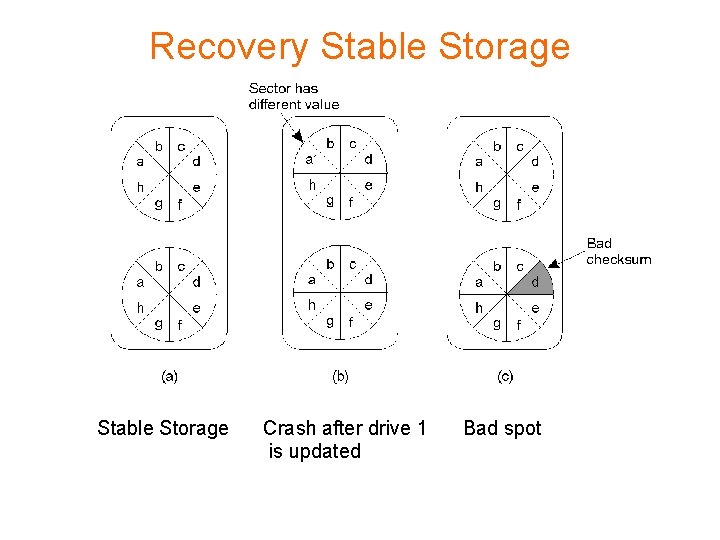
Recovery Stable Storage Crash after drive 1 is updated Bad spot
Implementing Stable Storage • Careful block operations (fault tolerance: transient faults) – careful_read: {get_block, check_parity, error=> N retries} – careful_write: {write_block, get_block, compare, error=> N retries} – irrecoverable failure => report to the “client” • Stable Storage operations (fault tolerance: data storage errors) – stable_get: {careful_read(replica_1), if failure then careful_read(replica_2)} – stable_put: {careful_write(replica_1), careful_write(replica_2)} – error/failure recovery: read both replicas and compare • both good and the same • both good and different • one good, one bad => ok => replace replica_2 with replica_1 => replace the bad block with the good block
Checkpointing Needed: a consistent global state to be used as a recovery line A recovery line: the most recent distributed snapshot
Independent Checkpointing Each process records its local state from time to time Þ difficult to find a recovery line If the most recently saved states do not form a recovery line Þ rollback to a previous saved state (threat: the domino effect). A solution: coordinated checkpointing
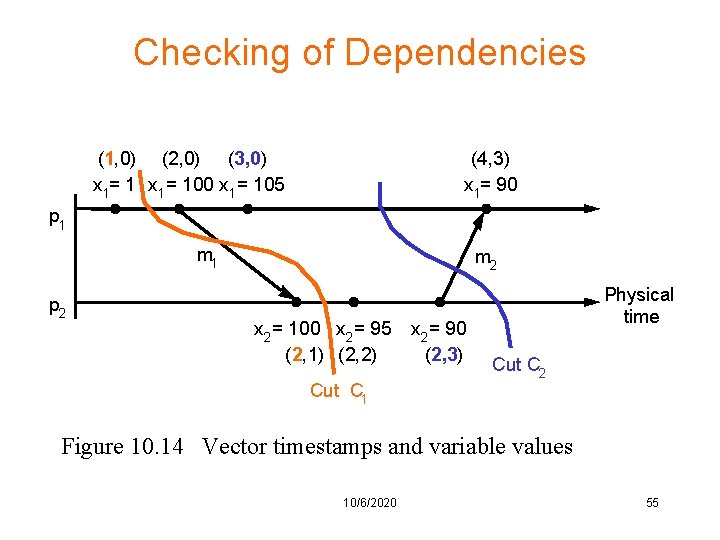
Checking of Dependencies (1, 0) (2, 0) (3, 0) x 1= 1 x 1 = 100 x 1 = 105 (4, 3) x 1= 90 p 1 m 1 p 2 m 2 x 2 = 100 x 2 = 95 (2, 1) (2, 2) Cut C 1 x 2 = 90 (2, 3) Physical time Cut C 2 Figure 10. 14 Vector timestamps and variable values 10/6/2020 55
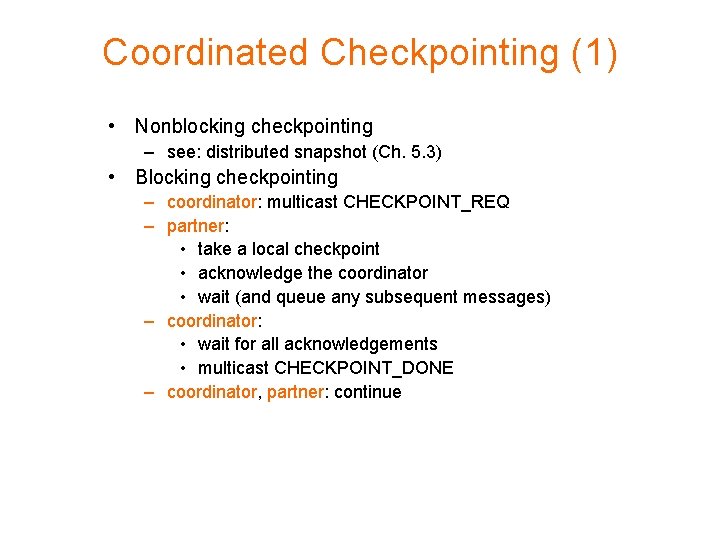
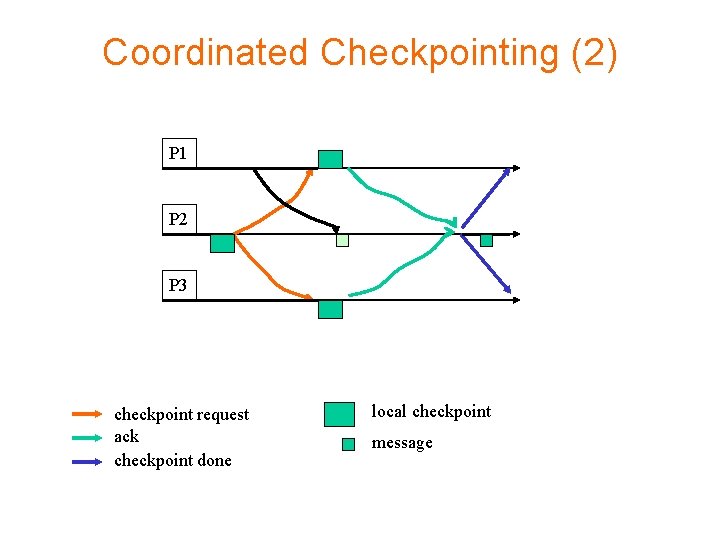
Coordinated Checkpointing (1) • Nonblocking checkpointing – see: distributed snapshot (Ch. 5. 3) • Blocking checkpointing – coordinator: multicast CHECKPOINT_REQ – partner: • take a local checkpoint • acknowledge the coordinator • wait (and queue any subsequent messages) – coordinator: • wait for all acknowledgements • multicast CHECKPOINT_DONE – coordinator, partner: continue
Coordinated Checkpointing (2) P 1 P 2 P 3 checkpoint request ack checkpoint done local checkpoint message
Message Logging Improving efficiency: checkpointing and message logging Recovery: most recent checkpoint + replay of messages Problem: Incorrect replay of messages after recovery may lead to orphan processes.