
Ch 6 ACIDS BASES n 6 1 Definitions
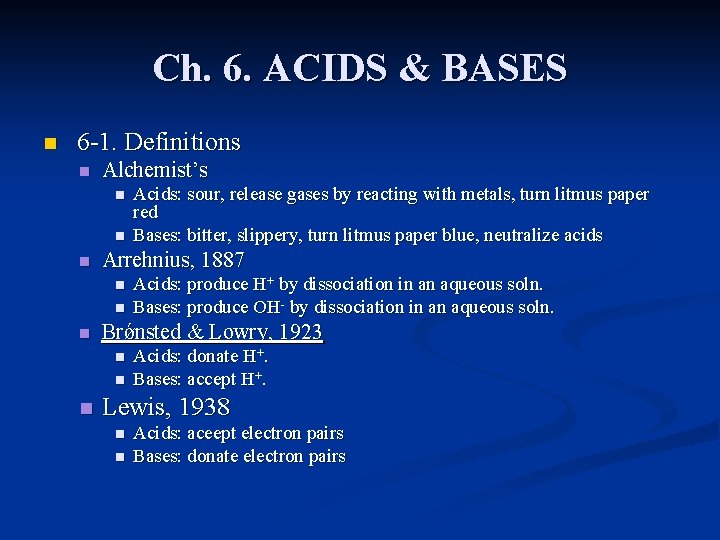
Ch. 6. ACIDS & BASES n 6 -1. Definitions n Alchemist’s n n n Arrehnius, 1887 n n n Acids: produce H+ by dissociation in an aqueous soln. Bases: produce OH- by dissociation in an aqueous soln. Brǿnsted & Lowry, 1923 n n n Acids: sour, release gases by reacting with metals, turn litmus paper red Bases: bitter, slippery, turn litmus paper blue, neutralize acids Acids: donate H+. Bases: accept H+. Lewis, 1938 n n Acids: aceept electron pairs Bases: donate electron pairs
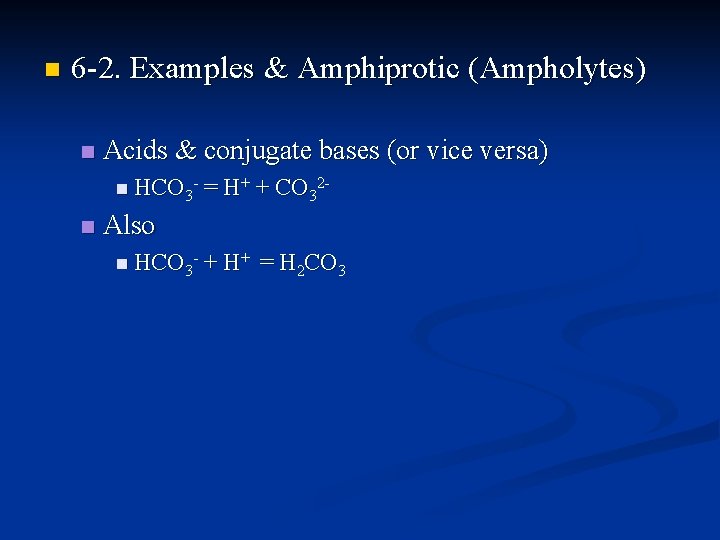
n 6 -2. Examples & Amphiprotic (Ampholytes) n Acids & conjugate bases (or vice versa) n HCO 3 - n = H+ + CO 32 - Also n HCO 3 - + H+ = H 2 CO 3
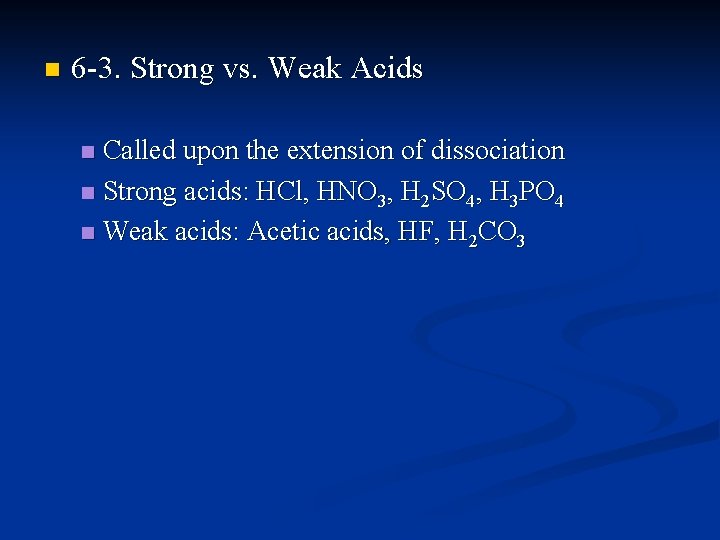
n 6 -3. Strong vs. Weak Acids Called upon the extension of dissociation n Strong acids: HCl, HNO 3, H 2 SO 4, H 3 PO 4 n Weak acids: Acetic acids, HF, H 2 CO 3 n

n 6 -4. Humic/Fulvic Acids n Non-humic substances Organic compounds having definite physical and chemical characteristics n Proteins, aldehydes, carbohydrates, amino acids n (easily) Biodegradable n n Humic substances: biologically refractive Acidic, dark colored, aromatic, MW 100 -more than a few 1, 000 n Fulvic acids: soluble in both acids and bases, lowest MW masterial in humic substances n Humic acids: soluble only in basic solutions n Humin: insoluble in either acidic or basic solutions n
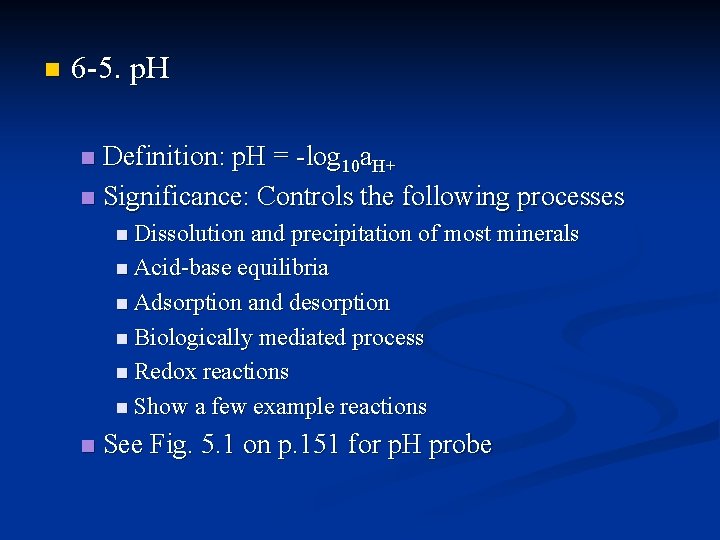
n 6 -5. p. H Definition: p. H = -log 10 a. H+ n Significance: Controls the following processes n n Dissolution and precipitation of most minerals n Acid-base equilibria n Adsorption and desorption n Biologically mediated process n Redox reactions n Show a few example reactions n See Fig. 5. 1 on p. 151 for p. H probe
n 6 -6. Carbonic Acids Carbon dioxide equilibria n Dissociation of carbonic acids n n See p. 153 -155, eqns (5. 12) –(5. 26) n Can you draw Fig. 5. 2 on p. 156 ?
n 6 -7. p. H of Water in Equil. w/ Various PCO 2 n Refer eqn. (5. 27) on p. 158. n Controls on PCO 2 n See Table 5. 3 on p. 157 n Respiration coefficient (RC) n RC=(CO 2 produced/O 2 consumed)
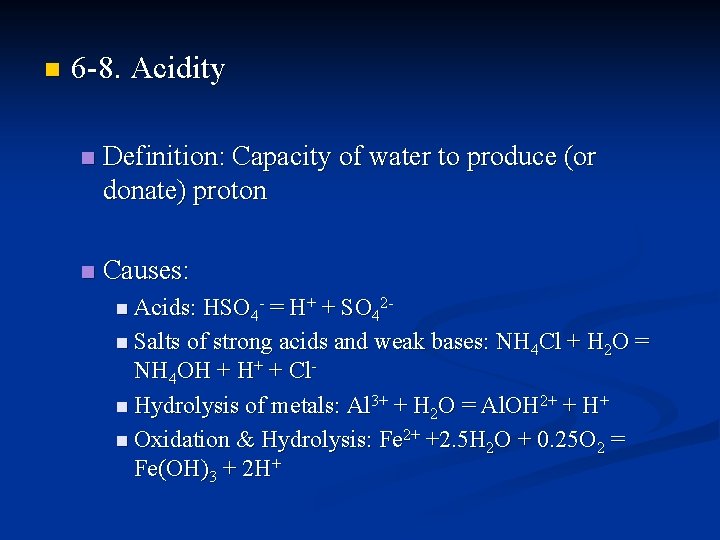
n 6 -8. Acidity n Definition: Capacity of water to produce (or donate) proton n Causes: n Acids: HSO 4 - = H+ + SO 42 n Salts of strong acids and weak bases: NH 4 Cl + H 2 O = NH 4 OH + H+ + Cln Hydrolysis of metals: Al 3+ + H 2 O = Al. OH 2+ + H+ n Oxidation & Hydrolysis: Fe 2+ +2. 5 H 2 O + 0. 25 O 2 = Fe(OH)3 + 2 H+
n Significance Attacking geological material n Increase solubilities of (hazardous) metals n Limit water resources usage n n Measurement Titration by 0. 02 N Na. OH (EPA) or 0. 0248 N Na. OH (USGS) n End points: p. H = 8. 3 n n Reports as mg/L H+ n meq/L H+ n mg/L Ca. CO 3 n mg/L H 2 SO 4 n
n 6 -9. Alkalinity n Definition: Capacity of water to consume (or accept) proton n Causes: n Cartbonate alkalinity = m. HCO 3 - + 2 m. CO 32 - n Caustic alkalinity = m. OHn Other alkalinities: NH 3, silicate, borate, etc. n Total alkalinity=sum of all threes above
n Significance n Indicate the tolerance (buffer capacity) of s system to the acid impact n Measurement n Titration by 0. 02 N HCl or H 2 SO 4 n End points: p. H = 4. 5 (actually it depends on CT) n Reports as n mg/L Ca. CO 3
n 6 -10. Buffer Capacity n Definition: Amount of base to change unit p. H n Causes: n Cartbonate alkalinity = m. HCO 3 - + 2 m. CO 32 - n Caustic alkalinity = m. OHn Other alkalinities: NH 3, silicate, borate, etc. n Total alkalinity=sum of all threes above
- Slides: 12