
CH 5 UNDERSTANDING STUDENTS WITH LEARNING DISABILITIES By
CH. 5: UNDERSTANDING STUDENTS WITH LEARNING DISABILITIES By: Jennifer Gardner and Casey Rendon http: //www. youtube. com/watch? v=az 0 M 0 DLCFw. U&feature=related
Defining Learning Disabilities Sam Kirk 1963 “Learning Disabilities” “IDEA defines as a “disorder in one or more of the basic psychological processes involved in understanding or in using language, spoken or written. ” “disorder may manifest itself in an imperfect ability to listen, think, speak, read, write, spell or do mathematical calculations. ”
Determine Specific Learning Disabilities Two Circumstance: The Inclusionary Standard: “First- Student must have a disorder in one or more of the basic psychological processes involved in understanding or in using language, spoken or written. ” It is also added that you could find these disorders through difficulty of the student to listen, think, speak, read, write, spell, or do math.
The Exclusionary Standard: “Second, however, the definition does not include “a learning problem that is primarily the result of visual, hearing, or motor disabilities of mental retardation, of emotional disturbance or of environment, cultural, or economic disadvantage” Both Inclusionary and exclusionary standards help and keep a students from being classified as having a specific learning disability.
Describing the Characteristics Students commonly have average or above average intelligence But perform at a low academic achievement in one or more areas 30% of students with learning disabilities also have been diagnosed with AD/HD
Academic Achievement “Reading difficulties is one of the most significant challenges facing students with learning disabilities. ” Reading is needed in almost all academic areas. Dyslexia- extreme difficulty in learning to read and commonly problems with spelling and writing. Dysgraphia- have a hard time remembering how to make certain alphabet or arithmetic symbols in handwriting, also may have difficulty with spelling Dyscalculia- Math difficulties Students with dyslexia commonly have difficulties with math
Memory Short-term – can not easily remember information shortly after they have received it Long-term- have a hard time retaining information for later
Metacognition How one thinks and monitors their thinking Have a hard time with: Knowing strategies When, where, and why Selecting and monitoring
Social, Emotional, and Behavioral Characteristics Risk of social, behavioral, and emotional problems ½ of a sample of more than 200 students with behavior disorders were found to also have a learning disability Likely to be rejected by their peers
Determining the Causes Central nervous system dysfunction Genetics Risks Reading impairment is 75% if both parents are affected and 51% if one parent is affected More than ½ reading impairments of identical twins have been found to be a result of heredity Learning disability has a recurrence rate of approx. 35 to 45% in susceptible families, indicating that a single gene may be involved Environmental Causes Connection with genetic and environmental causes Pollutants and teratogens
Evaluating Students with Learning Disabilities Raises the question: “just how imperfect does the students’ ability have to be? ” Discrepancy Standard Responsiveness to Intervention
Determining the Presence of a Learning Disability IQ tests and standardized achievement test (IQ) at or above 130 is gifted and at or below 70 are identified as having mental retardation with meeting other criteria Intelligence tests measure: Learning comprehension Reasoning Memory Ability to learn academic skills
IQ and WISC IV Discrepancies: Aptitude-achievement Intra-cognitive Intra-achievement Response to Intervention model Five steps Leaders believe that it provides a foundation for redefining learning disabilities and possibly a non-categorical approach to special education
Phonological Processing The ability to “understand use the sound system of our language to process written and oral information. ”
Assessments Should identify the current level of achievement in phonological awareness, phonological memory, rapid naming of letters, and oral vocab.
Comprehension Test of Phonological Processing Identifies: students whose level is significantly below their peers. Student’s strengths and weaknesses in the three areas of phonemics
Two versions: 1. children ages 5 -6 who are in the very beginning stages of reading 2. Children ages 7 -24 Both versions include core subtests of basic skills Scores Percentiles, standard scores, and grade equivalent scores. Given for each of 3 majors skills areas: awareness, memory, & rapid letter naming.
Designing IEPs Teachers should collaborate in the development of an Individualized Education Program. Actively involving students with disabilities is an important aspect of the process
Active involvement can take many forms: Self Directed IEP: Students learn how to do their own IEP Self Advocacy Strategy: A step by step process to lead their own IEP Setting goals & solving problems related to own education A Self-determined Learning Model of Instruction (ch. 9)
When students are present considerable benefits such as an increase in parent involvement and an increase in the probability that the student’s strengths, needs, & interests will be discussed.
Embedded Learning Opportunities No substitute for early intervention Teachers identify opportunities that are most salient to the individualized learning objectives for each child. Embed short systemic instructional interactions into existing routines and activities, that will support the child’s goals.
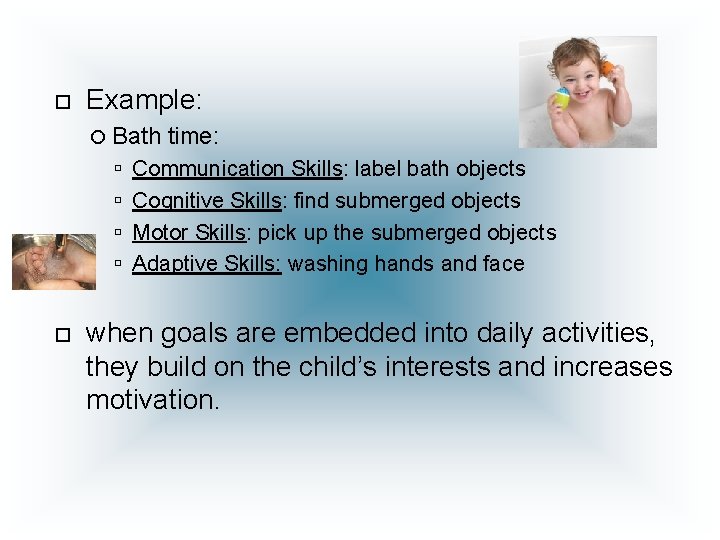
Example: Bath time: Communication Skills: label bath objects Cognitive Skills: find submerged objects Motor Skills: pick up the submerged objects Adaptive Skills: washing hands and face when goals are embedded into daily activities, they build on the child’s interests and increases motivation.
Teachers need to pair learning opportunities with instruction that lets children know what they need to do, how a correct response looks and feels, what the correct response is, as well as reassurance that a response will result in a positive outcome.
Differentiated Instruction http: //www. youtube. com/watch? v=THQRIs 3_H Mk&feature=related To make something different by altering or modifying it.
Teachers use more than one instructional strategy to: Increase students access to instructional materials in a variety of formats Expanding test taking and data collecting options Vary the nature and complexity of presented context
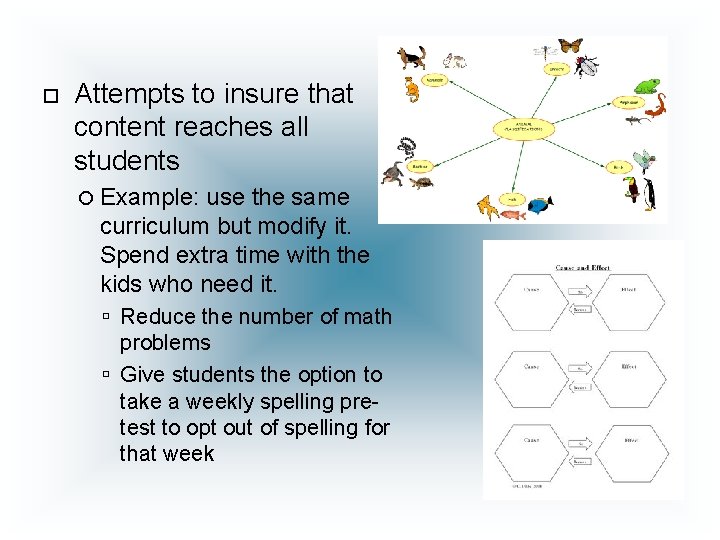
Attempts to insure that content reaches all students Example: use the same curriculum but modify it. Spend extra time with the kids who need it. Reduce the number of math problems Give students the option to take a weekly spelling pretest to opt out of spelling for that week
Learning Strategies Helps students with LDs to learn independently and to generalize, or to transfer their skills and behaviors to new situations. Effective for: test taking, paragraph writing, and lecture comprehension
Three steps when using a learning strategy: Assess how well a student can perform a skill. 2. Point out the benefit of using a learning strategy 1. Example: student will ultimately discover how to learn on his/her own and succeed in and out of school 3. Explain specifically what a student will be able to accomplish when (s)he has learned the skill.
Acquiring the information: Self questioning strategy: Students create questions, predict answers to the questions, and search for the answers while reading a passage Advantageous for 4 reasons: 1. Students actively interact with the material 2. Helps divide passage into small manageable units so students can acquire information more easily 3. Promotes intrinsic motivation for learning by having students identify their own reasons for reading the passage. 4. Students verbalize the information that they learn, enhancing understanding and later recall of information.
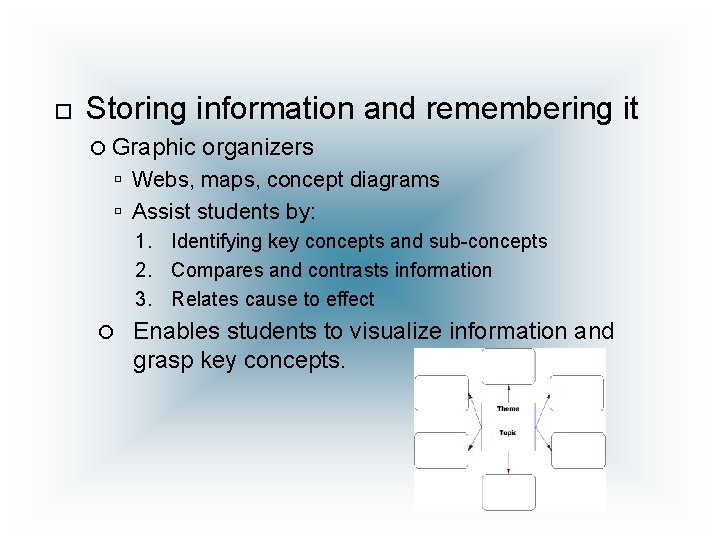
Storing information and remembering it Graphic organizers Webs, maps, concept diagrams Assist students by: 1. Identifying key concepts and sub-concepts 2. Compares and contrasts information 3. Relates cause to effect Enables students to visualize information and grasp key concepts.
Assessing Student Progress Curriculum Based Measurement: Direct assessment of a student’s skills in the content of the curriculum being taught. Brief timed samples or probes made up of academic material taken from curriculum. Scores for speed, fluency, and accuracy of performance Quick to give Easy to score Can be given repeatedly
Types of probes: Reading probes Maze task: students read a passage with words deleted and selects the proper words to input. Students read a passage out loud for a specified duration and the teacher counts the number of words read. Oral reading fluency
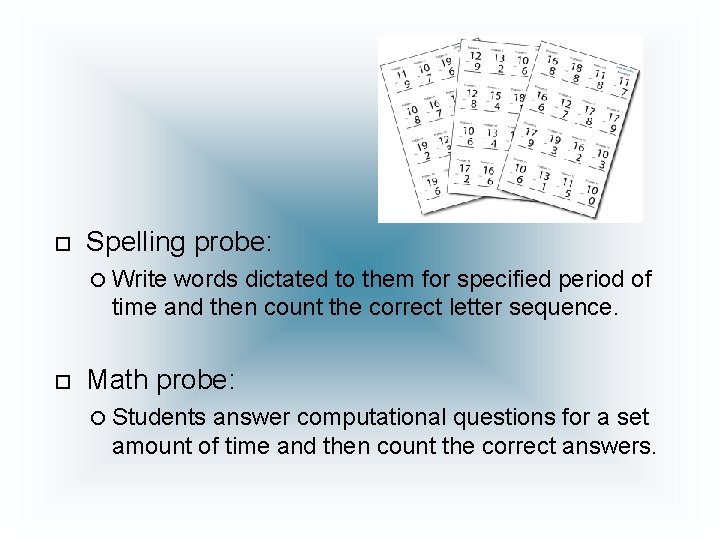
Spelling probe: Write words dictated to them for specified period of time and then count the correct letter sequence. Math probe: Students answer computational questions for a set amount of time and then count the correct answers.
Accommodations Test accommodations are extremely controversial for LDs! Students with more than one disability may need a wide range of accommodations to be able to perform according to their highest level on Standardized test. Ex: providing a math question reader for math test Extending the amount of time to take the test.
Food For Thought “Students with learning disabilities have the highest rates of inclusion in general education classes when compared to students with other disabilities. ” As a teacher, how can you help the students with LDs be as successful as possible?
- Slides: 35