
Ch 5 Oxidation and Reduction Milbank High School
Ch. 5 Oxidation and Reduction Milbank High School
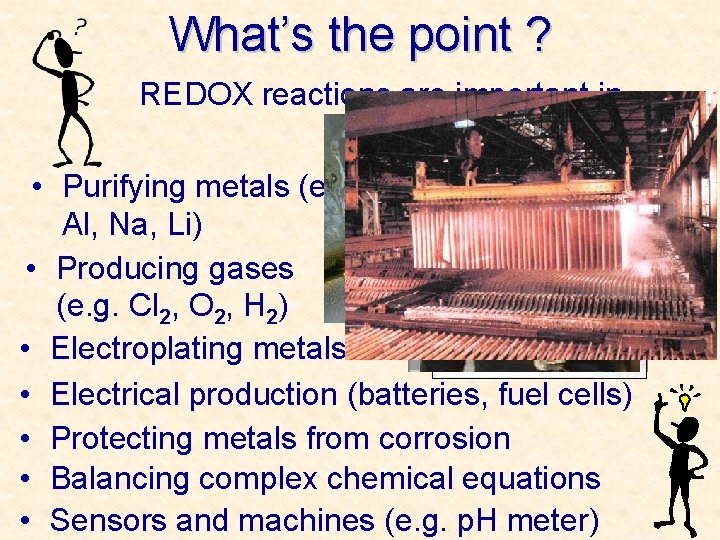
What’s the point ? REDOX reactions are important in … C 3 H 8 O + Cr. O 3 + H 2 SO 4 Cr 2(SO 4)3 + C 3 H 6 O + H 2 O • Purifying metals (e. g. Al, Na, Li) • Producing gases (e. g. Cl 2, O 2, H 2) • Electroplating metals • Electrical production (batteries, fuel cells) • Protecting metals from corrosion • Balancing complex chemical equations • Sensors and machines (e. g. p. H meter)
Overview • Oxidation and reduction reactions always occur together (redox reactions) • You can’t have one without the other • Includes: extracting metal from an ore • Salt on roads – Salt accelerates the reaction between oxygen and metal – Makes electron transfer easier
Oxidation Numbers • A count of the electrons transferred or shared in the formation or breaking of chemical bonds • You must assign each element in the reaction an oxidation number
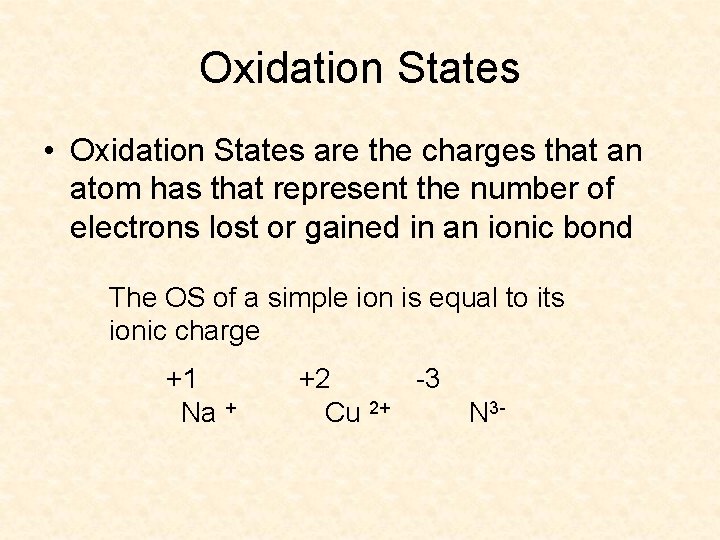
Oxidation States • Oxidation States are the charges that an atom has that represent the number of electrons lost or gained in an ionic bond The OS of a simple ion is equal to its ionic charge +1 Na + +2 -3 Cu 2+ N 3 -
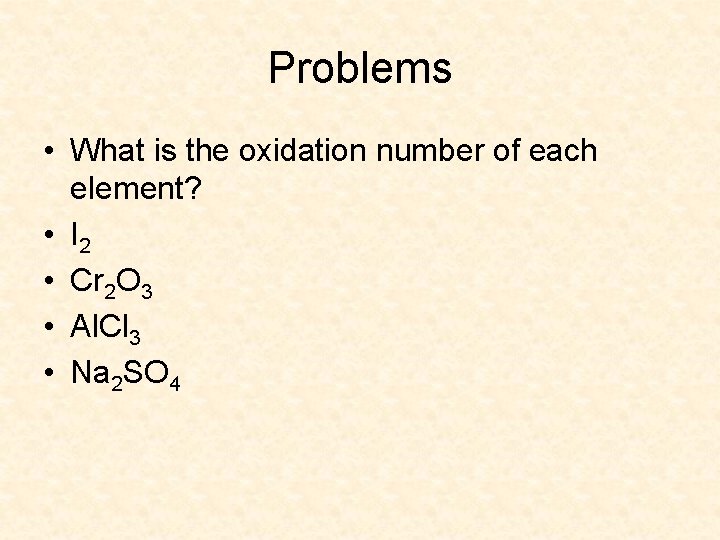
Problems • What is the oxidation number of each element? • I 2 • Cr 2 O 3 • Al. Cl 3 • Na 2 SO 4
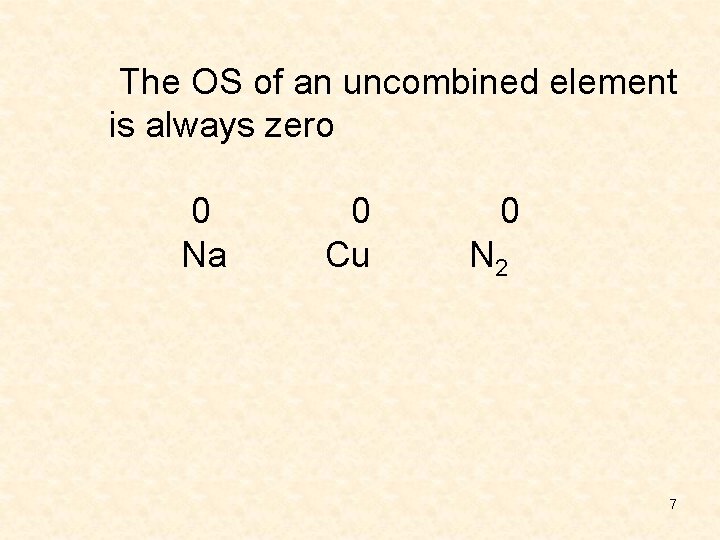
The OS of an uncombined element is always zero 0 Na 0 Cu 0 N 2 7
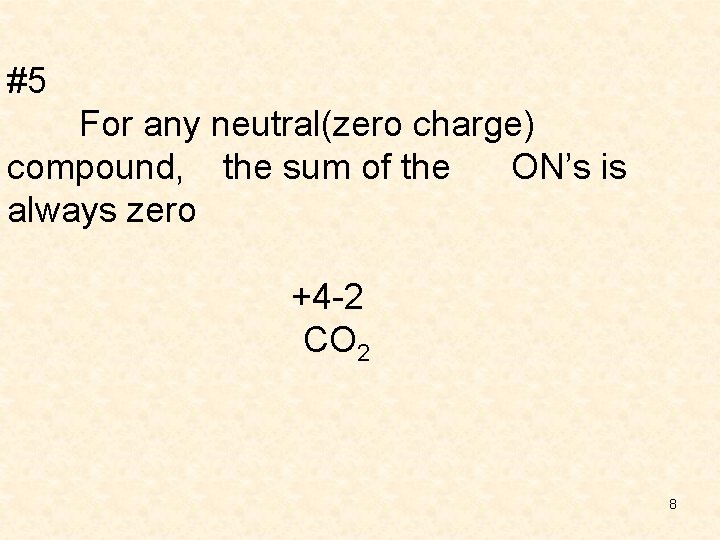
#5 For any neutral(zero charge) compound, the sum of the ON’s is always zero +4 -2 CO 2 8
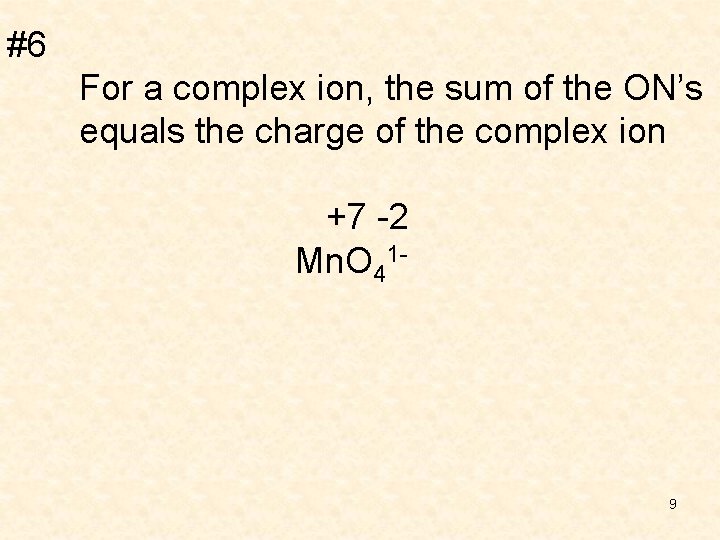
#6 For a complex ion, the sum of the ON’s equals the charge of the complex ion +7 -2 Mn. O 41 - 9
looking at oxidation and reduction Oxidation is a loss of electrons, reduction is a gain of electrons
Leo the Lion! • LEO the lion says GER – Loss of electrons is oxidation, gain of electrons is reduction
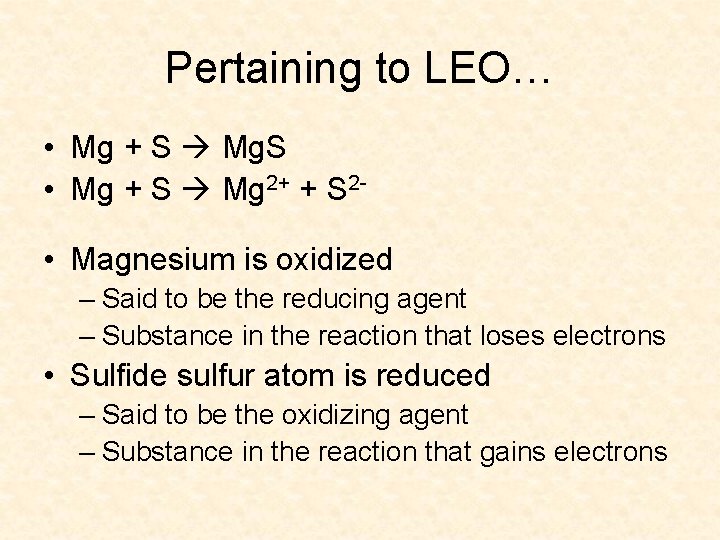
Pertaining to LEO… • Mg + S Mg. S • Mg + S Mg 2+ + S 2 • Magnesium is oxidized – Said to be the reducing agent – Substance in the reaction that loses electrons • Sulfide sulfur atom is reduced – Said to be the oxidizing agent – Substance in the reaction that gains electrons
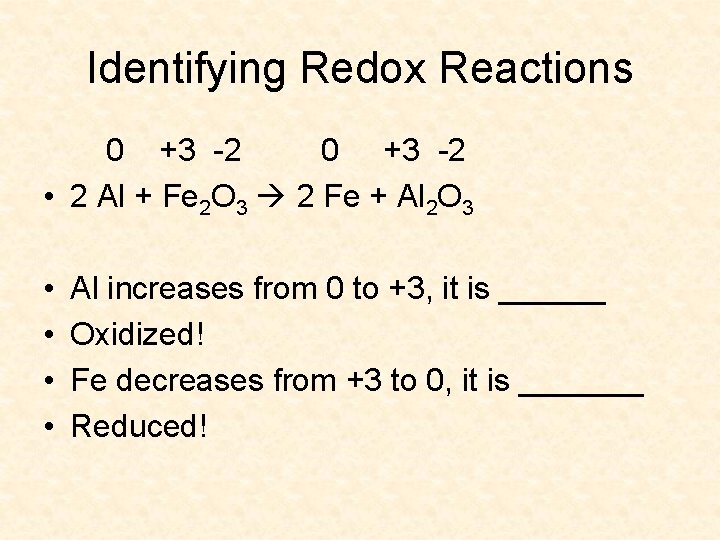
Identifying Redox Reactions 0 +3 -2 • 2 Al + Fe 2 O 3 2 Fe + Al 2 O 3 • • Al increases from 0 to +3, it is ______ Oxidized! Fe decreases from +3 to 0, it is _______ Reduced!
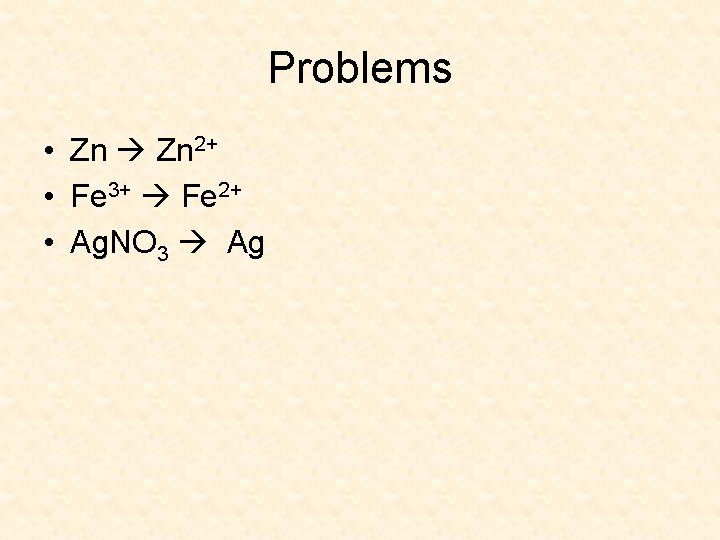
Problems • Zn 2+ • Fe 3+ Fe 2+ • Ag. NO 3 Ag
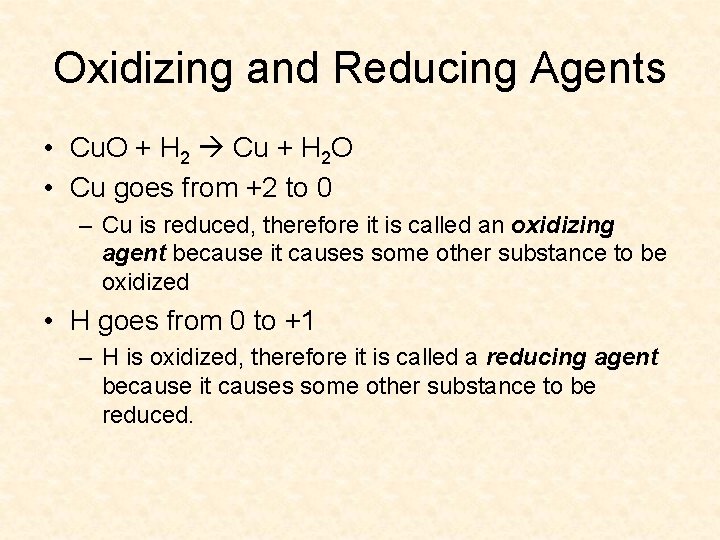
Oxidizing and Reducing Agents • Cu. O + H 2 Cu + H 2 O • Cu goes from +2 to 0 – Cu is reduced, therefore it is called an oxidizing agent because it causes some other substance to be oxidized • H goes from 0 to +1 – H is oxidized, therefore it is called a reducing agent because it causes some other substance to be reduced.

Identifying Agents in an Equation Reduction: Cu. O is the oxidizing agent • Cu. O + H 2 Cu + H 2 O Oxidation: H 2 is the reducing agent

+2 = LEO OA +2 -1 Sn. Cl 2 +4 -1 + +4 -1 Pb. Cl 4 +2 -1 Sn. Cl 4 + Pb. Cl 2 RA -2 = GER -3 = GER RA +2 -2 +1 Cu. S + H+ +5 -2 + NO 3 - +2 Cu+2 +2 -2 0 + S + +1 -2 NO + H 2 O OA +2 = LEO 17
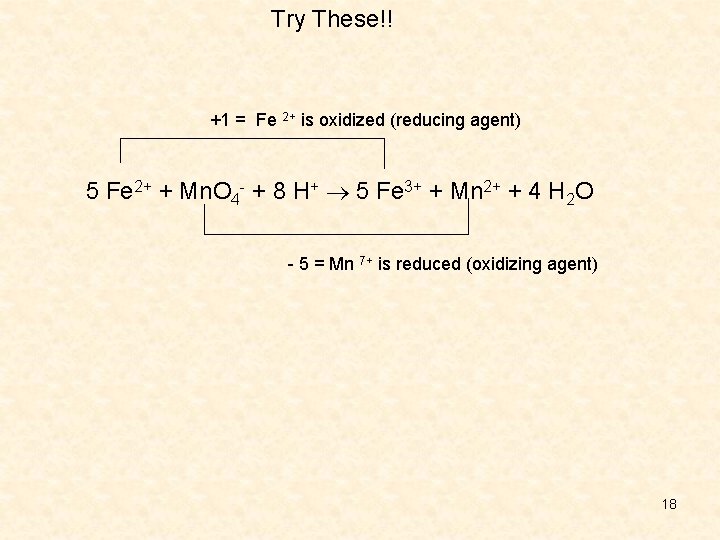
Try These!! +1 = Fe 2+ is oxidized (reducing agent) 5 Fe 2+ + Mn. O 4 - + 8 H+ ® 5 Fe 3+ + Mn 2+ + 4 H 2 O - 5 = Mn 7+ is reduced (oxidizing agent) 18
Some common oxidizing agents • Oxygen! – – Oxidized coal in electric power Gas in automobiles Wood in campfires Food we eat • Antiseptics – Hydrogen Peroxide – Benzoyl peroxide • Disinfectants – Chlorine
Some common reducing agents • Metals • Antioxidants – Ascorbic acid is used to prevent the browning of fruits by inhibiting air oxidation – Many antioxidants are believed to retard various oxidation reactions that are potentially damaging to vital components of living cells
- Slides: 20