
Ch 5 Newtons Laws of Motion DYNAMICS Concept
- Slides: 10
Ch. 5: Newton’s Laws of Motion DYNAMICS
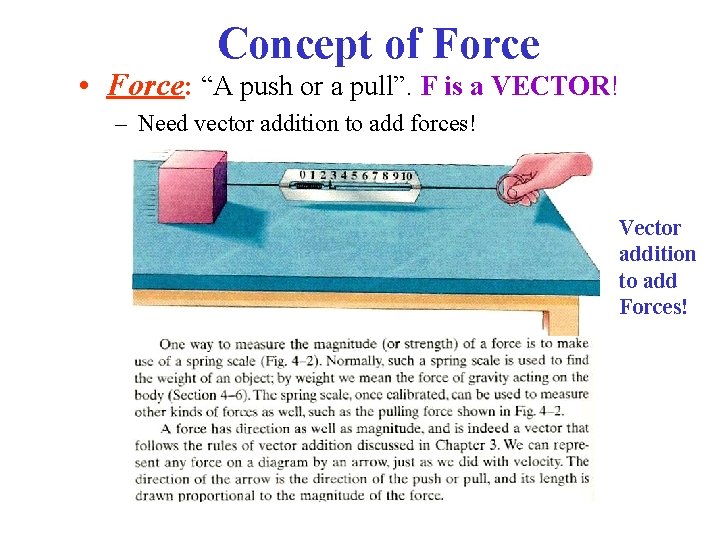
Concept of Force • Force: “A push or a pull”. F is a VECTOR! – Need vector addition to add forces! Vector addition to add Forces!
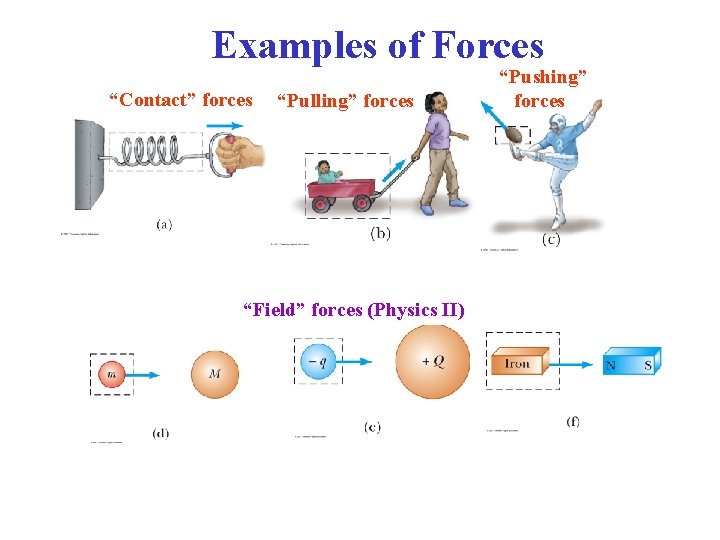
Examples of Forces “Contact” forces “Pulling” forces “Field” forces (Physics II) “Pushing” forces
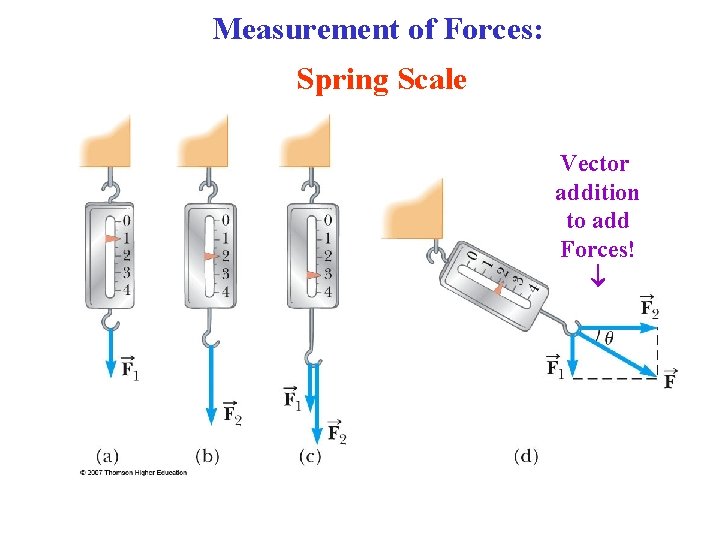
Measurement of Forces: Spring Scale Vector addition to add Forces!
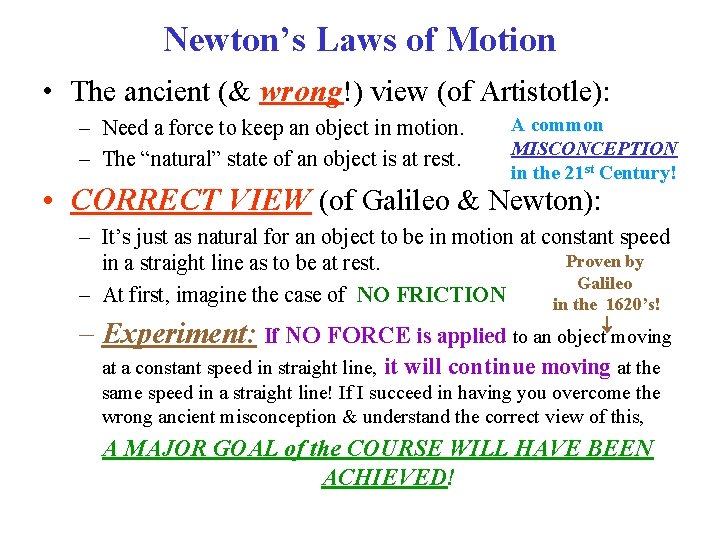
Newton’s Laws of Motion • The ancient (& wrong!) view (of Artistotle): – Need a force to keep an object in motion. – The “natural” state of an object is at rest. A common MISCONCEPTION in the 21 st Century! • CORRECT VIEW (of Galileo & Newton): – It’s just as natural for an object to be in motion at constant speed Proven by in a straight line as to be at rest. Galileo – At first, imagine the case of NO FRICTION in the 1620’s! – Experiment: If NO FORCE is applied to an object moving at a constant speed in straight line, it will continue moving at the same speed in a straight line! If I succeed in having you overcome the wrong ancient misconception & understand the correct view of this, A MAJOR GOAL of the COURSE WILL HAVE BEEN ACHIEVED!
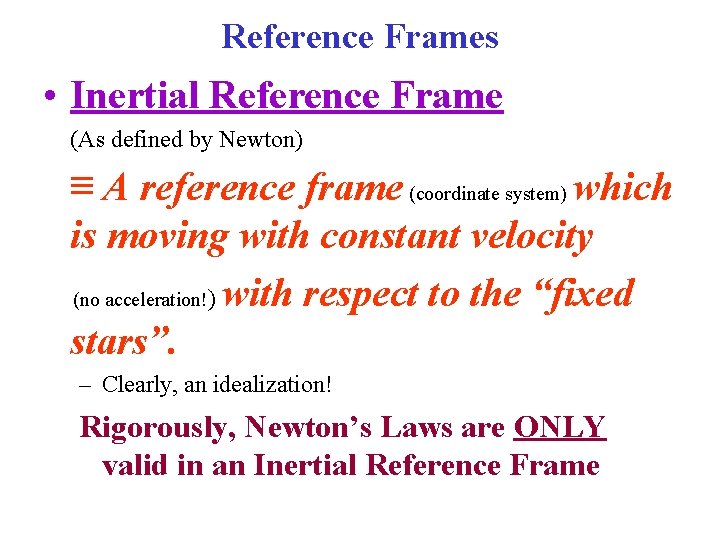
Reference Frames • Inertial Reference Frame (As defined by Newton) ≡ A reference frame (coordinate system) which is moving with constant velocity (no acceleration!) with respect to the “fixed stars”. – Clearly, an idealization! Rigorously, Newton’s Laws are ONLY valid in an Inertial Reference Frame
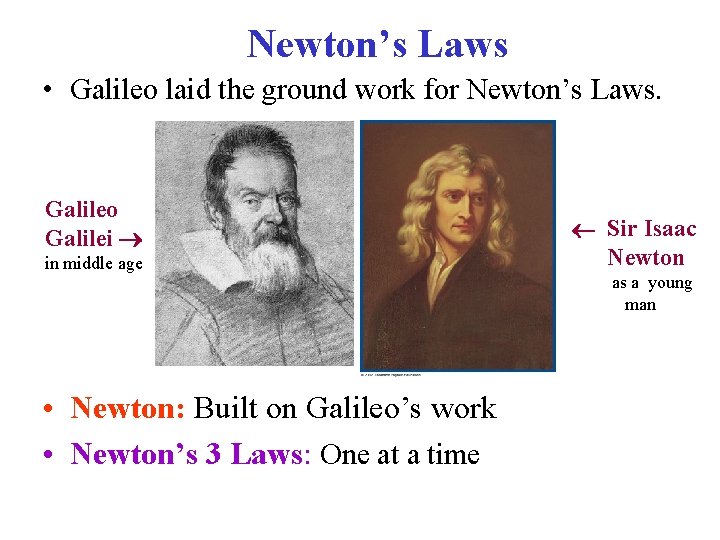
Newton’s Laws • Galileo laid the ground work for Newton’s Laws. Galileo Galilei in middle age • Newton: Built on Galileo’s work • Newton’s 3 Laws: One at a time Sir Isaac Newton as a young man
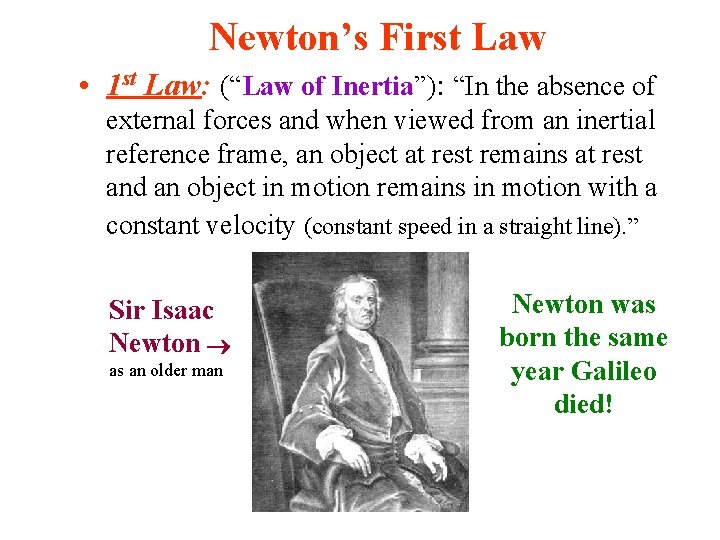
Newton’s First Law • 1 st Law: (“Law of Inertia”): “In the absence of external forces and when viewed from an inertial reference frame, an object at rest remains at rest and an object in motion remains in motion with a constant velocity (constant speed in a straight line). ” Sir Isaac Newton as an older man Newton was born the same year Galileo died!
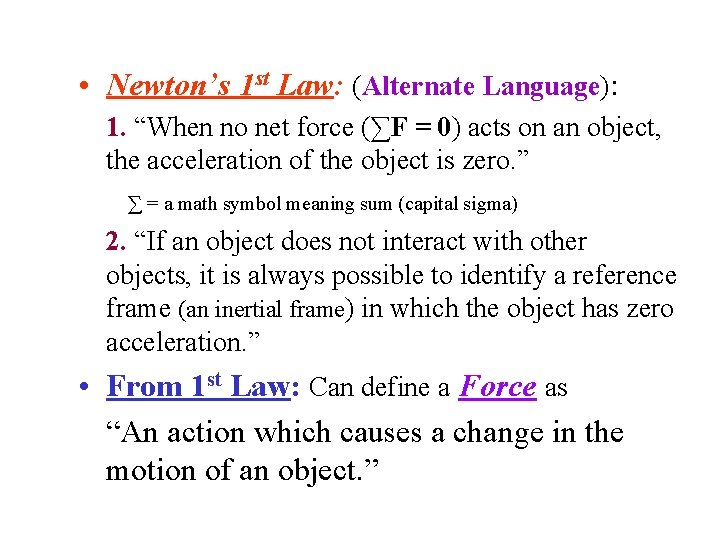
• Newton’s 1 st Law: (Alternate Language): 1. “When no net force (∑F = 0) acts on an object, the acceleration of the object is zero. ” ∑ = a math symbol meaning sum (capital sigma) 2. “If an object does not interact with other objects, it is always possible to identify a reference frame (an inertial frame) in which the object has zero acceleration. ” • From 1 st Law: Can define a Force as “An action which causes a change in the motion of an object. ”
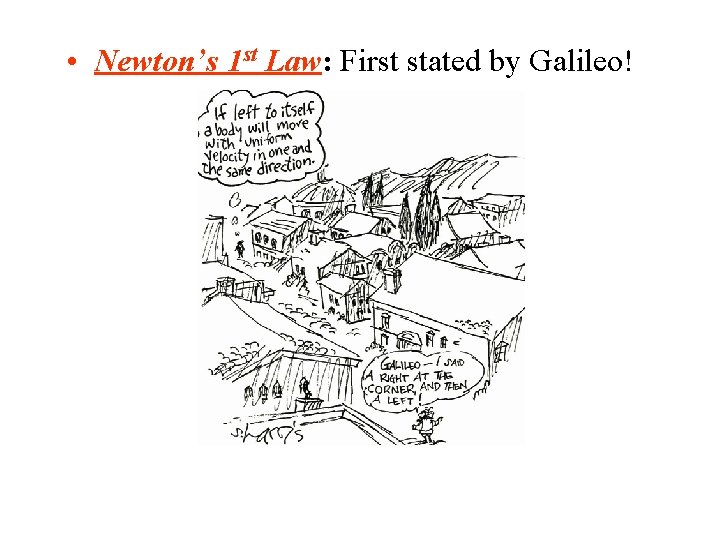
• Newton’s 1 st Law: First stated by Galileo!