
Ch 5 Intel 8086 study details from Yu
- Slides: 25
Ch. 5 – Intel 8086 – study details from Yu & Marut
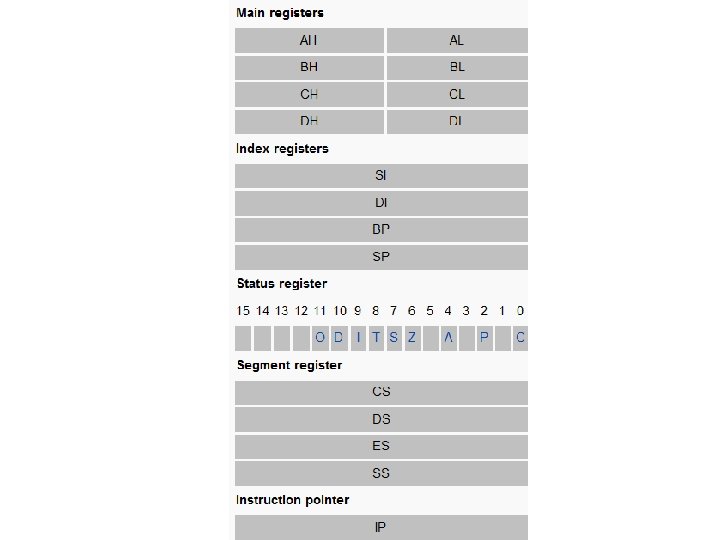
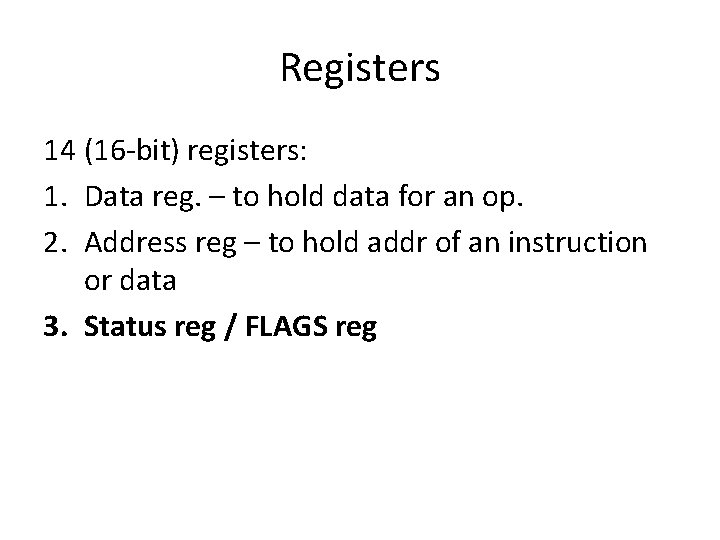
Registers 14 (16 -bit) registers: 1. Data reg. – to hold data for an op. 2. Address reg – to hold addr of an instruction or data 3. Status reg / FLAGS reg
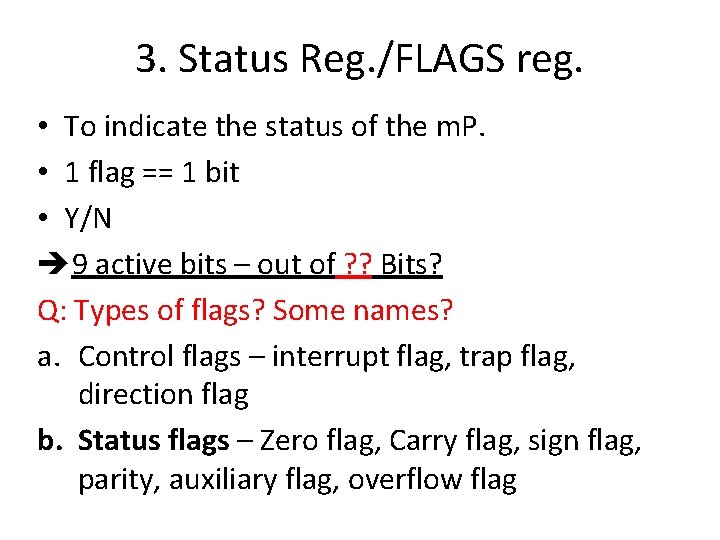
3. Status Reg. /FLAGS reg. • To indicate the status of the m. P. • 1 flag == 1 bit • Y/N 9 active bits – out of ? ? Bits? Q: Types of flags? Some names? a. Control flags – interrupt flag, trap flag, direction flag b. Status flags – Zero flag, Carry flag, sign flag, parity, auxiliary flag, overflow flag
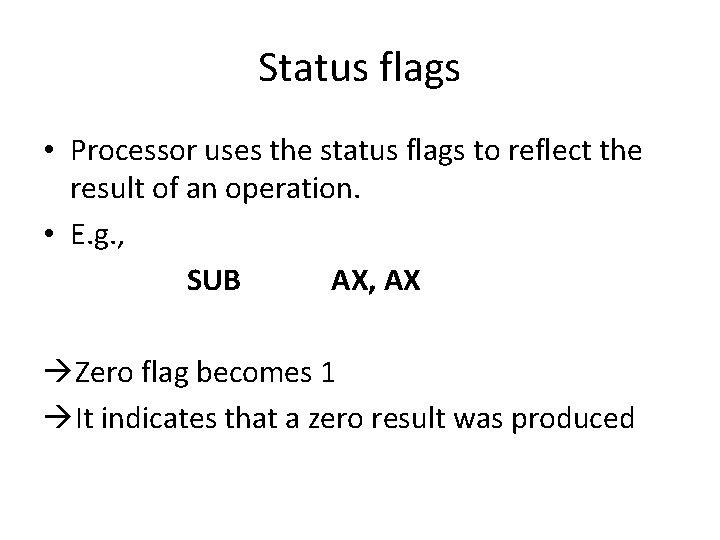
Status flags • Processor uses the status flags to reflect the result of an operation. • E. g. , SUB AX, AX Zero flag becomes 1 It indicates that a zero result was produced
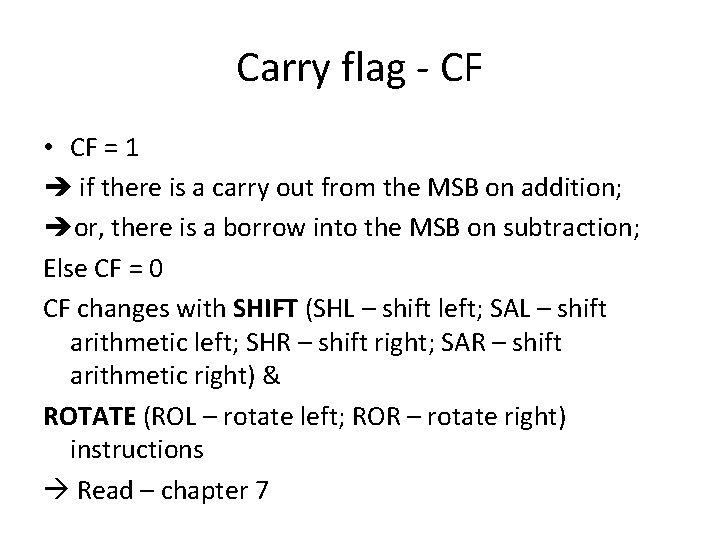
Carry flag - CF • CF = 1 if there is a carry out from the MSB on addition; or, there is a borrow into the MSB on subtraction; Else CF = 0 CF changes with SHIFT (SHL – shift left; SAL – shift arithmetic left; SHR – shift right; SAR – shift arithmetic right) & ROTATE (ROL – rotate left; ROR – rotate right) instructions Read – chapter 7
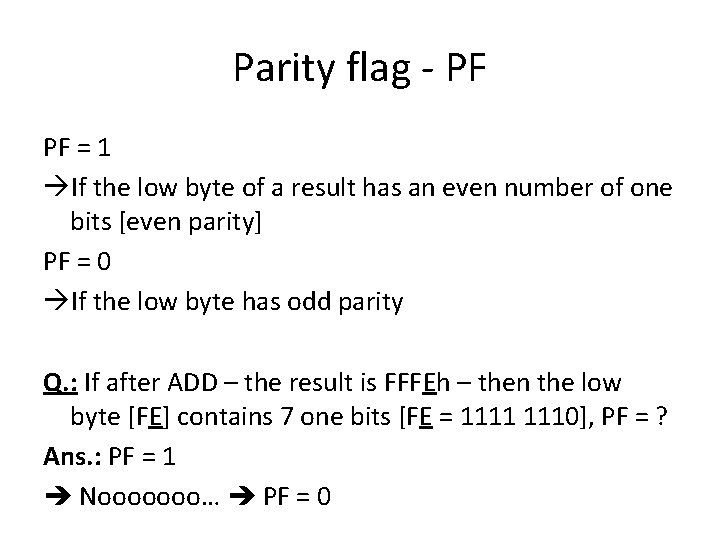
Parity flag - PF PF = 1 If the low byte of a result has an even number of one bits [even parity] PF = 0 If the low byte has odd parity Q. : If after ADD – the result is FFFEh – then the low byte [FE] contains 7 one bits [FE = 1111 1110], PF = ? Ans. : PF = 1 Nooooooo… PF = 0
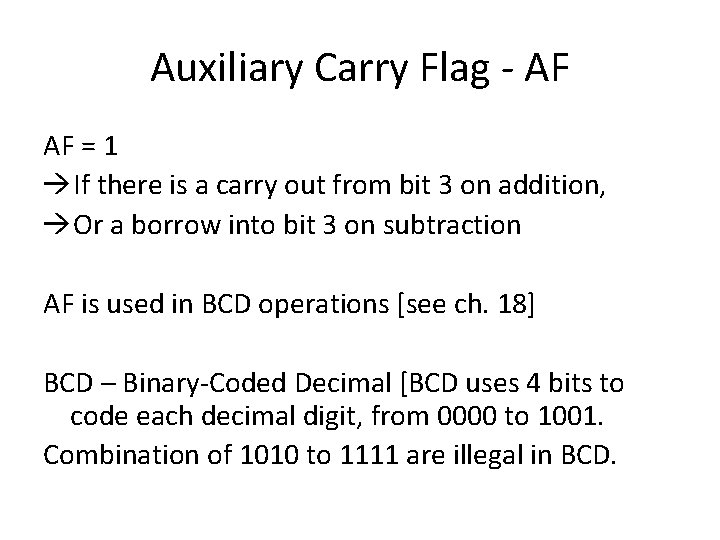
Auxiliary Carry Flag - AF AF = 1 If there is a carry out from bit 3 on addition, Or a borrow into bit 3 on subtraction AF is used in BCD operations [see ch. 18] BCD – Binary-Coded Decimal [BCD uses 4 bits to code each decimal digit, from 0000 to 1001. Combination of 1010 to 1111 are illegal in BCD.
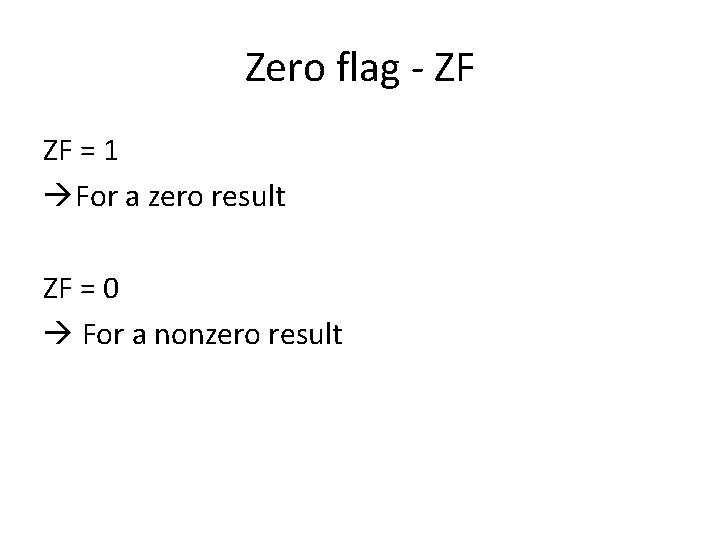
Zero flag - ZF ZF = 1 For a zero result ZF = 0 For a nonzero result
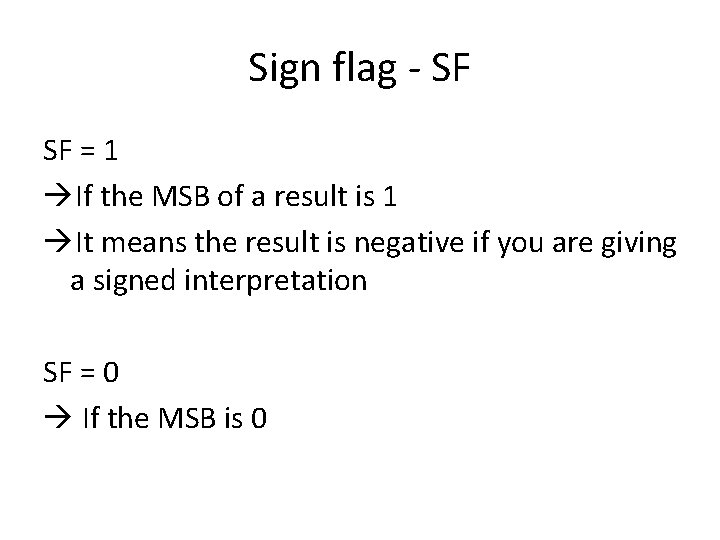
Sign flag - SF SF = 1 If the MSB of a result is 1 It means the result is negative if you are giving a signed interpretation SF = 0 If the MSB is 0
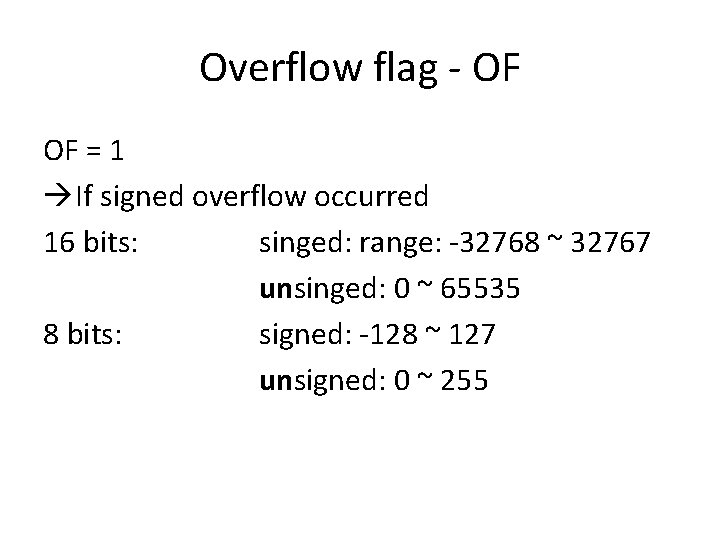
Overflow flag - OF OF = 1 If signed overflow occurred 16 bits: singed: range: -32768 ~ 32767 unsinged: 0 ~ 65535 8 bits: signed: -128 ~ 127 unsigned: 0 ~ 255
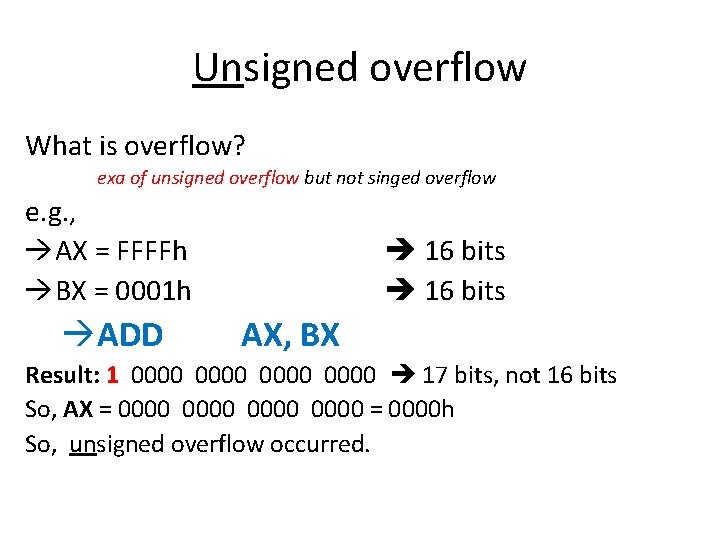
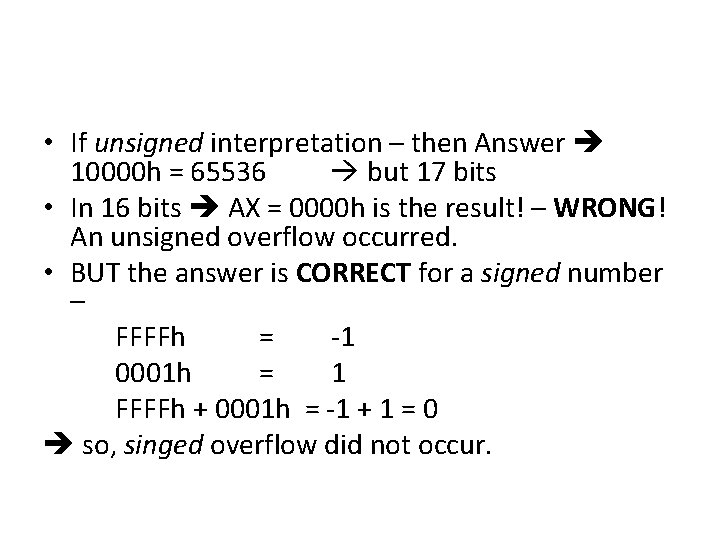
Unsigned overflow What is overflow? exa of unsigned overflow but not singed overflow e. g. , AX = FFFFh BX = 0001 h ADD 16 bits AX, BX Result: 1 0000 17 bits, not 16 bits So, AX = 0000 = 0000 h So, unsigned overflow occurred.
• If unsigned interpretation – then Answer 10000 h = 65536 but 17 bits • In 16 bits AX = 0000 h is the result! – WRONG! An unsigned overflow occurred. • BUT the answer is CORRECT for a signed number – FFFFh = -1 0001 h = 1 FFFFh + 0001 h = -1 + 1 = 0 so, singed overflow did not occur.
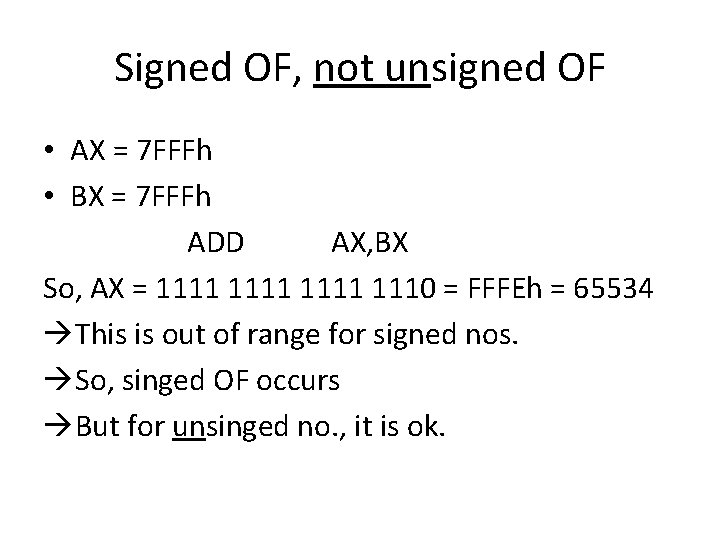
Signed OF, not unsigned OF • AX = 7 FFFh • BX = 7 FFFh ADD AX, BX So, AX = 1111 1110 = FFFEh = 65534 This is out of range for signed nos. So, singed OF occurs But for unsinged no. , it is ok.
Q. Questions are then – 1. How does the CPU indicate overflow? 2. How does it know that overflow occurred?
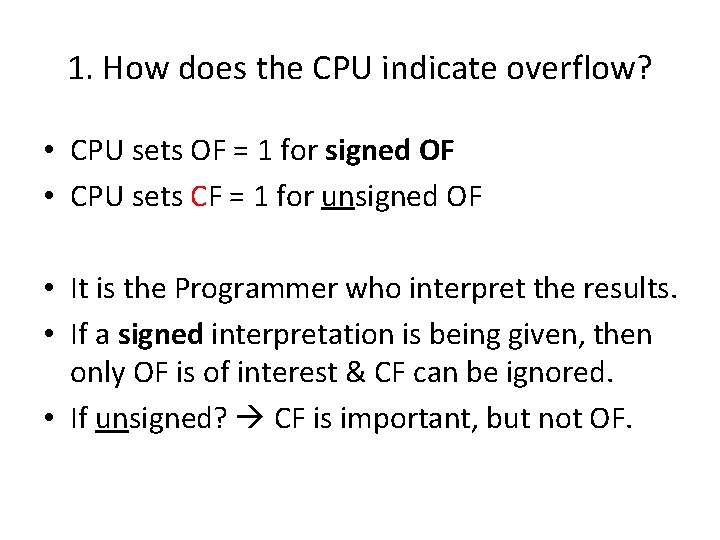
1. How does the CPU indicate overflow? • CPU sets OF = 1 for signed OF • CPU sets CF = 1 for unsigned OF • It is the Programmer who interpret the results. • If a signed interpretation is being given, then only OF is of interest & CF can be ignored. • If unsigned? CF is important, but not OF.
2. How CPU knows that overflow occurred? • Many instructions can cause overflow, e. g. , ADD, SUB
For unsigned overflow • ADD: unsigned overflow occurs when there is a carry out of the MSB. [i. e. , if result is larger than the capacity]. • SUB: … when there is a borrow into the MSB. [i. e. , the correct answer is smaller than 0]
For signed overflow • ADD: On addition of nos. with the same sign, signed overflow occurs when the sum has a different sign. • E. g. , 7 fffh + 7 fffh = fffeh = 1111…… 0 It is a negative result.
For signed overflow… • SUB: Subtraction of 2 nos. of different signs – means adding nos. of same sign. • E. g. , A – (-B) = A + B. -A – (+B) = -A + -B • Signed overflow occurs if the result has a different sign than expected. exa. 5. 3. • But, if ADD of nos. of different signs – overflow is impossible. • A + (-B) = A – B Result is smaller than A or B. No chance for overflow. • Likewise, SUB of nos. of same signs no overflow
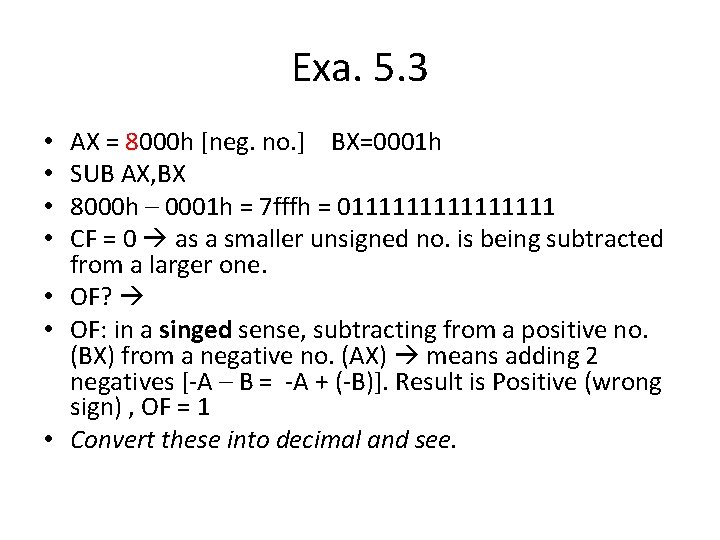
Exa. 5. 3 AX = 8000 h [neg. no. ] BX=0001 h SUB AX, BX 8000 h – 0001 h = 7 fffh = 011111111 CF = 0 as a smaller unsigned no. is being subtracted from a larger one. • OF? • OF: in a singed sense, subtracting from a positive no. (BX) from a negative no. (AX) means adding 2 negatives [-A – B = -A + (-B)]. Result is Positive (wrong sign) , OF = 1 • Convert these into decimal and see. • •
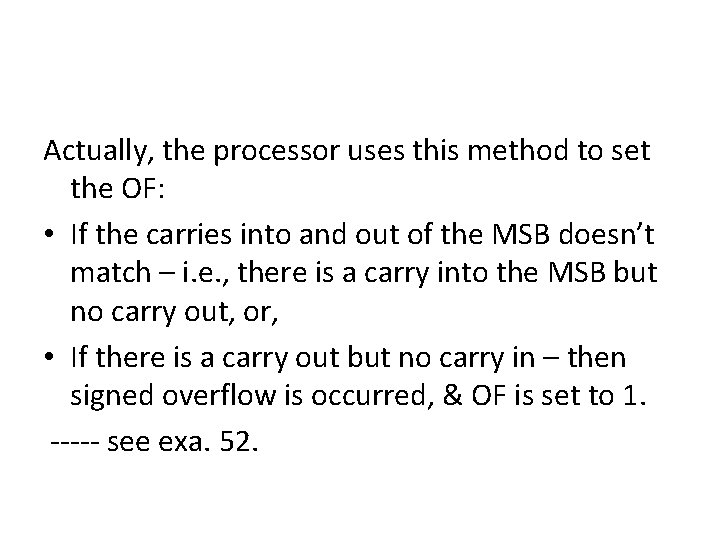
Actually, the processor uses this method to set the OF: • If the carries into and out of the MSB doesn’t match – i. e. , there is a carry into the MSB but no carry out, or, • If there is a carry out but no carry in – then signed overflow is occurred, & OF is set to 1. ----- see exa. 52.
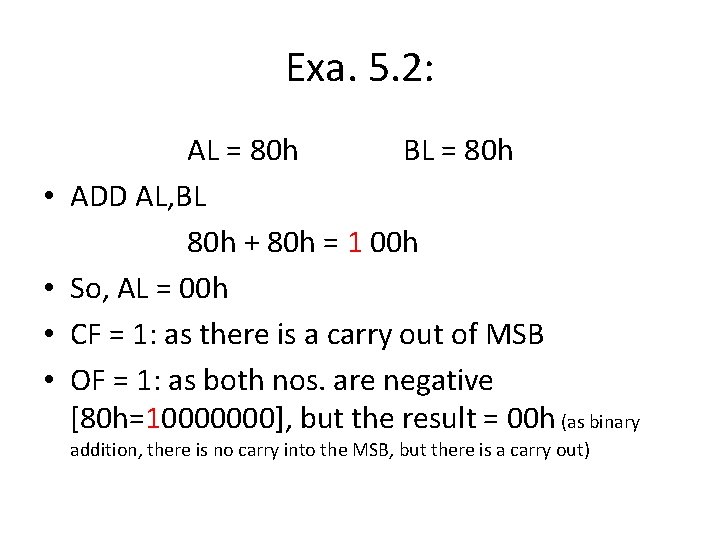
Exa. 5. 2: • • AL = 80 h BL = 80 h ADD AL, BL 80 h + 80 h = 1 00 h So, AL = 00 h CF = 1: as there is a carry out of MSB OF = 1: as both nos. are negative [80 h=10000000], but the result = 00 h (as binary addition, there is no carry into the MSB, but there is a carry out)
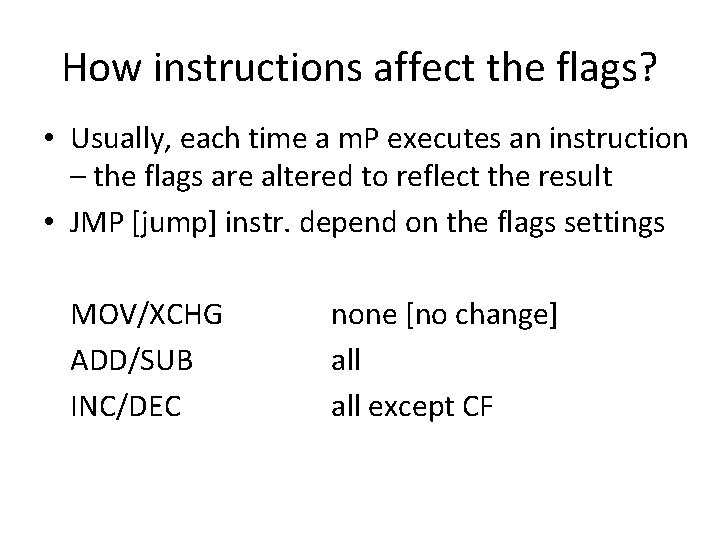
How instructions affect the flags? • Usually, each time a m. P executes an instruction – the flags are altered to reflect the result • JMP [jump] instr. depend on the flags settings MOV/XCHG ADD/SUB INC/DEC none [no change] all except CF
Q. : ADD AX, BX • • AX = FFFFh BX = FFFFh So, after ADD, AX = 1 FFFEh So inside …