
Ch 5 Determinants Ring Determinant functions Existence Uniqueness
![• Fields are commutative rings. • F[x] is a commutative ring with 1.](https://slidetodoc.com/presentation_image/4188c554212aa0cb7ea2fe96e5518dc4/image-3.jpg "• Fields are commutative rings. • F[x] is a commutative ring with 1.")
- Slides: 23
Ch. 5 Determinants Ring Determinant functions Existence, Uniqueness and Properties
Rings • A ring is a set K with operations – – – (x, y)->x+y. (x, y)->xy. (a) K is commutative under + (b) (xy)z=x(yz) (c ) x(y+z)=xy+xz, (y+z)x=yx+zx • If xy=yx, then K is a commutative ring. • If there exists 1 s. t. 1 x=x 1=x for all x in K, then K is a ring with 1.
• Fields are commutative rings. • F[x] is a commutative ring with 1. • Z the ring of integers is a commutative ring with 1. Not a field • Rings with 1. Two are commutative. • Zn. n any positive integer is a commutative ring with 1.
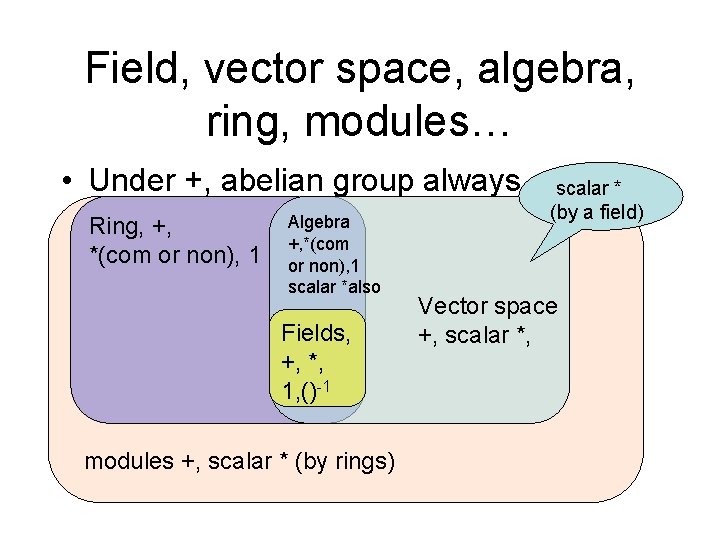
Field, vector space, algebra, ring, modules… • Under +, abelian group always Ring, +, *(com or non), 1 Algebra +, *(com or non), 1 scalar *also Fields, +, *, 1, ()-1 modules +, scalar * (by rings) scalar * (by a field) Vector space +, scalar *,
• Definition: Mmxn(K)={Amxn | aij in K }, K a commutative ring with 1. – Sum and product is defined – A(B+C)=AB+AC – A(BC)=(AB)C. – m=n case: This will be a ring (not commutative in general) • We introduce this object to prove some theorems elegantly in this book.
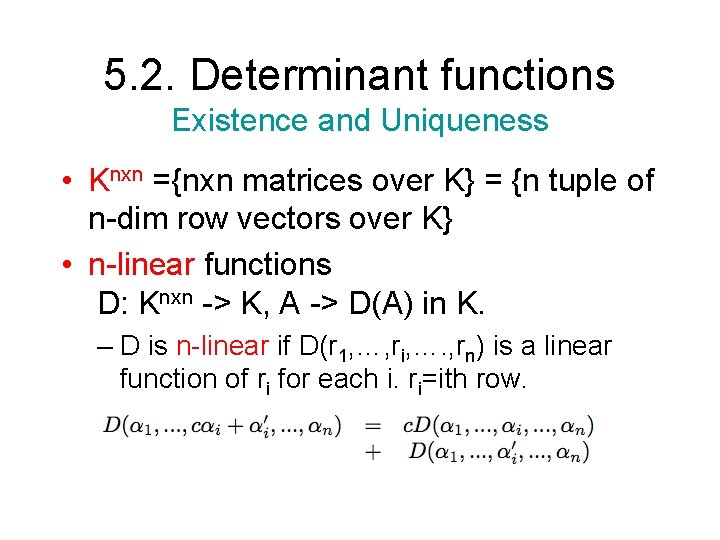
5. 2. Determinant functions Existence and Uniqueness • Knxn ={nxn matrices over K} = {n tuple of n-dim row vectors over K} • n-linear functions D: Knxn -> K, A -> D(A) in K. – D is n-linear if D(r 1, …, ri, …. , rn) is a linear function of ri for each i. ri=ith row.
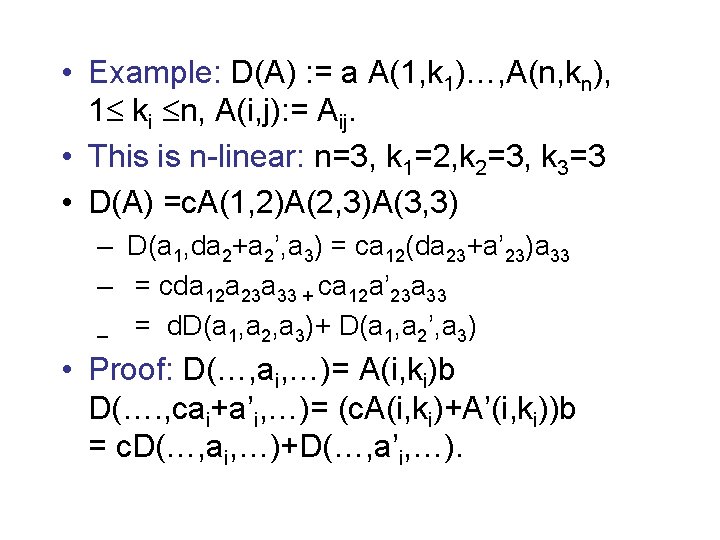
• Example: D(A) : = a A(1, k 1)…, A(n, kn), 1 ki n, A(i, j): = Aij. • This is n-linear: n=3, k 1=2, k 2=3, k 3=3 • D(A) =c. A(1, 2)A(2, 3)A(3, 3) – D(a 1, da 2+a 2’, a 3) = ca 12(da 23+a’ 23)a 33 – = cda 12 a 23 a 33 + ca 12 a’ 23 a 33 – = d. D(a 1, a 2, a 3)+ D(a 1, a 2’, a 3) • Proof: D(…, ai, …)= A(i, ki)b D(…. , cai+a’i, …)= (c. A(i, ki)+A’(i, ki))b = c. D(…, ai, …)+D(…, a’i, …).
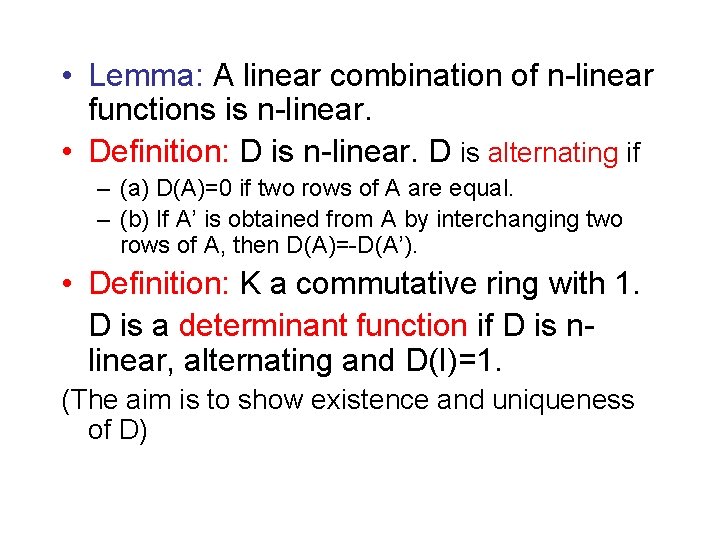
• Lemma: A linear combination of n-linear functions is n-linear. • Definition: D is n-linear. D is alternating if – (a) D(A)=0 if two rows of A are equal. – (b) If A’ is obtained from A by interchanging two rows of A, then D(A)=-D(A’). • Definition: K a commutative ring with 1. D is a determinant function if D is nlinear, alternating and D(I)=1. (The aim is to show existence and uniqueness of D)
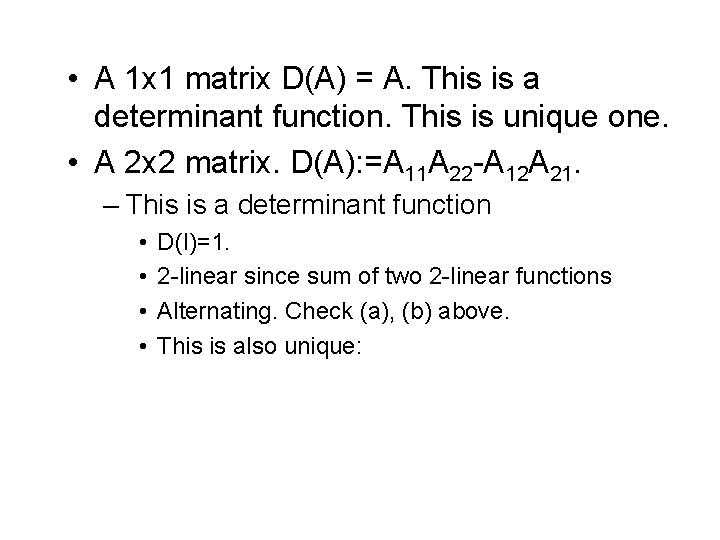
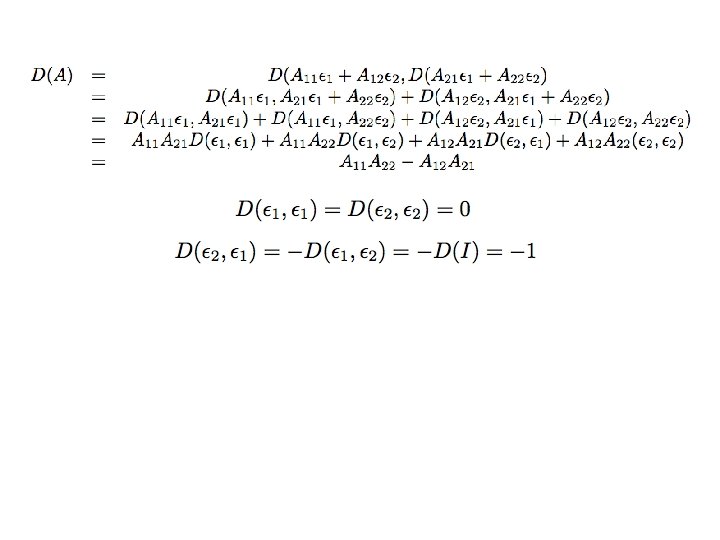
• A 1 x 1 matrix D(A) = A. This is a determinant function. This is unique one. • A 2 x 2 matrix. D(A): =A 11 A 22 -A 12 A 21. – This is a determinant function • • D(I)=1. 2 -linear since sum of two 2 -linear functions Alternating. Check (a), (b) above. This is also unique:
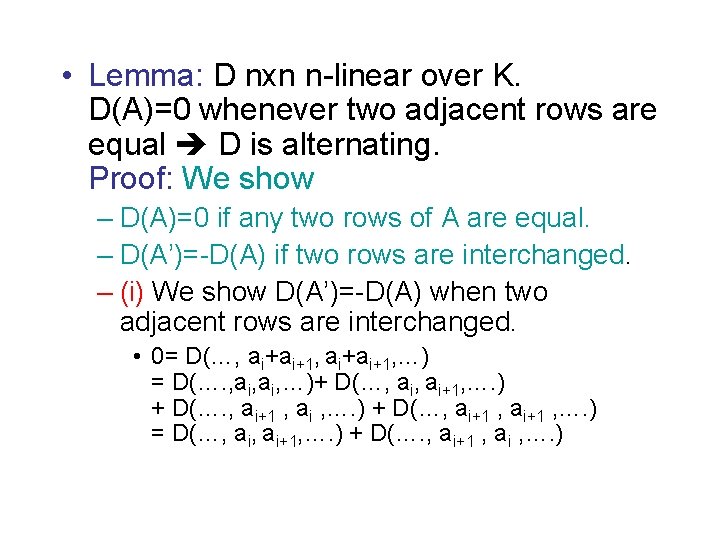
• Lemma: D nxn n-linear over K. D(A)=0 whenever two adjacent rows are equal D is alternating. Proof: We show – D(A)=0 if any two rows of A are equal. – D(A’)=-D(A) if two rows are interchanged. – (i) We show D(A’)=-D(A) when two adjacent rows are interchanged. • 0= D(…, ai+ai+1, …) = D(…. , ai, …)+ D(…, ai+1, …. ) + D(…. , ai+1 , ai , …. ) + D(…, ai+1 , …. ) = D(…, ai+1, …. ) + D(…. , ai+1 , ai , …. )
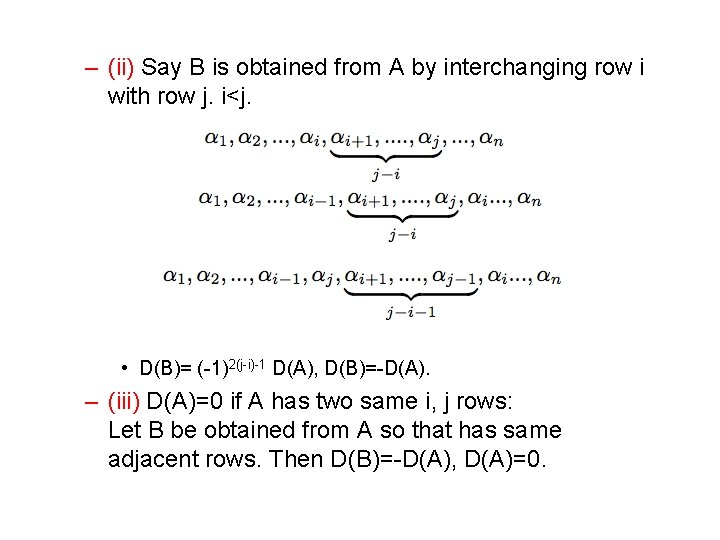
– (ii) Say B is obtained from A by interchanging row i with row j. i<j. • D(B)= (-1)2(j-i)-1 D(A), D(B)=-D(A). – (iii) D(A)=0 if A has two same i, j rows: Let B be obtained from A so that has same adjacent rows. Then D(B)=-D(A), D(A)=0.
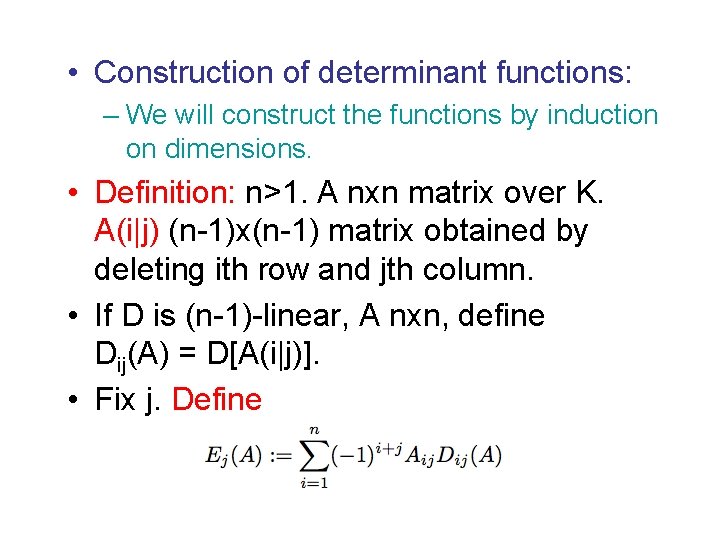
• Construction of determinant functions: – We will construct the functions by induction on dimensions. • Definition: n>1. A nxn matrix over K. A(i|j) (n-1)x(n-1) matrix obtained by deleting ith row and jth column. • If D is (n-1)-linear, A nxn, define Dij(A) = D[A(i|j)]. • Fix j. Define
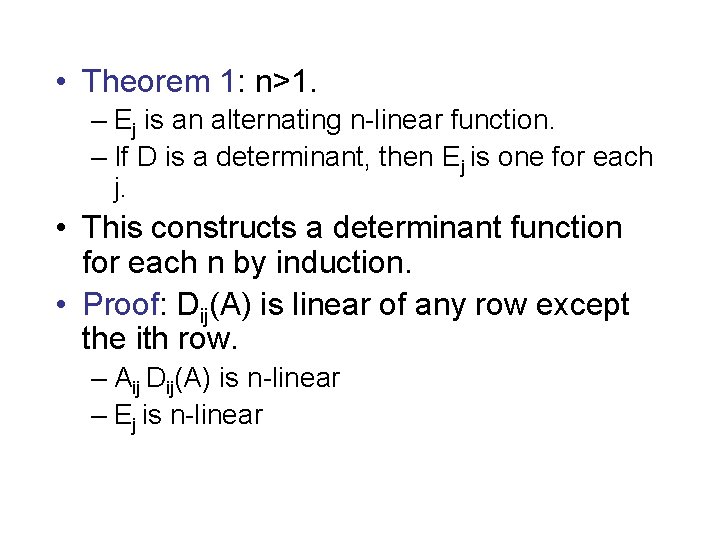
• Theorem 1: n>1. – Ej is an alternating n-linear function. – If D is a determinant, then Ej is one for each j. • This constructs a determinant function for each n by induction. • Proof: Dij(A) is linear of any row except the ith row. – Aij Dij(A) is n-linear – Ej is n-linear
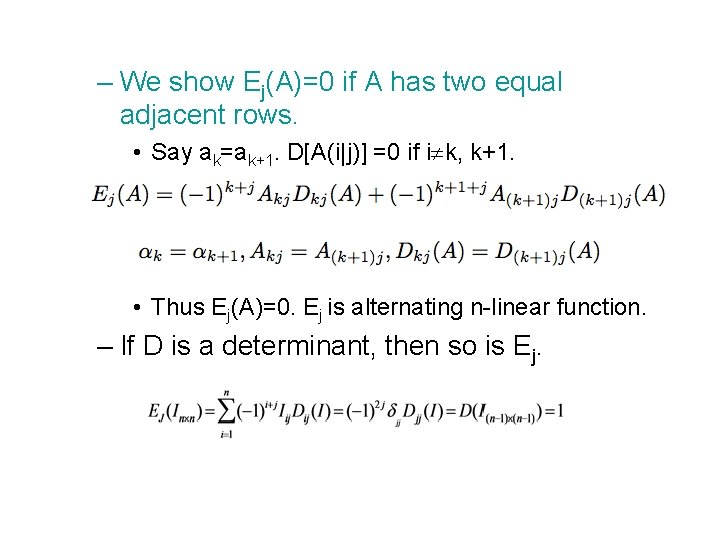
– We show Ej(A)=0 if A has two equal adjacent rows. • Say ak=ak+1. D[A(i|j)] =0 if i k, k+1. • Thus Ej(A)=0. Ej is alternating n-linear function. – If D is a determinant, then so is Ej.
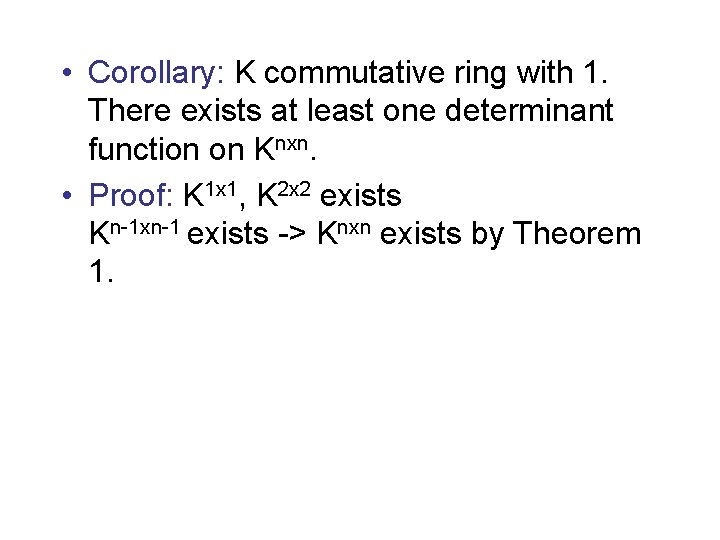
• Corollary: K commutative ring with 1. There exists at least one determinant function on Knxn. • Proof: K 1 x 1, K 2 x 2 exists Kn-1 xn-1 exists -> Knxn exists by Theorem 1.
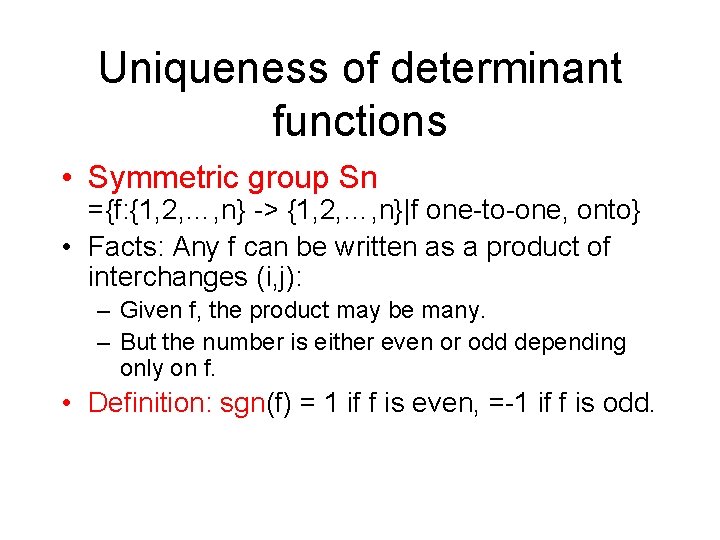
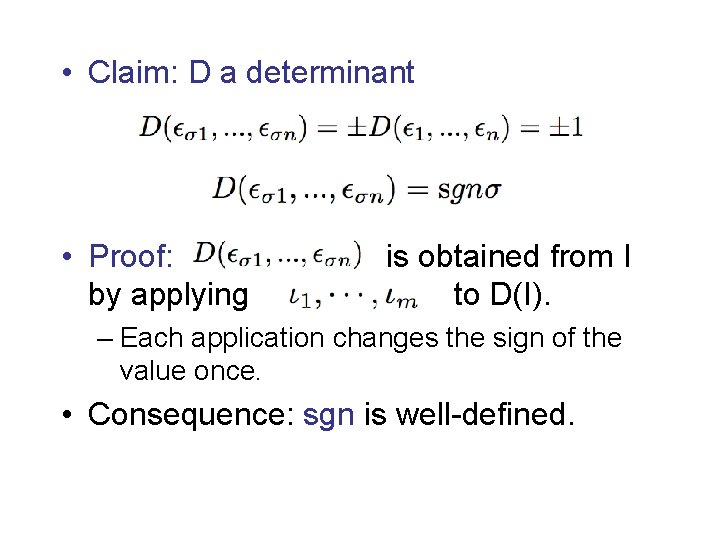
Uniqueness of determinant functions • Symmetric group Sn ={f: {1, 2, …, n} -> {1, 2, …, n}|f one-to-one, onto} • Facts: Any f can be written as a product of interchanges (i, j): – Given f, the product may be many. – But the number is either even or odd depending only on f. • Definition: sgn(f) = 1 if f is even, =-1 if f is odd.
• Claim: D a determinant • Proof: by applying is obtained from I to D(I). – Each application changes the sign of the value once. • Consequence: sgn is well-defined.
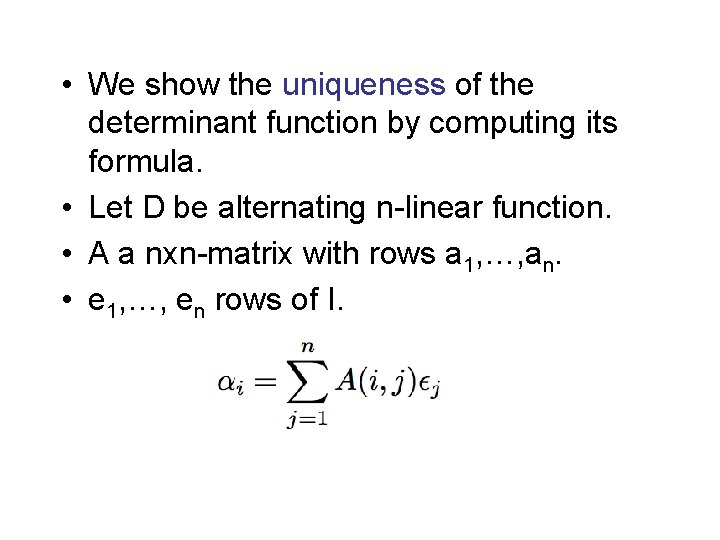
• We show the uniqueness of the determinant function by computing its formula. • Let D be alternating n-linear function. • A a nxn-matrix with rows a 1, …, an. • e 1, …, en rows of I.
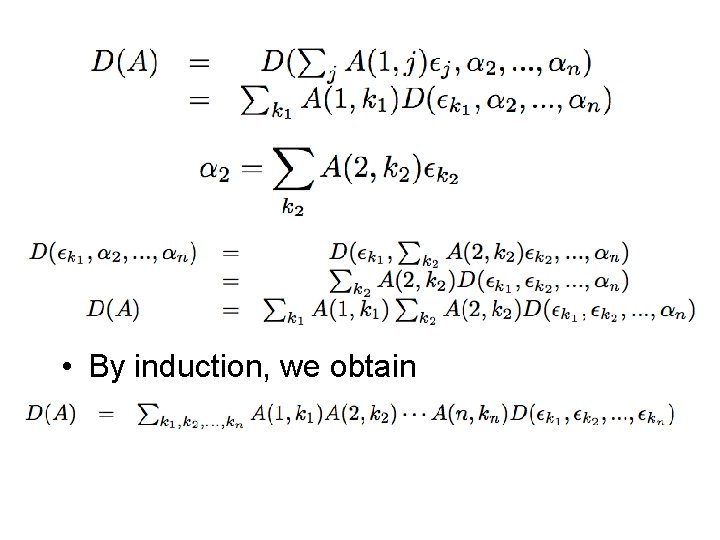
• By induction, we obtain
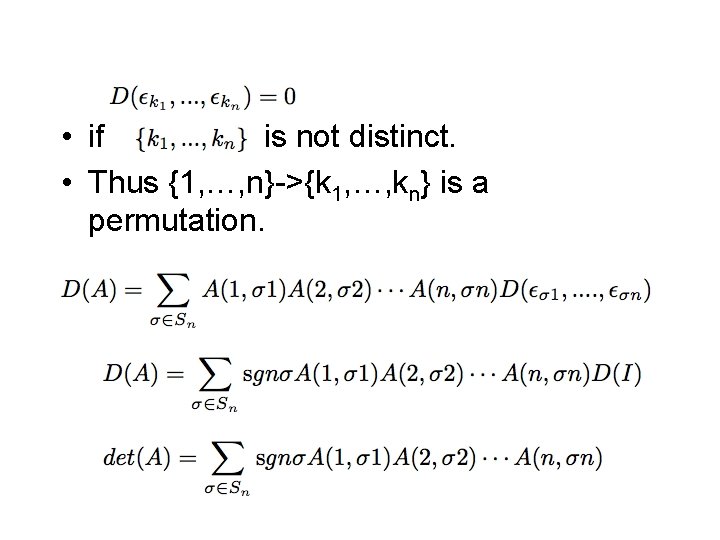
• if is not distinct. • Thus {1, …, n}->{k 1, …, kn} is a permutation.
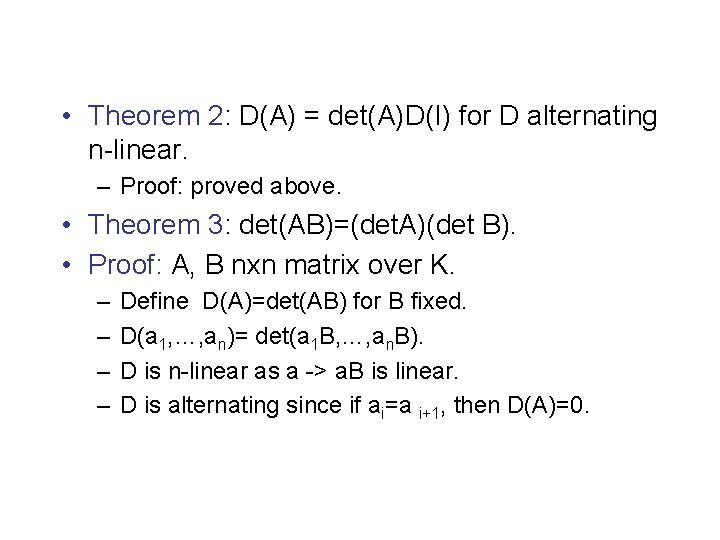
• Theorem 2: D(A) = det(A)D(I) for D alternating n-linear. – Proof: proved above. • Theorem 3: det(AB)=(det. A)(det B). • Proof: A, B nxn matrix over K. – – Define D(A)=det(AB) for B fixed. D(a 1, …, an)= det(a 1 B, …, an. B). D is n-linear as a -> a. B is linear. D is alternating since if ai=a i+1, then D(A)=0.
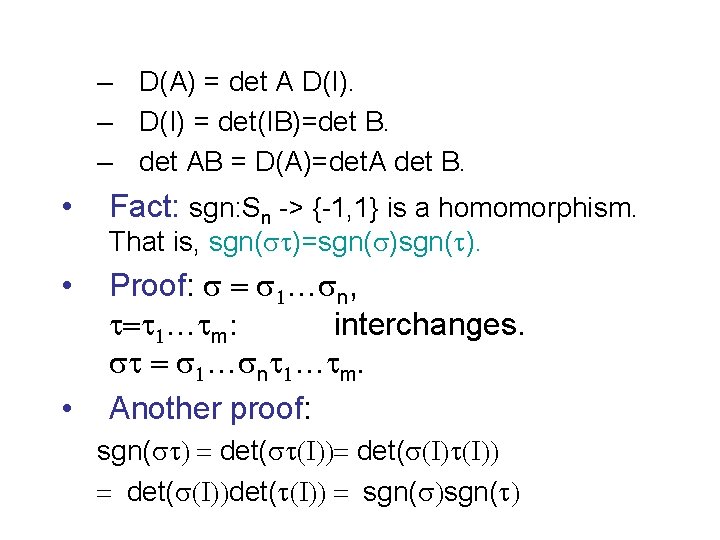
– D(A) = det A D(I). – D(I) = det(IB)=det B. – det AB = D(A)=det. A det B. • Fact: sgn: Sn -> {-1, 1} is a homomorphism. That is, sgn( )=sgn( ). • • Proof: … n, … m interchanges. … n … m Another proof: sgn( det( sgn(