
Ch 5 5 Euler Equations A relatively simple

- Slides: 18
Ch 5. 5: Euler Equations A relatively simple differential equation that has a regular singular point is the Euler equation, where , are constants. Note that x 0 = 0 is a regular singular point. The solution of the Euler equation is typical of the solutions of all differential equations with regular singular points, and hence we examine Euler equations before discussing the more general problem.
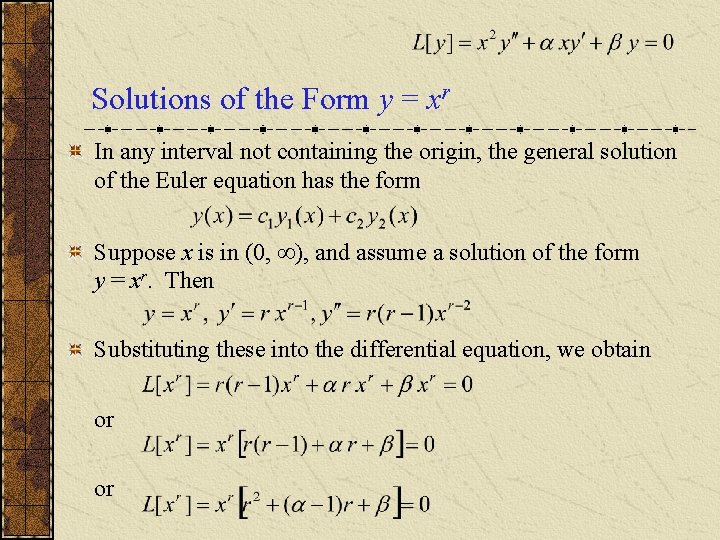
Solutions of the Form y = xr In any interval not containing the origin, the general solution of the Euler equation has the form Suppose x is in (0, ), and assume a solution of the form y = xr. Then Substituting these into the differential equation, we obtain or or
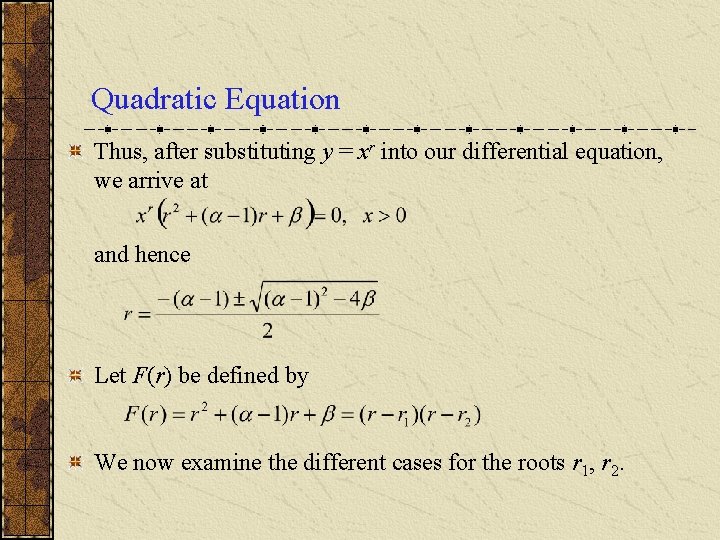
Quadratic Equation Thus, after substituting y = xr into our differential equation, we arrive at and hence Let F(r) be defined by We now examine the different cases for the roots r 1, r 2.
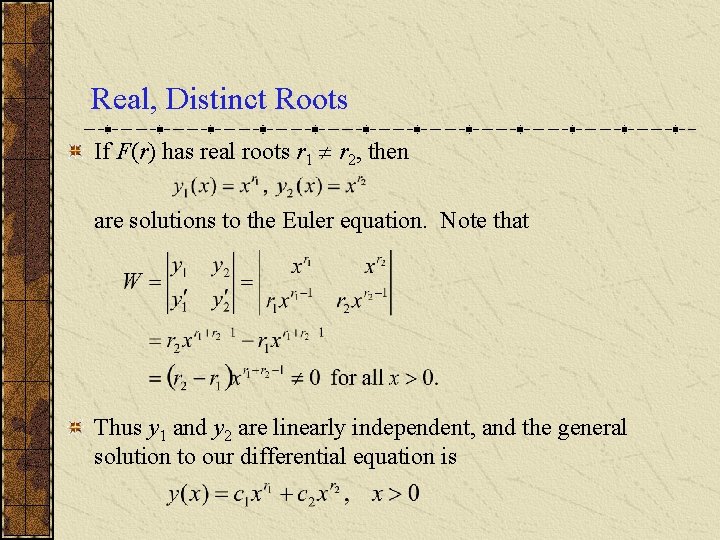
Real, Distinct Roots If F(r) has real roots r 1 r 2, then are solutions to the Euler equation. Note that Thus y 1 and y 2 are linearly independent, and the general solution to our differential equation is
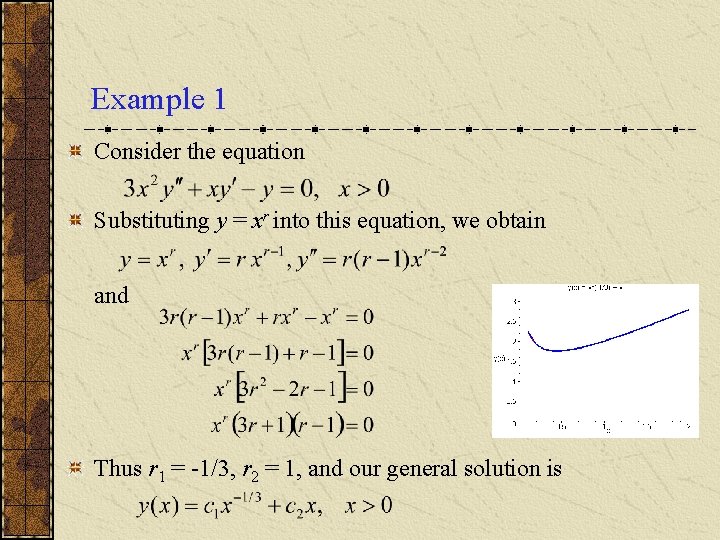
Example 1 Consider the equation Substituting y = xr into this equation, we obtain and Thus r 1 = -1/3, r 2 = 1, and our general solution is
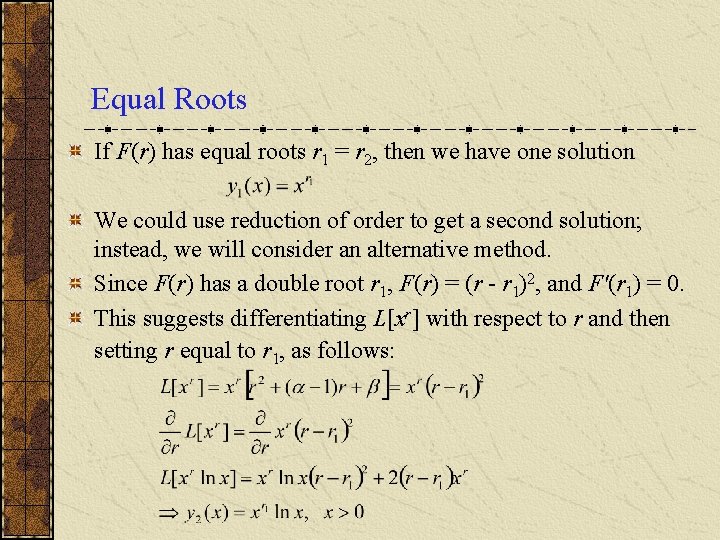
Equal Roots If F(r) has equal roots r 1 = r 2, then we have one solution We could use reduction of order to get a second solution; instead, we will consider an alternative method. Since F(r) has a double root r 1, F(r) = (r - r 1)2, and F'(r 1) = 0. This suggests differentiating L[xr] with respect to r and then setting r equal to r 1, as follows:
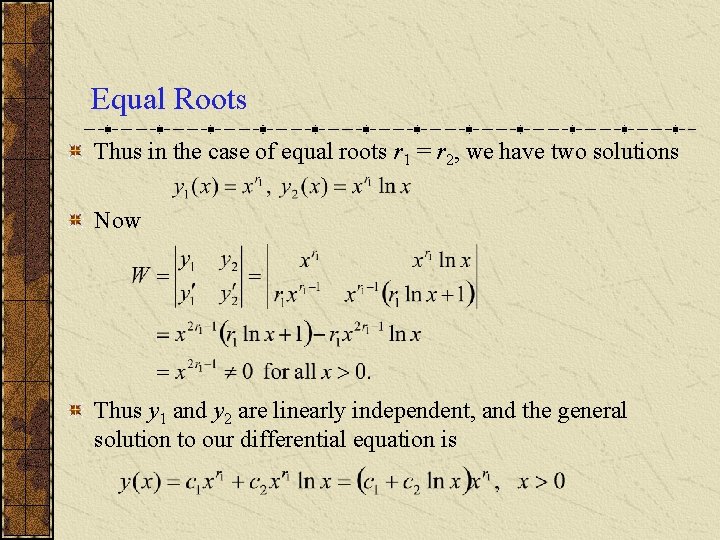
Equal Roots Thus in the case of equal roots r 1 = r 2, we have two solutions Now Thus y 1 and y 2 are linearly independent, and the general solution to our differential equation is
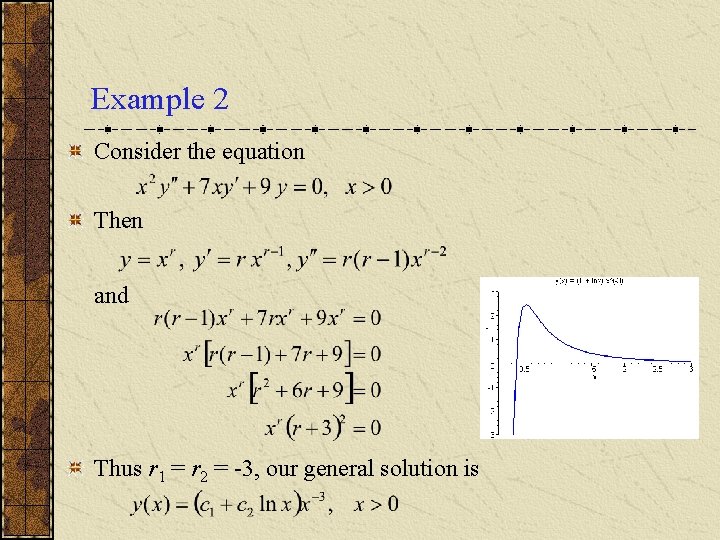
Example 2 Consider the equation Then and Thus r 1 = r 2 = -3, our general solution is
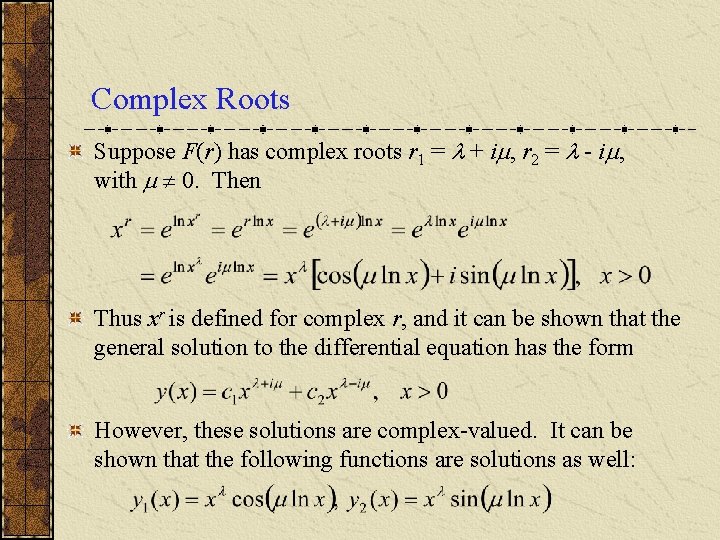
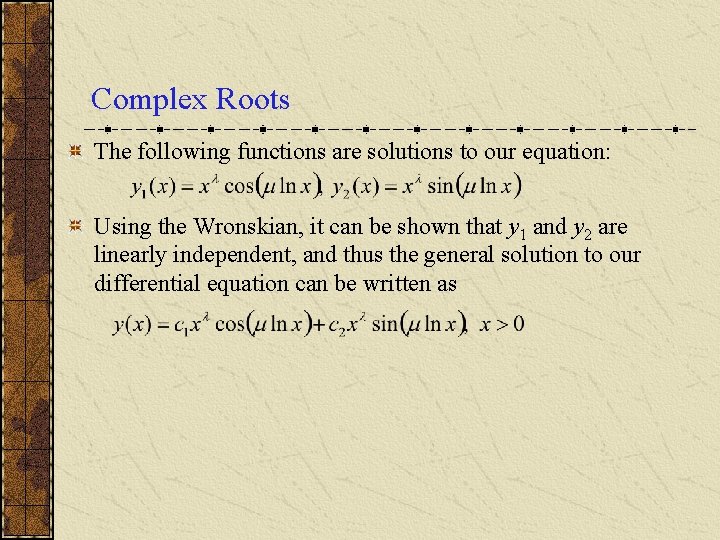
Complex Roots Suppose F(r) has complex roots r 1 = + i , r 2 = - i , with 0. Then Thus xr is defined for complex r, and it can be shown that the general solution to the differential equation has the form However, these solutions are complex-valued. It can be shown that the following functions are solutions as well:
Complex Roots The following functions are solutions to our equation: Using the Wronskian, it can be shown that y 1 and y 2 are linearly independent, and thus the general solution to our differential equation can be written as
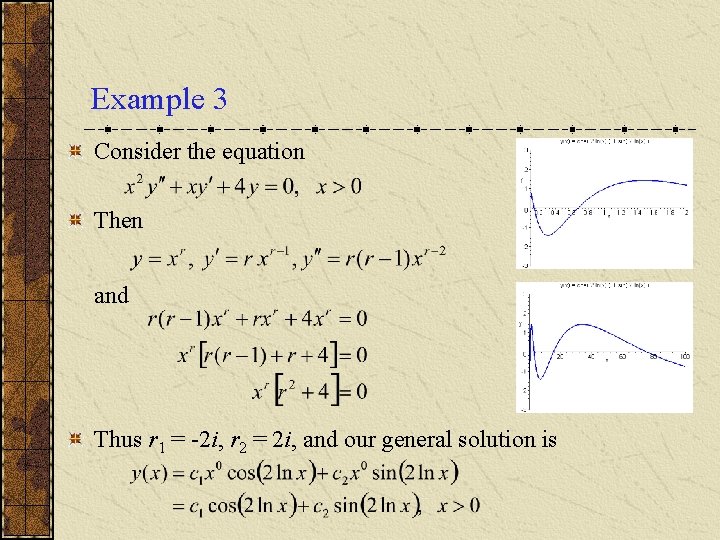
Example 3 Consider the equation Then and Thus r 1 = -2 i, r 2 = 2 i, and our general solution is
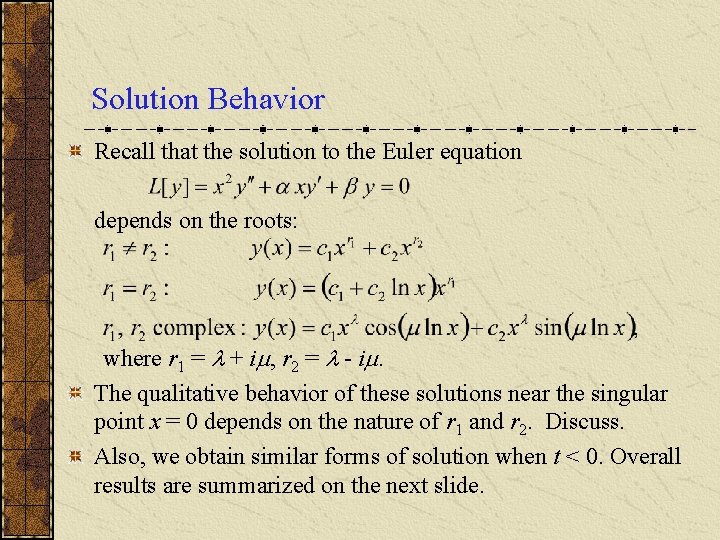
Solution Behavior Recall that the solution to the Euler equation depends on the roots: where r 1 = + i , r 2 = - i. The qualitative behavior of these solutions near the singular point x = 0 depends on the nature of r 1 and r 2. Discuss. Also, we obtain similar forms of solution when t < 0. Overall results are summarized on the next slide.
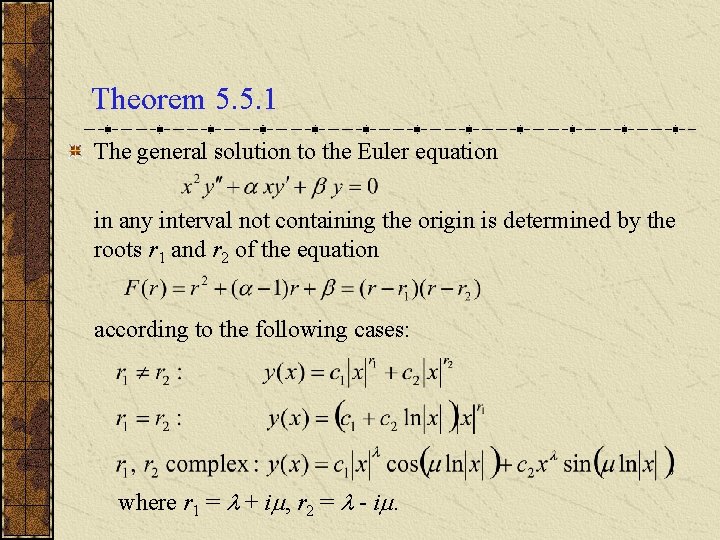
Theorem 5. 5. 1 The general solution to the Euler equation in any interval not containing the origin is determined by the roots r 1 and r 2 of the equation according to the following cases: where r 1 = + i , r 2 = - i.
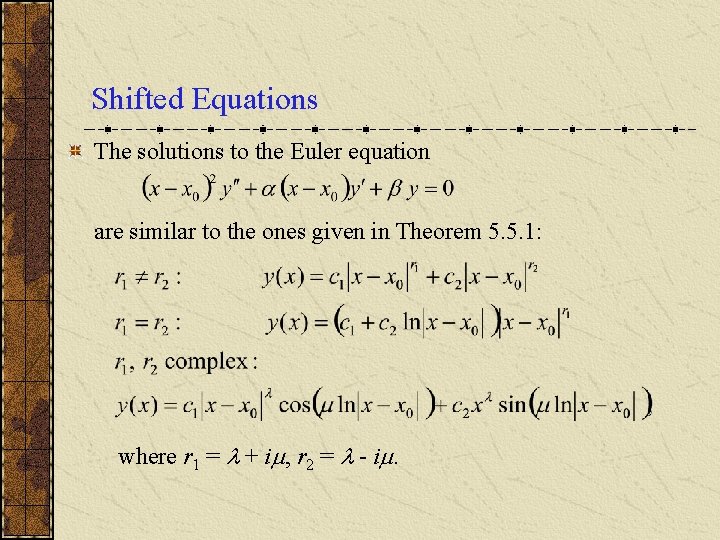
Shifted Equations The solutions to the Euler equation are similar to the ones given in Theorem 5. 5. 1: where r 1 = + i , r 2 = - i.
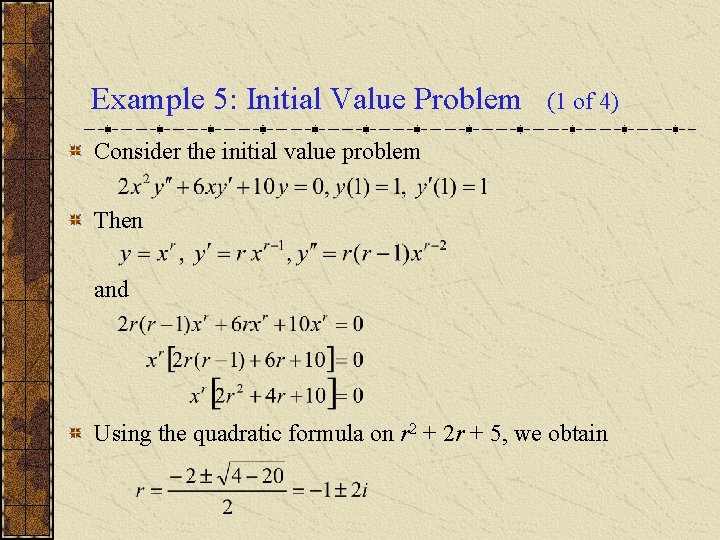
Example 5: Initial Value Problem (1 of 4) Consider the initial value problem Then and Using the quadratic formula on r 2 + 2 r + 5, we obtain
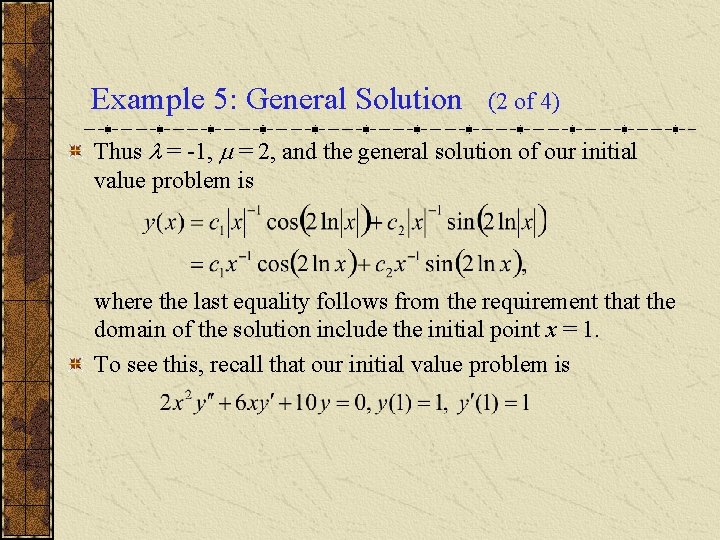
Example 5: General Solution (2 of 4) Thus = -1, = 2, and the general solution of our initial value problem is where the last equality follows from the requirement that the domain of the solution include the initial point x = 1. To see this, recall that our initial value problem is
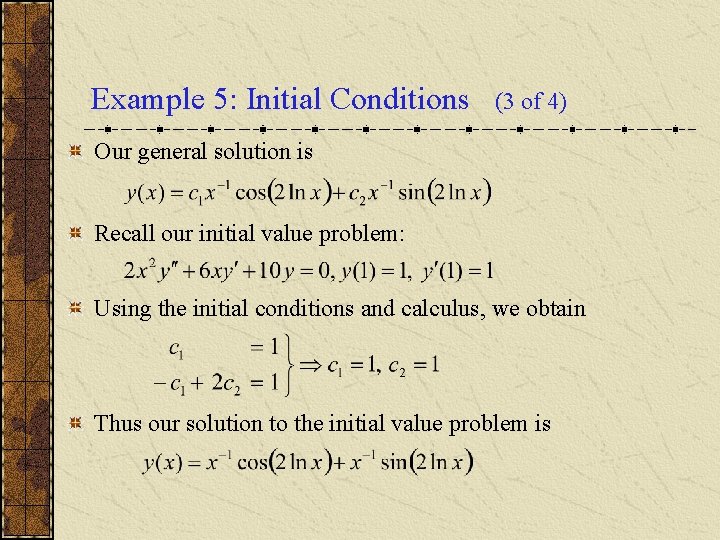
Example 5: Initial Conditions (3 of 4) Our general solution is Recall our initial value problem: Using the initial conditions and calculus, we obtain Thus our solution to the initial value problem is
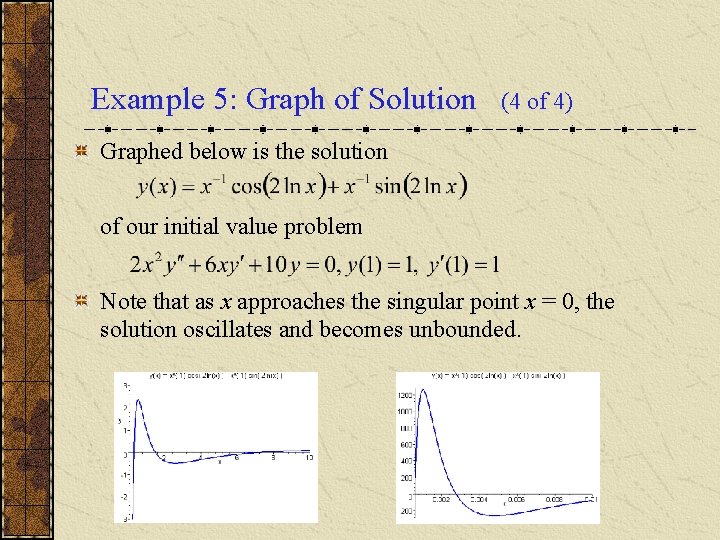
Example 5: Graph of Solution (4 of 4) Graphed below is the solution of our initial value problem Note that as x approaches the singular point x = 0, the solution oscillates and becomes unbounded.