
Ch 4 Tissues I Epithelial II Connective III
- Slides: 16
Ch. 4 Tissues I. Epithelial II. Connective III. Muscle IV. Nerve n n These form membranes and organs of the body Tissue: group of similar cells sharing a common origin that unite to perform a particular function
I. Epithelial Tissue · Cells packed closely together · Protective, absorptive and secretory functions · Little or no intercellular material between cells · Avascular tissue (blood vessels cannot penetrate between the cells) · Covers body surface · Lines inside of body cavities and organs and forms glands 2 Basic categories 1. Covering and lining 2. Glandular
1. Covering and Lining Epithelial Tissue · Covers external body surfaces and lines inner walls of cavities and organs · Cells are stationary and anchored to basement membrane
Classification based on cell shape and arrangement in layers of cells n Cell shape i. Squamous (flat) ii. Cuboidal (cubeshaped, equal height and width) iii. Columnar (cylindrical, greater in height than width) n Arrangement of cells i. Simple (single layer) ii. Stratified (multiple layers)
Most Common Types of Cells a. Simple squamous b. Simple cuboidal c. Simple columnar d. Stratified squamous e. Pseudostratified columnar f. Transitional
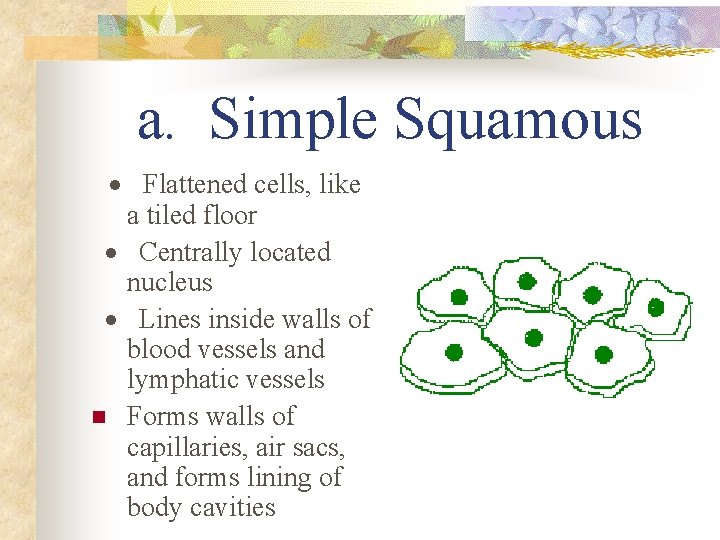
a. Simple Squamous · Flattened cells, like a tiled floor · Centrally located nucleus · Lines inside walls of blood vessels and lymphatic vessels n Forms walls of capillaries, air sacs, and forms lining of body cavities
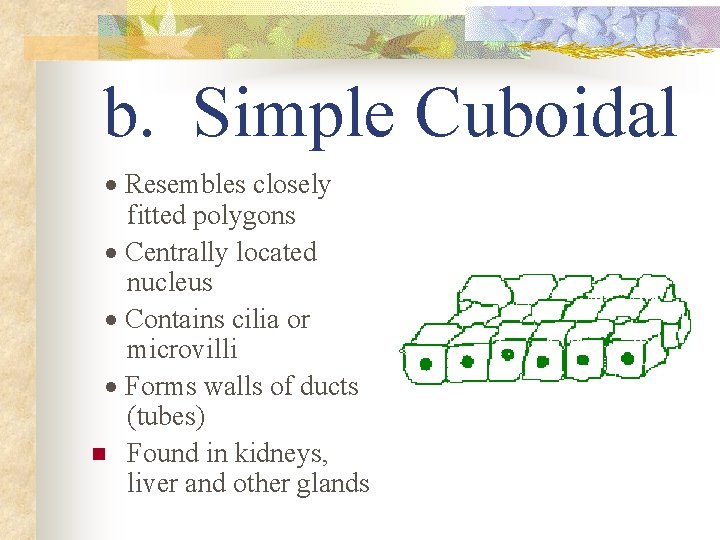
b. Simple Cuboidal · Resembles closely fitted polygons · Centrally located nucleus · Contains cilia or microvilli · Forms walls of ducts (tubes) n Found in kidneys, liver and other glands
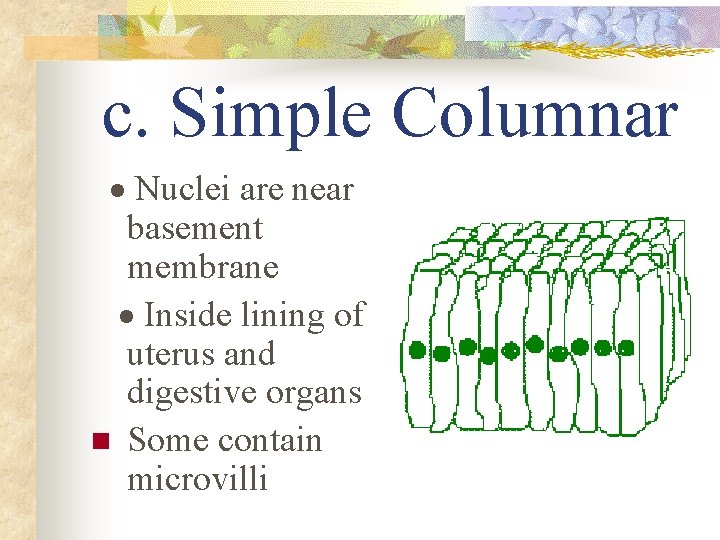
c. Simple Columnar · Nuclei are near basement membrane · Inside lining of uterus and digestive organs n Some contain microvilli
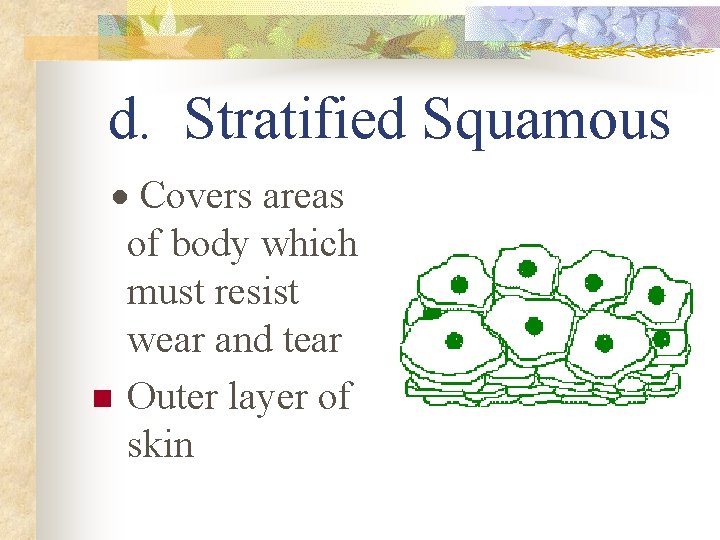
d. Stratified Squamous · Covers areas of body which must resist wear and tear n Outer layer of skin
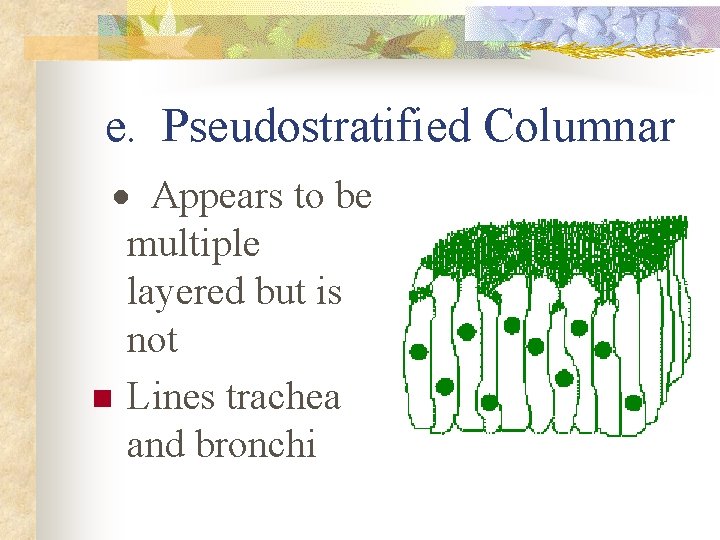
e. Pseudostratified Columnar · Appears to be multiple layered but is not n Lines trachea and bronchi
f. Transitional · Multiple layered, cubelike · Can expand in size, than recoil · Can stretch (elasticity) · Return to shape (extensibility) n Lines inside of organs which must be elastic: urinary bladder, ureters (tubes from kidneys to bladder)
2. Glandular Epithelial · Closely packed cells that are highly specialized to secrete products n Usually called a gland
2 types a. Exocrine glands b. Endocrine glands
a. Exocrine Glands · Empty products into ducts · These ducts carry products to where it is needed n Sweat glands, oil glands, salivary glands and mucous glands
b. Endocrine Glands · Secrete products into extracellular space where products diffuse into blood stream · Blood stream transports products throughout body n Pituitary glands (base of brain), thyroid gland (neck), adrenal gland (kidneys)
Both types of glands are composed of more than 1 type of tissue so they are also referred to as organs. n Packet pp. 57 -58 n Quiz on epithelial tissues n