
Ch 4 Skin and Body Membranes Integumentary System
�Ch 4: Skin and Body Membranes Integumentary System P 110
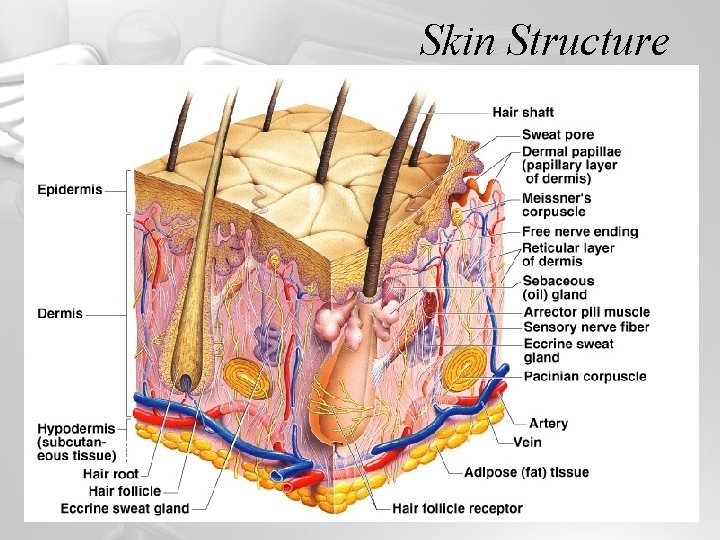
Skin Structure Figure 4. 4
Integumentary System w Skin (cutaneous membrane) w Also called the integument w Skin derivatives w Sweat glands w Oil glands w Hairs w Nails
Skin Functions w Protects deeper tissues from: w Mechanical damage (bumps) w Chemical damage (acids & bases) w Bacterial damage (from infection) w Thermal damage (heat or cold) w Ultraviolet radiation (effects of sunlight) w Desiccation (drying out)
Skin Functions w Aids in heat regulation w Aids in excretion of urea and uric acid w Synthesizes vitamin D
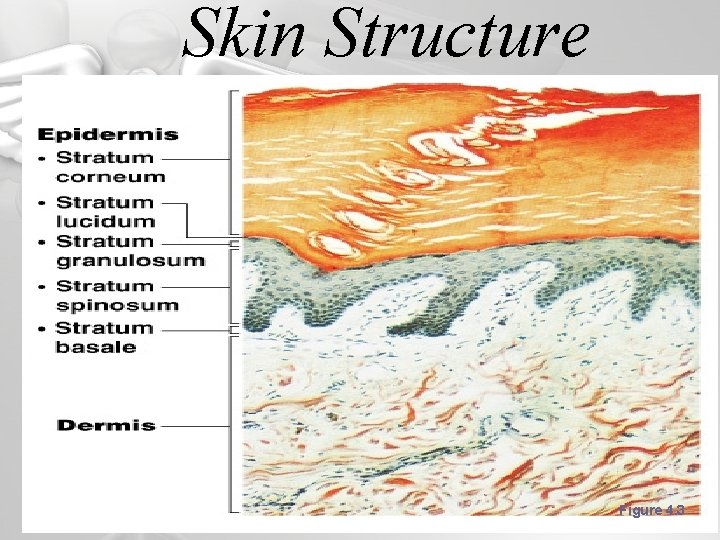
Skin Structure Figure 4. 3
Skin Structure w Epidermis – outer layer w Stratified squamous epithelium w Often keratinized (hardened by keratin) w Dermis - inner layer w Dense connective tissue w Found underneath the epidermis Figure 4. 3
Skin Structure w Deep to dermis is the hypodermis w Also called subcutaneous tissue w Not part of the skin w Anchors skin to underlying organs w Composed mostly of adipose tissue
Skin Layers w From outermost to inner most layer: w Stratum Corneum w Stratum Lucidum w Stratum Granulosum w Stratum Spinosum w Stratum Basale (Germinativum)
Layer of Epidermis 1. Stratum basale w Also called stratum germinativum w Stratum basale or germinativum is deepest layer w Lies next to dermis w Cells undergoing mitosis 2. Stratum spinosum 3. Stratum granulosum
Layer of Epidermis cont’d 4. Stratum lucidum w Occurs only in thick skin 5. Stratum corneum w Outermost layer of the epidermis w Shingle-like dead cells w Flakes off slowly and replaced by new cells
Epidermis Facts w Avascular w New epidermis every 35 -45 days
Melanin w Pigment (melanin) produced by melanocytes w Color is yellow to brown to black w Melanocytes are mostly in the stratum basale w Amount of melanin produced depends upon genetics and exposure to sunlight w Freckles and moles are found where melanin is concentrated to one spot w CROSS OUT THE NEXT LINE
Dermis w Two layers 1. Papillary layer w Outermost layer of dermis w Projections called dermal papillae w Pain receptors w Papillae arranged in patterns that are genetically determined w This is what allows you to leave fingerprints
Dermis 2. Reticular layer w Blood vessels w Glands w Nerve receptors
Dermis Facts w Vascular and helps maintain body temperature homeostasis w Various fibers are found in the dermis w Collagen fibers are responsible for the toughness and help keep skin hydrated w Elastic fibers gives skin its elasticity w Collagen & elastic fibers decrease as we age
- Slides: 16