
Ch 4 Crystal Chemistry Structure of an Atom
- Slides: 6
Ch. 4. Crystal Chemistry �Structure of an Atom Nucleus: neutron + proton determine the mass of an atom Electron(s): Occupy atomic orbitals quantumized determine the size (volume) of an atom Atomic orbital? A function representing the probability of electron presence in space, satisfying Schrodinger equation
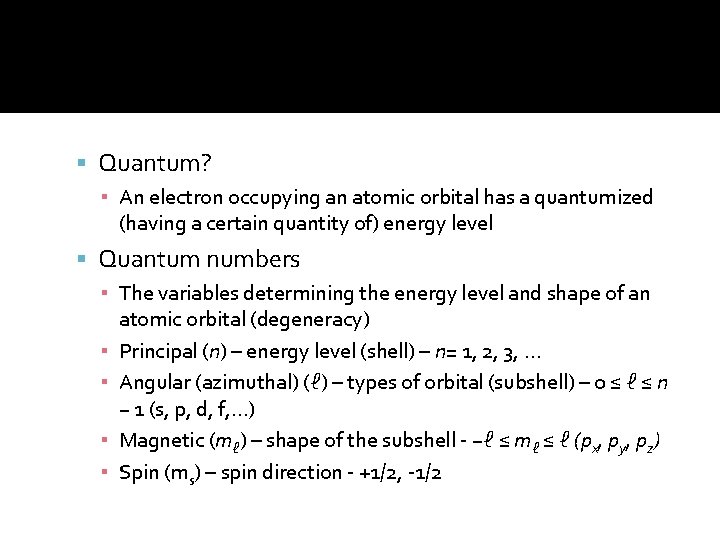
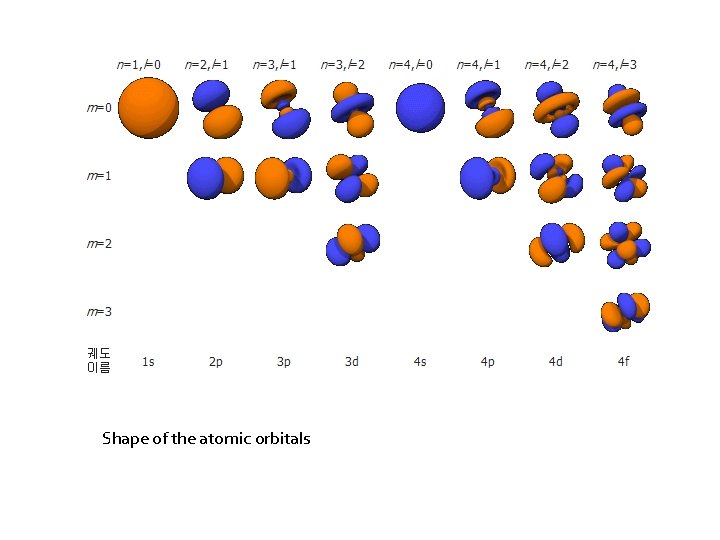
Quantum? ▪ An electron occupying an atomic orbital has a quantumized (having a certain quantity of) energy level Quantum numbers ▪ The variables determining the energy level and shape of an atomic orbital (degeneracy) ▪ Principal (n) – energy level (shell) – n= 1, 2, 3, … ▪ Angular (azimuthal) (ℓ) – types of orbital (subshell) – 0 ≤ ℓ ≤ n − 1 (s, p, d, f, …) ▪ Magnetic (mℓ) – shape of the subshell - −ℓ ≤ mℓ ≤ ℓ (px, py, pz) ▪ Spin (ms) – spin direction - +1/2, -1/2
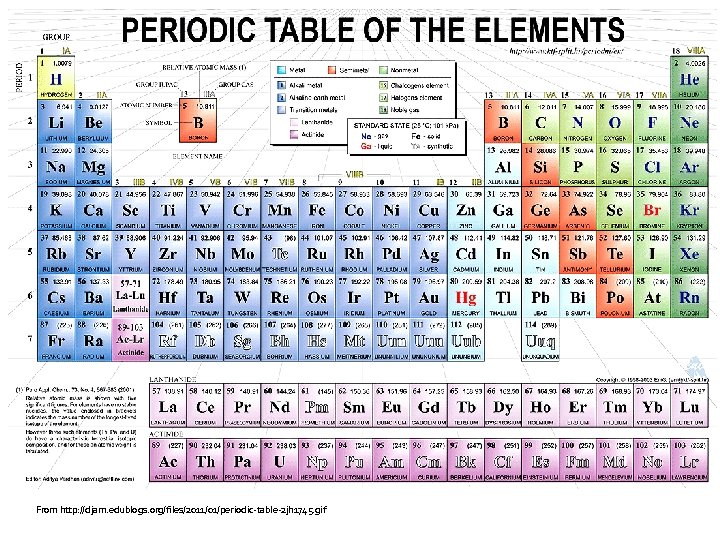
From http: //djarn. edublogs. org/files/2011/01/periodic-table-2 jh 1745. gif
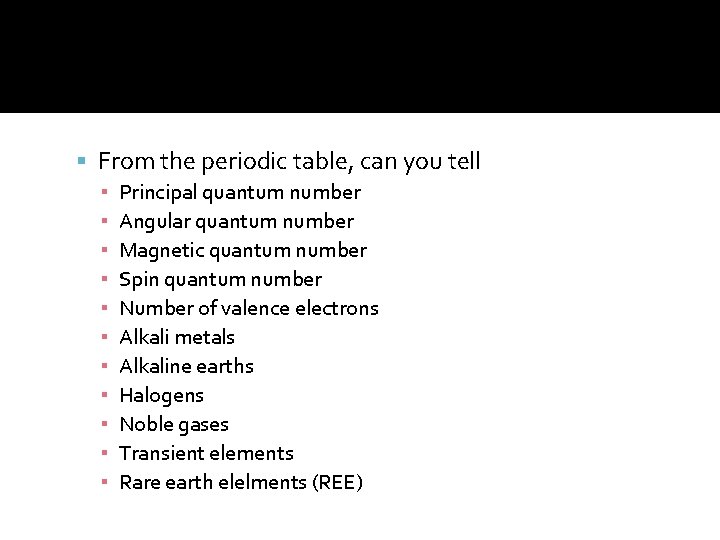
From the periodic table, can you tell ▪ ▪ ▪ Principal quantum number Angular quantum number Magnetic quantum number Spin quantum number Number of valence electrons Alkali metals Alkaline earths Halogens Noble gases Transient elements Rare earth elelments (REE)
Shape of the atomic orbitals
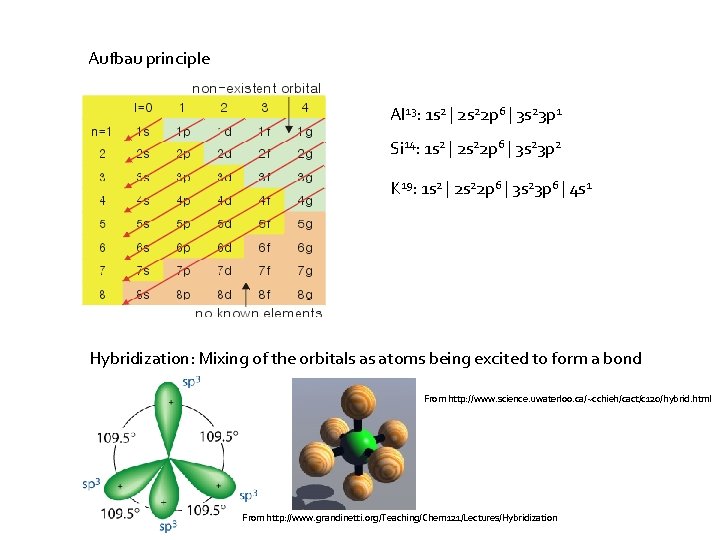
Aufbau principle Al 13: 1 s 2 | 2 s 22 p 6 | 3 s 23 p 1 Si 14: 1 s 2 | 2 s 22 p 6 | 3 s 23 p 2 K 19: 1 s 2 | 2 s 22 p 6 | 3 s 23 p 6 | 4 s 1 Hybridization: Mixing of the orbitals as atoms being excited to form a bond From http: //www. science. uwaterloo. ca/~cchieh/cact/c 120/hybrid. html From http: //www. grandinetti. org/Teaching/Chem 121/Lectures/Hybridization