
Ch 36 Platyhelminthes Phylum platyhelminthes Flatworms 3 cell
- Slides: 26
Ch. 36 Platyhelminthes ¬Phylum platyhelminthes · Flatworms · 3 cell (germ) layers · More complex than sponges, cnidarians and ctenophores ¬Bilateral symmetry (left and right side)
3 Classes ¬class: turbellaria *planaria (free living) ¬class: trematoda *flukes (parasitic) ¬class: cestoda *tapeworms (parasitic) These three classes make up 18, 000 species
Structure and Function · Simplest animal with bilateral symmetry · Develops from 3 germ layers 1. ectoderm (outer layer) 2. mesoderm (middle layer) 3. endoderm (inner layer) · In flatworm, all 3 germ layers are pressed against each other to form solid body ¬ Belong to group called acoelomate which means without body cavity
A. Respiration ¬ Since flat shape, all cells are in relative contact to its environment, so each cell exchanges gases by diffusion. It has no circulatory or respiratory system.
B. Digestion · Gastrovascular cavity is a gut with single opening. ¬ Food taken in, digested, and all waste back out same opening.
C. Nerves ¬Located in anterior end, called cephalization.
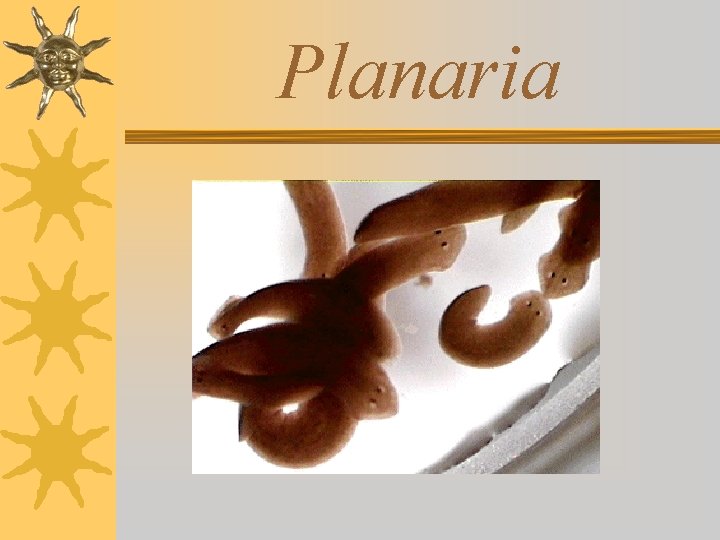
1. Turbellaria: non parasitic · Majority live in ocean · Some in fresh water *Planaria dugesia (known as Planaria) · Move in water using wave like motion ¬ Move on ground by producing mucous and using cilia to glide on it
Planaria
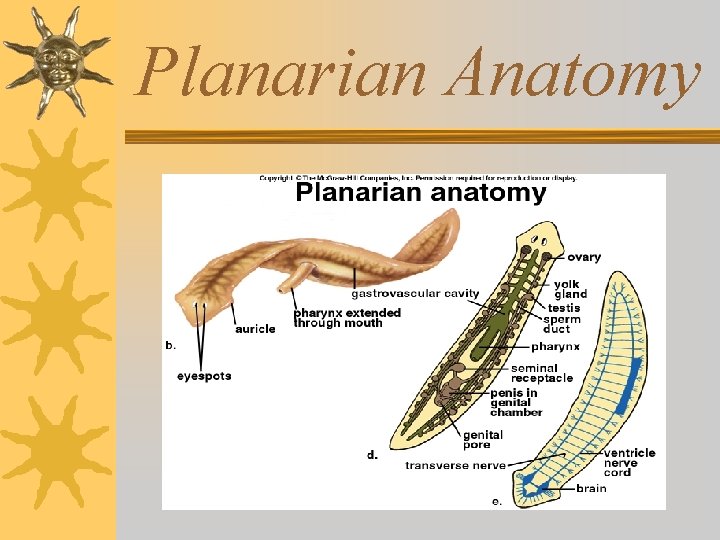
Planarian Anatomy
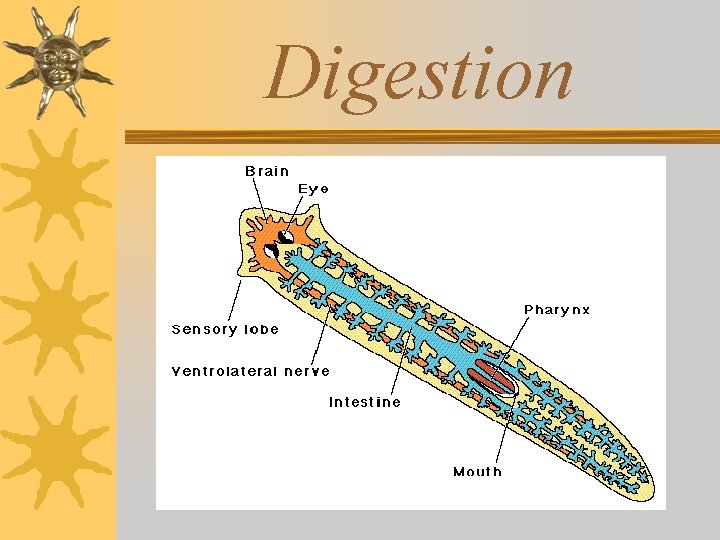
A. Digestion · Feed on decayed plant or animal · Food ingested through pharynx (muscular tube) extended through middle of body · Goes to gastrovascular cavity · Cells here absorb nutrients ¬draw p. 710 36 -2 a
Digestion
B. Excretion * To get rid of waste · Through network of excretory tubules · Run length of body · Connects to flame cell which are enclosed tufts of beating cilia ¬Draw p. 710 36 -2 b
C. Nerves · 2 clusters of nerve cells at anterior end called cerebral ganglia which serves as simple brain · Ganglia receive information from sensory cells · Transmit signals to muscles along nerves · Has ability to learn: moves from light · Uses eyespot near ganglia to sense environment ¬Draw p. 710 36 -2 c
D. Reproduction · Hermaphrodites · When reproduce sexually, they simultaneously fertilize each other · Usually asexual in summer by regeneration ¬They attach posterior end to something, anterior end moves until it splits. This is fission. Each half then regenerates into 2 complete planaria. ¬Draw p. 710 36 -2 d
2. Class Trematoda · Flukes · Leaf shape parasites · Difference between free-living and parasitic is that parasitic flatworms have simpler structures ¬Live inside host or outside on host
A. Digestion · Attaches itself with anterior and ventral sucker (see fig. 36 -3 p. 711) · Anterior sucker is around mouth · Draws hosts body fluid into gastrovascular cavity ¬Wastes go out the same opening
B. Nerves · No eyespots ¬Entire external surface is covered by a sheet of fused cells called tegument which protects fluke against host
C. Reproduction · Hermaphrodites but sexual reproduction occurs · Human is the primary host (this is where harm can be done) · Adult worm lives in human blood vessels · Eggs and sperm fertilize · Some fertilized eggs make it to host’s bladder and intestines and get excreted in urine or feces
Reproduction · These eggs make it to fresh water and develop into ciliated larvae · These larvae find a particular species of snail. They burrow into snail’s tissue and asexual reproduction takes place. Snail is intermediate host (no harm is done here) · Larvae develop tails and leave · Enter skin of human and begin cycle again · Bad in Asia, Africa and S. America ¬ Draw life cycle transp. 149 also on p. 712 fig. 364
3. Class Cestoda · Tapeworms · Parasitic · In intestines of most vertebrates · Up to 7 species can affect humans · Get through raw or undercooked food, which contains eggs or larvae ¬Causes digestive problems, weight loss, lack of energy and anemia
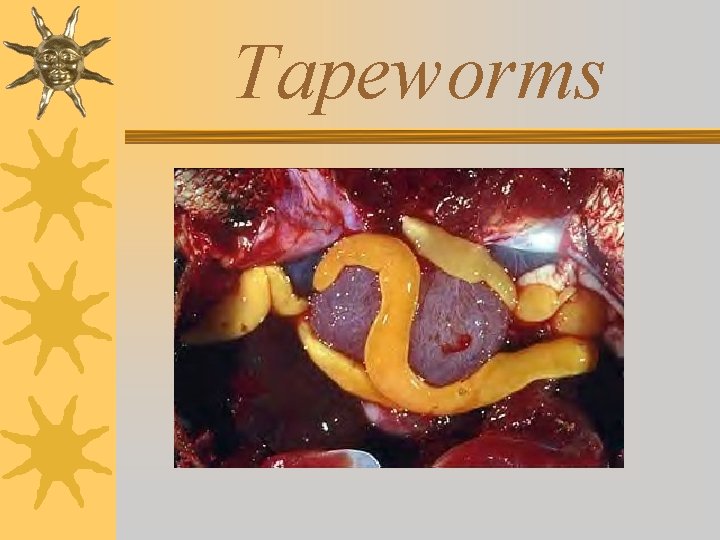
Tapeworms
A. Digestion · No mouth · No gastrovascular cavity · No digestive organs ¬Absorb nutrients directly from host’s digestive tract through its own tegument
B. Structure · Anterior is knob-shaped called scolex which has hooks and suckers · Short neck connects to proglottids (draw structure fig. 36 -5 p. 713) · As tapeworm grows, it adds new proglottids behind scolex, and pushes others behind · Can be 30 -35 ft. in length
C. Excretory ¬Out same manner as absorption
D. Nerves · No eyespots · No light sensitive structures ¬Have tegument which is close to environment
E. Reproduction · Hermaphrodites · Each proglottid contains both sex organs · Eggs stored in uterus ¬Oldest proglottids have most eggs (up to 100, 000) · Sperm from 1 proglottid fertilizes eggs from itself or another worm · Has 2 hosts *primary host is human *intermediate host is cow or pig ¬ Draw life cycle of tape worm transp. 150 or fig. 36 -6 p. 714