
Ch 36 Arthropods Phylum Arthropoda Means jointed legs



- Slides: 32
Ch. 36 - Arthropods Phylum: Arthropoda Means “jointed legs” 75% of all animals belong to this phylum Insects, lobsters, crabs, spiders, millipedes, & centipedes Video
Characteristics of Arthropods 1. Appendages – legs, antennae 2 appendages per segment 2. Open circulatory system 3. Digestive system 4. Ventral nervous system 5. Exoskeleton – protection & desiccation Made of chitin Video
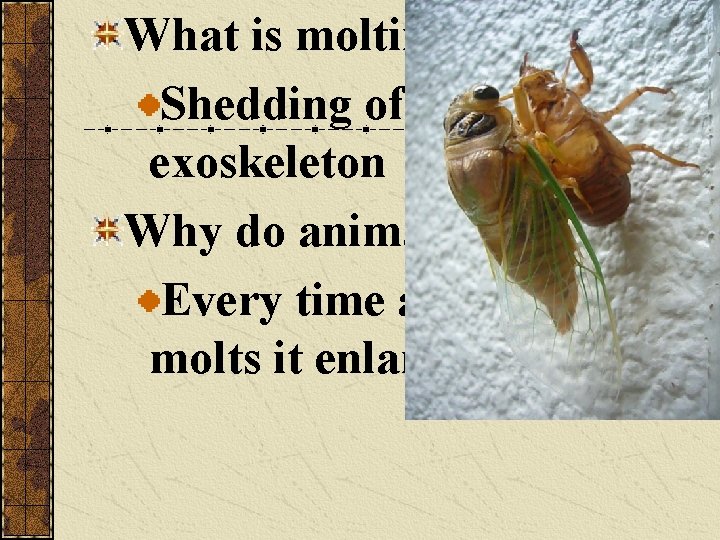
What is molting? Shedding of the exoskeleton Why do animals molt? Every time an animal molts it enlarges or grows
What are some advantages & disadvantages of molting? Protection, prevents desiccation Must molt to grow, vulnerable after it molts
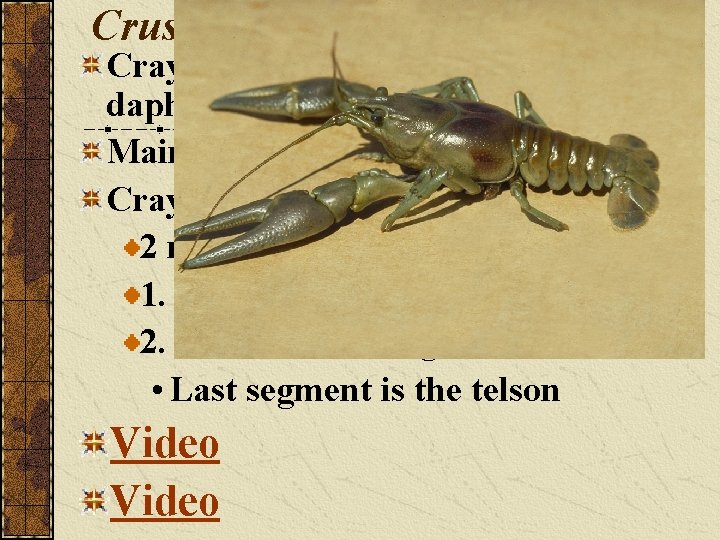
Crustacea subphylum Crayfish, lobsters, crab, sow bugs, daphnia. Mainly aquatic Crayfish Characteristics 2 main body parts 1. Cephalothorax – head & thorax 2. Abdomen – 7 segments • Last segment is the telson Video
Appendages of the Crayfish 1. Chelipeds – pinchers 2. Antennules – smaller (inside) 3. Antenna – larger (outside) 4. Walking legs – 4 along the thorax 5. Swimmerets – along the abdomen 6. Uropod – outside the telson
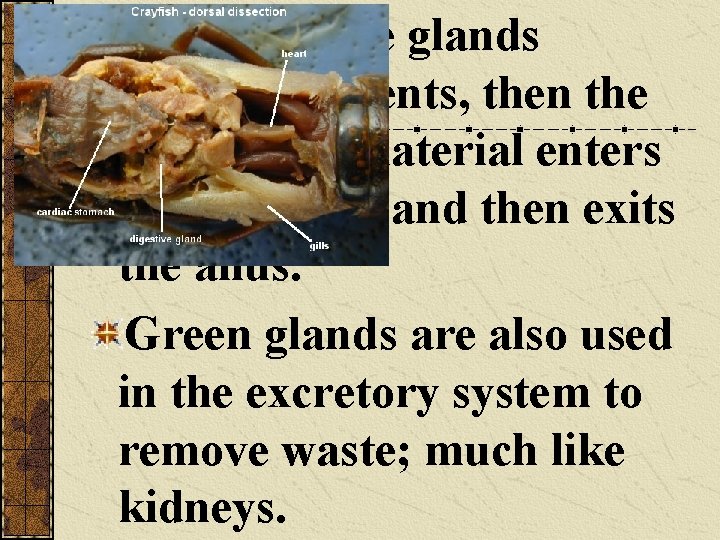
Digestive & Excretory Systems First the crayfish tears the food with their maxillae & maxillipeds. They chew their food with their mandibles The food passes through the esophagus to the stomach.
The digestive glands absorb nutrients, then the undigested material enters the intestine, and then exits the anus. Green glands are also used in the excretory system to remove waste; much like kidneys.
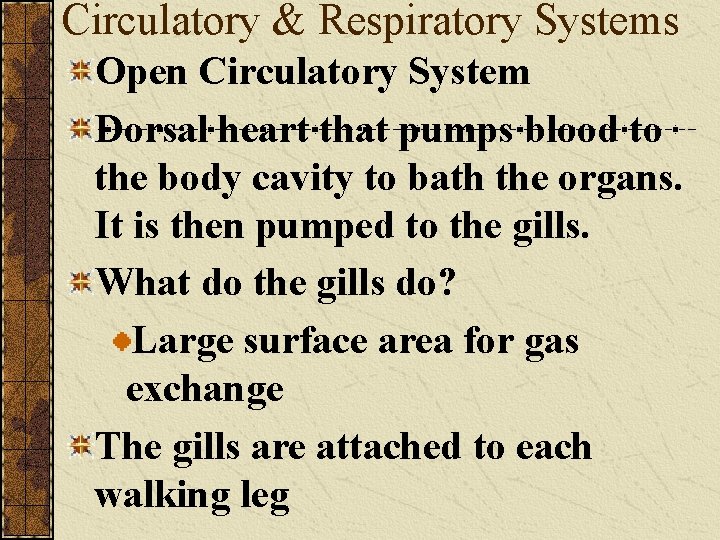
Circulatory & Respiratory Systems Open Circulatory System Dorsal heart that pumps blood to the body cavity to bath the organs. It is then pumped to the gills. What do the gills do? Large surface area for gas exchange The gills are attached to each walking leg
Nervous System Ventral nerve cord Brain Sense receptors antennules, antennae, & compound eyes A compound eye has many lenses Do you have a compound eye?
Reproductive System Usually mate in the fall The male uses its swimmerets to transfer sperm to the female, where she keeps the sperm until spring. The eggs are then fertilized and kept along the female’s swimmerets until they hatch.
Chelicerae - subphylum Class: Arachnida Spiders, mites, scorpions Many use stingers or fangs with poison. How do spiders catch their prey? with webs or “trap doors” Scorpions hunt at night and hide during the day. Video
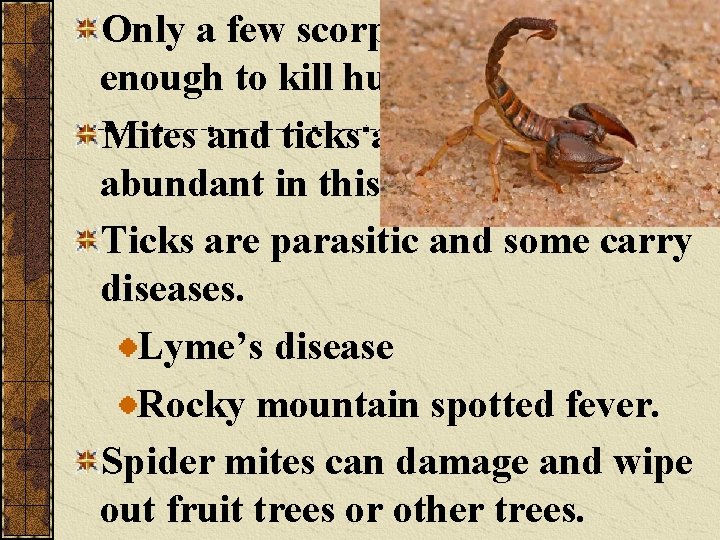
Only a few scorpions are poisonous enough to kill humans. Mites and ticks are the most abundant in this class. Ticks are parasitic and some carry diseases. Lyme’s disease Rocky mountain spotted fever. Spider mites can damage and wipe out fruit trees or other trees.
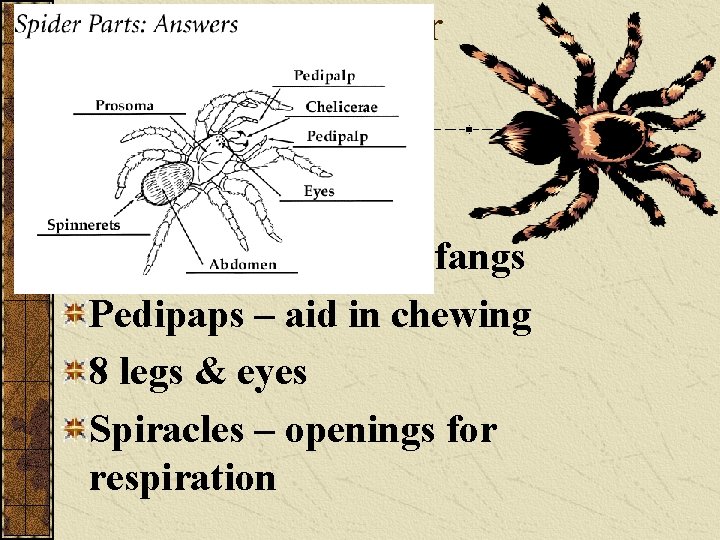
Structure of a spider 2 segments 1. Cephalothorax 2. Abdomen Chelicerae – hollow fangs Pedipaps – aid in chewing 8 legs & eyes Spiracles – openings for respiration
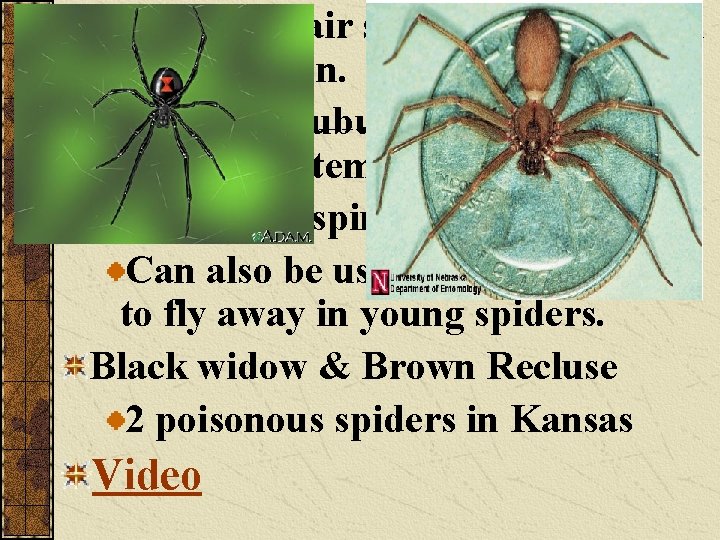
Book lung – air sacs in the abdomen for respiration. Malpighian tubules – kidney-like excretory system. Removes wastes. Spinnerets – spins silk for webs Can also be used as silk balloons to fly away in young spiders. Black widow & Brown Recluse 2 poisonous spiders in Kansas Video
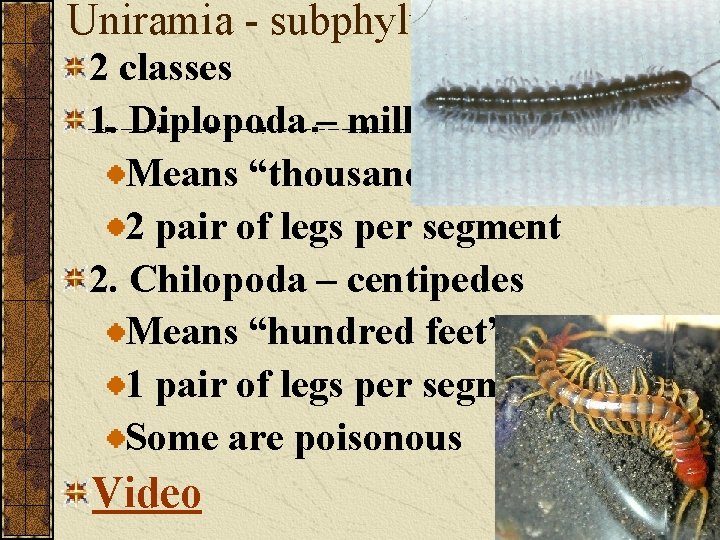
Uniramia - subphylum 2 classes 1. Diplopoda – millipedes Means “thousand feet” 2 pair of legs per segment 2. Chilopoda – centipedes Means “hundred feet” 1 pair of legs per segment Some are poisonous Video
Insects – 2 nd Part of Ch. 39 Most diverse and largest number of species of any class of organism. They were present on earth before the dinosaurs, over 300 million years ago. Differences from other arthropods 1. 3 body segments head, thorax, abdomen Video
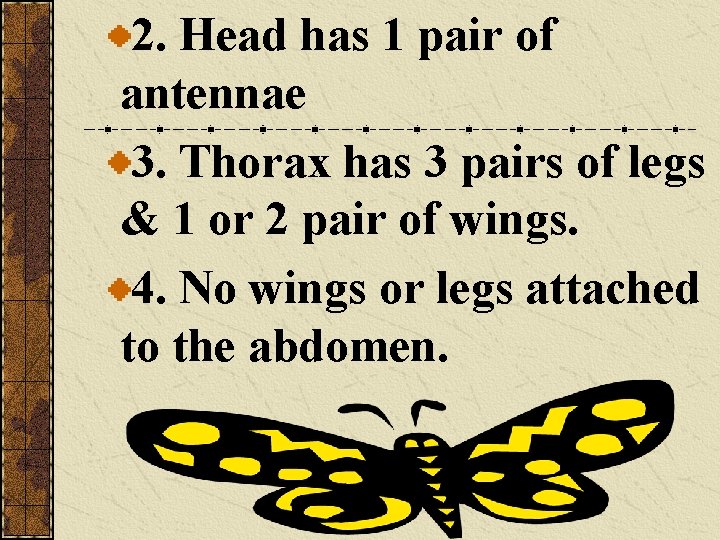
2. Head has 1 pair of antennae 3. Thorax has 3 pairs of legs & 1 or 2 pair of wings. 4. No wings or legs attached to the abdomen.
Kingdom: Animalia Phylum: Arthropoda • Class: Insecta (700, 000 + species named) What makes insect so successful? Lots of them – adapt very well Great diversity – several types Reproduce rapidly Small size & ability to fly (most)
Benefit of insects? 1. Pollination – plants can’t reproduce without insects. We need plants to survive. 2. Food – for other animals. Several animals rely on insects as a source of food. 3. Industrial uses – silk & honey What is the study of insects called? (E. C) Entomology Video
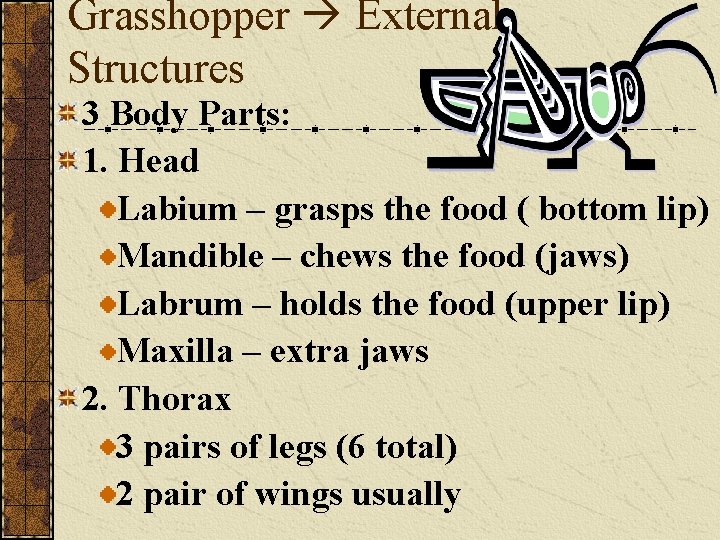
Grasshopper External Structures 3 Body Parts: 1. Head Labium – grasps the food ( bottom lip) Mandible – chews the food (jaws) Labrum – holds the food (upper lip) Maxilla – extra jaws 2. Thorax 3 pairs of legs (6 total) 2 pair of wings usually
3 parts to the thorax 1. Prothorax – pair of walking legs 2. Mesothorax. – pair of walking legs 3. Metathorax – pair of jumping legs Forewings are attached to the mesothorax Hindwings are attached to the metathorax
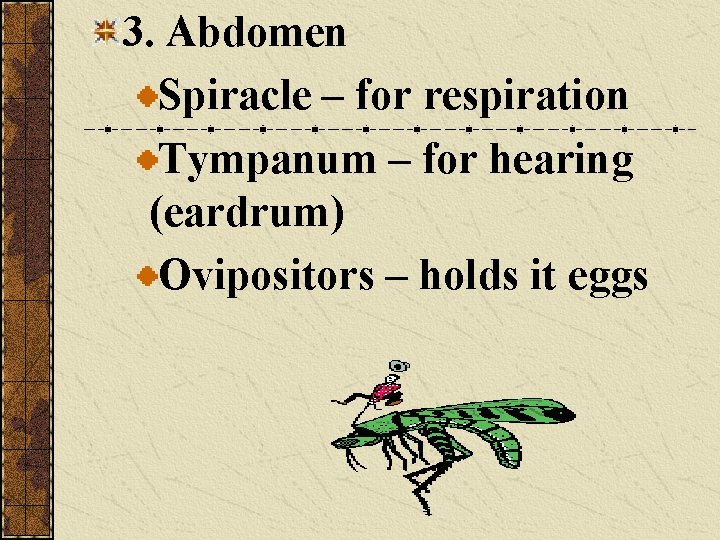
3. Abdomen Spiracle – for respiration Tympanum – for hearing (eardrum) Ovipositors – holds it eggs
Grasshopper Internal Structures Digestive System What do grasshoppers eat? What are the mouth parts? Food passage: esophagus crop (storage) gizzard (grind) midgut (digested) hindgut (rectum & colon) out the anus
Circulatory System Open Circulatory System An aorta is a large vessel that carries the blood on the dorsal side. 2 Hearts along the aorta
Respiratory System No lungs or gills Use spiracles – openings along the abdomen The spiracles lead to the trachea Nervous System Brain connected to a ventral nerve cord Has simple and complex eyes
Have antennae Tympanum for sensing sound Reproductive System The male deposits sperm into the seminal receptacle, which stores the sperm. The female uses its ovipositors to deposit her eggs in the ground.
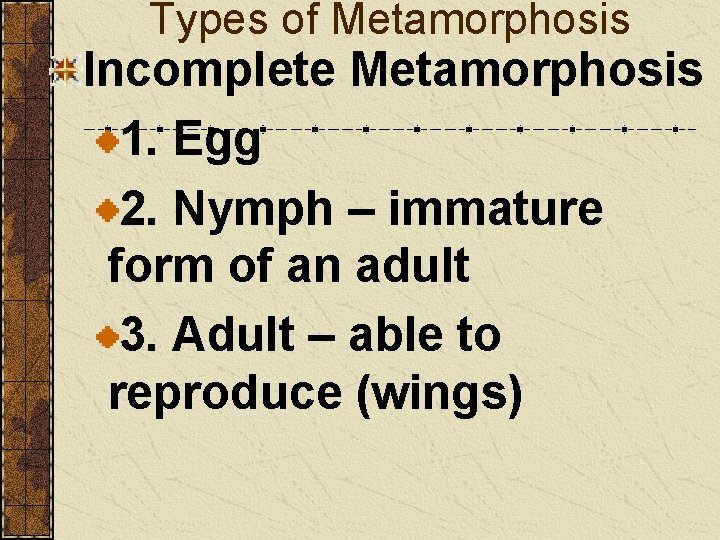
Types of Metamorphosis Incomplete Metamorphosis 1. Egg 2. Nymph – immature form of an adult 3. Adult – able to reproduce (wings)
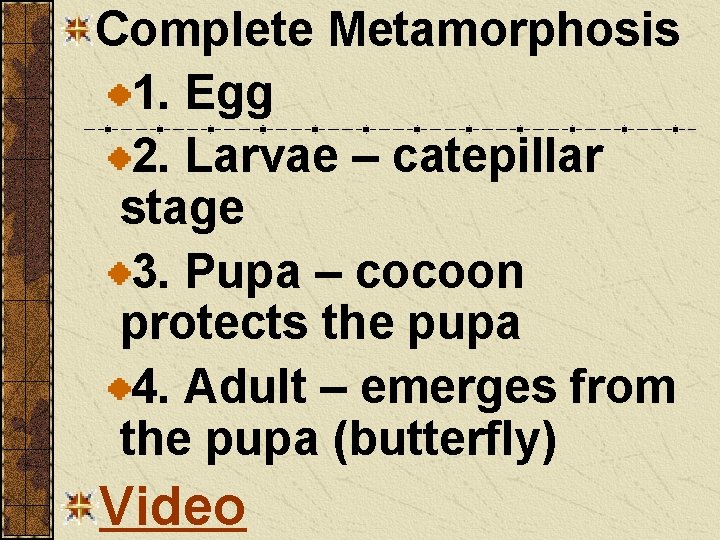
Complete Metamorphosis 1. Egg 2. Larvae – catepillar stage 3. Pupa – cocoon protects the pupa 4. Adult – emerges from the pupa (butterfly) Video
Defenses of Insects What ways do insects use defenses? 1. Stinger or bite – bee, wasp, ants 2. Camouflage – blend into their surroundings. Ex. Grasshopper, praying manthesis Video 3. Warning coloration – alert other animals that the insect might be poisonous.
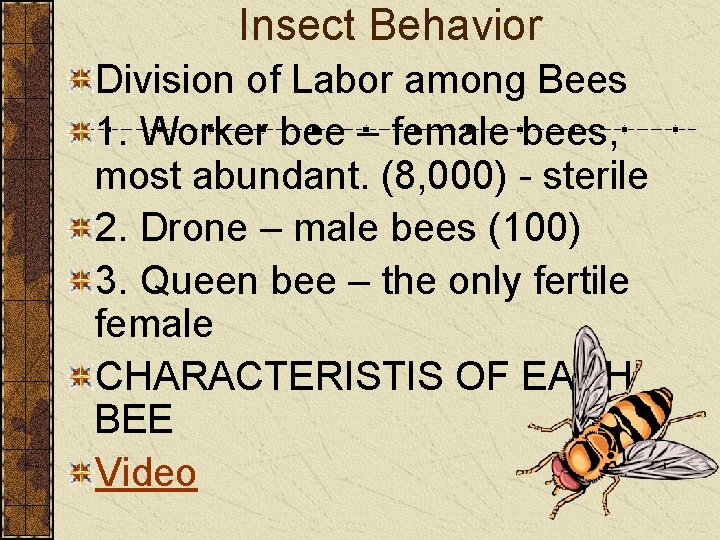
Insect Behavior Division of Labor among Bees 1. Worker bee – female bees, most abundant. (8, 000) - sterile 2. Drone – male bees (100) 3. Queen bee – the only fertile female CHARACTERISTIS OF EACH BEE Video
The worker bee produces royal jelly to feed the queen bee The worker also secretes wax to make the hive. The produces a pheromone called queen factor, which makes the other females sterile. Round Dance – tells the other bees food is within 50 meters Waggle Dance – tells the other bees food is greater than 50 meters.