
Ch 34 Animal Behavior Review Game The set

Ch. 34 Animal Behavior Review Game
The set of reactions of an organism to changes in its internal condition or external environment is called • A behavior • B learning • C conditioning • D stimuli • Ans: A
Light, sound, and temperature are examples of • A responses • B behaviors • C circadian rhythms • D external stimuli • Ans: D
A dog learns to expect food whenever a bell is rung. This is an example of • A insight learning • B classical conditioning • C migration • D instinct • Ans: B
A decrease in response to a stimulus that neither rewards nor harms an animal is called • A classical conditioning • B operant conditioning • C habituation • D instinct • Ans: C

Insight learning is common among • A dogs • B primates • C birds and insects • D birds only • Ans: B
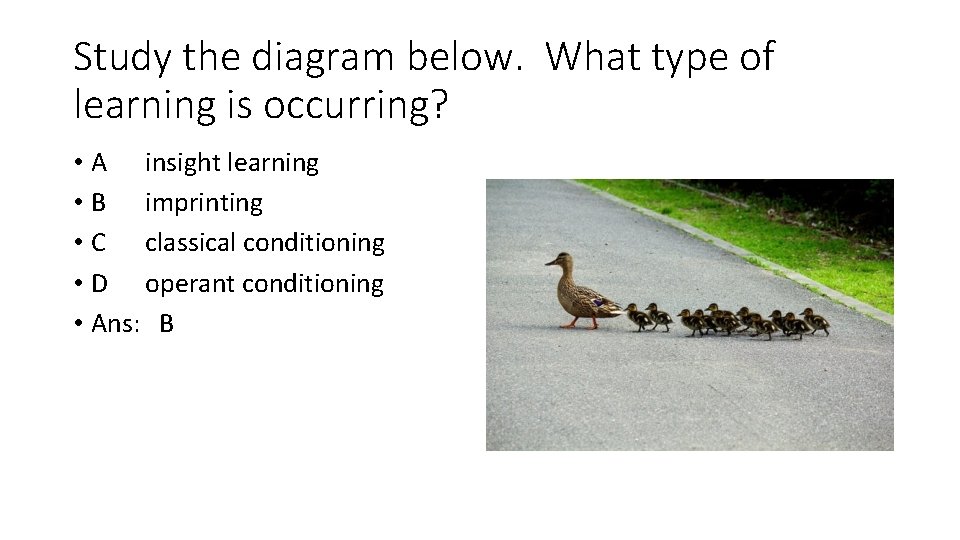
Study the diagram below. What type of learning is occurring? • A insight learning • B imprinting • C classical conditioning • D operant conditioning • Ans: B
The fact that you sleep at night and attend school during the day is an example of a(an) • A migration • B circadian rhythm • C aggressive behavior • D social behavior • Ans: B
Each year, a bird called the American redstart travels from its winter home in South America to its nesting area in New York. This behavior is called • A migration • B competition • C imprinting • D courtship • Ans: A
Which of the following is NOT a type of social behavior? • A operant conditioning • B communication • C hunting in a pack • D courtship • Ans: A
A system of communication that uses meaningful sounds, symbols, or gestures according to specific rules is called • A behavior • B language • C competition • D a signature • Ans: B
A rat learns to press a button to get food • A insight learning • B operant conditioning • C classical conditioning • D habituation • Ans: B
A dog always salivates at the ringing of a bell. • A insight learning • B operant conditioning • C classical conditioning • D habituation • Ans: C
A chimpanzee stacks boxes in order to reach a banana hanging from the ceiling. • A insight learning • B operant conditioning • C classical conditioning • D habituation • Ans: A
A bird stops responding to a repeated warning call when it is not followed by an attack • A insight learning • B operant conditioning • C classical conditioning • D habituation • Ans: D
Which kind of behavior does not involve learning? • A habituation • B trial and error • C imprinting • D instinct • Ans: D
male red-bellied sticklebacks and models of fishes that have a red underside. It will not attack males or models lacking a red underside. What can you conclude from the three-spined stickleback’s behavior? • A the stimulus for an attack is a red underside • B the stimulus for an attack is aggression • C the stimulus for an attack is the presence of a fish with red fins • D the stimulus for an attack is the presence of a fish model • Ans: A •
Which of the following is NOT an innate behavior? • A a dog looking for its food dish • B a baby mammal suckling milk • C a worm moving away from bright light • D a spider spinning a web • Ans: A
A woman moves into a house by a railroad track. After a couple weeks, she no longer notices the sound of the train. Her reaction is an example of • A operant conditioning • B habituation • C imprinting • D insight learning • Ans: B
- Slides: 19