
Ch 33 Politics of Boom and Bust AP
Ch. 33: Politics of Boom and Bust AP US History
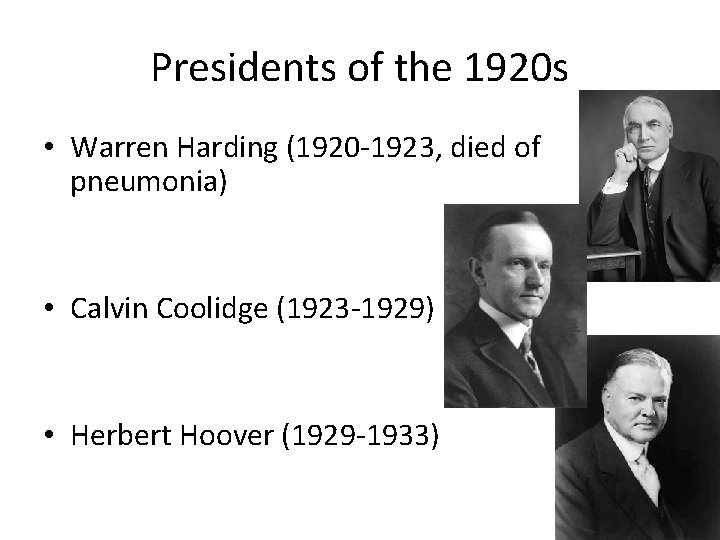
Presidents of the 1920 s • Warren Harding (1920 -1923, died of pneumonia) • Calvin Coolidge (1923 -1929) • Herbert Hoover (1929 -1933)
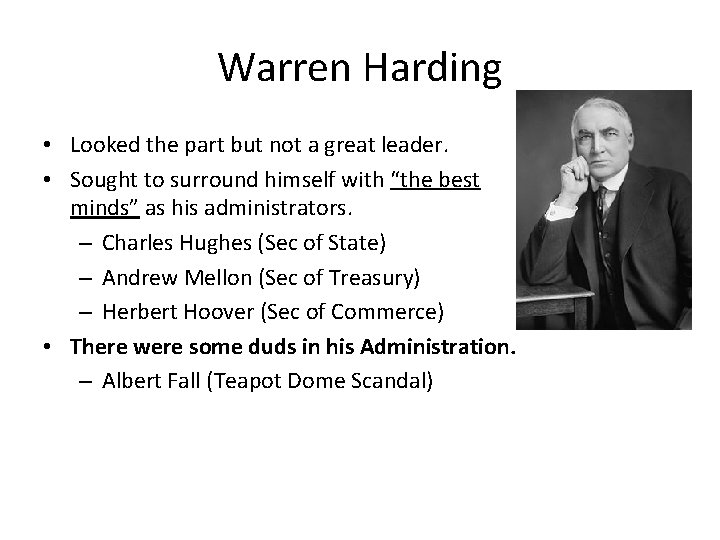
Warren Harding • Looked the part but not a great leader. • Sought to surround himself with “the best minds” as his administrators. – Charles Hughes (Sec of State) – Andrew Mellon (Sec of Treasury) – Herbert Hoover (Sec of Commerce) • There were some duds in his Administration. – Albert Fall (Teapot Dome Scandal)
The Aftermath of War • With the War over, the government stepped back and away from business intervention. – EX: RR went back to private ownership – Gov got out of shipping (Merchant Marine Act 1920) – Who will suffer from the governments pro-business policies? • Labor = strikes – Group that benefited from the Harding’s Administration were the VETERNS • Sought lost wages from war • Adjusted Compensation Act (Congress passed during Coolidge)
America Seeks Benefits W/O Burdens 1. “Unofficial observers” were sent to League of Nations to keep an eye on things. • Lack of US participation doomed L of N. 2. Harding saw need for oil • Harding secured oil rights in Middle East 3. Disarmament Conference 1921 -22 • • Japan and Britain were in a ship-building race Charles Hughes suggests ratio of ships at 5: 5: 3 (US: Britain: Japan) – RESULSTS IN SEVERAL TREATIES
America Seeks Benefits W/O Burdens • Disarmament Treaties: 1. Five-Power Treaty: set up 5: 5: 3: 1. 7 ratio and gave Japan a bonus to save face – US, Britain, Japan, France, and Italy 2. Four-Power Treaty: required Britain, Japan, France and the US to keep status quo in Pacific 3. Nine-Power Treaty: Kept open the Open Door Policy with China (Free trade for all) – Problems: 1. no limit on small ships 2. US agreed to Four-Power treaty but not bound to it.
America Seeks Benefits W/O Burdens • “War to End All Wars” = international trend to end all warfare – 1928 Kellogg-Briand Pact: • Outlawed War • 62 Nations signed this treaty • Under Administration of Calvin Coolidge (Frank Kellogg) • While a “beautiful idea” it was very unrealistic! – No provision for enforcement, nor provision for defensive war
Tariff Issues • Businesses wanted a higher tariff to protect themselves from foreign trade – Fordney-Mc. Cumber Tariff: increased tariff from 27% to 38. 5% • Harding/Coolidge had the okay to raise it up to 50% • PROBLEM: Europe needed to export to pay war debts back to US. High tariff = no payments
The Stench of Scandal • Harding’s gullibility and trust led to many scandals amongst his administration. (Not himself) • Teapot Dome Scandal 1923: – Sec. of Interior Albert Fall managed natural resources. – Oil was discovered in “Teapot Dome” Wyoming – Fall accepted bribes for oil drilling rights from Edward Doheny and Harry Sinclair (total $400, 000) • Harry Daugherty: – -possibly sold pardons and liquor permits (during prohibition) • Scandal led the public to not trust the courts or government – Scandals cost a lot and sentences were weak!

Teapot Dome Scandal
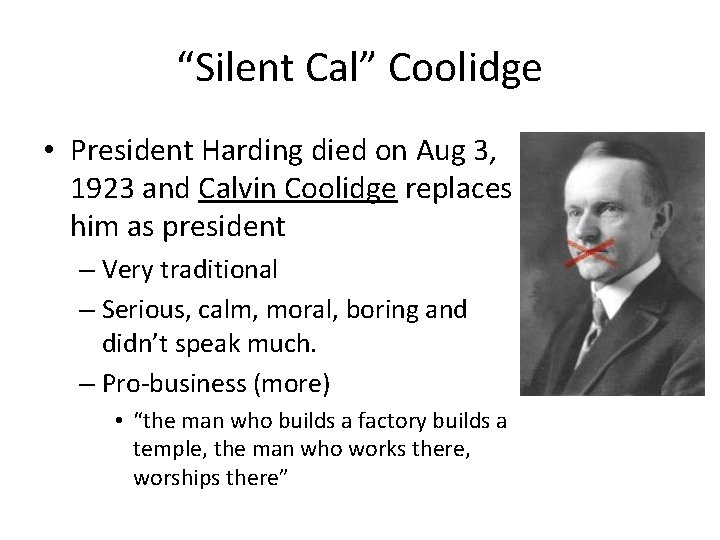
“Silent Cal” Coolidge • President Harding died on Aug 3, 1923 and Calvin Coolidge replaces him as president – Very traditional – Serious, calm, moral, boring and didn’t speak much. – Pro-business (more) • “the man who builds a factory builds a temple, the man who works there, worships there”
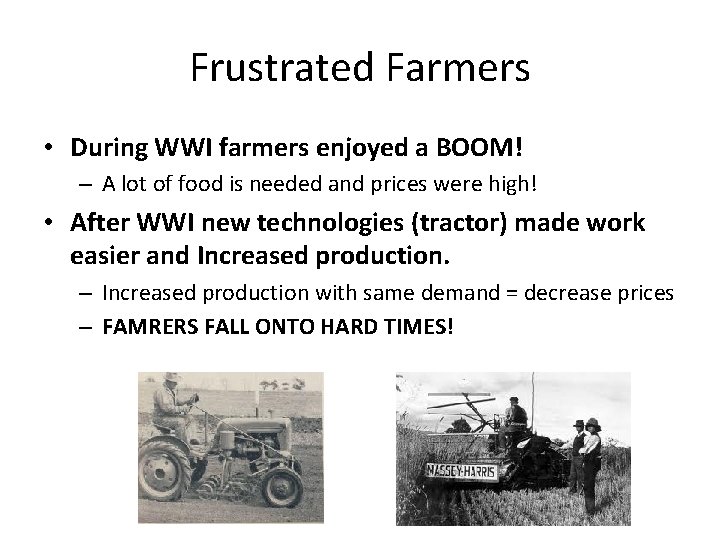
Frustrated Farmers • During WWI farmers enjoyed a BOOM! – A lot of food is needed and prices were high! • After WWI new technologies (tractor) made work easier and Increased production. – Increased production with same demand = decrease prices – FAMRERS FALL ONTO HARD TIMES!
Frustrated Farmers • Farmers turn to Congress for help… • Capper-Vostead Act: exempted farmers cooperatives from antitrust laws. • Mc. Nary-Haugen Bill: tried to keep the price of agricultural goods high. NEVER PASSED: Coolidge to conservative/thrifty – Government would buy excess surplus and selling to other nations.
Foreign Policy Flounderings • Isolationalism is the rule of thumb during the 1920 s – US still would not join the League of Nations (World Court) – US was involved in Latin America – European debt was a touchy issue but they couldn’t pay anyway.
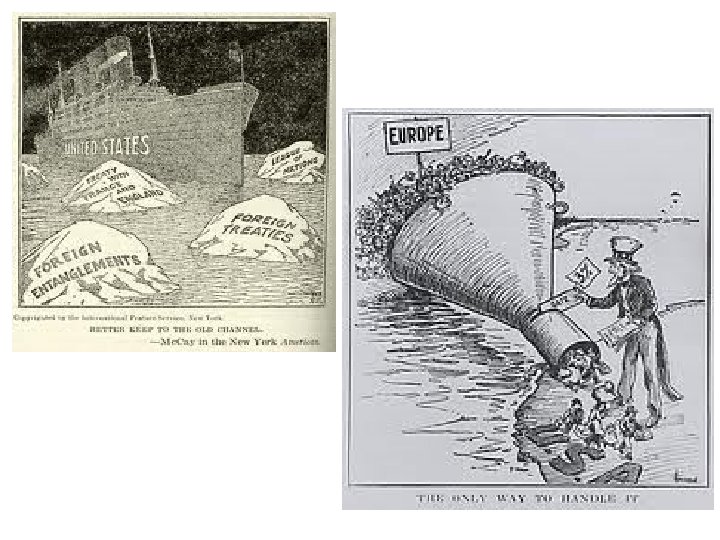
Unraveling the Debt Knot • Britain and France owe large amounts of war debt to the US after WWI – Can’t pay it back – Germany printed more money to pay debts which caused enormous inflation. – Coolidge wouldn’t forgive the debt even though France and Britain demanded it. • Dawes Plan: – – America would loan money to Germany would make payments to Britain and France would repay loans This is a big circle but at least on paper the debts are being paid
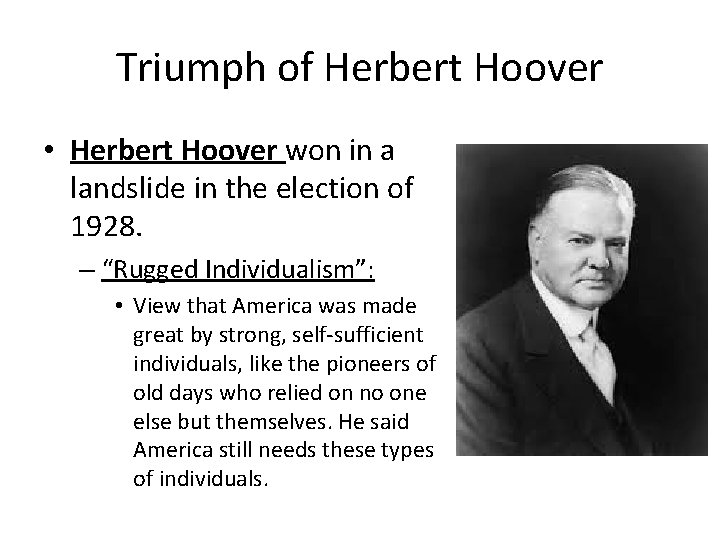
Triumph of Herbert Hoover • Herbert Hoover won in a landslide in the election of 1928. – “Rugged Individualism”: • View that America was made great by strong, self-sufficient individuals, like the pioneers of old days who relied on no one else but themselves. He said America still needs these types of individuals.
President Hoover’s First Moves • America is still prosperous at the beginning of Hoover’s election. – He promoted the strengthen of agriculture with the Agricultural Marketing Act • Federal Farm Board: – Lent money to farmers in need – Stabilized the price of grain (Surplus purchasing to keep price high)
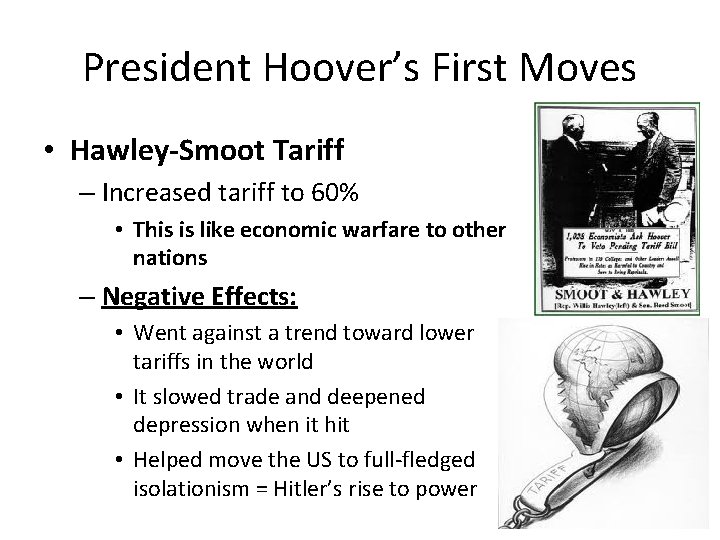
President Hoover’s First Moves • Hawley-Smoot Tariff – Increased tariff to 60% • This is like economic warfare to other nations – Negative Effects: • Went against a trend toward lower tariffs in the world • It slowed trade and deepened depression when it hit • Helped move the US to full-fledged isolationism = Hitler’s rise to power
Great Crash Ends the Golden Twenties • US grew “drunk” on prosperity and didn’t think it would come to an end • Causes of the Great Depression: 1. Stock Market Crash (TRIGGER) • “Black Tuesday”: October 29, 1929 • 25% decrease in three days ($30 Billion) • $40 Billion loss by end of 1929 2. Banks Failures 3. Over production 4. Economic relations with Europe • Hawley-Smoot Tariff 5. Drought
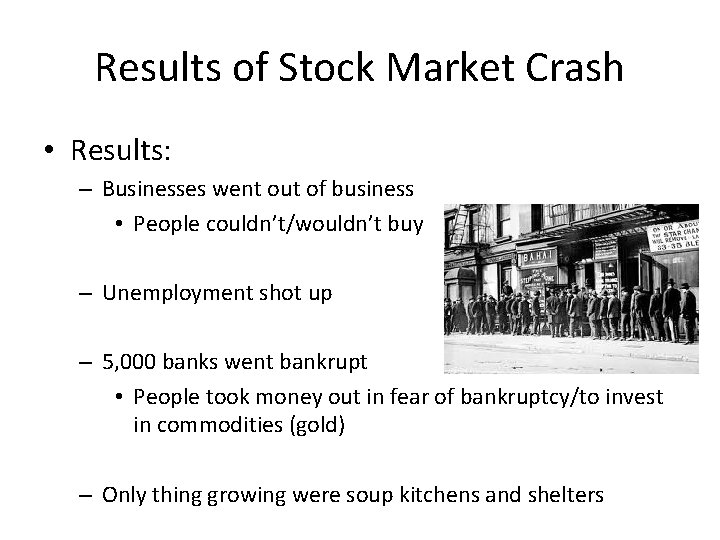
Results of Stock Market Crash • Results: – Businesses went out of business • People couldn’t/wouldn’t buy – Unemployment shot up – 5, 000 banks went bankrupt • People took money out in fear of bankruptcy/to invest in commodities (gold) – Only thing growing were soup kitchens and shelters
Rugged Times for Rugged Individualists • Hoover took the blame like all presidents during hard times. – Problem: He’s belief in rugged individualism made him slow to take any government action (Handouts) – Solution: Just wait it out • He believed this was just part of the “business cycle”: ups and downs of an economy – Hoover did eventually go against his nature and get the government to take some action
Hoover Battles the Great Depression • President Hoover got Congress to dole out $2. 25 Billion to jumpstart the economy. – EX: Hoover Dam: started in 1930 and finished in 1936 – Reconstruction Finance Corporation (RFC): Hoover’s most far-reaching effort to help the nation (financial) • Lent money to finance the massive government projects of FDR’s “New Deal”
Effect of Hoover • Despite his slogan of “rugged individualism”, belief in the business cycle and laissez-faire economics, and something of a reputation for not caring about people, Hoover did get the government involved in fighting the Great Depression. Just later rather then sooner.
Routing the Bonus Army in Washington • Bonus Expeditionary Force 1932 – 20, 000 WWI veterans who marched on Washington D. C. – Objective: Demand their promised bonus be paid as WWI Veterans – Result: President Hoover used force to disband the army. • • Gen. George Mac. Arthur “Battle of Anacostia Flats” Used bayonets, tear gas and fire to move the BEF out This hurt Hoover’s image even more
- Slides: 25