
Ch 3 WAN Design Laboratorium Telematika ITB Cisco

Ch 3. WAN Design Laboratorium Telematika - ITB Cisco Regional Networking Academy Semester 4 Version 2. 1. 2 Duration: 75 minutes
WAN Design Requirements n n WAN is usually a paid service The three requirements of WAN Design: u Optimize bandwidth u Minimize cost u Maximize effective service n With an expected increase of traffic up to 300% for the next 5 years, there will be greater pressure to contain WAN costs
WAN & LAN Differences n LAN — bandwidth is free u Connectivity limited only by hardware and implementation cost u Delay relatively insignificant n WAN — bandwidth has cost u Delay is significant — delay-sensitive traffic (e. g. voice) is usually separate from data n Main issue: Qo. S (Quality of Service) u The (subjective) measure of service quality in terms of delay, bandwidth, and jitter
Primary Goals of WAN Design n Application Availability u In other words, the network must do its job: carry data n Total Cost of Ownership u As WAN is used more and more, cost will increase u Bandwidth used must be optimized u Cost-effectiveness must be increased n VERY VITAL: Traffic characterization

Three General WAN Factors n Environmental variables u Location of hosts, servers, terminals u Projected traffic & costs n Performance constraints u Network n reliability, throughput, host speeds Networking variables u Topology, line capacities, packet traffic
First Step: Gather Information n n Business structure & process Who are the key people Who are the major users & where are they What are the current applications & projected needs What is the dominant component of availability u Response time – e. g. ATM, POS u Throughput – e. g. file transfer (usually high response time) u Reliability – e. g. financial services, security exchanges, police, military
Ways to Gather Information n n User community profile — determine requirements of groups Interviews, focus groups, surveys u Interview with everyone – time-consuming u Interview with key groups – least formal n Human factor test — trial run using sample of users on test implementation
Step Two: Analyze Requirements n n Will there be new networks/applications? What are the success criteria? u What is the availability definition – different for each user! n Analyze and predict average and peak data rates u If necessary, use a test network u Remember: peak varies throughout time u Remember: different traffic, different sensitivity demands on the network u Remember: random nature of network traffic
Step Three: Design n Hierarchical design uses the “layers” concept u Simplifies the design task u Simplifies internetworking u Facilitate changes u Help identify failure points & troubleshooting n Usually divided into three layers u The core layer provides optimal transport between sites u The distribution layer provides policy-based connectivity u The access layer provides workgroup and user access to the network
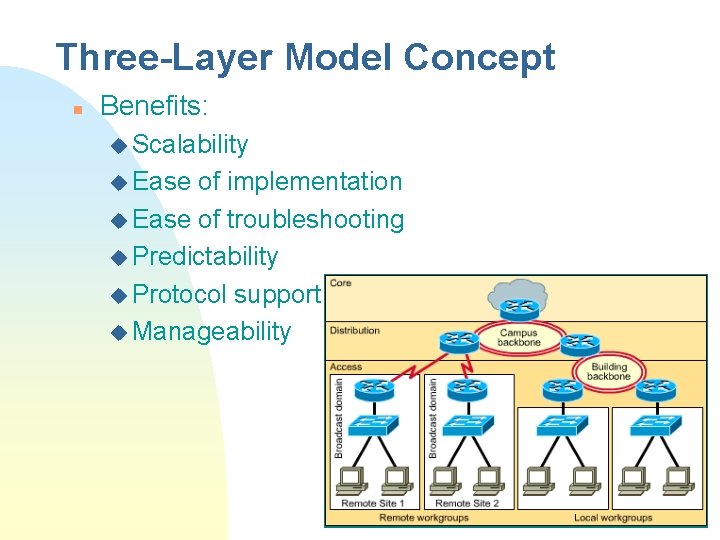
Three-Layer Model Concept n Benefits: u Scalability u Ease of implementation u Ease of troubleshooting u Predictability u Protocol support u Manageability

The End
- Slides: 12