
Ch 28 Current and Conductivity Current Motion of
- Slides: 27
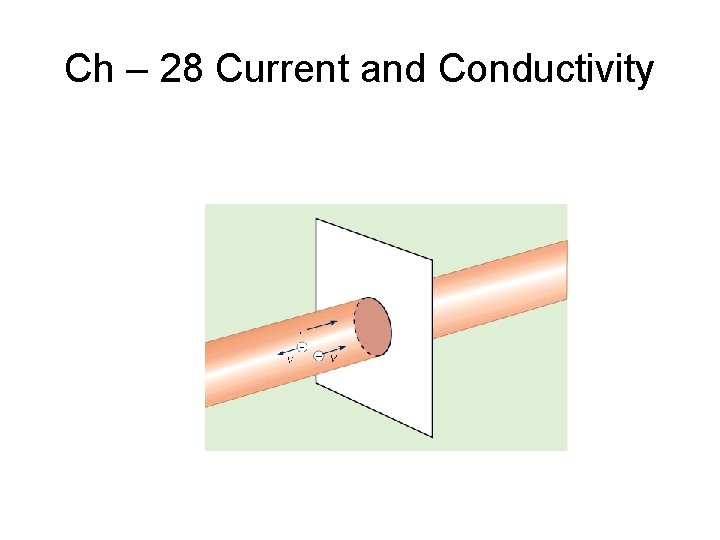
Ch – 28 Current and Conductivity
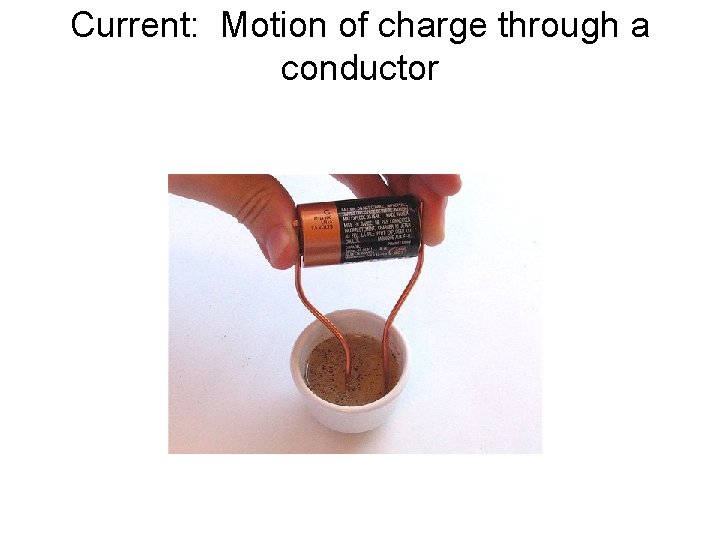
Current: Motion of charge through a conductor
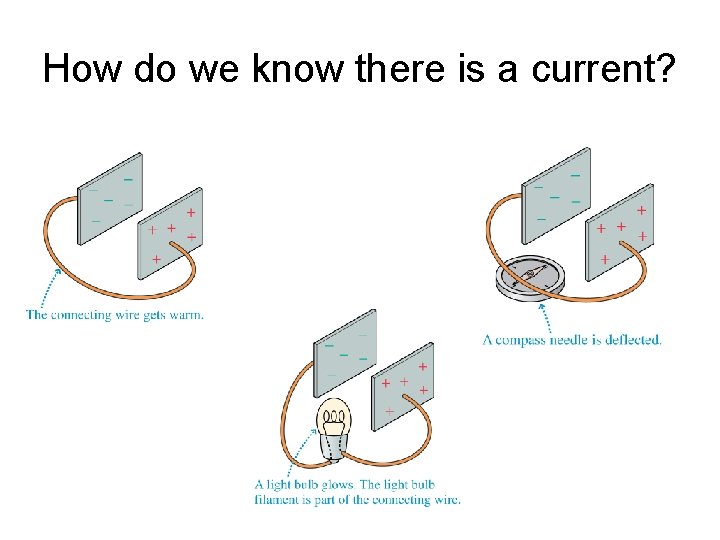
How do we know there is a current?
Charge carriers • 18 th century: Franklin and others developed the single fluid theory of electricity. Electricity flows from a body with an excess of charge (positive) to one with a deficit of charge (negative). • Theories of electricity advanced with the assumption of a positive charge carrier. • 19 th century: Thompson and others suggested that negatively-charged electrons were the charge carriers, in a conductor. • Confirmed by Tolson and Stewart in 1916 • Most engineering applications still assume positive charge carriers (aka electron holes)
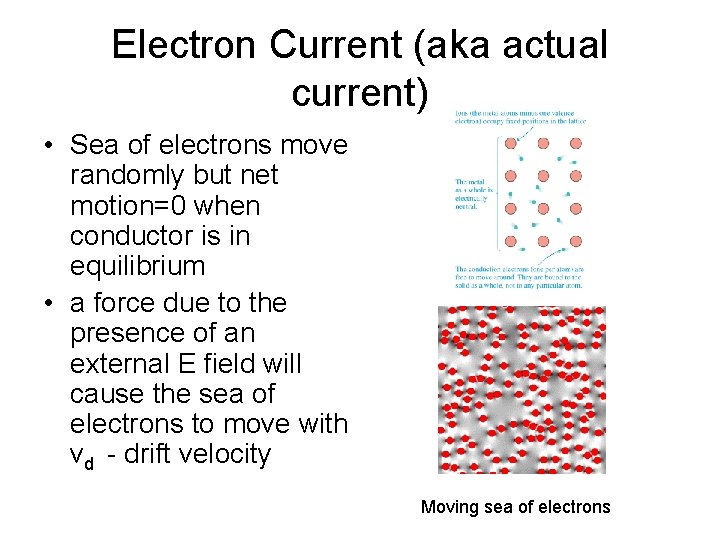
Electron Current (aka actual current) • Sea of electrons move randomly but net motion=0 when conductor is in equilibrium • a force due to the presence of an external E field will cause the sea of electrons to move with vd - drift velocity Moving sea of electrons
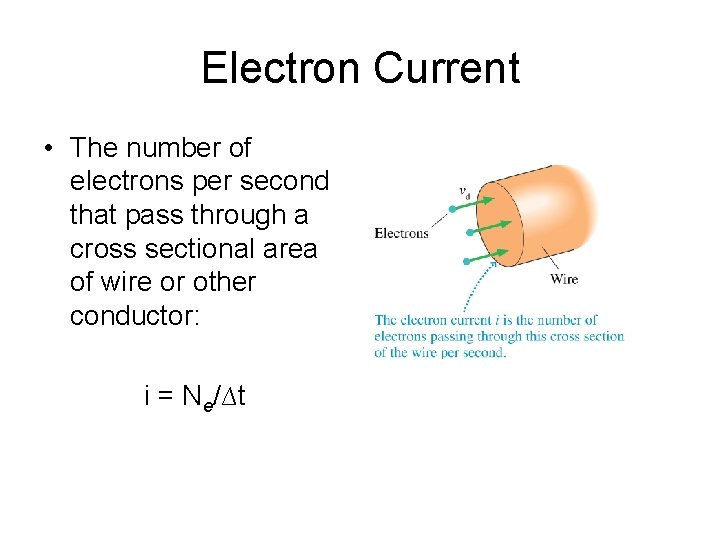
Electron Current • The number of electrons per second that pass through a cross sectional area of wire or other conductor: i = Ne/∆t
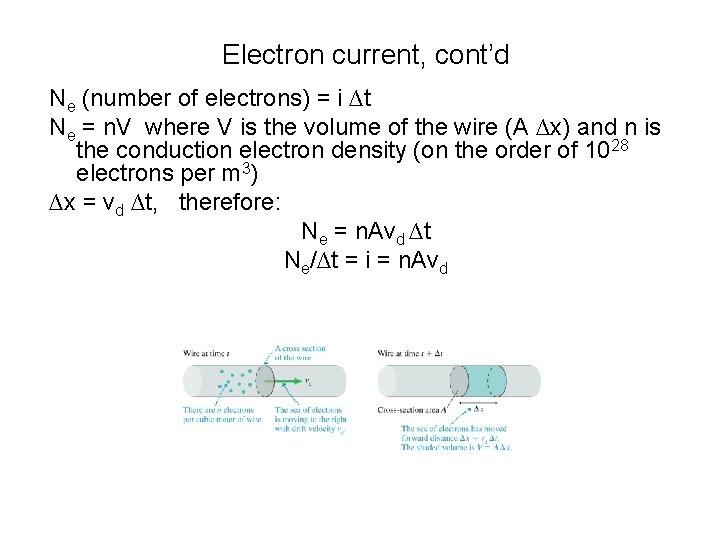
Electron current, cont’d Ne (number of electrons) = i ∆t Ne = n. V where V is the volume of the wire (A ∆x) and n is the conduction electron density (on the order of 1028 electrons per m 3) ∆x = vd ∆t, therefore: Ne = n. Avd ∆t Ne/∆t = i = n. Avd
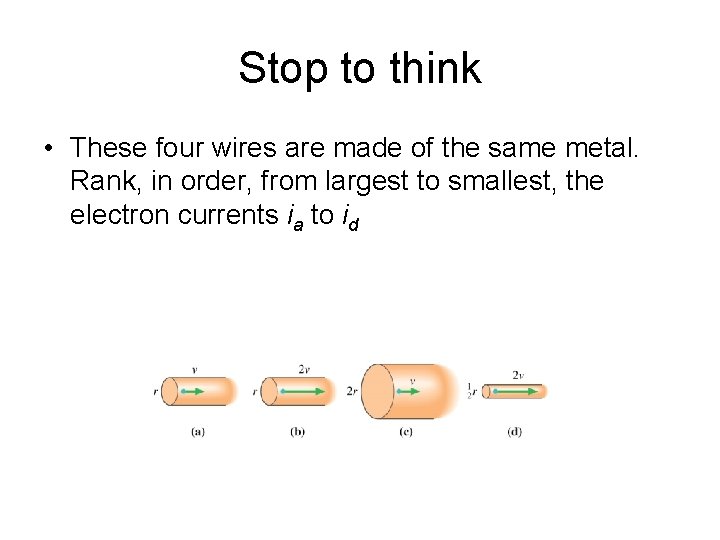
Stop to think • These four wires are made of the same metal. Rank, in order, from largest to smallest, the electron currents ia to id
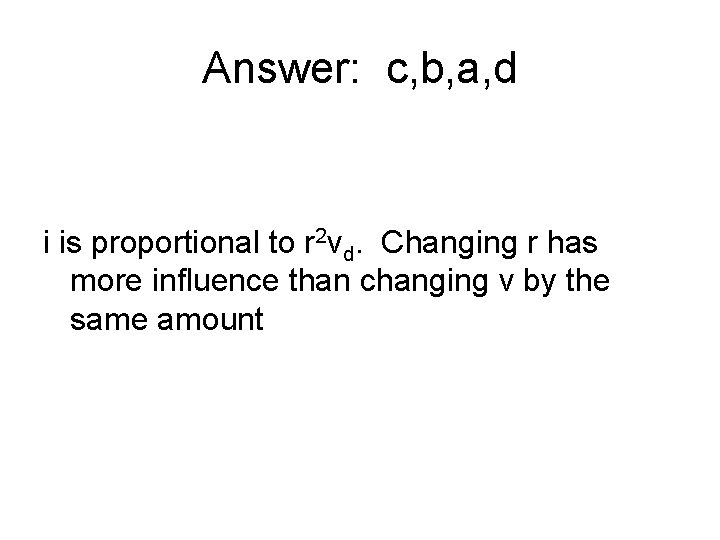
Answer: c, b, a, d i is proportional to r 2 vd. Changing r has more influence than changing v by the same amount
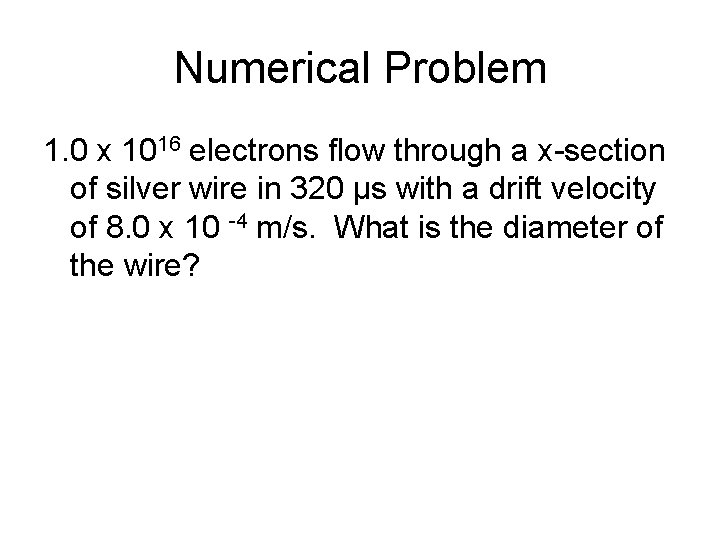
Numerical Problem 1. 0 x 1016 electrons flow through a x-section of silver wire in 320 μs with a drift velocity of 8. 0 x 10 -4 m/s. What is the diameter of the wire?
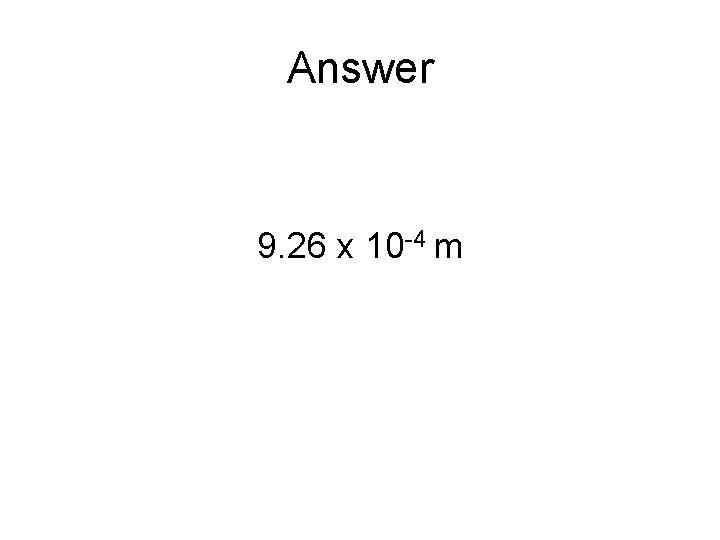
Answer 9. 26 x 10 -4 m
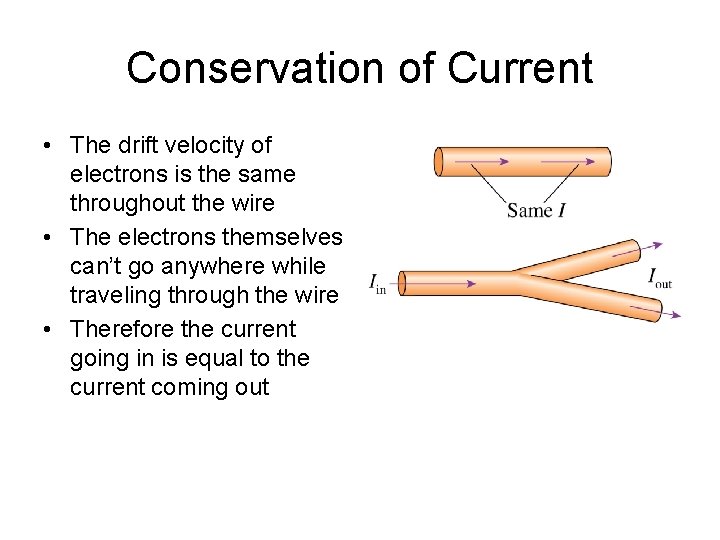
Conservation of Current • The drift velocity of electrons is the same throughout the wire • The electrons themselves can’t go anywhere while traveling through the wire • Therefore the current going in is equal to the current coming out
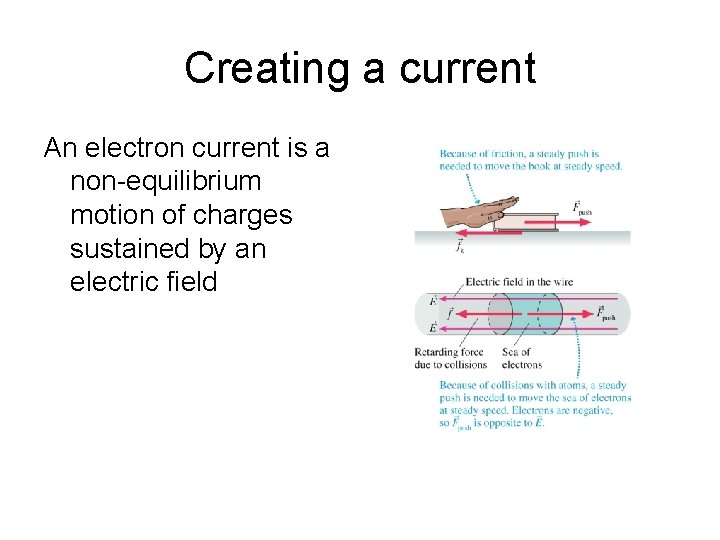
Creating a current An electron current is a non-equilibrium motion of charges sustained by an electric field
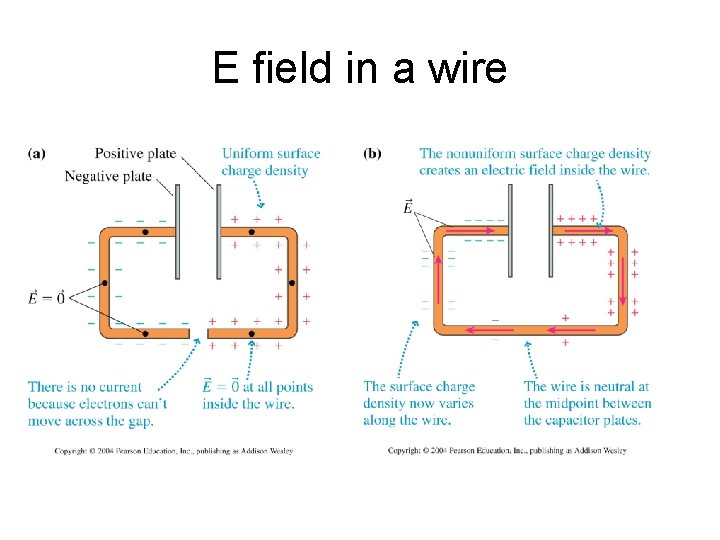
E field in a wire
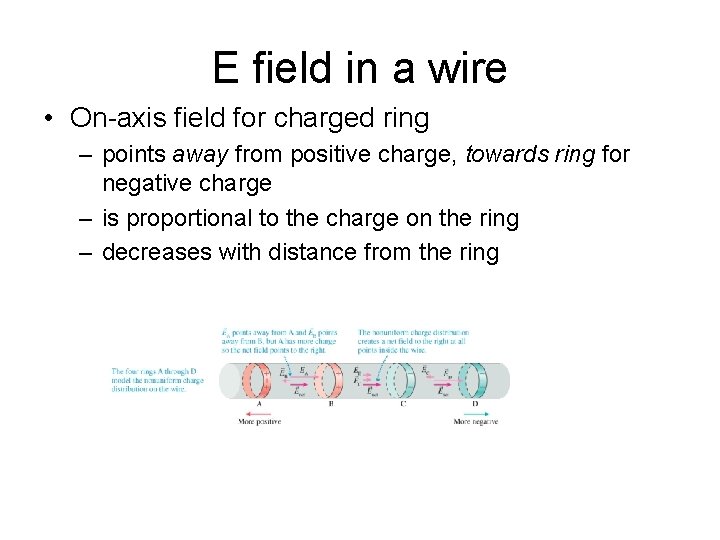
E field in a wire • On-axis field for charged ring – points away from positive charge, towards ring for negative charge – is proportional to the charge on the ring – decreases with distance from the ring
Stop to think# 2, page 886 in text
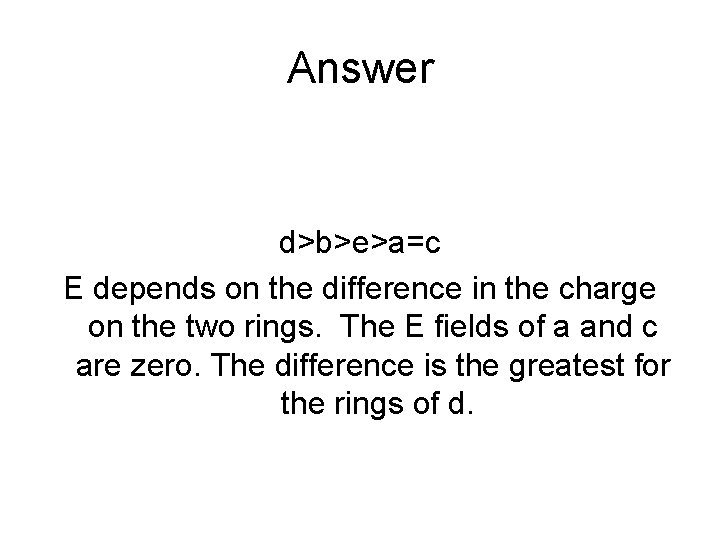
Answer d>b>e>a=c E depends on the difference in the charge on the two rings. The E fields of a and c are zero. The difference is the greatest for the rings of d.
Problem • What is the surface charge density of a 1. 0 mm-diameter wire with 1000 excess electrons per cm of length?
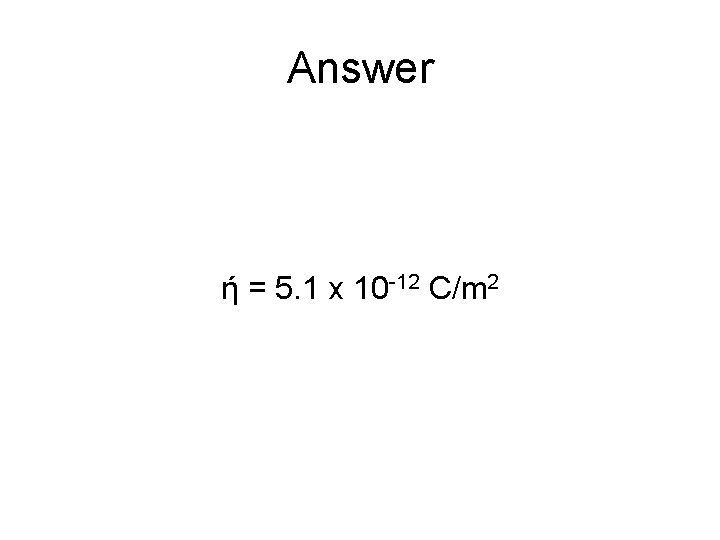
Answer ή = 5. 1 x 10 -12 C/m 2
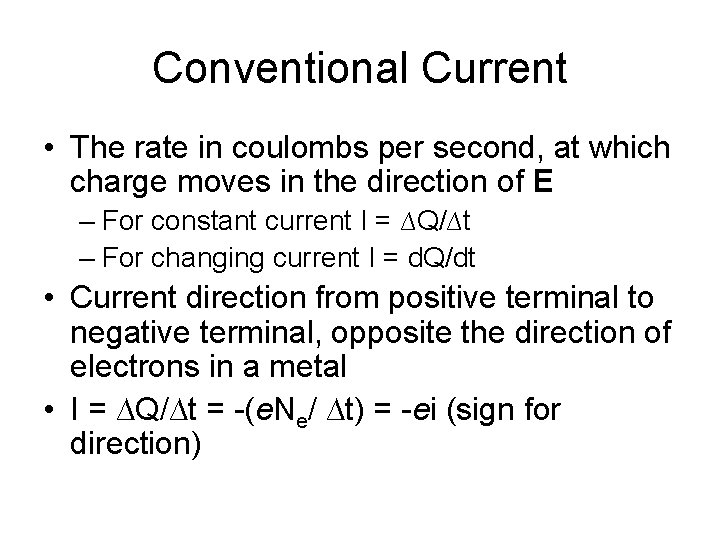
Conventional Current • The rate in coulombs per second, at which charge moves in the direction of E – For constant current I = ∆Q/∆t – For changing current I = d. Q/dt • Current direction from positive terminal to negative terminal, opposite the direction of electrons in a metal • I = ∆Q/∆t = -(e. Ne/ ∆t) = -ei (sign for direction)
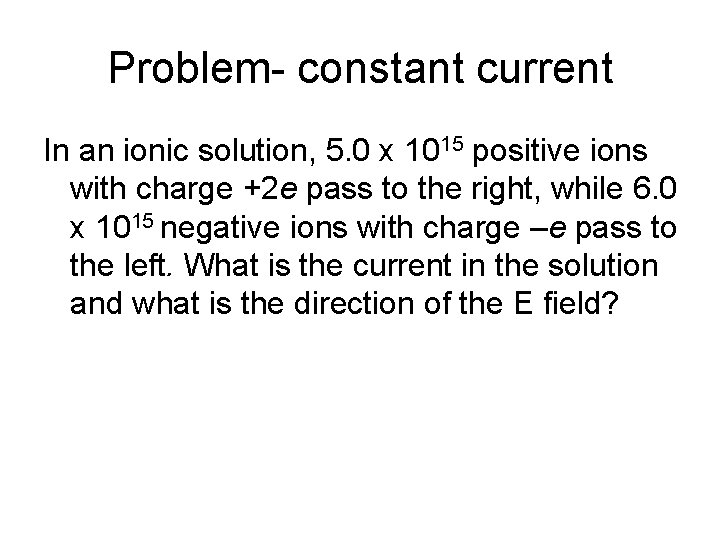
Problem- constant current In an ionic solution, 5. 0 x 1015 positive ions with charge +2 e pass to the right, while 6. 0 x 1015 negative ions with charge –e pass to the left. What is the current in the solution and what is the direction of the E field?
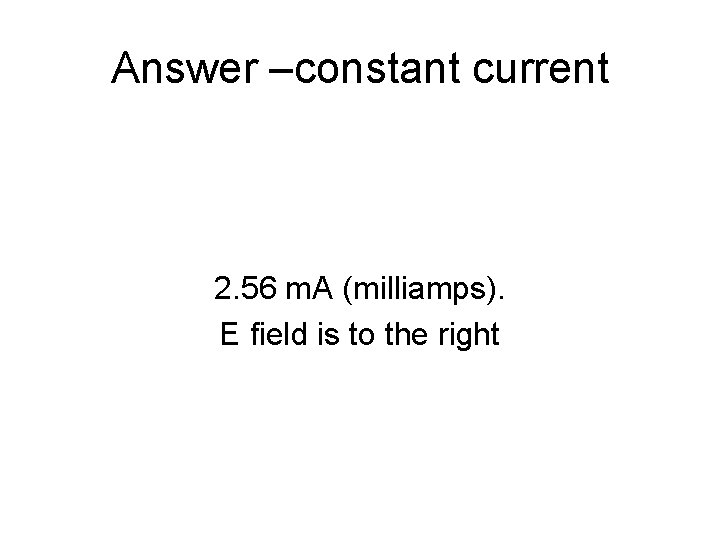
Answer –constant current 2. 56 m. A (milliamps). E field is to the right
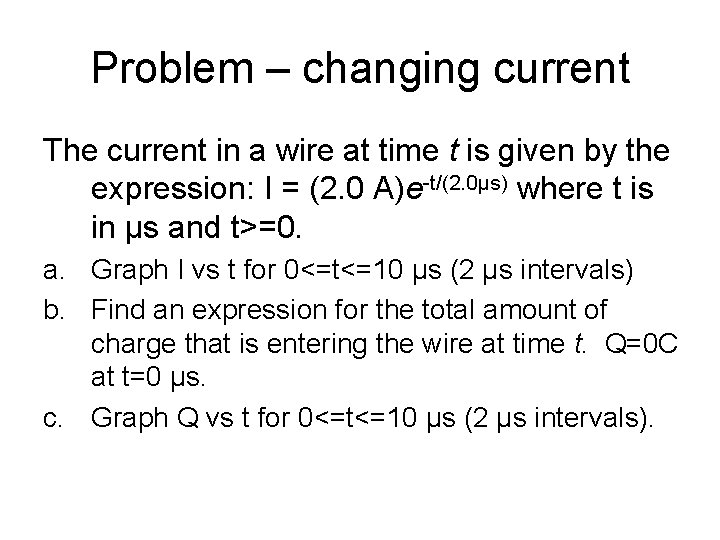
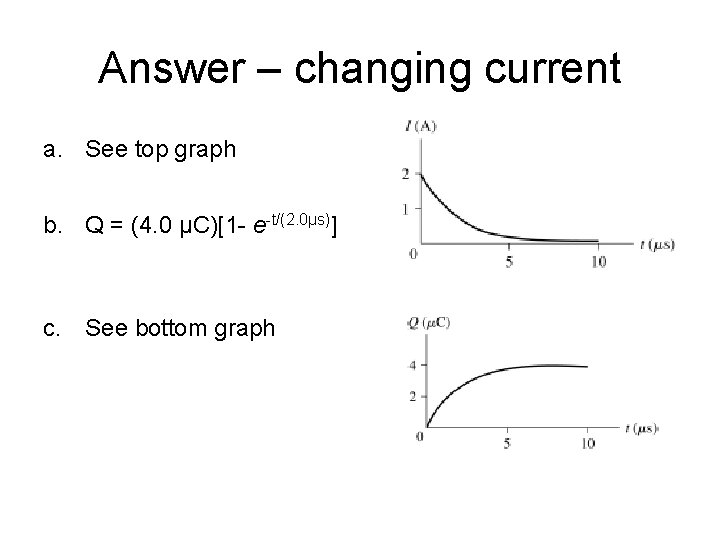
Problem – changing current The current in a wire at time t is given by the expression: I = (2. 0 A)e-t/(2. 0μs) where t is in μs and t>=0. a. Graph I vs t for 0<=t<=10 μs (2 μs intervals) b. Find an expression for the total amount of charge that is entering the wire at time t. Q=0 C at t=0 μs. c. Graph Q vs t for 0<=t<=10 μs (2 μs intervals).
Answer – changing current a. See top graph b. Q = (4. 0 μC)[1 - e-t/(2. 0μs)] c. See bottom graph
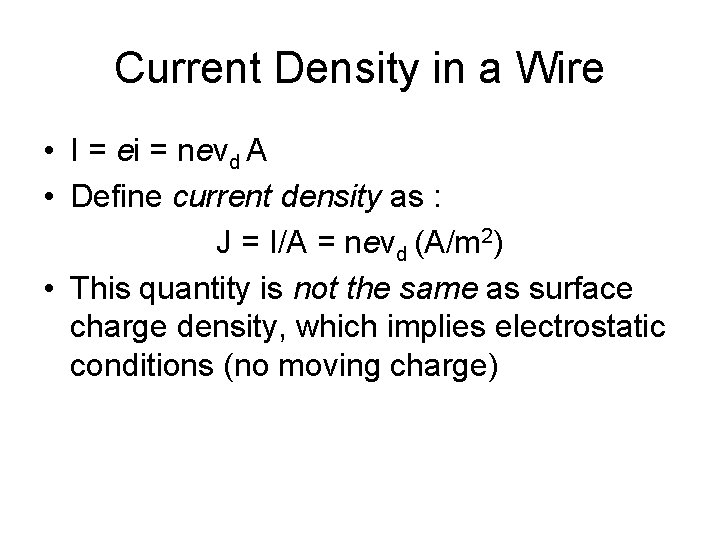
Current Density in a Wire • I = ei = nevd A • Define current density as : J = I/A = nevd (A/m 2) • This quantity is not the same as surface charge density, which implies electrostatic conditions (no moving charge)
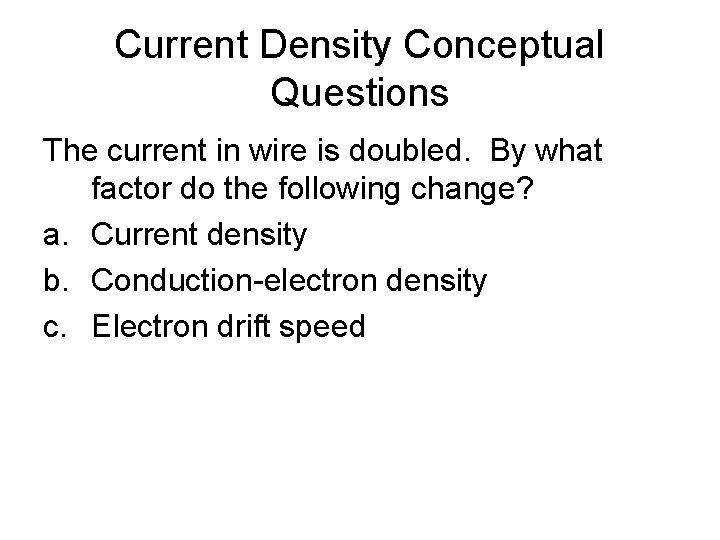
Current Density Conceptual Questions The current in wire is doubled. By what factor do the following change? a. Current density b. Conduction-electron density c. Electron drift speed
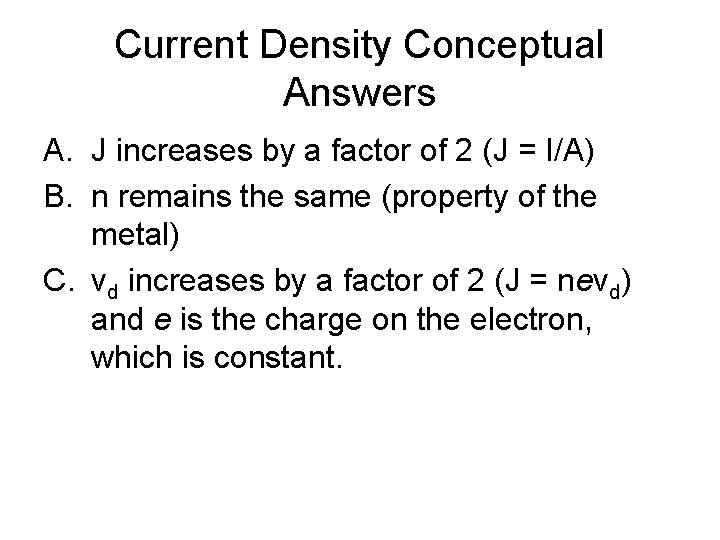
Current Density Conceptual Answers A. J increases by a factor of 2 (J = I/A) B. n remains the same (property of the metal) C. vd increases by a factor of 2 (J = nevd) and e is the charge on the electron, which is constant.