
Ch 26 The Road to WWII Dictatorships take
- Slides: 40
Ch. 26: The Road to WWII Dictatorships take charge
Section 1: The Rise of Dictatorships in Europe and Japan
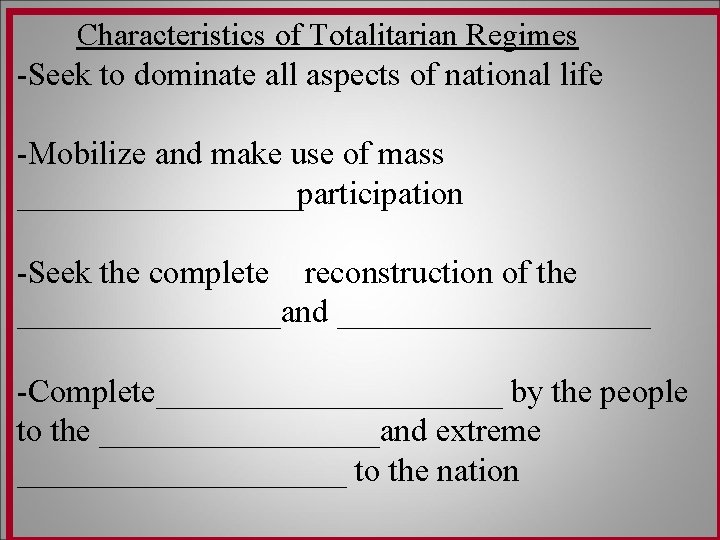
Characteristics of Totalitarian Regimes -Seek to dominate all aspects of national life -Mobilize and make use of mass _________participation -Seek the complete reconstruction of the ________and __________ -Complete___________ by the people to the _________and extreme __________ to the nation
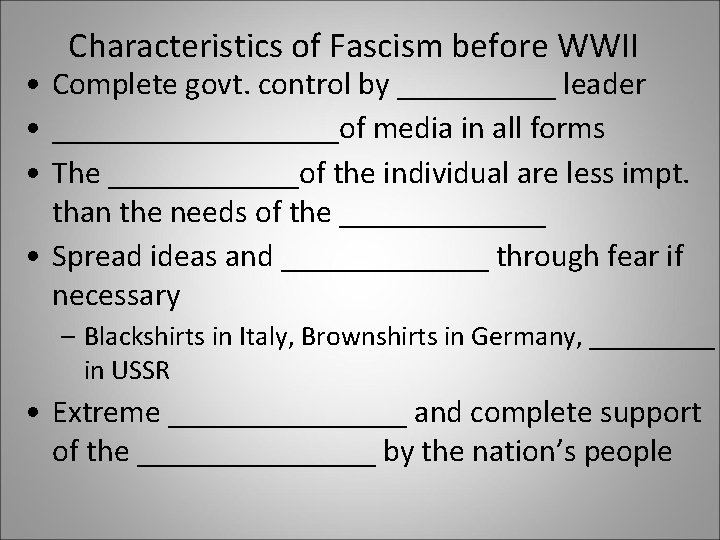
Characteristics of Fascism before WWII • Complete govt. control by _____ leader • _________of media in all forms • The ______of the individual are less impt. than the needs of the _______ • Spread ideas and _______ through fear if necessary – Blackshirts in Italy, Brownshirts in Germany, _____ in USSR • Extreme ________ and complete support of the ________ by the nation’s people
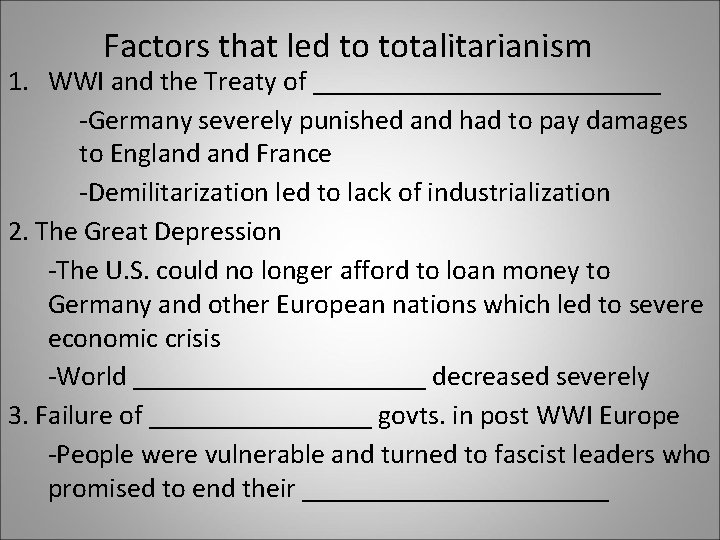
Factors that led to totalitarianism 1. WWI and the Treaty of _____________ -Germany severely punished and had to pay damages to England France -Demilitarization led to lack of industrialization 2. The Great Depression -The U. S. could no longer afford to loan money to Germany and other European nations which led to severe economic crisis -World ___________ decreased severely 3. Failure of ________ govts. in post WWI Europe -People were vulnerable and turned to fascist leaders who promised to end their ___________
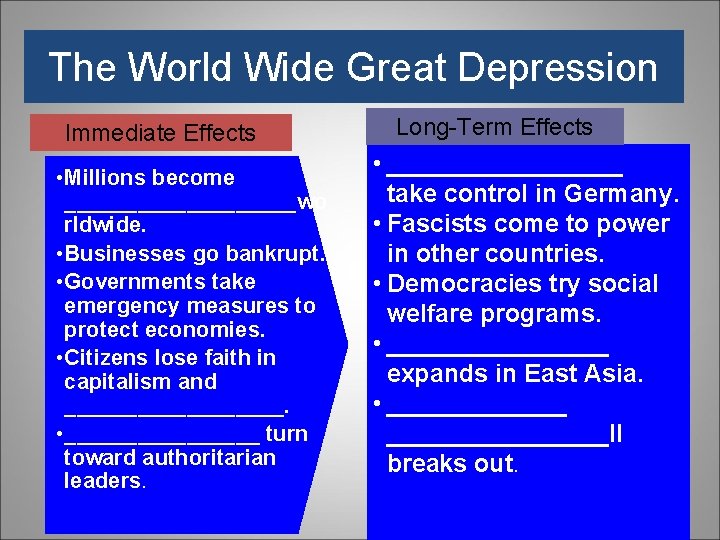
The World Wide Great Depression Immediate Effects • Millions become __________wo rldwide. • Businesses go bankrupt. • Governments take emergency measures to protect economies. • Citizens lose faith in capitalism and _________. • ________ turn toward authoritarian leaders. Long-Term Effects • _________ take control in Germany. • Fascists come to power in other countries. • Democracies try social welfare programs. • ________ expands in East Asia. • ________________II breaks out.
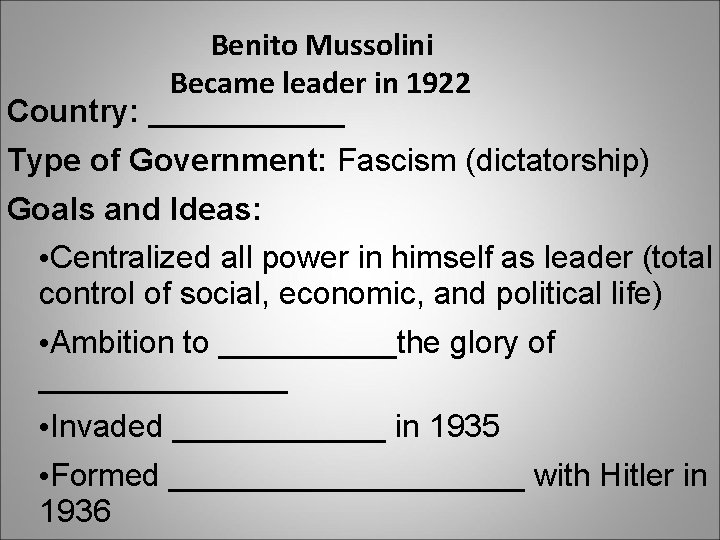
Benito Mussolini Became leader in 1922 Country: ______ Type of Government: Fascism (dictatorship) Goals and Ideas: • Centralized all power in himself as leader (total control of social, economic, and political life) • Ambition to _____the glory of _______ • Invaded ______ in 1935 • Formed __________ with Hitler in 1936
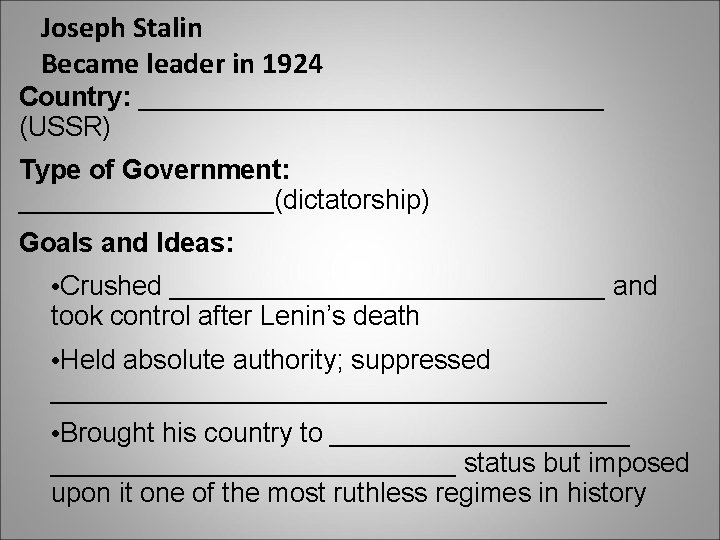
Joseph Stalin Became leader in 1924 Country: ________________ (USSR) Type of Government: _________(dictatorship) Goals and Ideas: • Crushed _______________ and took control after Lenin’s death • Held absolute authority; suppressed ___________________ • Brought his country to ___________________________ status but imposed upon it one of the most ruthless regimes in history
Joseph Stalin’s Ideas Contd. • New Economic Policies (NEP) • ________: exported seized goods and gained enough capital to finance a massive industrialization drive • Rapid ________: three 5 -year plans • ______________: KGB killed thousands of army officers and prominent Bolsheviks who opposed ___________ • Feared the growing power of _________________
Hideki Tojo-Became leader of Japan in 1941 Country: _____ Type of Government: _________ Goals and Ideas: • Military had taken control of the government • Emperor ________ could not stand up to the powerful generals, but had support of people • __________________ of Japan by imperial conquests in Asia • Invasion of Korea, Manchuria, and the rest of China (the League of _________ did nothing)
Background to Nazi Expansion • _______ – Treaty of Versailles, Germany unfairly punished, League of Nations created • 1923 – Start of __________ crisis in Germany • 1925 – Hitler writes Mein Kampf • 1932 -1934 – Nazi Party, Hitler take control of German government • 1936 -1937 – US passed “Neutrality Acts”, practiced _____________
Adolf Hitler Became German Chancellor in 1933 Country: ____________ Type of Government: ________(dictatorship) Hitler’s beliefs: • ___________ and depression weakened the democratic government in Germany and allowed an opportunity for Hitler to rise to power • Believed the western powers had no intention of using ___________ to maintain the Treaty of ___________________
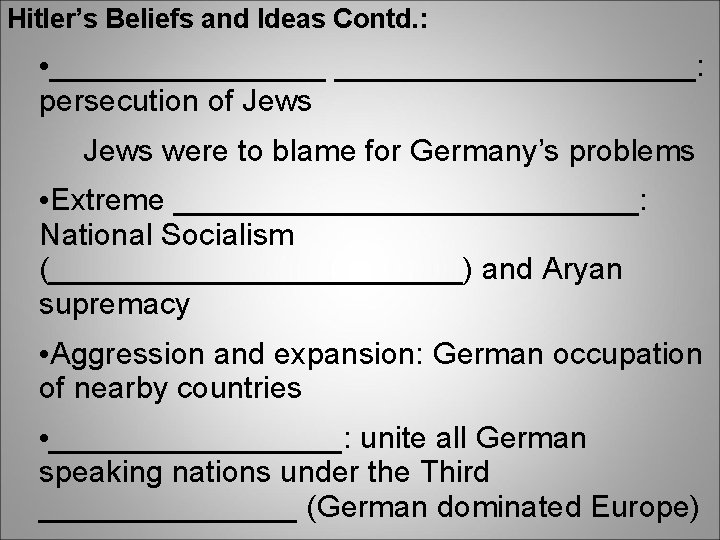
Hitler’s Beliefs and Ideas Contd. : • _____________________: persecution of Jews were to blame for Germany’s problems • Extreme ______________: National Socialism (____________) and Aryan supremacy • Aggression and expansion: German occupation of nearby countries • _________: unite all German speaking nations under the Third ________ (German dominated Europe)
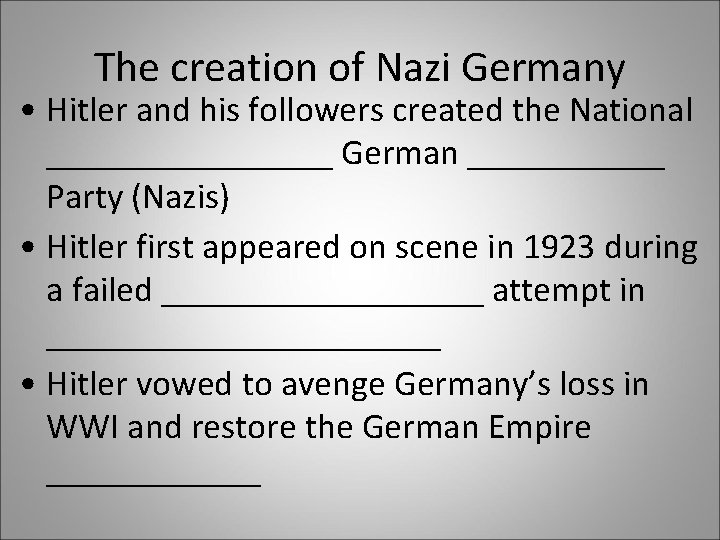
The creation of Nazi Germany • Hitler and his followers created the National ________ German ______ Party (Nazis) • Hitler first appeared on scene in 1923 during a failed _________ attempt in ___________ • Hitler vowed to avenge Germany’s loss in WWI and restore the German Empire ______
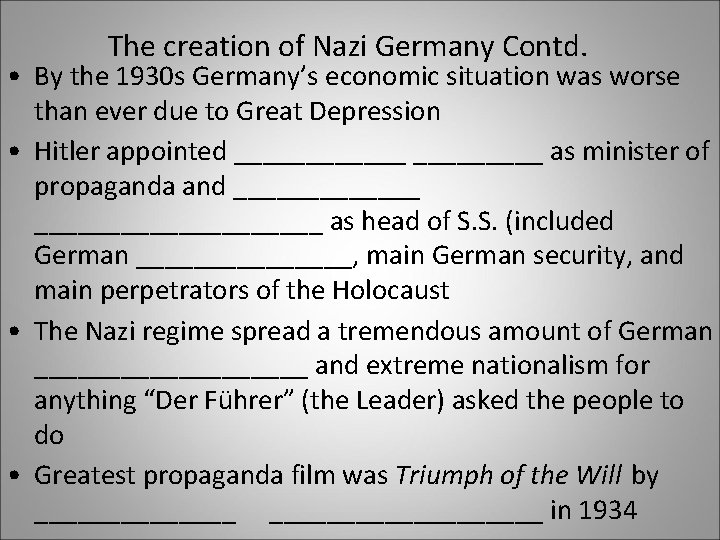
The creation of Nazi Germany Contd. • By the 1930 s Germany’s economic situation was worse than ever due to Great Depression • Hitler appointed ______ as minister of propaganda and ____________________ as head of S. S. (included German ________, main German security, and main perpetrators of the Holocaust • The Nazi regime spread a tremendous amount of German __________ and extreme nationalism for anything “Der Führer” (the Leader) asked the people to do • Greatest propaganda film was Triumph of the Will by ___________________ in 1934
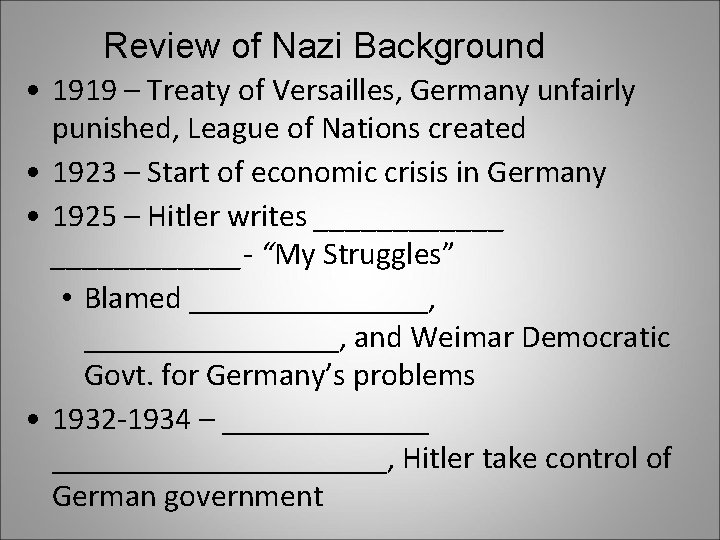
Review of Nazi Background • 1919 – Treaty of Versailles, Germany unfairly punished, League of Nations created • 1923 – Start of economic crisis in Germany • 1925 – Hitler writes ____________- “My Struggles” • Blamed ________, and Weimar Democratic Govt. for Germany’s problems • 1932 -1934 – _________________, Hitler take control of German government
Section 2: The Road to World War II Could World War II have been prevented?
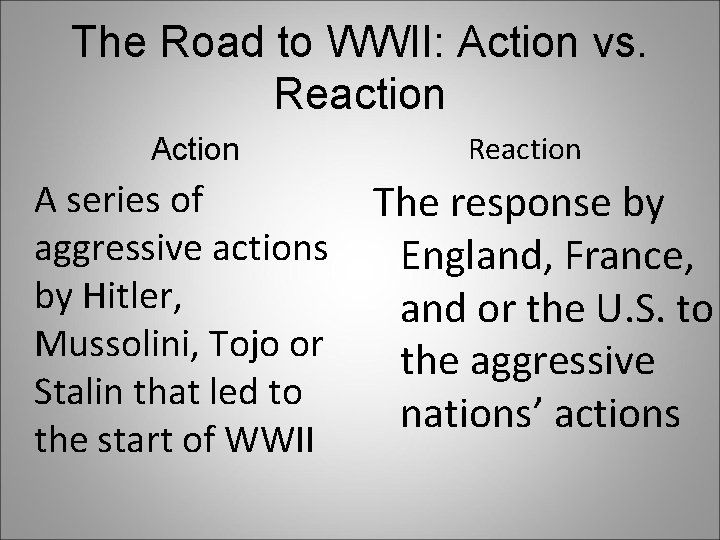
The Road to WWII: Action vs. Reaction A series of aggressive actions by Hitler, Mussolini, Tojo or Stalin that led to the start of WWII Reaction The response by England, France, and or the U. S. to the aggressive nations’ actions
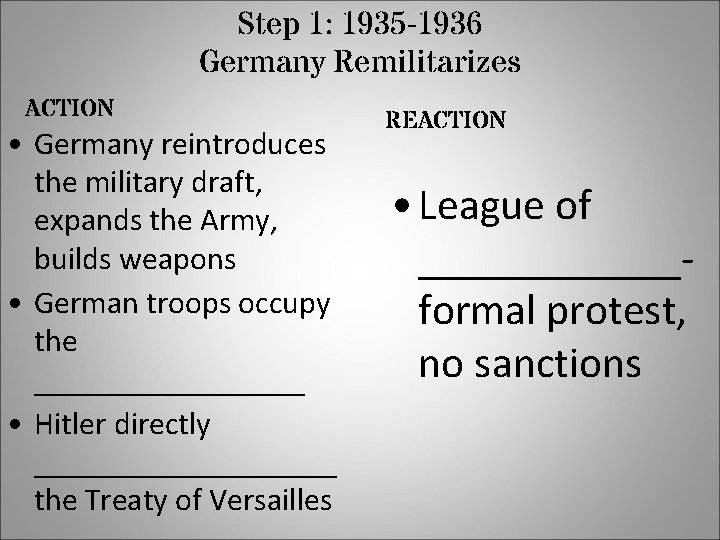
Step 1: 1935 -1936 Germany Remilitarizes ACTION • Germany reintroduces the military draft, expands the Army, builds weapons • German troops occupy the _________ • Hitler directly __________ the Treaty of Versailles REACTION • League of ______formal protest, no sanctions
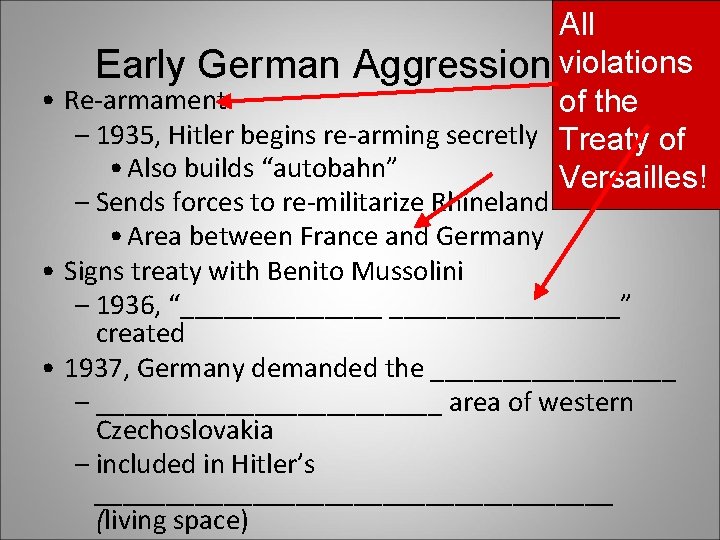
All Early German Aggression violations • Re-armament of the – 1935, Hitler begins re-arming secretly Treaty of • Also builds “autobahn” Versailles! – Sends forces to re-militarize Rhineland • Area between France and Germany • Signs treaty with Benito Mussolini – 1936, “________” created • 1937, Germany demanded the _________ – ____________ area of western Czechoslovakia – included in Hitler’s __________________ (living space)
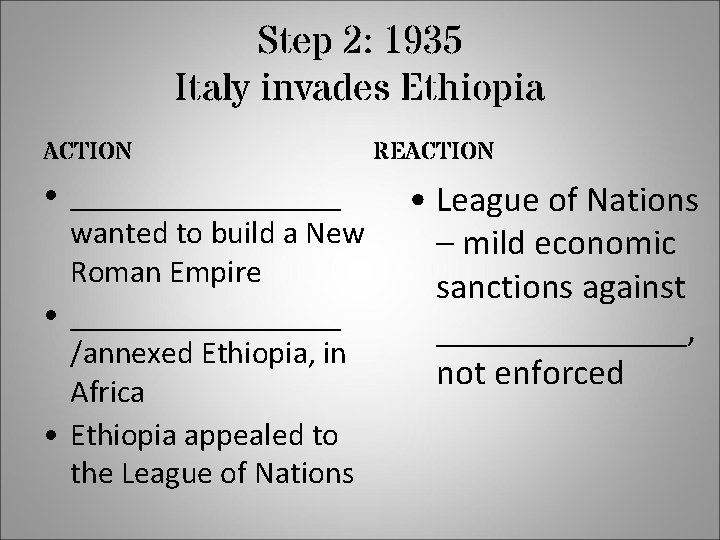
Step 2: 1935 Italy invades Ethiopia ACTION • _________ wanted to build a New Roman Empire • _________ /annexed Ethiopia, in Africa • Ethiopia appealed to the League of Nations REACTION • League of Nations – mild economic sanctions against _______, not enforced
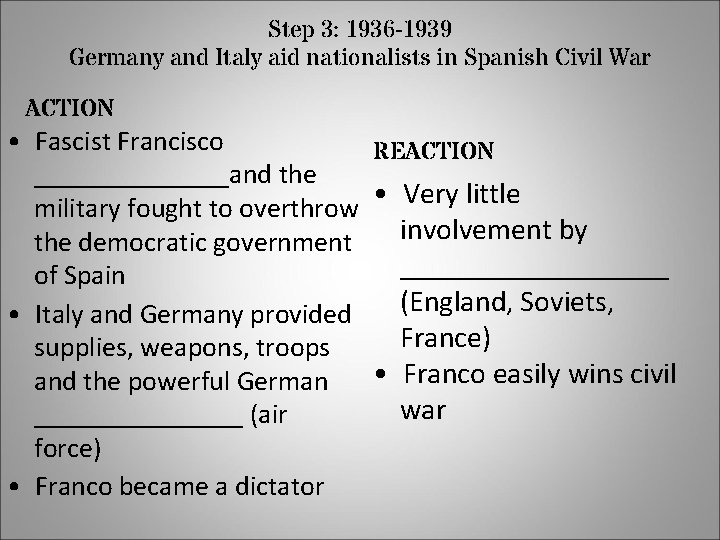
Step 3: 1936 -1939 Germany and Italy aid nationalists in Spanish Civil War ACTION • Fascist Francisco REACTION _______and the • Very little military fought to overthrow involvement by the democratic government _________ of Spain (England, Soviets, • Italy and Germany provided France) supplies, weapons, troops • Franco easily wins civil and the powerful German war ________ (air force) • Franco became a dictator
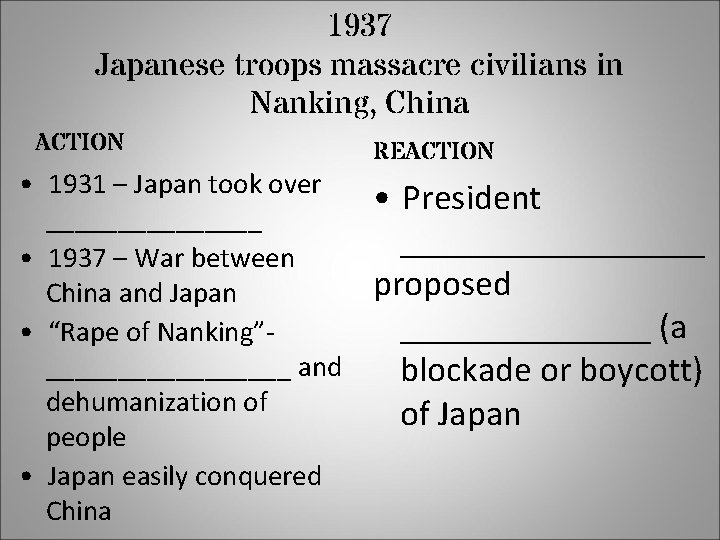
1937 Japanese troops massacre civilians in Nanking, China ACTION • 1931 – Japan took over ________ • 1937 – War between China and Japan • “Rape of Nanking”_________ and dehumanization of people • Japan easily conquered China REACTION • President _________ proposed _______ (a blockade or boycott) of Japan
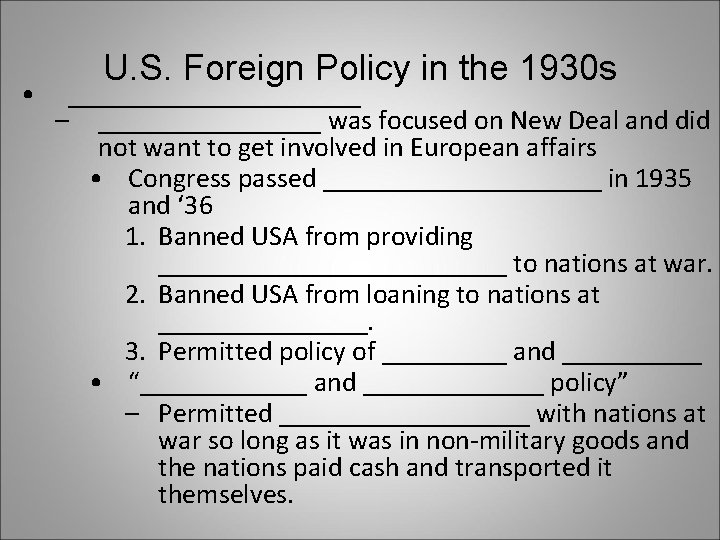
• U. S. Foreign Policy in the 1930 s ___________ – ________ was focused on New Deal and did not want to get involved in European affairs • Congress passed __________ in 1935 and ‘ 36 1. Banned USA from providing _____________ to nations at war. 2. Banned USA from loaning to nations at ________. 3. Permitted policy of _____ and _____ • “______ and _______ policy” – Permitted _________ with nations at war so long as it was in non-military goods and the nations paid cash and transported it themselves.
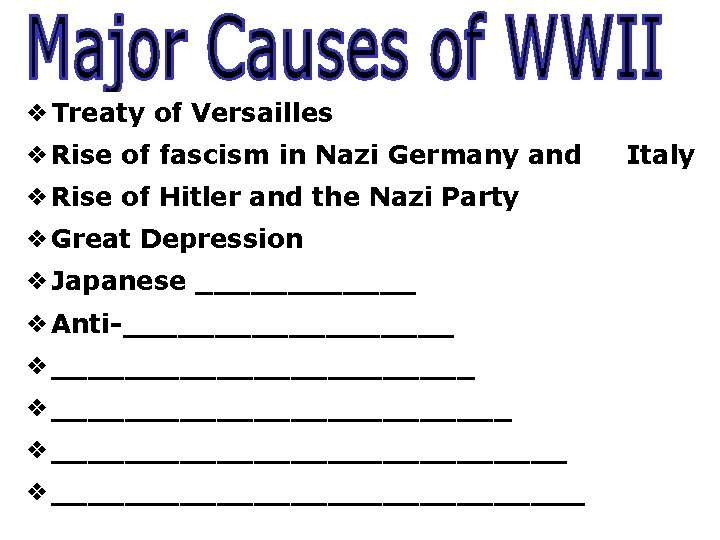
❖Treaty of Versailles ❖Rise of fascism in Nazi Germany and ❖Rise of Hitler and the Nazi Party ❖Great Depression ❖Japanese ______ ❖Anti-__________________ ❖_________________________ ❖___________________ Italy
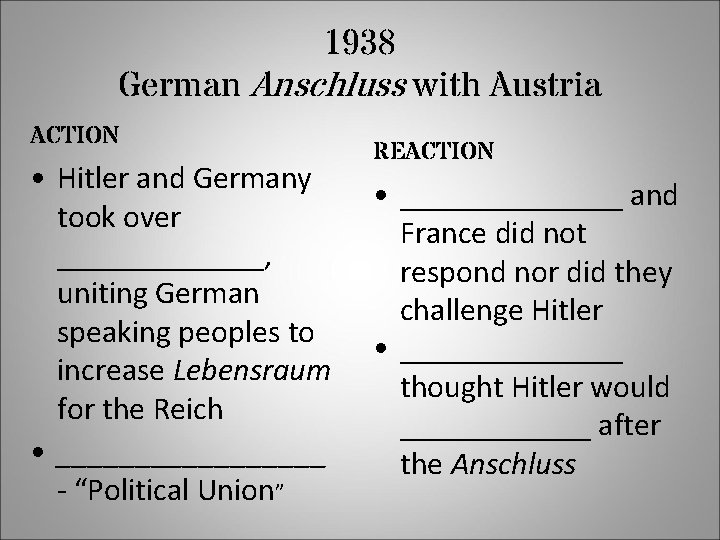
1938 German Anschluss with Austria ACTION • Hitler and Germany took over _______, uniting German speaking peoples to increase Lebensraum for the Reich • _________ - “Political Union” REACTION • _______ and France did not respond nor did they challenge Hitler • _______ thought Hitler would ______ after the Anschluss
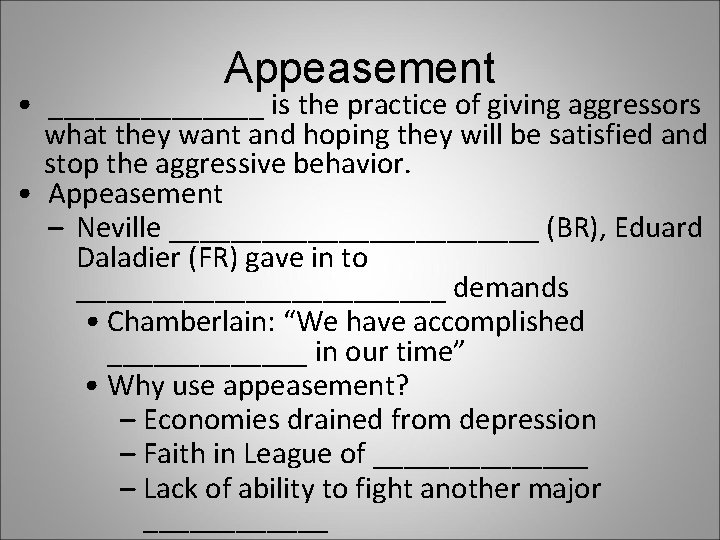
Appeasement • _______ is the practice of giving aggressors what they want and hoping they will be satisfied and stop the aggressive behavior. • Appeasement – Neville ____________ (BR), Eduard Daladier (FR) gave in to ____________ demands • Chamberlain: “We have accomplished _______ in our time” • Why use appeasement? – Economies drained from depression – Faith in League of _______ – Lack of ability to fight another major ______
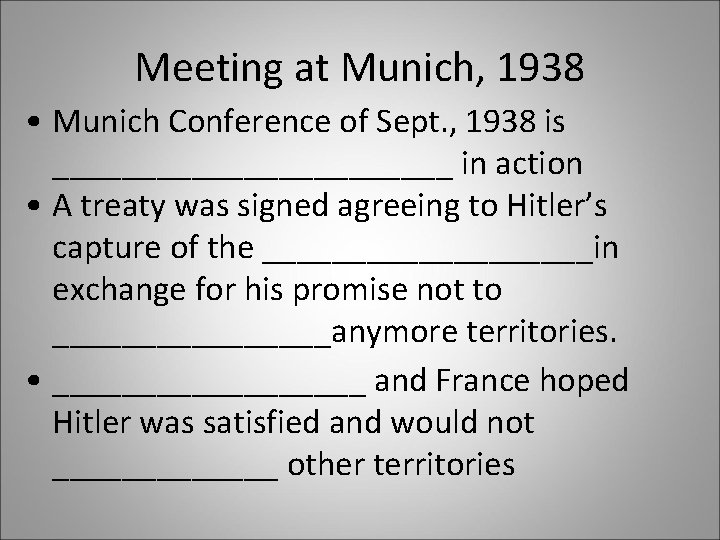
Meeting at Munich, 1938 • Munich Conference of Sept. , 1938 is ____________ in action • A treaty was signed agreeing to Hitler’s capture of the __________in exchange for his promise not to ________anymore territories. • _________ and France hoped Hitler was satisfied and would not _______ other territories
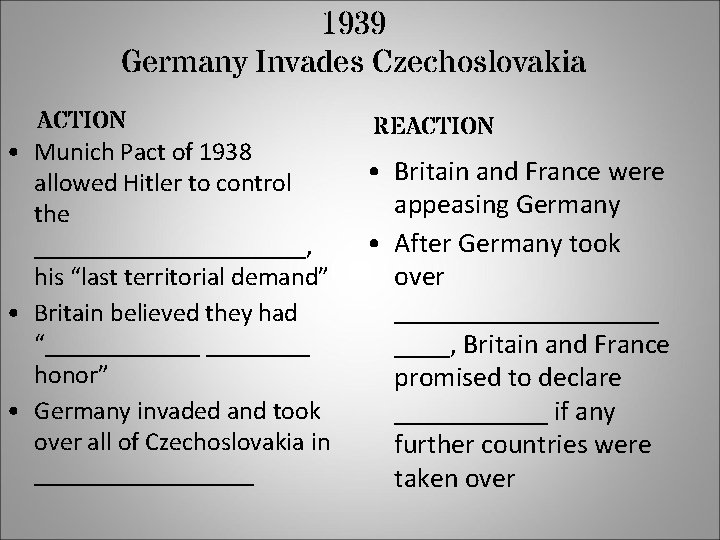
1939 Germany Invades Czechoslovakia ACTION • Munich Pact of 1938 allowed Hitler to control the ___________, his “last territorial demand” • Britain believed they had “______ honor” • Germany invaded and took over all of Czechoslovakia in _________ REACTION • Britain and France were appeasing Germany • After Germany took over __________, Britain and France promised to declare ______ if any further countries were taken over
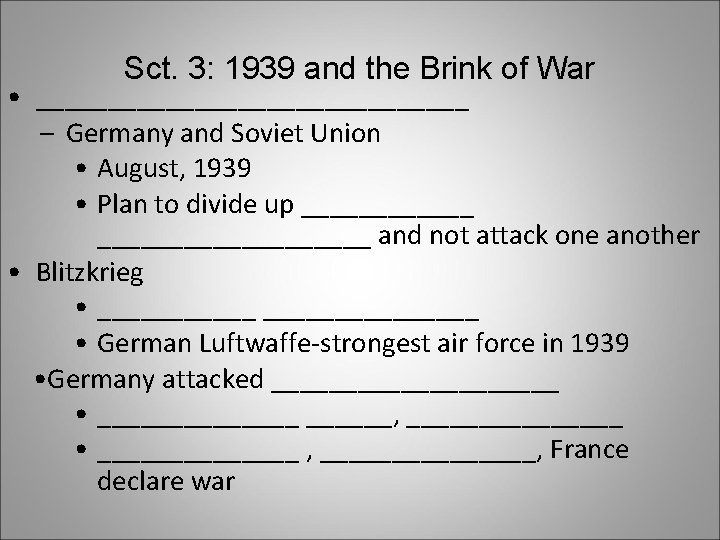
Sct. 3: 1939 and the Brink of War • _______________ – Germany and Soviet Union • August, 1939 • Plan to divide up ___________________ and not attack one another • Blitzkrieg • _______________ • German Luftwaffe-strongest air force in 1939 • Germany attacked __________ • _______, ________ • _______ , ________, France declare war
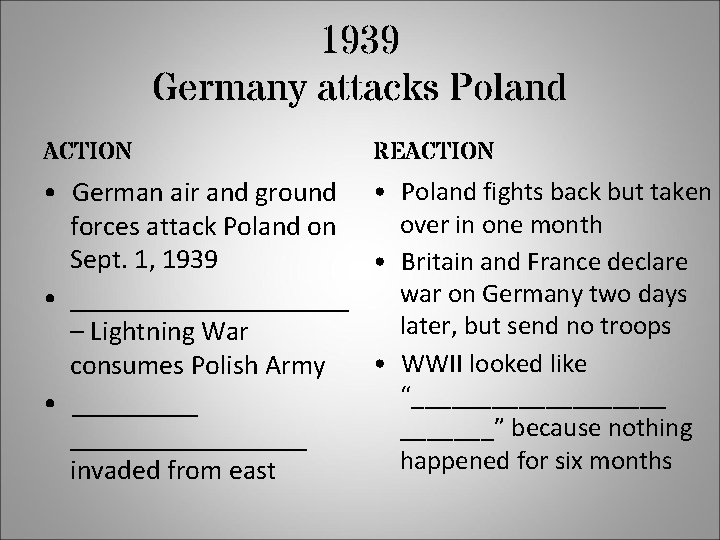
1939 Germany attacks Poland ACTION REACTION • German air and ground • Poland fights back but taken over in one month forces attack Poland on Sept. 1, 1939 • Britain and France declare war on Germany two days • __________ later, but send no troops – Lightning War • WWII looked like consumes Polish Army “__________ • _______” because nothing _________ happened for six months invaded from east
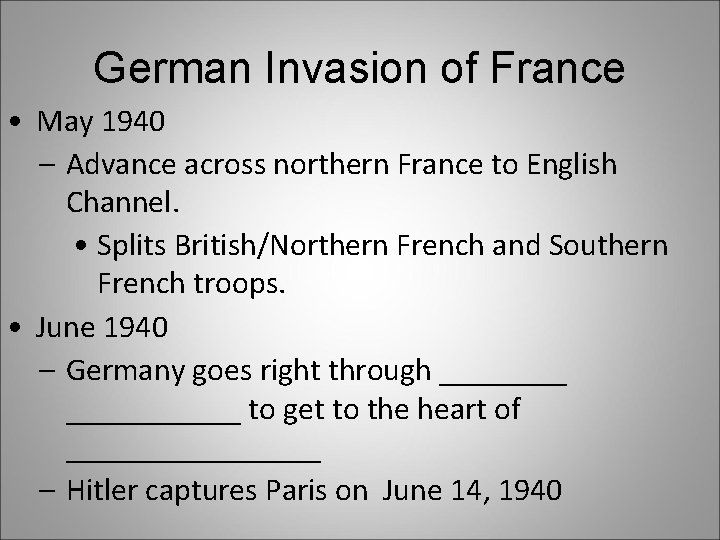
German Invasion of France • May 1940 – Advance across northern France to English Channel. • Splits British/Northern French and Southern French troops. • June 1940 – Germany goes right through ___________ to get to the heart of ________ – Hitler captures Paris on June 14, 1940
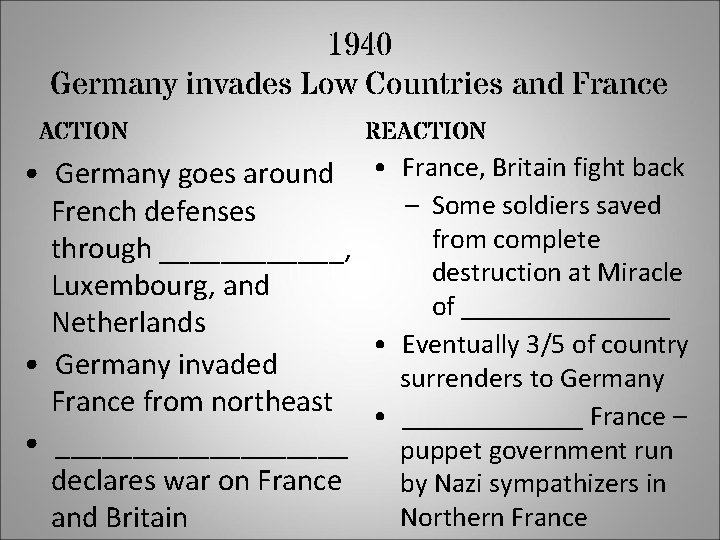
1940 Germany invades Low Countries and France ACTION REACTION • Germany goes around • France, Britain fight back – Some soldiers saved French defenses from complete through ______, destruction at Miracle Luxembourg, and of ________ Netherlands • Eventually 3/5 of country • Germany invaded surrenders to Germany France from northeast • _______ France – • __________ puppet government run declares war on France by Nazi sympathizers in Northern France and Britain
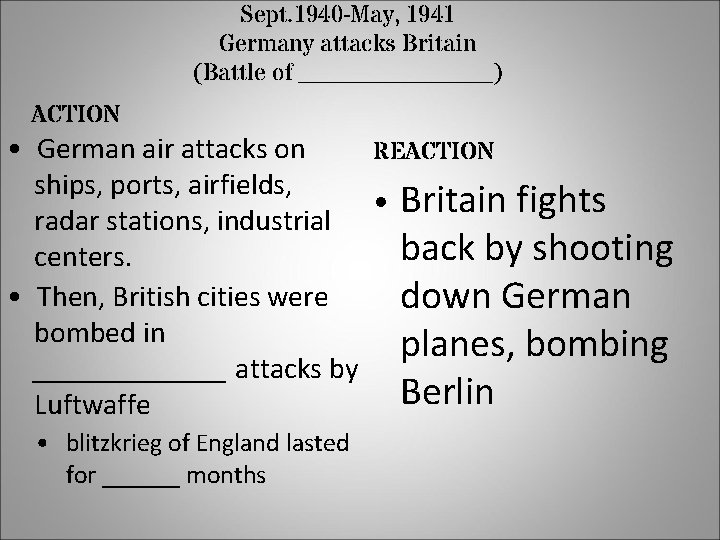
Sept. 1940 -May, 1941 Germany attacks Britain (Battle of _______) ACTION • German air attacks on REACTION ships, ports, airfields, • Britain fights radar stations, industrial back by shooting centers. • Then, British cities were down German bombed in planes, bombing _______ attacks by Berlin Luftwaffe • blitzkrieg of England lasted for ______ months
The Alliance System in 1940 _____ Powers • __________ _____ Powers ➢____________ Empire
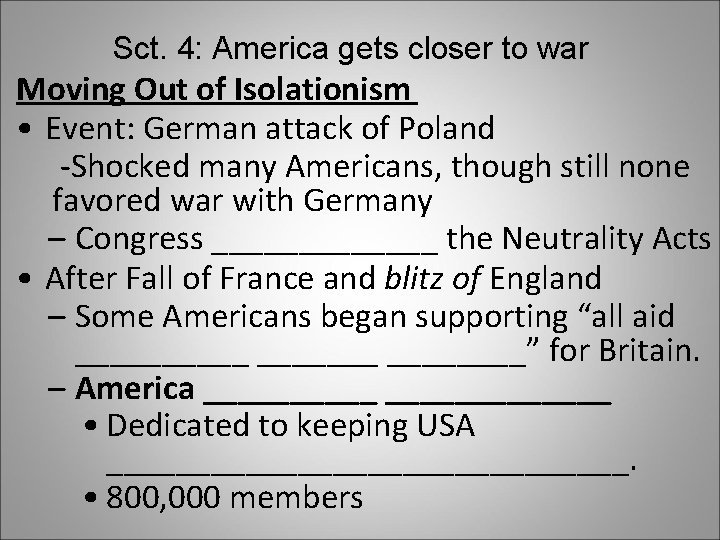
Sct. 4: America gets closer to war Moving Out of Isolationism • Event: German attack of Poland -Shocked many Americans, though still none favored war with Germany – Congress _______ the Neutrality Acts • After Fall of France and blitz of England – Some Americans began supporting “all aid ________” for Britain. – America _____________ • Dedicated to keeping USA _______________. • 800, 000 members
America Aids England, 1940 • End of _______ and _______ – Prime Minister Winston _________ to FDR: • “The moment approaches…when we will no longer be able to pay cash for supplies. ” – FDR proposed the _____-______ Bill • Plan to provide war supplies to ________ without any ___________ in return. • “If your neighbors house is on fire, you don’t sell him a hose. You lend it to him, and take it back when the fire’s out. ”-FDR, 1940
ACTION 1941 Japan attacks Pearl Harbor • Japan invaded Southeast _____ after ______ • U. S. aided Japan’s enemies, including China, froze Japanese money in U. S. banks, ________ export of oil to Japan • Japan bombed the U. S. naval base at Pearl Harbor, Hawaii on _______ , _____ REACTION • United States _______on Japan on Dec. 8, 1941 and officially entered WWII
December 8, 1941 • President Roosevelt delivers a speech. He describes December 7, 1941 as: “a day which will live in _______!” • FDR asks Congress for a declaration of war – Both houses of Congress approved a ___________ of war against Japan and later against Germany and Italy as well. • The U. S. had now officially entered __________
The Alliance System in 1942 Allied Powers • Great _____ • France • ________ • United States Axis Powers ➢______________ ➢Ottoman Empire