
Ch 22 Hydrocarbons Organic Chemistry The study of
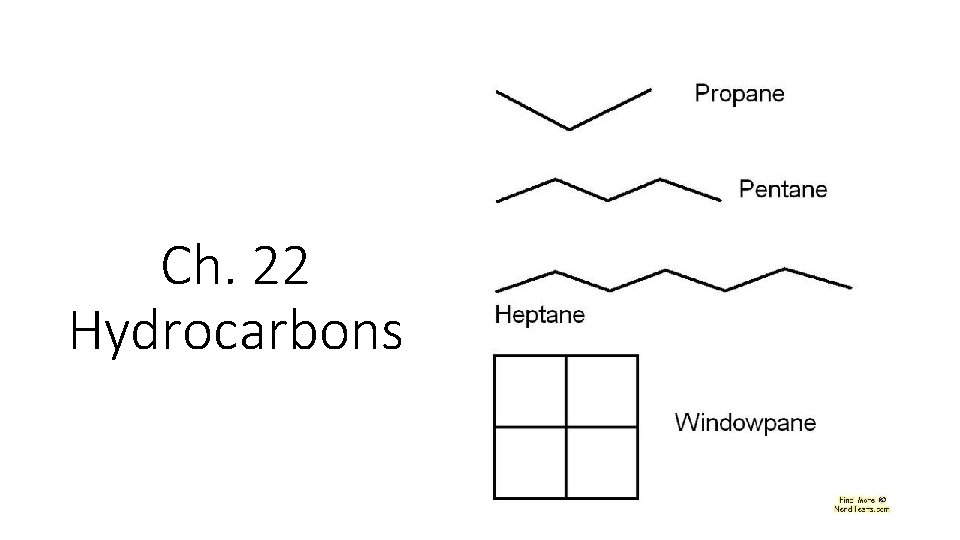
Ch. 22 Hydrocarbons
Organic Chemistry • The study of carbon containing compounds • C bonded to H, N, O, S, P and halogens (17 th column) • Hydrocarbon: simplest organic compound that contains only H and C **because C has four valence electrons, a carbon atoms always forms four covalent bonds
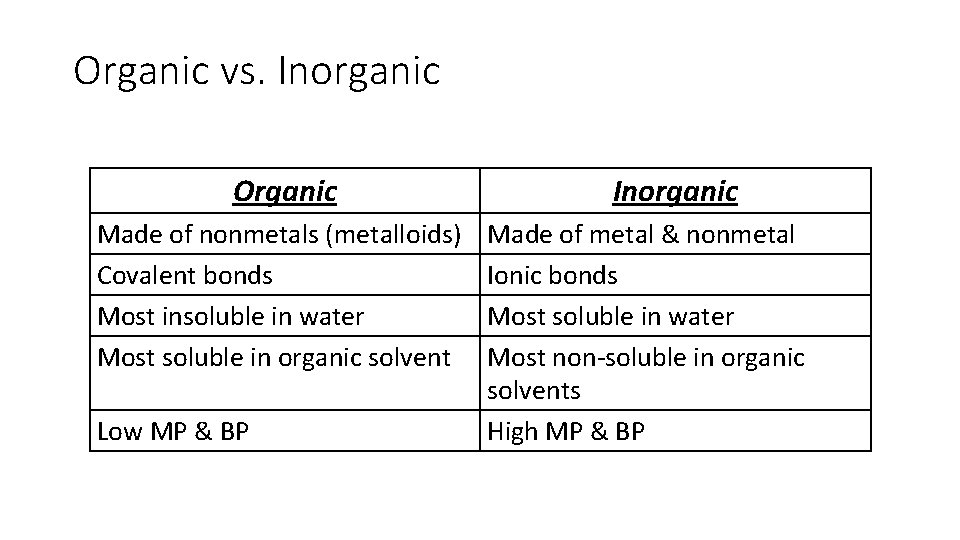
Organic vs. Inorganic Organic Made of nonmetals (metalloids) Covalent bonds Most insoluble in water Most soluble in organic solvent Low MP & BP Inorganic Made of metal & nonmetal Ionic bonds Most soluble in water Most non-soluble in organic solvents High MP & BP
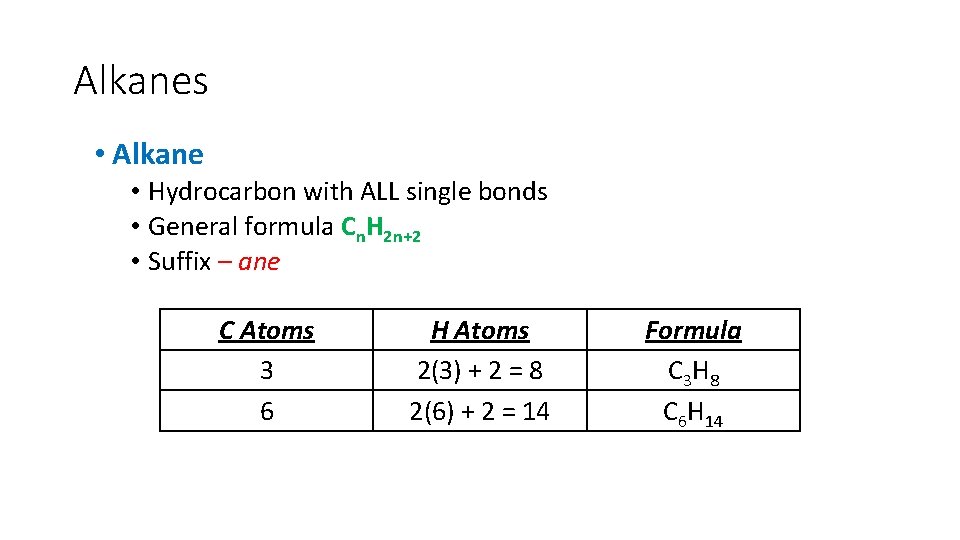
Alkanes • Alkane • Hydrocarbon with ALL single bonds • General formula Cn. H 2 n+2 • Suffix – ane C Atoms 3 6 H Atoms 2(3) + 2 = 8 2(6) + 2 = 14 Formula C 3 H 8 C 6 H 14
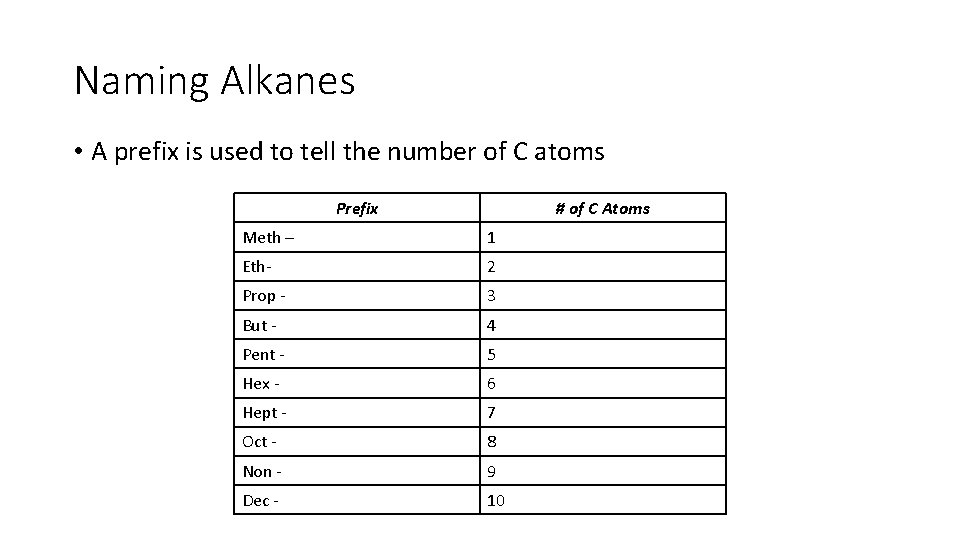
Naming Alkanes • A prefix is used to tell the number of C atoms Prefix # of C Atoms Meth – 1 Eth- 2 Prop - 3 But - 4 Pent - 5 Hex - 6 Hept - 7 Oct - 8 Non - 9 Dec - 10
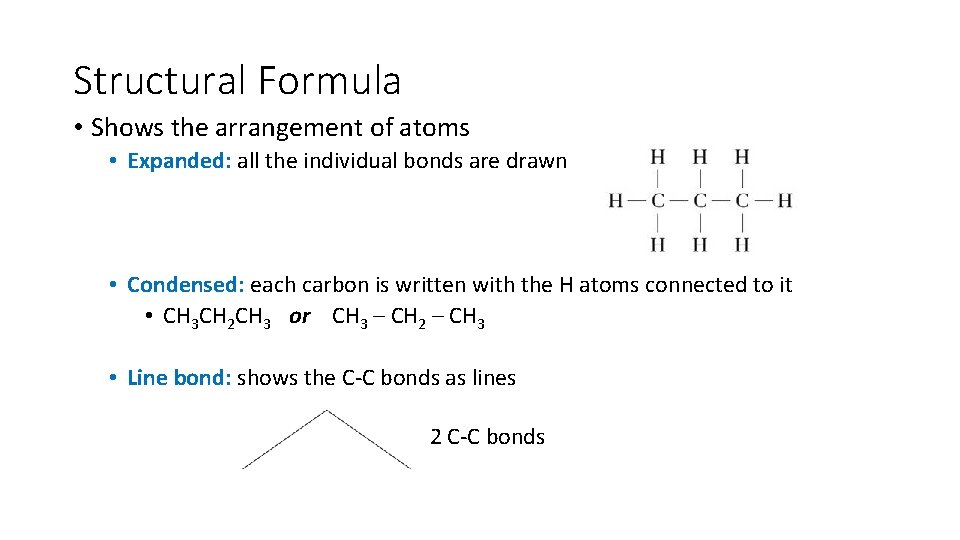
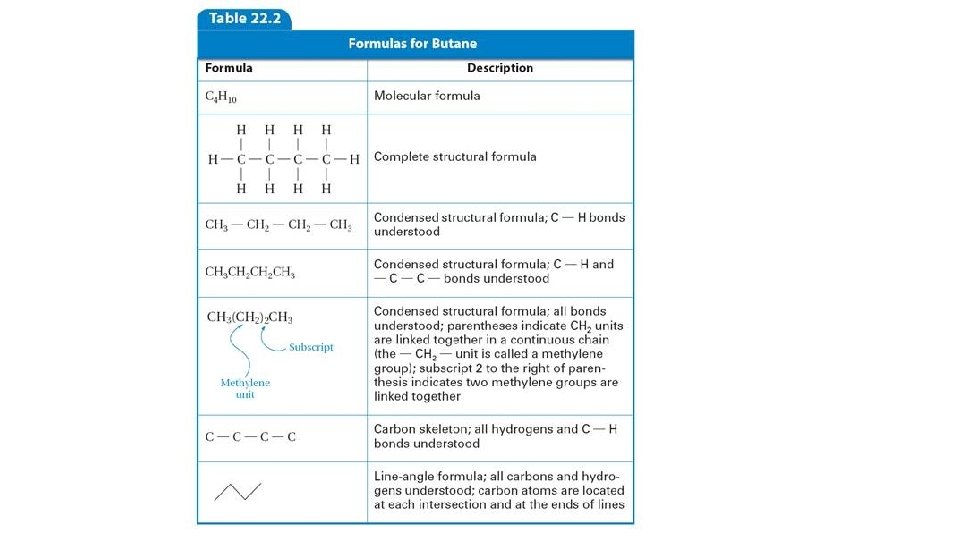
Structural Formula • Shows the arrangement of atoms • Expanded: all the individual bonds are drawn • Condensed: each carbon is written with the H atoms connected to it • CH 3 CH 2 CH 3 or CH 3 – CH 2 – CH 3 • Line bond: shows the C-C bonds as lines 2 C-C bonds
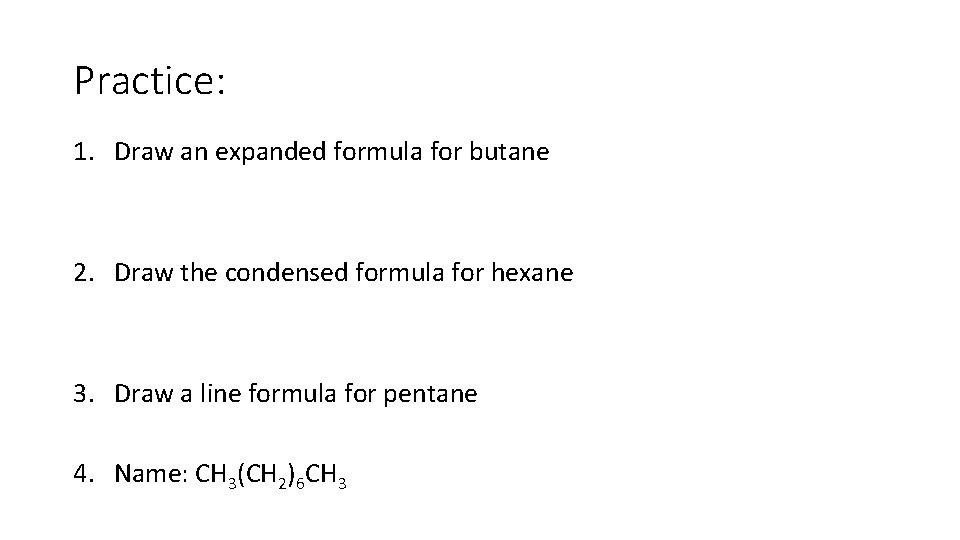
Practice: 1. Draw an expanded formula for butane 2. Draw the condensed formula for hexane 3. Draw a line formula for pentane 4. Name: CH 3(CH 2)6 CH 3
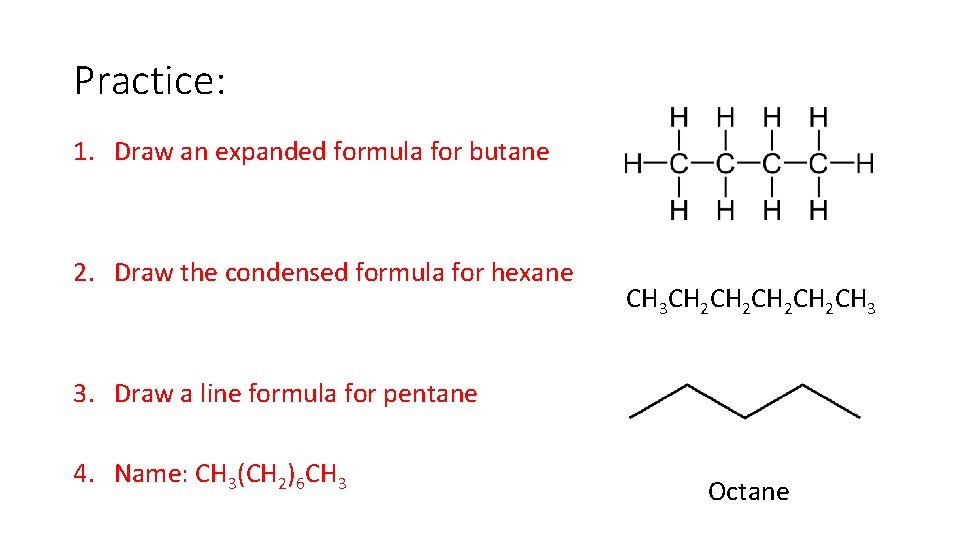
Practice: 1. Draw an expanded formula for butane 2. Draw the condensed formula for hexane CH 3 CH 2 CH 2 CH 3 3. Draw a line formula for pentane 4. Name: CH 3(CH 2)6 CH 3 Octane
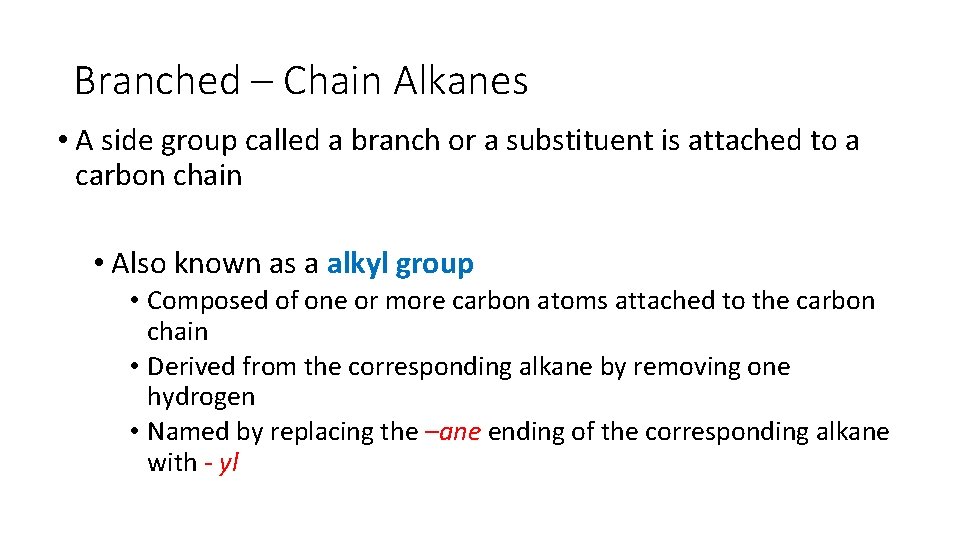
Branched – Chain Alkanes • A side group called a branch or a substituent is attached to a carbon chain • Also known as a alkyl group • Composed of one or more carbon atoms attached to the carbon chain • Derived from the corresponding alkane by removing one hydrogen • Named by replacing the –ane ending of the corresponding alkane with - yl
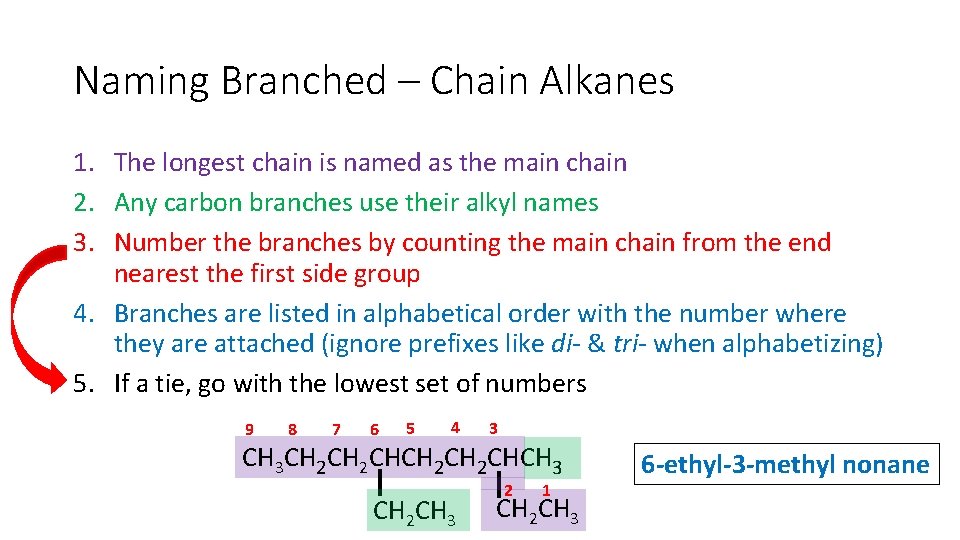
Naming Branched – Chain Alkanes 1. The longest chain is named as the main chain 2. Any carbon branches use their alkyl names 3. Number the branches by counting the main chain from the end nearest the first side group 4. Branches are listed in alphabetical order with the number where they are attached (ignore prefixes like di- & tri- when alphabetizing) 5. If a tie, go with the lowest set of numbers 9 8 7 6 5 4 3 CH 3 CH 2 CH 2 CHCH 3 CH 2 CH 3 2 1 CH 2 CH 3 6 -ethyl-3 -methyl nonane
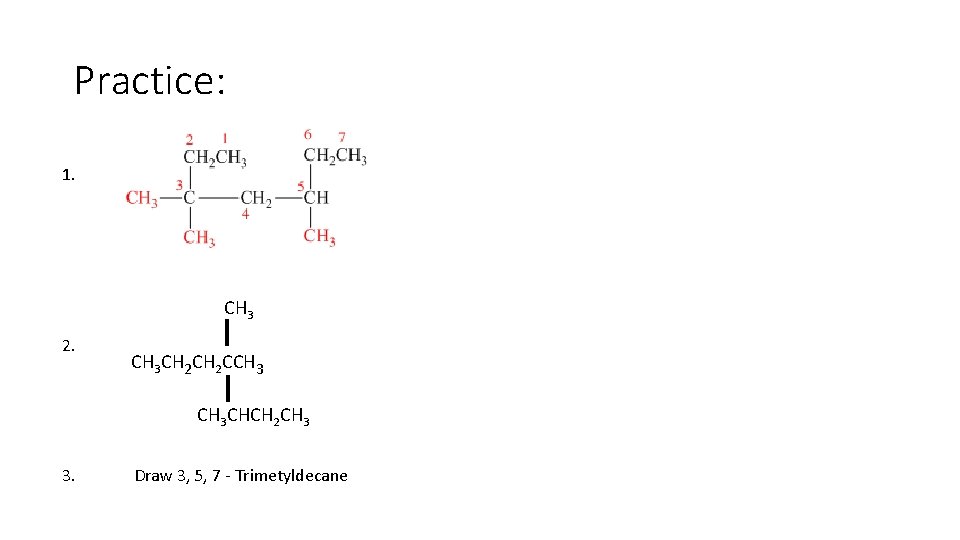
Practice: 1. CH 3 2. CH 3 CH 2 CCH 3 CHCH 2 CH 3 3. Draw 3, 5, 7 - Trimetyldecane
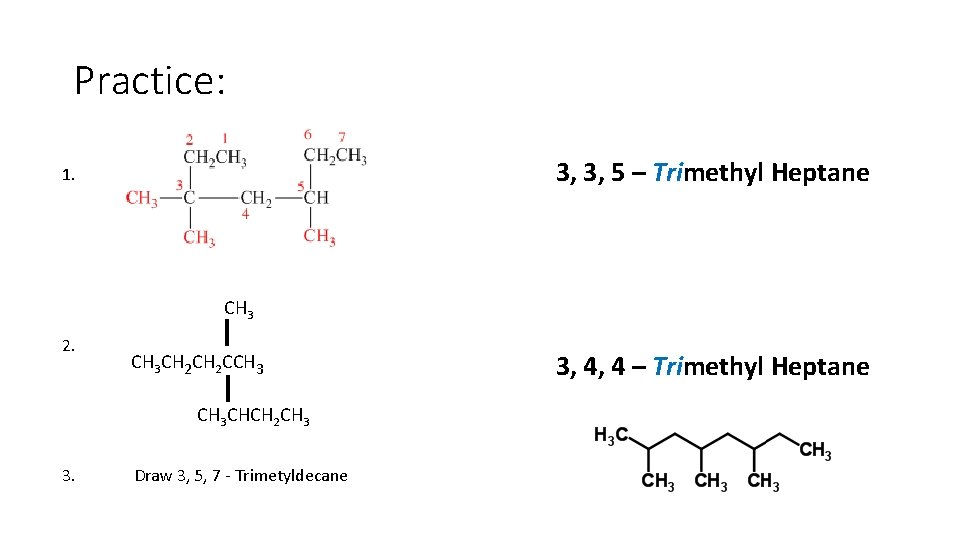
Practice: 3, 3, 5 – Trimethyl Heptane 1. CH 3 2. CH 3 CH 2 CCH 3 CHCH 2 CH 3 3. Draw 3, 5, 7 - Trimetyldecane 3, 4, 4 – Trimethyl Heptane
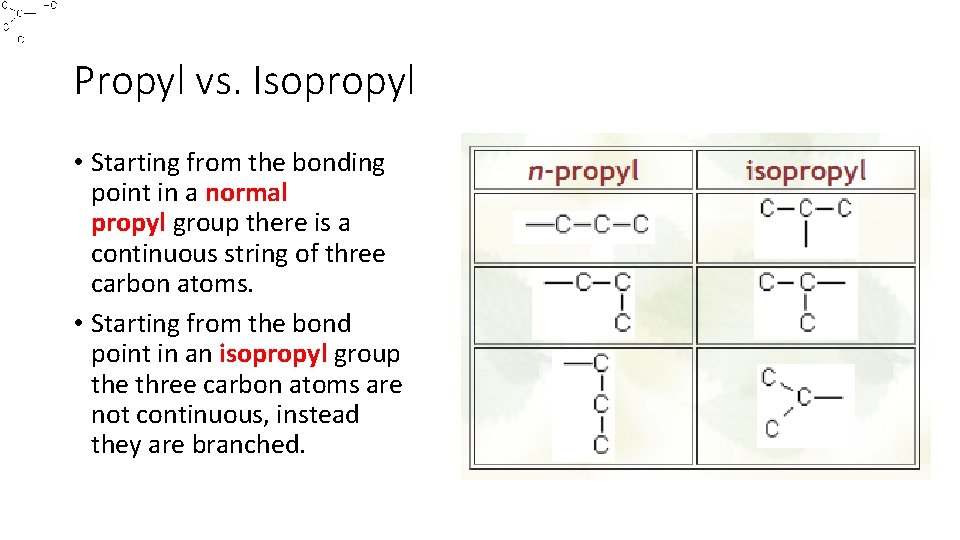
Propyl vs. Isopropyl • Starting from the bonding point in a normal propyl group there is a continuous string of three carbon atoms. • Starting from the bond point in an isopropyl group the three carbon atoms are not continuous, instead they are branched.
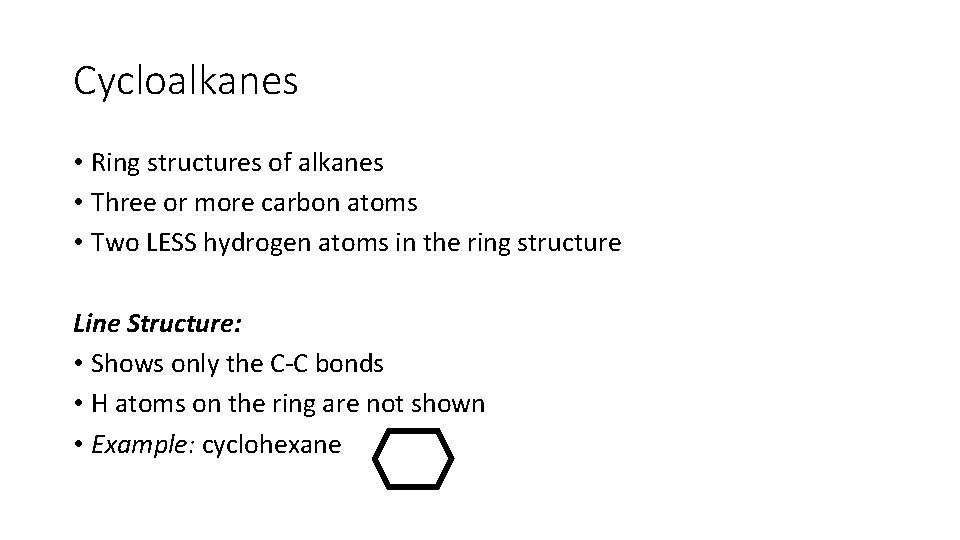
Cycloalkanes • Ring structures of alkanes • Three or more carbon atoms • Two LESS hydrogen atoms in the ring structure Line Structure: • Shows only the C-C bonds • H atoms on the ring are not shown • Example: cyclohexane
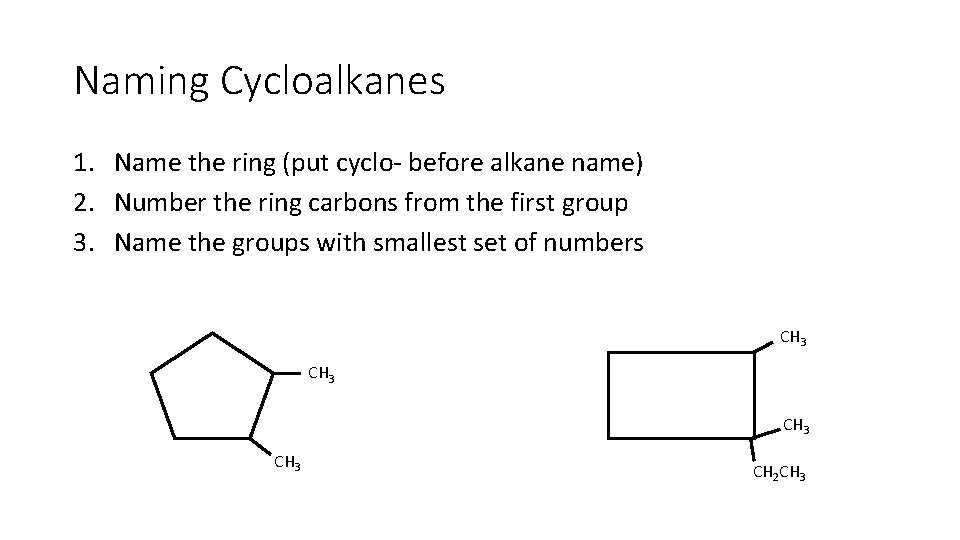
Naming Cycloalkanes 1. Name the ring (put cyclo- before alkane name) 2. Number the ring carbons from the first group 3. Name the groups with smallest set of numbers CH 3 CH 2 CH 3
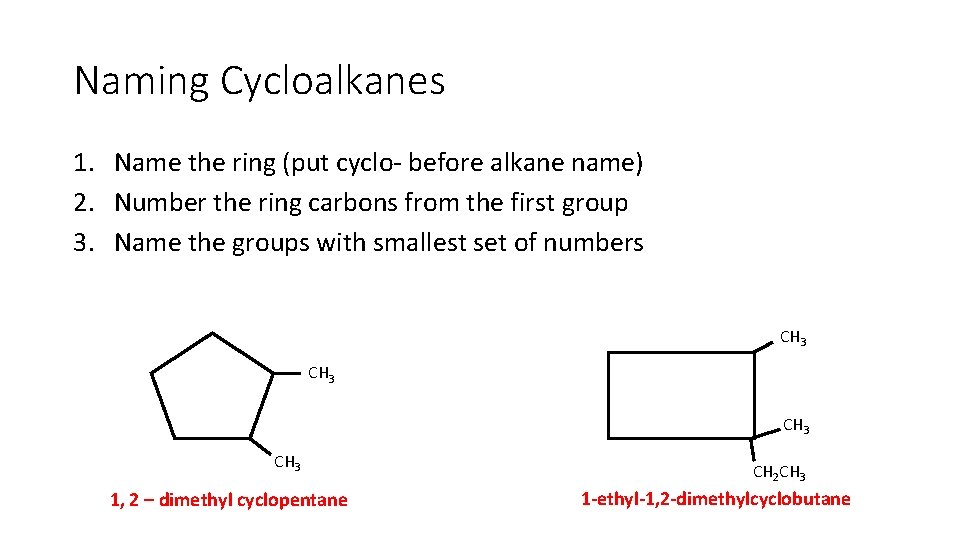
Naming Cycloalkanes 1. Name the ring (put cyclo- before alkane name) 2. Number the ring carbons from the first group 3. Name the groups with smallest set of numbers CH 3 1, 2 – dimethyl cyclopentane CH 2 CH 3 1 -ethyl-1, 2 -dimethylcyclobutane
Properties of Alkanes • Nonpolar • Low melting and boiling points • Not soluble in water • Low reactivity
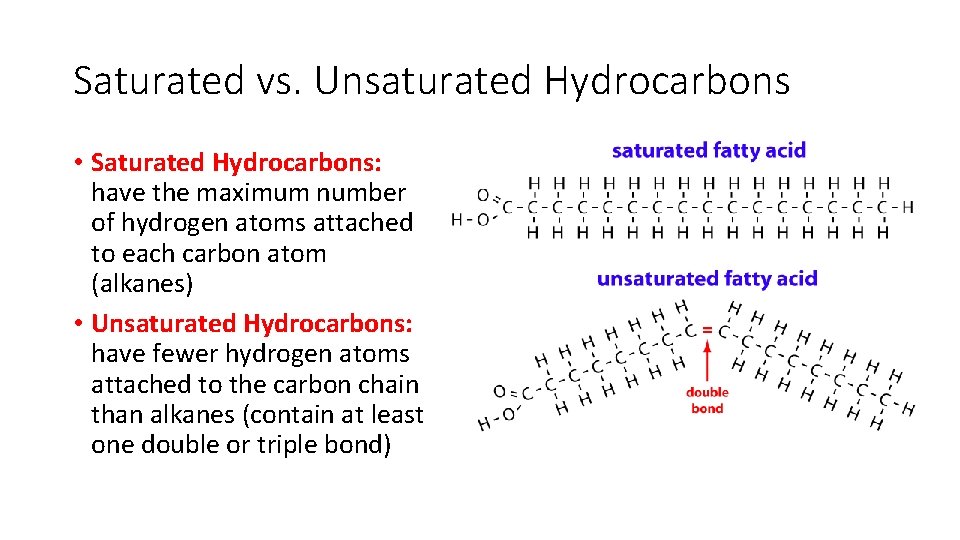
Saturated vs. Unsaturated Hydrocarbons • Saturated Hydrocarbons: have the maximum number of hydrogen atoms attached to each carbon atom (alkanes) • Unsaturated Hydrocarbons: have fewer hydrogen atoms attached to the carbon chain than alkanes (contain at least one double or triple bond)
Alkenes • Alkene • Contain one or more C = C double bonds • General molecular formula Cn. H 2 n • Suffix - ene • Smallest alkene – ethylene
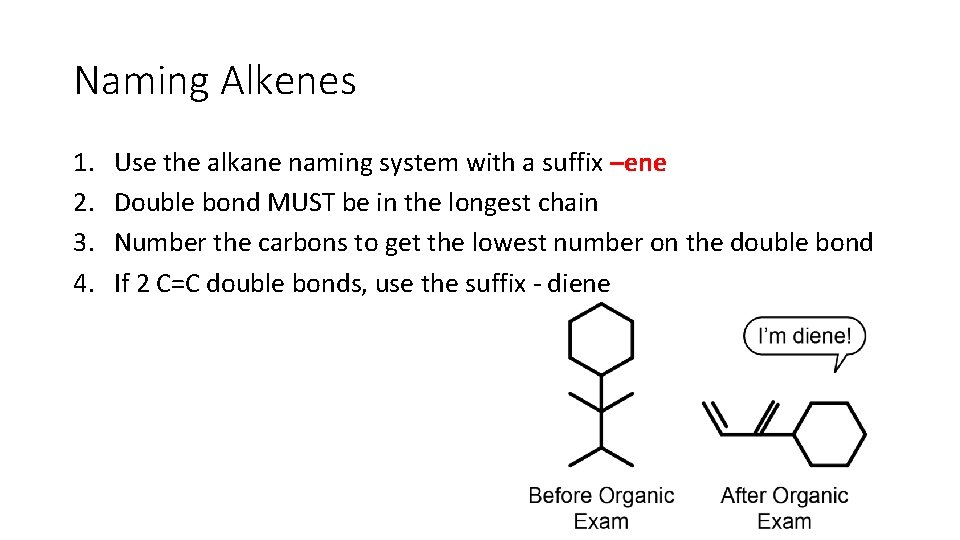
Naming Alkenes 1. 2. 3. 4. Use the alkane naming system with a suffix –ene Double bond MUST be in the longest chain Number the carbons to get the lowest number on the double bond If 2 C=C double bonds, use the suffix - diene
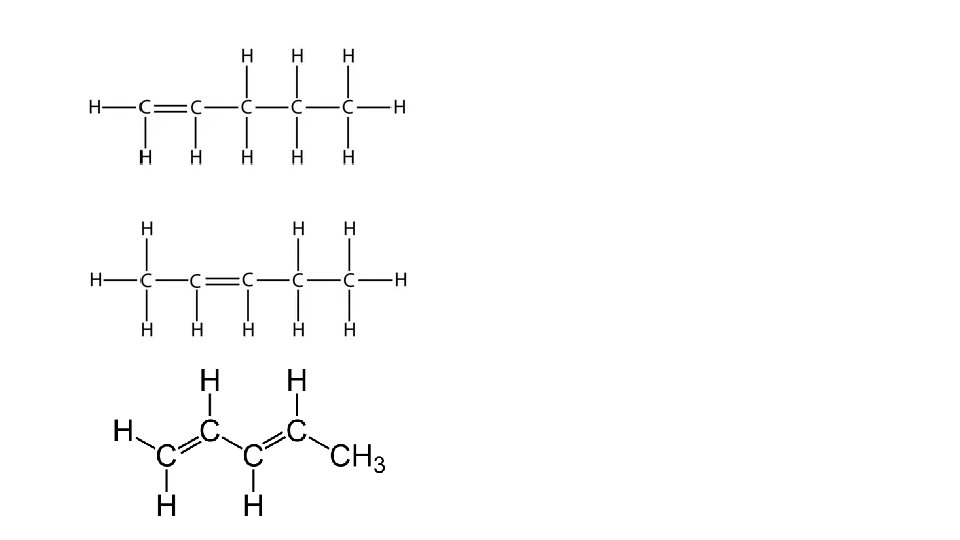

1, 3 - pentadiene
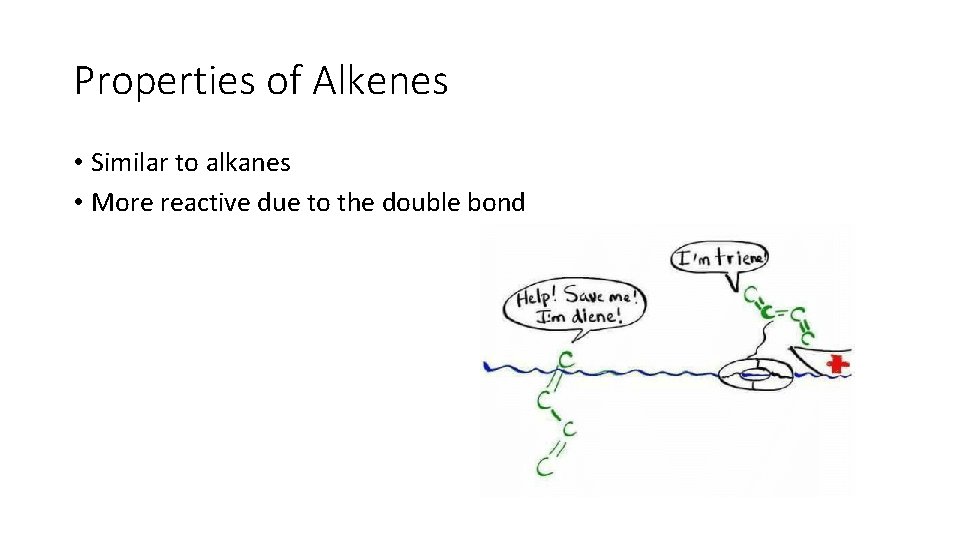
Properties of Alkenes • Similar to alkanes • More reactive due to the double bond
Alkynes • Contain one or more C C triple bonds • General molecular formula Cn. H 2 n-2 • Smallest alkynes …. Common name acetylene • Ethyne: H--C C—H • Properties of Alkynes • Similar to alkanes and alkenes • Even more reactive due to the triple bond • Naming Alkynes • Same as before – suffix -yne
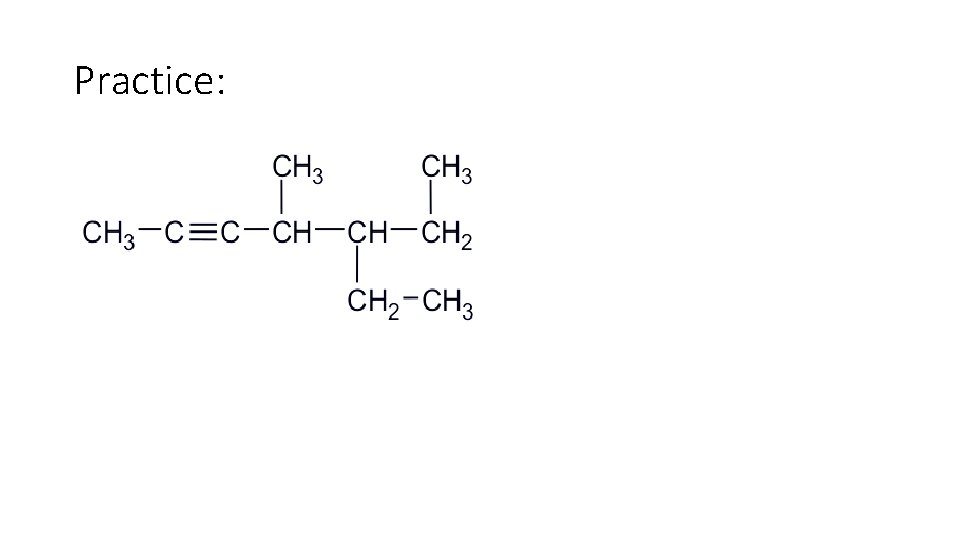
Practice:
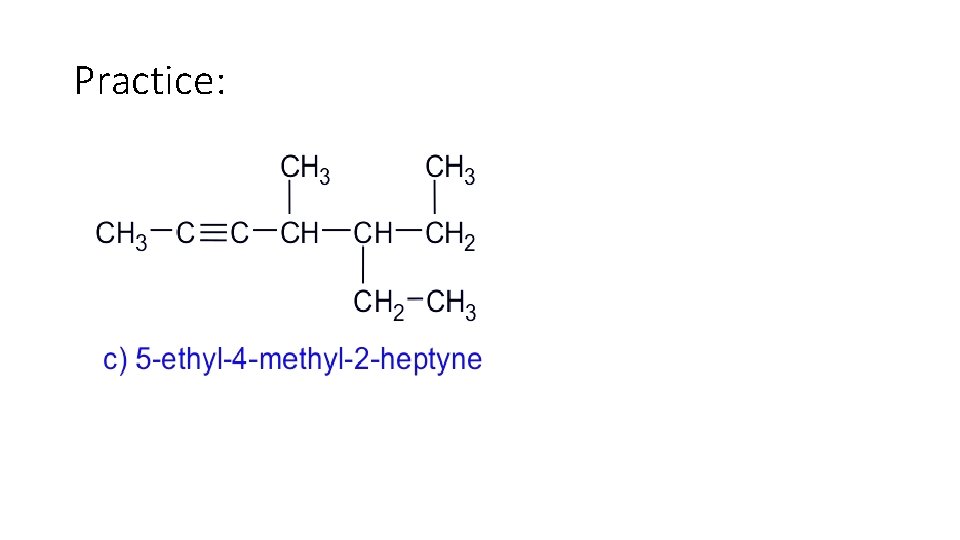
Practice:
Isomers • Isomer: structures that have the same molecular formula but different structure • Two types • Structural • Stereoisomers
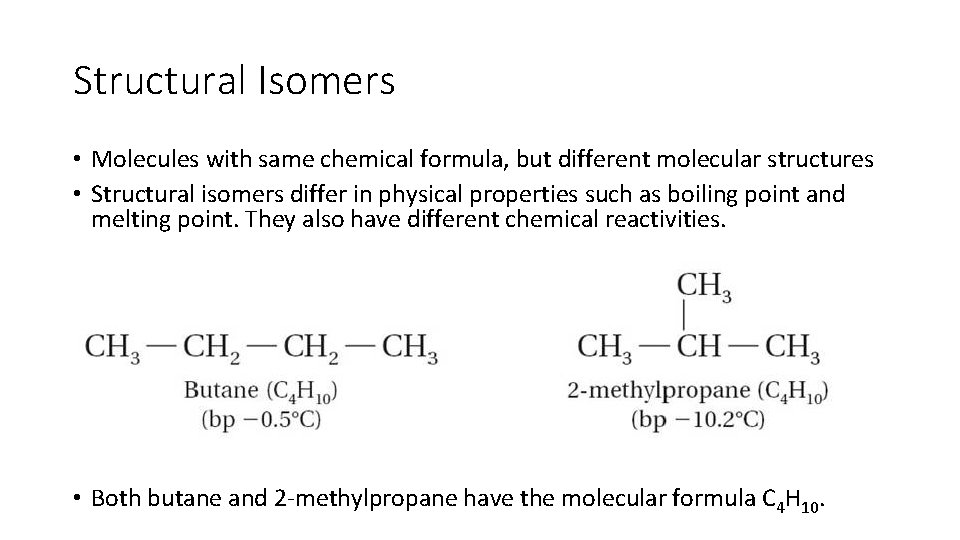
Structural Isomers • Molecules with same chemical formula, but different molecular structures • Structural isomers differ in physical properties such as boiling point and melting point. They also have different chemical reactivities. • Both butane and 2 -methylpropane have the molecular formula C 4 H 10.
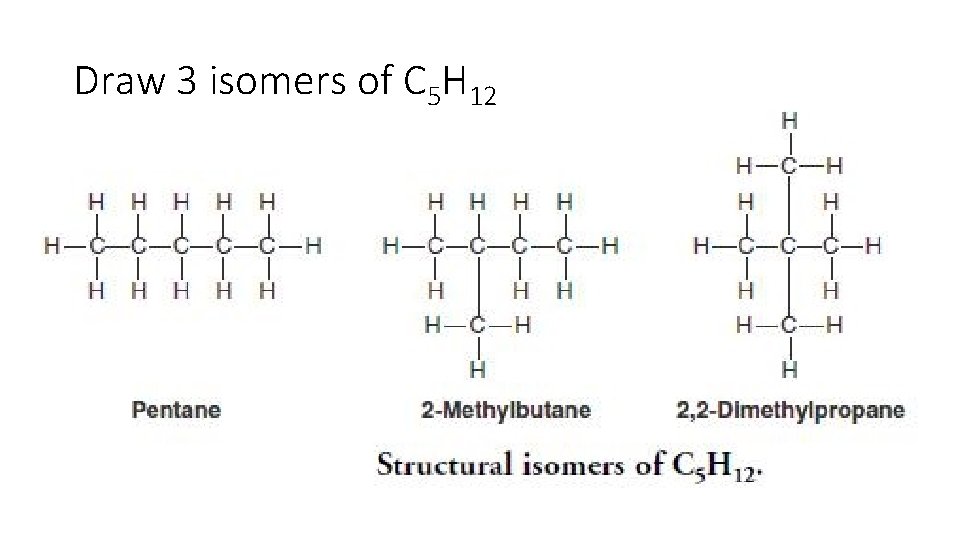
Draw 3 isomers of C 5 H 12
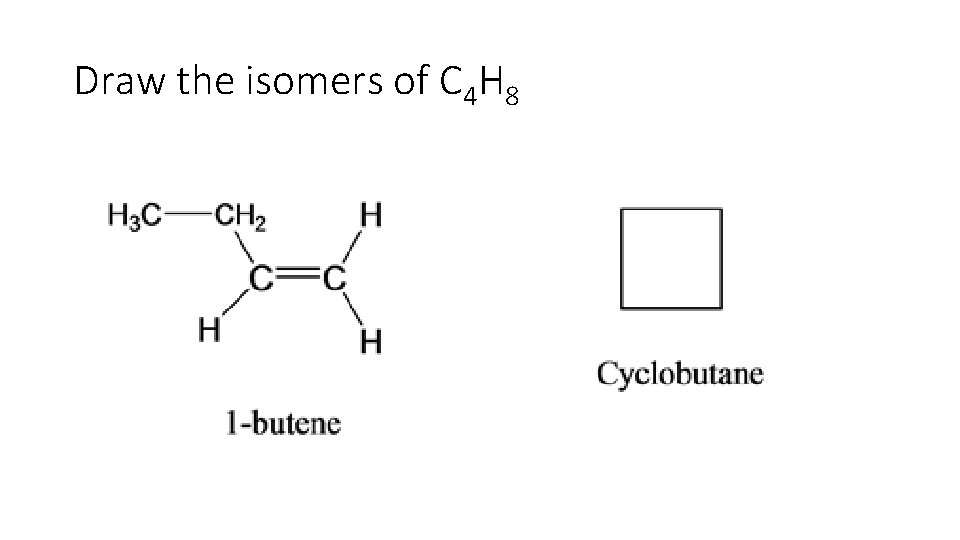
Draw the isomers of C 4 H 8
Stereoisomers • Stereoisomers: molecules in which the atoms are joined in the same order, but the positions of the atoms in space are different. • Two types • Geometric isomers • Optical isomers
Geometric Isomers • Geometric isomers have atoms joined in the same order, but differ in the orientation of groups around a double bond. • Across the double bond, two different conformations can exist • The inflexible double bond does not allow for rotation
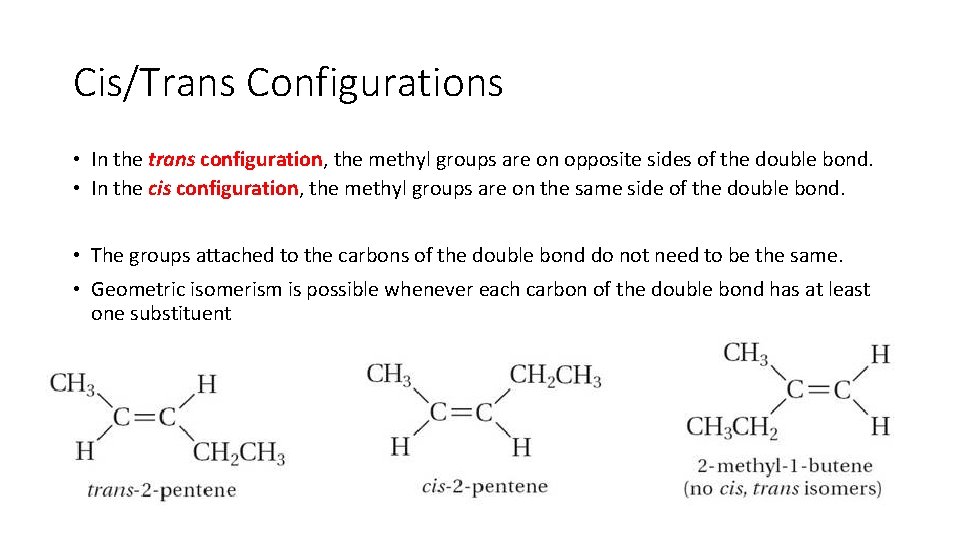
Cis/Trans Configurations • In the trans configuration, the methyl groups are on opposite sides of the double bond. • In the cis configuration, the methyl groups are on the same side of the double bond. • The groups attached to the carbons of the double bond do not need to be the same. • Geometric isomerism is possible whenever each carbon of the double bond has at least one substituent
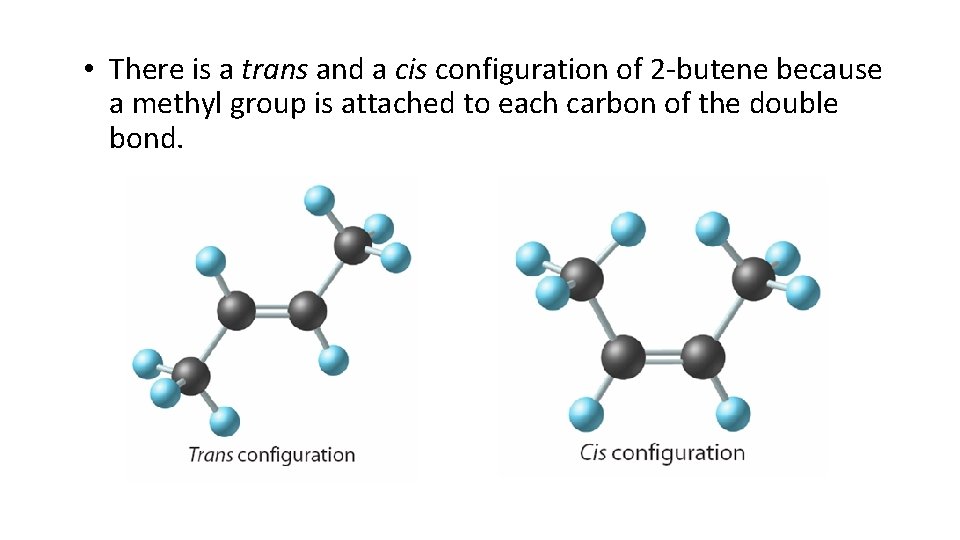
• There is a trans and a cis configuration of 2 -butene because a methyl group is attached to each carbon of the double bond.
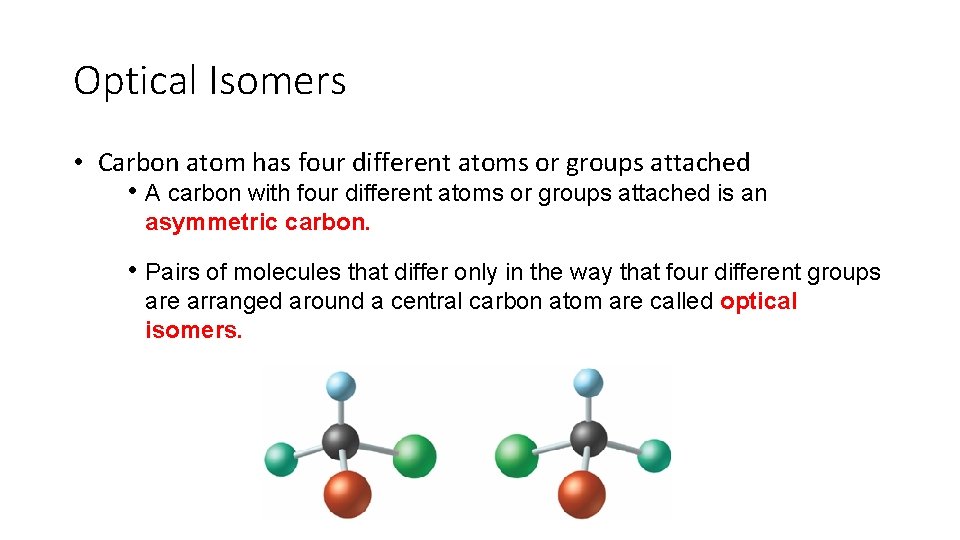
Optical Isomers • Carbon atom has four different atoms or groups attached • A carbon with four different atoms or groups attached is an asymmetric carbon. • Pairs of molecules that differ only in the way that four different groups are arranged around a central carbon atom are called optical isomers.
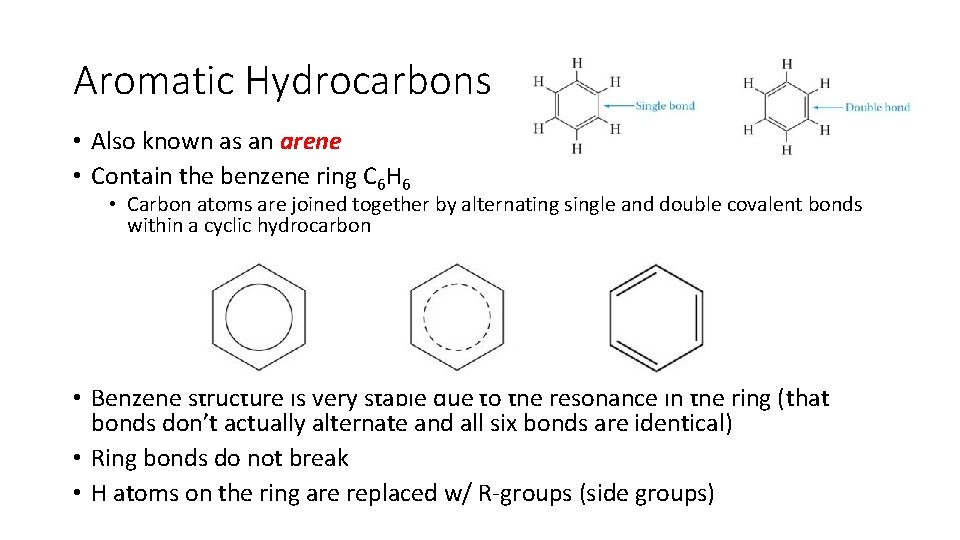
Aromatic Hydrocarbons • Also known as an arene • Contain the benzene ring C 6 H 6 • Carbon atoms are joined together by alternating single and double covalent bonds within a cyclic hydrocarbon • Benzene structure is very stable due to the resonance in the ring (that bonds don’t actually alternate and all six bonds are identical) • Ring bonds do not break • H atoms on the ring are replaced w/ R-groups (side groups)
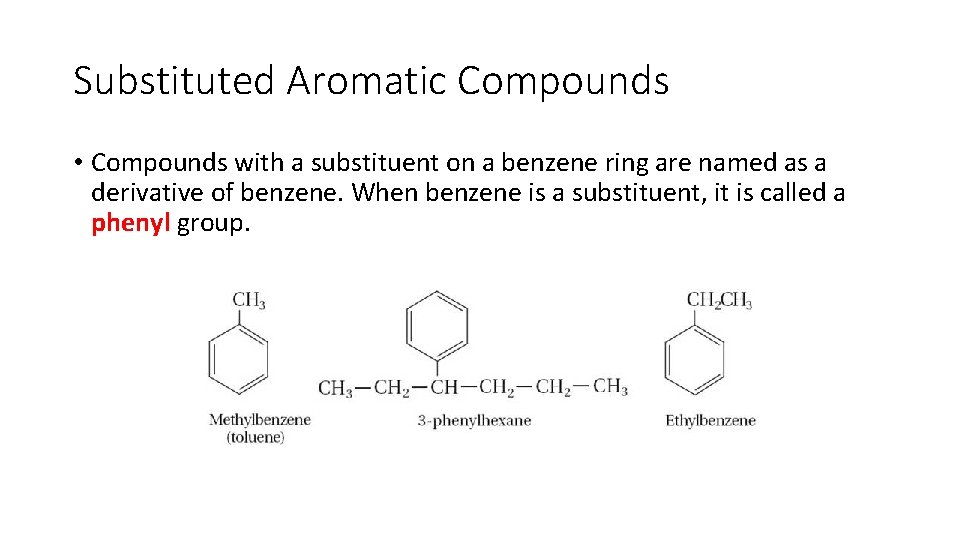
Substituted Aromatic Compounds • Compounds with a substituent on a benzene ring are named as a derivative of benzene. When benzene is a substituent, it is called a phenyl group.
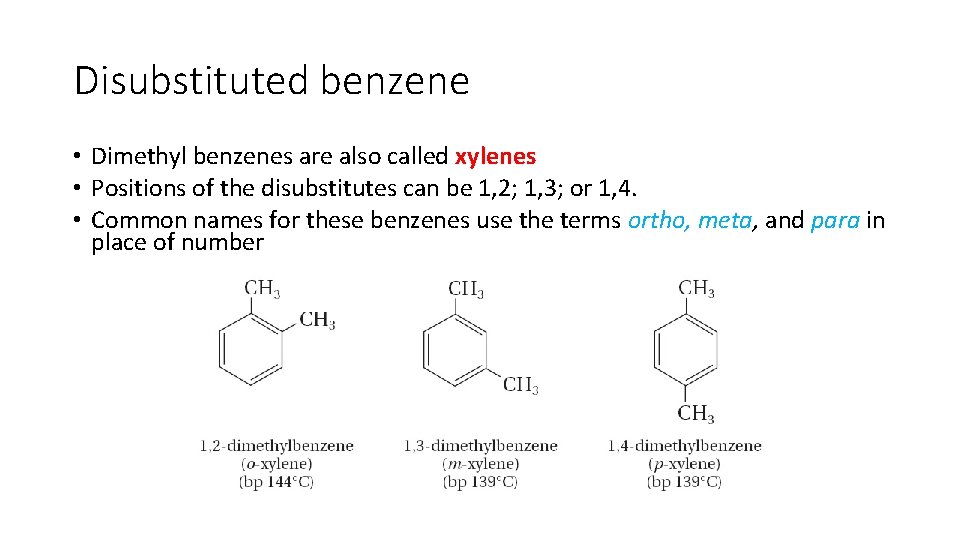
Disubstituted benzene • Dimethyl benzenes are also called xylenes • Positions of the disubstitutes can be 1, 2; 1, 3; or 1, 4. • Common names for these benzenes use the terms ortho, meta, and para in place of number
Polymers • Long-chain molecules consisting of many replacing units • Natural Polymers: • Cellulose in plants • Starches in foods • Proteins & DNA in the body • Synthetic Polymers: • Polyethylene & polystyrene (plastics) • Nylon • Teflon
- Slides: 40