
Ch 21 Adjective and Adverb 2016 CENGAGE LEARNING
Ch. 21 – Adjective and Adverb © 2016. CENGAGE LEARNING. ALL RIGHTS RESERVED.
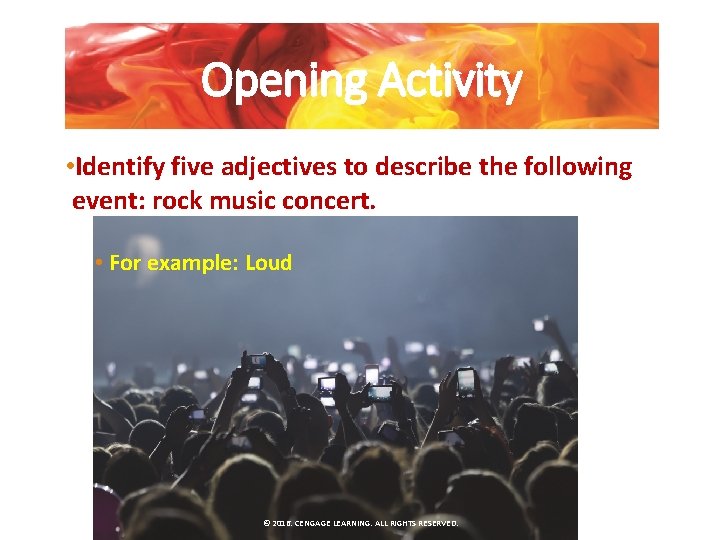
Opening Activity • Identify five adjectives to describe the following event: rock music concert. • For example: Loud © 2016. CENGAGE LEARNING. ALL RIGHTS RESERVED.
Answers • Identify five adjectives to describe the following event: rock music concert. • Loud • Invigorating • Exciting • Dark • Crowded • Smelly • Hectic • Fun © 2016. CENGAGE LEARNING. ALL RIGHTS RESERVED.
Learning Outcomes By the time you finish reading and studying this chapter, you should be able to: Recognize and use ◦ LO 1 Adjective Basics ◦ LO 2 Adjective Order ◦ LO 3 Adverb Basics ◦ L 04 Adverb Placement © 2016. CENGAGE LEARNING. ALL RIGHTS RESERVED.
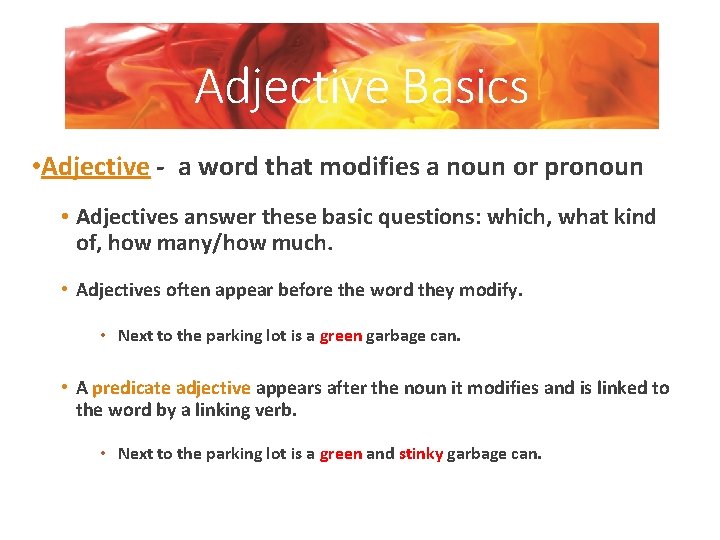
Adjective Basics • Adjective - a word that modifies a noun or pronoun • Adjectives answer these basic questions: which, what kind of, how many/how much. • Adjectives often appear before the word they modify. • Next to the parking lot is a green garbage can. • A predicate adjective appears after the noun it modifies and is linked to the word by a linking verb. • Next to the parking lot is a green and stinky garbage can. © 2016. CENGAGE LEARNING. ALL RIGHTS RESERVED.
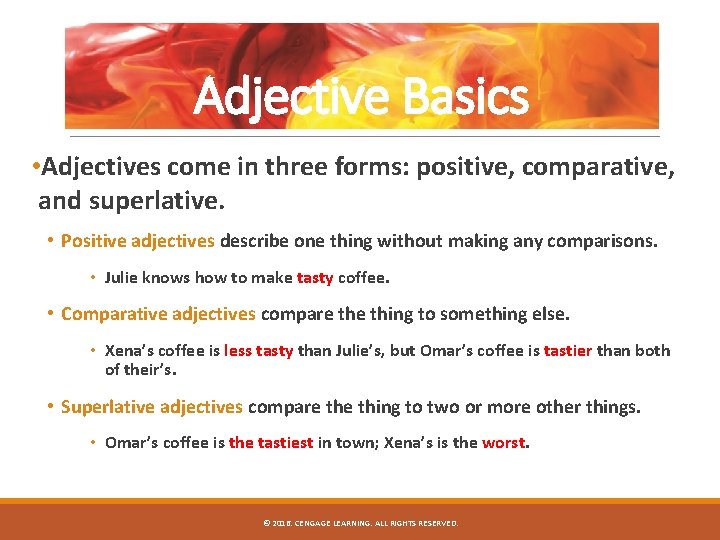
Adjective Basics • Adjectives come in three forms: positive, comparative, and superlative. • Positive adjectives describe one thing without making any comparisons. • Julie knows how to make tasty coffee. • Comparative adjectives compare thing to something else. • Xena’s coffee is less tasty than Julie’s, but Omar’s coffee is tastier than both of their’s. • Superlative adjectives compare thing to two or more other things. • Omar’s coffee is the tastiest in town; Xena’s is the worst. © 2016. CENGAGE LEARNING. ALL RIGHTS RESERVED.
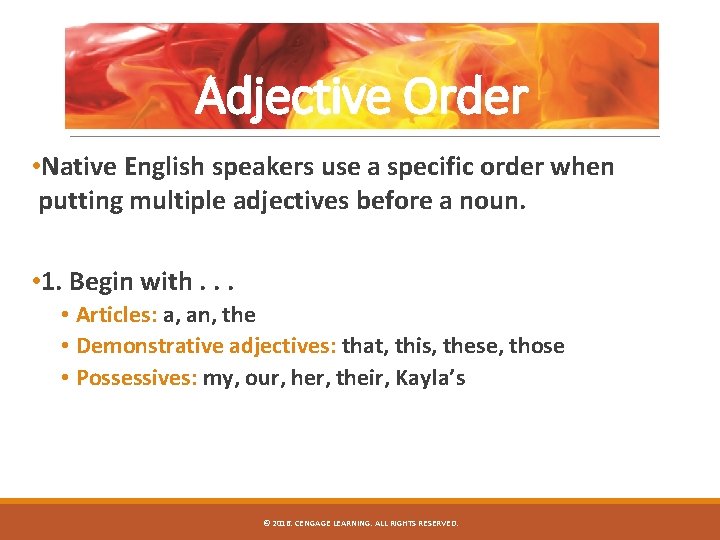
Adjective Order • Native English speakers use a specific order when putting multiple adjectives before a noun. • 1. Begin with. . . • Articles: a, an, the • Demonstrative adjectives: that, this, these, those • Possessives: my, our, her, their, Kayla’s © 2016. CENGAGE LEARNING. ALL RIGHTS RESERVED.
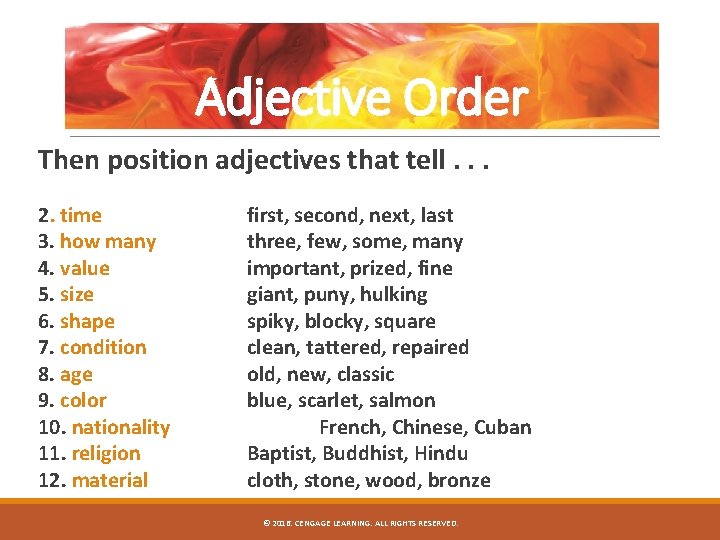
Adjective Order Then position adjectives that tell. . . 2. time 3. how many 4. value 5. size 6. shape 7. condition 8. age 9. color 10. nationality 11. religion 12. material first, second, next, last three, few, some, many important, prized, fine giant, puny, hulking spiky, blocky, square clean, tattered, repaired old, new, classic blue, scarlet, salmon French, Chinese, Cuban Baptist, Buddhist, Hindu cloth, stone, wood, bronze © 2016. CENGAGE LEARNING. ALL RIGHTS RESERVED.
![Adjective Order Finally place. . . 13. nouns used as adjectives • baby [seat],](http://slidetodoc.com/presentation_image_h2/2eaa8a4dfd14382f64ea2d9054de3734/image-9.jpg "Adjective Order Finally place. . . 13. nouns used as adjectives • baby [seat],")
Adjective Order Finally place. . . 13. nouns used as adjectives • baby [seat], shoe [lace] • The tiny, bumpy bullfrog leapt across the pond. • The tall and expressive teacher got out of his seat to write on the board. • Those shiny, patent leather shoes glisten in the sunlight. © 2016. CENGAGE LEARNING. ALL RIGHTS RESERVED.
Adjective Questions and Adjectivals • Adjectives answer four basic questions: which, what kind of, how many/how much. • A single word that answers one of these questions is called an adjective. • The young man called his angry ex-girlfriend. • If a phrase or clause answers one of these questions, it is an adjectival phrase or clause. • The young man called his angry ex-girlfriend who accused him of being jealous. © 2016. CENGAGE LEARNING. ALL RIGHTS RESERVED.
Adverb Basics • Adverb - modifies a verb, a verbal, an adjective, an adverb, or a whole sentence. • An adverb answers six basic questions: how, when, where, why, to what degree, how often. • The stylist expertly cut Jason’s hair. • The stylist cut Jason’s hair extremely carefully. © 2016. CENGAGE LEARNING. ALL RIGHTS RESERVED.
Adverb Basics • Adverbs have three forms: positive, comparative, and superlative. • Positive adverbs describe without comparing. • Patty speaks French fluently. • Comparative adverbs (-er, more, or less) describe by comparing with one other. • Patty speaks French less fluently than Simone. • Superlative adverbs (-est, most, or least) describe by comparing with more than one action. • Simone’s speaks French the most fluently, even though she’s not from France (she’s from Reunion Island). © 2016. CENGAGE LEARNING. ALL RIGHTS RESERVED.
Placement of Adverbs • Adverbs should be placed in different places in sentences, depending on their use. • How Adverbs - can appear anywhere except between a verb and a direct object. • The procession started quickly. • When Adverbs - tell when should go at the beginning or end of the sentence. • Yesterday, the procession started quickly. © 2016. CENGAGE LEARNING. ALL RIGHTS RESERVED.
Placement of Adverbs • Where Adverbs - tell where should follow the verb they modify, but should not come between the verb and the direct object. • The procession started quickly in the lobby. • To What Degree Adverbs - tell to what degree go right before the adverb they modify. • The procession started very quickly. • How Often Adverbs - tell how often should go right before an action verb, even if the verb has a helping verb. • Every Tuesday, the procession started quickly. © 2016. CENGAGE LEARNING. ALL RIGHTS RESERVED.
Adverb Phrases and Clauses • Adverbs answer six basic questions: how, when, where, why, to what degree, and how often. • Often, the adverb questions are answered by adverb phrases and clauses, which answer the same six questions. • The officer stood with his arms by his side. (How? ) • The officer stood at midnight. (When? ) • The officer stood on the side of the road. (Where? ) • The officer stood to hear the woman’s story. (Why? ) • The officer stood until he heard the whole story. (To what degree? ) • The officer stood for eight hours a day. (How often? ) © 2016. CENGAGE LEARNING. ALL RIGHTS RESERVED.
Closing Activity Complete the following sentences by adding different types of adverb phrases or clauses 1. The driver sped very quickly. (How? ) 2. The driver sped ____________ (When? ) 3. The driver sped ____________ (Where? ) 4. The driver sped ____________ (Why? ) 5. The driver sped ____________ (To what degree? ) 6. The driver sped ____________ (How often? ) © 2016. CENGAGE LEARNING. ALL RIGHTS RESERVED.
Answers Complete the following sentences by adding different types of adverb phrases or clauses. Answers Will Vary 1. The driver sped very quickly. (How? ) 2. The driver sped at noon. (When? ) 3. The driver sped around the corner. (Where? ) 4. The driver sped to avoid the officer. (Why? ) 5. The driver sped until he ran out of gas. (To what degree? ) 6. The driver sped every time he saw a non-school zone. (How often? ) © 2016. CENGAGE LEARNING. ALL RIGHTS RESERVED.
- Slides: 17