
Ch 2 Onedimensional Motion How do we measure
- Slides: 22
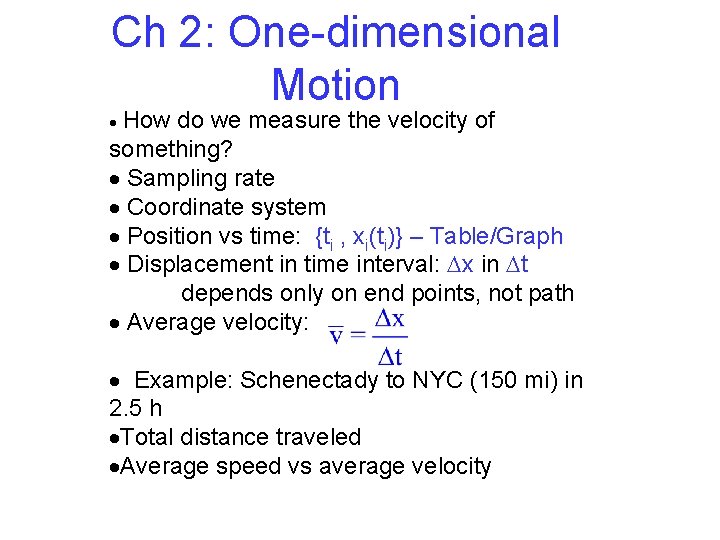
Ch 2: One-dimensional Motion How do we measure the velocity of something? Sampling rate Coordinate system Position vs time: {ti , xi(ti)} – Table/Graph Displacement in time interval: Dx in Dt depends only on end points, not path Average velocity: Example: Schenectady to NYC (150 mi) in 2. 5 h Total distance traveled Average speed vs average velocity
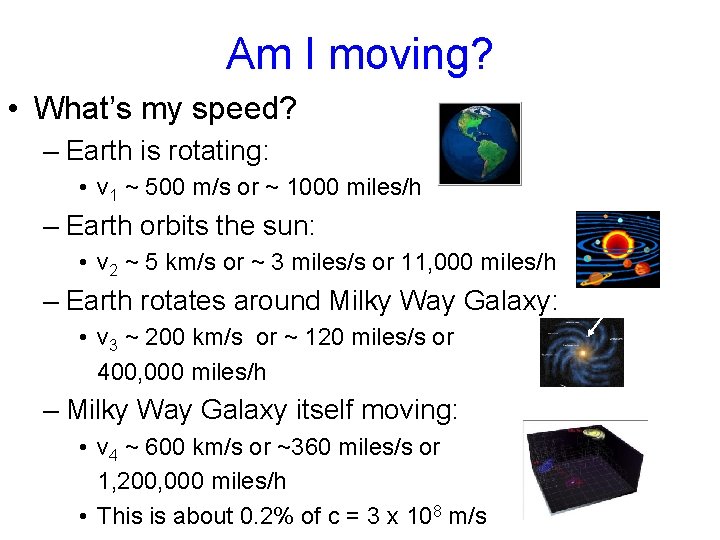
Am I moving? • What’s my speed? – Earth is rotating: • v 1 ~ 500 m/s or ~ 1000 miles/h – Earth orbits the sun: • v 2 ~ 5 km/s or ~ 3 miles/s or 11, 000 miles/h – Earth rotates around Milky Way Galaxy: • v 3 ~ 200 km/s or ~ 120 miles/s or 400, 000 miles/h – Milky Way Galaxy itself moving: • v 4 ~ 600 km/s or ~360 miles/s or 1, 200, 000 miles/h • This is about 0. 2% of c = 3 x 10⁸ m/s
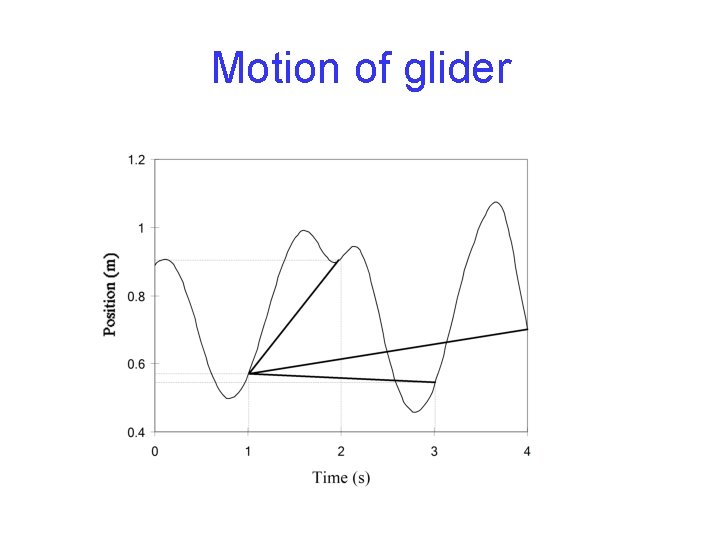
Motion of glider
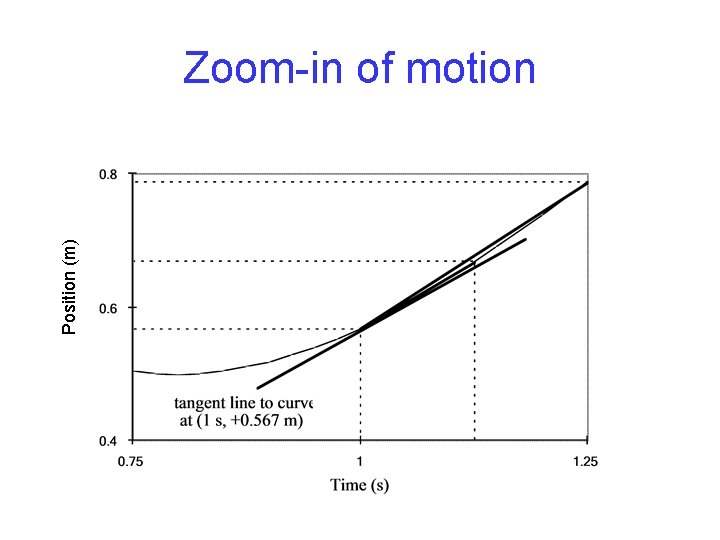
Position (m) Zoom-in of motion
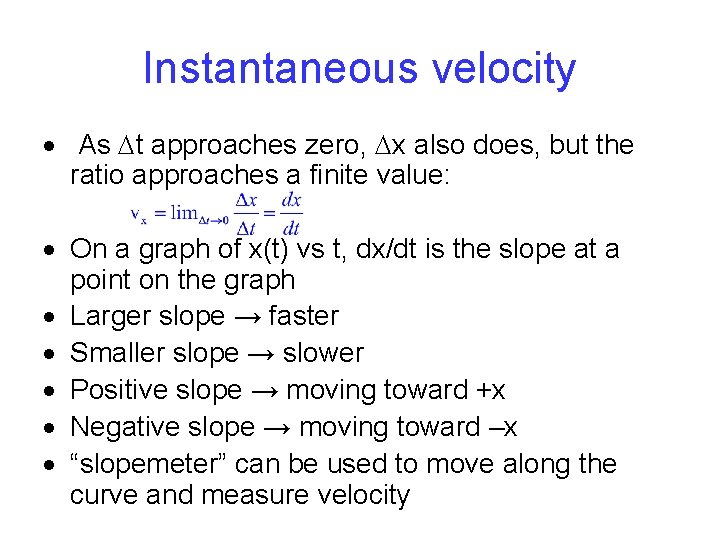
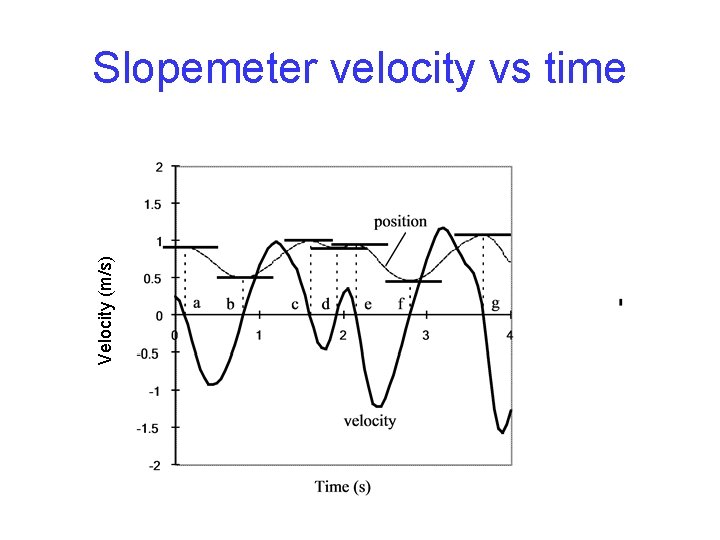
Instantaneous velocity As Dt approaches zero, Dx also does, but the ratio approaches a finite value: On a graph of x(t) vs t, dx/dt is the slope at a point on the graph Larger slope → faster Smaller slope → slower Positive slope → moving toward +x Negative slope → moving toward –x “slopemeter” can be used to move along the curve and measure velocity
Velocity (m/s) Slopemeter velocity vs time
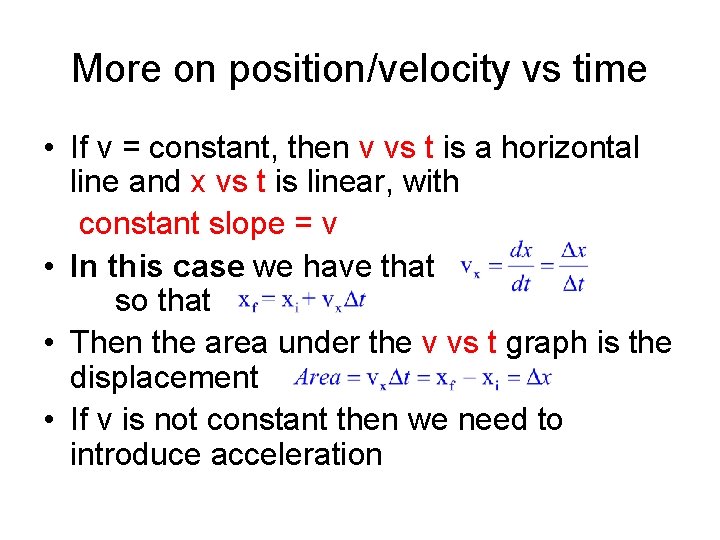
More on position/velocity vs time • If v = constant, then v vs t is a horizontal line and x vs t is linear, with constant slope = v • In this case we have that so that • Then the area under the v vs t graph is the displacement • If v is not constant then we need to introduce acceleration
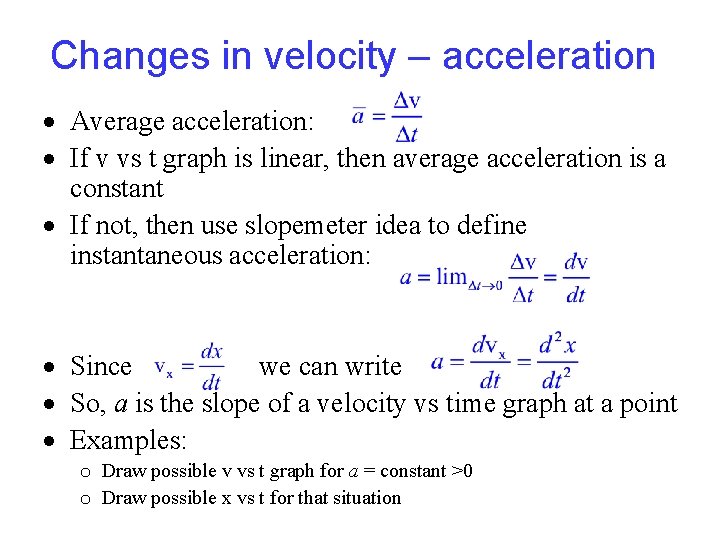
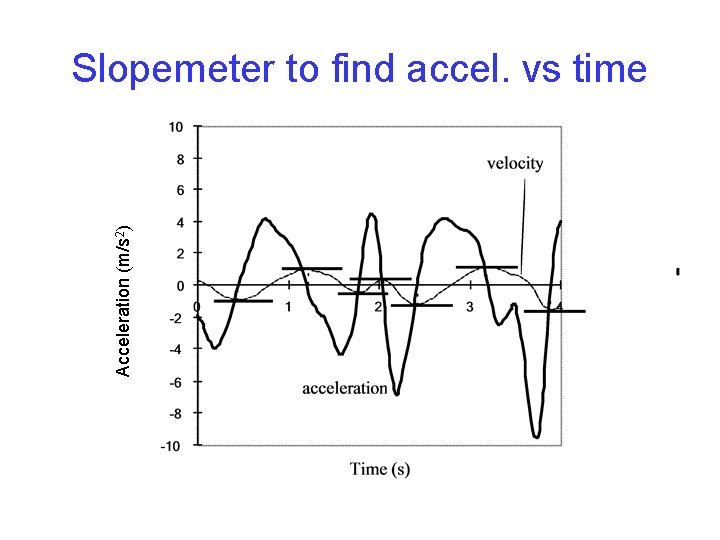
Changes in velocity – acceleration Average acceleration: If v vs t graph is linear, then average acceleration is a constant If not, then use slopemeter idea to define instantaneous acceleration: Since we can write So, a is the slope of a velocity vs time graph at a point Examples: o Draw possible v vs t graph for a = constant >0 o Draw possible x vs t for that situation
Acceleration (m/s 2) Slopemeter to find accel. vs time
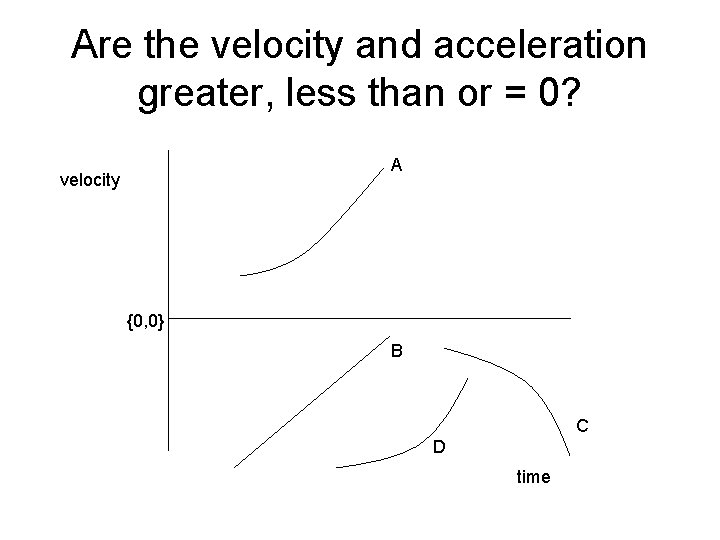
Are the velocity and acceleration greater, less than or = 0? A velocity {0, 0} B C D time
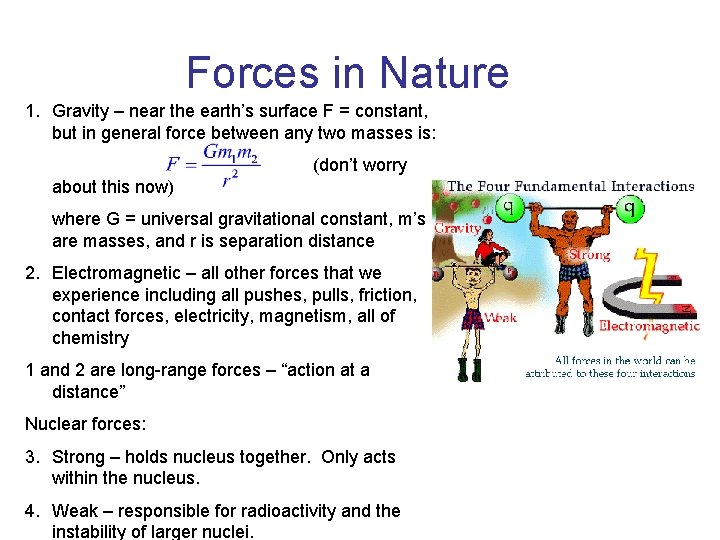
Forces in Nature 1. Gravity – near the earth’s surface F = constant, but in general force between any two masses is: (don’t worry about this now) where G = universal gravitational constant, m’s are masses, and r is separation distance 2. Electromagnetic – all other forces that we experience including all pushes, pulls, friction, contact forces, electricity, magnetism, all of chemistry 1 and 2 are long-range forces – “action at a distance” Nuclear forces: 3. Strong – holds nucleus together. Only acts within the nucleus. 4. Weak – responsible for radioactivity and the instability of larger nuclei.
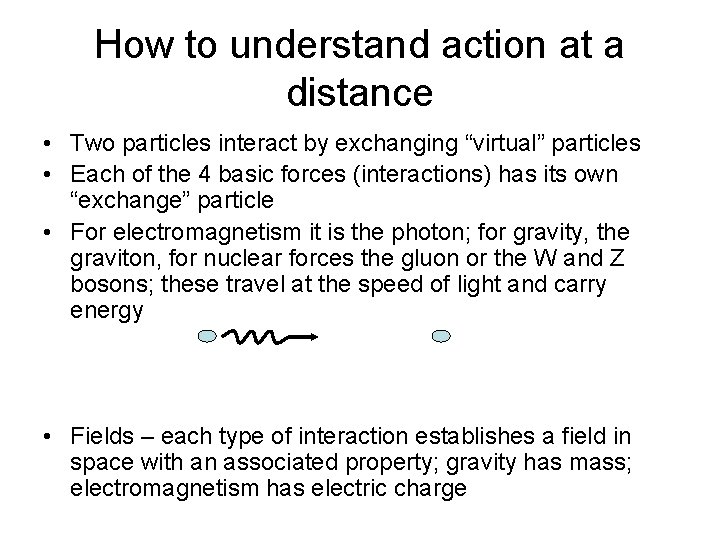
How to understand action at a distance • Two particles interact by exchanging “virtual” particles • Each of the 4 basic forces (interactions) has its own “exchange” particle • For electromagnetism it is the photon; for gravity, the graviton, for nuclear forces the gluon or the W and Z bosons; these travel at the speed of light and carry energy • Fields – each type of interaction establishes a field in space with an associated property; gravity has mass; electromagnetism has electric charge
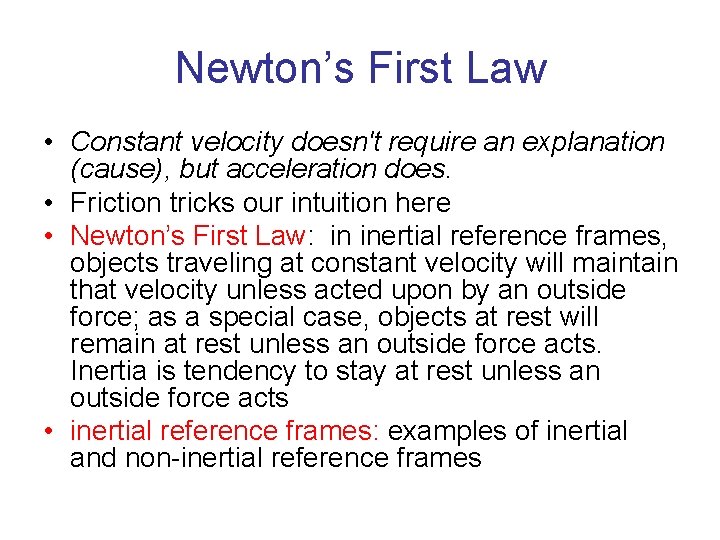
Newton’s First Law • Constant velocity doesn't require an explanation (cause), but acceleration does. • Friction tricks our intuition here • Newton’s First Law: in inertial reference frames, objects traveling at constant velocity will maintain that velocity unless acted upon by an outside force; as a special case, objects at rest will remain at rest unless an outside force acts. Inertia is tendency to stay at rest unless an outside force acts • inertial reference frames: examples of inertial and non-inertial reference frames
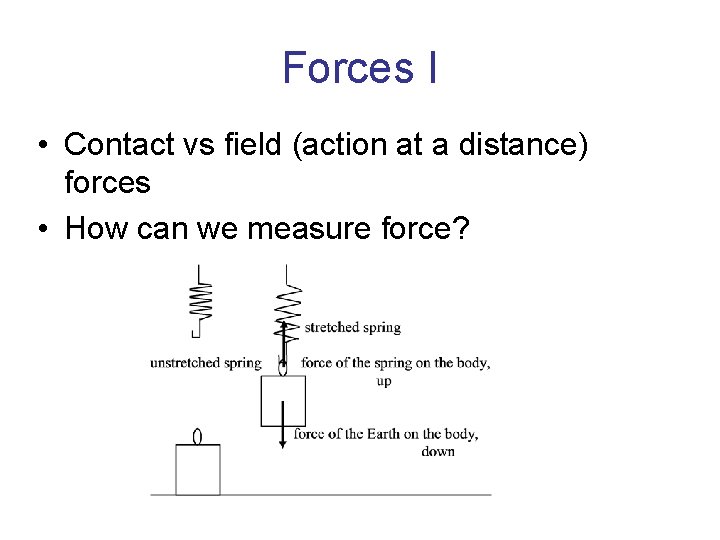
Forces I • Contact vs field (action at a distance) forces • How can we measure force?
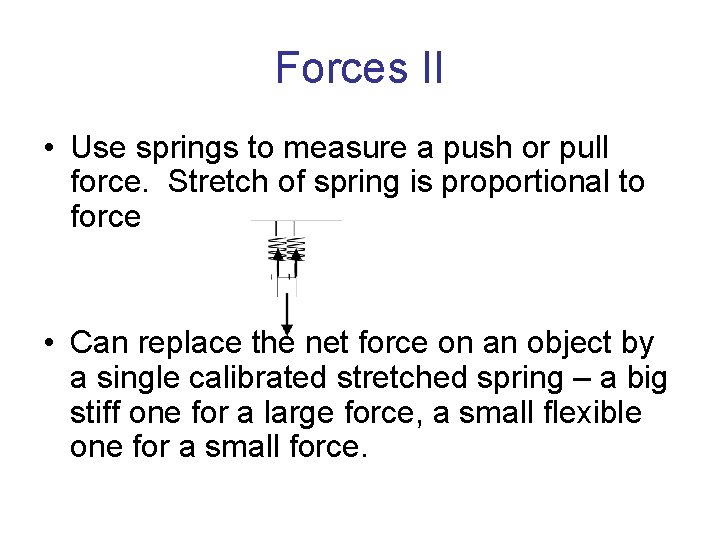
Forces II • Use springs to measure a push or pull force. Stretch of spring is proportional to force • Can replace the net force on an object by a single calibrated stretched spring – a big stiff one for a large force, a small flexible one for a small force.
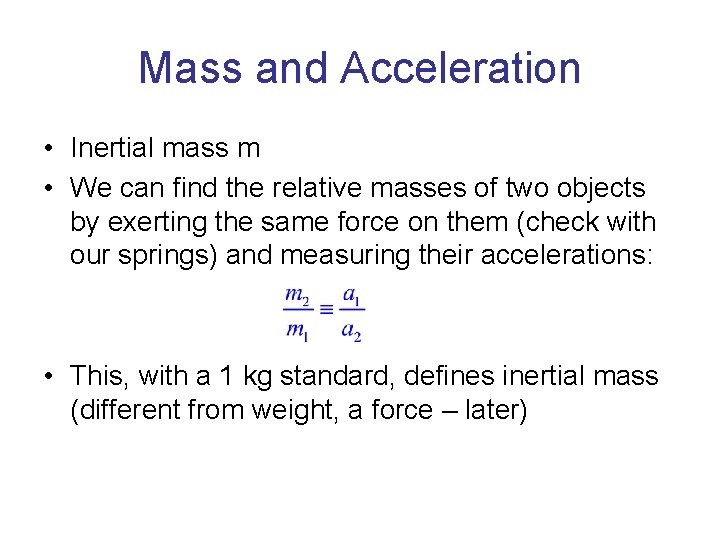
Mass and Acceleration • Inertial mass m • We can find the relative masses of two objects by exerting the same force on them (check with our springs) and measuring their accelerations: • This, with a 1 kg standard, defines inertial mass (different from weight, a force – later)
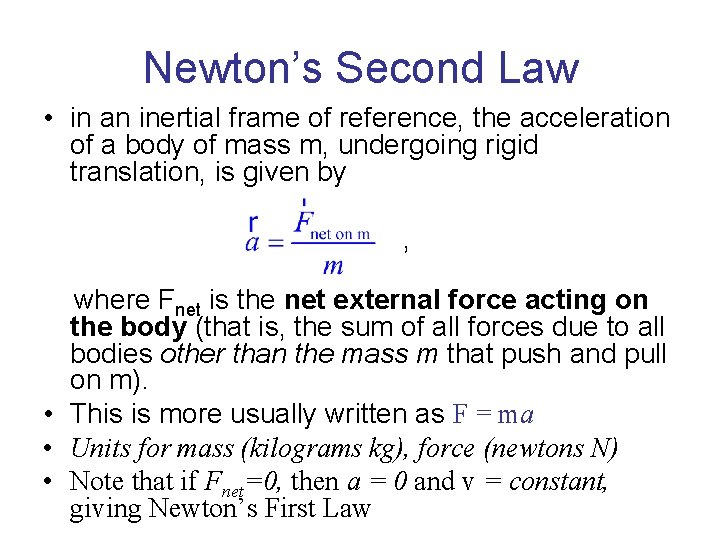
Newton’s Second Law • in an inertial frame of reference, the acceleration of a body of mass m, undergoing rigid translation, is given by , where Fnet is the net external force acting on the body (that is, the sum of all forces due to all bodies other than the mass m that push and pull on m). • This is more usually written as F = ma • Units for mass (kilograms kg), force (newtons N) • Note that if Fnet=0, then a = 0 and v = constant, giving Newton’s First Law
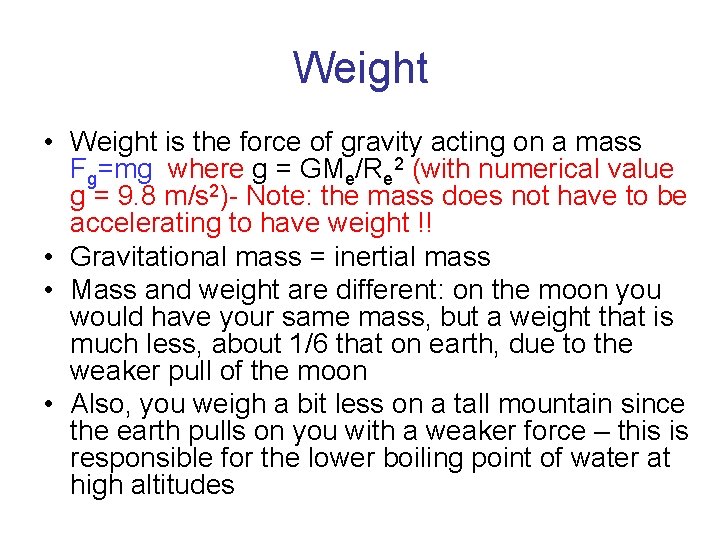
Weight • Weight is the force of gravity acting on a mass Fg=mg where g = GMe/Re 2 (with numerical value g = 9. 8 m/s 2)- Note: the mass does not have to be accelerating to have weight !! • Gravitational mass = inertial mass • Mass and weight are different: on the moon you would have your same mass, but a weight that is much less, about 1/6 that on earth, due to the weaker pull of the moon • Also, you weigh a bit less on a tall mountain since the earth pulls on you with a weaker force – this is responsible for the lower boiling point of water at high altitudes
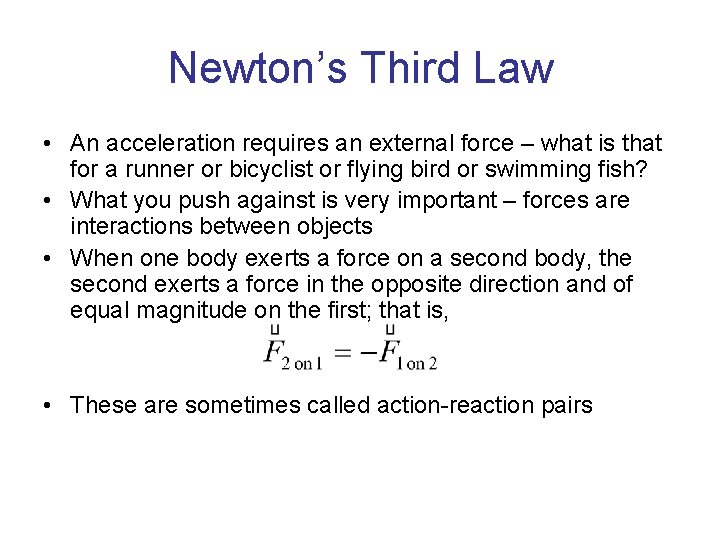
Newton’s Third Law • An acceleration requires an external force – what is that for a runner or bicyclist or flying bird or swimming fish? • What you push against is very important – forces are interactions between objects • When one body exerts a force on a second body, the second exerts a force in the opposite direction and of equal magnitude on the first; that is, • These are sometimes called action-reaction pairs
Third Law Examples • Identify the interaction pairs of forces. In each case draw a free-body diagram: – A book resting on a table with a second book on top of it – A cart being pulled by a horse along a level road – A heavy picture being pushed horizontally against the wall
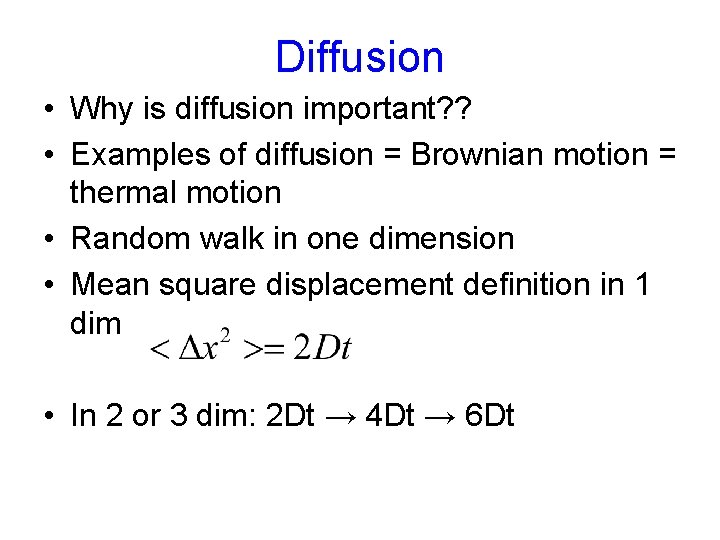
Diffusion • Why is diffusion important? ? • Examples of diffusion = Brownian motion = thermal motion • Random walk in one dimension • Mean square displacement definition in 1 dim • In 2 or 3 dim: 2 Dt → 4 Dt → 6 Dt
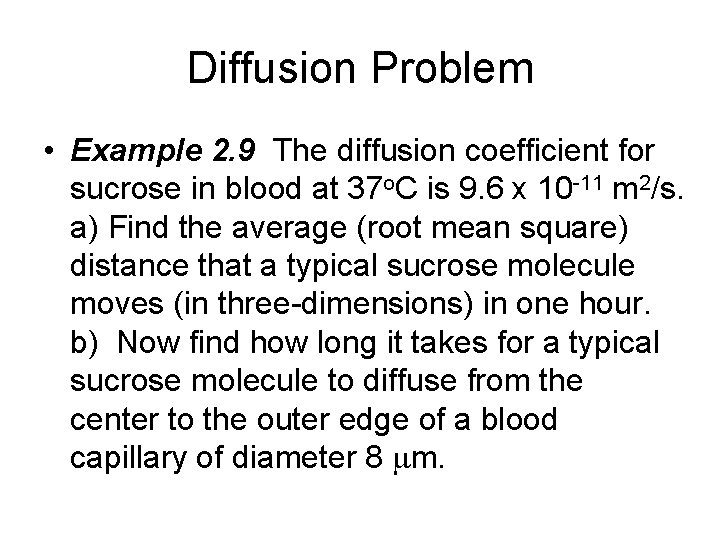
Diffusion Problem • Example 2. 9 The diffusion coefficient for sucrose in blood at 37 o. C is 9. 6 x 10 -11 m 2/s. a) Find the average (root mean square) distance that a typical sucrose molecule moves (in three-dimensions) in one hour. b) Now find how long it takes for a typical sucrose molecule to diffuse from the center to the outer edge of a blood capillary of diameter 8 m.