
CH 2 Molecules and covalent bonding Lewis Structures
CH 2. Molecules and covalent bonding Lewis Structures VSEPR MO Theory 1
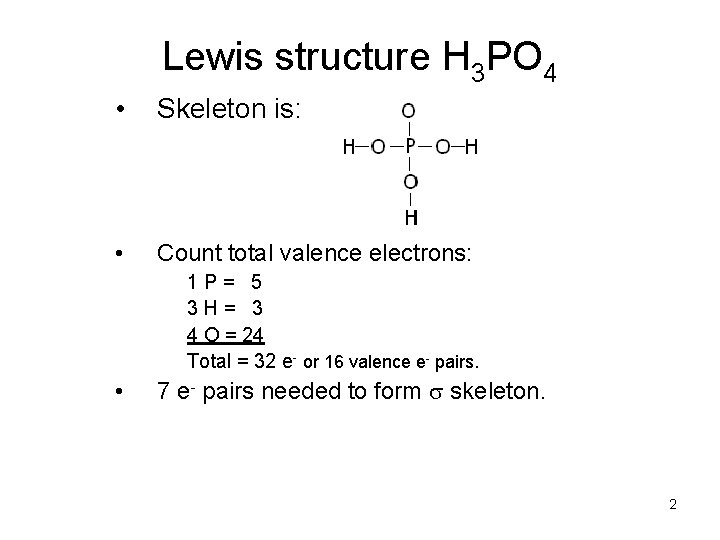
Lewis structure H 3 PO 4 • Skeleton is: • Count total valence electrons: 1 P= 5 3 H= 3 4 O = 24 Total = 32 e- or 16 valence e- pairs. • 7 e- pairs needed to form s skeleton. 2
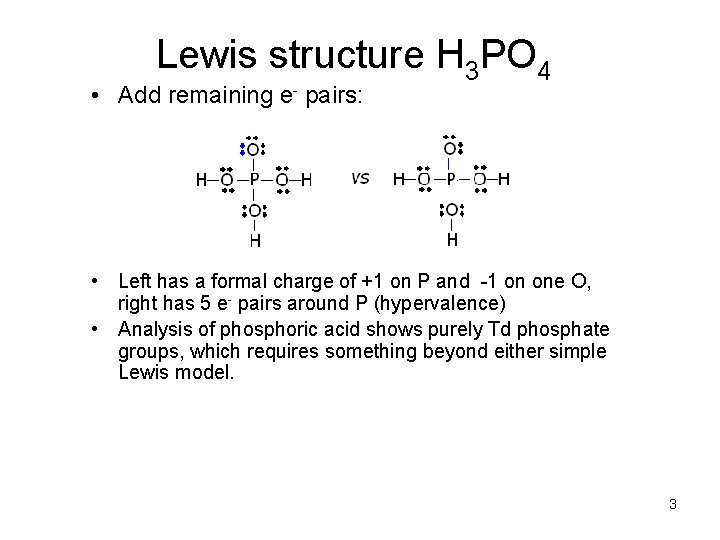
Lewis structure H 3 PO 4 • Add remaining e- pairs: • Left has a formal charge of +1 on P and -1 on one O, right has 5 e- pairs around P (hypervalence) • Analysis of phosphoric acid shows purely Td phosphate groups, which requires something beyond either simple Lewis model. 3
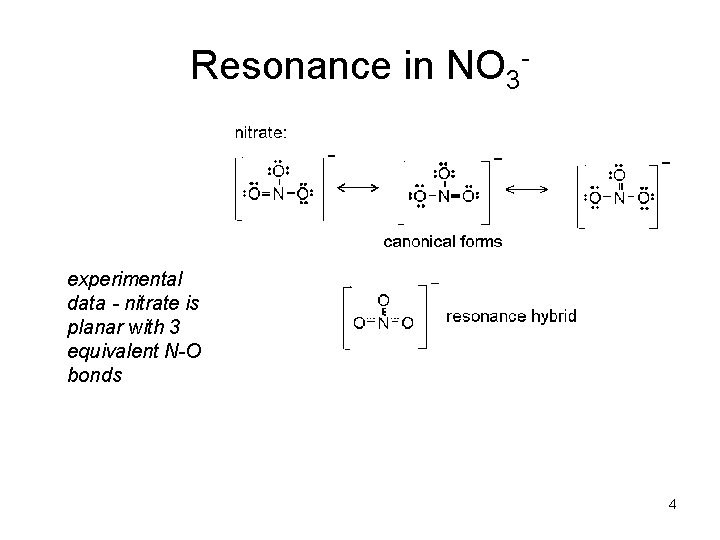
Resonance in NO 3 - experimental data - nitrate is planar with 3 equivalent N-O bonds 4
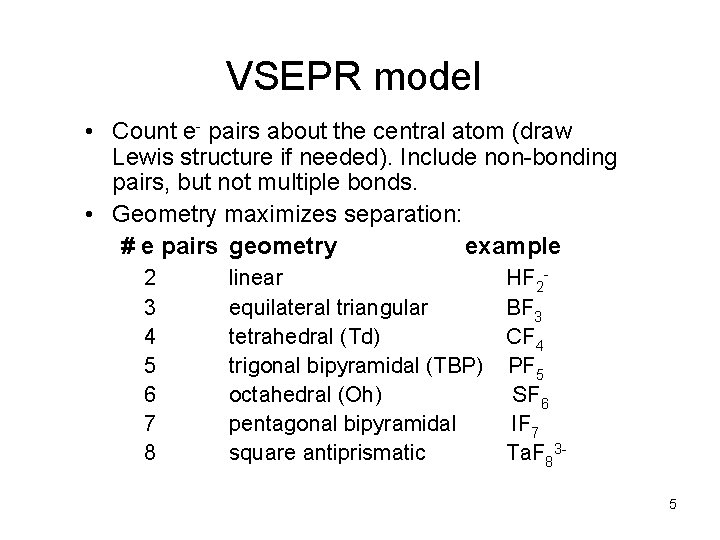
VSEPR model • Count e- pairs about the central atom (draw Lewis structure if needed). Include non-bonding pairs, but not multiple bonds. • Geometry maximizes separation: # e pairs geometry example 2 3 4 5 6 7 8 linear equilateral triangular tetrahedral (Td) trigonal bipyramidal (TBP) octahedral (Oh) pentagonal bipyramidal square antiprismatic HF 2 BF 3 CF 4 PF 5 SF 6 IF 7 Ta. F 835
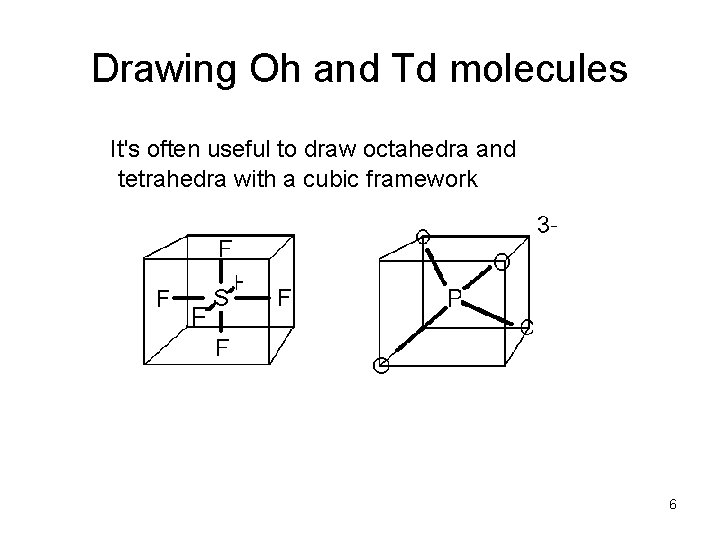
Drawing Oh and Td molecules It's often useful to draw octahedra and tetrahedra with a cubic framework 6
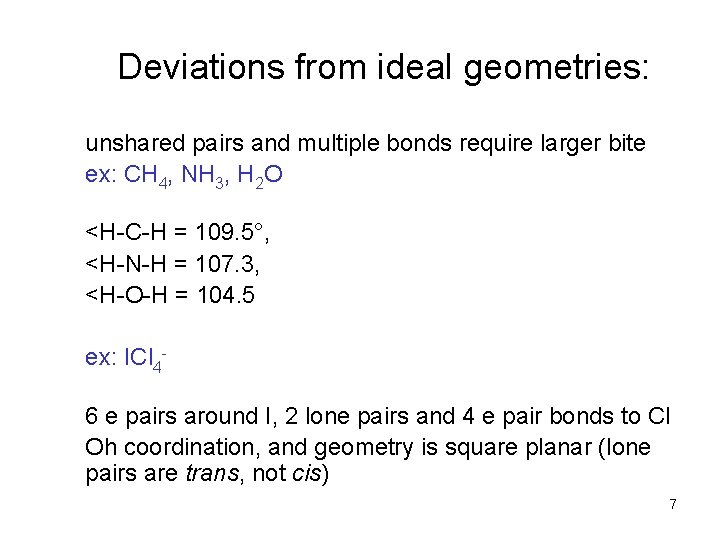
Deviations from ideal geometries: unshared pairs and multiple bonds require larger bite ex: CH 4, NH 3, H 2 O <H-C-H = 109. 5°, <H-N-H = 107. 3, <H-O-H = 104. 5 ex: ICl 46 e pairs around I, 2 lone pairs and 4 e pair bonds to Cl Oh coordination, and geometry is square planar (lone pairs are trans, not cis) 7
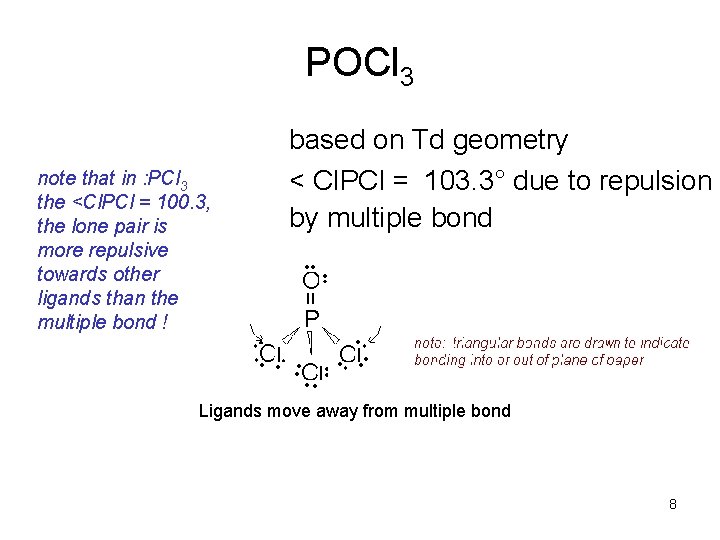
POCl 3 note that in : PCl 3 the <Cl. PCl = 100. 3, the lone pair is more repulsive towards other ligands than the multiple bond ! based on Td geometry < Cl. PCl = 103. 3° due to repulsion by multiple bond Ligands move away from multiple bond 8
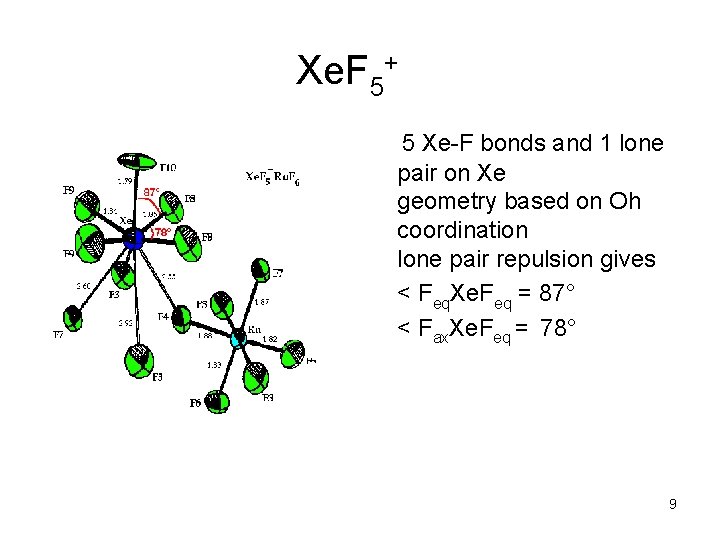
Xe. F 5+ 5 Xe-F bonds and 1 lone pair on Xe geometry based on Oh coordination lone pair repulsion gives < Feq. Xe. Feq = 87° < Fax. Xe. Feq = 78° 9
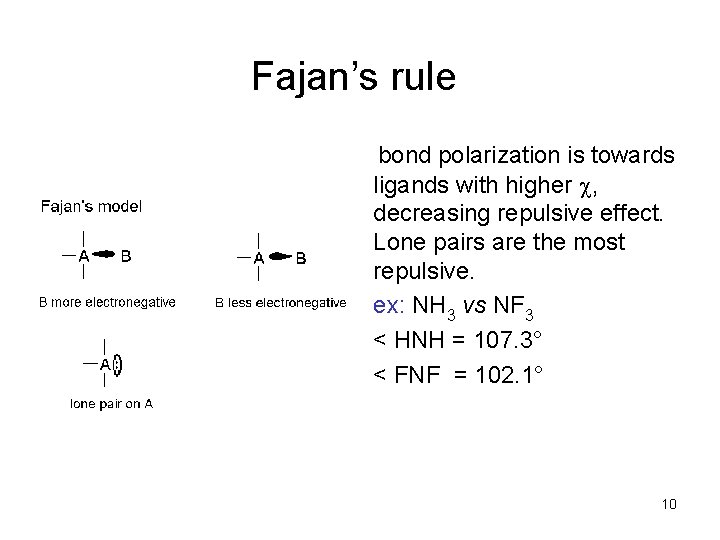
Fajan’s rule bond polarization is towards ligands with higher c, decreasing repulsive effect. Lone pairs are the most repulsive. ex: NH 3 vs NF 3 < HNH = 107. 3° < FNF = 102. 1° 10
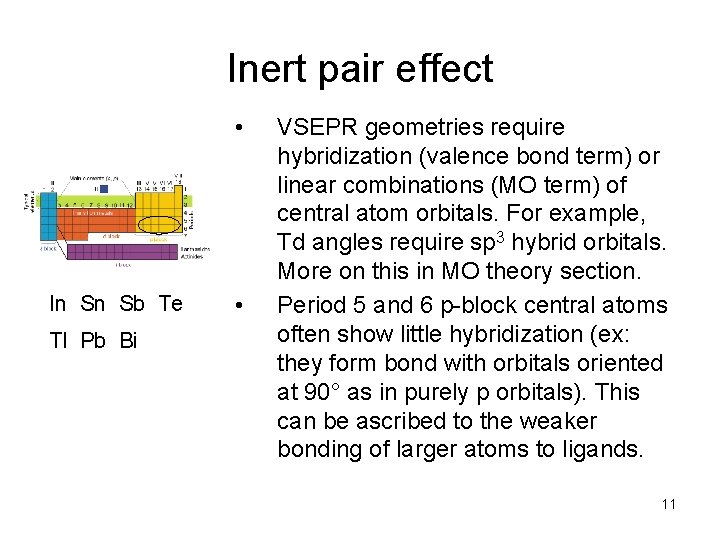
Inert pair effect • In Sn Sb Te Tl Pb Bi • VSEPR geometries require hybridization (valence bond term) or linear combinations (MO term) of central atom orbitals. For example, Td angles require sp 3 hybrid orbitals. More on this in MO theory section. Period 5 and 6 p-block central atoms often show little hybridization (ex: they form bond with orbitals oriented at 90° as in purely p orbitals). This can be ascribed to the weaker bonding of larger atoms to ligands. 11
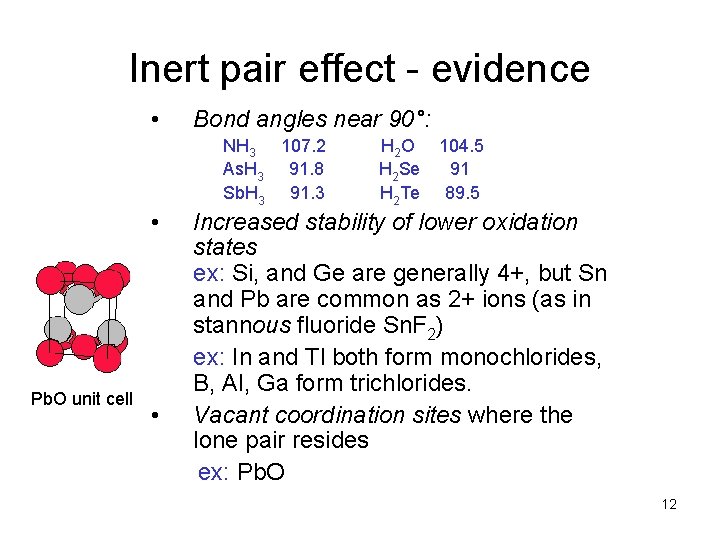
Inert pair effect - evidence • Bond angles near 90°: NH 3 107. 2 As. H 3 91. 8 Sb. H 3 91. 3 • Pb. O unit cell • H 2 O H 2 Se H 2 Te 104. 5 91 89. 5 Increased stability of lower oxidation states ex: Si, and Ge are generally 4+, but Sn and Pb are common as 2+ ions (as in stannous fluoride Sn. F 2) ex: In and Tl both form monochlorides, B, Al, Ga form trichlorides. Vacant coordination sites where the lone pair resides ex: Pb. O 12
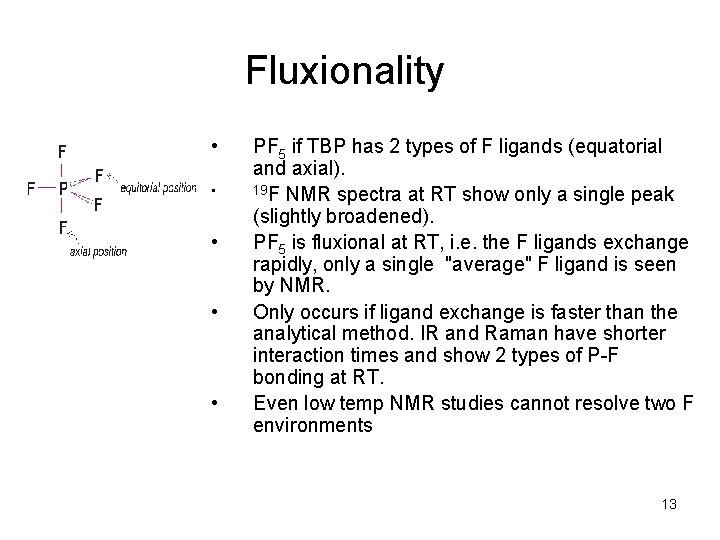
Fluxionality • • • PF 5 if TBP has 2 types of F ligands (equatorial and axial). 19 F NMR spectra at RT show only a single peak (slightly broadened). PF 5 is fluxional at RT, i. e. the F ligands exchange rapidly, only a single "average" F ligand is seen by NMR. Only occurs if ligand exchange is faster than the analytical method. IR and Raman have shorter interaction times and show 2 types of P-F bonding at RT. Even low temp NMR studies cannot resolve two F environments 13
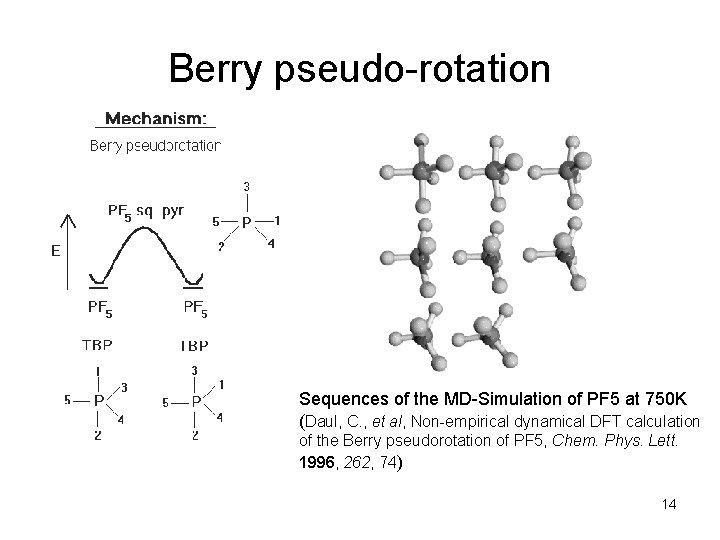
Berry pseudo-rotation Sequences of the MD-Simulation of PF 5 at 750 K (Daul, C. , et al, Non-empirical dynamical DFT calculation of the Berry pseudorotation of PF 5, Chem. Phys. Lett. 1996, 262, 74) 14
Molecular Orbitals n n Use linear combinations of atomic orbitals to derive symmetry-adapted linear combinations (SALCs). Use symmetry to determine orbital interactions. Provide a qualitative MO diagram for simple molecules. Read analyze an MO diagram by sketching MO’s / LCAO’s, describing the geometric affect on relative MO energies. 15
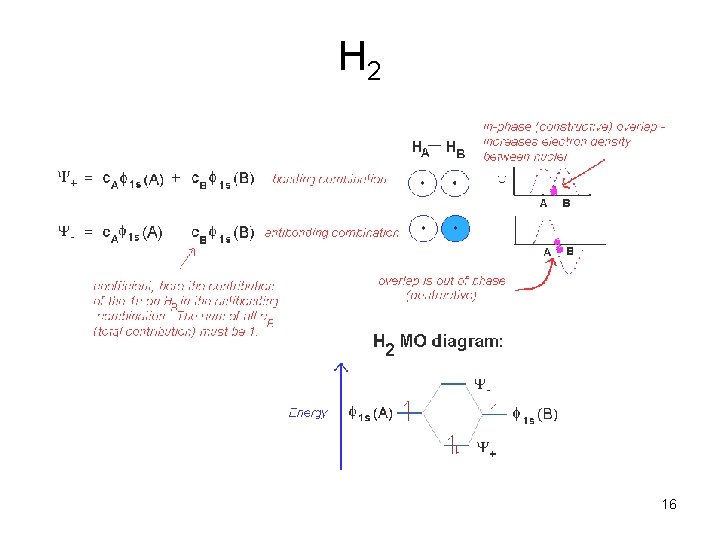
H 2 16
Some rules n The number of AO’s and MO’s must be equal. This follows from the mathematics of independent linear combinations. n More on symmetry labels later, but they come from the irreducible representations for the point group. s MO’s are symmetric about bond axis, p MO’s are not. Subscipt g is gerade (has center of symmetry), u is ungerade. Antibonding orbitals are often given a * superscript. n The bond order = ½ (bonding e- - antibonding e-). The bond energy actually depends on the energies of the filled MO’s relative to filled AO’s. 17
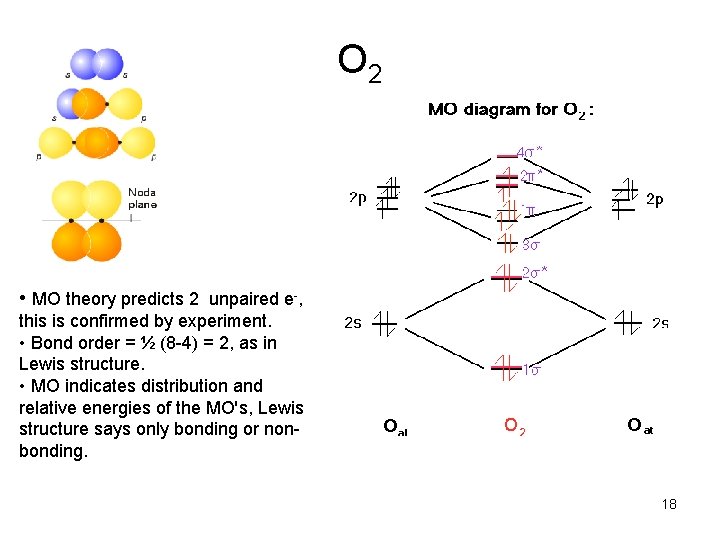
O 2 • MO theory predicts 2 unpaired e-, this is confirmed by experiment. • Bond order = ½ (8 -4) = 2, as in Lewis structure. • MO indicates distribution and relative energies of the MO's, Lewis structure says only bonding or nonbonding. 18
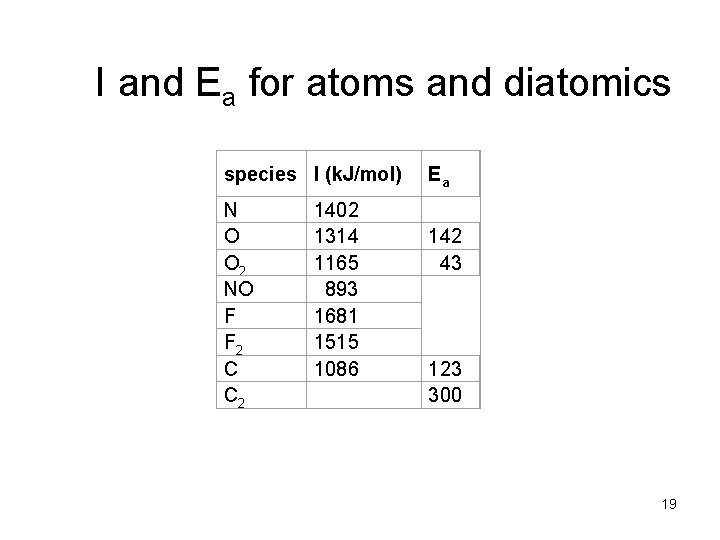
I and Ea for atoms and diatomics species I (k. J/mol) N O O 2 NO F F 2 C C 2 1402 1314 1165 893 1681 1515 1086 Ea 142 43 123 300 19
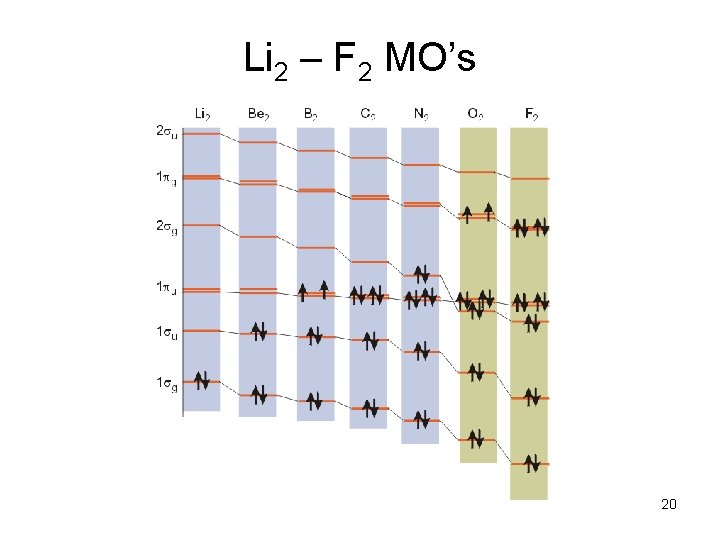
Li 2 – F 2 MO’s 20
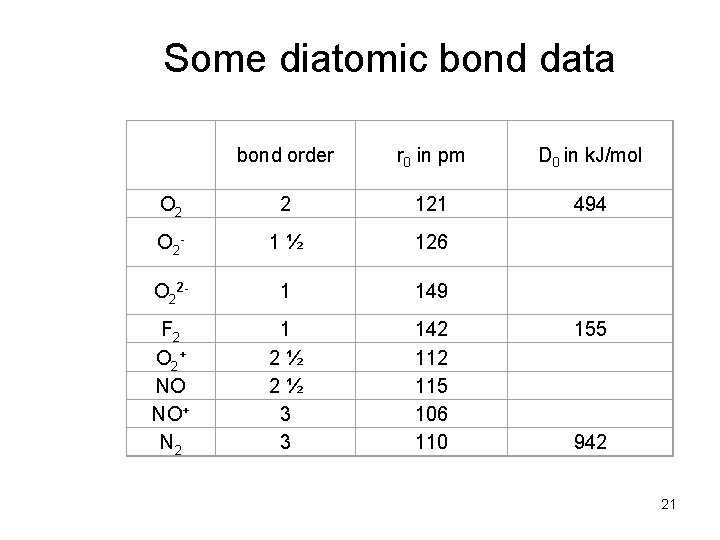
Some diatomic bond data bond order r 0 in pm D 0 in k. J/mol O 2 2 121 494 O 2 - 1½ 126 O 22 - 1 149 F 2 O 2 + NO NO+ N 2 1 2½ 2½ 3 3 142 115 106 110 155 942 21
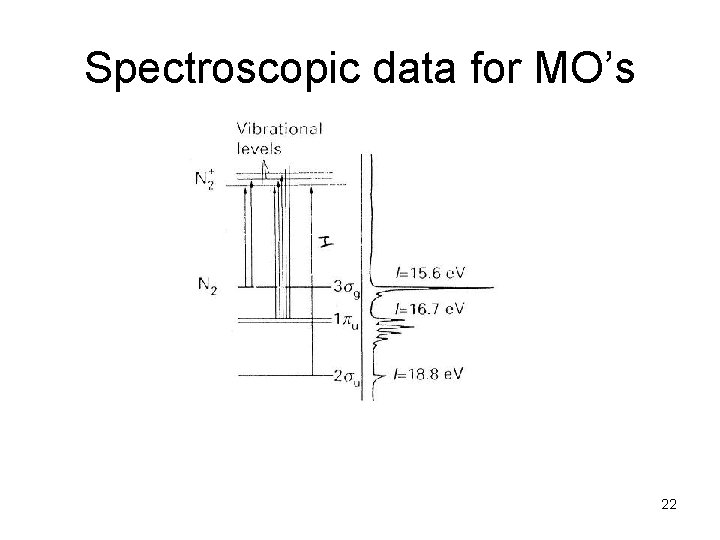
Spectroscopic data for MO’s 22
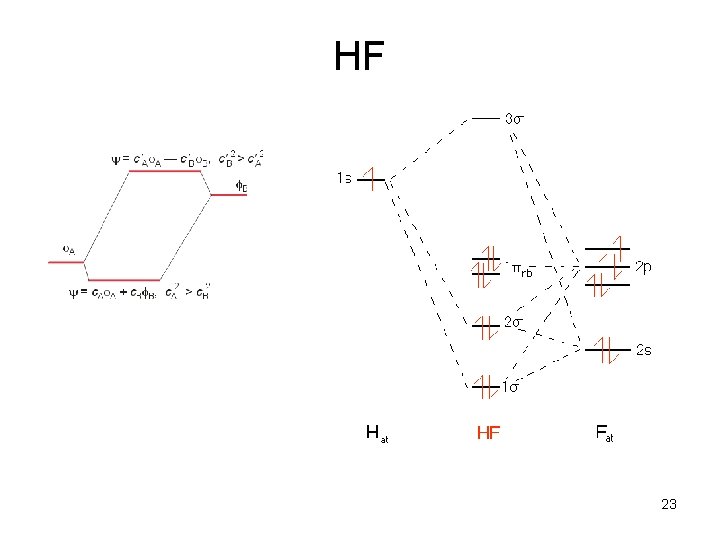
HF 23
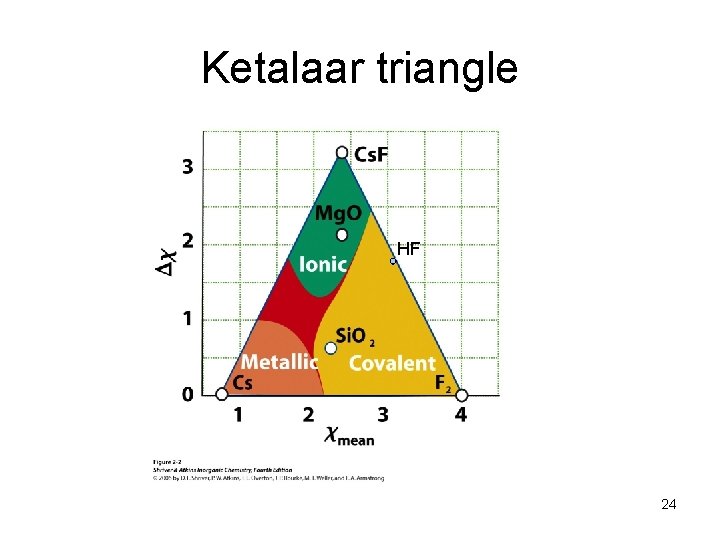
Ketalaar triangle HF 24
Hybridization • Linear combinations of AO’s from same atom makes hybrid orbitals. • Hybridization can be included in the MO diagram. • In MO theory, any proportion of s and p can be mixed (the coefficients of the AO’s are variable). sp and sp 3 hybrids are specific examples. 25
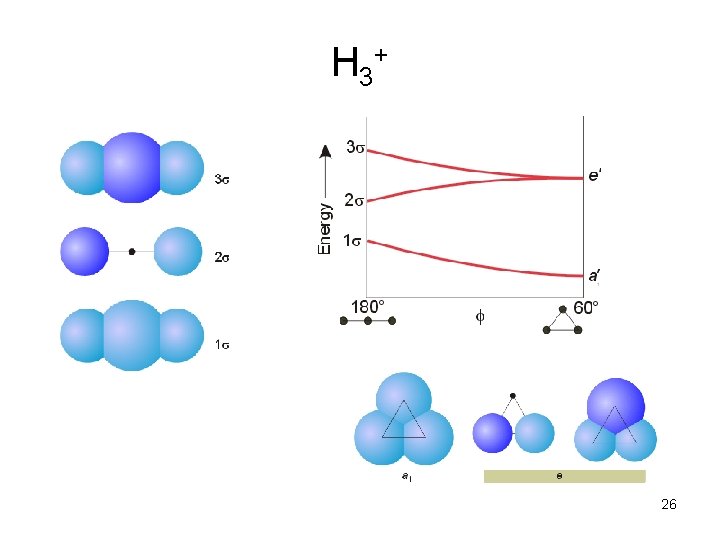
H 3+ 26
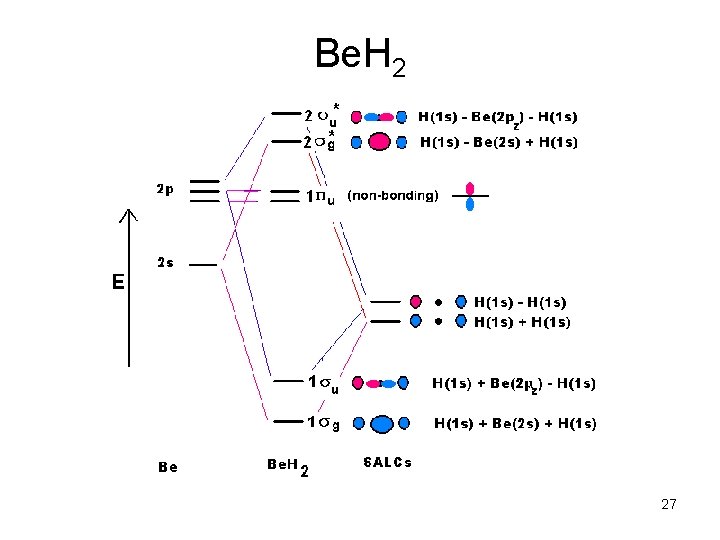
Be. H 2 27
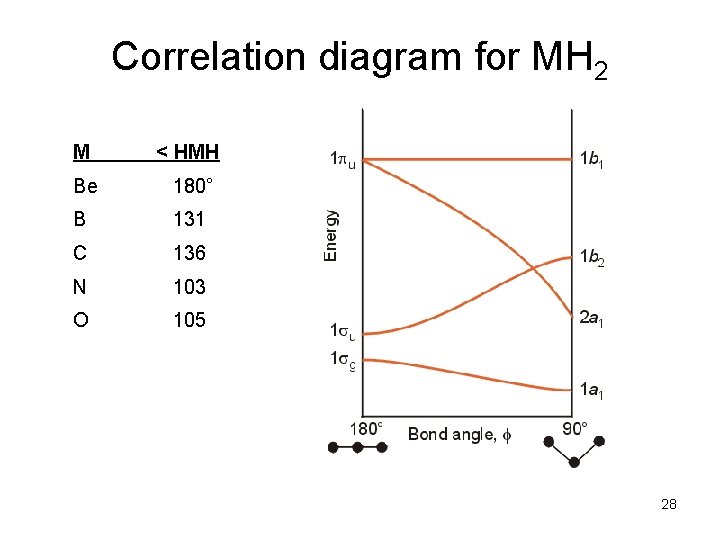
Correlation diagram for MH 2 M < HMH Be 180° B 131 C 136 N 103 O 105 28
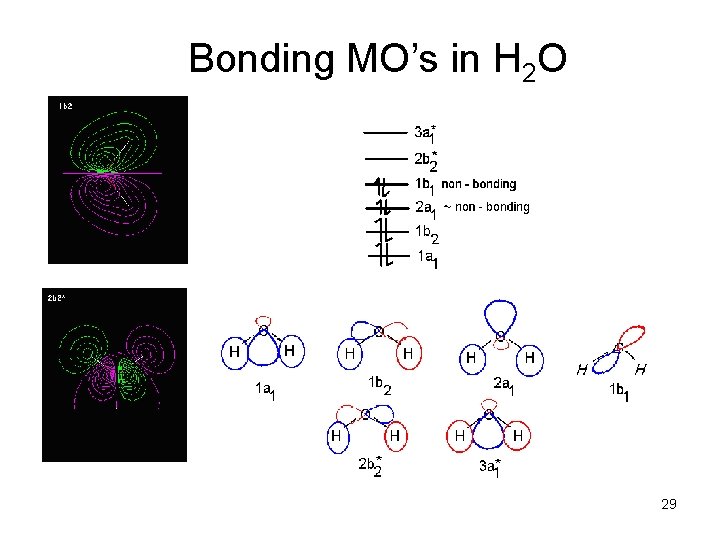
Bonding MO’s in H 2 O 29
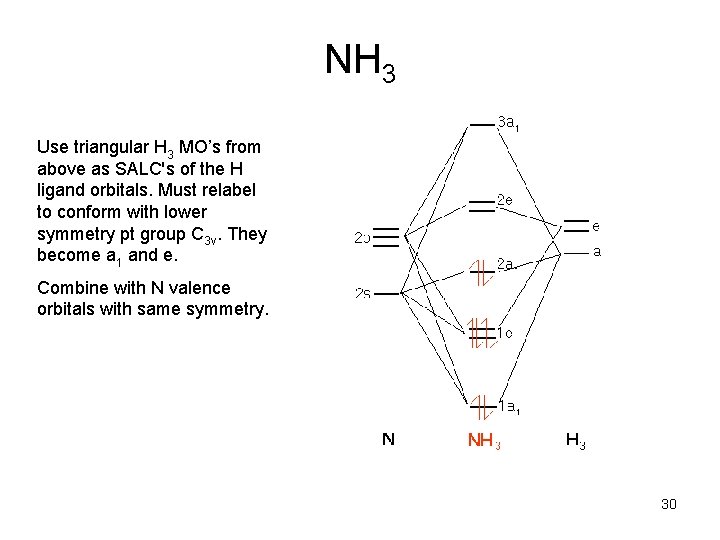
NH 3 Use triangular H 3 MO’s from above as SALC's of the H ligand orbitals. Must relabel to conform with lower symmetry pt group C 3 v. They become a 1 and e. Combine with N valence orbitals with same symmetry. 30
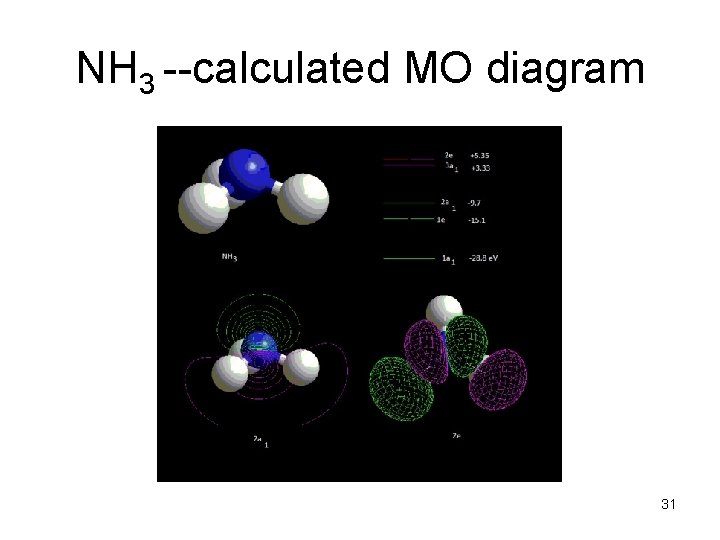
NH 3 --calculated MO diagram 31
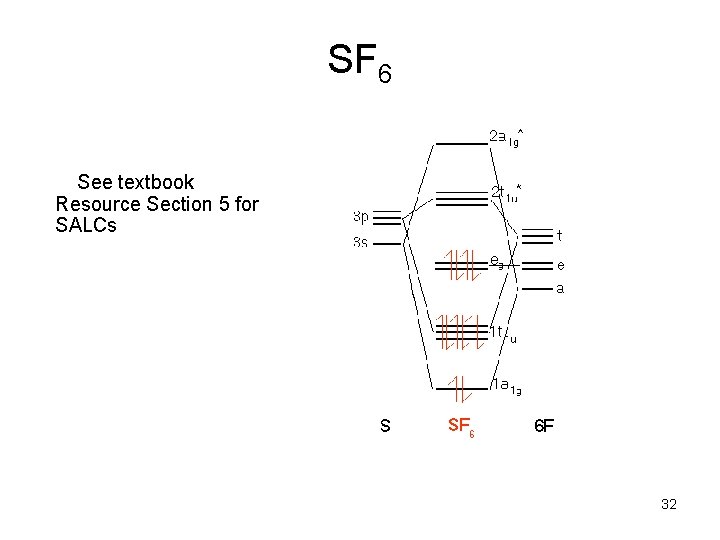
SF 6 See textbook Resource Section 5 for SALCs 32
- Slides: 32