
Ch 17 Overview The Flow of Genetic Information
- Slides: 40
Ch 17 Overview: The Flow of Genetic Information • The information content of DNA is in the form of specific sequences of nucleotides • The DNA inherited by an organism leads to specific traits by dictating the synthesis of proteins • Proteins are the links between genotype and phenotype • Gene expression, the process by which DNA directs protein synthesis, includes two stages: transcription and translation Copyright © 2008 Pearson Education Inc. , publishing as Pearson Benjamin Cummings
Concept 17. 1: Genes specify proteins via transcription and translation • How was the fundamental relationship between genes and proteins discovered? Copyright © 2008 Pearson Education Inc. , publishing as Pearson Benjamin Cummings
Evidence from the Study of Metabolic Defects • In 1909, British physician Archibald Garrod first suggested that genes dictate phenotypes through enzymes that catalyze specific chemical reactions – He thought symptoms of an inherited disease reflect an inability to synthesize a certain enzyme – Linking genes to enzymes required understanding that cells synthesize and degrade molecules in a series of steps, a metabolic pathway • Genes=proteins or enzymes Copyright © 2008 Pearson Education Inc. , publishing as Pearson Benjamin Cummings
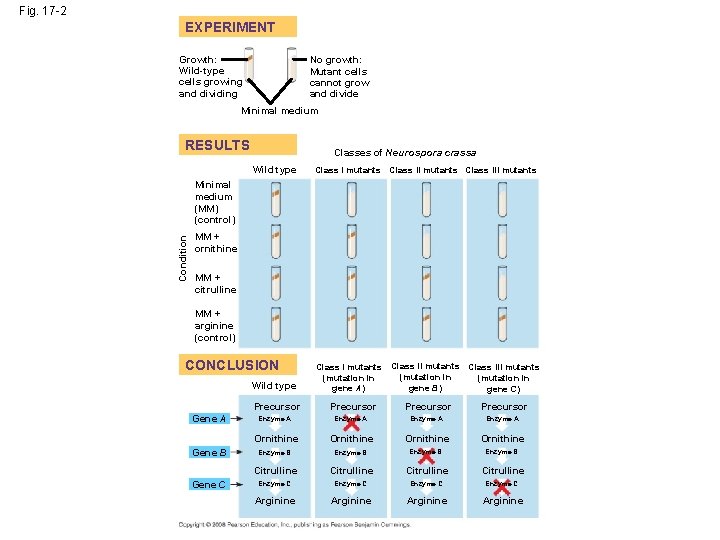
Nutritional Mutants in Neurospora: Scientific Inquiry • George Beadle and Edward Tatum exposed bread mold to X-rays, creating mutants that were unable to survive on minimal medium as a result of inability to synthesize certain molecules • They developed a one gene–one enzyme hypothesis, which states that each gene dictates production of a specific enzyme Copyright © 2008 Pearson Education Inc. , publishing as Pearson Benjamin Cummings
Fig. 17 -2 EXPERIMENT No growth: Mutant cells cannot grow and divide Growth: Wild-type cells growing and dividing Minimal medium RESULTS Classes of Neurospora crassa Wild type Class I mutants Class III mutants Condition Minimal medium (MM) (control) MM + ornithine MM + citrulline MM + arginine (control) CONCLUSION Wild type Precursor Gene A Gene B Gene C Class I mutants Class III mutants (mutation in gene B) gene A) gene C) Precursor Enzyme A Ornithine Enzyme B Citrulline Enzyme C Arginine
The Products of Gene Expression: A Developing Story • Some proteins aren’t enzymes, so researchers later revised the hypothesis: one gene–one protein • Many proteins are composed of several polypeptides, each of which has its own gene • Therefore, Beadle and Tatum’s hypothesis is now restated as the one gene–one polypeptide hypothesis • Note that it is common to refer to gene products as proteins rather than polypeptides Copyright © 2008 Pearson Education Inc. , publishing as Pearson Benjamin Cummings
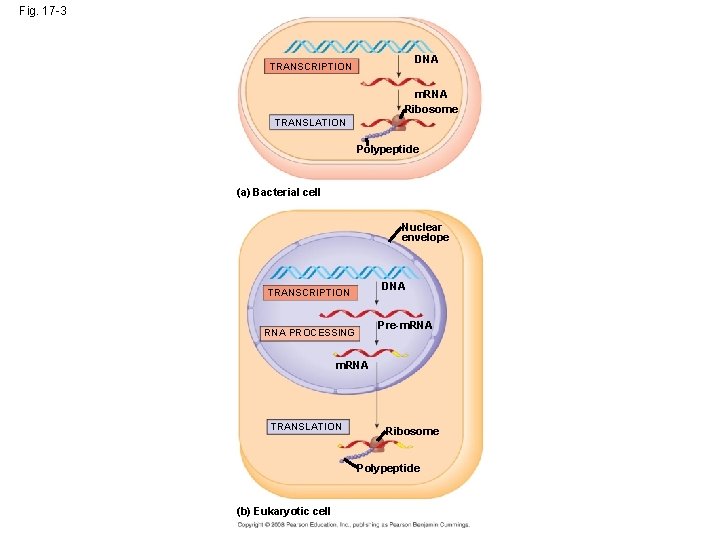
Basic Principles of Transcription and Translation • RNA is the intermediate between genes and the proteins for which they code • Transcription is the synthesis of RNA under the direction of DNA • Transcription produces messenger RNA (m. RNA) • Translation is the synthesis of a polypeptide, which occurs under the direction of m. RNA • Ribosomes are the sites of translation Copyright © 2008 Pearson Education Inc. , publishing as Pearson Benjamin Cummings
• In prokaryotes, m. RNA produced by transcription is immediately translated without more processing • In a eukaryotic cell, the nuclear envelope separates transcription from translation • Eukaryotic RNA transcripts are modified through RNA processing to yield finished m. RNA Copyright © 2008 Pearson Education Inc. , publishing as Pearson Benjamin Cummings
• A primary transcript is the initial RNA transcript from any gene • The central dogma is the concept that cells are governed by a cellular chain of command: DNA RNA protein Copyright © 2008 Pearson Education Inc. , publishing as Pearson Benjamin Cummings
Fig. 17 -3 DNA TRANSCRIPTION m. RNA Ribosome TRANSLATION Polypeptide (a) Bacterial cell Nuclear envelope DNA TRANSCRIPTION Pre-m. RNA PROCESSING m. RNA TRANSLATION Ribosome Polypeptide (b) Eukaryotic cell
The Genetic Code • How are the instructions for assembling amino acids into proteins encoded into DNA? • There are 20 amino acids, but there are only four nucleotide bases in DNA • How many bases correspond to an amino acid? Copyright © 2008 Pearson Education Inc. , publishing as Pearson Benjamin Cummings
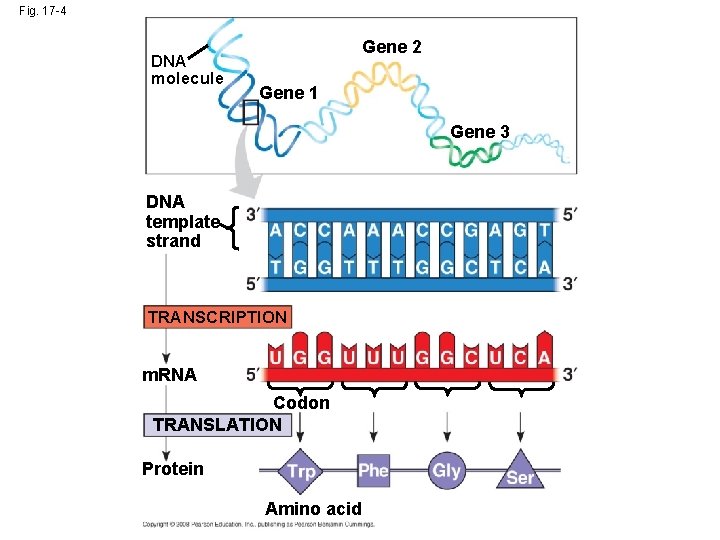
Codons: Triplets of Bases • The flow of information from gene to protein is based on a triplet code: a series of nonoverlapping, three-nucleotide words • These triplets are the smallest units of uniform length that can code for all the amino acids • Example: AGT at a particular position on a DNA strand results in the placement of the amino acid serine at the corresponding position of the polypeptide to be produced Copyright © 2008 Pearson Education Inc. , publishing as Pearson Benjamin Cummings
• During transcription, one of the two DNA strands called the template strand provides a template for ordering the sequence of nucleotides in an RNA transcript • During translation, the m. RNA base triplets, called codons, are read in the 5 to 3 direction • Each codon specifies the amino acid to be placed at the corresponding position along a polypeptide Copyright © 2008 Pearson Education Inc. , publishing as Pearson Benjamin Cummings
• Codons along an m. RNA molecule are read by translation machinery in the 5 to 3 direction • Each codon specifies the addition of one of 20 amino acids Copyright © 2008 Pearson Education Inc. , publishing as Pearson Benjamin Cummings
Fig. 17 -4 DNA molecule Gene 2 Gene 1 Gene 3 DNA template strand TRANSCRIPTION m. RNA Codon TRANSLATION Protein Amino acid
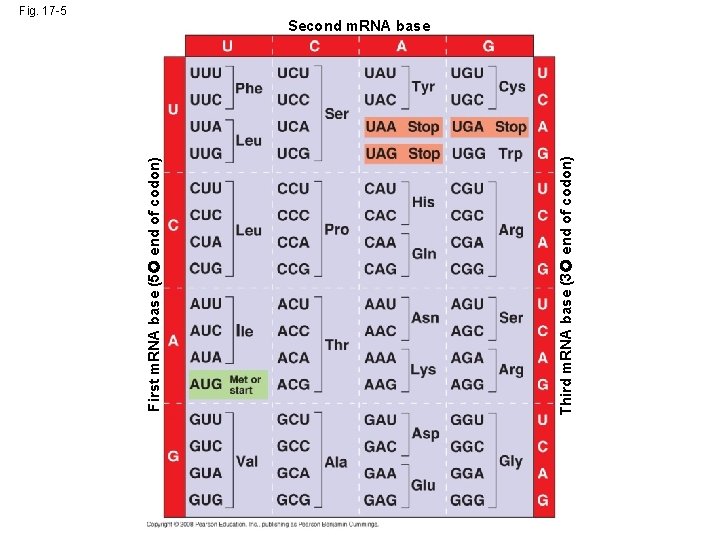
Cracking the Code • All 64 codons were deciphered by the mid 1960 s • Of the 64 triplets, 61 code for amino acids; 3 triplets are “stop” signals to end translation • The genetic code is redundant but not ambiguous; no codon specifies more than one amino acid • Codons must be read in the correct reading frame (correct groupings) in order for the specified polypeptide to be produced Copyright © 2008 Pearson Education Inc. , publishing as Pearson Benjamin Cummings
Third m. RNA base (3 end of codon) First m. RNA base (5 end of codon) Fig. 17 -5 Second m. RNA base
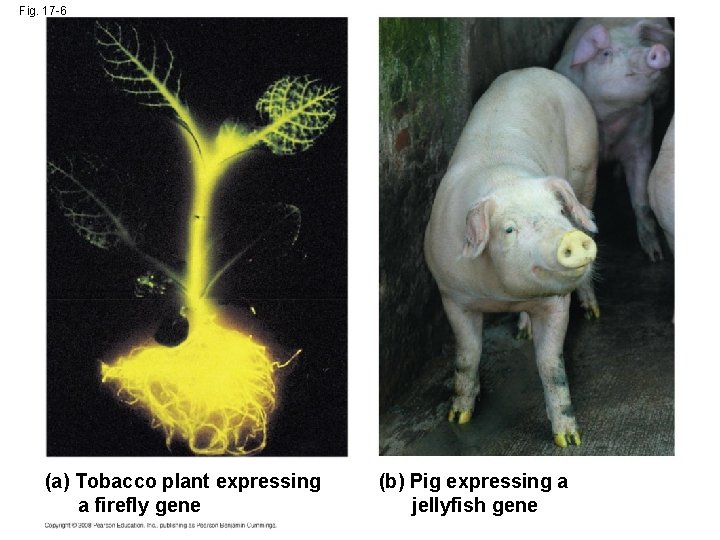
Evolution of the Genetic Code • The genetic code is nearly universal, shared by the simplest bacteria to the most complex animals • Genes can be transcribed and translated after being transplanted from one species to another Copyright © 2008 Pearson Education Inc. , publishing as Pearson Benjamin Cummings
Fig. 17 -6 (a) Tobacco plant expressing a firefly gene (b) Pig expressing a jellyfish gene
Concept 17. 2: Transcription is the DNA-directed synthesis of RNA: a closer look • Transcription, the first stage of gene expression, can be examined in more detail Copyright © 2008 Pearson Education Inc. , publishing as Pearson Benjamin Cummings
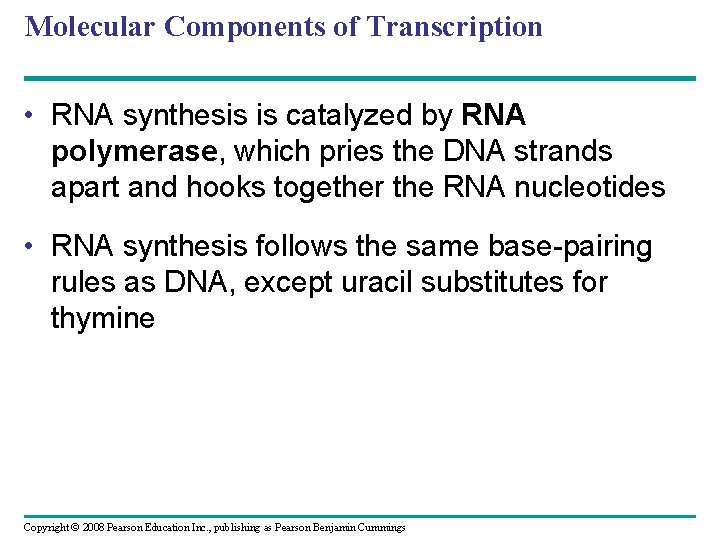
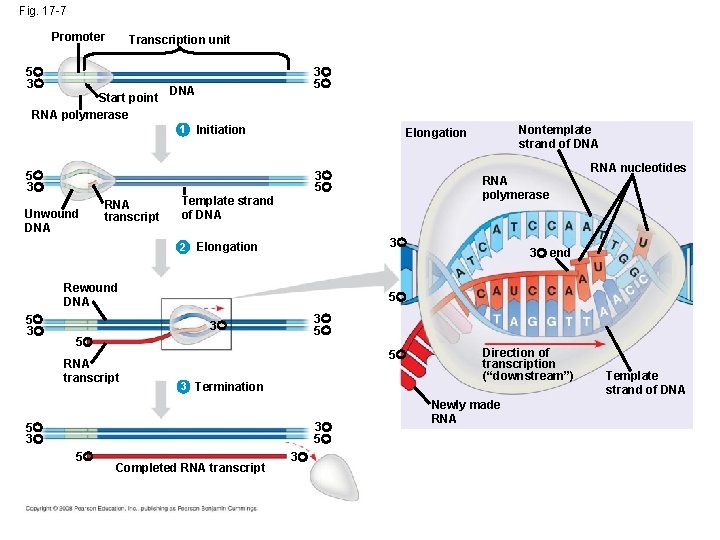
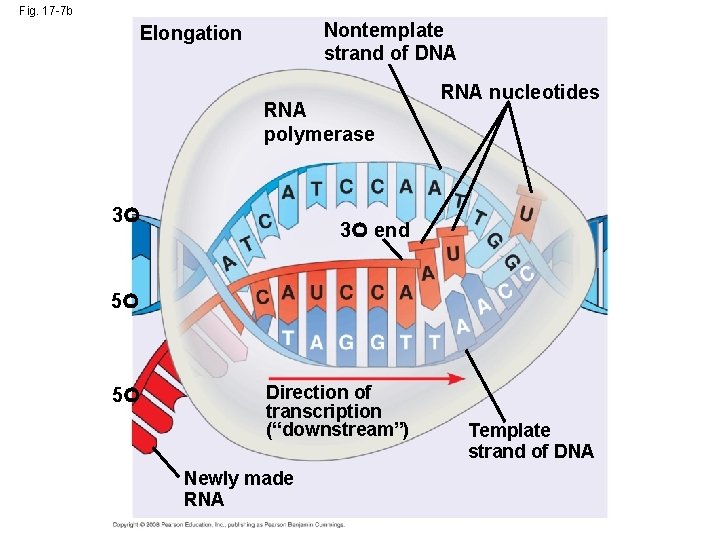
Molecular Components of Transcription • RNA synthesis is catalyzed by RNA polymerase, which pries the DNA strands apart and hooks together the RNA nucleotides • RNA synthesis follows the same base-pairing rules as DNA, except uracil substitutes for thymine Copyright © 2008 Pearson Education Inc. , publishing as Pearson Benjamin Cummings
Fig. 17 -7 Promoter Transcription unit 5 3 Start point RNA polymerase 3 5 DNA 1 Initiation 5 3 3 5 Unwound DNA RNA transcript 3 Rewound DNA 3 end 3 5 5 5 3 Termination 3 5 5 3 5 RNA nucleotides 5 3 RNA transcript RNA polymerase Template strand of DNA 2 Elongation 5 3 Nontemplate strand of DNA Elongation Completed RNA transcript 3 Direction of transcription (“downstream”) Newly made RNA Template strand of DNA
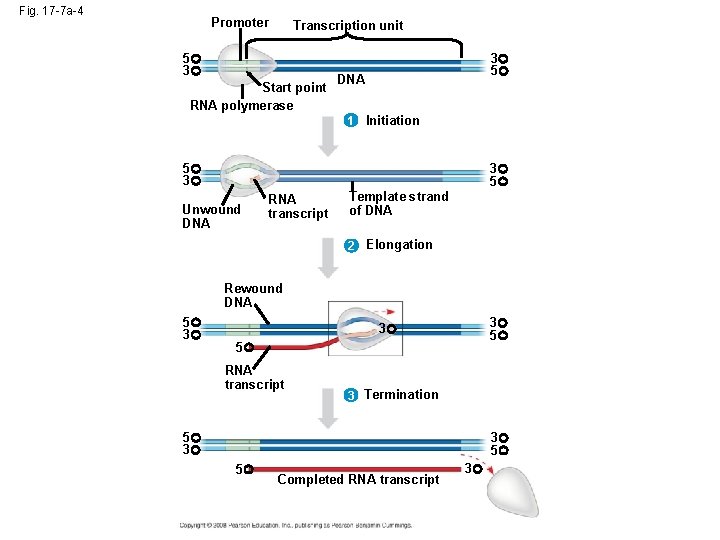
Fig. 17 -7 a-4 Promoter Transcription unit 5 3 Start point RNA polymerase 3 5 DNA 1 Initiation 5 3 3 5 Unwound DNA RNA transcript Template strand of DNA 2 Elongation Rewound DNA 5 3 3 5 RNA transcript 3 Termination 5 3 3 5 5 Completed RNA transcript 3
Fig. 17 -7 b Nontemplate strand of DNA Elongation RNA polymerase 3 RNA nucleotides 3 end 5 5 Direction of transcription (“downstream”) Newly made RNA Template strand of DNA
Synthesis of an RNA Transcript • The three stages of transcription: – Initiation – Elongation – Termination Copyright © 2008 Pearson Education Inc. , publishing as Pearson Benjamin Cummings
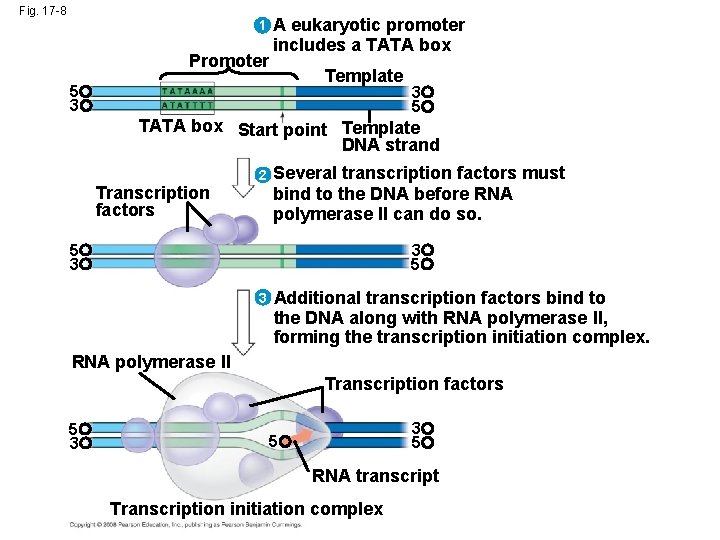
RNA Polymerase Binding and Initiation of Transcription • Promoters signal the initiation of RNA synthesis • Transcription factors mediate the binding of RNA polymerase and the initiation of transcription • The completed assembly of transcription factors and RNA polymerase II bound to a promoter is called a transcription initiation complex • A promoter called a TATA box is crucial in forming the initiation complex in eukaryotes Copyright © 2008 Pearson Education Inc. , publishing as Pearson Benjamin Cummings
Fig. 17 -8 1 Promoter A eukaryotic promoter includes a TATA box Template 5 3 3 5 TATA box Start point Template DNA strand 2 Transcription factors Several transcription factors must bind to the DNA before RNA polymerase II can do so. 5 3 3 5 3 Additional transcription factors bind to the DNA along with RNA polymerase II, forming the transcription initiation complex. RNA polymerase II Transcription factors 5 3 3 5 5 RNA transcript Transcription initiation complex
Elongation of the RNA Strand • As RNA polymerase moves along the DNA, it untwists the double helix, 10 to 20 bases at a time • Transcription progresses at a rate of 40 nucleotides per second in eukaryotes • A gene can be transcribed simultaneously by several RNA polymerases Copyright © 2008 Pearson Education Inc. , publishing as Pearson Benjamin Cummings
Termination of Transcription • The mechanisms of termination are different in bacteria and eukaryotes • In bacteria, the polymerase stops transcription at the end of the terminator • In eukaryotes, the polymerase continues transcription after the pre-m. RNA is cleaved from the growing RNA chain; the polymerase eventually falls off the DNA Copyright © 2008 Pearson Education Inc. , publishing as Pearson Benjamin Cummings
Concept 17. 3: Eukaryotic cells modify RNA after transcription • Enzymes in the eukaryotic nucleus modify prem. RNA before the genetic messages are dispatched to the cytoplasm • During RNA processing, both ends of the primary transcript are usually altered • Also, usually some interior parts of the molecule are cut out, and the other parts spliced together Copyright © 2008 Pearson Education Inc. , publishing as Pearson Benjamin Cummings
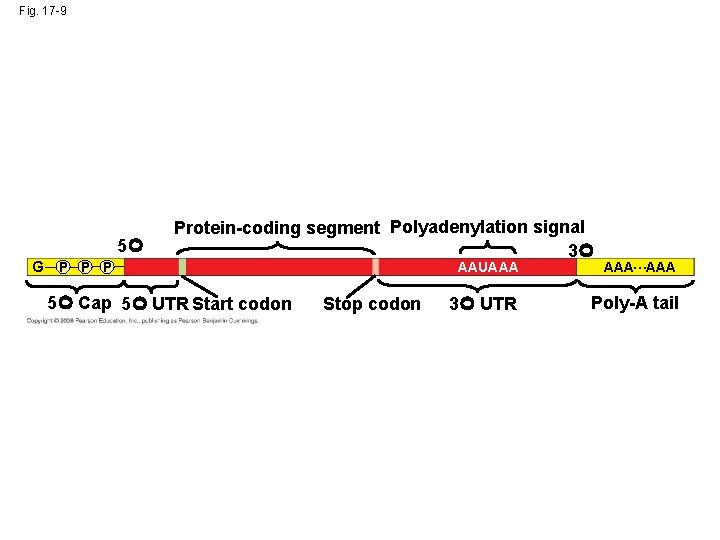
Alteration of m. RNA Ends • Each end of a pre-m. RNA molecule is modified in a particular way: – The 5 end receives a modified nucleotide 5 cap – The 3 end gets a poly-A tail • These modifications share several functions: – They seem to facilitate the export of m. RNA – They protect m. RNA from hydrolytic enzymes – They help ribosomes attach to the 5 end Copyright © 2008 Pearson Education Inc. , publishing as Pearson Benjamin Cummings
Fig. 17 -9 5 G P Protein-coding segment Polyadenylation signal 3 5 Cap 5 UTR Start codon Stop codon AAUAAA AAA…AAA 3 UTR Poly-A tail
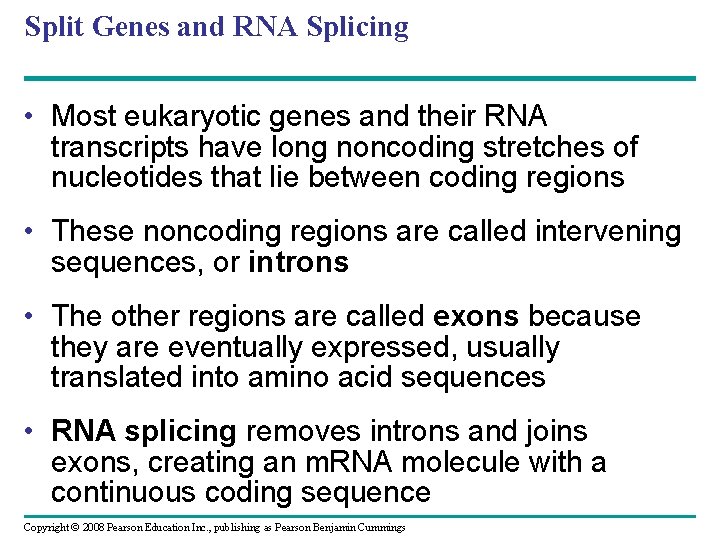
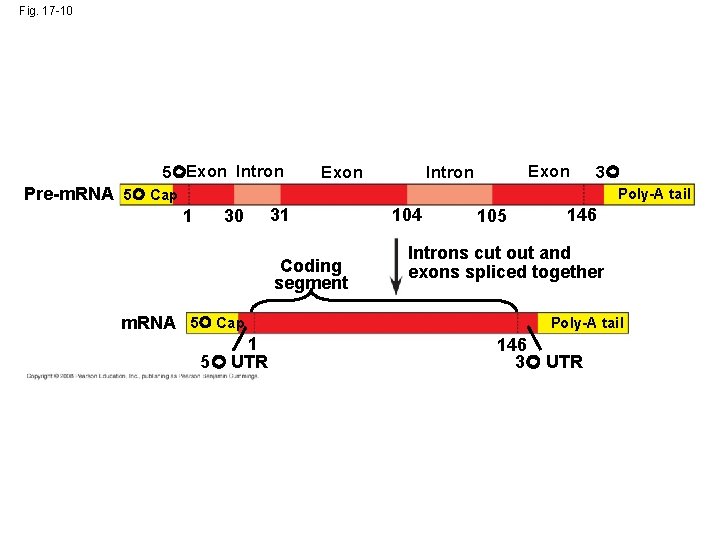
Split Genes and RNA Splicing • Most eukaryotic genes and their RNA transcripts have long noncoding stretches of nucleotides that lie between coding regions • These noncoding regions are called intervening sequences, or introns • The other regions are called exons because they are eventually expressed, usually translated into amino acid sequences • RNA splicing removes introns and joins exons, creating an m. RNA molecule with a continuous coding sequence Copyright © 2008 Pearson Education Inc. , publishing as Pearson Benjamin Cummings
Fig. 17 -10 5 Exon Intron 3 Pre-m. RNA 5 Cap Poly-A tail 1 30 31 Coding segment m. RNA 5 Cap 1 5 UTR 104 105 146 Introns cut out and exons spliced together Poly-A tail 146 3 UTR
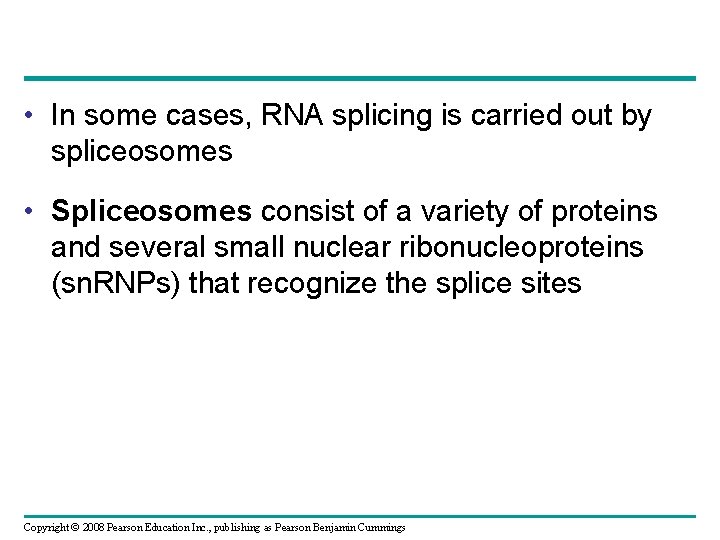
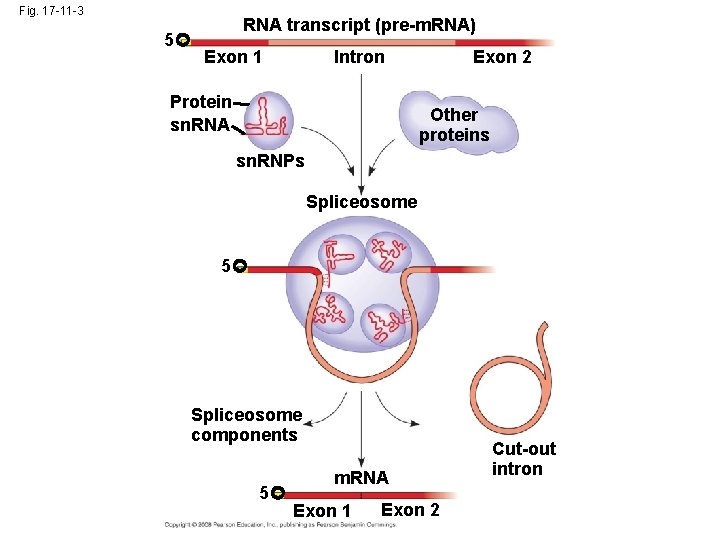
• In some cases, RNA splicing is carried out by spliceosomes • Spliceosomes consist of a variety of proteins and several small nuclear ribonucleoproteins (sn. RNPs) that recognize the splice sites Copyright © 2008 Pearson Education Inc. , publishing as Pearson Benjamin Cummings
Fig. 17 -11 -3 5 RNA transcript (pre-m. RNA) Exon 1 Intron Protein sn. RNA Exon 2 Other proteins sn. RNPs Spliceosome 5 Spliceosome components 5 m. RNA Exon 1 Exon 2 Cut-out intron
The Functional and Evolutionary Importance of Introns • Some genes can encode more than one kind of polypeptide, depending on which segments are treated as exons during RNA splicing • Such variations are called alternative RNA splicing • Because of alternative splicing, the number of different proteins an organism can produce is much greater than its number of genes Copyright © 2008 Pearson Education Inc. , publishing as Pearson Benjamin Cummings
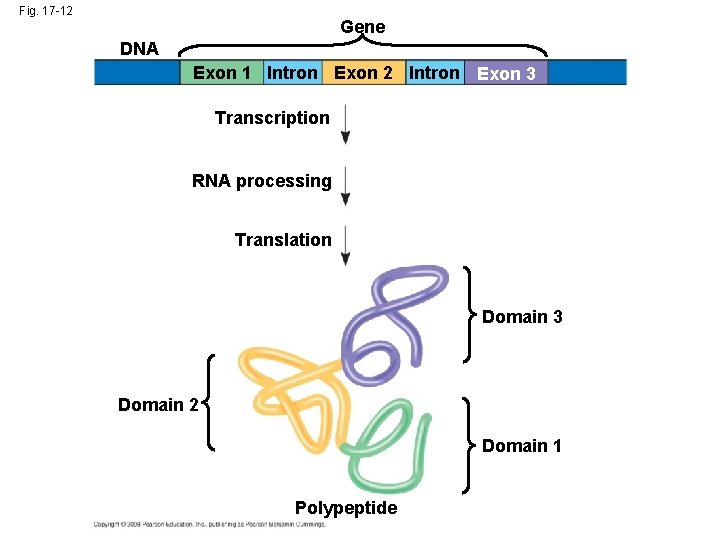
• Proteins often have a modular architecture consisting of discrete regions called domains • In many cases, different exons code for the different domains in a protein • Exon shuffling may result in the evolution of new proteins Copyright © 2008 Pearson Education Inc. , publishing as Pearson Benjamin Cummings
Fig. 17 -12 Gene DNA Exon 1 Intron Exon 2 Intron Exon 3 Transcription RNA processing Translation Domain 3 Domain 2 Domain 1 Polypeptide
• In summary, a gene can be defined as a region of DNA that can be expressed to produce a final functional product, either a polypeptide or an RNA molecule Copyright © 2008 Pearson Education Inc. , publishing as Pearson Benjamin Cummings