
CH 17 Alcohols and Phenols Renee Y Becker
CH 17: Alcohols and Phenols Renee Y. Becker CHM 2211 Valencia Community College 1
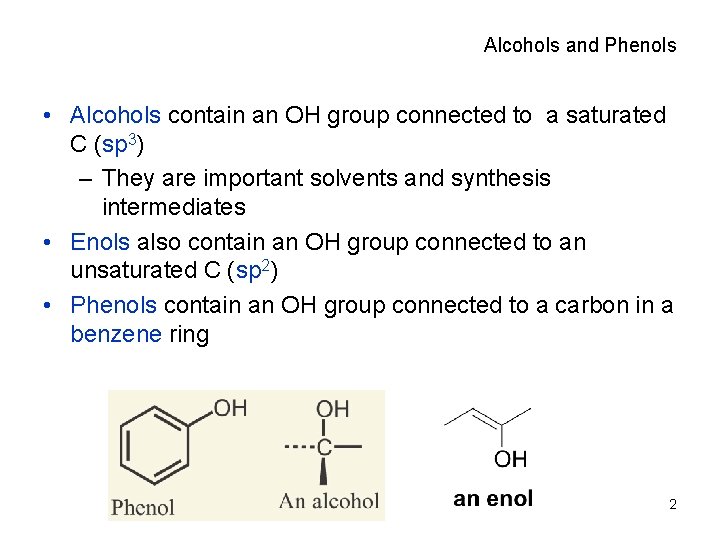
Alcohols and Phenols • Alcohols contain an OH group connected to a saturated C (sp 3) – They are important solvents and synthesis intermediates • Enols also contain an OH group connected to an unsaturated C (sp 2) • Phenols contain an OH group connected to a carbon in a benzene ring 2
Alcohols and Phenols • Methanol, CH 3 OH, called methyl alcohol, is a common solvent, a fuel additive, produced in large quantities • Ethanol, CH 3 CH 2 OH, called ethyl alcohol, is a solvent, fuel, beverage • Phenol, C 6 H 5 OH (“phenyl alcohol”) has diverse uses - it gives its name to the general class of compounds 3
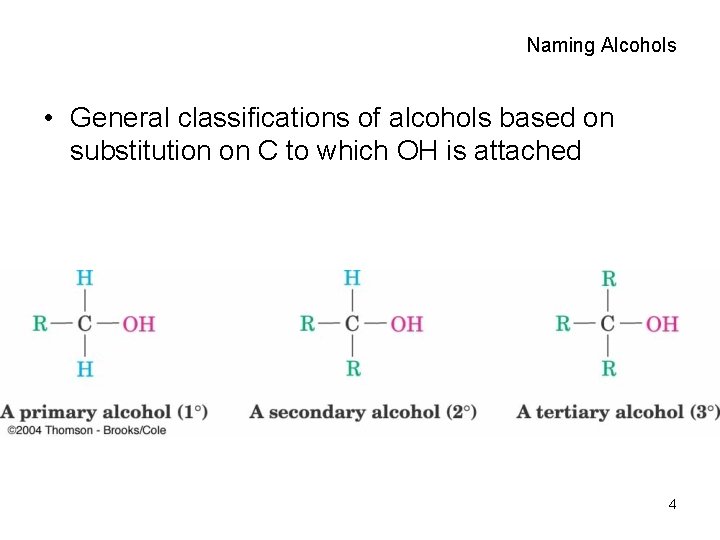
Naming Alcohols • General classifications of alcohols based on substitution on C to which OH is attached 4
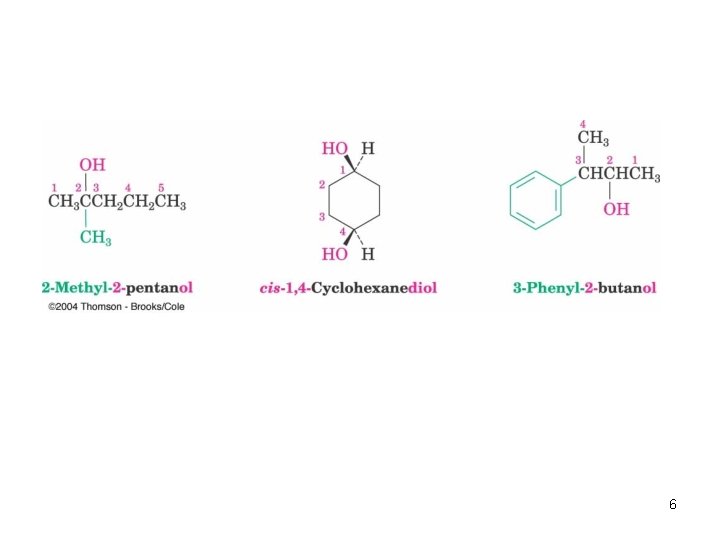
IUPAC Rules for Naming Alcohols • Select the longest carbon chain containing the hydroxyl group, and derive the parent name by replacing the -e ending of the corresponding alkane with -ol • Number the chain from the end nearer the hydroxyl group • Number substituents according to position on chain, listing the substituents in alphabetical order 5
6
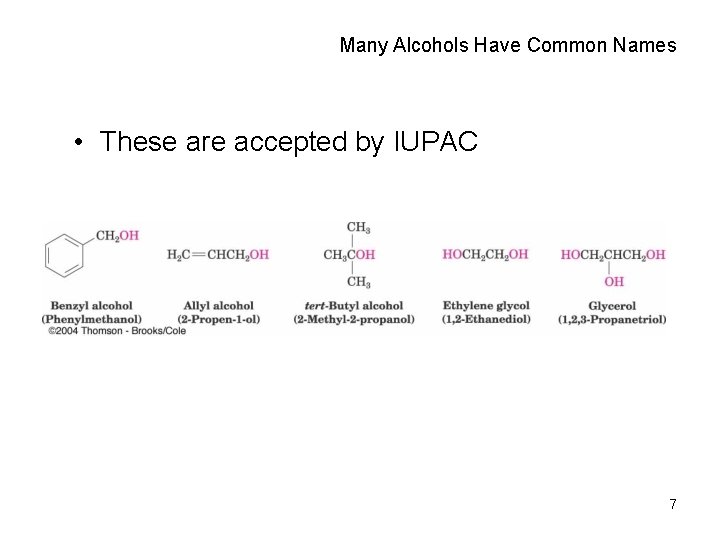
Many Alcohols Have Common Names • These are accepted by IUPAC 7
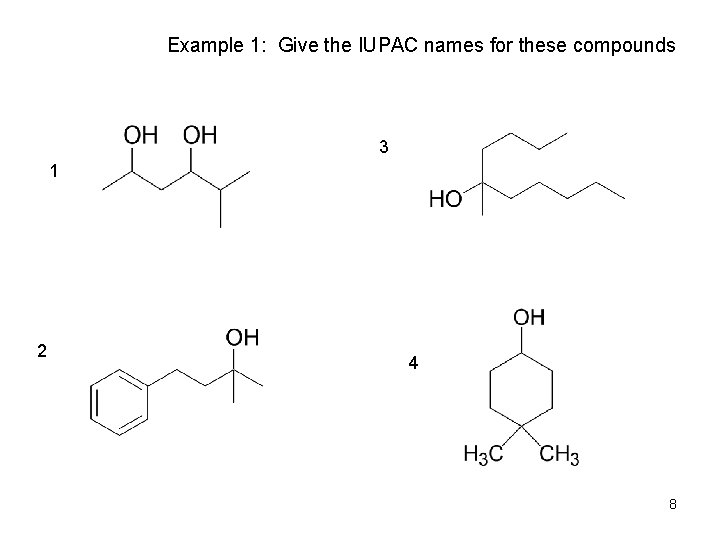
Example 1: Give the IUPAC names for these compounds 3 1 2 4 8
Example 2: Draw the following structures • 2 -Ethyl-2 -buten-1 -ol • 3 -Cyclohexen-1 -ol • 1, 4 -Pentanediol 9
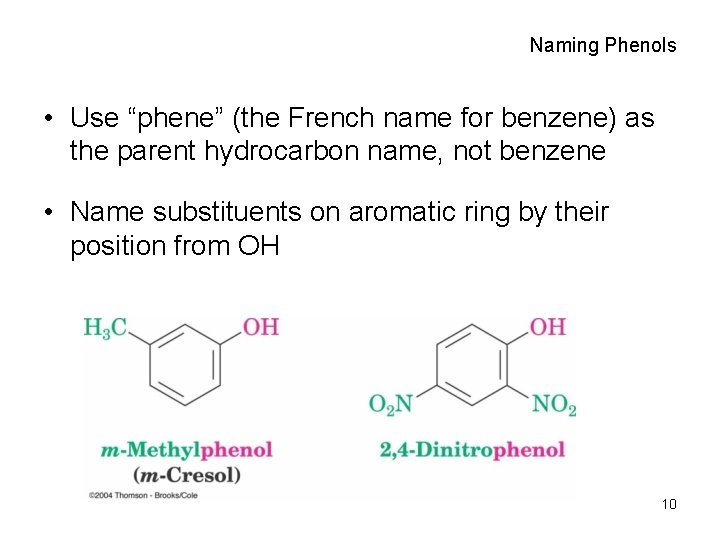
Naming Phenols • Use “phene” (the French name for benzene) as the parent hydrocarbon name, not benzene • Name substituents on aromatic ring by their position from OH 10
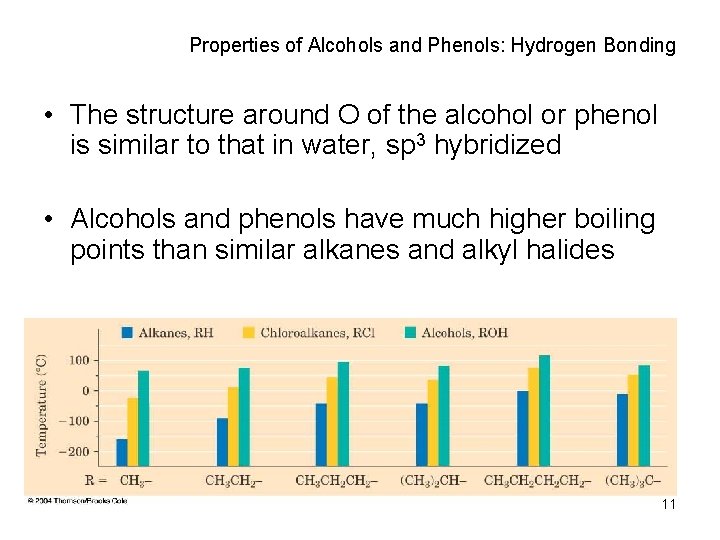
Properties of Alcohols and Phenols: Hydrogen Bonding • The structure around O of the alcohol or phenol is similar to that in water, sp 3 hybridized • Alcohols and phenols have much higher boiling points than similar alkanes and alkyl halides 11
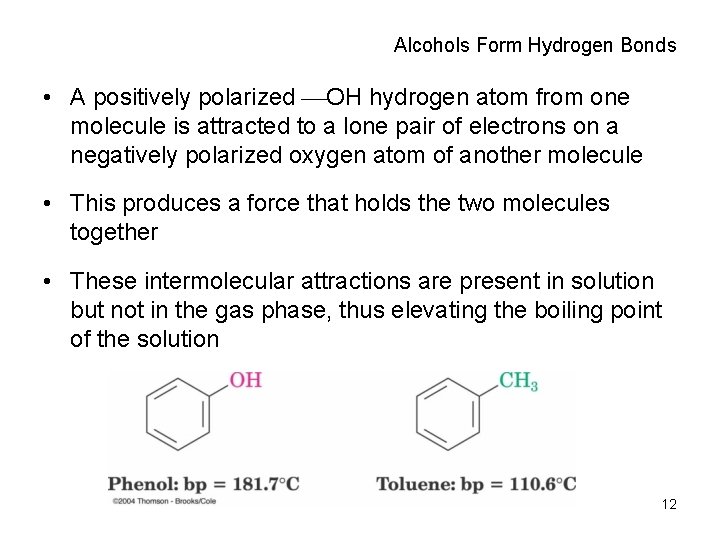
Alcohols Form Hydrogen Bonds • A positively polarized OH hydrogen atom from one molecule is attracted to a lone pair of electrons on a negatively polarized oxygen atom of another molecule • This produces a force that holds the two molecules together • These intermolecular attractions are present in solution but not in the gas phase, thus elevating the boiling point of the solution 12
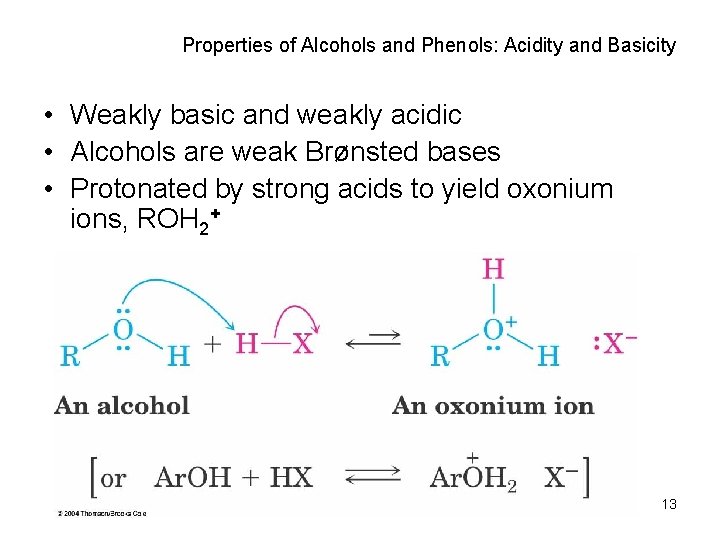
Properties of Alcohols and Phenols: Acidity and Basicity • Weakly basic and weakly acidic • Alcohols are weak Brønsted bases • Protonated by strong acids to yield oxonium ions, ROH 2+ 13
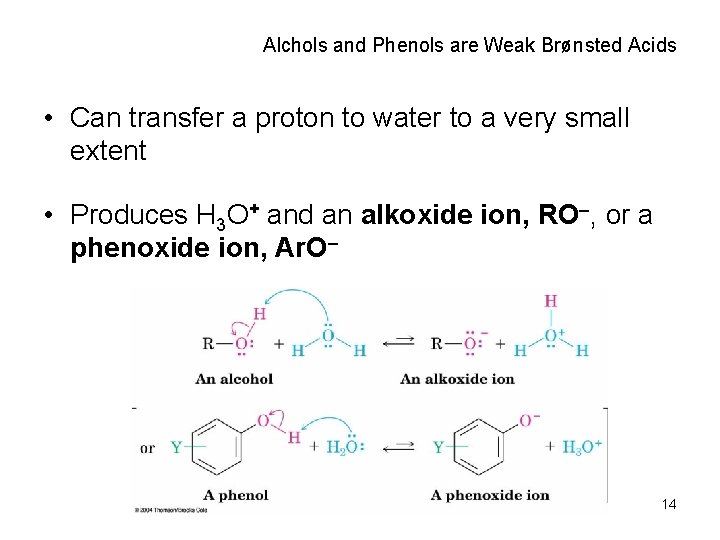
Alchols and Phenols are Weak Brønsted Acids • Can transfer a proton to water to a very small extent • Produces H 3 O+ and an alkoxide ion, RO , or a phenoxide ion, Ar. O 14
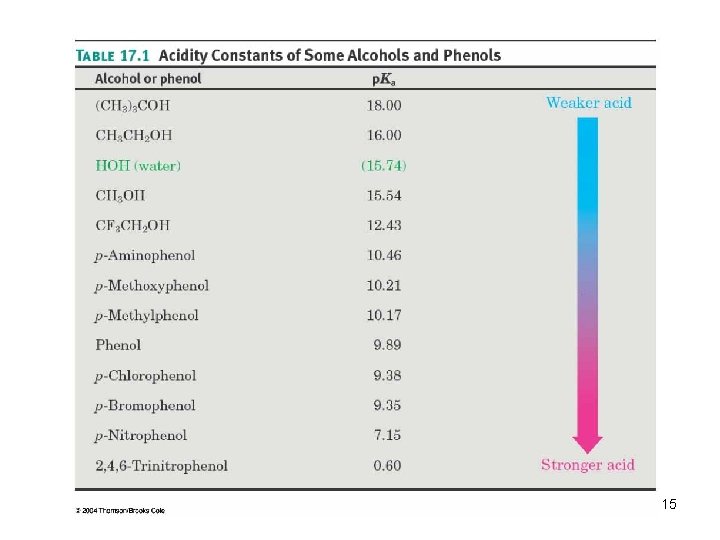
15
Relative Acidities of Alcohols • Simple alcohols are about as acidic as water • Alkyl groups make an alcohol a weaker acid • The more easily the alkoxide ion is solvated by water the more its formation is energetically favored • Steric effects are important 16
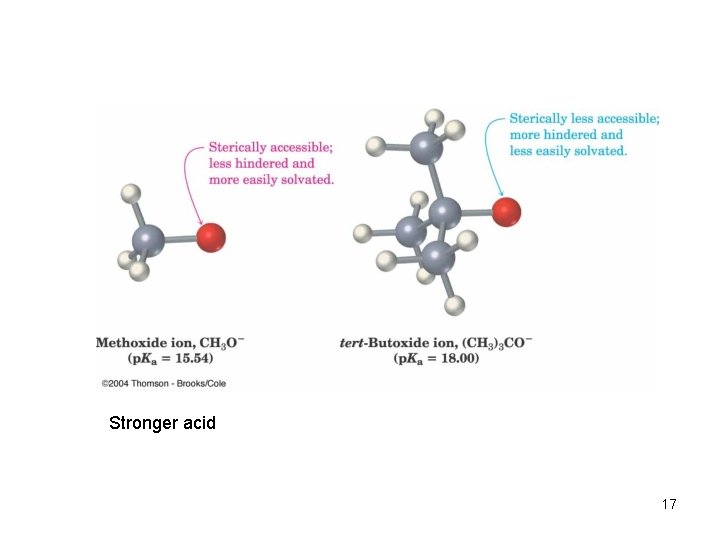
Stronger acid 17
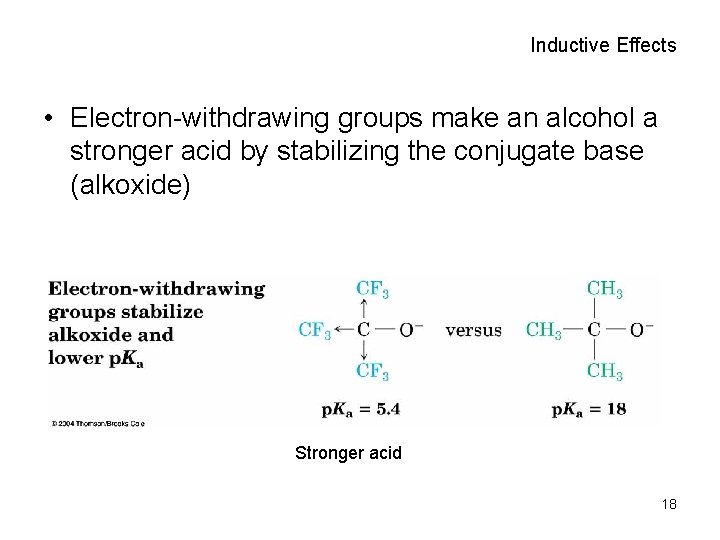
Inductive Effects • Electron-withdrawing groups make an alcohol a stronger acid by stabilizing the conjugate base (alkoxide) Stronger acid 18
Generating Alkoxides from Alcohols • Alcohols are weak acids – requires a strong base to form an alkoxide such as Na. H, sodium amide Na. NH 2, and Grignard reagents (RMg. X) • Alkoxides are bases used as reagents in organic chemistry 19
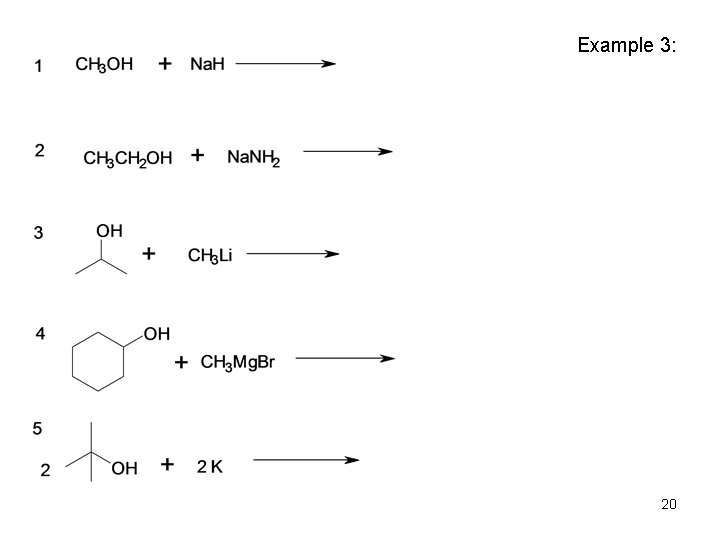
Example 3: 20
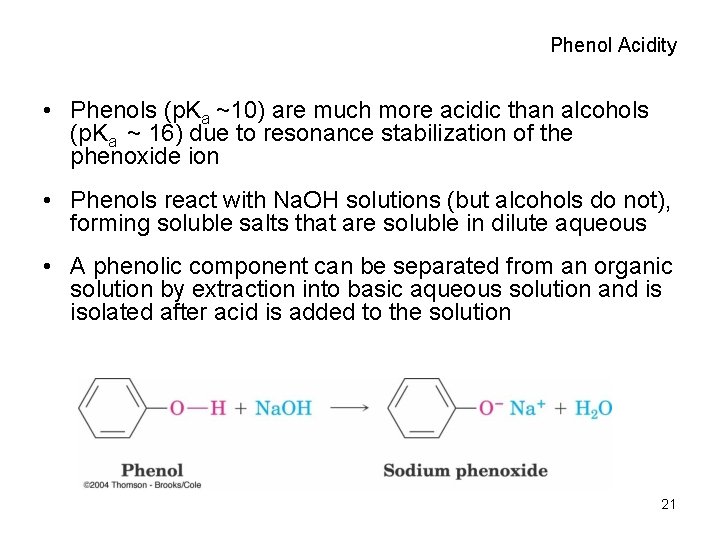
Phenol Acidity • Phenols (p. Ka ~10) are much more acidic than alcohols (p. Ka ~ 16) due to resonance stabilization of the phenoxide ion • Phenols react with Na. OH solutions (but alcohols do not), forming soluble salts that are soluble in dilute aqueous • A phenolic component can be separated from an organic solution by extraction into basic aqueous solution and is isolated after acid is added to the solution 21
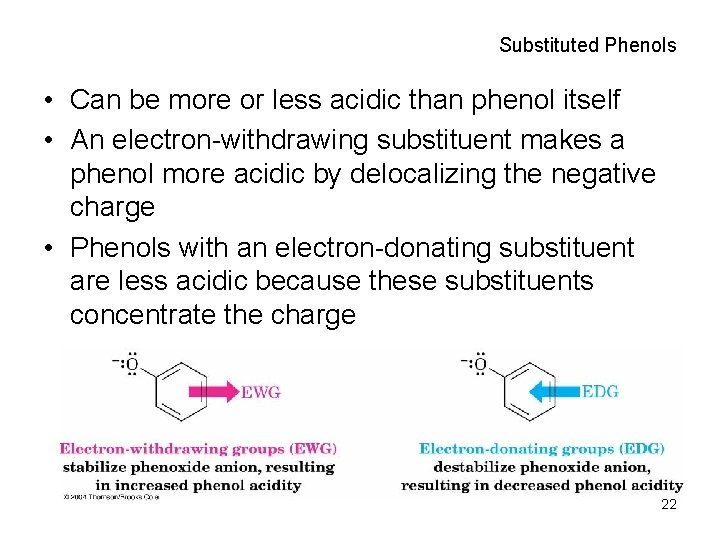
Substituted Phenols • Can be more or less acidic than phenol itself • An electron-withdrawing substituent makes a phenol more acidic by delocalizing the negative charge • Phenols with an electron-donating substituent are less acidic because these substituents concentrate the charge 22
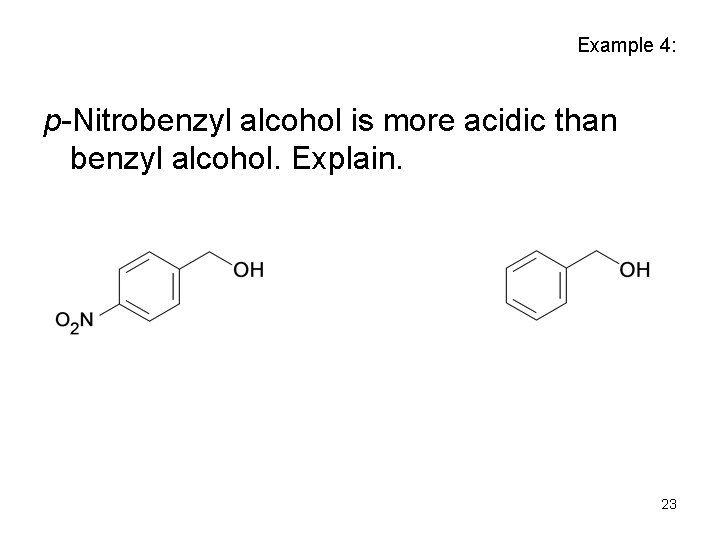
Example 4: p-Nitrobenzyl alcohol is more acidic than benzyl alcohol. Explain. 23
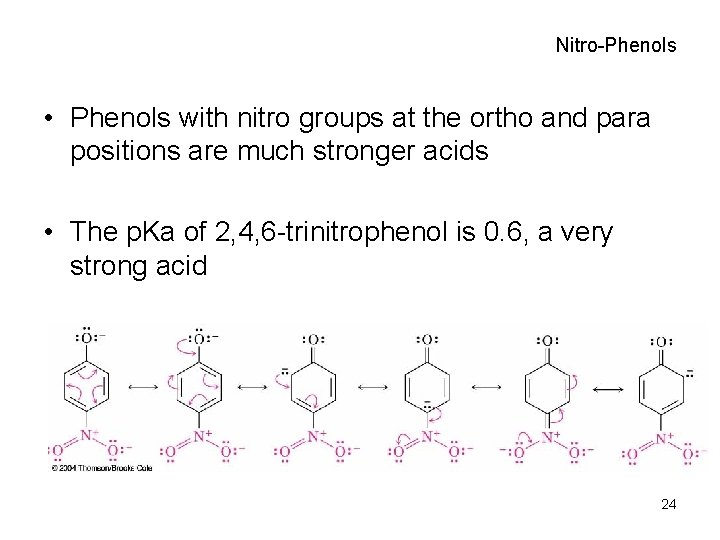
Nitro-Phenols • Phenols with nitro groups at the ortho and para positions are much stronger acids • The p. Ka of 2, 4, 6 -trinitrophenol is 0. 6, a very strong acid 24
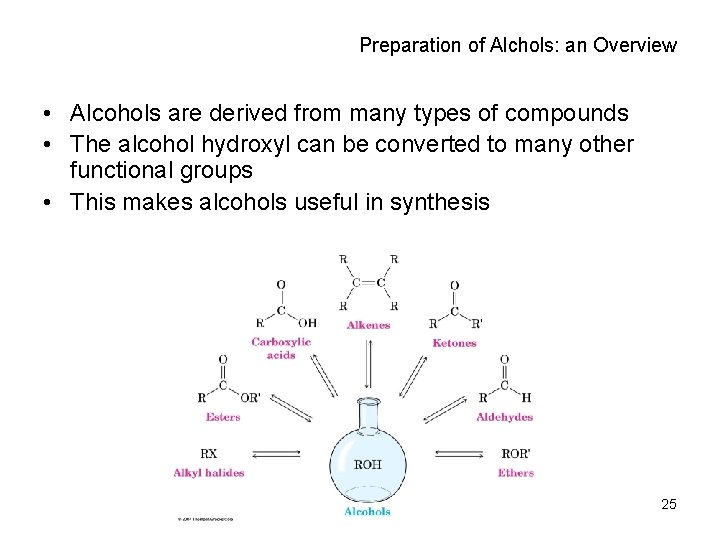
Preparation of Alchols: an Overview • Alcohols are derived from many types of compounds • The alcohol hydroxyl can be converted to many other functional groups • This makes alcohols useful in synthesis 25
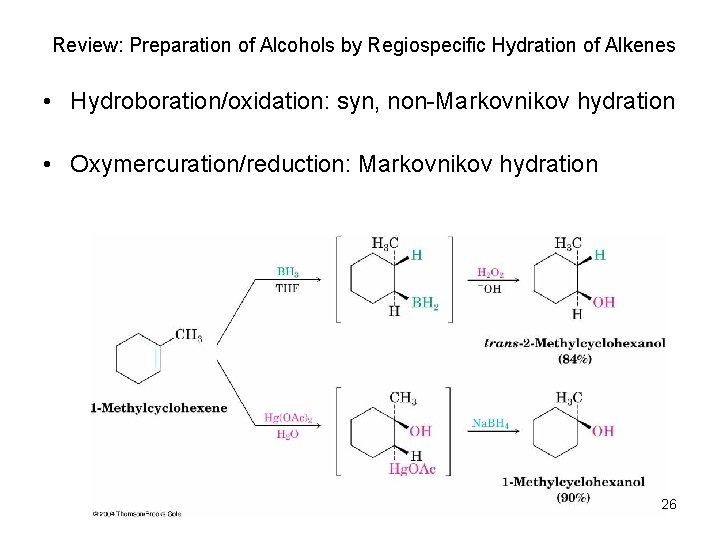
Review: Preparation of Alcohols by Regiospecific Hydration of Alkenes • Hydroboration/oxidation: syn, non-Markovnikov hydration • Oxymercuration/reduction: Markovnikov hydration 26
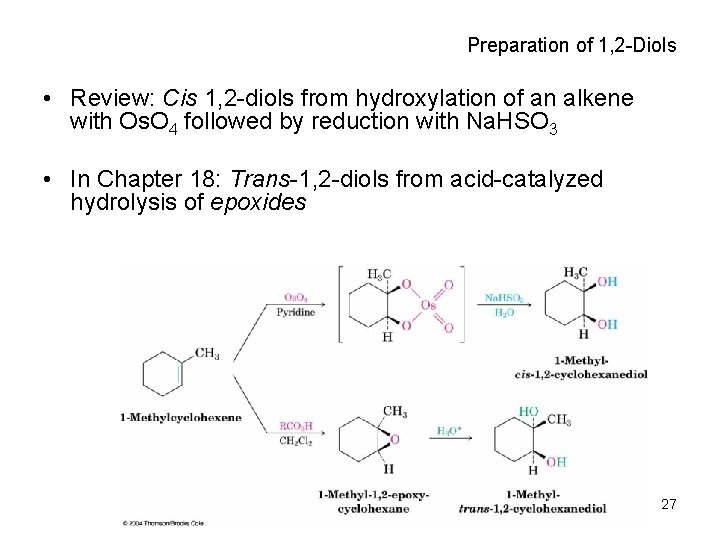
Preparation of 1, 2 -Diols • Review: Cis 1, 2 -diols from hydroxylation of an alkene with Os. O 4 followed by reduction with Na. HSO 3 • In Chapter 18: Trans-1, 2 -diols from acid-catalyzed hydrolysis of epoxides 27
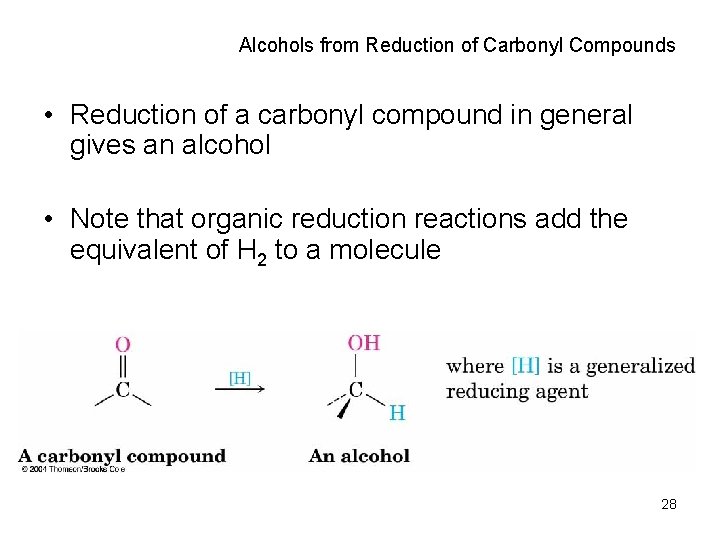
Alcohols from Reduction of Carbonyl Compounds • Reduction of a carbonyl compound in general gives an alcohol • Note that organic reduction reactions add the equivalent of H 2 to a molecule 28
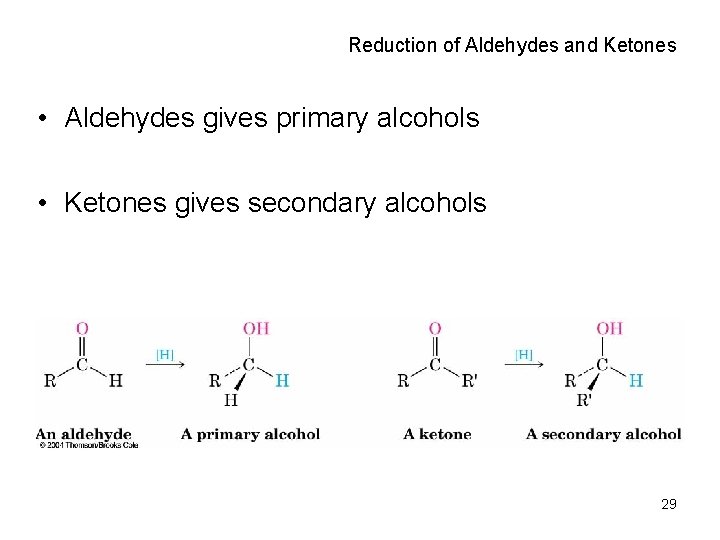
Reduction of Aldehydes and Ketones • Aldehydes gives primary alcohols • Ketones gives secondary alcohols 29
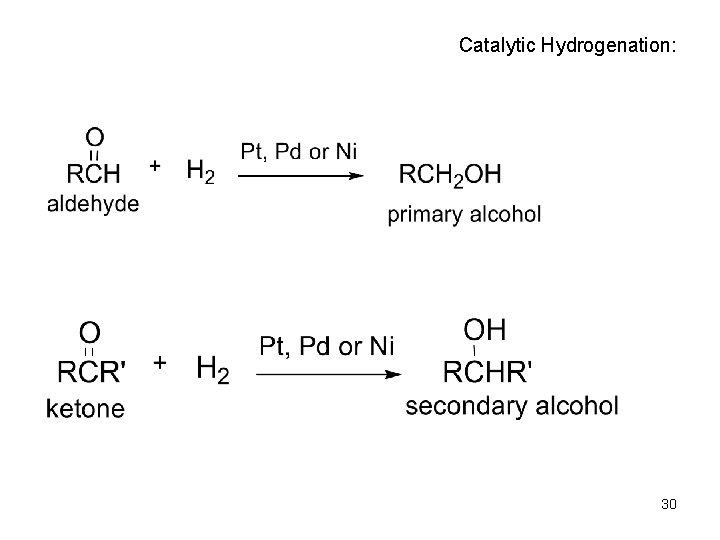
Catalytic Hydrogenation: 30
Reduction Reagent: Sodium Borohydride • Na. BH 4 is not sensitive to moisture and it does not reduce other common functional groups • Lithium aluminum hydride (Li. Al. H 4) is more powerful, less specific, and very reactive with water • Both add the equivalent of “H-” 31
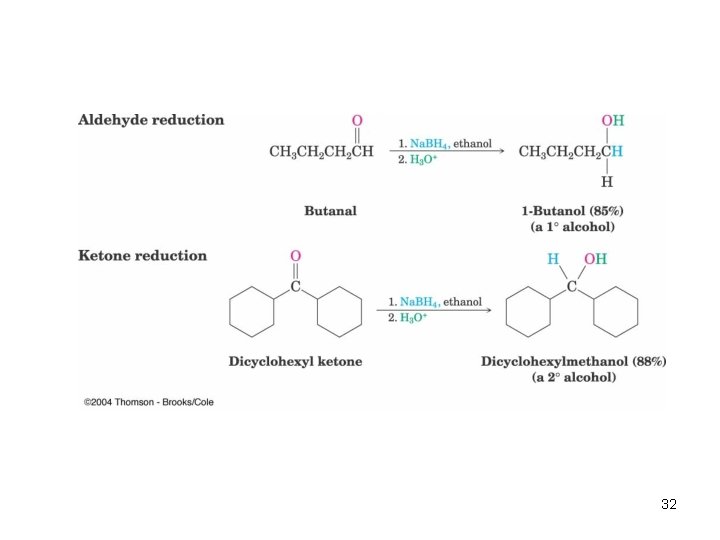
32
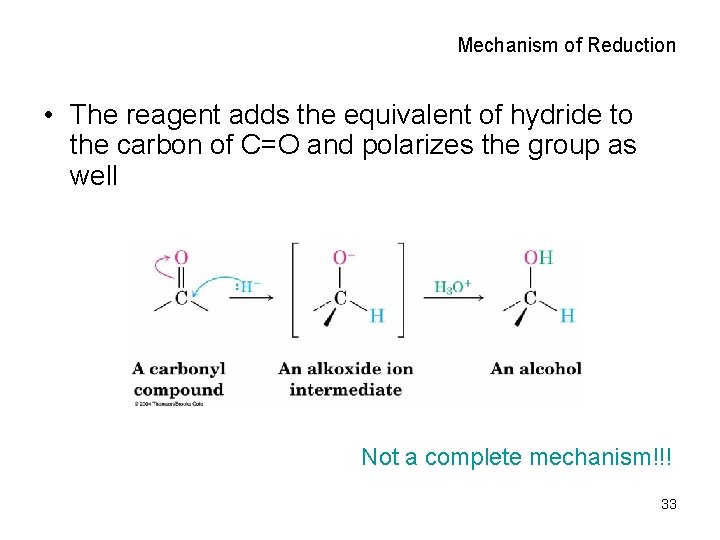
Mechanism of Reduction • The reagent adds the equivalent of hydride to the carbon of C=O and polarizes the group as well Not a complete mechanism!!! 33
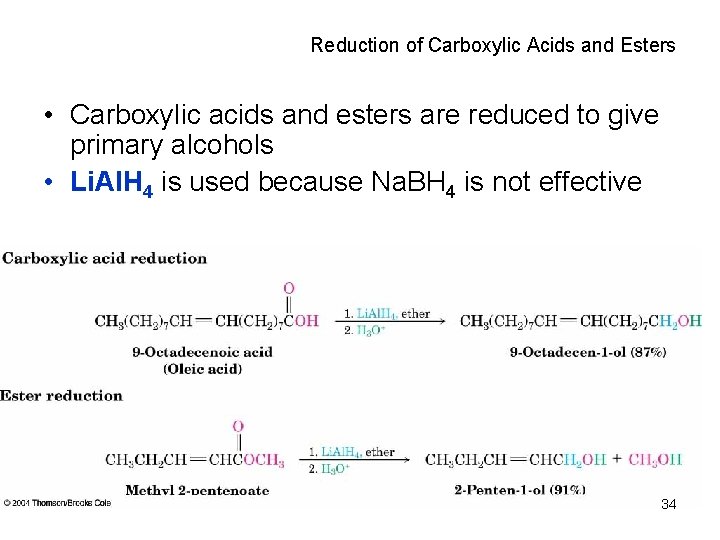
Reduction of Carboxylic Acids and Esters • Carboxylic acids and esters are reduced to give primary alcohols • Li. Al. H 4 is used because Na. BH 4 is not effective 34
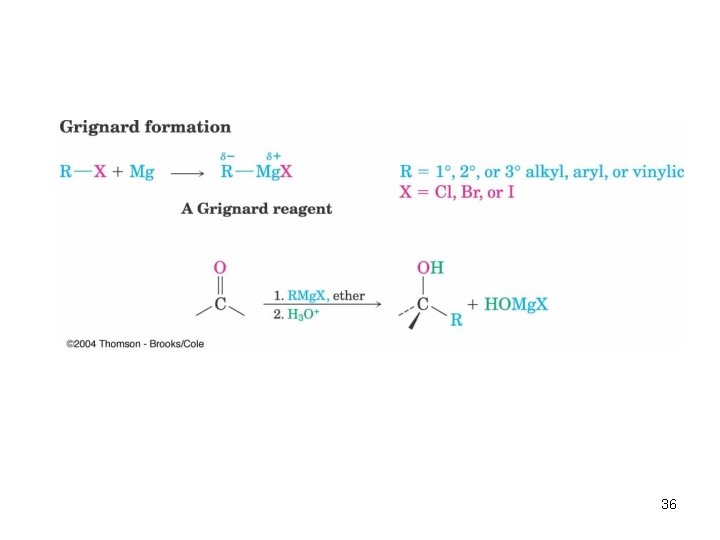
Alcohols from Reaction of Carbonyl Compounds with Grignard Reagents • Alkyl, aryl, and vinylic halides react with magnesium in ether or tetrahydrofuran to generate Grignard reagents, RMg. X • Grignard reagents react with carbonyl compounds to yield alcohols 35
36
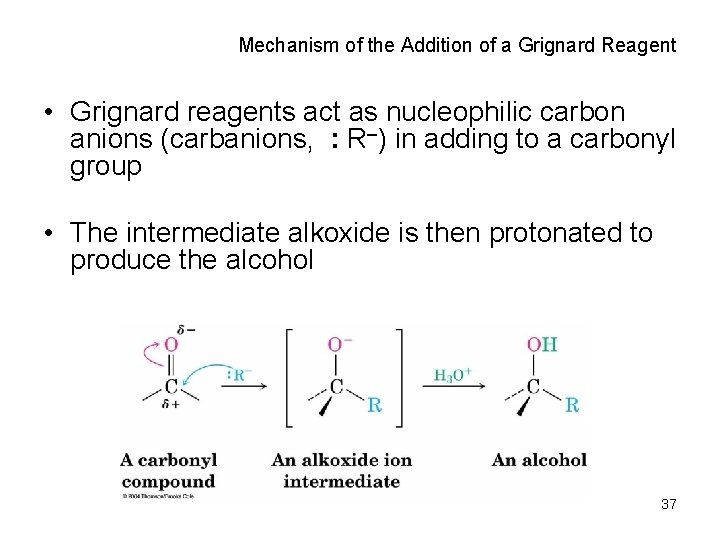
Mechanism of the Addition of a Grignard Reagent • Grignard reagents act as nucleophilic carbon anions (carbanions, : R ) in adding to a carbonyl group • The intermediate alkoxide is then protonated to produce the alcohol 37
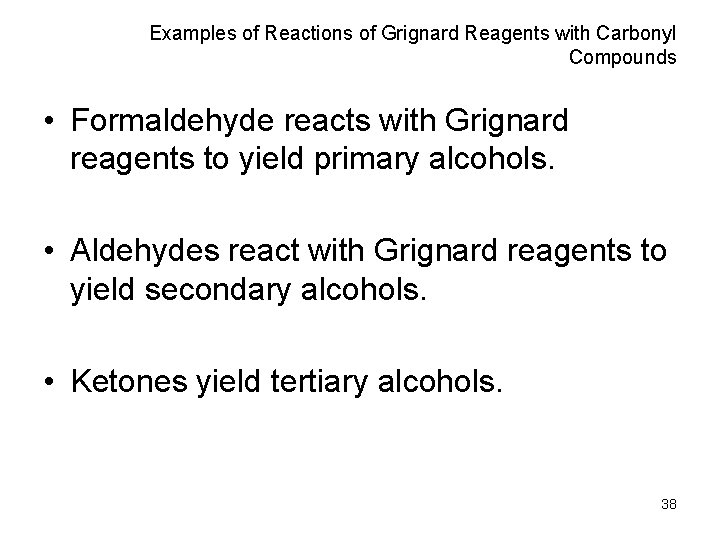
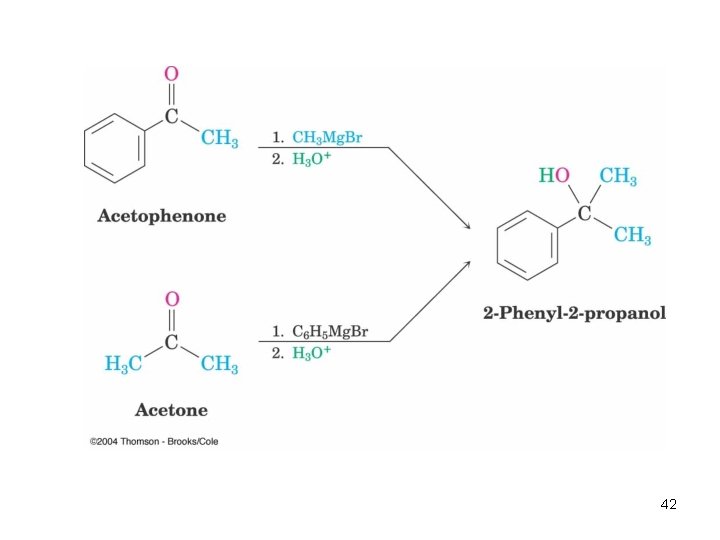
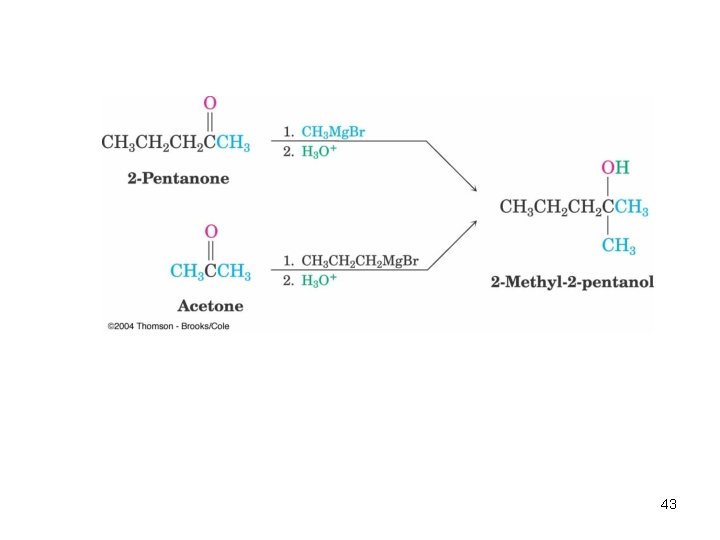
Examples of Reactions of Grignard Reagents with Carbonyl Compounds • Formaldehyde reacts with Grignard reagents to yield primary alcohols. • Aldehydes react with Grignard reagents to yield secondary alcohols. • Ketones yield tertiary alcohols. 38
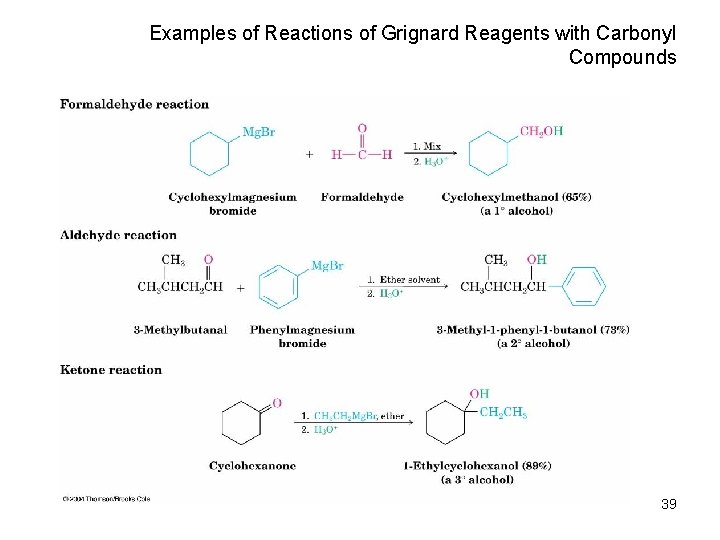
Examples of Reactions of Grignard Reagents with Carbonyl Compounds 39
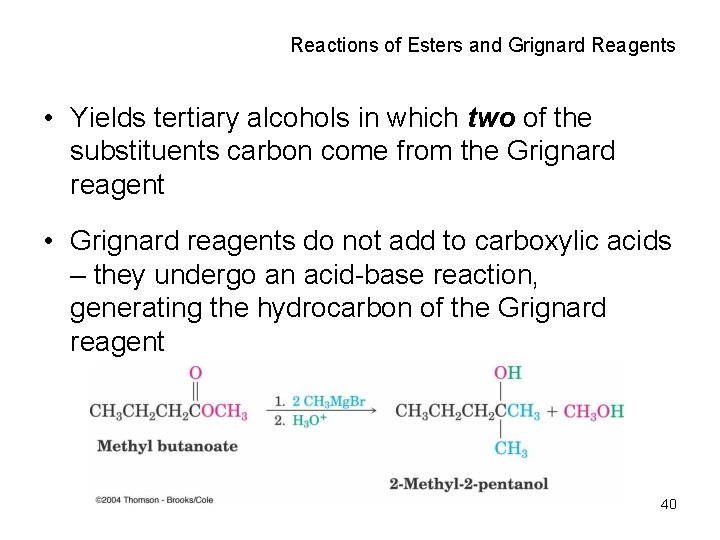
Reactions of Esters and Grignard Reagents • Yields tertiary alcohols in which two of the substituents carbon come from the Grignard reagent • Grignard reagents do not add to carboxylic acids – they undergo an acid-base reaction, generating the hydrocarbon of the Grignard reagent 40
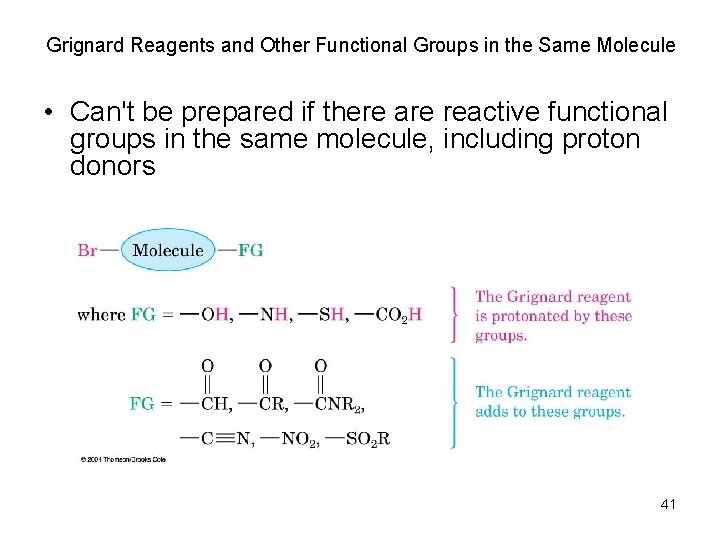
Grignard Reagents and Other Functional Groups in the Same Molecule • Can't be prepared if there are reactive functional groups in the same molecule, including proton donors 41
42
43
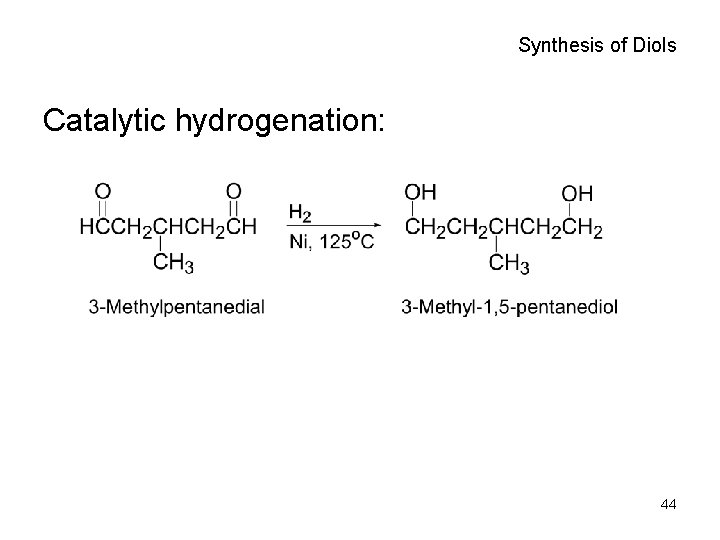
Synthesis of Diols Catalytic hydrogenation: 44
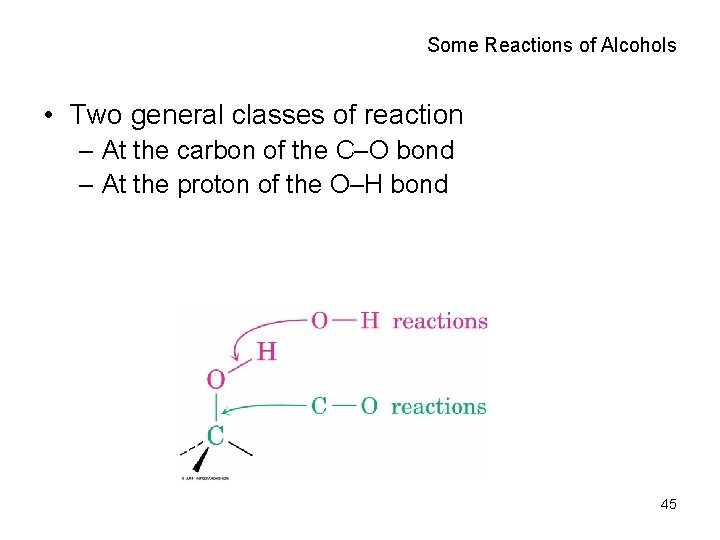
Some Reactions of Alcohols • Two general classes of reaction – At the carbon of the C–O bond – At the proton of the O–H bond 45
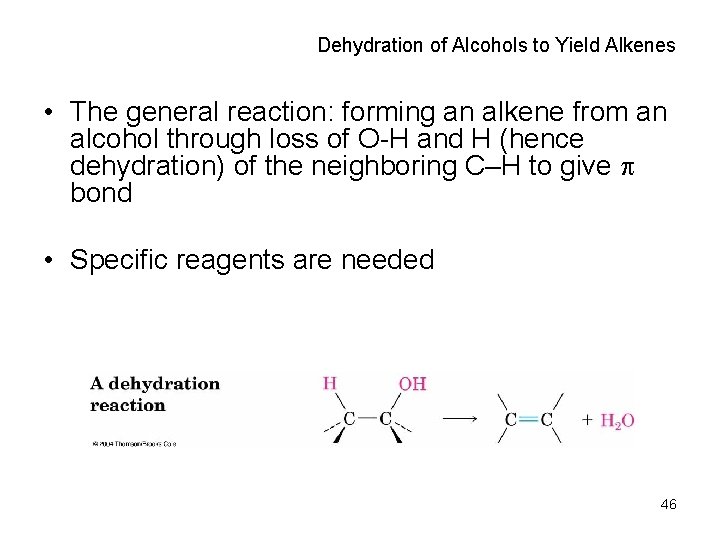
Dehydration of Alcohols to Yield Alkenes • The general reaction: forming an alkene from an alcohol through loss of O-H and H (hence dehydration) of the neighboring C–H to give bond • Specific reagents are needed 46
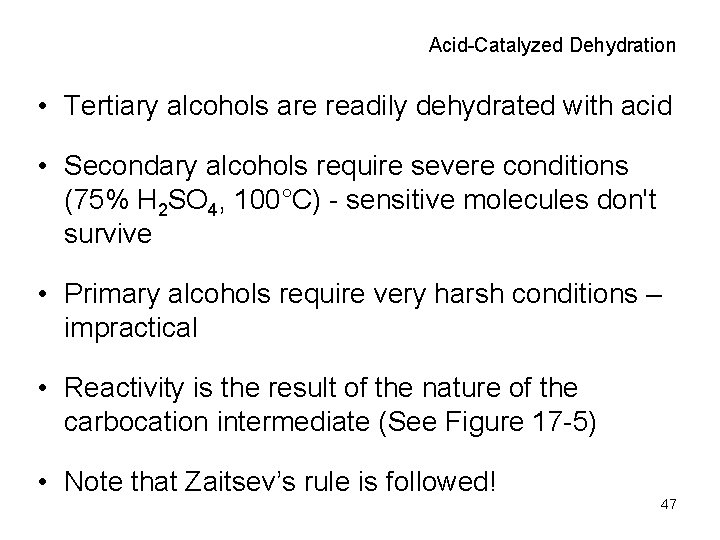
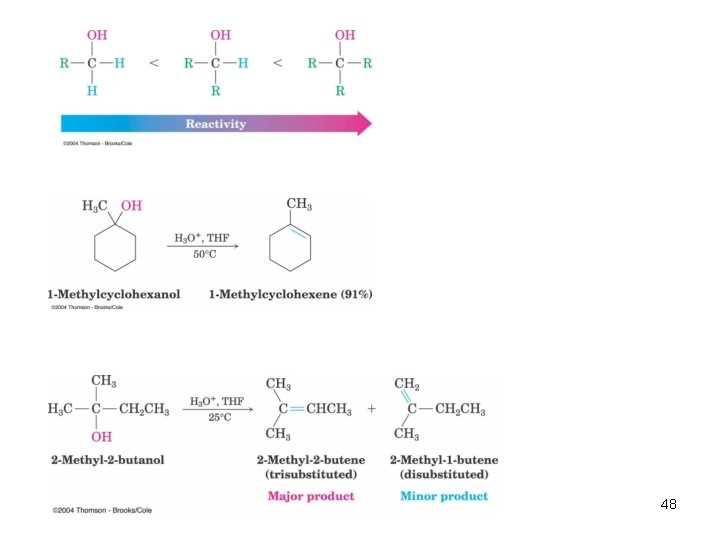
Acid-Catalyzed Dehydration • Tertiary alcohols are readily dehydrated with acid • Secondary alcohols require severe conditions (75% H 2 SO 4, 100°C) - sensitive molecules don't survive • Primary alcohols require very harsh conditions – impractical • Reactivity is the result of the nature of the carbocation intermediate (See Figure 17 -5) • Note that Zaitsev’s rule is followed! 47
48
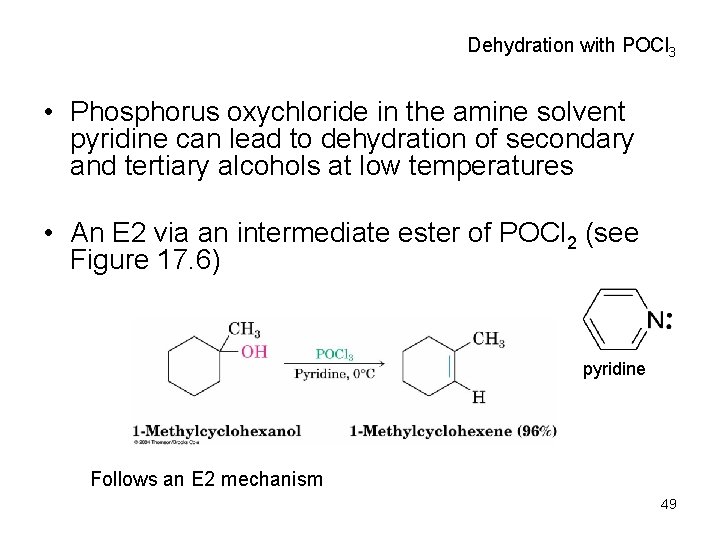
Dehydration with POCl 3 • Phosphorus oxychloride in the amine solvent pyridine can lead to dehydration of secondary and tertiary alcohols at low temperatures • An E 2 via an intermediate ester of POCl 2 (see Figure 17. 6) pyridine Follows an E 2 mechanism 49
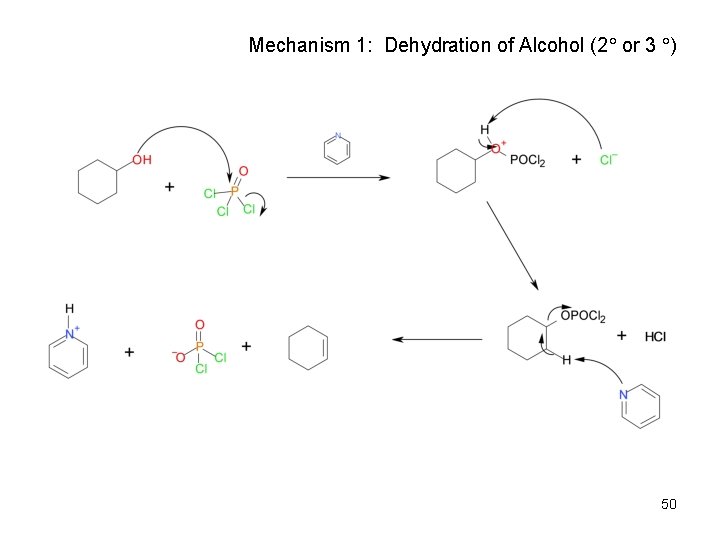
Mechanism 1: Dehydration of Alcohol (2 or 3 ) 50
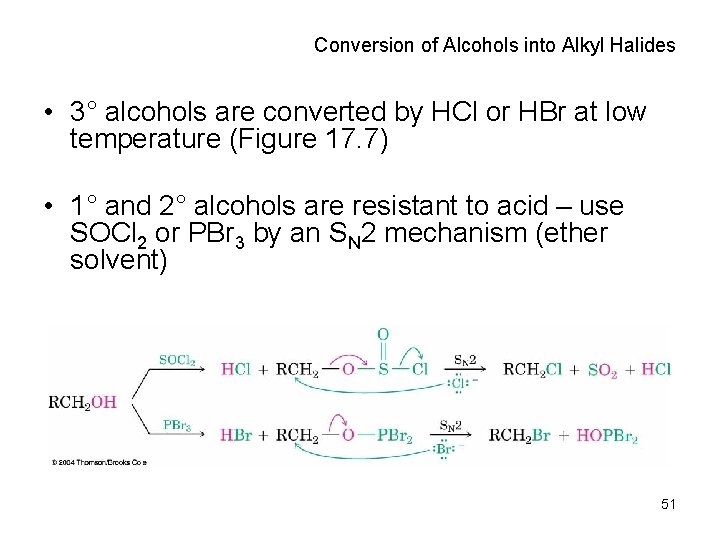
Conversion of Alcohols into Alkyl Halides • 3° alcohols are converted by HCl or HBr at low temperature (Figure 17. 7) • 1° and 2° alcohols are resistant to acid – use SOCl 2 or PBr 3 by an SN 2 mechanism (ether solvent) 51
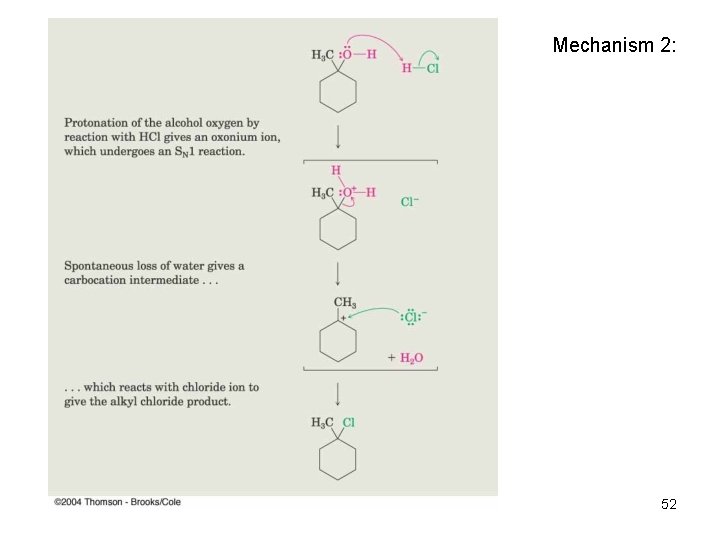
Mechanism 2: 52
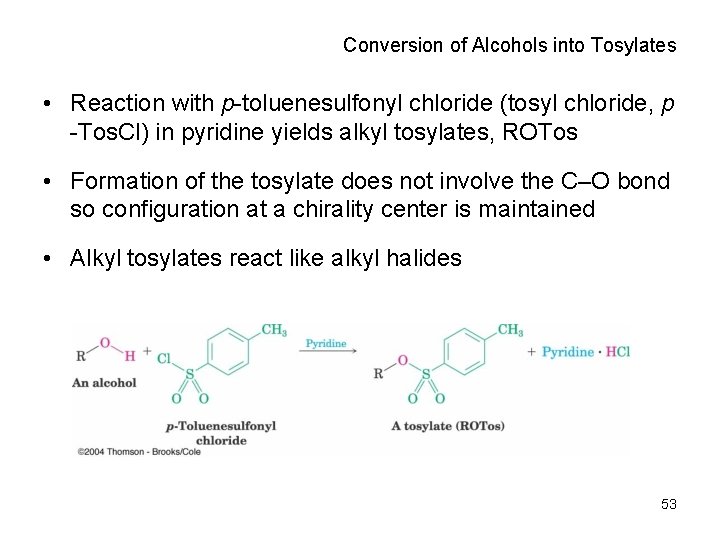
Conversion of Alcohols into Tosylates • Reaction with p-toluenesulfonyl chloride (tosyl chloride, p -Tos. Cl) in pyridine yields alkyl tosylates, ROTos • Formation of the tosylate does not involve the C–O bond so configuration at a chirality center is maintained • Alkyl tosylates react like alkyl halides 53
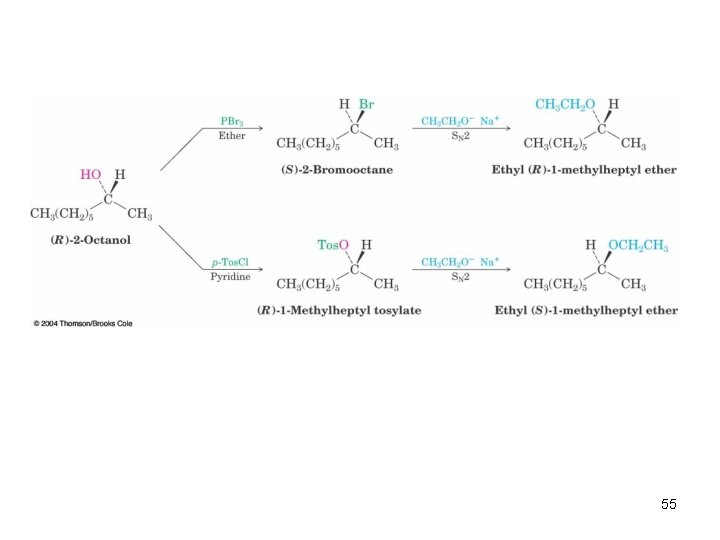
Stereochemical Uses of Tosylates • The SN 2 reaction of an alcohol via a tosylate, produces inversion at the chiral center • The SN 2 reaction of an alcohol via an alkyl halide proceeds with two inversions, giving product with same arrangement as starting alcohol 54
55
56
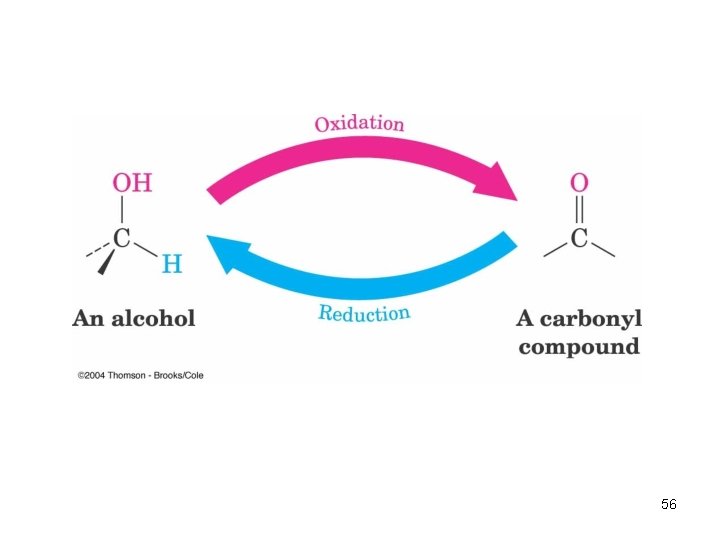
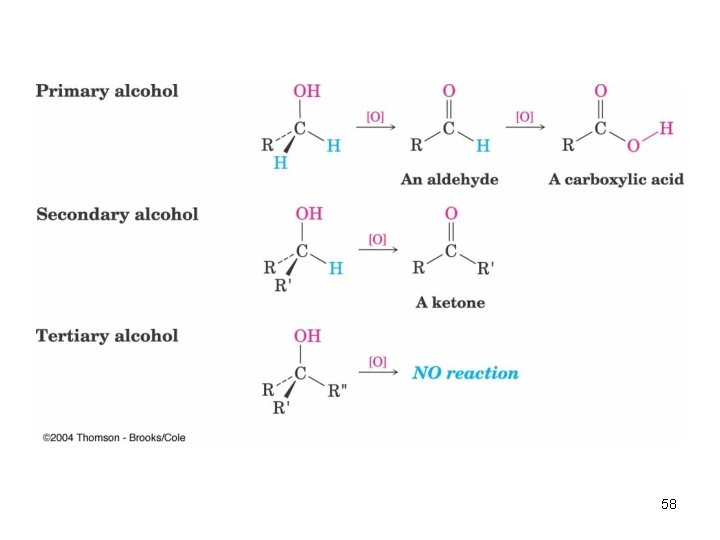
Oxidation of Alcohols • Can be accomplished by inorganic reagents, such as KMn. O 4, Cr. O 3, and Na 2 Cr 2 O 7 or by more selective, expensive reagents 57
58
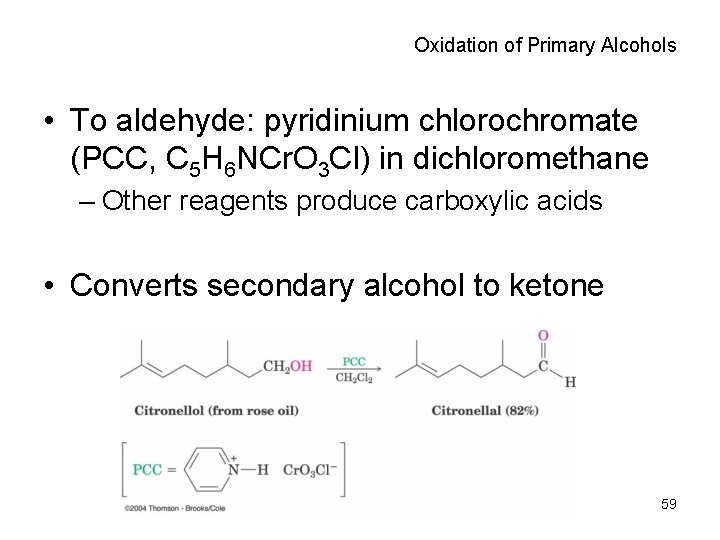
Oxidation of Primary Alcohols • To aldehyde: pyridinium chlorochromate (PCC, C 5 H 6 NCr. O 3 Cl) in dichloromethane – Other reagents produce carboxylic acids • Converts secondary alcohol to ketone 59
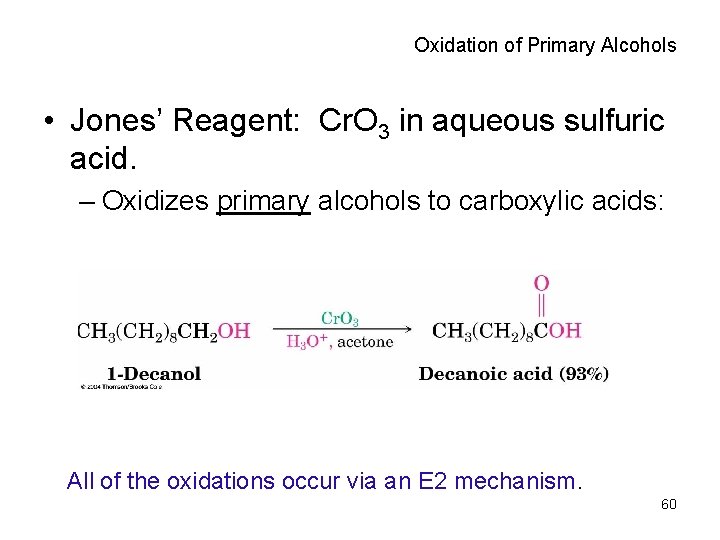
Oxidation of Primary Alcohols • Jones’ Reagent: Cr. O 3 in aqueous sulfuric acid. – Oxidizes primary alcohols to carboxylic acids: All of the oxidations occur via an E 2 mechanism. 60
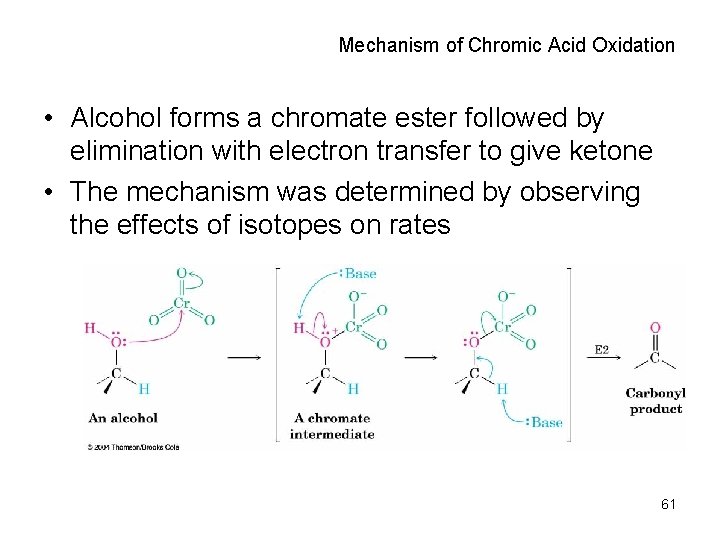
Mechanism of Chromic Acid Oxidation • Alcohol forms a chromate ester followed by elimination with electron transfer to give ketone • The mechanism was determined by observing the effects of isotopes on rates 61
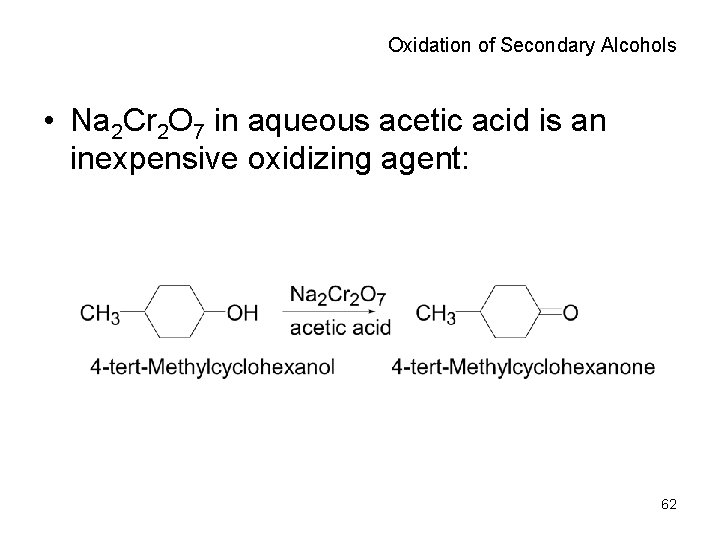
Oxidation of Secondary Alcohols • Na 2 Cr 2 O 7 in aqueous acetic acid is an inexpensive oxidizing agent: 62
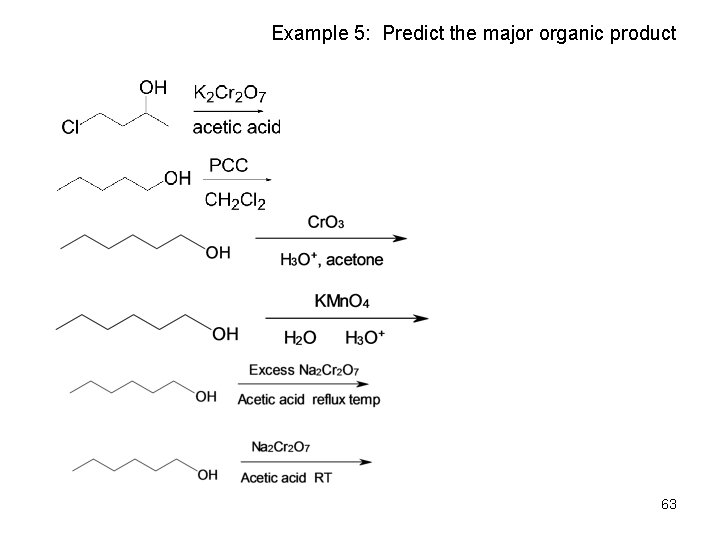
Example 5: Predict the major organic product 63
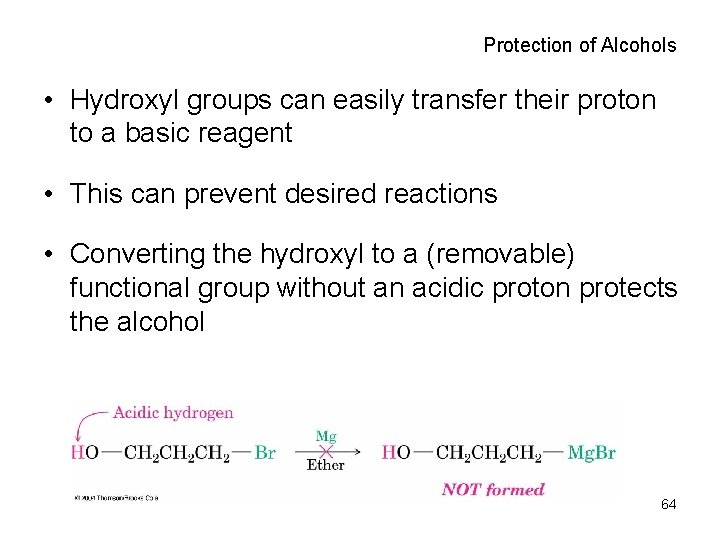
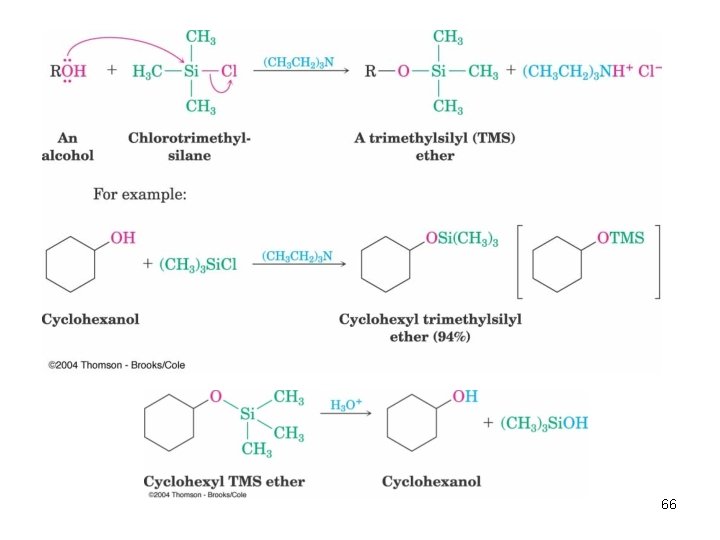
Protection of Alcohols • Hydroxyl groups can easily transfer their proton to a basic reagent • This can prevent desired reactions • Converting the hydroxyl to a (removable) functional group without an acidic proton protects the alcohol 64
Methods to Protect Alcohols • Reaction with chlorotrimethylsilane in the presence of base yields an unreactive trimethylsilyl (TMS) ether • The ether can be cleaved with acid or with fluoride ion to regenerate the alcohol 65
66
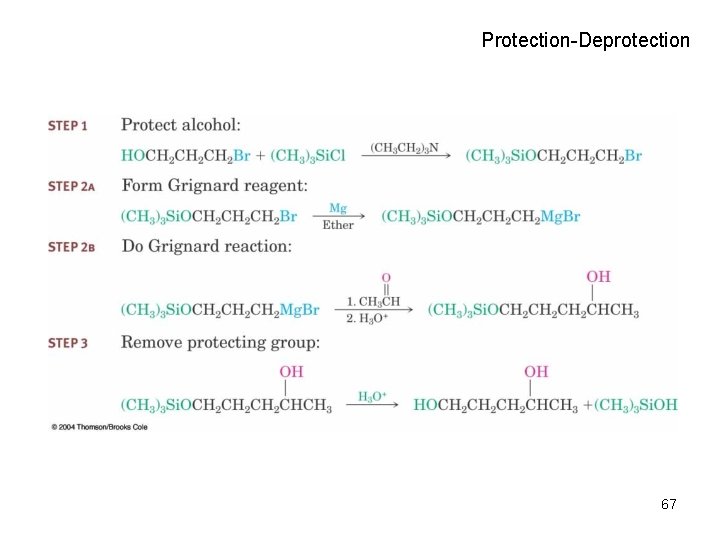
Protection-Deprotection 67
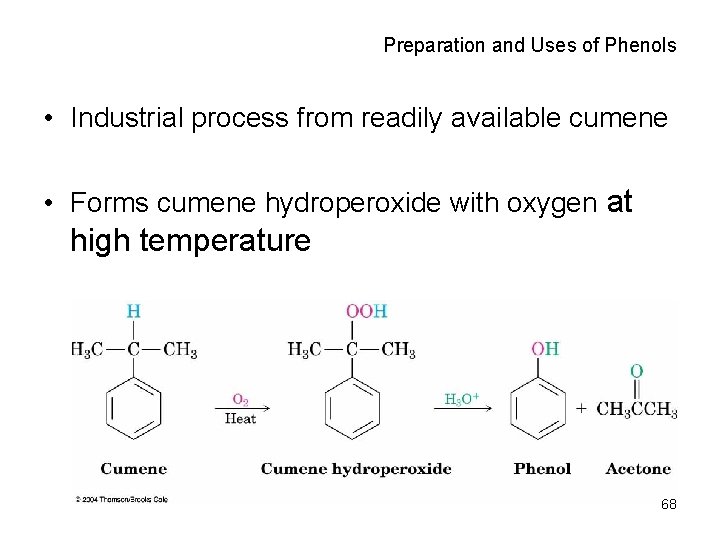
Preparation and Uses of Phenols • Industrial process from readily available cumene • Forms cumene hydroperoxide with oxygen at high temperature 68
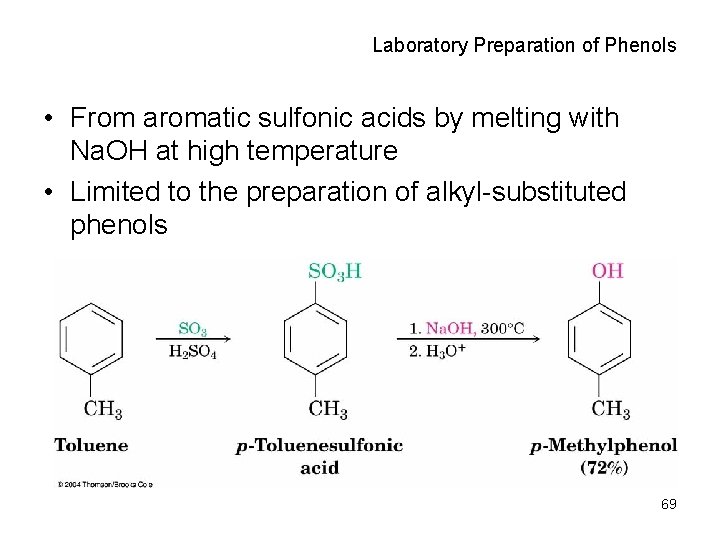
Laboratory Preparation of Phenols • From aromatic sulfonic acids by melting with Na. OH at high temperature • Limited to the preparation of alkyl-substituted phenols 69
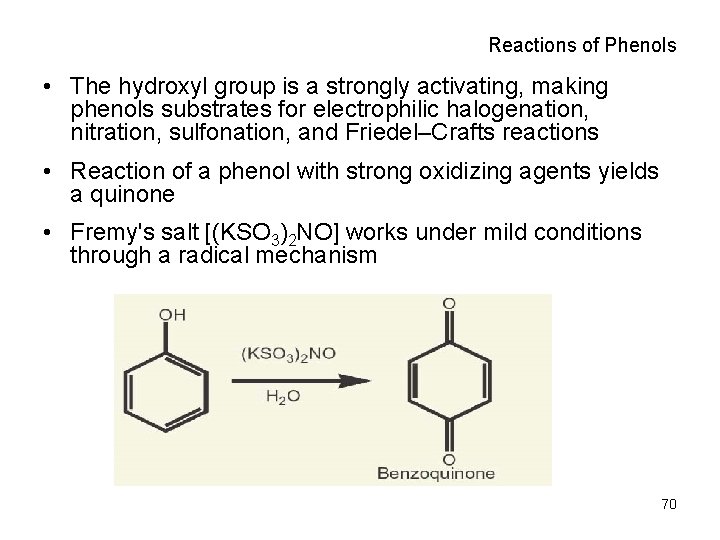
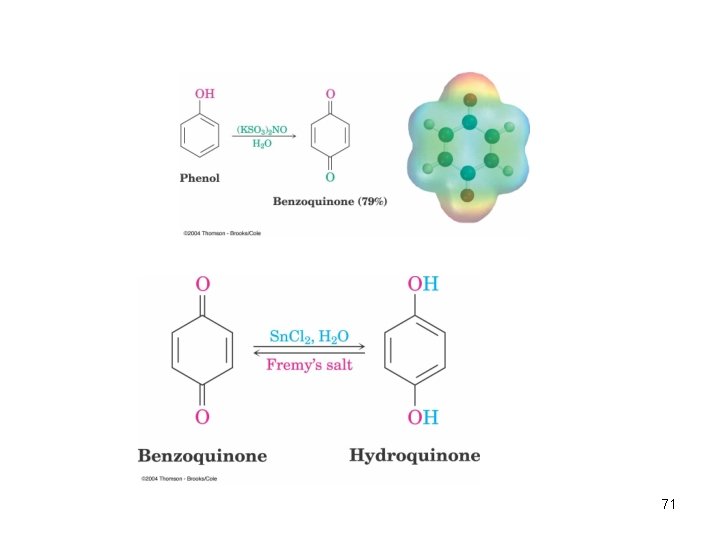
Reactions of Phenols • The hydroxyl group is a strongly activating, making phenols substrates for electrophilic halogenation, nitration, sulfonation, and Friedel–Crafts reactions • Reaction of a phenol with strong oxidizing agents yields a quinone • Fremy's salt [(KSO 3)2 NO] works under mild conditions through a radical mechanism 70
71
- Slides: 71