
Ch 16 sections 34 Severe Weather and Forecasting


- Slides: 26
Ch. 16, sections 3&4 Severe Weather and Forecasting Copy Objectives: 1. Name and describe the purpose of weather instruments. 2. Name and describe severe weather events. Weather Brainpop hotlink
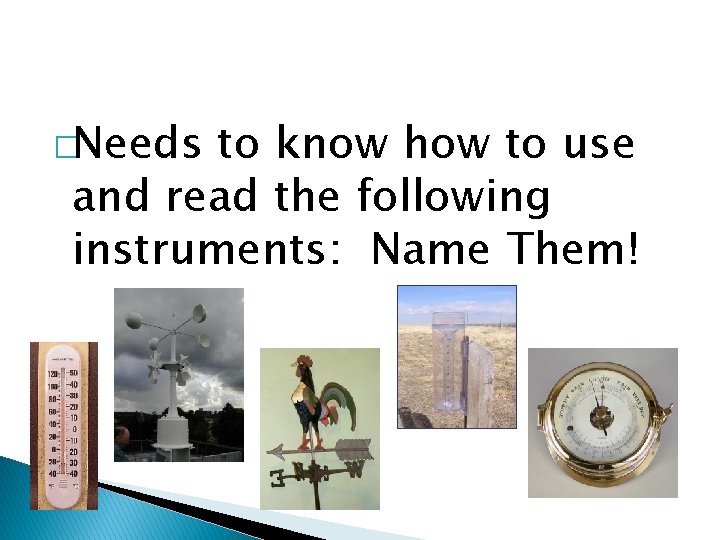
�Needs to know how to use and read the following instruments: Name Them!
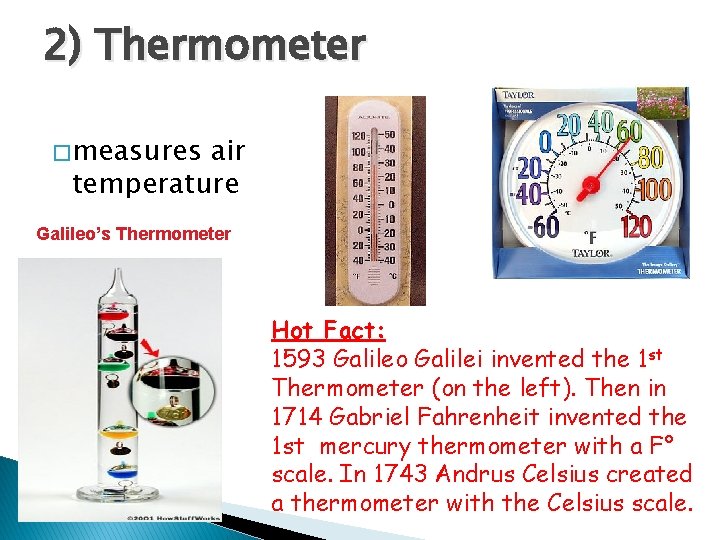
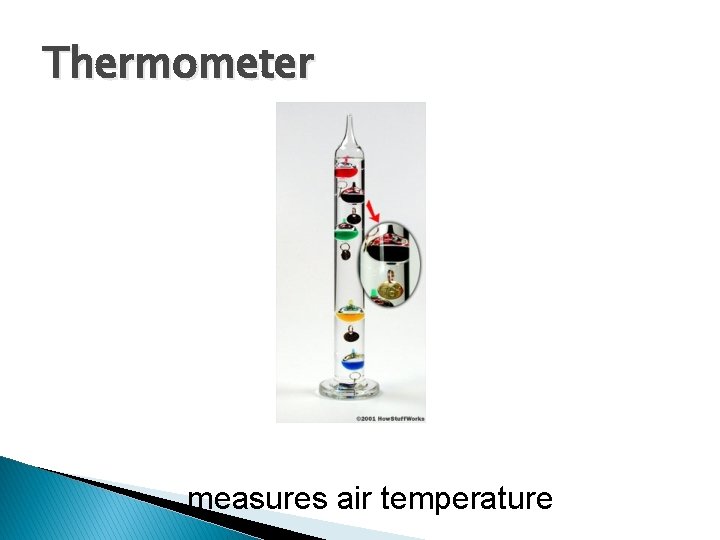
2) Thermometer � measures air temperature Galileo’s Thermometer Hot Fact: 1593 Galileo Galilei invented the 1 st Thermometer (on the left). Then in 1714 Gabriel Fahrenheit invented the 1 st mercury thermometer with a F° scale. In 1743 Andrus Celsius created a thermometer with the Celsius scale.
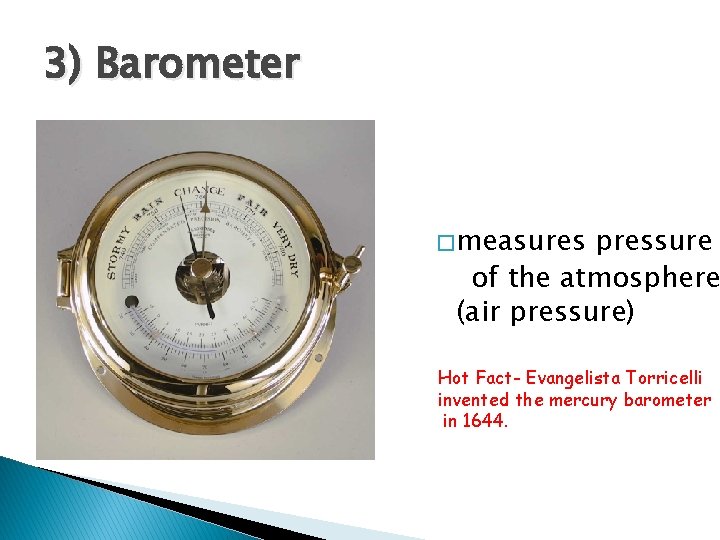
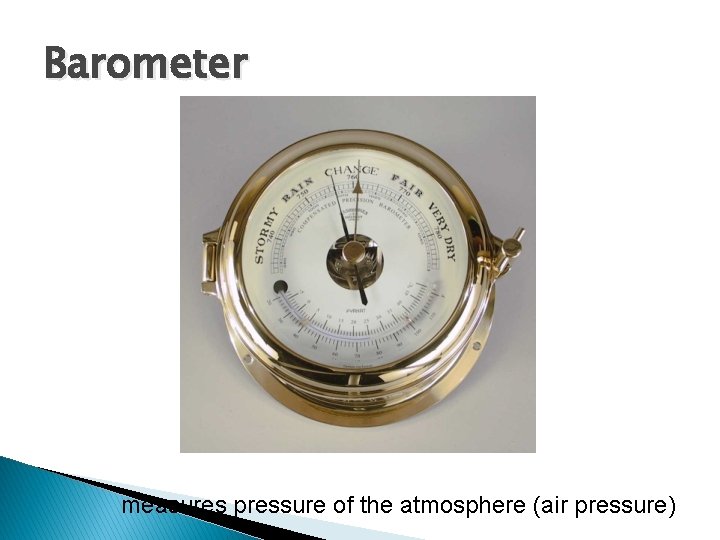
3) Barometer � measures pressure of the atmosphere (air pressure) Hot Fact- Evangelista Torricelli invented the mercury barometer in 1644.
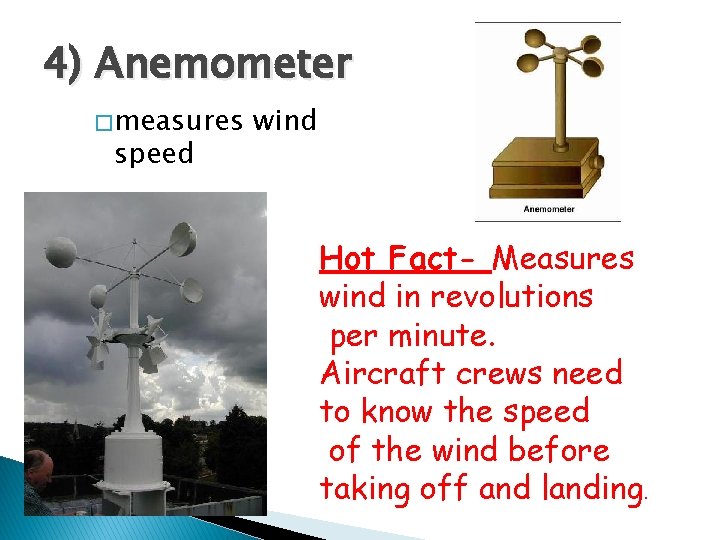
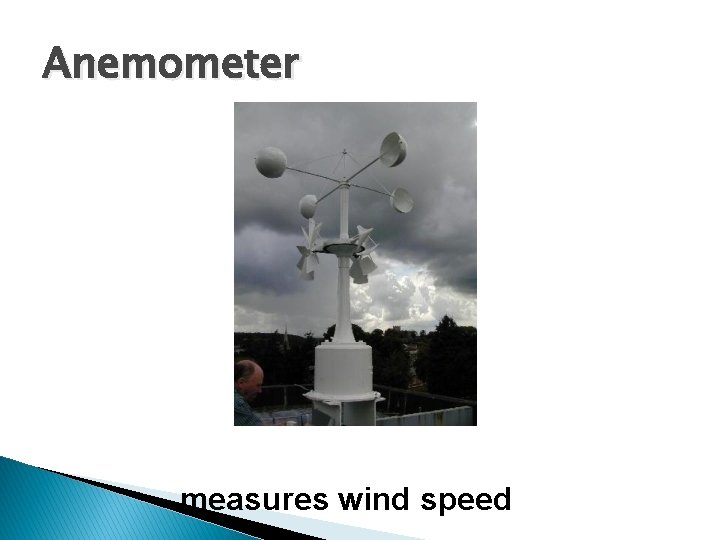
4) Anemometer � measures speed wind Hot Fact- Measures wind in revolutions per minute. Aircraft crews need to know the speed of the wind before taking off and landing.
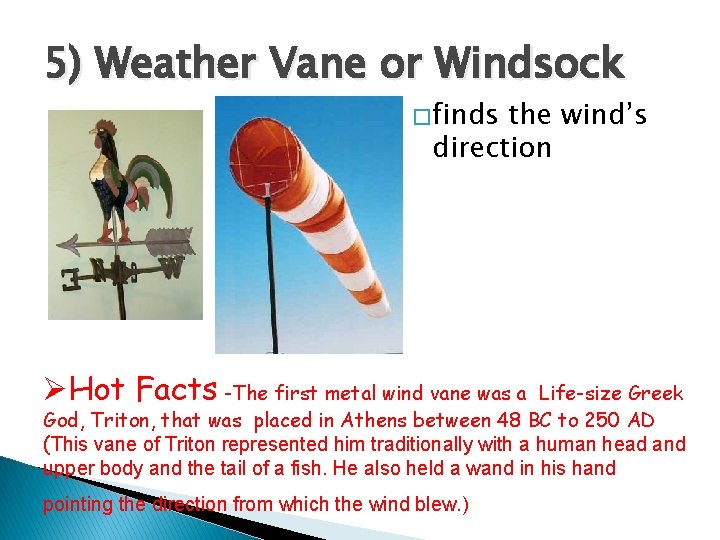
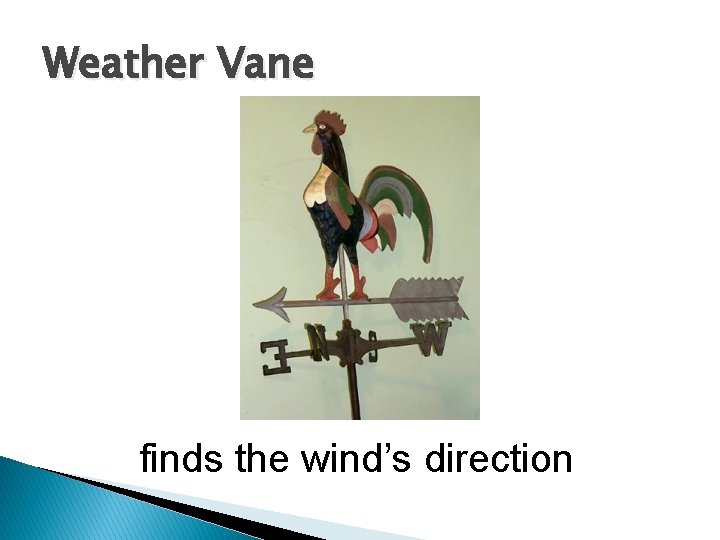
5) Weather Vane or Windsock � finds the wind’s direction ØHot Facts -The first metal wind vane was a Life-size Greek God, Triton, that was placed in Athens between 48 BC to 250 AD (This vane of Triton represented him traditionally with a human head and upper body and the tail of a fish. He also held a wand in his hand pointing the direction from which the wind blew. )
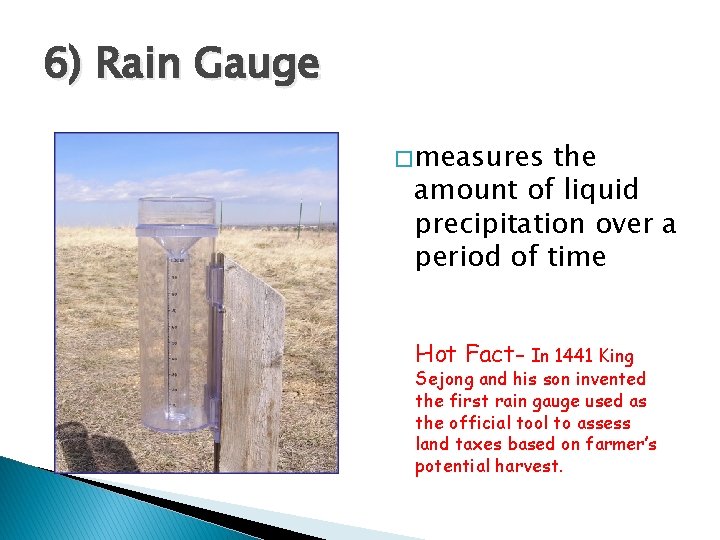
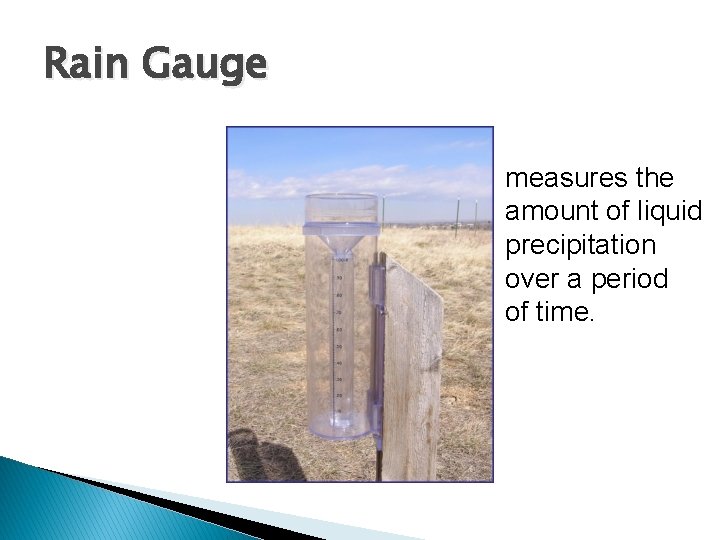
6) Rain Gauge � measures the amount of liquid precipitation over a period of time Hot Fact- In 1441 King Sejong and his son invented the first rain gauge used as the official tool to assess land taxes based on farmer’s potential harvest.
Weather Vane finds the wind’s direction
Anemometer measures wind speed
Rain Gauge measures the amount of liquid precipitation over a period of time.
Thermometer measures air temperature
Barometer measures pressure of the atmosphere (air pressure)
Handmade Instruments: What do you think they do?
Now, are you ready to explore and learn more about weather and the way weather instruments work? Let’s Research how these instruments are used in extreme weather. Take out the packet from your blue tubs.
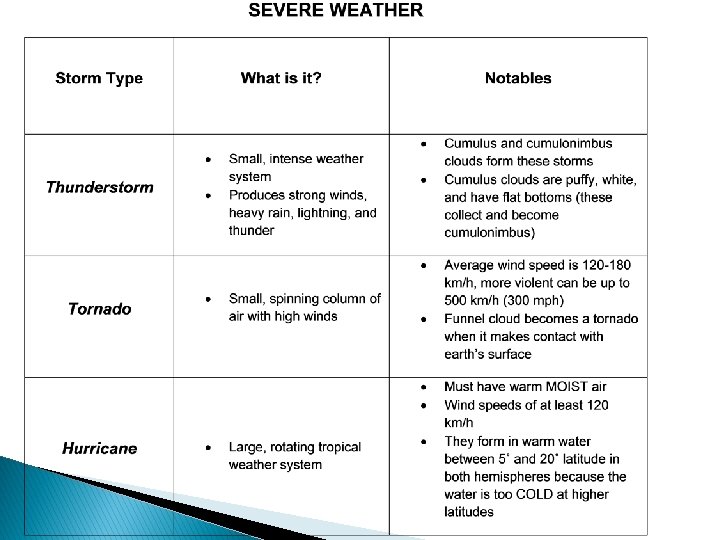
Hand out graphic organizer to glue in the IAN. • Task: Read your packet to help you pull out 3 bullets of essential information on thunderstorms, tornadoes, and hurricanes.
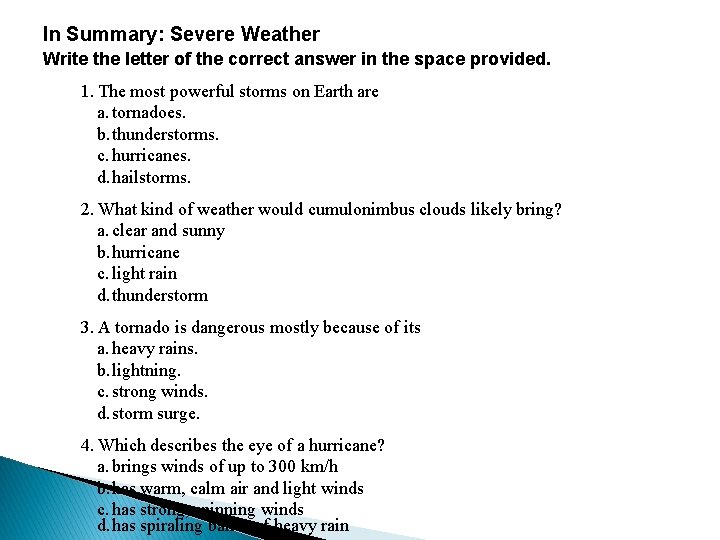
In Summary: Severe Weather Write the letter of the correct answer in the space provided. 1. The most powerful storms on Earth are a. tornadoes. b. thunderstorms. c. hurricanes. d. hailstorms. 2. What kind of weather would cumulonimbus clouds likely bring? a. clear and sunny b. hurricane c. light rain d. thunderstorm 3. A tornado is dangerous mostly because of its a. heavy rains. b. lightning. c. strong winds. d. storm surge. 4. Which describes the eye of a hurricane? a. brings winds of up to 300 km/h b. has warm, calm air and light winds c. has strong, spinning winds d. has spiraling bands of heavy rain
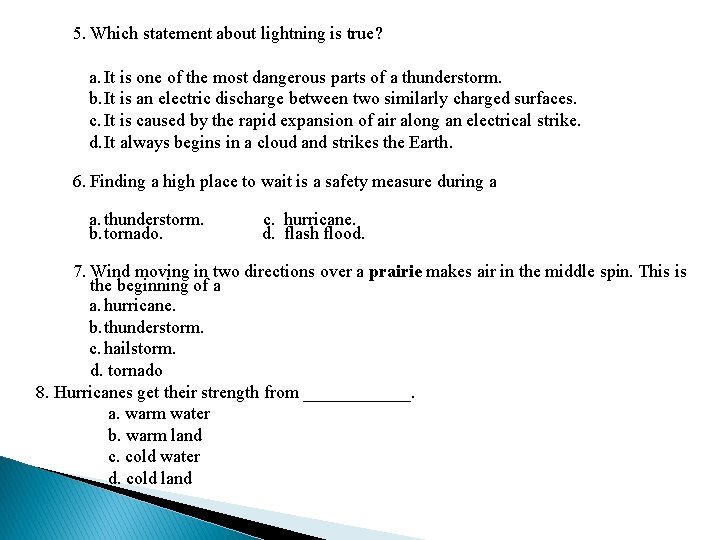
5. Which statement about lightning is true? a. It is one of the most dangerous parts of a thunderstorm. b. It is an electric discharge between two similarly charged surfaces. c. It is caused by the rapid expansion of air along an electrical strike. d. It always begins in a cloud and strikes the Earth. 6. Finding a high place to wait is a safety measure during a a. thunderstorm. b. tornado. c. hurricane. d. flash flood. 7. Wind moving in two directions over a prairie makes air in the middle spin. This is the beginning of a a. hurricane. b. thunderstorm. c. hailstorm. d. tornado 8. Hurricanes get their strength from ______. a. warm water b. warm land c. cold water d. cold land
� Tornadoes Brainpop � Hurricanes Brainpop � Severe Weather Brainpop Homework: Finish visual organizer on weather instruments.
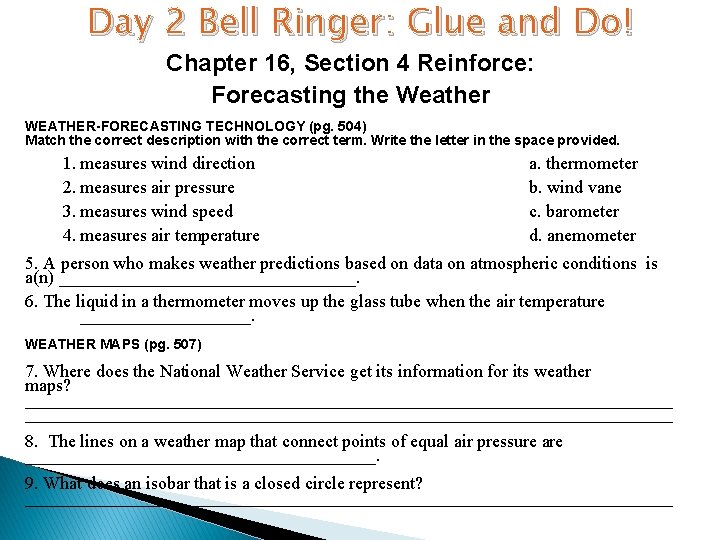
Day 2 Bell Ringer: Glue and Do! Chapter 16, Section 4 Reinforce: Forecasting the Weather WEATHER-FORECASTING TECHNOLOGY (pg. 504) Match the correct description with the correct term. Write the letter in the space provided. 1. measures wind direction 2. measures air pressure 3. measures wind speed 4. measures air temperature a. thermometer b. wind vane c. barometer d. anemometer 5. A person who makes weather predictions based on data on atmospheric conditions is a(n) _________________. 6. The liquid in a thermometer moves up the glass tube when the air temperature __________. WEATHER MAPS (pg. 507) 7. Where does the National Weather Service get its information for its weather maps? ________________________________________________________________________ 8. The lines on a weather map that connect points of equal air pressure are ____________________. 9. What does an isobar that is a closed circle represent? ____________________________________
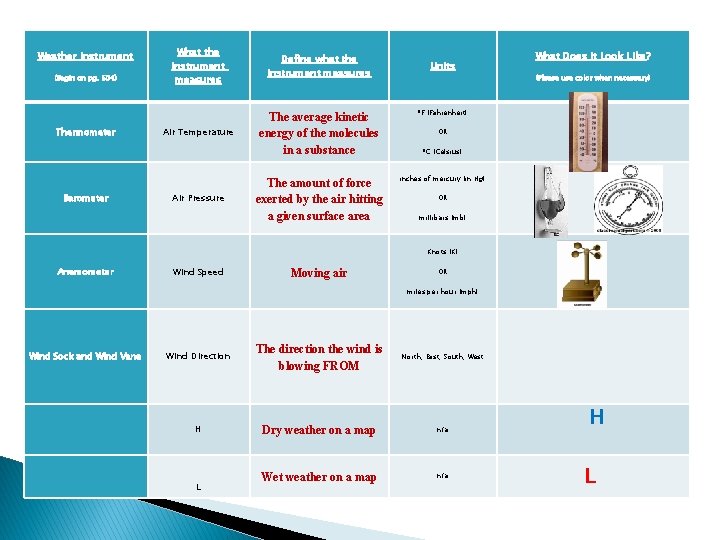
Weather Instrument (Begin on pg. 504) Thermometer Barometer What the instrument measures Define what the instrument measures Air Temperature The average kinetic energy of the molecules in a substance Air Pressure The amount of force exerted by the air hitting a given surface area Units 0 F What Does It Look Like? (Please use color when necessary) (Fahrenheit) OR 0 C (Celsius) inches of mercury (in Hg) OR millibars (mb) Knots (K) Anemometer Wind Speed Moving air OR miles per hour (mph) Wind Sock and Wind Vane Wind Direction The direction the wind is blowing FROM North, East, South, West H Dry weather on a map n/a Wet weather on a map n/a L H L
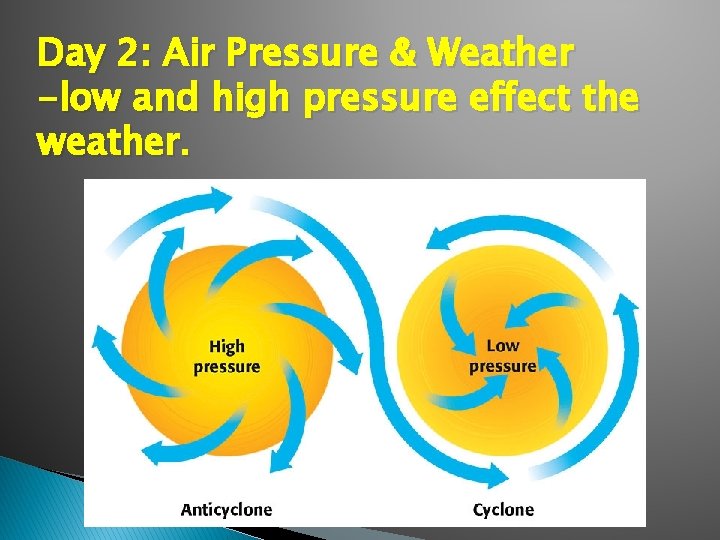
Day 2: Air Pressure & Weather -low and high pressure effect the weather.
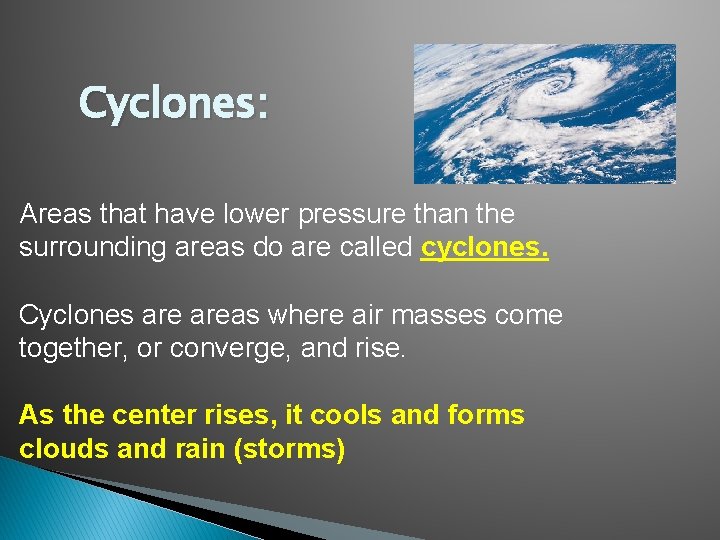
Cyclones: Areas that have lower pressure than the surrounding areas do are called cyclones. Cyclones areas where air masses come together, or converge, and rise. As the center rises, it cools and forms clouds and rain (storms)
Anticyclone • Areas that have high pressure are called anticyclones. • Anticyclones areas where air moves apart, or diverges, and sinks. The sinking air is denser than the surrounding air, and the pressure is higher. • As center air sinks, warm air absorbs moisture. This makes dry, clear weather!
Let’s Summarize Again… With your desk partner, fill out the half sheet and glue it in.
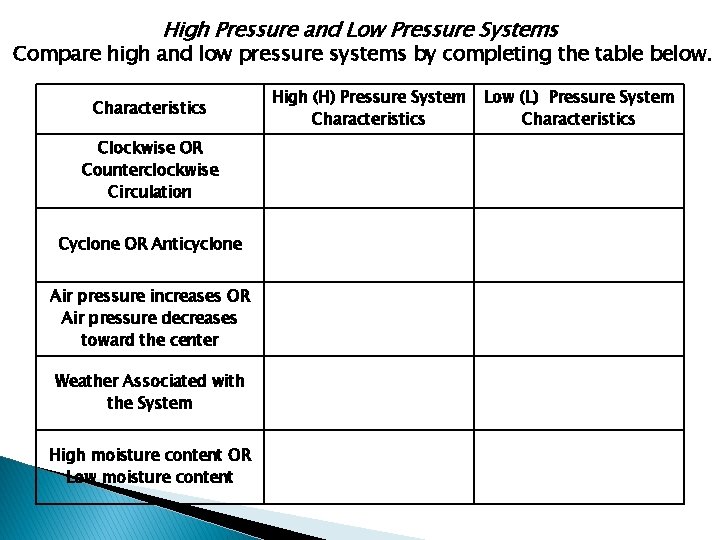
High Pressure and Low Pressure Systems Compare high and low pressure systems by completing the table below. Characteristics Clockwise OR Counterclockwise Circulation Cyclone OR Anticyclone Air pressure increases OR Air pressure decreases toward the center Weather Associated with the System High moisture content OR Low moisture content High (H) Pressure System Characteristics Low (L) Pressure System Characteristics