
Ch 16 Geology of the Oceans Origin of
- Slides: 45
Ch. 16 Geology of the Oceans
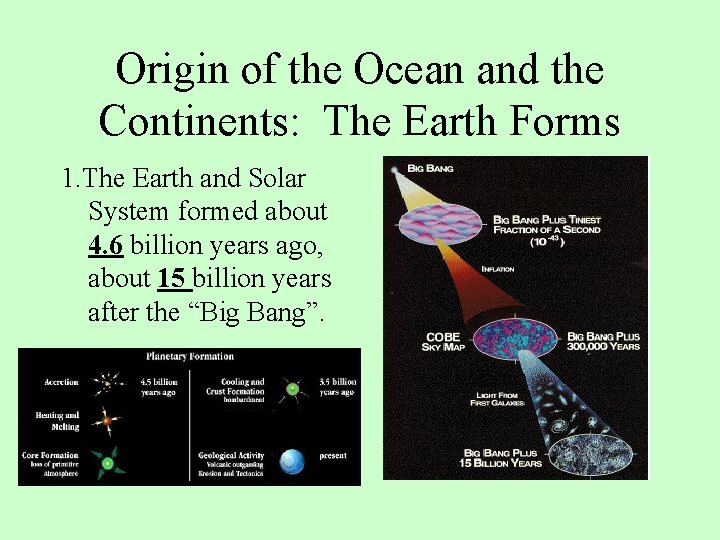
Origin of the Ocean and the Continents: The Earth Forms 1. The Earth and Solar System formed about 4. 6 billion years ago, about 15 billion years after the “Big Bang”.
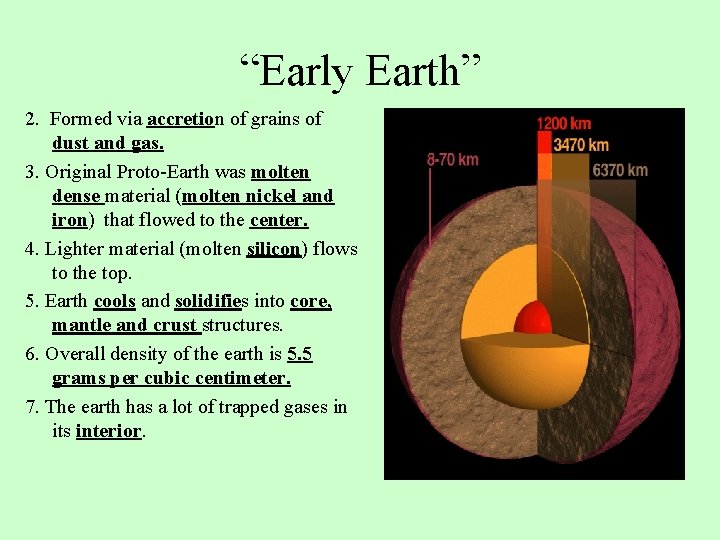
“Early Earth” 2. Formed via accretion of grains of dust and gas. 3. Original Proto-Earth was molten dense material (molten nickel and iron) that flowed to the center. 4. Lighter material (molten silicon) flows to the top. 5. Earth cools and solidifies into core, mantle and crust structures. 6. Overall density of the earth is 5. 5 grams per cubic centimeter. 7. The earth has a lot of trapped gases in its interior.
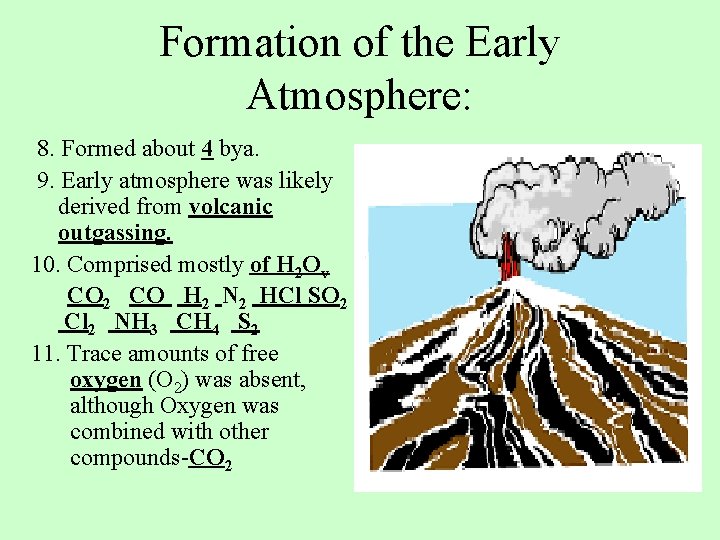
Formation of the Early Atmosphere: 8. Formed about 4 bya. 9. Early atmosphere was likely derived from volcanic outgassing. 10. Comprised mostly of H 2 Ov CO 2 CO H 2 N 2 HCl SO 2 Cl 2 NH 3 CH 4 S 2 11. Trace amounts of free oxygen (O 2) was absent, although Oxygen was combined with other compounds-CO 2
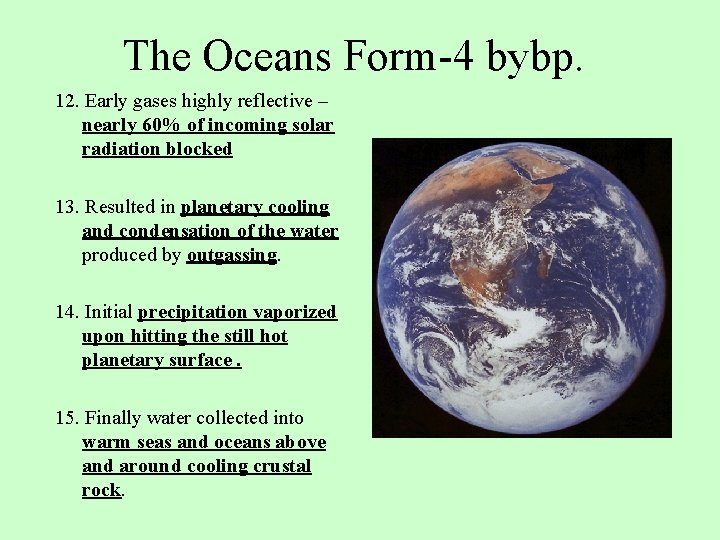
The Oceans Form-4 bybp. 12. Early gases highly reflective – nearly 60% of incoming solar radiation blocked 13. Resulted in planetary cooling and condensation of the water produced by outgassing. 14. Initial precipitation vaporized upon hitting the still hot planetary surface. 15. Finally water collected into warm seas and oceans above and around cooling crustal rock.
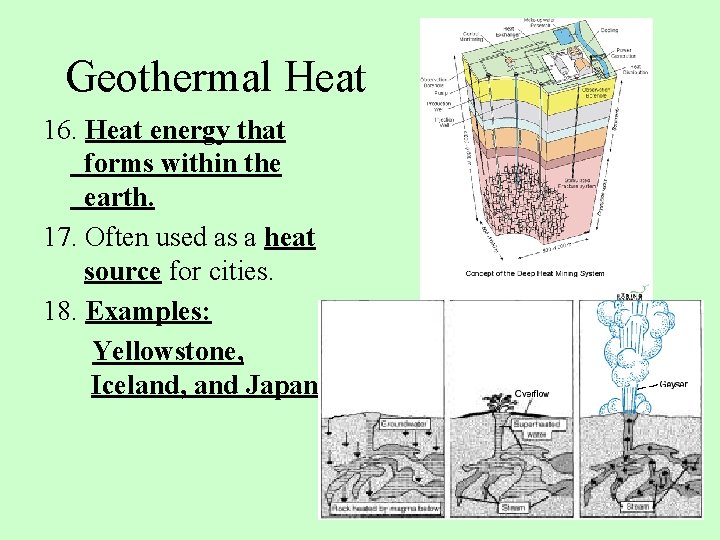
Geothermal Heat 16. Heat energy that forms within the earth. 17. Often used as a heat source for cities. 18. Examples: Yellowstone, Iceland, and Japan.
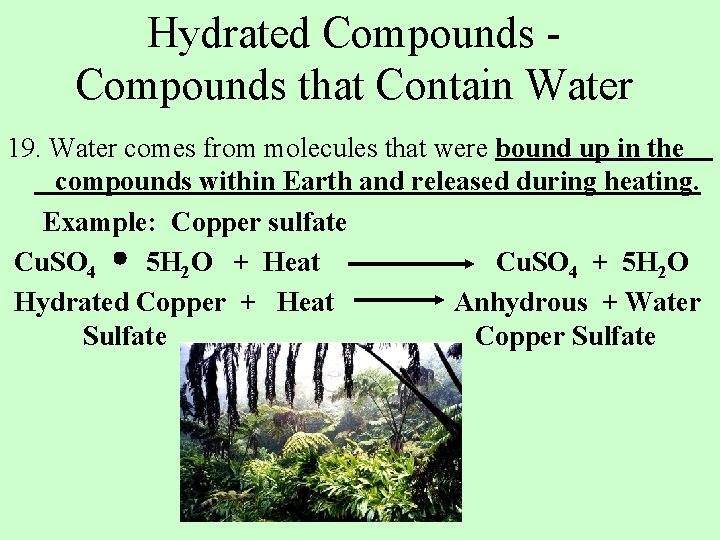
Hydrated Compounds that Contain Water 19. Water comes from molecules that were bound up in the compounds within Earth and released during heating. Example: Copper sulfate Cu. SO 4 5 H 2 O + Heat Cu. SO 4 + 5 H 2 O Hydrated Copper + Heat Anhydrous + Water Sulfate Copper Sulfate
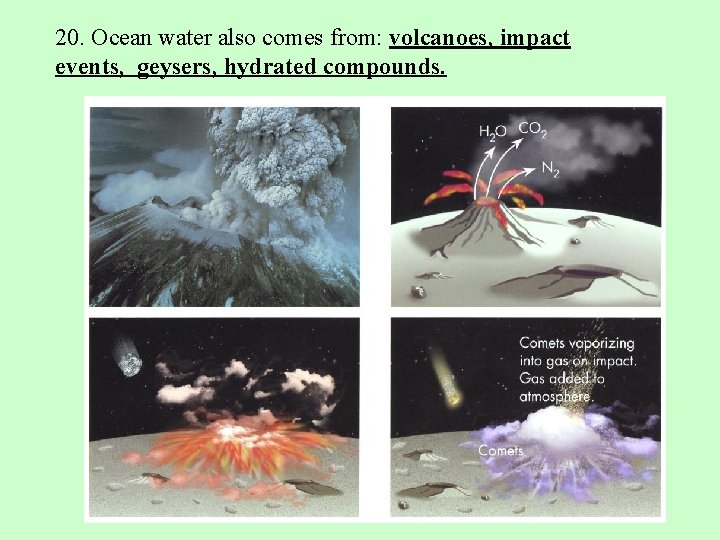
20. Ocean water also comes from: volcanoes, impact events, geysers, hydrated compounds.
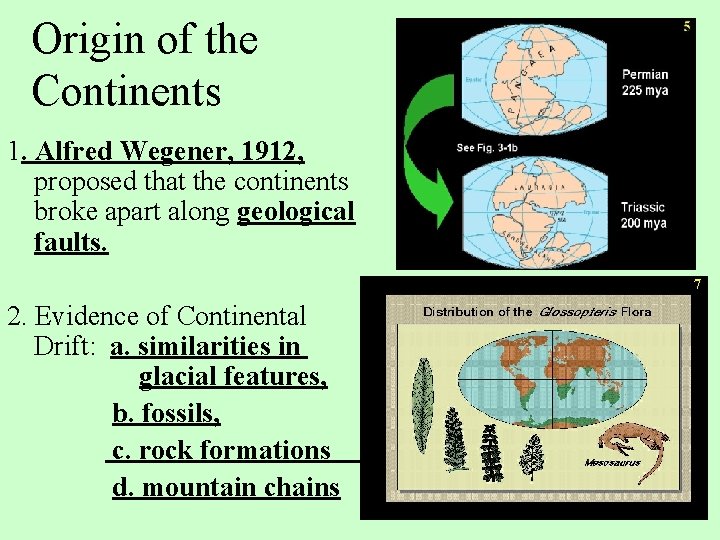
Origin of the Continents 1. Alfred Wegener, 1912, proposed that the continents broke apart along geological faults. 2. Evidence of Continental Drift: a. similarities in glacial features, b. fossils, c. rock formations d. mountain chains
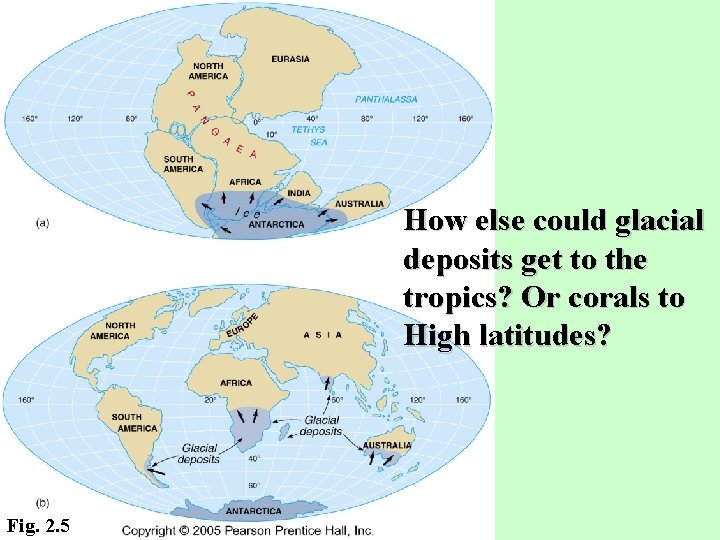
How else could glacial deposits get to the tropics? Or corals to High latitudes? Fig. 2. 5
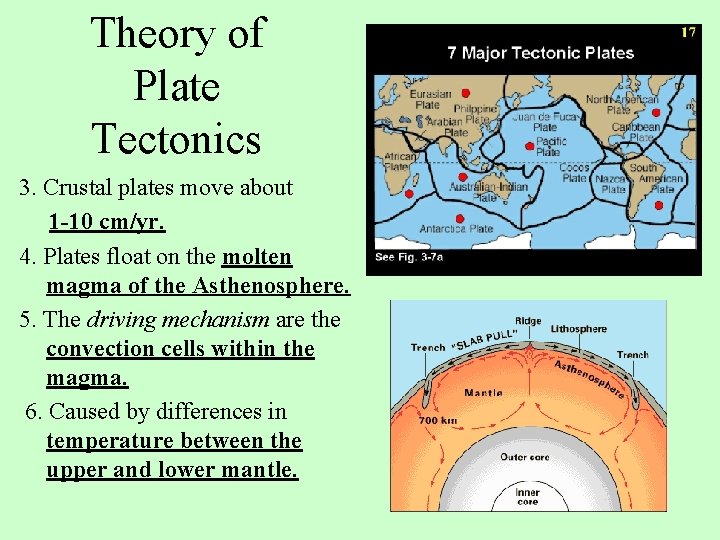
Theory of Plate Tectonics 3. Crustal plates move about 1 -10 cm/yr. 4. Plates float on the molten magma of the Asthenosphere. 5. The driving mechanism are the convection cells within the magma. 6. Caused by differences in temperature between the upper and lower mantle.
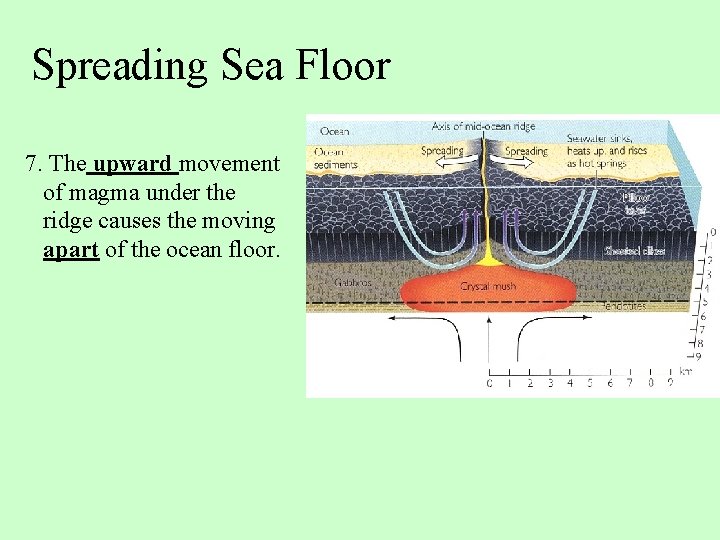
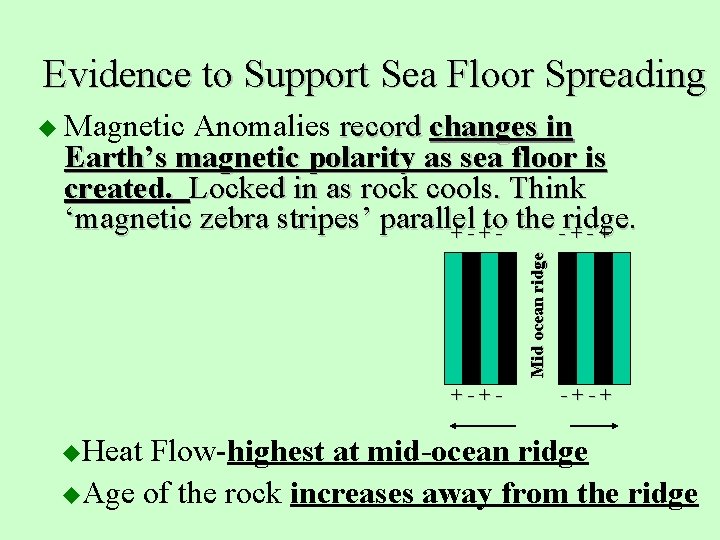
Spreading Sea Floor 7. The upward movement of magma under the ridge causes the moving apart of the ocean floor.
Evidence to Support Sea Floor Spreading Anomalies record changes in Earth’s magnetic polarity as sea floor is created. Locked in as rock cools. Think ‘magnetic zebra stripes’ parallel to the -ridge. +-++-+ Mid ocean ridge u Magnetic +-+- u. Heat -+-+ Flow-highest at mid-ocean ridge u. Age of the rock increases away from the ridge
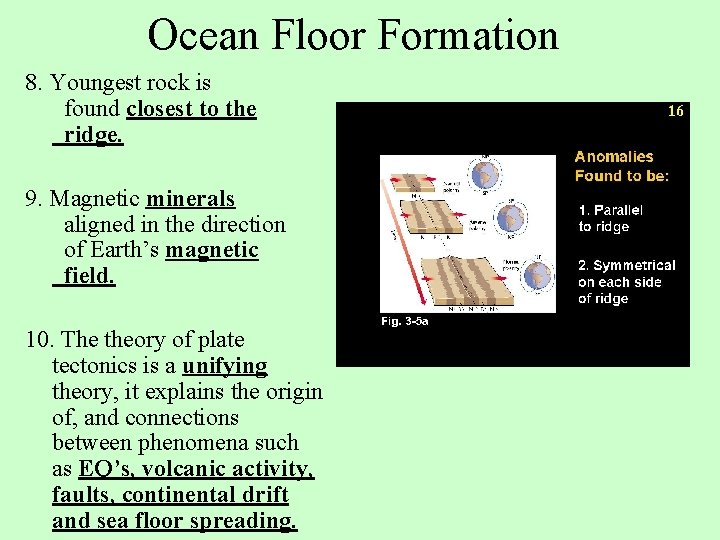
Ocean Floor Formation 8. Youngest rock is found closest to the ridge. 9. Magnetic minerals aligned in the direction of Earth’s magnetic field. 10. The theory of plate tectonics is a unifying theory, it explains the origin of, and connections between phenomena such as EQ’s, volcanic activity, faults, continental drift and sea floor spreading.
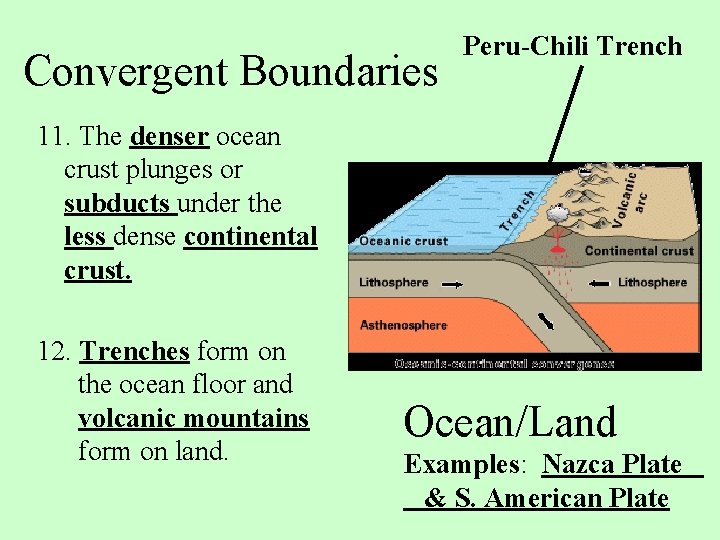
Convergent Boundaries Peru-Chili Trench 11. The denser ocean crust plunges or subducts under the less dense continental crust. 12. Trenches form on the ocean floor and volcanic mountains form on land. Ocean/Land Examples: Nazca Plate & S. American Plate
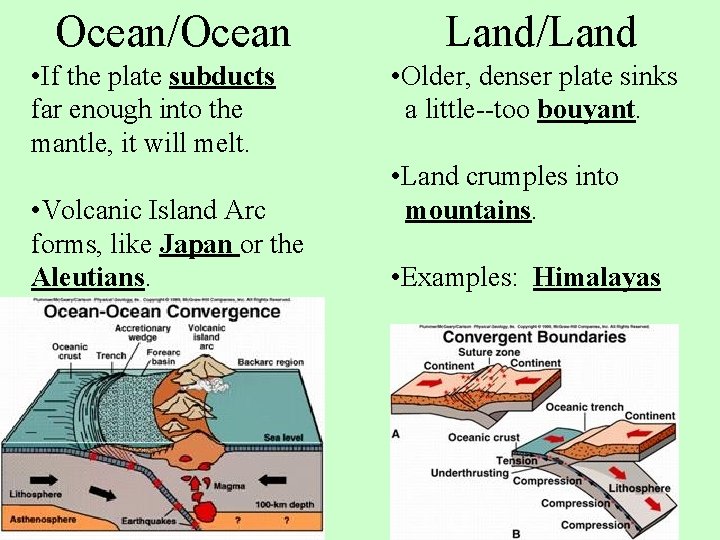
Ocean/Ocean • If the plate subducts far enough into the mantle, it will melt. • Volcanic Island Arc forms, like Japan or the Aleutians. Land/Land • Older, denser plate sinks a little--too bouyant. • Land crumples into mountains. • Examples: Himalayas
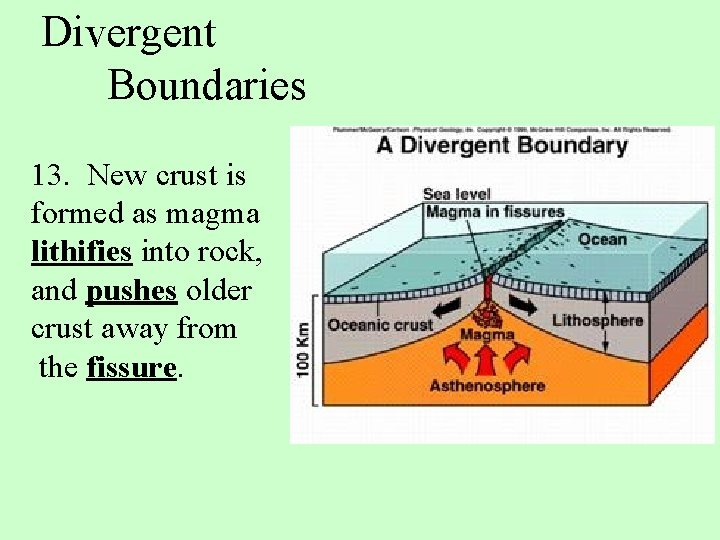
Divergent Boundaries 13. New crust is formed as magma lithifies into rock, and pushes older crust away from the fissure.
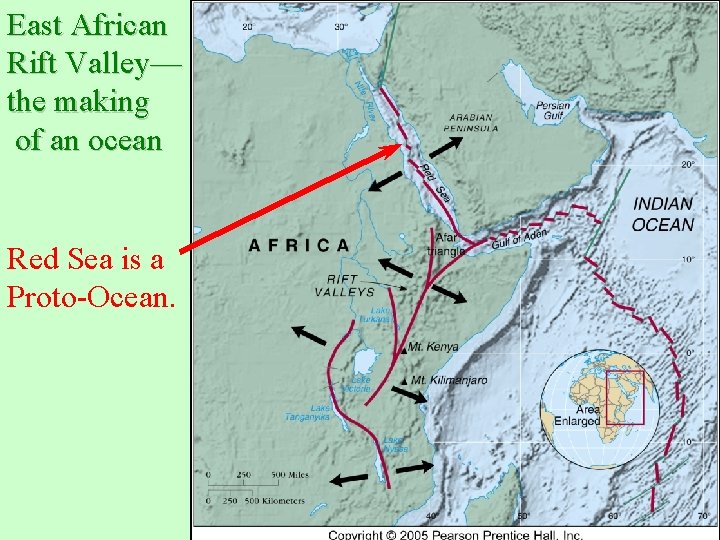
East African Rift Valley— the making of an ocean Red Sea is a Proto-Ocean.
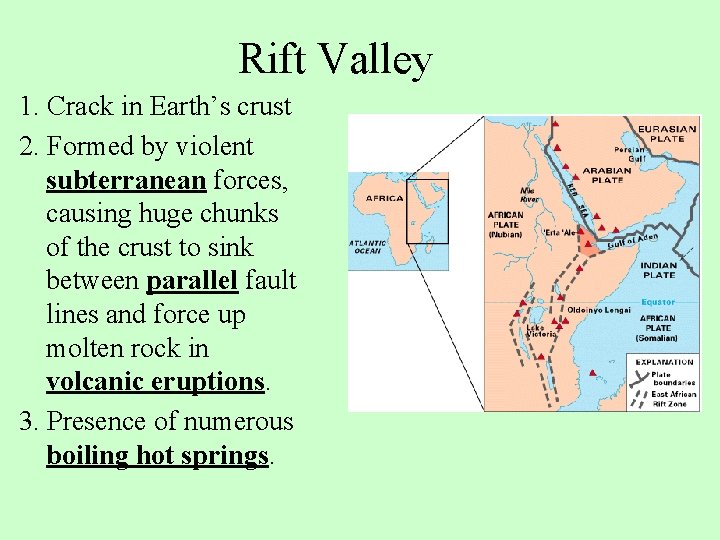
Rift Valley 1. Crack in Earth’s crust 2. Formed by violent subterranean forces, causing huge chunks of the crust to sink between parallel fault lines and force up molten rock in volcanic eruptions. 3. Presence of numerous boiling hot springs.
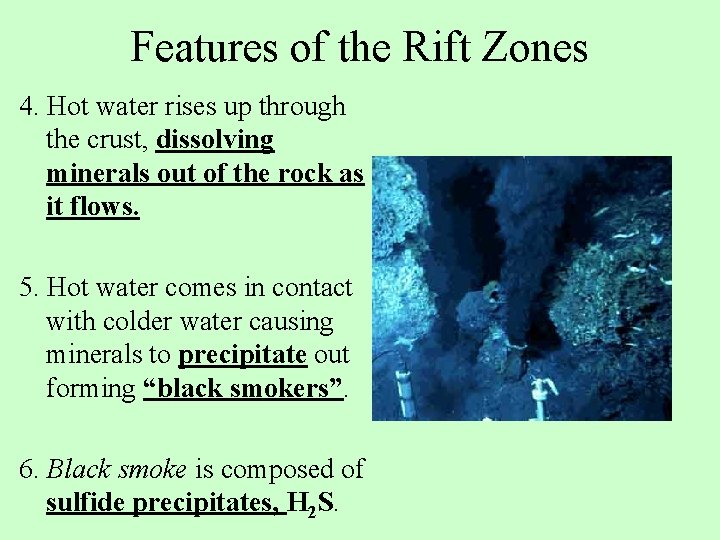
Features of the Rift Zones 4. Hot water rises up through the crust, dissolving minerals out of the rock as it flows. 5. Hot water comes in contact with colder water causing minerals to precipitate out forming “black smokers”. 6. Black smoke is composed of sulfide precipitates, H 2 S.
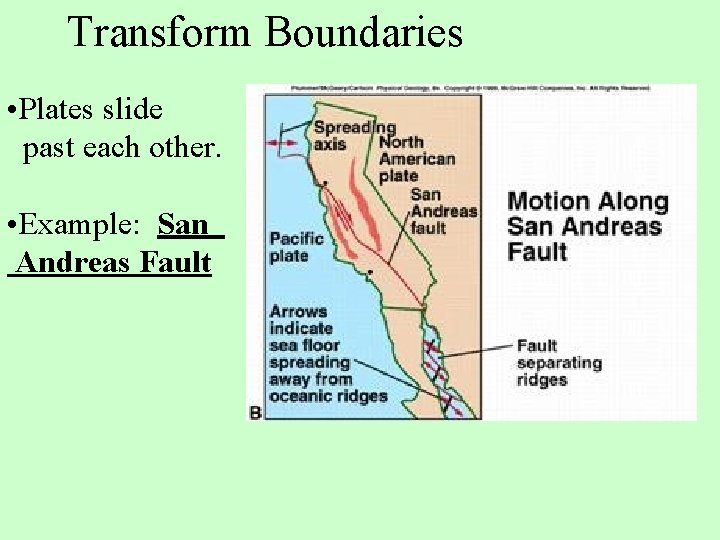
Transform Boundaries • Plates slide past each other. • Example: San Andreas Fault
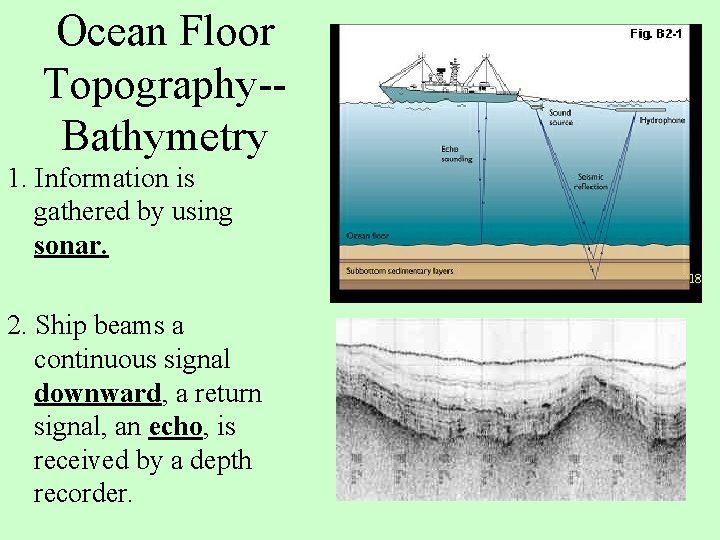
Ocean Floor Topography-Bathymetry 1. Information is gathered by using sonar. 2. Ship beams a continuous signal downward, a return signal, an echo, is received by a depth recorder.
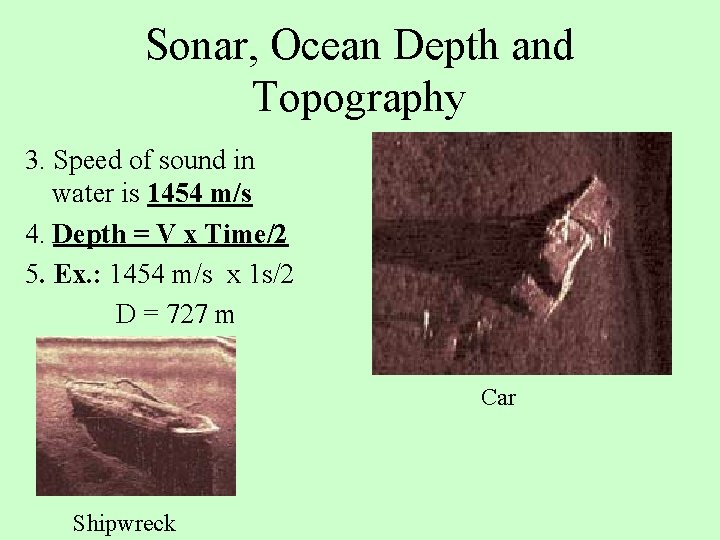
Sonar, Ocean Depth and Topography 3. Speed of sound in water is 1454 m/s 4. Depth = V x Time/2 5. Ex. : 1454 m/s x 1 s/2 D = 727 m Car Shipwreck
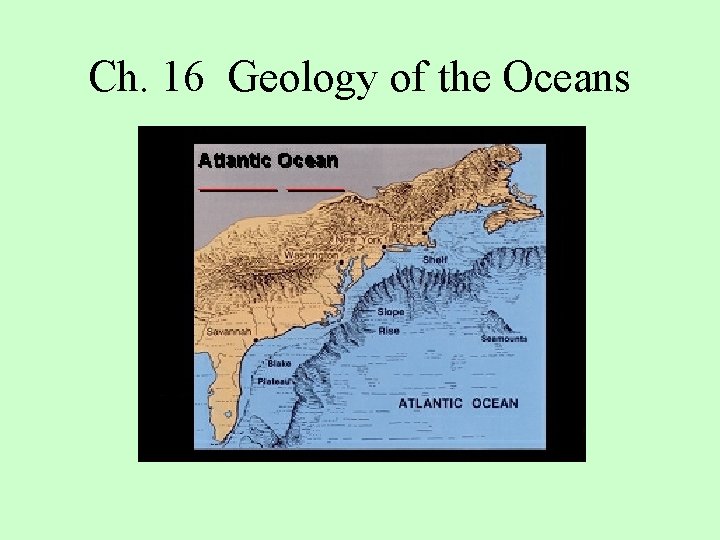
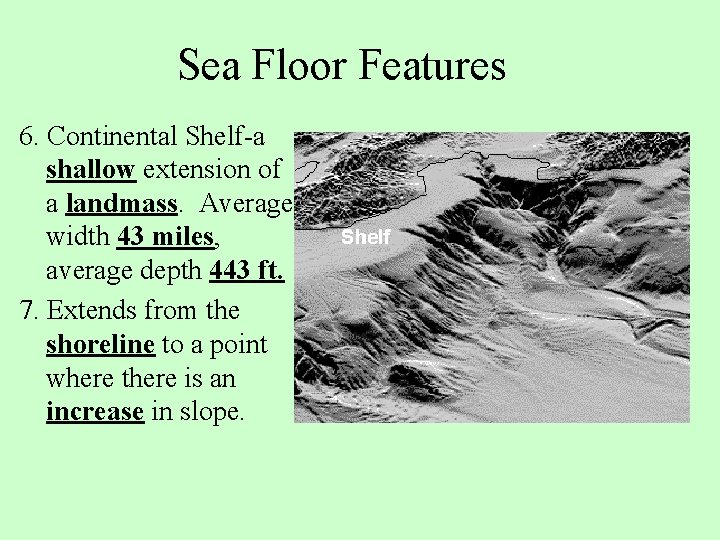
Sea Floor Features 6. Continental Shelf-a shallow extension of a landmass. Average width 43 miles, average depth 443 ft. 7. Extends from the shoreline to a point where there is an increase in slope.
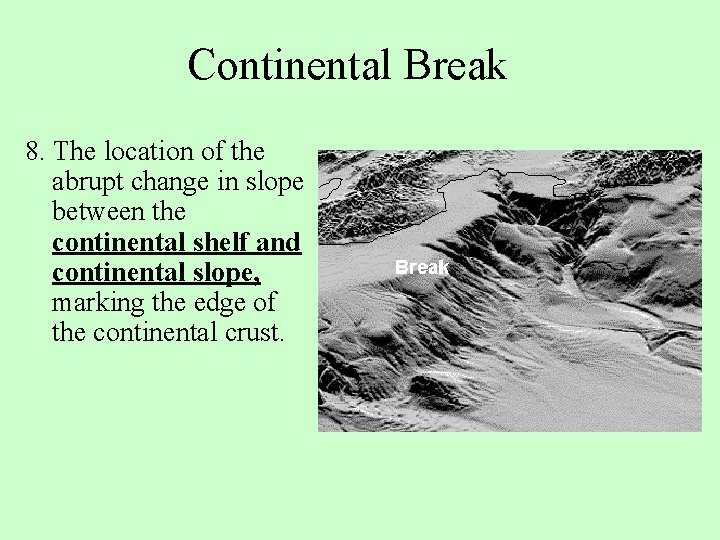
Continental Break 8. The location of the abrupt change in slope between the continental shelf and continental slope, marking the edge of the continental crust.
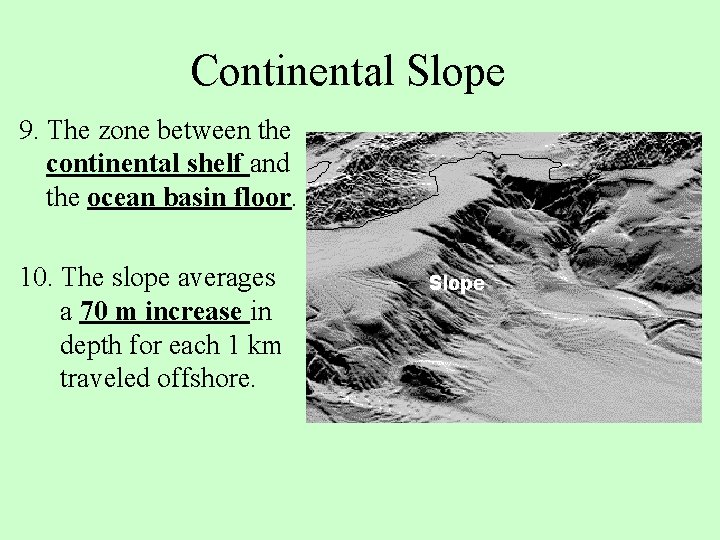
Continental Slope 9. The zone between the continental shelf and the ocean basin floor. 10. The slope averages a 70 m increase in depth for each 1 km traveled offshore.
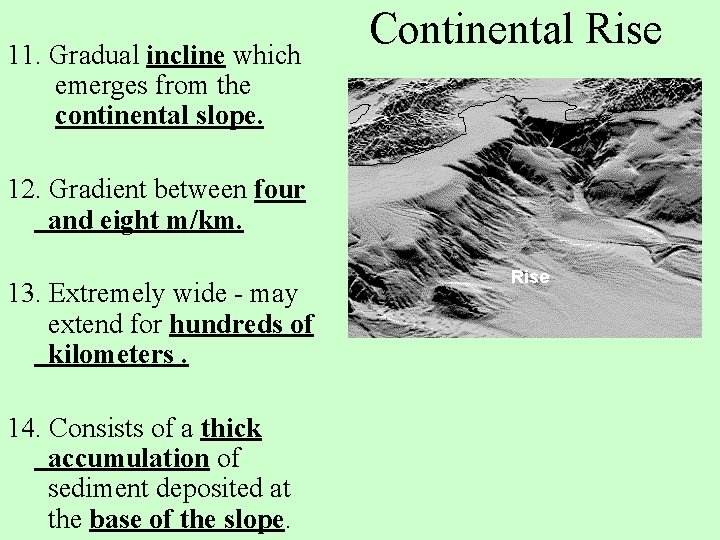
11. Gradual incline which emerges from the continental slope. 12. Gradient between four and eight m/km. 13. Extremely wide - may extend for hundreds of kilometers. 14. Consists of a thick accumulation of sediment deposited at the base of the slope. Continental Rise
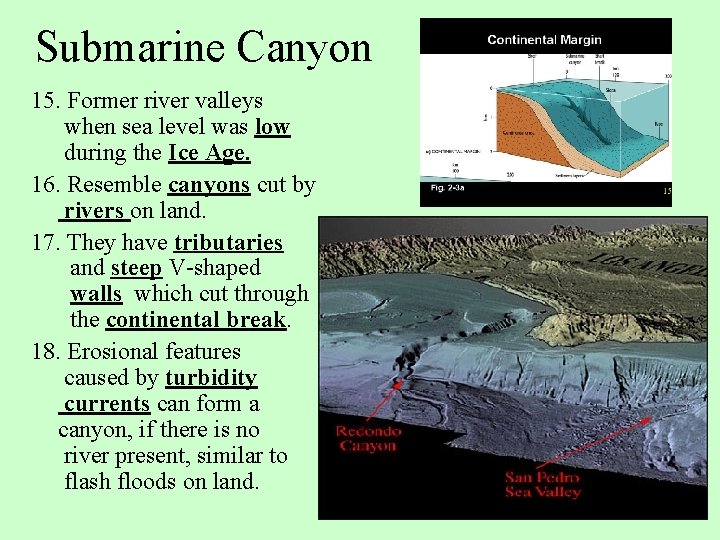
Submarine Canyon 15. Former river valleys when sea level was low during the Ice Age. 16. Resemble canyons cut by rivers on land. 17. They have tributaries and steep V-shaped walls which cut through the continental break. 18. Erosional features caused by turbidity currents can form a canyon, if there is no river present, similar to flash floods on land.
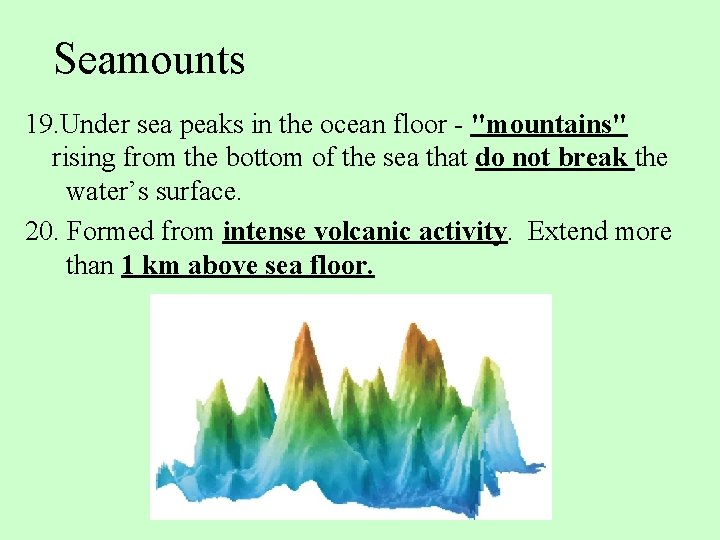
Seamounts 19. Under sea peaks in the ocean floor - "mountains" rising from the bottom of the sea that do not break the water’s surface. 20. Formed from intense volcanic activity. Extend more than 1 km above sea floor.
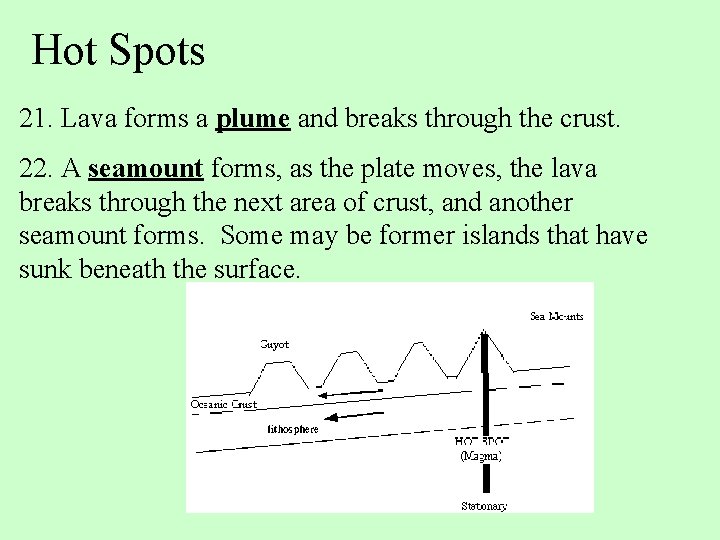
Hot Spots 21. Lava forms a plume and breaks through the crust. 22. A seamount forms, as the plate moves, the lava breaks through the next area of crust, and another seamount forms. Some may be former islands that have sunk beneath the surface.
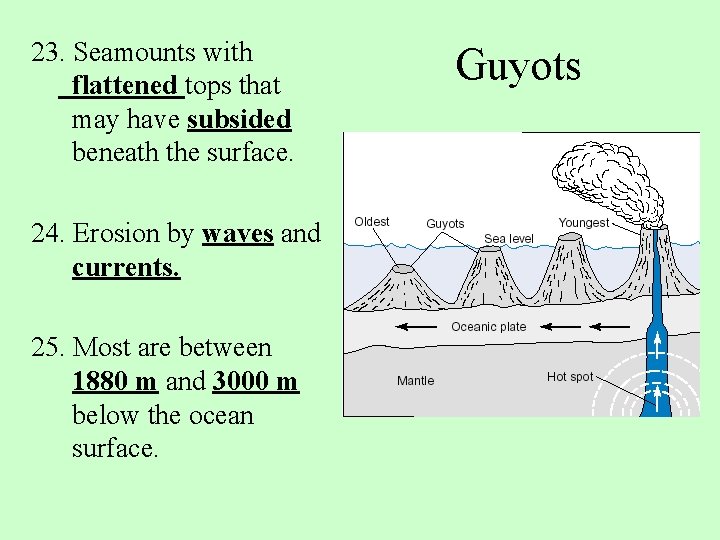
23. Seamounts with flattened tops that may have subsided beneath the surface. 24. Erosion by waves and currents. 25. Most are between 1880 m and 3000 m below the ocean surface. Guyots
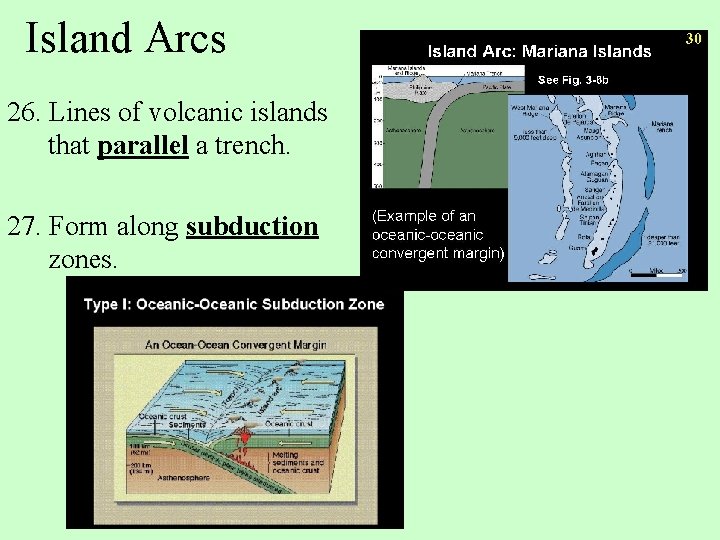
Island Arcs 26. Lines of volcanic islands that parallel a trench. 27. Form along subduction zones.
28. Active (Pacific) Margins • Considered 'destructive' • Continental margin moving toward a subduction zone • Characterized by volcanism, many earthquakes, and active mountain building • Friction of subducting plate causes earthquake activity and heat generation • Ocean crust is heated to melting point • Molten rock (magma) rises to the surface to create island arcs and volcanoes
29. Passive (Atlantic-Type) Margins: • Found on continent-bearing plates • Continental margin moving away from the mid-ocean spreading center • Not characterized by mountain building • Zone of low seismicity and no volcanism – essentially stable • Characterized by thick sediment deposits and old oceanic crust • Comprised of shelf, slope, and rise • Examples include the eastern coasts of North and South America
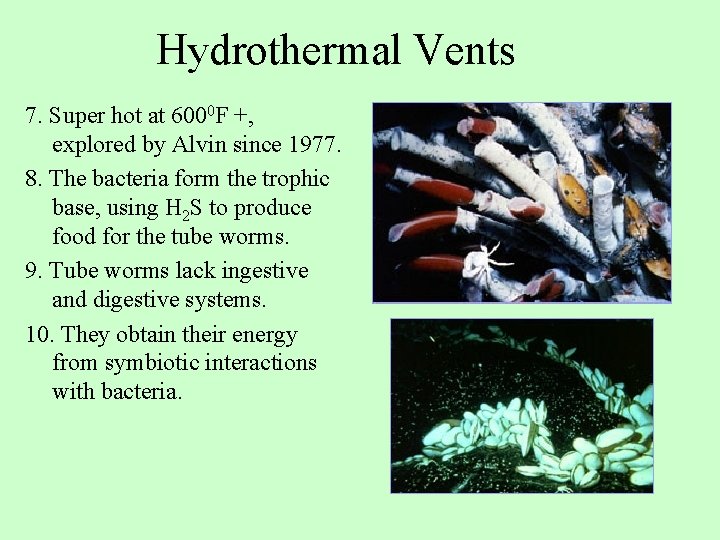
Hydrothermal Vents 7. Super hot at 6000 F +, explored by Alvin since 1977. 8. The bacteria form the trophic base, using H 2 S to produce food for the tube worms. 9. Tube worms lack ingestive and digestive systems. 10. They obtain their energy from symbiotic interactions with bacteria.
Photosynthesis & Chemosynthesis 11. Manufacture of simple carbohydrates by plants in the presence of chlorophyll and sunlight. 12. . Manufacture of food by bacteria using H 2 S in the absence of sunlight and chlorophyll. 13. Organisms derive their energy from chemicals.
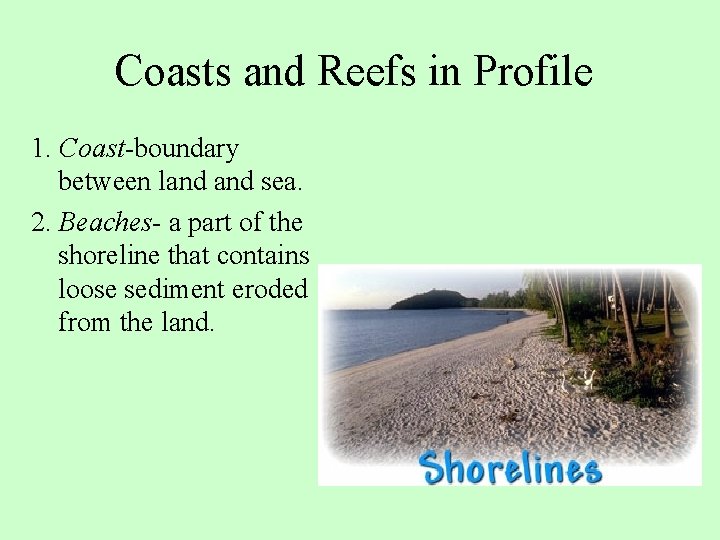
Coasts and Reefs in Profile 1. Coast-boundary between land sea. 2. Beaches- a part of the shoreline that contains loose sediment eroded from the land.
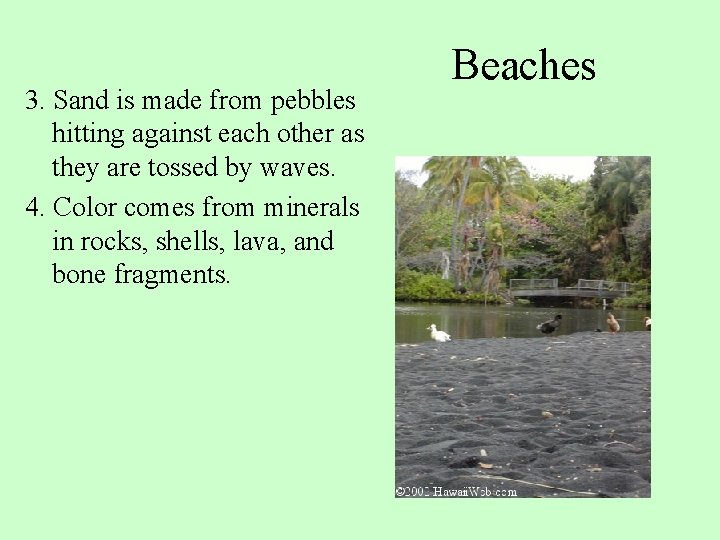
3. Sand is made from pebbles hitting against each other as they are tossed by waves. 4. Color comes from minerals in rocks, shells, lava, and bone fragments. Beaches
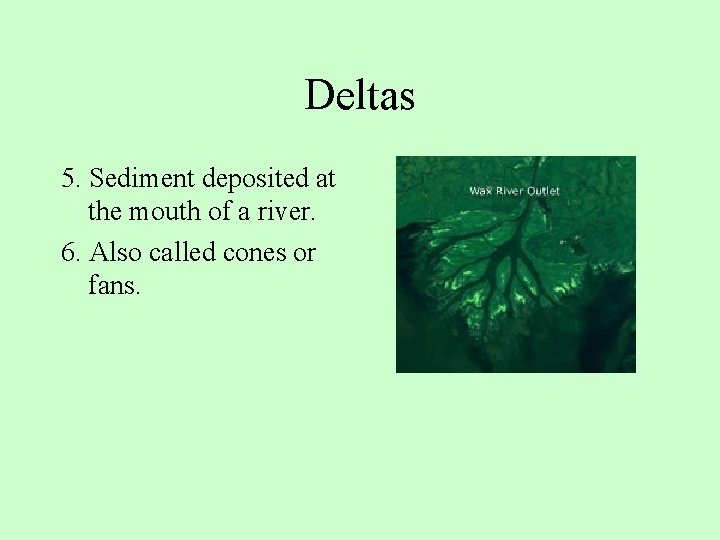
Deltas 5. Sediment deposited at the mouth of a river. 6. Also called cones or fans.
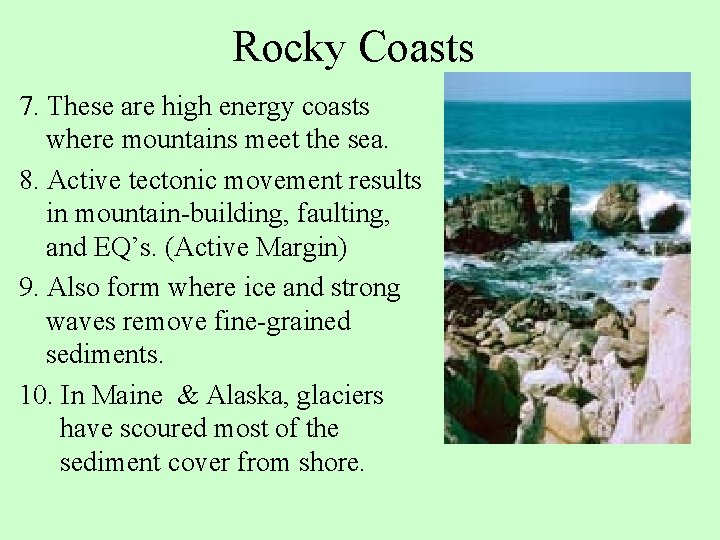
Rocky Coasts 7. These are high energy coasts where mountains meet the sea. 8. Active tectonic movement results in mountain-building, faulting, and EQ’s. (Active Margin) 9. Also form where ice and strong waves remove fine-grained sediments. 10. In Maine & Alaska, glaciers have scoured most of the sediment cover from shore.
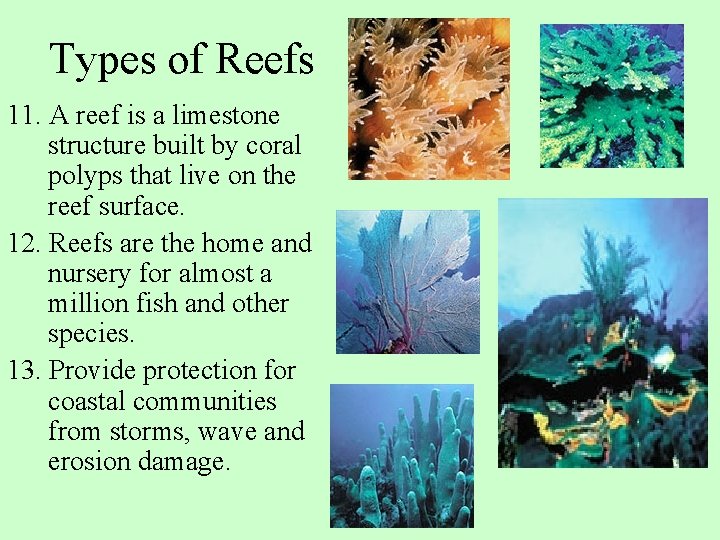
Types of Reefs 11. A reef is a limestone structure built by coral polyps that live on the reef surface. 12. Reefs are the home and nursery for almost a million fish and other species. 13. Provide protection for coastal communities from storms, wave and erosion damage.
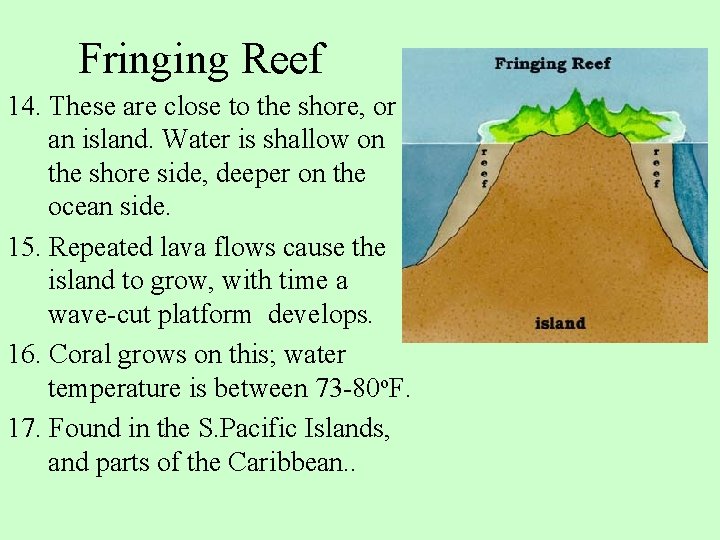
Fringing Reef 14. These are close to the shore, or an island. Water is shallow on the shore side, deeper on the ocean side. 15. Repeated lava flows cause the island to grow, with time a wave-cut platform develops. 16. Coral grows on this; water temperature is between 73 -80 o. F. 17. Found in the S. Pacific Islands, and parts of the Caribbean. .
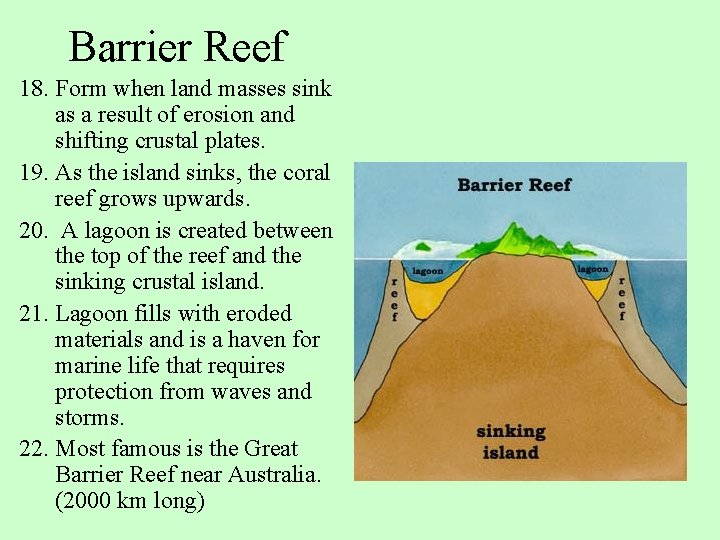
Barrier Reef 18. Form when land masses sink as a result of erosion and shifting crustal plates. 19. As the island sinks, the coral reef grows upwards. 20. A lagoon is created between the top of the reef and the sinking crustal island. 21. Lagoon fills with eroded materials and is a haven for marine life that requires protection from waves and storms. 22. Most famous is the Great Barrier Reef near Australia. (2000 km long)
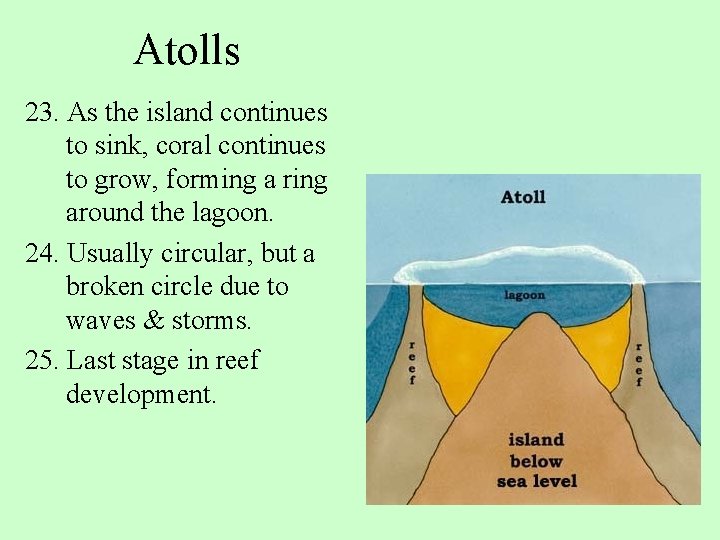
Atolls 23. As the island continues to sink, coral continues to grow, forming a ring around the lagoon. 24. Usually circular, but a broken circle due to waves & storms. 25. Last stage in reef development.
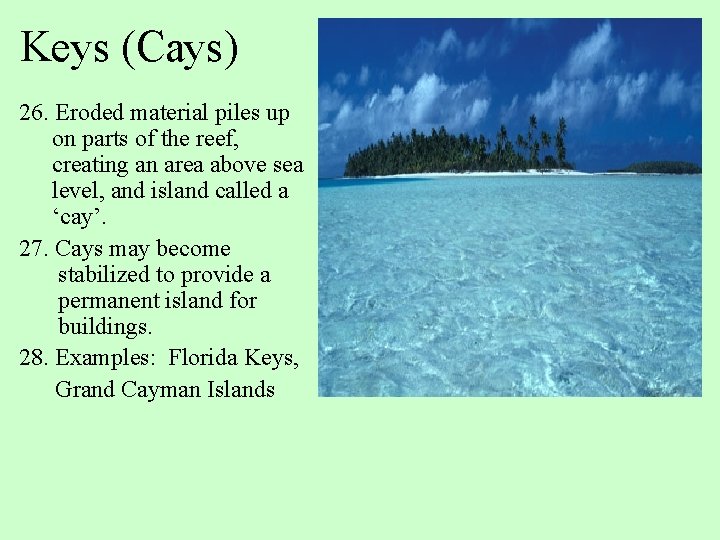
Keys (Cays) 26. Eroded material piles up on parts of the reef, creating an area above sea level, and island called a ‘cay’. 27. Cays may become stabilized to provide a permanent island for buildings. 28. Examples: Florida Keys, Grand Cayman Islands