
Ch 16 Ecosystems Ch 17 Biological Community Biology
Ch. 16: Ecosystems Ch. 17: Biological Community Biology Spring 2011 E. Baker
§ Ecology-the study of the relationship b/t organisms and their environment. § Environment-anything that affects an organism during its lifetime. 2 Types of Environmental Influences: 1)Biotic factors-living things 2)Abiotic factors-nonliving influences Ex: water, air, minerals, inorganic compounds, soil conditions, sunlight, wind. § Ecosystem-interacting collection of organisms and the abiotic factors that affect them.
Succession § Climax community-a relatively stable long lasting community. § Succession-process of changing from one type of community to another. § Sere (successional stage or successional community)-each intermediate stage leading to the climax community.
2 Types of Succession 1) 2) Primary succession-community of plants and animals develop where none had existed before. Pioneer species (small plants with short life cycles) colonize a barren habitat. Succession Rate 100 -200 yrs. and up to 1, 000 yrs in harsh conditions Ex: new volcanic island, retreat of a glacier Secondary succession-community of organisms is disturbed by natural or human related event. Ex: hurricane, windfall, volcano, fire, earthquake, forest harvest, farming. Takes about 200 yrs. No need to develop a soil layer, it is already there.
Flow of Energy ) Producers-green plants that manufacture their own food in the presence of sunlight. Ex: clover, alfalfa, trees, grass, flowers, bushes. They are also autotrophs (self feeders) 1 2) Consumers-feed on producers. They are also heterotrophs. a. Herbivores-feed on plants Ex. Deer, rabbit, cattle b. Carnivores-animals that feed on other animals Ex. Wolves, tigers, sharks c. Omnivores-feed on plants & animals Ex. Humans, bears d. Detritivores-organisms that obtain their energy from the organic wastes & dead bodies that are produced at all trophic levels. Also known as decomposers. Ex. Bacteria, fungi, certain insects
§ Trophic levels-feeding levels which are steps or stages in the flow of energy through an ecosystem. § Food chain-series of trophic levels through which energy is transferred. § Food web-interrelated series of food chains. § Community-collection of interacting organism within an ecosystem § Population-number of individuals of a particular species in an area.
Trophic Levels § 1 st Level – Producers (autotrophs) green plants Consumers are divided into several categories depending on how they fit into the flow of energy through the system. § 2 nd Level – Herbivores (primary consumers) Carnivores are secondary consumers that fall into 2 categories depending on what animals they eat. § 3 rd Level – Primary Carnivores (feed on herbivores) § 4 th Level – Secondary carnivores (feed on primary carnivores) See pg. 348 Fig. 9
§ Each time energy passes from 1 trophic level to the next, about 90% of the energy is lost from the ecosystem. § As energy is converted from one form to another, some energy is lost as useless heat energy (2 nd Law of Thermodynamics)
§ Biogeochemical cycle-a pathway that forms when substances enter living organisms such as trees from the atmosphere, water or soil; stays for a time in the living organism; then returns to the nonliving environment.
Ecosystems Cycle Materials I. Water Cycle – Water can fall as precipitation & either evaporates from bodies of water, is stored as ground water, or cycles through plants & evaporates through transpiration. Water has the greatest influence on an ecosystem’s inhabitants. II. Carbon Cycle – Carbon enters the living portion of the carbon cycle through photosynthesis. Organisms release carbon through cellular respiration. Carbon trapped in rocks & fossil fuels is released by erosion and also burning in a process called combustion.
§ Phosphorus and Nitrogen are used by organisms to build proteins and nucleic acids. Phosphorus is an essential part of ATP and DNA.
III. IV. Nitrogen cycle – Bacteria fix atmospheric nitrogen into a usable form of ammonia, thus making ammonia available to other organisms. Phosphorus cycle – Cycled through plants into animals. Phosphorus is present in soil and rock as calcium phosphate which dissolves in water to form phosphorus ions. This is absorbed by the roots of plants and used to build molecules. Animals eat plants and reuse organic phosphorus.
Ch. 17: Biological Communities § Habitat-where an organism lives; the place or part of the ecosystem occupied by the organism. § Niche-organism’s functional role in the community (occupation).
Interaction among Species 1)Predation-one organism eats the other organism. Predator-one that kills Prey-one that is killed 2)Competition-2 or more species are competing for factors in their environment Ex. Fox-Weasel-competing for same food supply, Plants-Weeds-competing for same requirements
Symbiosis- “living together”; close relationship b/t 2 different kinds of organisms 1) 2) 3) 3 Types of Symbiotic Relationships Parasitism-1 organism lives at the expense of another organism Ex. fleas-dogs, cats-rats Commensalism-1 organism benefits while the other is not affected by the relationship Ex. Sharks-remoras, epiphytes-trees Mutualism-both species must have the other in order to exist; obligatory relationship Ex. flowering plants-bees
Marine Communities Nearly ¾ of the Earth’s surface is covered by the ocean. This marine environment consists of 3 major kinds of habitats: • Shallow ocean waters • Open sea surfaces • Deep sea waters
3 Zones of a Freshwater community 1) Littoral zone - shallow zone near shore 2) Limnetic zone – farther away from shore but close to the surface 3) Profundal zone – deeper water zone that is below the limits of effective light penetration
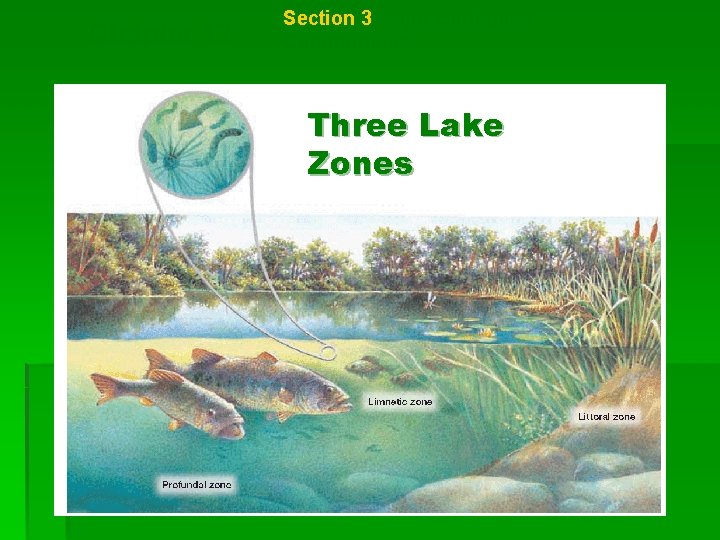
Chapter 17 Section 3 Major Biological Communities Three Lake Zones
- Slides: 18