
Ch 16 Americas Gilded Age 1870 1890 VERTICAL


- Slides: 40
Ch. 16: America's Gilded Age, 1870 -1890 VERTICAL INTEGRATION ROBBER BARONS DAWES ACT GHOST DANCE THE GILDED AGE CIVIL SERVICE ACT OF 1883 INTERSTATE COMMERCE COMMISSION SHERMAN ANTITRUST ACT SOCIAL DARWINISM GREAT RAILROAD STRIKE KNIGHTS OF LABOR SOCIAL GOSPEL
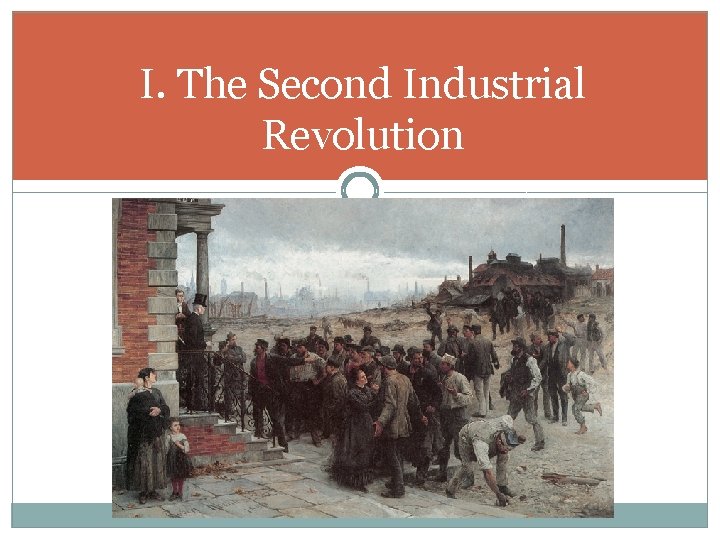
I. The Second Industrial Revolution
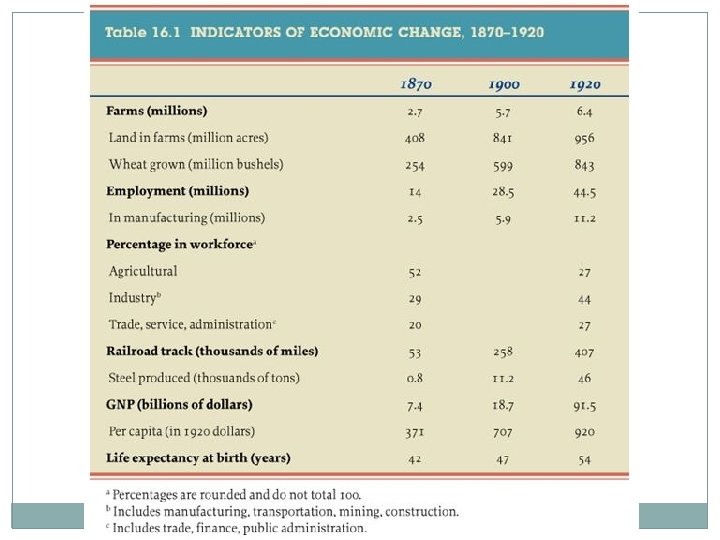
A. The Industrial Economy �By 1913, the United States produced one-third of the world's industrial output. �The 1880 census showed for the first time that a majority of the workforce engaged in non-farming jobs. �The growth of cities was vital for financing industrialization. Great Lakes region Pittsburgh Chicago
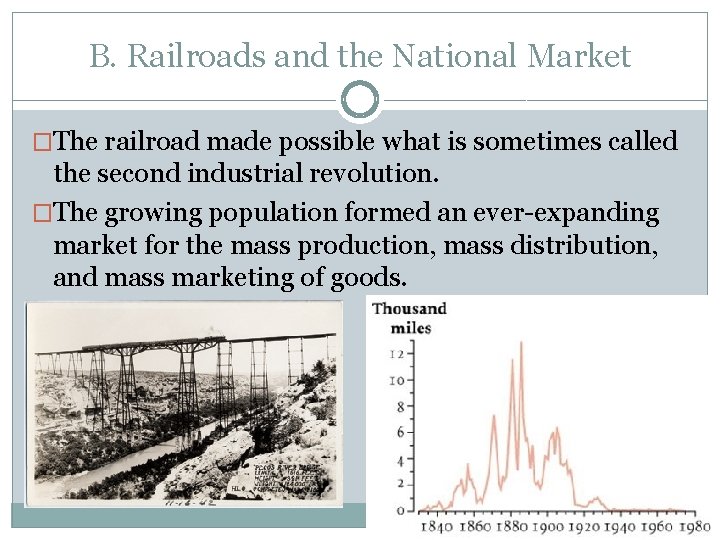
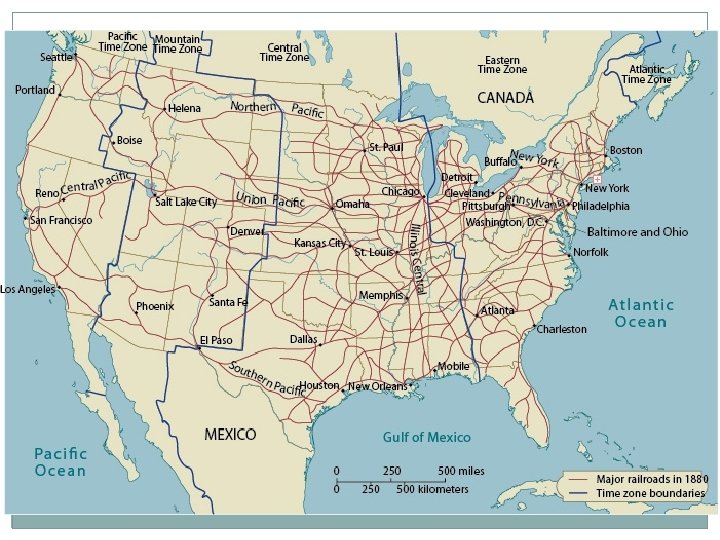
B. Railroads and the National Market �The railroad made possible what is sometimes called the second industrial revolution. �The growing population formed an ever-expanding market for the mass production, mass distribution, and mass marketing of goods.
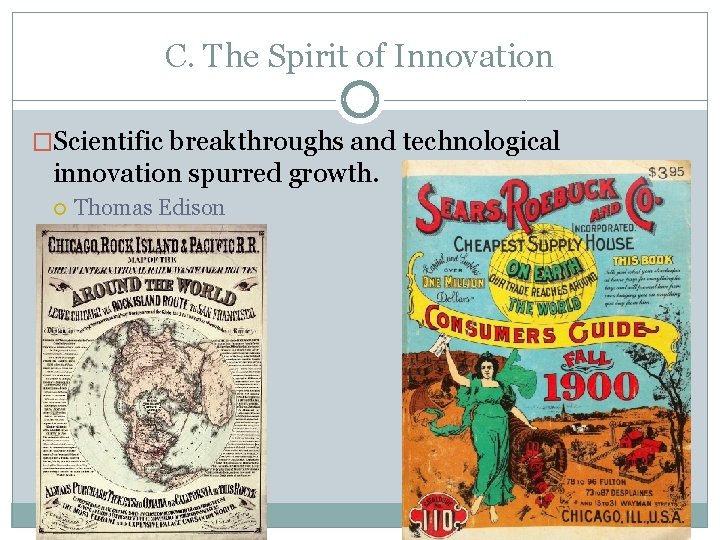
C. The Spirit of Innovation �Scientific breakthroughs and technological innovation spurred growth. Thomas Edison
D. Competition and Consolidation �The economy suffered prolonged downturns between 1873 and 1897. �Businesses engaged in ruthless competition. �To avoid cutthroat competition, more and more corporations battled to control entire industries. Between 1897 and 1904, 4, 000 firms vanished into larger corporations.
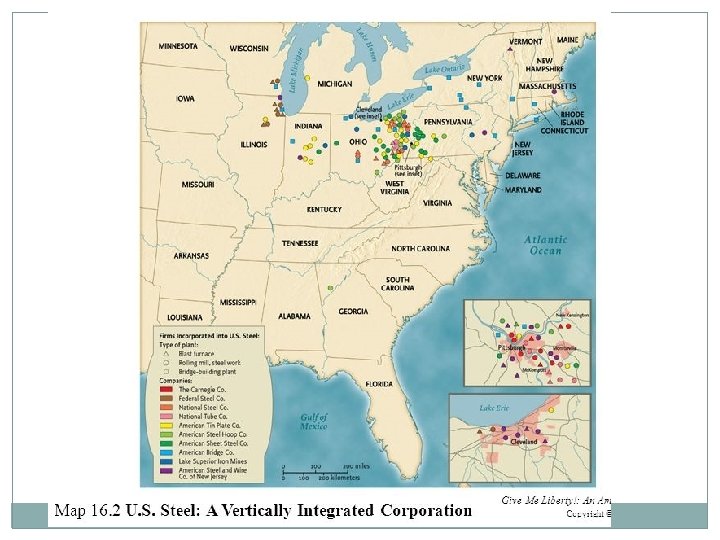
E. The Rise of Andrew Carnegie �The railroad pioneered modern techniques of business organization. �By the 1890 s, Carnegie dominated the steel industry. Vertical integration: controlled every phase of the business, from raw materials to transportation, manufacturing, and distribution. �Carnegie's life reflected his desire to succeed and his desire to give back to society. But he ran his factories non-stop: two twelve-hour shifts everyday of the year except the 4 th of July.
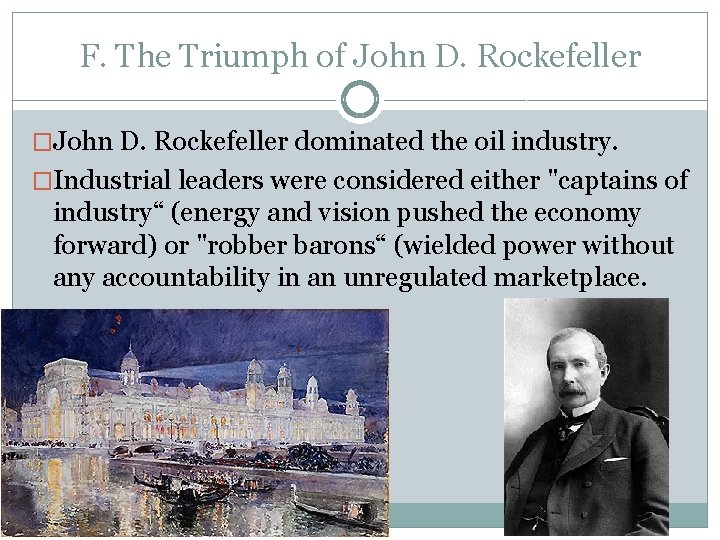
F. The Triumph of John D. Rockefeller �John D. Rockefeller dominated the oil industry. �Industrial leaders were considered either "captains of industry“ (energy and vision pushed the economy forward) or "robber barons“ (wielded power without any accountability in an unregulated marketplace.
G. Workers’ Freedom in an Industrial Age �For a minority of workers, the rapidly expanding industrial system created new forms of freedom. �For most workers, economic insecurity remained a basic fact of life. �Between 1880 and 1900, an average of 35, 000 workers perished each year in factory and mine accidents, the highest rate in the industrial world. �Class divisions became more and more visible. �Many of the wealthiest Americans consciously pursued an aristocratic lifestyle. Thorstein Veblen on conspicuous consumption �The working class lived in desperate conditions.
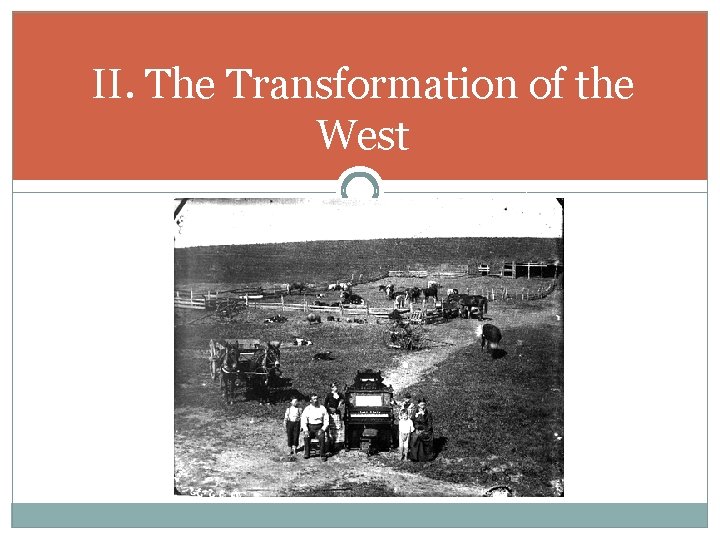
II. The Transformation of the West
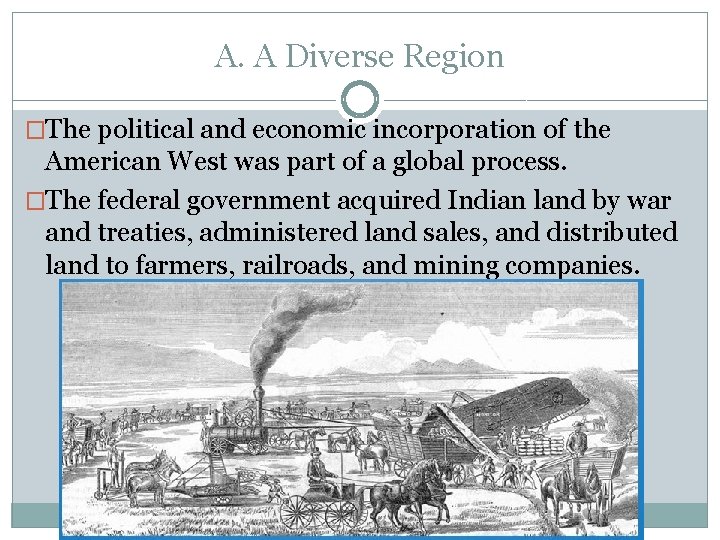
A. A Diverse Region �The political and economic incorporation of the American West was part of a global process. �The federal government acquired Indian land by war and treaties, administered land sales, and distributed land to farmers, railroads, and mining companies.
B. Farming in the Trans-Mississippi West �More land came into cultivation during the thirty years after the Civil War than during the previous two-and-a-half centuries of American history. �Farming was difficult and much of the burden fell to women. �As crop production increased, prices fell and small farmers throughout the world suffered severe difficulties during the last quarter of the nineteenth century. �The future of western farming ultimately lay with giant agricultural enterprises, as seen in California.
An Arizona’s Woman’s Morning Chores �“Get up, turn out my chickens, draw a pail of water…make a fire, put potatoes to cook, brush and sweep half inch of dust off floor, feed three litters of chickens, then mix biscuits, get breakfast, milk, besides work in the house, and this morning had to go half a mile after calves. ”
C. The Cowboy and the Corporate West �Cowboys became symbols of a life of freedom on the open range. �By the mid-1880 s, farmers enclosed more of the open range and moved cattle operations close to rail connections. �Many western industries fell under the sway of companies that mobilized eastern and European investment in order to introduce advanced technology.
D. The Subjugation of the Plains Indians �The incorporation of the West into the national economy spelled the doom of the Plains Indians and their world. �As settlers encroached on Indian lands, bloody conflict between the army and Plains tribes began in the 1850 s and continued for decades. �Numbering 30 million in 1800, buffalo were nearly extinct due to hunting and army campaigns by 1890.
E. “Let Me Be a Free Man” �The Nez Percé were chased over 1, 700 miles before surrendering in 1877. �Chief Joseph spoke of freedom before a distinguished audience in 1879. �Defending their land, Sioux and Cheyenne warriors attacked Custer at Little Big Horn. �Indian resistance only temporarily delayed the onward march of white soldiers, settlers, and prospectors.
Chief Joseph’s Speech �“Treat all men alike. Give them the same law…Let me be a free man—free to travel, free to stop, free to work, free to trade where I choose, free to choose my own teachers, free to follow the religion of my fathers, free to think and talk and act for myself—and I will obey every law, or submit to the penalty. ”
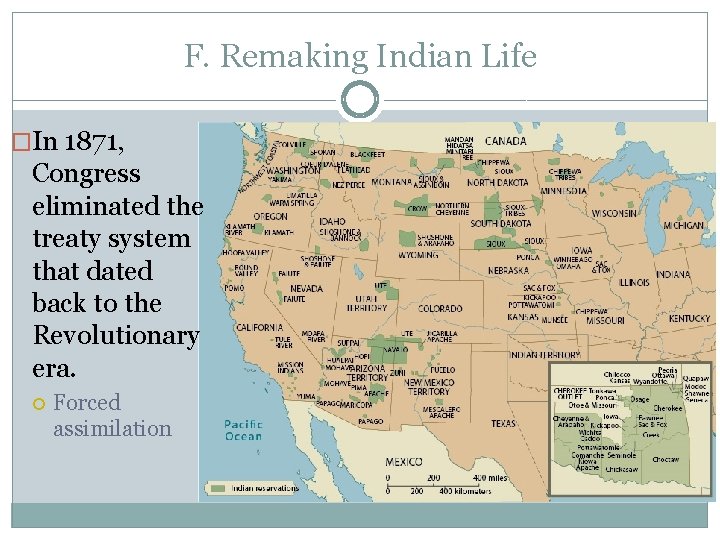
F. Remaking Indian Life �In 1871, Congress eliminated the treaty system that dated back to the Revolutionary era. Forced assimilation
G. The Dawes Act and Wounded Knee �The crucial step in attacking tribalism came in 1887, with the passage of the Dawes Act. The policy proved to be a disaster for the Indians. They lost 86 million of the 138 million acres in their possession in 1887. �Some Indians sought solace in the Ghost Dance, a religious revitalization campaign reminiscent of the pan-Indian movements. �On December 29, 1890, soldiers opened fire on Ghost Dancers encamped on Wounded Knee Creek in South Dakota, killing between 150 and 200 Indians, mostly women and children.
H. Settler Societies and Global Wests �The conquest of the American West was part of a global process. �Countries like Argentina, Australia, Canada, and New Zealand, as well as the United States, are often called "settler societies, " because immigrants from overseas quickly outnumbered and displaced the original inhabitants.
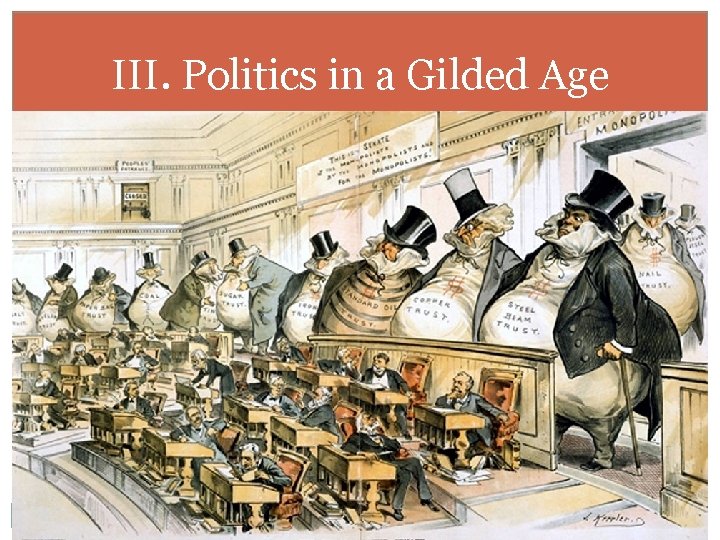
III. Politics in a Gilded Age
A. The Corruption of Politics �Americans during the Gilded Age saw their nation as an island of political democracy in a world still dominated by undemocratic governments. �Political corruption was rife. �Urban politics fell under the sway of corrupt political machines. Boss Tweed �Corruption was at the national level too. Crédit Mobilier
B. The Politics of Dead Center �Every Republican candidate for president from 1868 to 1900 had fought in the Union army. Union soldiers' pensions �Democrats dominated the southern and Catholic votes. �The parties were closely divided and national elections very close. �Gilded Age presidents made little effort to mobilize public opinion or to exert executive leadership. �In some ways, American democracy in the Gilded Age seemed remarkably healthy.
C. Government and the Economy �The nation's political structure proved ill-equipped to deal with the problems created by the economy's rapid growth. Tariff policy debated Return to gold standard in 1879 �Republican economic policies strongly favored the interests of eastern industrialists and bankers.
D. Reform Legislation �The Civil Service Act of 1883 created a merit system for federal employees. �Congress established the Interstate Commerce Commission (ICC) in 1887. �The Sherman Antitrust Act, passed in 1890, banned practices that restrained free trade.
E. Political Conflict in the States �State governments expanded their responsibilities to the public. �Third parties enjoyed significant (if short-lived) success in local elections. The Greenback-Labor Party �Farmers responded to railroad policies by organizing the Grange. More than 700 k members by mid-1870 s. Called on state governments to establish fair freight rates and warehouse charges. �Some states passed eight-hour-day laws.
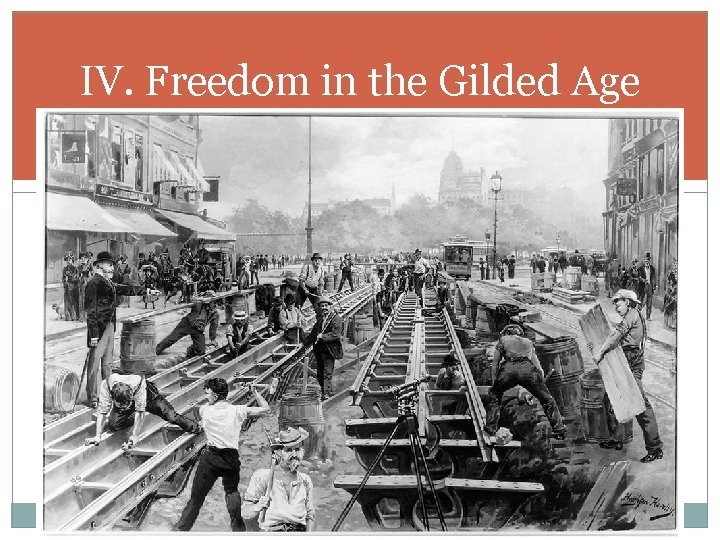
IV. Freedom in the Gilded Age
A. The Social Problem �As the United States matured into an industrial economy, Americans struggled to make sense of the new social order. �Many Americans sensed that something had gone wrong in the nation's social development. �Many Americans viewed the concentration of wealth as inevitable, natural, and justified by progress.
B. Social Darwinism in America �Charles Darwin put forth theory of evolution, whereby plant and animal species best suited to their environment took the place of those less able to adapt. �Social Darwinism argued that evolution was as natural a process in human society as it was in nature and that government must not interfere. �Failure to advance in society was widely thought to indicate a lack of character. �The Social Darwinist William G. Sumner believed that freedom required frank acceptance of inequality.
C. Liberty of Contract and the Courts �Labor contracts reconciled freedom and authority in the workplace. �The courts viewed state regulation of business as an insult to free labor. �The courts generally sided with business enterprises that complained of a loss of economic freedom. �Lochner v. New York voided a state law establishing ten hours per day or sixty per week as the maximum hours of work for bakers, citing that it infringed on individual freedom.
V. Labor and the Republic
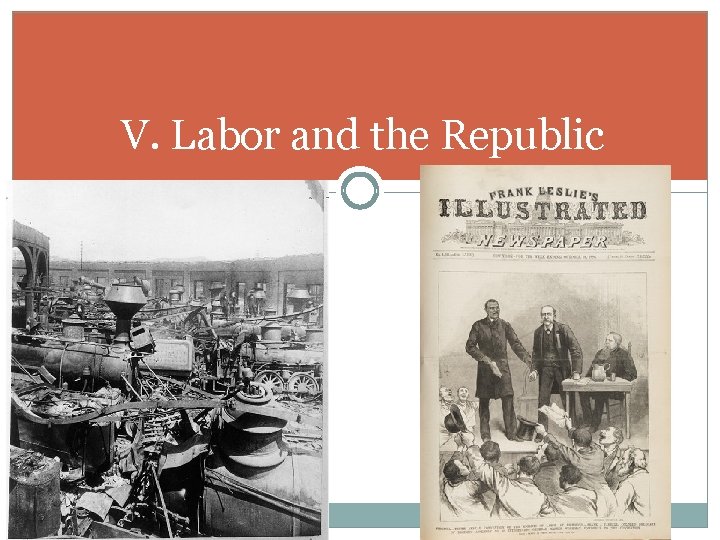
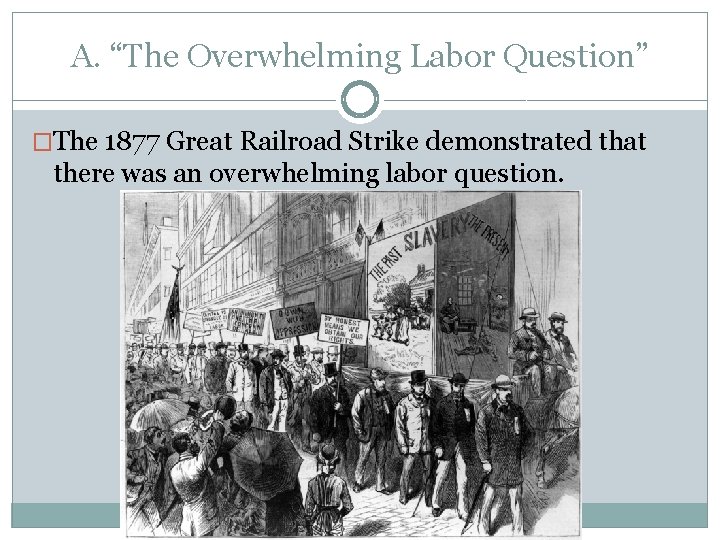
A. “The Overwhelming Labor Question” �The 1877 Great Railroad Strike demonstrated that there was an overwhelming labor question.
B. The Knights of Labor and the “Conditions to Essential Liberty” �The Knights of Labor organized all workers to improve social conditions. Peak membership of nearly 800 k in 1886 Involved millions of workers in strikes, boycotts, political action, and educational and social activities. �Labor raised the question of whether meaningful freedom could exist in a situation of extreme economic inequality.
C. Middle-Class Reformers �Alarmed by fear of class warfare and the growing power of concentrated capital, social thinkers offered numerous plans for change. �Henry George's solution was the single tax. �Lawrence Gronlund's Cooperative Commonwealth (1884) was the first book to popularize socialist ideas for an American audience. �Freedom, Edward Bellamy insisted, was a social condition resting on interdependence, not on autonomy. �Bellamy held out the hope of retaining the material abundance made possible by industrial capitalism while eliminating inequality.
D. A Social Gospel �Walter Rauschenbusch insisted that freedom and spiritual self-development required an equalization of wealth and power and that unbridled competition mocked the Christian ideal of brotherhood. �Social Gospel adherents established mission and relief programs in urban areas.
E. The Haymarket Affair �On May 1, 1886, some 350, 000 workers in cities across the country demonstrated for an eight-hour day. �A riot ensued after a bomb killed a policeman on May 4. �Employers took the opportunity to paint the labor movement as a dangerous and un-American force prone to violence and controlled by foreign-born radicals. �Seven of the eight men accused of plotting the Haymarket bombing were foreign-born.
F. Labor and Politics �Henry George ran for mayor of New York in 1886 on a labor ticket. �The events of 1886 suggested that labor might be on the verge of establishing itself as a permanent political force.