
Ch 16 1 Properties of Magnets A magnet
- Slides: 35
Ch. 16. 1: Properties of Magnets • A magnet creates magnetic effects. • Magnetic materials: - are affected by magnets - do not create their own magnetism - exert forces on magnets or magnetic materials.
• Permanent magnets: - keep their magnetic properties, even when far from other magnets. - ONLY exist in solids. They can become demagnetized if : - the temperature gets too hot - they experience strong shocks - they encounter stronger magnets
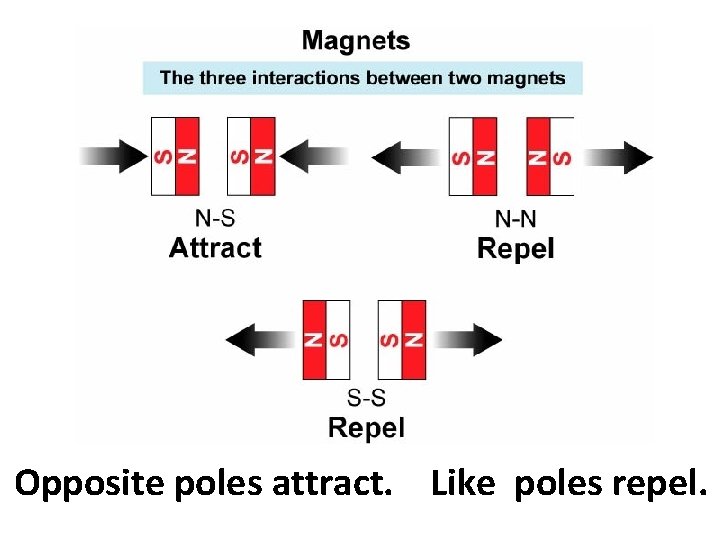
Magnets: - exert forces on one another - have 2 opposite poles (north & south) - cannot have only a north or south pole. - attract or repel one another, depending on the direction of their poles. • If you cut a magnet in half, each half will have its own north and south poles.
Opposite poles attract. Like poles repel.
• Magnetic forces can pass through many materials with no decrease in strength. • Plastics, wood, & most insulators: - transparent to magnetic forces • Most Conducting metals: (Ex: Aluminum) - allow magnetic forces to pass through, but may change them. • Iron & iron-like materials: - can block magnetic forces
• Magnetic forces are used in many applications. They are easy to create & can be very strong. • Magnets create forces on each other at a distance much larger than their sizes. • Because all magnets have two poles, part of the same magnet feels an attractive force & part feels a repelling force.
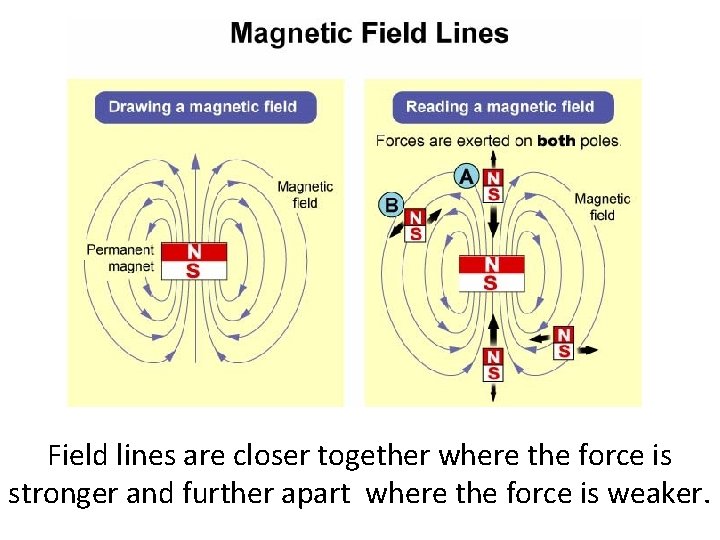
• In a magnet, the force flows away from the north pole & towards the south pole. • The interaction between magnets occurs in two steps: 1. A magnet creates a magnetic field. 2. This field creates forces on other magnets.
Field lines are closer together where the force is stronger and further apart where the force is weaker.
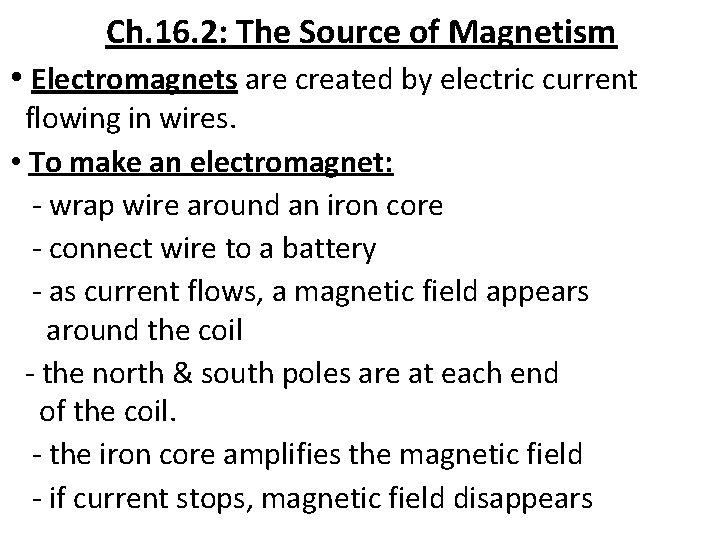
Ch. 16. 2: The Source of Magnetism • Electromagnets are created by electric current flowing in wires. • To make an electromagnet: - wrap wire around an iron core - connect wire to a battery - as current flows, a magnetic field appears around the coil - the north & south poles are at each end of the coil. - the iron core amplifies the magnetic field - if current stops, magnetic field disappears
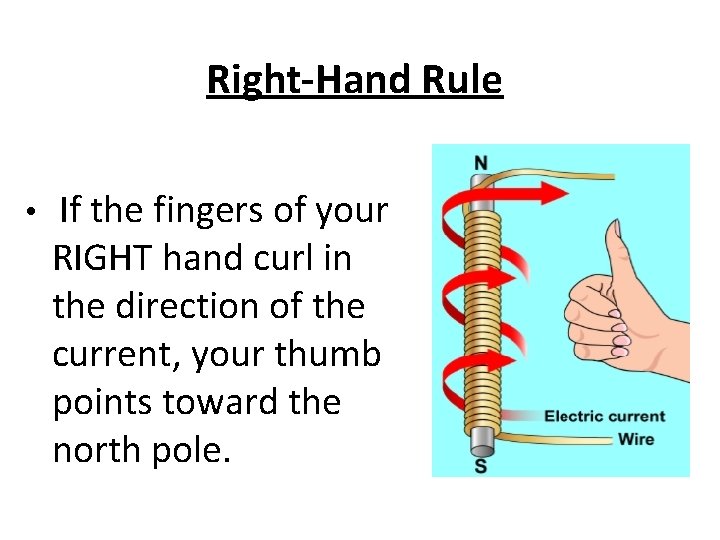
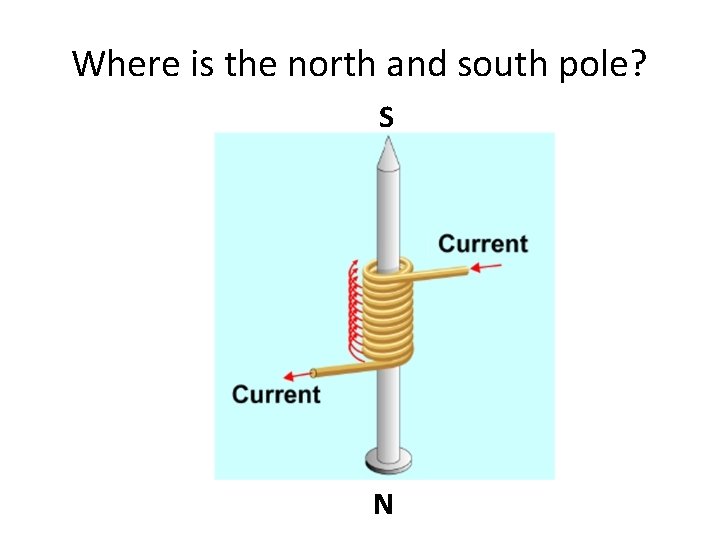
Right-Hand Rule • If the fingers of your RIGHT hand curl in the direction of the current, your thumb points toward the north pole.
Where is the north and south pole? S N
Electromagnets have advantages over permanent magnets: • can be turned on and off by turning current on and off • north & south poles can be switched by reversing the direction of the current • magnetic field strength can be changed by altering the current in the coil • They’re often stronger than permanent magnets!
The magnetic field of a simple electromagnet depends on 3 things: 1. amount of current in the wire 2. amount & type of material in the core 3. number of turns of wire in the coil To make an electromagnet stronger: - Increase the current - Add more turns of wire around core - Increase amount of iron in the core
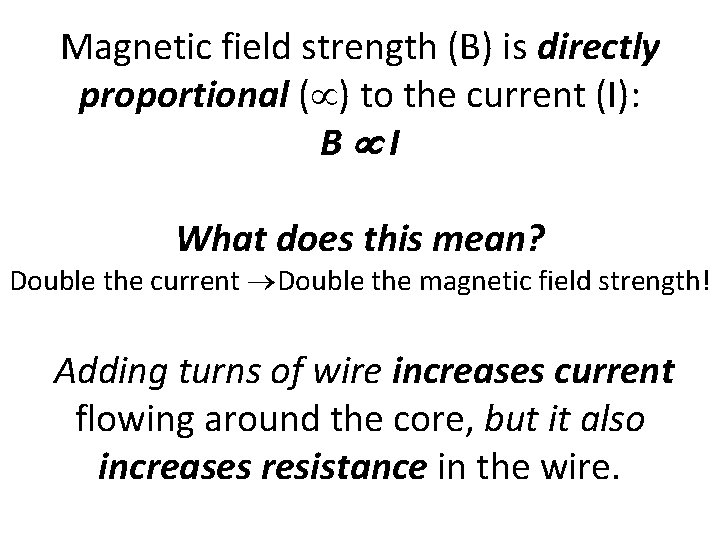
Magnetic field strength (B) is directly proportional ( ) to the current (I): B I What does this mean? Double the current Double the magnetic field strength! Adding turns of wire increases current flowing around the core, but it also increases resistance in the wire.
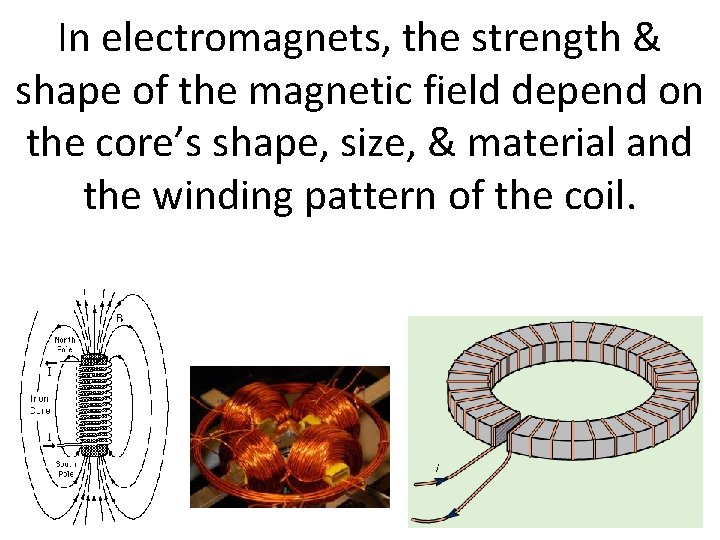
In electromagnets, the strength & shape of the magnetic field depend on the core’s shape, size, & material and the winding pattern of the coil.
Magnetism comes from electric currents! • An atom’s electrons act like small loops of current, forming mini electromagnets. • Magnetic properties vary, depending on the arrangement of electrons in atoms.
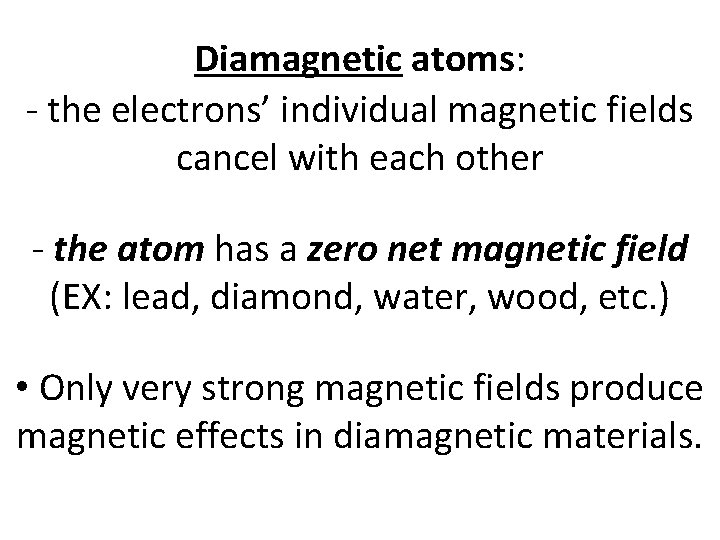
Diamagnetic atoms: - the electrons’ individual magnetic fields cancel with each other - the atom has a zero net magnetic field (EX: lead, diamond, water, wood, etc. ) • Only very strong magnetic fields produce magnetic effects in diamagnetic materials.
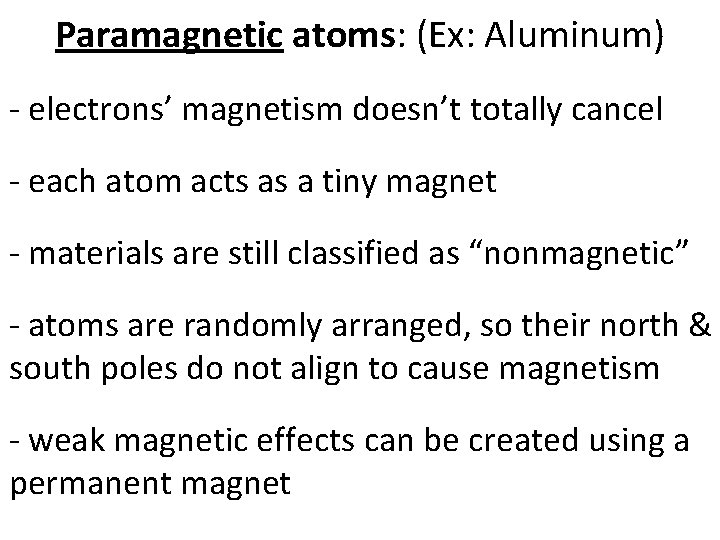
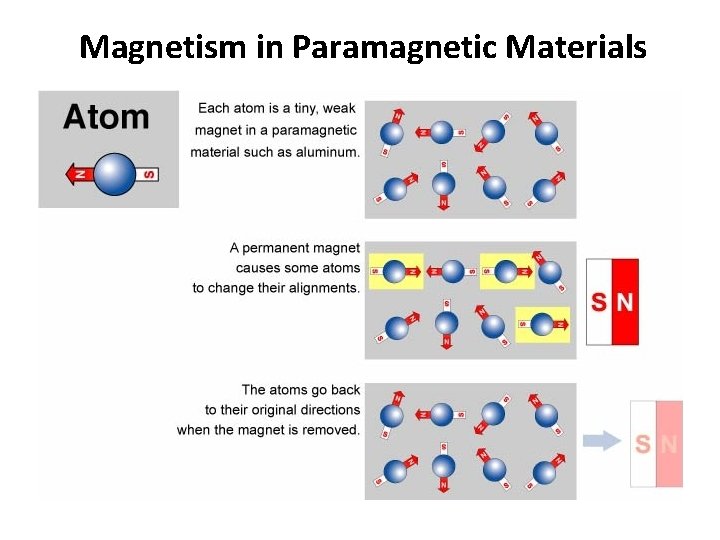
Paramagnetic atoms: (Ex: Aluminum) - electrons’ magnetism doesn’t totally cancel - each atom acts as a tiny magnet - materials are still classified as “nonmagnetic” - atoms are randomly arranged, so their north & south poles do not align to cause magnetism - weak magnetic effects can be created using a permanent magnet
Magnetism in Paramagnetic Materials
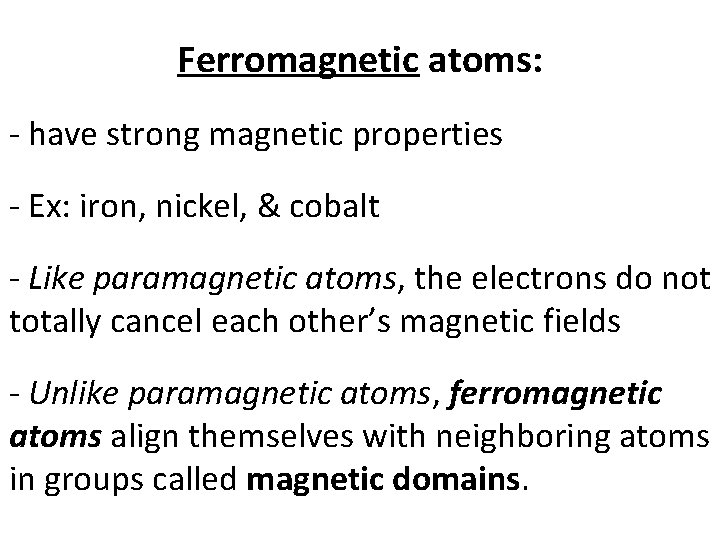
Ferromagnetic atoms: - have strong magnetic properties - Ex: iron, nickel, & cobalt - Like paramagnetic atoms, the electrons do not totally cancel each other’s magnetic fields - Unlike paramagnetic atoms, ferromagnetic atoms align themselves with neighboring atoms in groups called magnetic domains.
In a magnetic domain: - atoms align & their magnetic fields add up, creating a relatively strong magnetic field - each domain may contain millions of atoms, but its size is still small - There are hundreds of domains in a single steel paper clip. - if domains are randomly arranged, their magnetic fields cancel each other out
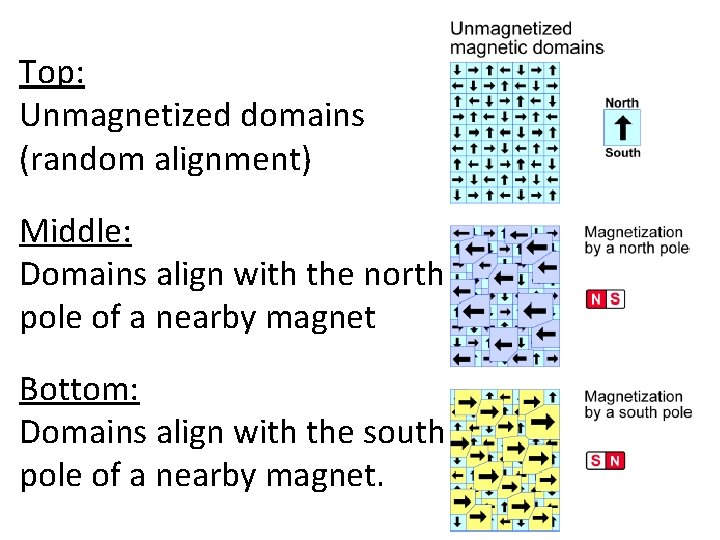
Top: Unmagnetized domains (random alignment) Middle: Domains align with the north pole of a nearby magnet Bottom: Domains align with the south pole of a nearby magnet.
• Atoms in a domain align with a nearby magnet, creating a magnetic field of attraction. • If the magnet is removed, domains return to a random orientation & magnetism disappears. • Permanent magnets are made when magnetic domains are so well-aligned that they stay aligned after the other magnet is removed.
• A soft magnet is easy to magnetize and demagnetize. (Ex: steel) • Heat, strong shocks, and other magnets can demagnetize soft magnets. • Hard magnets have domains that tend to remain aligned for a long time. They make good permanent magnets. (Ex: neodymium) • Strong electromagnets are used to magnetize hard magnets.
Ch. 16. 3: Earth’s Magnetic Field • By 500 B. C. , people had found that some materials had magnetic properties. • The Greeks saw that one end of a suspended lodestone pointed north & the other end pointed south – this led to the compass. • The compass was used in China by 220 B. C. • By 1088 A. D. , iron refining had improved & the Chinese made small, needle-like compasses. • By 1200 A. D. Italian explorers used compasses.
A compass needle: - is a magnet that is free to spin - will align with any magnetic field - its north pole always points towards the south pole of a permanent magnet. * With any magnet, the end that points towards the geographic north pole is the north pole of the magnet. The opposite end is the south pole.
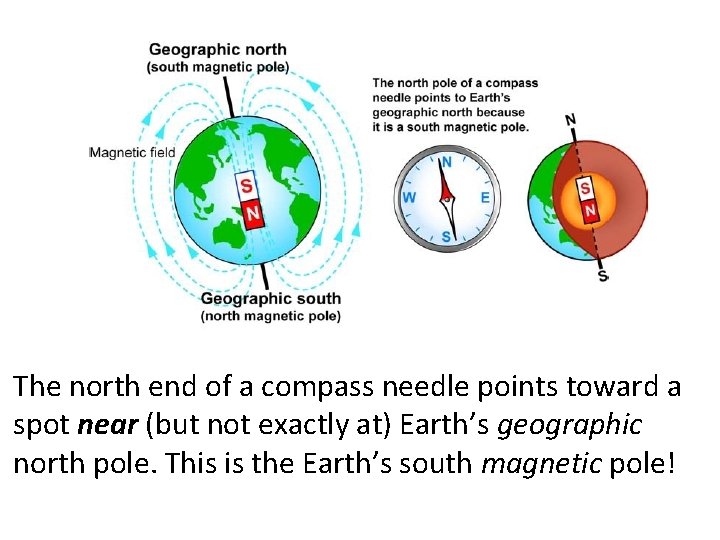
The north end of a compass needle points toward a spot near (but not exactly at) Earth’s geographic north pole. This is the Earth’s south magnetic pole!
• Our geographic north pole (true north) & magnetic south pole are not at exactly the same place, so a compass reading will be slightly off. • The difference between the direction a compass points & the direction of true north is called magnetic declination.
• The Earth’s core is made of hot, dense molten iron, nickel, & possibly other metals that slowly circulate around a solid inner core.
• Huge currents flow in the molten iron core, producing the Earth’s magnetic field. • The Earth’s magnetic field is weak compared to most magnets we use, so you cannot trust a compass to point north if magnets are nearby. • The gauss is the unit of magnetic field strength. A small ceramic magnet has a field between 300 -1000 gauss at its surface, while the Earth’s magnetic field averages ~ 0. 5 gauss. • A planet’s magnetic field strength & its north & south poles can change over time.
• Studies of magnetized rocks in Earth’s crust show that the poles have reversed many times over the last tens of millions of years. • It flips about every 500, 000 years. The last reversal was about 750, 000 years ago. • The Earth is losing ~ 7% of its strength every 100 years. If this trend continues, the poles will reverse sometime in the next 2000 years. • During a reversal, the Earth’s magnetic field would not completely disappear, but would be useless for navigation.
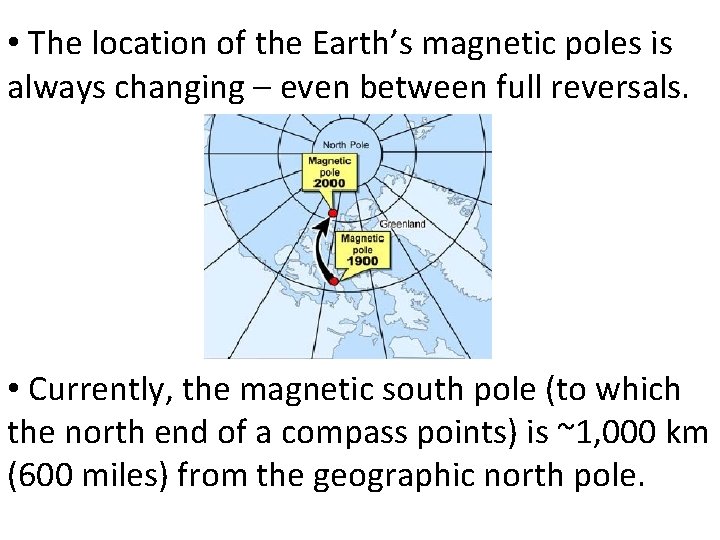
• The location of the Earth’s magnetic poles is always changing – even between full reversals. • Currently, the magnetic south pole (to which the north end of a compass points) is ~1, 000 km (600 miles) from the geographic north pole.
• Like the Earth, other planets in the solar system have magnetic fields. (Ex: Jupiter) • Stars also have magnetic fields. The sun has a very strong magnetic field, and like the Earth, it rotates (1 solar day = ~ 25 days). • Because it is not solid, the different parts of the sun rotate at different rates. It rotates once every 25 days at its equator, but it takes ~35 days to rotate once near its poles. • This uneven rotation twists the magnetic field lines, & periodically they “snap” and reconnect.
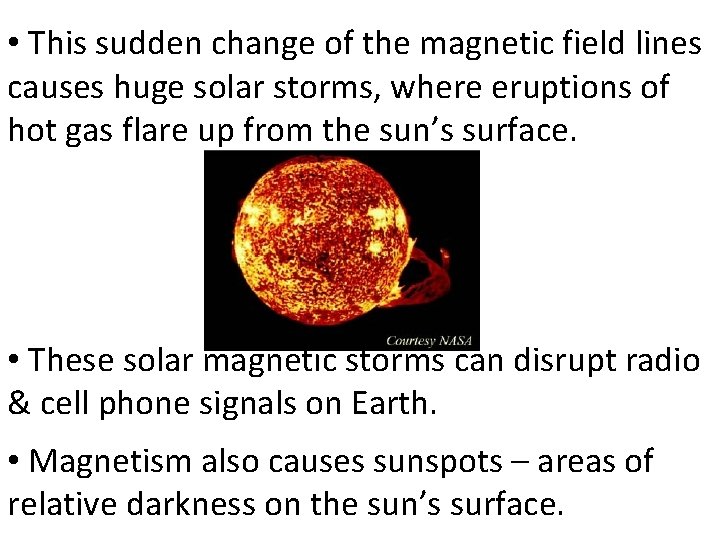
• This sudden change of the magnetic field lines causes huge solar storms, where eruptions of hot gas flare up from the sun’s surface. • These solar magnetic storms can disrupt radio & cell phone signals on Earth. • Magnetism also causes sunspots – areas of relative darkness on the sun’s surface.
• The electrical currents that create the Earth’s magnetic field would quickly stop flowing if energy were not constantly being added. • As the Earth moves around the sun, its magnetic field acts like a giant net, sweeping up free electrons & protons flowing from the sun. • These charged particles create a current that flows in & out through the Earth’s poles, feeding energy into the core & driving the currents that maintain Earth’s magnetic field.