
CH 15 MarketBased Valuation Topics Method of Comparables

CH 15 Market-Based Valuation

Topics • • Method of Comparables P/B Ratios P/E Ratios Reverse Engineering Stock Prices

Valuation using Market Multiples • Popular due to simplicity • Forecasts of future performance not required • Referred to as “method of comparables”
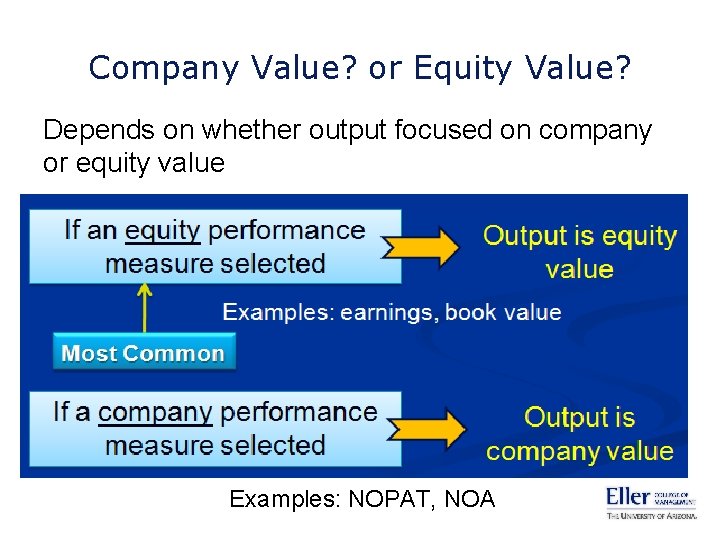
Company Value? or Equity Value? Depends on whether output focused on company or equity value Examples: NOPAT, NOA

Applying Market Multiples Step 1 Select target’s performance measure Step 2 Identify companies that are comparables Step 3 Compute market multiple as average of each comparable’s market value to performance measure Multiply target’s performance measure by market multiple to get target’s value Step 4 Step 5 If equity performance measure, divide by outstanding shares; if company performance measure, subtract net nonoperating obligations before dividing by outstanding shares
Weakness of Market Multiple Method • No ‘right’ performance measure to use • No ‘right’ companies as comparables • Comparable companies themselves could be over or undervalued • No ‘right’ way to combine comparables to yield multiple (Median, equal-weighted average, valueweighted average, etc. )
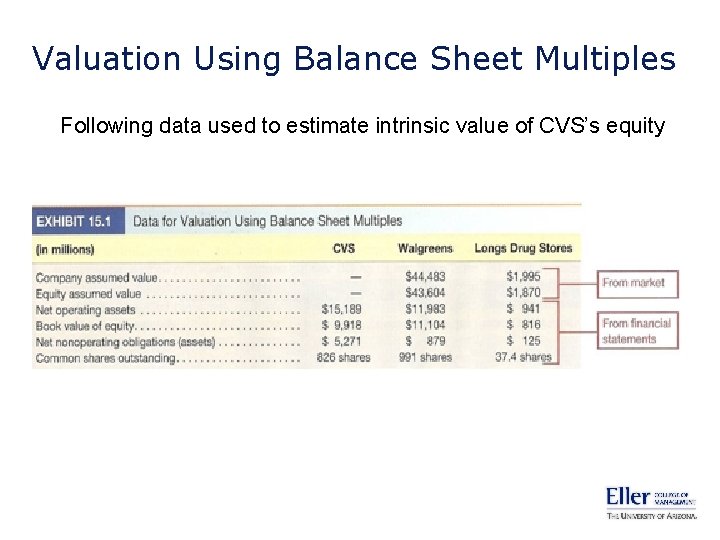
Valuation Using Balance Sheet Multiples Following data used to estimate intrinsic value of CVS’s equity
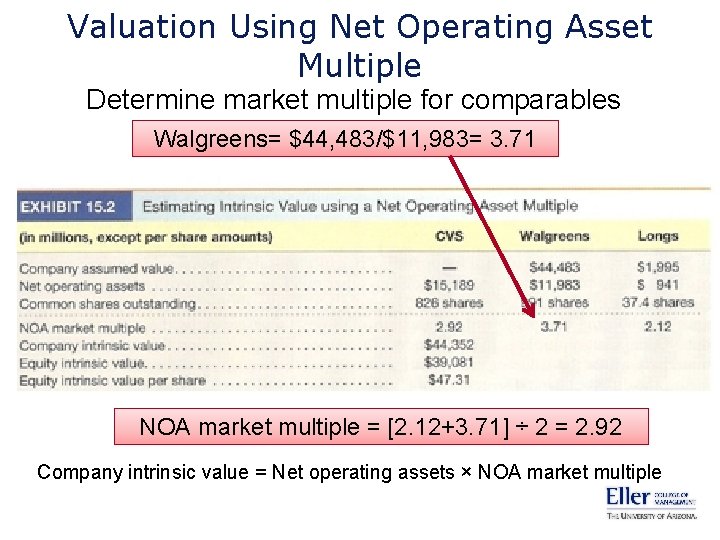
Valuation Using Net Operating Asset Multiple Determine market multiple for comparables Walgreens= $44, 483/$11, 983= 3. 71 NOA market multiple = [2. 12+3. 71] ÷ 2 = 2. 92 Company intrinsic value = Net operating assets × NOA market multiple
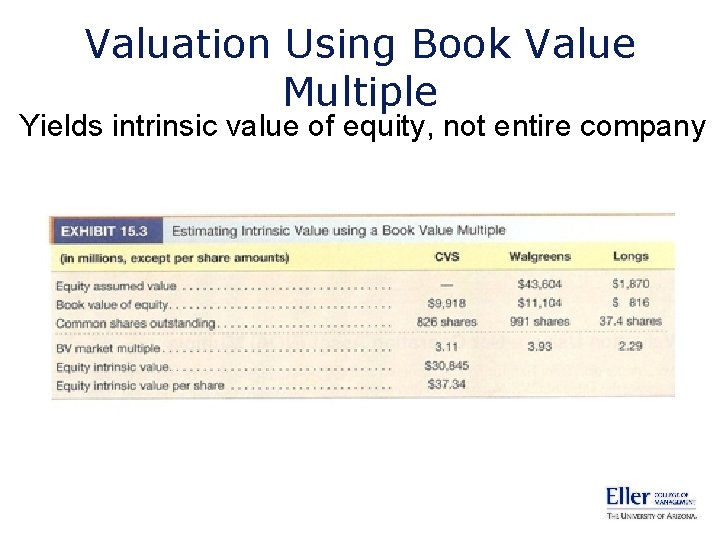
Valuation Using Book Value Multiple Yields intrinsic value of equity, not entire company
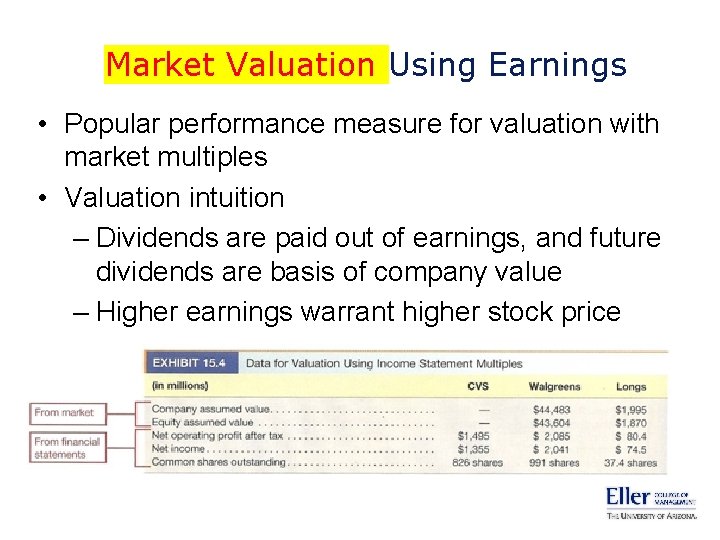
Market Valuation Using Earnings • Popular performance measure for valuation with market multiples • Valuation intuition – Dividends are paid out of earnings, and future dividends are basis of company value – Higher earnings warrant higher stock price
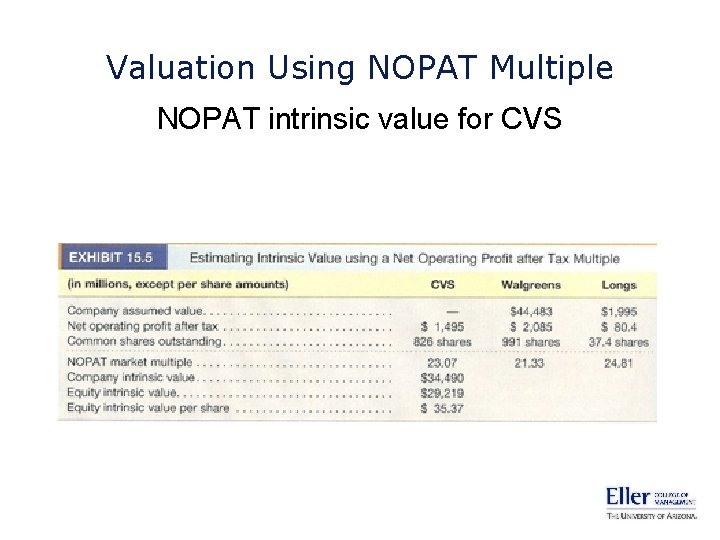
Valuation Using NOPAT Multiple NOPAT intrinsic value for CVS Company = Net operating × NOPAT market multiple intrinsic value profit after tax CVS’s intrinsic = value $1, 495 × 23. 07 = $34, 490 million
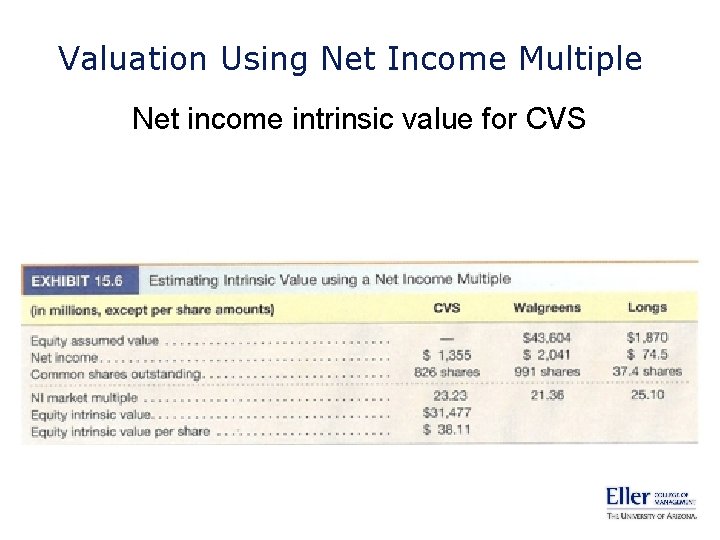
Valuation Using Net Income Multiple Net income intrinsic value for CVS Equity = Net income × NI market multiple intrinsic value
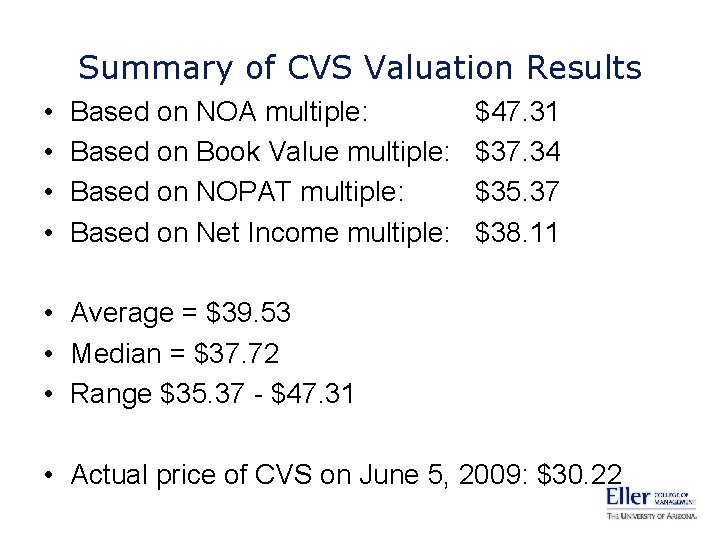
Summary of CVS Valuation Results • • Based on NOA multiple: Based on Book Value multiple: Based on NOPAT multiple: Based on Net Income multiple: $47. 31 $37. 34 $35. 37 $38. 11 • Average = $39. 53 • Median = $37. 72 • Range $35. 37 - $47. 31 • Actual price of CVS on June 5, 2009: $30. 22
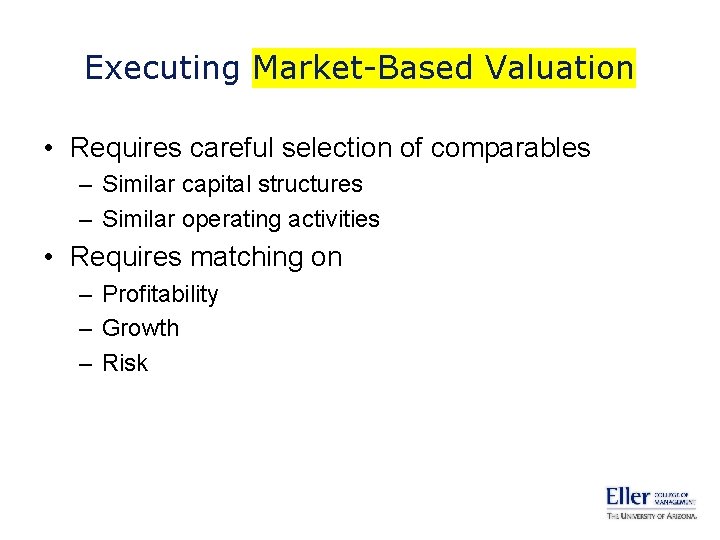
Executing Market-Based Valuation • Requires careful selection of comparables – Similar capital structures – Similar operating activities • Requires matching on – Profitability – Growth – Risk
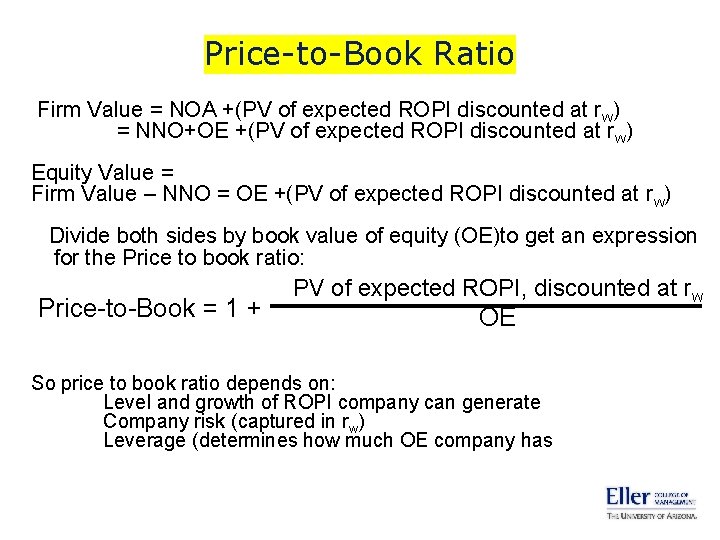
Price-to-Book Ratio Firm Value = NOA +(PV of expected ROPI discounted at rw) = NNO+OE +(PV of expected ROPI discounted at r w) Equity Value = Firm Value – NNO = OE +(PV of expected ROPI discounted at rw) Divide both sides by book value of equity (OE)to get an expression for the Price to book ratio: Price-to-Book = 1 + PV of expected ROPI, discounted at rw OE So price to book ratio depends on: Level and growth of ROPI company can generate Company risk (captured in rw) Leverage (determines how much OE company has
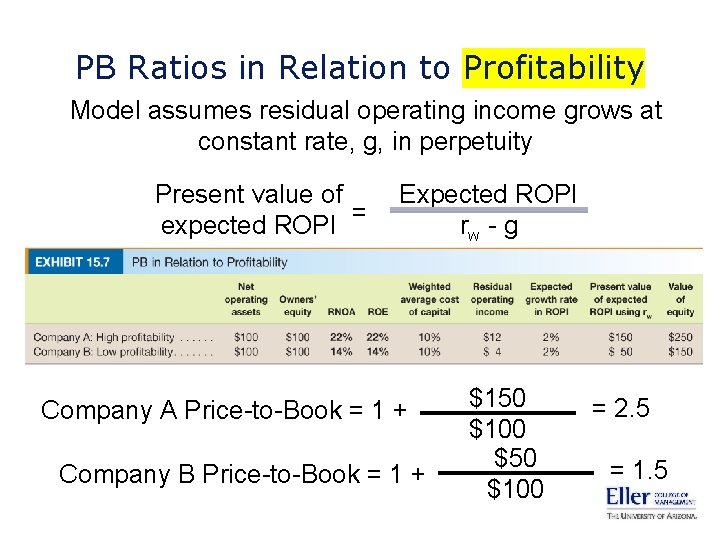
PB Ratios in Relation to Profitability Model assumes residual operating income grows at constant rate, g, in perpetuity Present value of = expected ROPI Expected ROPI rw - g Company A Price-to-Book = 1 + Company B Price-to-Book = 1 + $150 $100 $50 $100 = 2. 5 = 1. 5
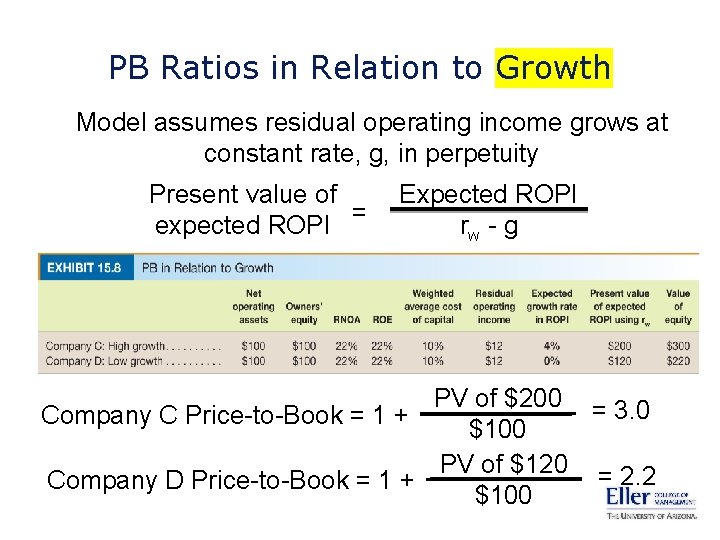
PB Ratios in Relation to Growth Model assumes residual operating income grows at constant rate, g, in perpetuity Present value of = expected ROPI Expected ROPI rw - g PV of $200 = 3. 0 Company C Price-to-Book = 1 + $100 PV of $120 = 2. 2 Company D Price-to-Book = 1 + $100
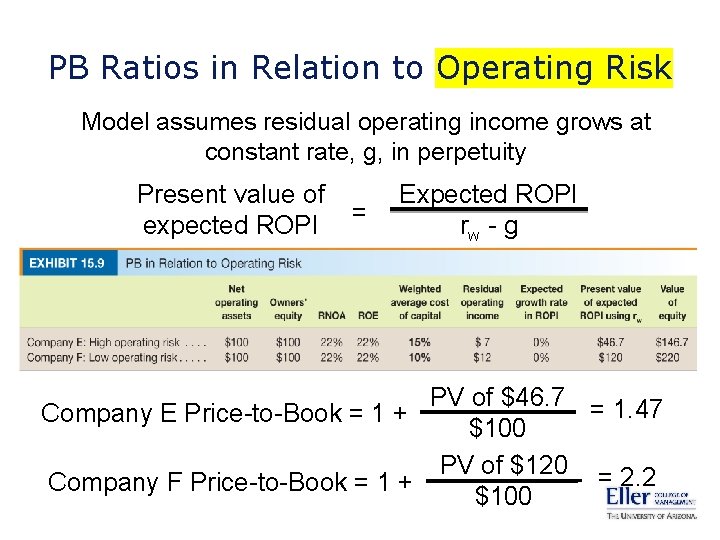
PB Ratios in Relation to Operating Risk Model assumes residual operating income grows at constant rate, g, in perpetuity Present value of expected ROPI = Expected ROPI rw - g PV of $46. 7 = 1. 47 Company E Price-to-Book = 1 + $100 PV of $120 = 2. 2 Company F Price-to-Book = 1 + $100
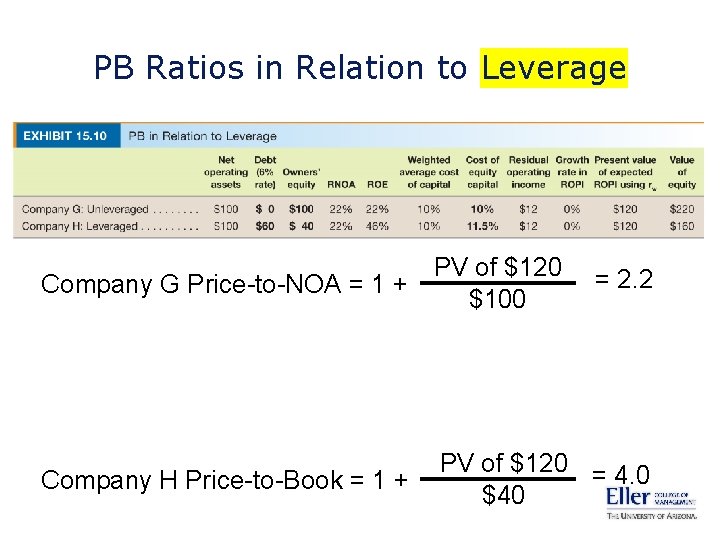
PB Ratios in Relation to Leverage PV of $120 Company G Price-to-NOA = 1 + $100 Company H Price-to-Book = 1 + = 2. 2 PV of $120 = 4. 0 $40
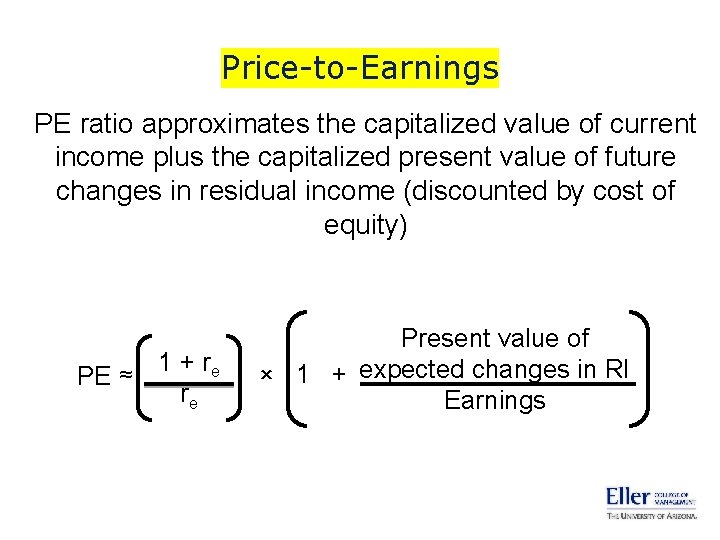
Price-to-Earnings PE ratio approximates the capitalized value of current income plus the capitalized present value of future changes in residual income (discounted by cost of equity) 1 + re PE ≈ re Present value of × 1 + expected changes in RI Earnings
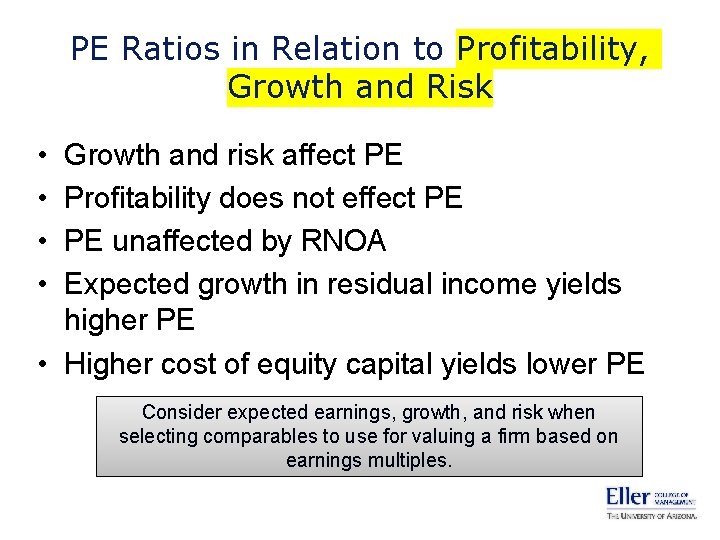
PE Ratios in Relation to Profitability, Growth and Risk • • Growth and risk affect PE Profitability does not effect PE PE unaffected by RNOA Expected growth in residual income yields higher PE • Higher cost of equity capital yields lower PE Consider expected earnings, growth, and risk when selecting comparables to use for valuing a firm based on earnings multiples.
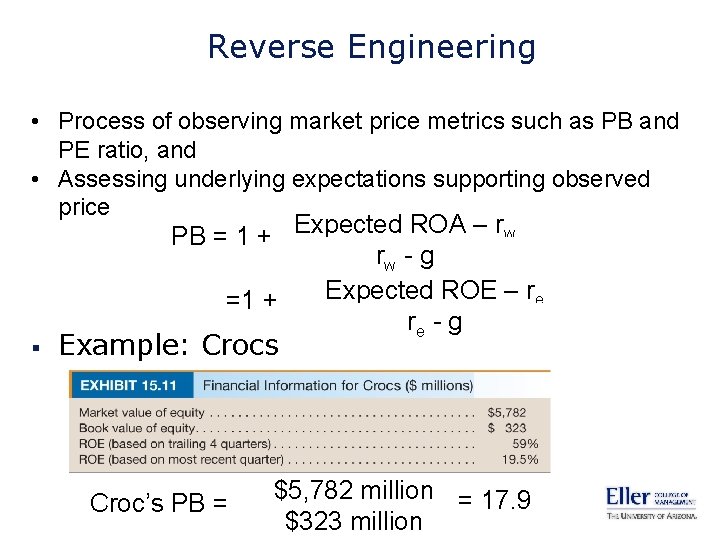
Reverse Engineering • Process of observing market price metrics such as PB and PE ratio, and • Assessing underlying expectations supporting observed price § PB = 1 + Expected ROA – rw rw - g Expected ROE – re =1 + re - g Example: Crocs Croc’s PB = $5, 782 million = 17. 9 $323 million
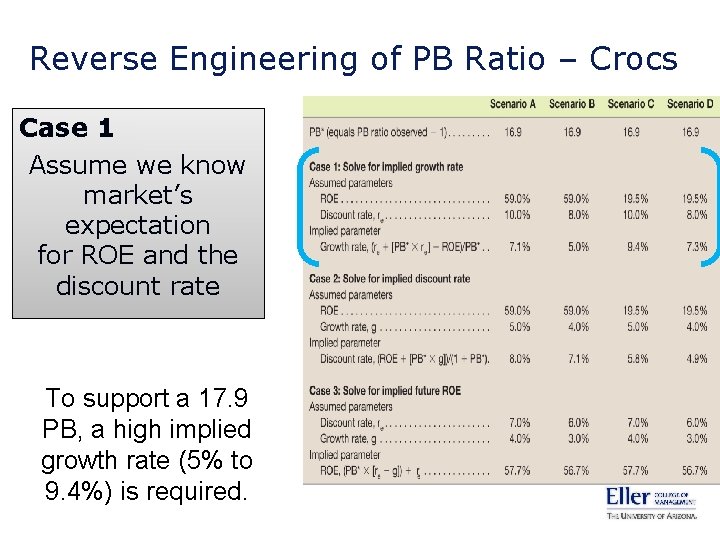
Reverse Engineering of PB Ratio – Crocs Case 1 Assume we know market’s expectation for ROE and the discount rate To support a 17. 9 PB, a high implied growth rate (5% to 9. 4%) is required.
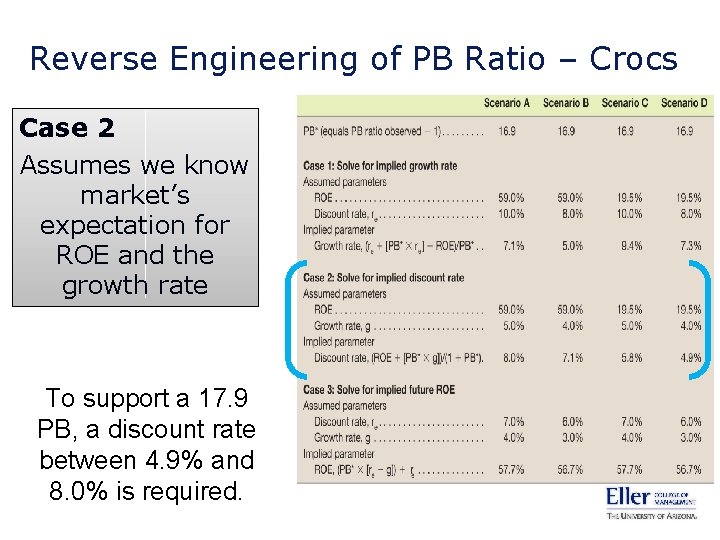
Reverse Engineering of PB Ratio – Crocs Case 2 Assumes we know market’s expectation for ROE and the growth rate To support a 17. 9 PB, a discount rate between 4. 9% and 8. 0% is required.
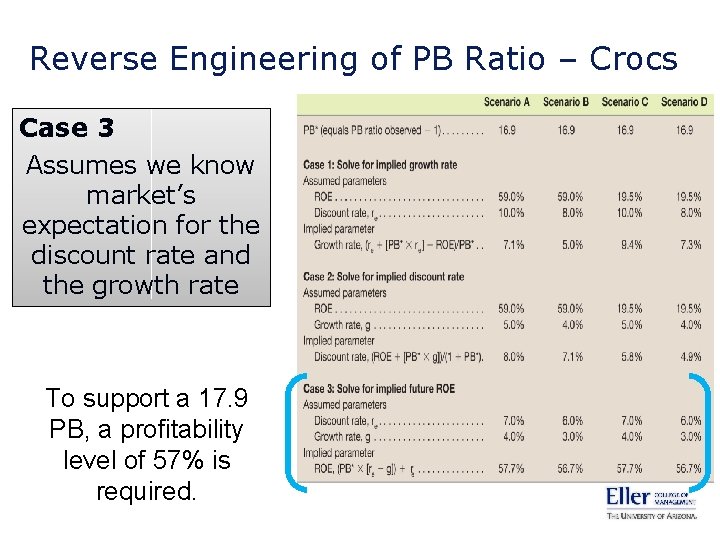
Reverse Engineering of PB Ratio – Crocs Case 3 Assumes we know market’s expectation for the discount rate and the growth rate To support a 17. 9 PB, a profitability level of 57% is required.
![Interpreting PE Ratio • PE approx. capitalization factor [1 + re] ÷ re PE](http://slidetodoc.com/presentation_image/0937e0db748498a3308ea33164d80aeb/image-26.jpg "Interpreting PE Ratio • PE approx. capitalization factor [1 + re] ÷ re PE")
Interpreting PE Ratio • PE approx. capitalization factor [1 + re] ÷ re PE ≈ 1 + re re Present value of × 1 + expected changes in RI Earnings Example: A company has a 10% cost of equity capital, which implies a capitalization factor of 11. If investors expect residual income to not change, then PE ≈ 11 If investors expect residual income to increase (decrease), relative to 10% times change in book value, then PE >11 (or <11)
Perspectives on Valuation • Valuation models require modeling and forecasting future company performance – Discounted dividends – Discounted cash flows – Residual operating income • Market multiples lack theoretical underpinnings, but are widely applied
- Slides: 27